
#BrainUp Daily Tech News – (Friday, January 16ᵗʰ)
Welcome to today’s curated collection of interesting links and insights for 2026/01/16. Our Hand-picked, AI-optimized system has processed and summarized 21 articles from all over the internet to bring you the latest technology news.
As previously aired🔴LIVE on Clubhouse, Chatter Social, Instagram, Twitch, X, YouTube, and TikTok.
Also available as a #Podcast on Apple 📻, Spotify🛜, Anghami, and Amazon🎧 or anywhere else you listen to podcasts.
1. World-first EV battery tech debuts with 595km of range from just 10 minutes of charging
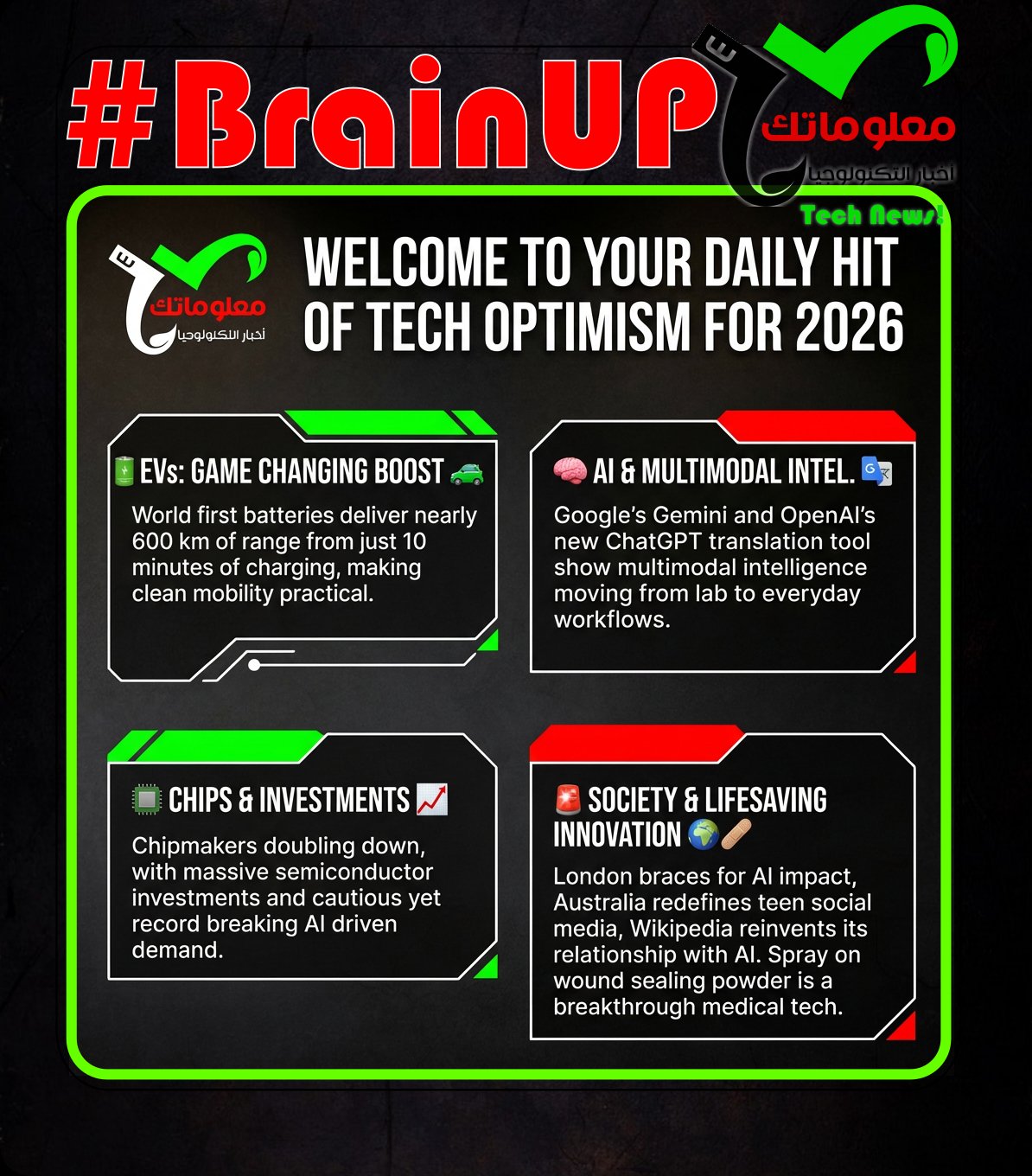
A groundbreaking #electricvehicle battery technology has been introduced, capable of providing 595km of range after only 10 minutes of charging. This innovation represents a significant leap in #EV charging speed and range efficiency, addressing two major barriers to electric vehicle adoption: range anxiety and lengthy charging times. By enabling faster and longer driving distances, this technology could accelerate the transition to clean transportation and reduce reliance on fossil fuels. The development is poised to influence automakers and consumers alike by demonstrating that rapid charging with extended range is achievable. This advancement signals a promising step towards widespread electric vehicle acceptance and environmental sustainability.
2. Reprompt Single-Click Copilot Exploit
A new exploit targeting Microsoft’s Copilot integration allows attackers to bypass security measures with a single click. Researchers demonstrated that reprompting can trick Copilot into generating malicious code, revealing vulnerabilities in AI-assisted coding tools. This exploit highlights the challenges in securing AI-driven development environments against social engineering and prompt manipulation. The findings underscore the need for robust safeguards and continuous testing against evolving threat vectors in AI applications. The incident emphasizes the necessity for developers and organizations to adopt stricter verification protocols for AI-generated outputs to mitigate abuse risks.
TSMC’s CEO expressed anxiety about a potential AI investment bubble despite the company’s record-setting financial performance in the most recent quarter. The CEO highlighted the risk of careless investments, warning they could be disastrous for TSMC, even while reaffirming confidence in continued demand for semiconductor chips driven by AI growth. To balance caution with growth, TSMC plans to invest between $52 billion and $56 billion in capital expenditures, signaling a strong but measured approach toward expanding production capacity. This cautious yet confident strategy reflects broader industry concerns about maintaining sustainable growth amid rapidly evolving AI technology demands. TSMC’s approach underscores the need for prudent investment to capture opportunities within the #AI-driven semiconductor market without fueling unsustainable speculative excess.
4. Taiwan to invest $250B in US semiconductor manufacturing
Taiwan plans to invest $250 billion in the US semiconductor manufacturing sector to strengthen chip production capabilities and foster innovation. This substantial investment aligns with global efforts to diversify semiconductor supply chains and reduce dependency on single sources amid geopolitical tensions. Taiwan’s commitment highlights its strategic role in the #semiconductor industry and supports US efforts to boost domestic manufacturing under recent policy incentives. The funding is expected to drive technological advancements and enhance chip supply reliability. This move reflects a collaborative approach to securing essential technology infrastructure and addresses growing demands in the global tech market.
5. Iran’s internet shutdown is now one of its longest ever, as protests continue | TechCrunch
Iran’s government-imposed internet shutdown has become one of the longest nationwide outages, with 92 million Iranians blocked for more than a week and the disruption exceeding 170 hours. NetBlocks’ Isik Mater says the current shutdown is the third-longest on record, behind Sudan’s ~35 days and Mauritania’s 22 days, with rankings depending on measurement. @Zach Rosson of @Access Now notes the ongoing shutdown is on a path to crack the top 10 longest in history. The crackdown has been violent and a U.S.-based human rights group estimates at least 2,000 deaths, while some government departments and parts of the economy, such as bank transfers and gas-station payment processors, have had access restored. The Guardian reports that some Iranians have used #Starlink terminals smuggled into the country to connect to the internet, illustrating how people seek alternative connectivity during the blackout and highlighting the broader #internetfreedom landscape.
6. France studying possible transfer of Eutelsat terminals to Iran, foreign minister says
France is considering the potential transfer of Eutelsat satellite terminals to Iran, according to French Foreign Minister. This discussion arises amid ongoing geopolitical tensions and negotiations involving Iran’s access to satellite technologies. The move indicates France’s engagement in balancing technological cooperation and international regulatory frameworks in relation to Iran. Analysts note that this could impact Iran’s satellite communication capabilities while also testing diplomatic relations. The decision reflects the broader dynamics of European countries navigating complex policies with Iran on technology transfer and international security.
7. ICE error meant some recruits were sent into field offices without proper training, sources say
ICE’s push to add 10,000 officers relied on an AI screening tool that miscategorized many applicants, sending some recruits into field offices for the #LEO_program without the required training, according to @Julia Ainsley. The tool flagged résumés containing the word ‘officer’ and often labeled non-LEO candidates as LEOs, and about 200 hires were identified for full training at the #FLETC after the mistake was spotted in mid-fall, a DHS spokesperson called it a ‘technological snag’ that was quickly fixed. Field offices provide additional training beyond the academy and online course, and ICE said the vast majority of new hires are experienced officers who have already completed a law enforcement academy, with manual résumé reviews later implemented to catch such errors. The incident occurred amid a surge to boost deportations and comes with scrutiny of ICE enforcement tactics, with Minneapolis illustrating the broader impact as more than 2,000 officers were deployed and have apprehended over 2,400 people since late November.
8. DDR5 RAM Prices Now Over 4x Higher Since September 2025
DDR5 RAM prices have surged dramatically, increasing more than four times since September 2025 due to multiple factors impacting the market. Supply chain constraints, combined with strong demand from new PC builds and server upgrades, have tightened availability and driven costs upward. The price hike affects consumers and enterprises alike, making DDR5 memory a significantly more expensive component compared to earlier periods. Manufacturers and analysts suggest that this trend may continue as production struggles to keep pace with demand, underscoring the challenges in balancing technological advancement with affordability. This price dynamic highlights the ongoing evolution and market pressures within the #computerhardware industry.
9. Australia social media ban hits 4.7 million teen accounts in first month
Australia’s new social media ban targeted at users under 18 has affected 4.7 million teen accounts during its first month of enforcement, highlighting the government’s strict approach to online safety for minors. The policy requires social platforms to verify users’ ages to prevent underage access, aiming to reduce the risks associated with teenage exposure to harmful content. Social media companies have implemented various age verification measures, although challenges remain in balancing user privacy and effective enforcement. This regulation reflects Australia’s commitment to protecting youth from online harms while provoking debate on digital rights and platform responsibilities. The ban’s impact signals a shift towards more regulated social media environments, with potential implications for global internet governance.
11. Verizon to issue $20 credits to customers affected by cell service outage
A widespread Verizon cell service outage disrupted voice and data services for many customers for roughly ten hours. In response, @Verizon said it would issue a $20 account credit redeemable in the myVerizon app and advised customers to restart their devices to reconnect to the network. Verizon noted that the credit is not a full remedy for the disruption but a gesture acknowledging the inconvenience. The outage drew scrutiny from lawmakers and the FCC, with officials signaling ongoing investigations into the cause and its impact on public safety and critical communications. The episode highlights concerns about the resilience of the nation’s wireless infrastructure #FCC.
12. Sadiq Khan to urge ministers to act over ‘colossal’ impact of AI on London jobs
In his Mansion House address, @Sadiq Khan warns that #AI could usher in a new era of mass unemployment in London unless ministers act, even as he recognises its potential to transform #publicservices and boost productivity. He argues London’s economy, dominated by #finance, #creativeindustries, and professional services, sits at the sharp edge of change and that about 70% of skills in the average job could shift by 2030. The plan includes a City Hall #taskforce on #AI and the #futureofwork and offering free AI training to Londoners, with evidence that more than half of London workers expect #AI to affect their jobs in the next year and UK projections of up to 3 million low-skilled roles at risk by 2035. He cites research from @Anthropic and @Forrester showing AI could augment rather than fully replace work, and that human collaboration and judgment remain essential in knowledge-intensive tasks, while there is a risk of over-automation and ‘AI washing’. The overall message is that there is a choice to seize #AI as a tool for positive transformation or risk its weaponisation against jobs, and that policy action and training are needed to create new roles to replace those lost.
13. Wikipedia will share content with AI firms in new licensing deals
Wikipedia announced it will enter new licensing agreements to share its content with AI companies, aiming to support responsible AI training. The Wikimedia Foundation, which operates Wikipedia, decided to move away from its previous approach of public content availability without formal licenses for AI use, citing concerns about misuse and fair compensation. This change is illustrated by partnerships that enable AI firms to access high-quality, vetted data under agreed terms, ensuring ethical usage and attribution. The shift reflects Wikipedia’s effort to balance openness with control to address challenges in the growing AI landscape. By formalizing AI data access, Wikipedia seeks to protect its community’s work while fostering innovation in #artificialintelligence.
14. Wikipedia turns 25 today but faces more threats than ever before – 9to5Mac
@Wikipedia marks its 25th anniversary, yet the piece argues its long-term future faces a perfect storm of threats. Since 2001’s launch with four pages, it has grown to more than 65 million articles across 300+ languages and draws billions of views monthly, informing everyday life, AI chatbots, journalism, and trivia while nearly 250,000 volunteers write, edit, and fact-check under #neutrality and #reliability standards, celebrated on a Wikimedia Foundation microsite. Forces on the political right have attacked the project, with @HeritageFoundation saying it will identify and target editors. AI bots relentlessly scrape Wikipedia’s content, straining servers, and the volunteer pool continues to gray, making replenishment a challenge. The article warns that the core ideals of neutrality, evaluating sources, volunteering for the public benefit, and a noncommercial online project may feel old-fashioned in today’s partisan, lawless, antihuman, ‘greed is good’ internet, and whether Wikipedia survives ultimately depends on us.
15. UPS MD-11 Louisville crash report highlights prior Boeing warnings
A preliminary report from the @NationalTransportationSafetyBoard into the fatal Louisville cargo plane crash on November 4, 2025 has revealed that @Boeing was aware years earlier of failures in the spherical bearing race assembly that secures an engine to the wing on MD-11 aircraft, but at the time did not classify the issue as a safety-of-flight threat, instead issuing a service letter recommending periodic visual inspections. The investigation into UPS Airlines Flight 2976 found that fatigue cracks in that bearing led to the left engine detaching soon after takeoff, causing a deadly crash that killed 15 people including crew and those on the ground, while debris and fire spread across a warehouse and adjacent industrial area. The preliminary findings underscore questions about how Boeing, UPS and regulators responded to historical part failures flagged in 2011, and whether inspection protocols and maintenance schedules adequately mitigated the risk before the tragedy unfolded, prompting scrutiny of aging aircraft design, oversight and safety culture.
Definition: Spherical bearing race
A spherical bearing race is a precision-machined aviation component that helps attach an aircraft’s engine mount to the wing, allowing controlled movement under load while maintaining structural alignment. Fatigue cracks or failures in this part can compromise the integrity of the engine mount, potentially leading to separation of critical hardware during flight, which is why aviation investigators focus on such components when determining causes of catastrophic structural failures.
16. NVIDIA Reportedly Ends GeForce RTX 5070 Ti Production, RTX 5060 Ti 16 GB Next
@NVIDIA faced conflicting reports after @ASUS said a supply shortage effectively ended the model, while a later statement from @NVIDIA to @HardwareLuxx said the series remains in production and that elevated demand is drying up inventory. NVIDIA issued that ‘we continue to ship all GeForce SKUs and are working closely with our suppliers to maximize memory availability.’ The situation also foreshadows changes in the RTX 5060 Ti lineup, with the 16 GB version winding down as resources shift to the 8 GB variant and stocks dwindle with rising prices #memory_shortage #GDDR7. The ongoing #DRAM and #GDDR7 memory shortage is cited as the reason a CES launch of the RTX 50 ‘SUPER’ refresh did not occur, and no series refresh is planned. Overall, high demand and scarce memory are shaping @NVIDIA’s mid-range GPU availability and drive resource reallocation across the RTX lineup.
17. Google’s Gemini AI is the latest contender in the AI race
Google’s Gemini AI is an emerging competitor in the AI landscape, designed to outperform existing models by integrating advanced capabilities. It combines the strengths of language understanding and image generation, positioning itself against leaders like OpenAI’s GPT and Midjourney. Gemini leverages Google’s extensive research and infrastructure to enhance multimodal understanding and creativity, aiming to set new benchmarks in AI performance. This development highlights Google’s strategic push into the AI race, emphasizing innovation to capture both enterprise and consumer markets. The launch underlines the intensifying competition among AI developers to deliver versatile, powerful tools for diverse applications.
18. Scientists Develop Spray-On Powder That Instantly Seals Life-Threatening Wounds
Scientists have created a spray-on powder that can instantly stop severe bleeding by sealing wounds immediately, potentially saving lives in emergency situations. The powder works by rapidly interacting with blood to form a strong, flexible clot that resists high blood pressure and prevents blood loss effectively. Tests demonstrated the powder’s ability to control bleeding in different wound types, including puncture and deep wounds, outperforming existing methods like traditional gauze or glues. This innovation addresses critical challenges in trauma care by providing a quick, easy-to-apply solution that improves survival chances in cases of life-threatening hemorrhages. By advancing #woundcare technology, this spray-on powder represents a significant leap forward in emergency medicine and could transform frontline treatment of traumatic injuries.
19. Mercedes Cancels Level 3 Drive Pilot
Mercedes-Benz has decided to cancel the Level 3 Drive Pilot system, which was initially introduced to enable semi-autonomous driving under specific conditions. Despite the system being approved in Germany, regulatory hurdles and the complexity of legal requirements in other markets limited its broader rollout. Mercedes faced challenges with ensuring consistent safety and liability frameworks, leading to the decision to halt this advanced driver assistance technology. This move reflects the ongoing difficulties automakers encounter when trying to implement higher levels of automation in vehicles. The cancellation highlights the gap between technological readiness and regulatory acceptance in the autonomous driving industry.
20. Flaw in 17 Google Fast Pair audio devices could let hackers eavesdrop
Security researchers have identified a vulnerability in at least 17 audio devices that use #Google’s Fast Pair protocol, a system designed to simplify Bluetooth pairing between devices and Android phones, that could allow nearby attackers to intercept audio streams or gain access to sensitive information if the devices are targeted during the pairing process. The flaw stems from how certain hardware makers implemented the Fast Pair specification, resulting in weak encryption and authentication that could be exploited in physical proximity attacks, potentially letting bad actors eavesdrop or inject malicious audio without user consent. Google and affected manufacturers are working on firmware updates to address the vulnerability, and users are urged to apply patches when available and avoid pairing in untrusted environments until fixes are rolled out.
Definition: Fast Pair protocol
The Fast Pair protocol is a Bluetooth feature developed by Google to streamline the process of connecting wireless accessories like earbuds, headphones, and speakers to Android devices, using location, Bluetooth and account signals to make setup quicker and more seamless while also enabling automatic re-connection. Poor implementation or weak security in the handshake and encryption stages can expose devices to nearby attackers.
21. OpenAI quietly rolls out a dedicated ChatGPT translation tool
OpenAI has introduced a standalone translation tool powered by #ChatGPT that can convert text across multiple languages with high accuracy. This tool extends the capabilities of the widely used ChatGPT model, focusing specifically on translation tasks to provide more specialized and efficient language conversion. Users can benefit from improved translations that leverage the advanced AI understanding developed by @OpenAI, addressing common challenges in automated translation such as context and nuance. By decoupling translation features into a dedicated product, OpenAI aims to increase usability and accessibility for diverse applications, from casual users to professional environments. This release highlights OpenAI’s ongoing efforts to enhance AI-driven language services and broaden the reach of its technology.
That’s all for today’s digest for 2026/01/16! We picked, and processed 21 Articles. Stay tuned for tomorrow’s collection of insights and discoveries.
Thanks, Patricia Zougheib and Dr Badawi, for curating the links
See you in the next one! 🚀
