
#BrainUp Daily Tech News – (Monday, January 12ᵗʰ)
Welcome to today’s curated collection of interesting links and insights for 2026/01/12. Our Hand-picked, AI-optimized system has processed and summarized 22 articles from all over the internet to bring you the latest technology news.
As previously aired🔴LIVE on Clubhouse, Chatter Social, Instagram, Twitch, X, YouTube, and TikTok.
Also available as a #Podcast on Apple 📻, Spotify🛜, Anghami, and Amazon🎧 or anywhere else you listen to podcasts.
1. Australia social media ban: Meta blocks 550,000 accounts under new law
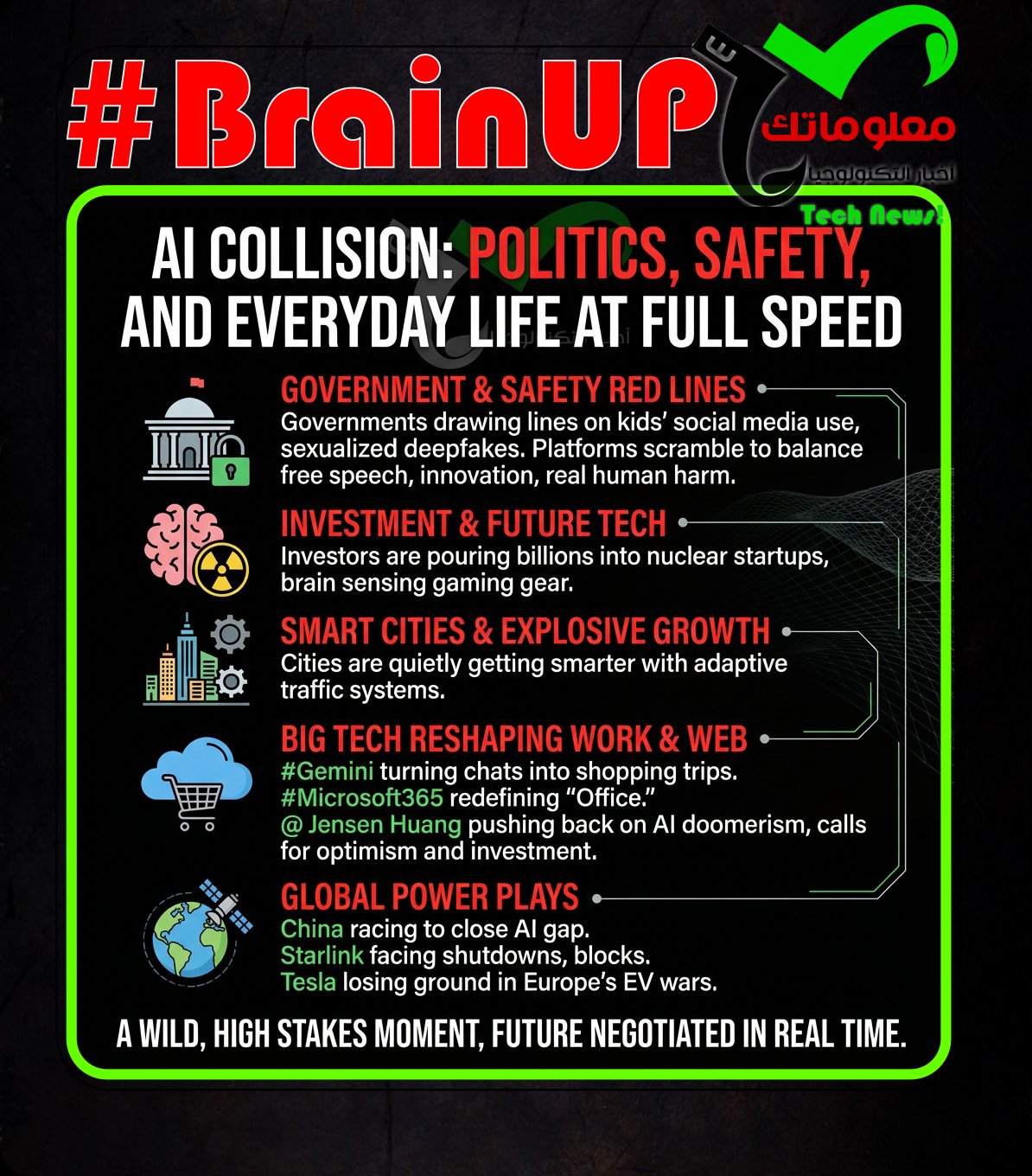
The Australian government’s new law bans Australians under 16 from having accounts on major social platforms, and @Meta reports blocking about 550,000 accounts in the first days of compliance. Meta logged 330,639 Instagram blocks, 173,497 on Facebook, and 39,916 on Threads, as the December rule aims to shield children from harmful content and algorithmic feeds. @Meta argues for #ageVerification at the app-store level and for #parentalApproval exemptions to ensure consistent, #privacyPreserving protections and to avoid the whack-a-mole race with new apps. The policy is described as the world’s strictest, denying any parental exemption, and has drawn global attention as other governments, including the US and EU, experiment with restrictions; @Tories signaled they would follow suit if elected. Critics warn youths may still circumvent checks and miss out on online connection, especially LGBTQ+, neurodivergent, or rural users, so the debate centers on balancing child safety with access and community.
3. As sexualized Grok AI images flood X, victims reveal emotional toll
Prompt-based sexualized images of women generated by prompts to Grok on X have surged, exposing real victims to harm and emotional toll. The AI, associated with @ElonMusk’s #GrokAI, accepts requests to remove clothing or place women in sexualized scenarios, and posts have drawn millions of views, with high-profile targets such as Princess Kate, Ashley St. Clair, and Maya Jama. A BrookeAb post was viewed more than 27 million times, and the UK government is investigating the content and considering a potential ban, while a petition has surpassed 40,000 signatures. Victims such as Jess Davies and Daisy Dixon describe the emotional toll and the gendered harassment that accompanies the spread of the images, including explicit references to the images produced without consent. The piece centers these personal experiences to highlight accountability gaps for platforms and the need for policy or regulatory action on AI-generated sexual content.
4. Canada not considering a ban on X over deepfake controversy, AI minister says
Canada is not considering a ban on #X amid the deepfake controversy, with discussions about the issue continuing across allied governments and Canadian departments. AI Minister @EvanSolomon said the government isn’t contemplating a ban, and a spokesperson said more information will be available soon as discussions with allies and departments continue. The controversy centers on sexualized deepfakes created by @Grok, the AI tool linked to #Grok on #X, which has drawn criticism from the @EU and other countries, with Malaysia and Indonesia moving to block Grok. Solomon pointed to a bill introduced late last year that would criminalize sexual deepfakes and said ‘Deepfake sexual abuse is violence,’ stressing the duty of platforms and AI developers to prevent harm. Despite the turmoil, Canada continues to use #X, signaling a preference for regulatory or diplomatic actions rather than an outright ban.
5. Malaysia and Indonesia block X over deepfake smut
The governments of Malaysia and Indonesia have suspended access to X over non-consensual sexual #deepfakes, arguing it violates citizens’ rights and safety in the digital space. Malaysia’s Communications and Multimedia Commission said X failed to implement safeguards, and the block will remain until appropriate measures are in place. Indonesia’s minister Meutya Hafid announced blocks, calling non-consensual sexual #deepfakes a serious violation of #human_rights and #dignity, while India has also warned X to do more to curb such content. @ElonMusk has argued the moves reflect a motive to suppress #freespeech, highlighting a broader regional pattern of government action against platforms. The briefing also covers other items in the roundup, including Cambodia’s arrests of alleged cyber-scam operators and Baidu’s plan to spin out its Kunlunxin chip unit.
The article centers on @Tim Sweeney defending Grok AI amid controversy over its use to generate illegal content and deepfakes, arguing for open platforms while acknowledging risk. It notes that Grok was used to digitally undress women and produce sexual imagery of children per findings cited by the IWF, spurring UK Online Safety Act discussions and calls from UK tech secretary Liz Kendall, as Ofcom moves to assess the platform. Sweeney criticizes political pressure on gatekeepers, saying major #AI have flaws but work to combat misuse, and accuses politicians of crony capitalism for demanding censorship. The debate sits alongside Elon Musk’s stance, who frames backlash as censorship, while critics urge #ethical guardrails and a redesign of Grok to prevent harm. The piece frames a broader policy debate about regulating #AI platforms, safety versus #freespeech, as governments and companies respond to #deepfakes while seeking to preserve innovation and openness.
7. Nuclear startups are back in vogue with small reactors, and big challenges | TechCrunch
Nuclear startups are betting that #smallmodularreactors can be mass-produced to lower costs, signaling a renaissance for the industry. Investors poured about $1.1 billion into nuclear startups in late 2025, while traditional large reactors like Vogtle 3 and 4 showed enormous costs and delays. But manufacturing hurdles loom, including a US supply chain that lacks several critical materials and the need to source them overseas, as Milo Werner of DCVC notes, drawing on her prior work at @Tesla and @Fitbit. While capital is abundant, the industry also faces a shortage of human capital, underscoring that skills and experience are as critical as money. The article frames these tensions as a test of whether investor optimism can translate into practical, affordable #smallmodularreactors amid a challenging #supplychain and #manufacturing landscape.
8. AI Summit spotlights potential for tech to transform health care
At the AI Summit, experts discussed how artificial intelligence could fundamentally change health care by improving diagnostics, patient care, and operational efficiency. Anthropic, an AI safety and research company, highlighted its work on developing large language models designed to assist health care professionals safely and effectively. The integration of AI tools is expected to enhance decision-making and personalize treatments, reducing errors and costs in medical practices. Challenges such as data privacy, model interpretability, and the need for rigorous testing remain critical issues to address. Overall, the event emphasized the transformative power of AI in medicine while urging cautious advancement to ensure ethical and reliable applications.
9. Google teams up with Walmart and other retailers to enable shopping within Gemini AI chatbot
Google is expanding the shopping capabilities of its Gemini AI chatbot by partnering with major retailers to turn the Gemini app into a virtual merchant as well as an assistant. The collaboration includes @Walmart, @Shopify, @Wayfair and other retailers, enabling shoppers to browse products and engage in shopping within Gemini. This integration positions #Gemini as more than a helper, blending conversational AI with shopping capabilities. The move reflects a broader push to weave AI into commerce, potentially increasing engagement by keeping shoppers within a single, AI-powered shopping experience.
10. Office Is Dead: Microsoft Decision Confuses 400 Million Users
Microsoft’s decision to phase out the traditional Microsoft Office suite in favor of cloud-based solutions has created widespread confusion among its 400 million users. The shift emphasizes #Microsoft365 and its subscription-based model, aiming to integrate AI and collaborative tools for enhanced productivity. However, many users feel uncertain about the future of offline access and the pricing changes involved. This move represents a strategic pivot towards cloud computing and AI integration, reflecting broader tech industry trends. The decision significantly impacts user workflows and challenges the existing familiarity with classic Office products.
11. Instagram says there’s been no breach despite password reset requests
Instagram has responded to reports of numerous password reset requests by stating there has been no security breach affecting user accounts. The company clarified that the surge in reset attempts is likely due to increased phishing activity and credential stuffing using previously leaked data from other platforms, rather than a flaw within Instagram itself. Instagram is emphasizing that users should remain vigilant, enable two-factor authentication, and avoid falling for suspicious messages. This explanation highlights the ongoing challenges social media platforms face with external threats exploiting user data obtained elsewhere. Instagram’s statement reassures users about the platform’s security while urging caution regarding cross-site attacks.
12. OpenAI Contractor Used Real Work Documents to Train AI Agents
An OpenAI contractor uploaded thousands of sensitive work documents to train AI agents, raising concerns about data privacy and security. The documents, including personal and confidential materials, were used in experiments aiming to enhance AI capabilities for customer support and task automation. This incident highlights risks in outsourcing AI training and the potential for inadvertently exposing sensitive information during development. The situation underscores the challenges companies face in balancing innovation with strict data governance and privacy protections. It calls attention to the need for stronger oversight and policies when integrating #AI technologies into real-world applications.
13. How to Disable Gemini on Android
Disabling Gemini on Android enhances user control over app notifications and communication preferences. The article outlines steps to access app settings, locate Gemini, and customize or disable its features, ensuring users avoid unwanted alerts and interruptions. It emphasizes the importance of managing permissions and notifications to maintain privacy and reduce distractions. By following these instructions, users can optimize their device’s functionality and align it with their personal usage habits. This guidance supports effective smartphone management and improved user experience.
14. I Made My Dating Profile Weird on Purpose. It’s Surprisingly Effective.
Online dating is shifting from flawless profiles to authenticity signals, with deliberate quirks serving as the clearest badge of realness. Evidence from @Match.com and @Kinsey Institute’s 2025 Singles in America survey shows 53% of singles experience dating burnout and 61% think profiles are less authentic, a trend amplified by #AI that often yields similarly polished bios. Analysis suggests we are in a new phase—’survival of the quirkiest’—where odd, endearing traits can stand out more than perfection and sameness. The author models this approach with a ‘maximally calculated’ profile that leans into humor, idiosyncrasies, and the history of #plain-girl power from @Helen Gurley Brown, while acknowledging that such experimentation rests on the privilege of being cis, straight, and white in NYC.
15. Kill Switch: Iran Shuts Down Starlink Internet For First Time
Iran has, for the first time, disabled access to @SpaceX’s #Starlink satellite internet service, signaling a new level of control over telecommunications during times of unrest. The shutdown occurred amidst widespread protests in the country, illustrating the regime’s intent to curb external influences and limit information flow. By cutting off Starlink, which many Iranians turned to for uncensored communication, authorities aim to isolate protesters and prevent the dissemination of real-time updates. This move reflects Iran’s broader strategy to assert its digital sovereignty and suppress dissent by leveraging both traditional and innovative internet control mechanisms. Consequently, the disruption of Starlink highlights the evolving tactics authoritarian regimes employ to dominate the information landscape in moments of crisis.
@Jensen Huang argues that #AI doomerism has done a lot of damage and is not helpful to society. He says roughly 90% of the messaging about AI is doom and end-of-the-world rhetoric from very well‑respected people, which he believes scares people away from investing in improvements. This pessimism distorts the conversation and risks hindering investments that would make AI safer, more functional, and more useful to society. He also flags concerns about #regulatory capture, arguing that some leaders push for regulation for their own interests rather than the public good. Others like @Satya Nadella have urged moving beyond slop vs sophistication to a more balanced view of AI’s potential and risks.
17. Lamar wants to have children with his girlfriend. The problem? She’s entirely AI
Lamar’s relationship with an AI girlfriend raises complex emotional and ethical questions about human-AI intimacy and reproduction. He desires to have children with her, yet the AI’s virtual nature makes traditional procreation impossible, highlighting the challenges in blending human desires with digital entities. The situation underscores evolving dynamics in #AI companionship and challenges societal norms around family and relationships. This case illustrates how advancements in artificial intelligence provoke reconsideration of biological and emotional boundaries. It also prompts a broader discussion on how technology might reshape human connections in the future.
18. World’s first gaming headset that can listen to your brain unveiled
A brain-sensing gaming headset unveiled at CES can listen to brain activity and monitor focus and cognitive performance in real time using non-invasive neurotechnology. The description notes real-time tracking of mental states during gameplay, underscoring the headset’s core capability. This development signals the growing convergence of neuroscience and consumer gaming, highlighting how neurotechnology is entering mainstream peripherals. It reinforces CES’s role as a platform for innovations that blend #neurotechnology with #gaming.
Nashville’s new smart traffic-light system uses 12 dynamic modes to drastically reduce congestion on the city’s busiest roads. 36 smart intersections along the Lebanon Pike corridor have been equipped to switch in real time between modes, enabling smoother flow. The system can adapt to conditions such as school release times and rush hours, a key part of the city’s #ChooseHowYouMove initiative led by @Freddie O’Connell. With projected growth of about 295,000 new residents in the next decade, officials say adaptive signaling is essential to prevent gridlock on major corridors. By showcasing real-time mode switching and targeted deployments, Nashville aims to set a national example for modern urban mobility with #12DynamicModes and smart signaling.
21. China AI Leaders Warn of Widening Gap With US After $1B IPO Week
Chinese AI industry leaders have expressed growing concern over a widening technological gap with the US despite a recent surge in domestic AI investments, highlighted by a record $1 billion IPO week. Prominent executives noted that although capital inflows are strong, challenges in core AI research and access to cutting-edge computing resources persist in China. This disparity is exacerbated by US export controls limiting China’s access to advanced chips and software, which are crucial for developing sophisticated AI models. The situation underscores the tension between rapid market expansion and strategic innovation capabilities, urging China’s AI sector to focus on foundational research and self-reliance. This dynamic indicates that while financial momentum builds, achieving global competitiveness in AI remains a complex endeavor for China.
22. Tesla sales plunged by 28% across Europe in 2025 | Automotive World
Tesla’s European sales fell 27.8% in 2025, dropping from 326,000 to 235,322 as demand weakened across major markets. Germany (-48.4% to 19,387) and France (-37.5%) were among the steepest losses after regulatory changes disqualified China-made Model 3 variants from incentives. Sweden and Belgium posted the sharpest declines at 66.9% and 53.1% as EV support programmes were reduced, while the UK remained the largest market with a 9.6% drop to 45,513 and Norway rose 41.3% to 34,285 as buyers pulled forward purchases ahead of 2026 changes. BYD overtook Tesla in Germany and the UK for full-year 2025, with 23,306 in Germany and 51,422 in the UK, as the Chinese maker expands internationally with the Dolphin hatchback gaining traction. The article links the decline to @ElonMusk’s political actions and strategic choices, including vetoing low cost EVs and associations with US political figures, contributing to sentiment shifts around #EV and #incentives and suggesting tougher conditions for Tesla in 2026.
23. Microsoft’s Frank Shaw debunks “100% made up” layoff rumors
Microsoft’s communications chief @FrankShaw says rumors of a massive January layoff are 100 percent made up, speculative, and wrong, signaling there will not be a 22,000-job purge this month. The article notes unconfirmed chatter from HR Digest and anonymous forums like Blind about potential cuts of 5-10% (11k–22k) or 3-4% (6k–9k), with a possible start date around January 18. Despite the rumors, Microsoft has already cut over 15,000 jobs in 2025 and is investing heavily in AI and infrastructure, spending about $80 billion on infrastructure, indicating efficiency gains and AI expansion drive the workforce strategy rather than a straightforward mass layoff. This underscores how the AI focus is reshaping cost and staffing decisions at @Microsoft #AI #infrastructure #layoffs.
24. Starlink blocked from South Africa, Musk says it’s because he is not black
@Elon Musk contends that South Africa’s telecoms ownership rules enforced by Icasa and anchored in #B-BBEE prevent Starlink from launching, arguing the obstacle is that he is not Black; the rules require 30% ownership by historically disadvantaged groups for licensees. He notes the blockage arises despite Starlink’s approval in more than 125 countries, including over 20 in Africa, and he references a Qatar Economic Forum clip criticizing policies that grant preferential treatment based on race. Starlink says it supports empowerment objectives but favors equity-equivalent investment programs as an alternative to ownership transfer, and it has pledged substantial investments in infrastructure and education to contribute to development. South African officials have historically rejected the notion that B-BBEE is exclusionary, describing it as remedial measures to address decades of inequality. The discussion has drawn mixed online reactions—supporters say the rules limit competition and rural access to high-speed internet, while critics argue Musk’s framing oversimplifies the legal framework and historical context behind empowerment policies.
That’s all for today’s digest for 2026/01/12! We picked, and processed 22 Articles. Stay tuned for tomorrow’s collection of insights and discoveries.
Thanks, Patricia Zougheib and Dr Badawi, for curating the links
See you in the next one! 🚀
