
#BrainUp Daily Tech News – (Thursday, January 8ᵗʰ)
Welcome to today’s curated collection of interesting links and insights for 2026/01/08. Our Hand-picked, AI-optimized system has processed and summarized 26 articles from all over the internet to bring you the latest technology news.
As previously aired🔴LIVE on Clubhouse, Chatter Social, Instagram, Twitch, X, YouTube, and TikTok.
Also available as a #Podcast on Apple 📻, Spotify🛜, Anghami, and Amazon🎧 or anywhere else you listen to podcasts.
1. Dell finally admits that consumers don’t actually want AI PCs
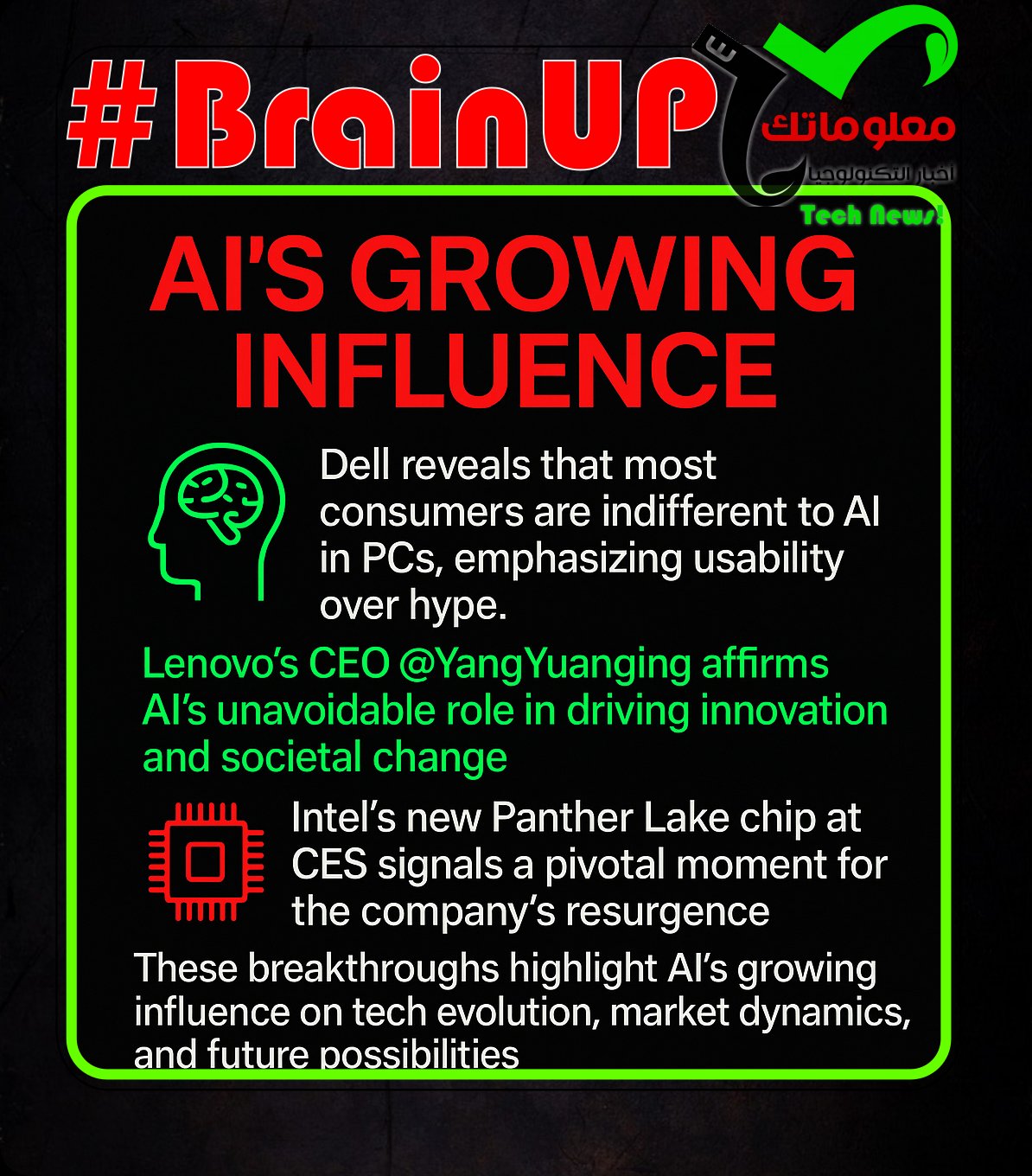
Dell contends that consumers aren’t buying PCs based on #AI, suggesting the AI PC push isn’t resonating. In a PC Gamer interview, @Kevin_Terwilliger notes that consumers aren’t buying based on AI and that AI may confuse them more than it helps. Dell’s latest hardware is not marketed as #AI-first, even though each device includes an #NPU and is AI-capable. This challenges the idea that #Copilot+ PCs or Windows AI features will spur upgrades and aligns with buyer priorities like battery life, performance, and display, while memory shortages dampen growth. Overall, Dell reframes AI as a capability rather than the primary selling point, a stance that could shape future OEM messaging.
2. Lenovo CEO addresses AI skeptics at CES: ‘Nobody can avoid it.’
At CES 2026, Lenovo unveiled Qira, a personal AI assistant that works across Lenovo and Motorola devices, along with a new line of AI laptops and devices, signaling AI’s integration into the ecosystem #Qira #AI. @YangYuanqing said AI is an unstoppable trend and will empower people rather than replace them, framing AI as a tool to help users do more and be more creative #AI. @TolgaKurtoglu emphasized Lenovo’s commitment to responsible AI, with guardrails, strict processes, and adherence to privacy and security regulations #responsibleAI #privacy #security. The company stressed the opt-in nature of Qira and its AI tools, noting users must choose to participate and can opt out if they prefer #optIn #privacy. The broader CES 2026 narrative centers on pervasive AI—from wearables like the concept Project Maxwell AI wearable to AI-enabled devices across smartphones, TVs, washing machines and more #ProjectMaxwell #AI.
3. Intel stock rallies as CES debut of Panther Lake chip marks make-or-break moment
Intel’s CES debut of the Core Ultra Series 3 chips, dubbed Panther Lake (#PantherLake), built on the latest manufacturing tech (#18A), marks a pivotal milestone in its turnaround by delivering a real product. The Panther Lake chips are in production, ramping, and available for order, and Intel’s stock rose about 6.5% after the announcement. Analysts say completing this 18A upgrade helps close a long credibility gap and could persuade chip designers to adopt Intel’s next-generation nodes (#18A-P, #14A), even without marquee customers yet on board. Buoyed by U.S. government support and investment from @Nvidia, the move aims to revive Intel’s manufacturing arm and reduce pressure from @AMD and @Arm, reinforcing that Intel is returning to execution.
4. The Growler: Signal-Jamming Jet That Helped Capture Nicolas Maduro
The article discusses the role of the Boeing EA-18G Growler, a sophisticated signal-jamming jet, in aiding U.S. efforts against Venezuelan leader @NicolasMaduro. The Growler’s advanced electronic warfare capabilities enabled disruption of Maduro’s communications and radar systems during critical military operations. This technology provided a strategic advantage by limiting Maduro’s situational awareness and command control, contributing significantly to his capture attempts. The effectiveness of the Growler underscores the increasing importance of electronic warfare in modern conflict. Its deployment reflects a shift towards integrated aerial platforms that combine intelligence, surveillance, and jamming to influence outcomes in geopolitical confrontations.
5. Can this AI digital twin help you skip some of those work meetings?
At CES 2026, @IgniteTech unveiled #MyPersonas, an #AI-powered platform that creates digital twins of employees from their video, voice, and written materials, enabling them to be in two places at once. The digital stand-ins can answer questions, chat on video, and respond in 160 languages, while replicating mannerisms and speech patterns. The company says the system could ease pressure on staff such as HR managers by handling repetitive questions, training, and onboarding around the clock. But the idea of digital doubles raises ethical and privacy concerns about who controls a likeness, how consent is managed, and whether a company should continue using a twin after someone leaves. The technology highlights potential productivity gains alongside the need to protect employee privacy as AI tools reshape the workplace.
6. Cloudy Outlook for Cyber Jobs as AI Fills Security Gaps
The cybersecurity job market faces uncertainty as AI and automation increasingly handle tasks traditionally performed by human analysts, potentially reducing the demand for entry-level positions. Companies are integrating AI technologies that can monitor networks and detect threats more efficiently, which shifts the required skill set toward expertise in managing and interpreting AI outputs rather than manual threat hunting. This transformation challenges the typical career path for new cybersecurity professionals, prompting calls for updated training programs that emphasize AI literacy and advanced cybersecurity skills. The evolving landscape suggests that while AI augments security teams, it also necessitates a reevaluation of workforce development strategies to align with technological advancements. As AI fills routine security gaps, the future cyber workforce will need to focus on complex problem-solving and strategic oversight.
7. DeepSeek $1.6B GPU Gamble: The End of Sovereign AI | Trendy Tech Tribe
DeepSeek’s $1.6B GPU investment is framed as a challenge to the notion that sovereign AI requires ever larger silicon footprints, arguing that architectural innovation can unlock cheaper paths to intelligence than brute-force scaling. Its DeepSeek-MHC approach constrains hyperconnections to a low-dimensional manifold, projecting high-dimensional data to reduce interconnect bandwidth by about 70% and enabling frontier models to be trained on 50,000 @Nvidia GPUs for roughly $1.6B, a fraction of the $10B clusters pursued by Western hyperscalers. This reframing emphasizes the #InterconnectBottleneck and argues that high-level mathematics, not simply more silicon, can bypass scaling bottlenecks, potentially turning 100B USD planned data centers into stranded assets if workloads shift to #ArchitecturalAlpha. Amid CES 2026 headlines and @ElonMusk confirming @xAI’s plan to build a cluster of one million GPUs, the piece frames the debate as a tug of war between the #CapexTrap and a new arc of efficiency that could redefine the ROI of large AI systems. In sum, the article warns that if architectural innovations like DeepSeek-MHC prove scalable, the industry may shift from chasing raw compute to optimizing data movement and structure, linking cost curves back to practical exploitation of #Manifold-ConstrainedHyperconnections.
8. Historic Artemis 2 moon launch may be just 1 month away
NASA’s Artemis 2 mission is approaching its launch, potentially just one month away, marking a significant milestone in lunar exploration. The mission is planned to carry astronauts around the Moon aboard the Orion spacecraft, propelled by the Space Launch System (SLS) rocket. This mission aims to pave the way for future lunar landings and long-term human presence on the Moon, highlighting NASA’s commitment to advancing space exploration. The successful launch and execution of Artemis 2 will demonstrate critical systems and operational procedures necessary for deep space crewed missions. Consequently, Artemis 2 serves as a vital step in fulfilling NASA’s broader Artemis program goals, including the eventual return of humans to the lunar surface.
Nvidia’s @Jensen Huang would face about $8 billion under California’s proposed 5% wealth tax on net worth over $1.1 billion, yet he says he’s ‘perfectly fine’ with that outcome. He told @Bloomberg Television that he hasn’t thought about the bill and that ‘we chose to live in Silicon Valley’ and ‘whatever taxes they would like to apply, so be it.’ The measure would tax the total assets of CA residents with a net worth above $1.1 billion as of 2026, exclude real estate, and allow payments over five years to fund the state’s health care budget and public programs. Proponents say the plan could raise roughly $100 billion from California’s top 200 wealthiest individuals, including Huang, whose wealth largely comes from his ~3% Nvidia stake according to Forbes. Critics among fellow billionaires, such as Palmer Luckey and Vinod Khosla, argue the policy could force liquidity events, highlighting the tension over taxes and cash needs among California’s ultra-rich.
10. OpenAI unveils ChatGPT Health, says 230 million users ask about health each week | TechCrunch
@OpenAI is launching ChatGPT Health, creating a dedicated space for health conversations to keep health context separate from standard chats. The company says more than 230 million people ask health and wellness questions each week, and Health can integrate with personal data from wellness apps like Apple Health, Function, and MyFitnessPal. It will nudge users to switch to Health if they start health topics in other chats, and within Health it may reference things discussed in standard chats, linking context across experiences. However, the feature raises questions about relying on #LLMs for medical guidance, since they predict likely responses rather than guaranteeing correctness, and OpenAI says the service is not intended for diagnosis or treatment. Health conversations will not be used to train its models, and @FidjiSimo describes Health as addressing healthcare issues such as cost, access barriers, overbooked doctors, and lack of continuity in care, with rollout expected in coming weeks.
11. Anthropic reportedly raising $10B at $350B valuation | TechCrunch
Anthropic is reportedly raising a fresh $10 billion at a $350 billion valuation, a move that would nearly double the $183 billion valuation it reached in its previous round and underscores ongoing demand for its #AI @Claude platform. Coatue Management and @GIC, Singapore’s sovereign wealth fund, are leading the round, per The Wall Street Journal, and the deal would be separate from the $15 billion Nvidia and Microsoft recently committed to invest in Anthropic for compute. Anthropic has been winning developer interest with Claude Code, powered by Claude Opus 4.5, as it prepares for a potential IPO this year alongside its main rival @OpenAI. The move reflects a broader trajectory in AI financing where strategic compute cycles and partnerships, including the Nvidia–Microsoft arrangement, shape valuations and appetites as the industry eyes a more ambitious growth path.
12. Smart Glasses With ‘Pet Translation’ Smell Like Total BS
Gizmodo’s CES 2026 coverage by @James Pero casts the Syncglasses G2 from Chmu Technology as a dubious mix of hardware and hype, especially around a claimed #PetTranslation feature. They bill themselves as the world’s first AI glasses with non-contact health monitoring, and the brochure suggests this is paired with a controversial ability to understand pet behavior. Chmu reportedly trained an AI on animal videos and demo footage showed a cat near a litter setup, a video Gizmodo notes was almost certainly AI-generated rather than depicting a real scenario. The piece argues that truly understanding animal behavior is far more complex than AI trained on online pet clips, underscoring the broader AI hype at CES 2026 and the limits of these gadgets. While acknowledging potential benefits of AI and computer vision for tasks like aiding people with low vision, the author remains skeptical that pet translation or similar claims amount to a meaningful advancement, and sees CES as more a glimpse of a future that may not resemble these showpieces. #AI #CES2026 #smartglasses #PetTranslation #lowvision
13. Orange pigments in birds are linked to human redheads’ hair color genetics
Research has uncovered a genetic connection between the orange pigmentation found in bird feathers and the hair color of human redheads. The study identifies that both birds and humans share similar biochemical pathways involving the pigment pheomelanin, which gives rise to their distinctive coloring. By examining these pigments, scientists revealed that variations in certain genes influence the expression of red or orange hues in both species. This discovery provides insights into evolutionary biology and suggests a closer genetic linkage in pigment production across distant species. Understanding this connection helps explain how nature uses comparable genetic mechanisms to produce similar color traits in birds and humans.
14. Bose open sources its SoundTouch home theater smart speakers ahead of EOL
Bose has open sourced the software for its SoundTouch home theater smart speakers as the product line approaches end of life, allowing the community to maintain and build upon the technology. This decision came after Bose officially announced the discontinuation of SoundTouch products and their cloud services. By releasing the code on GitHub, Bose enables enthusiasts and developers to support legacy devices and potentially extend their functionality. This move reflects a growing trend in tech companies allowing software longevity through open sourcing before hardware reaches obsolescence. The availability of SoundTouch’s code under open source terms fosters innovation and maintains value for existing customers despite official support ending.
15. AI-generated sensors open new paths for early cancer detection
AI-designed peptides bound to nanoparticles create sensors that signal when cancer-linked proteases are overactive in the body. An AI model designs short proteins targeted by proteases overactive in cancer cells, and when these peptides coat nanoparticles they are cleaved if cancer proteases are present, releasing detectable signals in urine. Depending on which proteases are detected, doctors could identify the cancer type, with signals read by a simple at-home paper-strip test. As @Sangeeta Bhatia notes, the goal is ultra-sensitive detection in early cancer and potential recurrence, a vision advanced by @Ava Amini and colleagues in a study published in Nature Communications. This work—described by MIT and Microsoft researchers in Nature Communications—extends a decade-long focus on protease activity as an early cancer marker and points toward at-home urine tests for early detection #MIT #NatureCommunications #AI #proteases #peptides #nanoparticles #urineTest
16. [News] Samsung, SK Reportedly Hike Server DRAM Prices 60-70% – Google, Microsoft in the Queue
Samsung @Samsung and @SKhynix reportedly hiked server DRAM prices by 60–70% from Q4 to Q1 2026, with Microsoft @Microsoft and Google in the queue and other PC and smartphone DRAM buyers seeing similar gains. The move comes as the memory market becomes a seller’s market, with both Korean giants reportedly rejecting long-term LTAs of two to three years in favor of quarterly contracts and expecting stepwise DRAM price increases through 2027. HBM3E-driven demand from AI accelerators and regulatory approvals for NVIDIA’s H200 exports to China are cited as major price drivers, with Chinese buyers placing about $3 billion in new HBM3E orders since last month and each H200 card needing eight HBM3E modules. TrendForce notes that conventional DRAM prices are set to rise 55–60% QoQ in 1Q26, with NAND Flash up 33–38% QoQ, as the DRAM supply-demand gap widens with CSPs locking in capacity. Other tech giants, including Microsoft and Amazon, are rushing to secure supply, with procurement teams staying in Korea and hotels near Pangyo reported as packed, underscoring tight availability and ongoing price pressure.
17. Samsung Electronics estimates surge as AI, memory prices skyrocket in Q4
Samsung Electronics forecasted a significant profit surge for Q4, driven by soaring prices of AI chips and memory components. The company benefitted from the rising demand for #ArtificialIntelligence technology, particularly for high-performance memory essential for AI workloads. This price increase helped offset previous market softness and chip inventory adjustments. Analysts note that Samsung’s optimistic earnings reflect a broader recovery in the semiconductor sector fueled by AI advancements. This trend underscores Samsung’s leading position in supplying critical components for AI, shaping its financial outlook for the upcoming quarters.
18. Qualcomm Talks Samsung 2nm Chip Product, TSMC Rising Costs
Qualcomm is discussing the development of a 2nm chip product with @Samsung, highlighting collaboration in advanced semiconductor technology. Despite the progress, rising costs at foundries like #TSMC are influencing the semiconductor industry pricing and strategic decisions. This trend affects the manufacturing dynamics and companies’ approaches to innovation and production. Qualcomm’s engagement with Samsung signals its commitment to leveraging cutting-edge #processnodes while navigating market pressures. Overall, these developments reflect the competitive and costly environment of next-generation chip manufacturing.
19. OpenAI Must Turn Over 20 Million ChatGPT Logs, Judge Affirms
A federal judge has affirmed the order requiring @OpenAI to produce over 20 million logs from its ChatGPT service as part of a discovery dispute. The ruling highlights the court’s insistence on thorough access to data for litigation purposes, despite OpenAI’s concerns about privacy and trade secrets. This decision underscores the growing legal scrutiny on #AI transparency and accountability. By enforcing this exchange of logs, the court ensures that parties have adequate information to litigate AI-related claims effectively. This case illustrates the intersection of technology and law, emphasizing how regulatory frameworks adapt to emerging #AI challenges.
20. California lawmaker proposes a four-year ban on AI chatbots in kids’ toys | TechCrunch
California Senator @StevePadilla introduces #SB867 to ban the sale and manufacture of AI chatbot toys for children under 18 for four years to let #safety regulators craft appropriate guidelines. He says safety regulations around this #AI technology are in their infancy and must grow as the tech evolves. The move follows concerns and incidents cited by lawmakers, including PIRG’s warning about Kumma toys and NBC News reporting on Miiloo reflecting CCP values. The proposal aligns with broader #policy actions on child safety and AI, including Padilla’s prior work on #SB243 to require safeguards for children and vulnerable users. By pausing sales of chatbot-enabled #toys, the aim is to protect children while regulators develop a safety framework for these products.
21. AI consciousness is a red herring in the safety debate
The debate about AI safety often diverts attention towards whether artificial intelligence can achieve consciousness, which distracts from more pressing issues related to its societal impact. Experts argue that the concern over AI consciousness is misplaced because it overshadows tangible risks such as algorithmic bias, privacy violations, and misuse of AI technologies. Prominent voices in technology ethics emphasize that focusing on concrete governance, regulation, and transparency measures offers more practical pathways to ensuring AI safety. This shift in focus encourages policymakers and technologists to address real-world dangers actively rather than engaging in philosophical debates about machine sentience. Addressing direct challenges like trustworthiness and accountability in AI systems ultimately leads to more effective management of AI’s risks and benefits.
22. Researchers Develop an LSD Analogue with Potential for Treating Schizophrenia
The UC Davis team developed JRT, an LSD-related molecule designed to promote neuroplasticity with reduced hallucinogenic potential for treating schizophrenia and other neuropsychiatric or neurodegenerative diseases. By flipping the position of two atoms in LSD, JRT retains neurotherapeutic properties while improving selectivity and lowering psychedelic risk, according to @David E. Olson. In cellular and mouse studies, JRT produced strong neuroplastic effects, including a 46% increase in dendritic spine density and an 18% rise in synapse density in the prefrontal cortex, without triggering hallucinogenic-like behaviors. JRT binds very selectively to #5-HT2A receptors, a key driver of cortical neuron growth, and demonstrates a safety profile superior to LSD in the tested models. Named after @Jeremy R. Tuck for his role in its synthesis, the 12-step process took nearly five years, and the findings point to a path where psychedelics can be used as starting points to develop medicines accessible to patient groups where psychedelic use is precluded, with potential applications across #neuroplasticity, #psychedelics, and #schizophrenia research.
23. Stack Overflow in freefall: 78 percent drop in number of questions
Stack Overflow is in freefall, with a 78% drop in questions in December 2025 compared with December 2024, totaling 3,862 questions. Developers are shifting to AI tools in their IDEs, such as @GitHub Copilot, bypassing the forum and reducing the need for traditional Q&A. A 2025 #survey indicates 84% of developers now use or plan to use AI tools, up from 76% a year earlier, while moderation issues and a focus on a limited set of ‘high-quality’ questions may deter newcomers. This decline also complicates language data sources, as #Redmonk language rankings rely on Stack Overflow for half of their data, and the #TIOBE Index measurements are questionable because much code remains in closed-source projects. Reddit is presented as a contrast, offering help without the same moderation stance.
24. Google Chrome 143 Security Bypass puts 3 Billion Users at Risk
A critical security bypass vulnerability has been identified in Google Chrome version 143, potentially putting over 3 billion users at risk. This flaw allows attackers to circumvent Chrome’s built-in security protocols, exposing users to malicious exploits. Cybersecurity experts warn that this bypass could lead to significant data breaches and unauthorized access to sensitive information. Immediate updates and patches are recommended to mitigate the threat, emphasizing the urgent need for users and organizations to prioritize their browser security. This vulnerability underscores the importance of continuous vigilance and timely software maintenance to protect against evolving cyber threats in widely used platforms like #GoogleChrome.
25. JPMorgan Chase becomes the new issuer of the Apple Card | TechCrunch
@Apple announced that @JPMorganChase will take over as the issuer of the Apple Card, replacing @GoldmanSachs, with a transition expected to take up to 24 months. The Apple Card will continue to run on the #Mastercard network during the transition and there are no immediate changes for consumers applying for new cards. @JPMorganChase says the deal will bring over $20B in card balances to Chase, while @GoldmanSachs is reportedly selling the portfolio at about a $1B discount. This move underscores the ongoing #Fintech trend of partnerships between consumer platforms and traditional banks to grow card portfolios on #Mastercard rails.
26. Solar hydrogen can be generated more efficiently with less platinum
Solar hydrogen generation can be made more efficient by developing catalysts that require less platinum, a scarce and expensive resource. Researchers have designed a new platinum-iridium oxide catalyst that performs well in acidic environments and reduces the amount of platinum needed for hydrogen production. This advancement addresses the challenge of costly materials in the photoelectrochemical cells used for solar hydrogen generation. By optimizing catalyst composition, the team improved durability and catalytic activity, facilitating scalable and sustainable hydrogen fuel production. This progress supports the broader goal of producing clean, renewable energy to reduce reliance on fossil fuels and mitigate climate change.
That’s all for today’s digest for 2026/01/08! We picked, and processed 26 Articles. Stay tuned for tomorrow’s collection of insights and discoveries.
Thanks, Patricia Zougheib and Dr Badawi, for curating the links
See you in the next one! 🚀
