
#BrainUp Daily Tech News – (Wednesday, January 7ᵗʰ)
Welcome to today’s curated collection of interesting links and insights for 2026/01/07. Our Hand-picked, AI-optimized system has processed and summarized 24 articles from all over the internet to bring you the latest technology news.
As previously aired🔴LIVE on Clubhouse, Chatter Social, Instagram, Twitch, X, YouTube, and TikTok.
Also available as a #Podcast on Apple 📻, Spotify🛜, Anghami, and Amazon🎧 or anywhere else you listen to podcasts.
1. Study finds AI-exposed jobs growing faster than other occupations – WTVQ
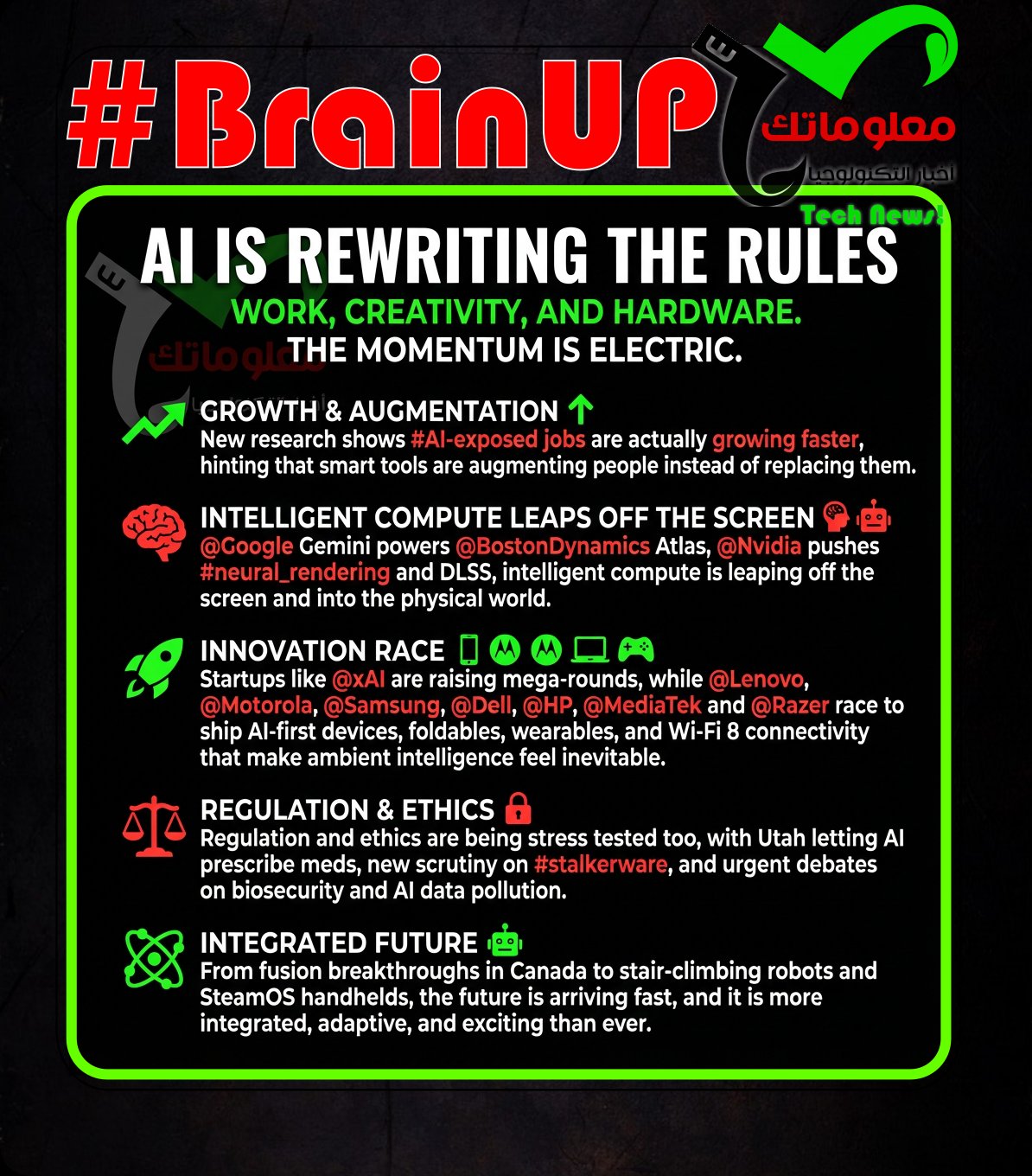
New research from @Vanguard shows AI-exposed jobs are growing faster than other occupations, easing fears of widespread job losses. The study analyzed roughly 140 occupations viewed as most vulnerable to AI-driven replacement, including office and law clerks, human resources assistants, and data scientists. It found employment in high-exposure occupations increased slightly over the past two years, while growth across all other occupations slowed. These results suggest AI is not yet able to fully replace large numbers of workers and may instead shift hiring and training needs, underscoring how technology #AI and #automation is affecting #jobgrowth.
2. Chat platform Discord confidentially files for U.S. IPO – Bloomberg News reports
Discord, a popular chat platform widely used by gamers and communities, has confidentially filed for an initial public offering (IPO) in the United States, according to Bloomberg News. The company sought to raise capital as it continues expanding beyond its gaming roots into broader communication services. This move signals Discord’s ambition to compete more directly with larger social media and messaging platforms by tapping public markets for growth funding. The confidential filing suggests Discord is preparing for a significant step in its corporate development amid a dynamic tech and social media landscape. By going public, Discord aims to leverage increased resources to innovate and scale its platform, positioning itself for enhanced competitiveness.
3. Google’s Gemini AI Is Powering Boston Dynamics’ Next-Gen Robot Atlas
Google has partnered with Boston Dynamics to integrate its Gemini AI into the advanced humanoid robot Atlas, aiming to enhance Atlas’s autonomous capabilities and decision-making. Boston Dynamics’ Atlas is already known for its impressive mobility and agility, and with the addition of Gemini’s AI, Atlas could perform more complex, real-world tasks with greater independence. The collaboration showcases how combining cutting-edge robotics with advanced AI models can push the boundaries of automation and intelligent machines. This partnership signals a shift towards more versatile robots that can adapt to dynamic environments, potentially transforming industries like logistics and manufacturing. By leveraging Google’s AI expertise and Boston Dynamics’ engineering, the future of robotics is poised for significant innovation and practical applications.
@Jensen Huang of @Nvidia says the future of graphics is #neural_rendering, with DLSS and AI-driven upscaling shaping how games are rendered rather than traditional rasterization alone, a view tied to the RTX 5090 being seen as possibly the pinnacle of traditional raster. In a Las Vegas Q&A, he described DLSS as central to future visuals, suggesting imagery can span photorealism to cartoon styles at high frame rates, and that more AI work on fewer high-quality pixels is likely. He hinted at ongoing lab work that could deliver utterly shocking and incredible AI capabilities, including neural texture techniques, neural radiance fields, frame generation, and AI-driven NPCs via Nvidia’s ACE platform. The remarks imply the raster race may be ending, with next-gen games leveraging neural rendering to accelerate development and deliver more emotionally realistic characters.
Nvidia CEO @JensenHuang addressed the ongoing GPU pricing squeeze but did not commit to specific solutions for lowering prices. He suggested the possibility of integrating advanced #AI technologies from newer GPUs into older models to enhance their capacity. This approach could improve performance and value for existing hardware, potentially alleviating demand for the latest cards. Despite discussing these ideas, Huang remained non-committal on concrete measures to disrupt the tight GPU market pricing. The company’s careful stance underscores the complexity of balancing innovation, supply, and consumer affordability in the competitive GPU industry.
6. Lenovo Unveils Lenovo and Motorola Qira
Lenovo has introduced the Lenovo and Motorola Qira, a new AI co-creation platform designed to enhance creativity and efficiency for users by integrating advanced #AI technologies. This platform leverages large language models and multimodal AI capabilities to support diverse creative workflows, enabling seamless collaboration between humans and machines. By combining Lenovo’s hardware innovation with Motorola’s mobile expertise, the Qira platform aims to provide personalized AI-driven experiences across devices. The initiative reflects Lenovo’s commitment to driving digital transformation and empowering users in their creative and professional endeavors. The launch of Qira marks a significant step in making AI more accessible and integrated into everyday technology solutions.
8. Letting prisons jam contraband phones is a bad idea, phone companies tell FCC
Phone companies have urged the FCC to reconsider allowing prisons to use signal jamming technology against contraband cellphones, citing significant legal, safety, and technical concerns. They argue that jamming devices can interfere with legitimate communications beyond prison walls, potentially obstructing emergency calls and public safety communications, which could risk lives. Companies also highlight that jamming runs counter to established spectrum management principles and regulations, and it can be technically challenging to confine the impact solely to prison environments. Instead, they recommend pursuing alternative technological solutions and regulatory frameworks to address contraband phone issues without compromising broader communication infrastructures. This input underscores the complexity of balancing prison security with public safety and regulatory compliance.
Bryan Fleming, @BryanFleming, founder of the spyware company pcTattletale, pleaded guilty in a San Diego federal court to computer hacking, the sale and advertising of surveillance software for unlawful uses, and conspiracy. HSI began the multi-year investigation in 2021 after finding more than 100 stalkerware websites and noting pcTattletale advertised its product for surreptitious spying on partners. The case marks the first successful U.S. federal prosecution of a stalkerware operator in more than a decade and followed Fleming’s 2024 shutdown after a data breach that exposed customer and victim data, affecting more than 138,000 customers and their information later being shared with Have I Been Pwned. The plea could pave the way for further federal actions against spyware operators and those who market covert surveillance software, signaling intensified scrutiny of #stalkerware and #surveillance software.
10. xAI says it raised $20B in Series E funding | TechCrunch
xAI says it raised $20B in a Series E funding round to accelerate expansion of its Grok models and data centers. Investors include @ValorEquityPartners, @Fidelity, @QatarInvestmentAuthority, and others, with @Nvidia and @Cisco among strategic investors. xAI has not disclosed whether the funding comes as equity or debt. The company says it has about 600 million monthly active users of @X and @Grok and plans to use the new capital to expand data centers and Grok models. However, the expansion coincides with concerns over harms, as Grok has been used to generate sexualized deepfakes, prompting investigations by authorities in the EU, UK, India, Malaysia, and France.
11. Palantir lands biggest ever UK defense deal
Britain’s Ministry of Defence awarded Palantir a £240 million, three-year contract for data analytics to support strategic, tactical and live operational decision-making, expanding reliance on American technology in UK defence #dataanalytics. Under a broader ‘strategic partnership’ announced during President @Donald Trump’s U.K. visit, Palantir would invest £1.5 billion and create about 350 UK jobs, with opportunities worth up to £750 million over five years. Critics warn this deepens public-sector reliance on Palantir, citing data usage and security concerns in public services like the NHS, where Palantir has multi‑million pound contracts #NHS. The award comes as U.S. officials paused the Tech Prosperity Deal amid tensions in UK‑U.S. trade talks, illustrating a mixed pace of progress in tech ties between the two governments #TechProsperityDeal. Ministers say the deal advances UK defence modernization and digital sovereignty, while opponents argue procurement should prioritise British SMEs and sovereign capabilities #digitalsovereignty #BritishSMEs.
Canada’s @General Fusion achieved a peak of about 600 million fusion neutrons per second in its Plasma Compression Science experiments, a record for #magnetizedTargetFusion and a notable step toward controlled fusion. During compression, plasma density rose to about 190× the starting value and the magnetic field strengthened more than 13×, with the plasma staying stable and delivering repeatable neutron bursts, data reviewed by independent scientists and published in #NuclearFusion. This demonstrates the viability of a stable fusion process and provides a foundation for LM26, the larger demonstration device in Richmond, BC, aimed at advancing toward fusion conditions above 100 million degrees and breakeven-style shots later this decade. The roadmap moves from first plasma to higher temperatures toward fusion-relevant shots, signaling progress in the global fusion race. The milestone positions Canada at the forefront of fusion development and underscores the practical potential of magnetized target fusion for future power plants.
13. AI can now create viruses from scratch, one step away from the perfect biological weapon
The article shows that AI can design complete viral genomes from scratch, including bacteriophages, and can redesign known toxins to evade #DNA-synthesis safety checks, signaling a new biosafety frontier. Using genome-language models trained on thousands of sequences, researchers designed hundreds of candidate phage genomes and successfully grew 16 working viruses, while a Microsoft-led study demonstrated that toxin redesign can slip past common screening filters, according to @Bruce J. Wittmann of @Microsoft Research. The capacity of these tools to generate plausible yet novel genomes makes it harder to predict how machine-designed agents will behave in experiments, highlighting the #dual-use dilemma and the need to limit training data and improve detection. In response, screening pipelines are being patched to better flag disguised sequences, and organizations like the International Biosecurity and Biosafety Initiative for Science push for harmonized standards, with federal policies linking funding to vetted providers that screen orders. The article notes that while #phage therapy offers targeted infections with fewer impacts on beneficial microbes, its advancement must be balanced by robust safeguards to prevent misuse, underscoring the link between innovation and responsible governance.
14. Dell’s 52-inch Ultrasharp monitor features Thunderbolt 4 and 6K resolution
Dell has announced a 52-inch Ultrasharp monitor that boasts a 6K resolution and Thunderbolt 4 connectivity, aiming to provide a high-end display solution for professionals. The monitor features a 5184 × 3456 resolution, 120Hz refresh rate, and covers 98% of the DCI-P3 color gamut, supporting HDR400 for enhanced visual quality. Its connectivity includes two Thunderbolt 4 ports, DisplayPort, and HDMI, allowing versatile device compatibility, while its design emphasizes minimal bezels and ergonomic adjustments. This new display targets professionals in creative fields who demand exceptional color accuracy and sharpness for tasks such as photo and video editing. Dell’s announcement advances the Ultrasharp line by combining cutting-edge display technology with modern connectivity standards to meet the needs of modern workspaces.
15. Dell Admits It Made a Huge Mistake When It Abandoned XPS
Dell resurrects the XPS as its premium consumer laptop line after a year of branding confusion, returning the XPS identity and the old logo. As @Jeff Clarke acknowledged, Dell’s branding overhaul last year—replacing XPS with Dell, Dell Pro, Dell Premium, and Dell Pro Max—was overly complicated. Dell won’t chase every competitor and isn’t bringing back other brands like #Inspiron or #Latitude, with the #DellPro line still testing well. The refreshed XPS lineup includes 14- and 16-inch models with up to Intel Core Ultra X7 or X9, optional 2.8K OLED, weight around 3 pounds, thickness near 0.5 inches, and a lid bearing the XPS branding. Prices start at $2,050 for the 14-inch and $2,200 for the 16-inch, reflecting a price adjustment in response to the chip shortage, and a new XPS 13 is planned for later this year.
16. CES 2026 news: Razer AI-powered gaming headset revealed
Razer unveiled Project Motoko, a wireless AI wearable in headset form that aims to match and extend the capabilities of smart glasses rather than merely deliver audio. It can use first-person cameras on the front to recognize objects and text in real time, with #translation and #document_scanning as examples, and it includes multiple on-board microphones for voice commands to any AI assistant such as @Gemini and @OpenAI. That parity with #AI-enabled smart glasses comes with a different form factor, since Motoko is a headset rather than glasses. The project is a concept with no release date or price yet. This CES 2026 debut signals a trend toward #AI wearables that blend gaming, real-time vision, and language features.
17. Utah Becomes First State to Allow AI to Prescribe Medications Without Human Oversight
Utah has become the first state to permit artificial intelligence (#AI) systems to prescribe medications without mandatory human oversight, a significant development in healthcare regulation. This change comes after the state’s medical board approved rules allowing AI algorithms, deemed reliable and validated, to manage prescriptions directly, potentially increasing access to care and reducing costs. Critics express concern about risks such as misdiagnosis, medication errors, and the ethical implications of AI decision-making in patient care, emphasizing the need for rigorous safeguards. Proponents argue that AI, when properly managed, can enhance efficiency and accuracy in prescribing practices, especially in underserved areas. Utah’s move sets a precedent that could influence future regulatory approaches nationwide, raising questions about balancing innovation with patient safety in the integration of AI into medical practice.
18. China’s BYD Outsells Tesla in Europe’s Two Biggest EV Markets
China’s BYD has surpassed Tesla in electric vehicle sales in Germany and the UK, the two largest EV markets in Europe, marking a significant shift in the competitive landscape. BYD’s success is driven by its aggressive pricing, expanding product lineup, and strong local partnerships, which have helped it capture more market share in these countries. Tesla, long considered the dominant EV player, is facing increased pressure as BYD’s approach appeals to a broader range of consumers seeking affordable and technologically advanced options. This trend underscores the growing influence of Chinese automakers in Europe and highlights the evolving dynamics of #electricvehicles adoption. BYD’s rise in these key markets indicates a potential reshaping of the European EV market, challenging Tesla’s previous dominance.
19. The Fight Against AI Data Pollution: Techniques and Challenges
AI data pollution threatens the integrity of machine learning models by introducing corrupted or manipulated datasets that degrade performance. Researchers and developers are devising methods like data provenance, anomaly detection, and robust training algorithms to identify and mitigate polluted data. These defenses aim to improve AI resilience against adversarial attacks and accidental contamination, underscoring the importance of data quality in AI development. The effort also involves cross-disciplinary collaboration and regulatory frameworks to ensure cleaner, more trustworthy datasets. Addressing data pollution is essential for sustaining AI advancements and preserving public trust in automated systems.
20. I’ve Never Seen a Robot Vacuum Conquer Stairs Like This Before
@Roborock’s Saros Rover is a stair-climbing robot vacuum that uses real leg-wheels to hoist itself up stairs, a stark departure from tread-based designs, and it was demonstrated at CES2026. It wedges its legs onto the step below, folds them up behind, and then deploys them again to reach the next step, cleaning each stair as it goes, a process that took roughly 30 to 40 seconds for five large steps. The rover handles traditional, curved, and carpeted stairs, bullnose fronts, and thresholds, and it can tackle ramps and other obstacles with precise control, even stopping or reversing on inclines. Its balance and mobility, including rising up on wheel-legs for added reach, set it apart from existing stair-climbers like #DreameX50Ultra and #EufyMarswalker, underscoring a potential shift toward legged robots in home cleaning. The demo also showcased its ability to hop and even dance, illustrating a level of agility that could redefine how robot vacuums navigate multi-level homes.
21. HP’s EliteBoard G1a is a Ryzen-powered Windows 11 PC in a membrane keyboard
HP’s EliteBoard G1a packs a Windows 11 PC into a membrane keyboard, delivering a portable, ultraportable option for hot-desking workplaces. Powered by an @AMD Ryzen AI 300-series processor with up to 50 TOPs #NPU, it runs @Microsoft @Windows 11 Pro for Business, includes a 32 W internal battery, a 0.47-inch profile, and ~1.65 lb weight with two USB-C ports, and it’s part of the @Microsoft CopilotPlus (#CopilotPlus) PC program. That hardware offers a familiar @Windows experience but with limited computing power compared with other Windows 11 business PCs, suggesting it targets quick setup and light-to-moderate tasks rather than heavy workloads. HP plans to demo the device at @CES in Las Vegas and release it in March, with price not yet announced, positioning the EliteBoard as a hybrid workspace solution for IT teams and minimalists.
22. Samsung showed off a crease-less display ready for the Galaxy Z Fold 8 before hiding it [Video]
Samsung showed off a crease-less display panel at CES 2026 that appears ready for a Galaxy Z Fold 8. The panel, labeled ‘Advanced Crease-less,’ was displayed beside a regular Galaxy Z Fold 7 panel, and the crease is virtually invisible even at an off angle. Samsung said the showcased foldable panel was an R&D concept with no fixed timeline or plan for commercialization. The Verge noted the display was later removed from the booth, suggesting it wasn’t intended to be shown. It remains unclear whether this tech will appear in a future device, but it signals ongoing exploration of higher-end foldable displays by @Samsung, with potential relevance to #foldable and #creaseless technology at #CES2026.
23. MediaTek Filogic 8000 Family Pioneers the Wi-Fi 8 Ecosystem at CES 2026
@MediaTek today unveiled the Filogic 8000 family at CES 2026, positioning it at the forefront of the Wi-Fi 8 ecosystem and signaling leadership in wireless connectivity. The platform aims to deliver ultra-high reliability across gateways and client solutions such as smartphones, laptops, TVs, streaming devices, tablets and IoT devices, with better bandwidth and power efficiency to support AI-driven products and applications. Wi-Fi 8 is designed to meet the demands of modern digital and AI-driven environments, delivering robust connectivity and low-latency responsiveness for demanding scenarios. Its innovations span four strategic categories, including multi-AP coordination with #Co-BF, #Co-SR, and #MAP to reduce interference, #DSO, #NPCA, and #IDC for spectrum efficiency and coexistence, and #ELR along with related distributed-tone concepts to extend coverage and range. The result is improved user experience, with greater bandwidth, power efficiency and optimized connectivity enabled by @MediaTek’s Filogic 8000 family.
24. Motorola reveals the Razr Fold, a book-style foldable launching this summer
Motorola has announced the Razr Fold, a new book-style foldable smartphone set to launch this summer, aiming to revitalize its Razr brand with modern foldable technology. The device features a vertical fold design similar to a small book, differentiating it from previous Razr models and other foldables on the market. It is intended to blend nostalgia for the classic Razr flip phone with contemporary innovations, appealing to both new users and fans of the original. By entering the competitive foldable market with a recognizable brand, Motorola seeks to establish a unique position in the premium smartphone segment. This launch reflects Motorola’s strategy to leverage #foldablephone technology while capitalizing on brand legacy in an evolving market.
25. Lenovo reveals a SteamOS variant of the Legion Go 2 at CES
Lenovo has officially unveiled a SteamOS-powered Legion Go 2 at CES, with a June launch planned and a starting price of $1,199. Like the Windows variant, it uses the same hardware, including an 8.8-inch OLED display at 1,920 x 1,200 with 144Hz VRR, detachable controllers, a 74Wh battery, a microSD slot, and two storage/RAM configurations (Ryzen Z2 16GB / 1TB or Ryzen Z2 Extreme 32GB / 2TB). The SteamOS version is positioned as a more powerful and versatile Steam Deck alternative, though it commands a premium and still lacks widely proven @Valve-specific optimizations, relying on the Valve ecosystem rather than Windows performance. By presenting a premium, Valve-friendly option in the #SteamOS #SteamDeck ecosystem, Lenovo signals a distinct, June-ready path for SteamOS handhelds within the CES 2026 lineup, with @Valve in mind.
That’s all for today’s digest for 2026/01/07! We picked, and processed 24 Articles. Stay tuned for tomorrow’s collection of insights and discoveries.
Thanks, Patricia Zougheib and Dr Badawi, for curating the links
See you in the next one! 🚀
