
#BrainUp Daily Tech News – (Tuesday, January 6ᵗʰ)
Welcome to today’s curated collection of interesting links and insights for 2026/01/06. Our Hand-picked, AI-optimized system has processed and summarized 30 articles from all over the internet to bring you the latest technology news.
As previously aired🔴LIVE on Clubhouse, Chatter Social, Instagram, Twitch, X, YouTube, and TikTok.
Also available as a #Podcast on Apple 📻, Spotify🛜, Anghami, and Amazon🎧 or anywhere else you listen to podcasts.
1. Amazon Brings Alexa To Web Browsers, Expanding Its Reach Beyond Echo Devices
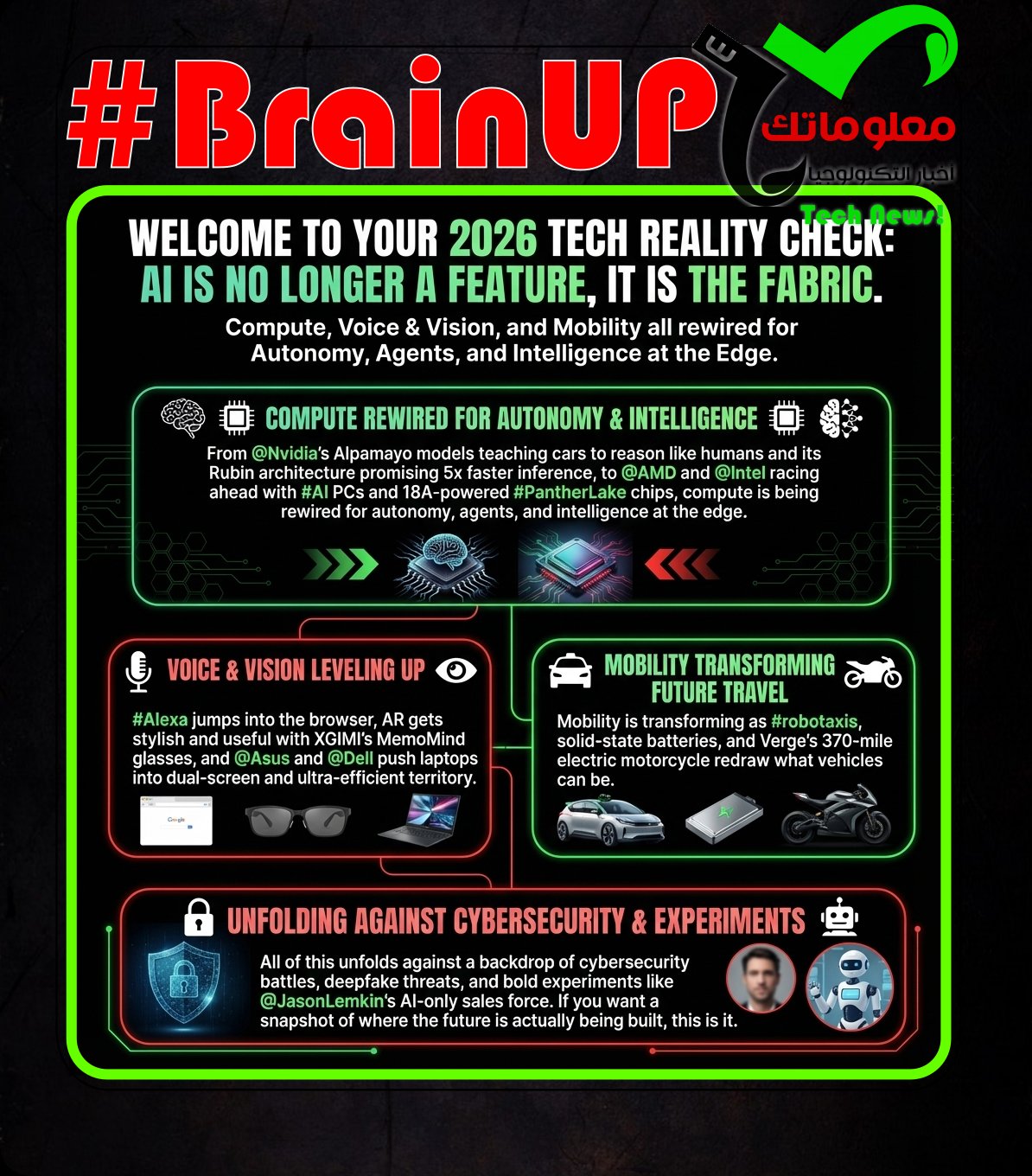
Amazon is expanding the accessibility of its #Alexa virtual assistant by launching a web app available on browsers like Google Chrome, Microsoft Edge, and Apple Safari. This development allows users to access Alexa without relying solely on Echo devices, broadening the assistant’s reach to millions who use web browsers daily. The web app supports voice commands for tasks such as playing music, managing calendars, and controlling smart home devices, enhancing user convenience and interaction. By integrating Alexa into browsers, Amazon strengthens its competitive position against other voice assistants and increases potential user engagement across platforms. This approach aligns with Amazon’s strategy to grow Alexa’s ecosystem and embeds its technology more deeply into daily digital experiences.
2. Hyundai and Boston Dynamics May Have Just Stolen The Robot Factory Narrative Away From Tesla
Hyundai’s recent acquisition of Boston Dynamics positions the company to lead in robotics manufacturing, potentially overtaking Tesla’s ambitions in this field. Boston Dynamics, famous for its advanced agile robots like Spot and Atlas, enriches Hyundai’s capabilities by merging high-tech robotics with Hyundai’s manufacturing scale and resources. This merger exemplifies the growing integration of #robotics and #automotive industries, where innovation is driven by combining AI, hardware, and manufacturing expertise. Hyundai’s strategic move suggests a shift in the robot factory narrative, emphasizing collaboration and industrial know-how rather than Tesla’s largely self-styled approach. This development highlights how traditional automotive giants are rapidly advancing in robotics, challenging tech-centric companies in the emerging robot economy.
3. NordVPN Denies Breach Claims, Says Attackers Have Dummy Data
NordVPN has denied claims of a recent security breach, stating that the attackers only obtained dummy data with no real user information or credentials. The company emphasized its strong security measures, including audited infrastructure and encryption protocols, to protect customer privacy. Despite the attackers’ claims, NordVPN reassured users that their actual data remains secure and no service interruptions have occurred. This response highlights the importance of verifying breach reports and the challenges cybersecurity firms face in managing misinformation. NordVPN’s statement aims to maintain trust by clarifying the situation and affirming its commitment to user security.
Nvidia’s Alpamayo introduces a family of open-source AI models, simulation tools, and datasets designed to help autonomous vehicles reason through complex driving scenarios. At the core is Alpamayo 1, a 10‑billion-parameter chain-of-thought #VLA model that breaks down problems into steps, reasons through possibilities, and explains the action it will take and the expected trajectory. @AliKani described how it can navigate rare edge cases, such as a traffic light outage, by reasoning about every possibility to select the safest path, while @JensenHuang framed Alpamayo as bringing reasoning to physical AI and enabling clearer explanations of decisions. Developers can fine-tune Alpamayo into smaller, faster versions, train simpler driving systems, or build tools like auto-labeling systems and evaluators, and can use #Cosmos to generate synthetic data for training and testing #Alpamayo-based AV applications. Nvidia also released an open dataset with 1,700+ hours of driving data and launched #AlpaSim, an open-source simulation framework for validating autonomous driving systems, available on GitHub, and the underlying code is on @HuggingFace.
5. Nvidia wants to power robotaxi fleets with chips, software by 2027
Nvidia aims to power robotaxi fleets with its AI chips and Drive AV software by 2027, making robotics the company’s second-largest growth area after AI, per @JensenHuang. The company says it will work with robotaxi operators to deploy #Level4 #robotaxi technology in defined regions around 2027, starting with limited availability as partners test the footing. Nvidia has sold Drive AGX Thor hardware priced at about $3,500 per chip and helps tune software for each vehicle, including Mercedes-Benz models due in late 2026 to navigate cities like San Francisco. The push follows partnerships such as a robotaxi deal with #Uber announced in October, with #Waymo leading robotaxi services in multiple U.S. markets. Automotive and robotics chips accounted for about $592 million in sales in the quarter ended October, roughly 1% of Nvidia’s total revenue, but Nvidia frames robotics as a core growth driver alongside #AI infrastructure and envisions a future with billions of autonomous cars as robotaxis or owned vehicles.
6. Gmail preparing to drop POP3 mail fetching
Gmail will drop POP3 mail fetching and the Gmailify feature beginning January 2026. A Google support note confirms that starting January 2026, Gmail will no longer support Gmailify or the ‘Check mail from other accounts’ feature that fetches third-party mail via POP. Some market observers link the change to security concerns around POP3, which can require sending passwords in plaintext, and The Reg has asked Google for comment. The article notes that @Jamie Zawinski used Gmailify for staff email at DNA Lounge, illustrating how the feature was used in practice. With the service no longer retrieving external mail, users who rely on cross-account consolidation are advised to switch to #IMAP or a local client such as MZLA Thunderbird to manage mail.
Dell has reintroduced its XPS laptop lineup with significant updates that remove the capacitive touch bar and introduce a 1Hz display option, enhancing both usability and power efficiency. The 14- and 16-inch models now feature improved specs, presumably including better processors, display technologies, and build quality, aligning with the expectations for premium laptops in 2024. By ditching the touch bar, Dell responds to user feedback favoring traditional keyboard layouts over less tactile controls, while the 1Hz display option targets improved battery life during static screen use. These upgrades position the new XPS models strongly in the competitive high-end laptop market, blending performance, design, and user experience. This evolution reflects Dell’s commitment to refining its flagship series by balancing innovation with practical user needs.
@Intel unveils Panther Lake as the #CoreUltraSeries3 lineup built on the 18A process, with 14 SKUs including X9 and X7 variants that feature a larger integrated GPU and 12 Xe3 cores. The compute tile combines up to four P-cores, eight E-cores, and up to four low-power E-cores, organized around a dedicated ‘low-power island’ to improve efficiency and battery life. Intel touts @GAA transistors and #PowerVia as part of Panther Lake’s design, and says it delivers more than 10% higher single-threaded performance at ISO power and over 50% higher multi-threaded performance in the same power envelope versus #LunarLake. The company plans preorder starting January 6 and general availability from January 27, with embedded edge deployments in #robotics, #automation, and #healthcare expected in Q2 2026. The headline’s 76% faster gaming performance claim and the note that the #X-series can match a discrete #RTX4050 frame Panther Lake underscore a gaming-focused upgrade within the #CoreUltraSeries3 lineage.
9. Intel launches Core Ultra Series 3 CPUs, made using its long-awaited 18A process
@Intel unveils the Core Ultra Series 3 laptop CPUs using the long-awaited 18A process, aiming at high-end ultraportables. During CES, Intel announced Panther Lake #PantherLake with 14 chips across 5 families, expected in over 200 PC designs, with initial availability on January 27 and more launches through the first half of the year. The top models @Core Ultra X9 and X7 pair a full CPU/GPU stack with a 12-core @Intel Arc B390 iGPU and support for faster #LPDDR5x-9600, while offering 20 PCIe lanes to pair with discrete GPUs. The @Core Ultra 9 and X7 reuse similar tech but reduce GPU cores and offer either #LPDDR5x-8533 or #DDR5-7200 memory, still delivering 20 PCIe lanes. A lower-end @Core Ultra 5 line includes the 338H variant with 12 CPU cores and a 10-core Arc B370 GPU, and the design hinges on a chiplet-based Panther Lake architecture with an 18A-based compute tile and a separate platform controller tile built at @TSMC, plus a graphics tile that uses either 12-core or 4-core configurations across a mix of manufacturing nodes.
10. Under anti-vaccine RFK Jr., CDC slashes childhood vaccine schedule
Under Robert F. Kennedy Jr.’s leadership, the CDC has drastically reduced the childhood vaccine schedule, eliminating multiple vaccines previously recommended for children. This change follows Kennedy’s longstanding anti-vaccine views and activism, raising concerns among public health experts about potential increases in preventable diseases. The reduction includes cutting vaccines for diseases such as hepatitis B and chickenpox, which epidemiologists warn could lead to outbreaks and endanger community immunity. Critics argue that the diminished vaccine schedule contradicts decades of scientific consensus on vaccine safety and effectiveness, potentially undermining trust in public health institutions. These developments highlight the ongoing tension between vaccine advocacy and skepticism, emphasizing the critical role of evidence-based policy in maintaining population health.
11. X blames users for Grok-generated CSAM, no fixes announced
X has faced criticism after its AI tool Grok was found to generate child sexual abuse material (CSAM), yet the company has not announced any fixes. Users who prompted Grok to produce CSAM were blamed by X’s leadership for the content, diverting responsibility from the platform. Despite the severity of the issue, no clear policy or technical remedy has been promised to prevent such outputs in the future. This stance raises concerns about the platform’s commitment to safety and content moderation surrounding AI-generated content. The situation reflects broader challenges tech companies face in balancing AI innovation with ethical safeguards.
12. HP-UX finally reaches end of life after decades
HP-UX, Hewlett-Packard’s proprietary UNIX operating system, has reached its official end of life as of 2026, concluding over 40 years of service. The platform was initially launched in the late 1980s and became a staple for enterprise environments, especially on HP’s PA-RISC and later Itanium-based servers. Over time, the rise of Linux and other open systems, coupled with shifts in hardware trends, diminished HP-UX’s market relevance and support. This transition marks an important milestone for legacy enterprise clients who must now migrate workloads to modern operating systems and hardware architectures. HP’s decision reflects broader industry trends moving away from specialized UNIX variants towards more flexible and widely supported platforms like Linux and cloud solutions.
13. Hacktivist deletes white supremacist websites live onstage during hacker conference | TechCrunch
At the Chaos Communication Congress in Hamburg, Germany, hacktivist @MarthaRoot remotely wiped the servers of #WhiteDate, #WhiteChild, and #WhiteDeal during her talk, with the sites still offline as of publication. Root, dressed as the Pink Ranger from @PowerRangers, infiltrated the sites using AI chatbots that bypassed verification and were verified as ‘white’ according to the talks’ abstract. She published leaked data scraped from WhiteDate, including user profiles with names, photos, ages, locations, and precise geolocation metadata. The administrator of the three sites called the action cyberterrorism and vowed repercussions, while DDoSecrets said it had received files and is offering access to a full 100GB dataset to verified journalists and researchers. The incident highlights weak cybersecurity hygiene among extremist platforms and prompts questions about the ethics and legality of takedowns carried out live.
14. World’s first solid-state electric motorcycle debuts at CES 2026
At CES 2026, @Verge_Motorcycles unveils the world’s first production-ready solid-state electric motorcycle, bringing #solid-state_batteries to public roads with up to 370 miles of range. The description explicitly notes Verge’s production-ready model with up to 370 miles of range. This milestone could signal a shift in #electric_mobility, as solid-state chemistry promises longer range and potential improvements in safety and charging, though the article provides no technical specifics. The debut at a major tech show reinforces CES 2026 as a platform for progress in #solid-state_batteries and #electric_mobility.
15. First Production-Ready All-Solid-State Battery Official Specs
The article announces the official specifications of the first production-ready all-solid-state battery, representing a major advancement in battery technology. The battery offers improved energy density, enhanced safety, and faster charging capabilities compared to traditional lithium-ion batteries. These benefits are attributed to the use of solid electrolytes instead of liquid ones, which reduce risks of leaks and thermal runaway. The breakthrough could significantly impact the electric vehicle industry by enabling longer-range vehicles with shorter charging times, thus accelerating the adoption of #EVs. This development aligns with global trends towards sustainable transportation, supporting @automakers and policymakers striving for greener mobility solutions.
16. NVIDIA accelerates Apache Spark workloads with DGX H100 systems
NVIDIA has introduced improvements to accelerate #ApacheSpark workloads using its DGX H100 systems, aiming to boost performance for AI and data analytics tasks. The enhancements leverage the H100 Tensor Core GPUs along with optimized software stacks, significantly reducing runtime and increasing throughput for Spark jobs. This development allows enterprises to process large-scale datasets faster while maintaining flexibility in hybrid and multi-cloud environments. By integrating GPU acceleration directly into Spark, NVIDIA transforms how data teams handle complex machine learning pipelines and large data processing workloads. These advancements reinforce NVIDIA’s strategy to embed AI capabilities into core data infrastructure, making it a critical player in AI-driven analytics.
17. Lego announces Smart Brick, the ‘most significant evolution’ in 50 years
Lego unveils Smart Brick, a tiny computer embedded inside a 2×4 brick that aims to bring interactive play to @Lego @Star Wars sets. It detects #NFC-equipped smart tags in new tiles and minifigures and forms a Bluetooth mesh with other Smart Bricks to drive lights, sounds, and in-set interactions. The bricks are wirelessly charged with a pad and house a sub-stud-sized custom #ASIC powered by a battery designed to endure years of inactivity, with firmware updates available via a smartphone app. Lego says there is no #AI and no #camera in the product, and the built-in microphone is a virtual button for real-time reactions rather than a recording device. Shipping begins March 1, 2026 with three initial sets—473-piece Darth Vader’s TIE Fighter, 584-piece Luke’s Red Five X-Wing, and 962-piece Darth Vader’s Throne Room Duel & A-Wing—priced at $70, $100, and $160 respectively, illustrating how the Smart Brick scales from a single brick to whole Star Wars builds and underscoring Lego’s claim of a significant evolution in play.
18. Nvidia launches powerful new Rubin chip architecture | TechCrunch
At CES Nvidia unveiled the six-chip Rubin computing architecture led by a Rubin GPU and described as state of the art in AI hardware, with @Jensen Huang noting it is in production and set to ramp up in the second half of 2026. Rubin will replace the Blackwell architecture as part of Nvidia’s ongoing hardware cycle. The stack includes the Rubin GPU at the center, a new Vera CPU for agentic reasoning, and improvements in storage and interconnection via #Bluefield and #NVLink, plus a new external storage tier to scale the memory pool. Nvidia says Rubin delivers up to 3.5x faster training and 5x faster inference, reaching as high as 50 petaflops, with eight times more inference compute per watt. Rubin is slated for broad adoption by cloud providers such as #Anthropic and #OpenAI and AWS, and will power systems like HPE’s Blue Lion and Berkeley Lab’s Doudna; it is named for the astronomer @Vera Rubin.
A study led by @Kalyani Chaubey from the Pieper Laboratory shows that restoring brain #NAD+ balance can prevent and even reverse Alzheimer’s disease pathology and cognitive deficits in preclinical mouse models. The researchers used two mouse lines carrying human mutations in amyloid processing and tau protein, and they found that NAD+ decline is more severe in AD brains; treatment with the pharmacologic agent #P7C3-A20 restored NAD+ balance and halted or reversed major disease features. Delayed treatment in mice with advanced disease enabled recovery of cognitive function, with normalization of brain energy balance and pathology in both models. This work highlights brain energy metabolism and NAD+ homeostasis as central drivers of AD and suggests a potential therapeutic strategy to reverse disease, though no human clinical trials have demonstrated reversal to date.
20. KimWOLF Android Botnet Grows Through Residential Proxy Networks
The KimWOLF Android botnet has expanded significantly by exploiting residential proxy networks typically used for evading detection and geographic restrictions. Researchers observed that KimWOLF leverages these proxies to mask its activities, making it harder to trace its command-and-control communications and distributing its malicious payload. This strategic use of residential proxies enhances the botnet’s resilience and reach, as infected devices can access the internet through different IP addresses that appear legitimate. As a result, KimWOLF poses a heightened threat to mobile users and network security, emphasizing the need for enhanced detection methods that consider proxy usage patterns. Understanding this botnet’s growth tactics underlines the importance of securing mobile environments against evolving threats that use sophisticated evasion techniques.
21. Jeep Pulls Wrangler and Grand Cherokee 4xe Hybrids From Website as Quiet Stop-Sale Drags on
Jeep has quietly pulled the Wrangler and Grand Cherokee 4xe hybrids from its online configurators as a recall-driven stop-sale drags on. The models vanish from the Electric & Hybrid page, the 2026 Wrangler 4xe Build & Price tool is missing, and 2025 pages redirect to gas variants, while a November engine-fire recall is unresolved and @Stellantis projects a remedy by Q2 2026. Jeep’s own statement that stop-sales are standard until a remedy is in place underscores why the situation has escalated into a broader production hiatus. The Drive highlights the ongoing uncertainty for buyers and fans of #4xe, as the recall timeline remains unclear and @Jeep’s online storefront reflects the disruption.
22. Rivian Deliveries Decline in Line With Expectations
Rivian reported a decline in vehicle deliveries during the recent quarter, which aligned with the company’s earlier guidance. The company delivered fewer electric trucks than in the previous period, citing production slowdowns and supply chain issues as contributing factors. Despite the decline, Rivian emphasized its commitment to resolving these challenges and ramping up production capacity throughout the year. Investors and analysts saw the results as consistent with Rivian’s strategy to focus on long-term growth and operational stability rather than short-term delivery spikes. This cautious approach supports Rivian’s positioning in the competitive #electricvehicle market as it navigates production hurdles.
24. Free Starlink in Venezuela? Read the fine print
Starlink is offering free service credits to Venezuelans through February 3, but the service isn’t available in Venezuela and no hardware is being sold locally, a move the article frames as political rather than philanthropic, led by @ElonMusk. Active Starlink users in Venezuela will see credits applied to their accounts, while inactive users can reactivate through February without paying for service. Venezuela appears on Starlink’s service map as coming soon, meaning many would be roaming with equipment not sold locally, and roaming in unauthorized countries may trigger immediate restrictions, complicating any real access. Starlink says it doesn’t know if or when a receiver can be purchased in Venezuela, citing evolving regulatory requirements and no local purchase timeline. Gartner analyst @BillRay calls the move political and notes that very few people will be able to obtain the equipment, underscoring the idea that the credits are more symbolic than broadly enabling #Starlink #roaming #Venezuela.
25. SanDisk says goodbye to WD Blue and Black SSDs, hello to new “Optimus” drives
SanDisk reorganizes its SSD lineup after @WD’s split, discontinuing mainstream WD Blue and WD Black drives and replacing them with SanDisk Optimus models that keep the same numbers (5100, GX 7100, GX Pro 850X/8100) to ease overlap. The underlying hardware stays the same: Optimus 5100 uses #QLC flash with Host Memory Buffer (#HMB), while Optimus GX 7100 uses #TLC, preserving performance tiers. The high‑end Optimus GX Pro 8100 moves to #PCIe5 and retains a dedicated #DRAM cache, whereas the Optimus GX Pro 850X remains PCIe 4.0 with DRAM; the 850X is described as an older drive relative to the 8100. The rebrand emphasizes model‑number continuity and a clearer performance ladder, with #SanDisk Dashboard remaining the tool for firmware updates and maintenance. The piece notes ongoing volatility in memory prices, driven in part by #AI data-center demand.
26. Qualcomm Expands Snapdragon on Windows With X2 Plus 10-Core ARM CPU, Boasts 35% Single-Core Jump
Qualcomm has announced the Snapdragon X2 Plus, a 10-core ARM CPU designed to enhance performance in Windows on ARM devices. The new chip delivers a 35% improvement in single-core performance over its predecessor, addressing a key bottleneck in ARM-based computing. This advancement showcases Qualcomm’s commitment to competing with traditional x86 processors by providing faster and more efficient mobile computing solutions. By integrating this upgraded CPU, Qualcomm aims to expand the presence and appeal of Snapdragon-powered Windows devices in the market. The X2 Plus reflects ongoing innovation in ARM architecture, promising better performance for end users.
@Jason Lemkin, founder of SaaStr, says he has replaced most of his go-to-market sales team with AI agents, signaling a shift away from hiring humans in sales. After two high-paid reps quit in May, SaaStr expanded to 20 AI agents automating tasks formerly done by a 10-person sales team. Amelia Lerutte, SaaStr’s chief AI officer, explains that ramping from 1 agent in May to 2–20+ by June was a deliberate reallocation of headcount toward agents. Lemkin argues that training an agent on the company’s best salespeople allows the AI to emulate top performance, offering loyalty and cost benefits over hiring junior humans at about $150,000 per year. Still, the move highlights broader industry experiments with #AI agents and acknowledges the risks involved as companies push the limits of AI in the workplace.
28. The new menace of deepfakes on YouTube, by Yanis Varoufakis
Deepfakes on YouTube represent a rising threat that weaponizes artificial intelligence to spread misinformation effectively. Yanis Varoufakis highlights how manipulated videos, which appear deceptively real, undermine public trust and distort political discourse. This technology amplifies the risk of propaganda by creating false narratives that are difficult to debunk, thus eroding democratic processes. Addressing this menace requires both technological countermeasures and robust regulations to protect information integrity. Ultimately, combating deepfakes involves collective efforts to preserve truth in digital communication.
29. AMD unveils new AI PC processors for general use and gaming at CES | TechCrunch
AMD kicked off CES 2026 by unveiling a new line of AI-powered PC processors, the Ryzen AI 400 Series, for general use and gaming, signaling that AI-powered personal computing is the future. The company claims the Ryzen AI 400 Series delivers 1.3x faster multitasking and 1.7x faster content creation, powered by 12 CPU cores and 24 threads, as an upgrade from the Ryzen AI 300 Series. The lineup includes the gaming-focused Ryzen 7 9850X3D, with PCs featuring either the Ryzen AI 300 Series or the 9850X3D slated to ship in Q1 2026, and AMD notes more than 250 AI PC platforms on its recent briefing. AMD also updated its Redstone ray tracing technology to enhance graphics without lag. @Rahul Tikoo, senior VP and GM of AMD’s client business, underscored that AI will be a multi-layer fabric woven into everyday computing, and @Lisa Su emphasized AI for everyone and how it will reshape how we work, play, create, and connect, reinforcing a broader #AI strategy across consumer devices and #RedstoneRayTracing.
30. CES 2026: Asus revives its dual-screen gaming laptop, adds full-sized OLED displays
@Asus unveils a redesigned ROG Zephyrus Duo at CES 2026, turning the two-screen concept into a true #DualScreen gaming laptop with two full-sized 16-inch 3K OLED displays rather than the old ScreenPad Plus. @Asus includes a larger detachable keyboard with a centered touchpad beneath it, delivering 213% more screen real estate for multitasking on @Intel and @NVIDIA-powered hardware. Rotatable, built-in kickstand and a hinge that reaches 320 degrees enable five modes: #DualScreen, #Laptop, #Sharing, #BookMode, and #TentMode, making it flexible for different workflows. It runs an Intel Core @Intel Ultra chip with up to @NVIDIA GeForce RTX 5090, up to 64GB RAM and 2TB storage, and each 16-inch display is a 3K OLED panel at 120Hz with up to 1,100 nits brightness for HDR. Cooling is handled by a vapor chamber, liquid metal, two fans, and a graphite sheet beneath the second display, while the aluminum chassis in @Asus’s Stellar Gray carries a diagonal ‘Slash Lighting’ RGB LED strip with 35 lighting zones, six Dolby Atmos speakers, and a suite of ports including #Thunderbolt4, USB-A, an SD card slot, and HDMI. It measures 0.77 inches thick and weighs 6.28 pounds, and Asus has yet to reveal its starting price. This upgrade aligns with @ZenBookDuo’s productivity-oriented approach while preserving gaming prowess.
31. Hands-On: XGIMI’s MemoMind AI Glasses Solve One Of AR’s Biggest Issues – BGR
@XGIMI’s MemoMind Memo One glasses are designed to make AR practical for daily use by pairing a design-forward form with dual-eye displays and an integrated AI experience. With eight frame styles, five interchangeable temple designs, prescription lens support, and a sunglasses add-on, the glasses prioritize wearability and style while delivering the dual-screen experience that yields sharper, brighter text than single-eye rivals. Powered by a multi-LLM hybrid OS that supports @OpenAI, @Azura, and @Qwen, a single button navigates features like live translation, conversation recording and summarization, calendar checks, music playback, and a teleprompter, and live Mandarin to English translation stands out despite ongoing challenges balancing information with eye contact. Planned for release in Q2 at around $599, with Memo Air Display later as a cheaper single-display variant, MemoMind emphasizes a reliable AR experience without a camera in the first batch.
That’s all for today’s digest for 2026/01/06! We picked, and processed 30 Articles. Stay tuned for tomorrow’s collection of insights and discoveries.
Thanks, Patricia Zougheib and Dr Badawi, for curating the links
See you in the next one! 🚀
