
#BrainUp Daily Tech News – (Tuesday, December 30ᵗʰ)
Welcome to today’s curated collection of interesting links and insights for 2025/12/30. Our Hand-picked, AI-optimized system has processed and summarized 29 articles from all over the internet to bring you the latest technology news.
As previously aired🔴LIVE on Clubhouse, Chatter Social, Instagram, Twitch, X, YouTube, and TikTok.
Also available as a #Podcast on Apple 📻, Spotify🛜, Anghami, and Amazon🎧 or anywhere else you listen to podcasts.
1. Meta just bought Manus, an AI startup everyone has been talking about | TechCrunch
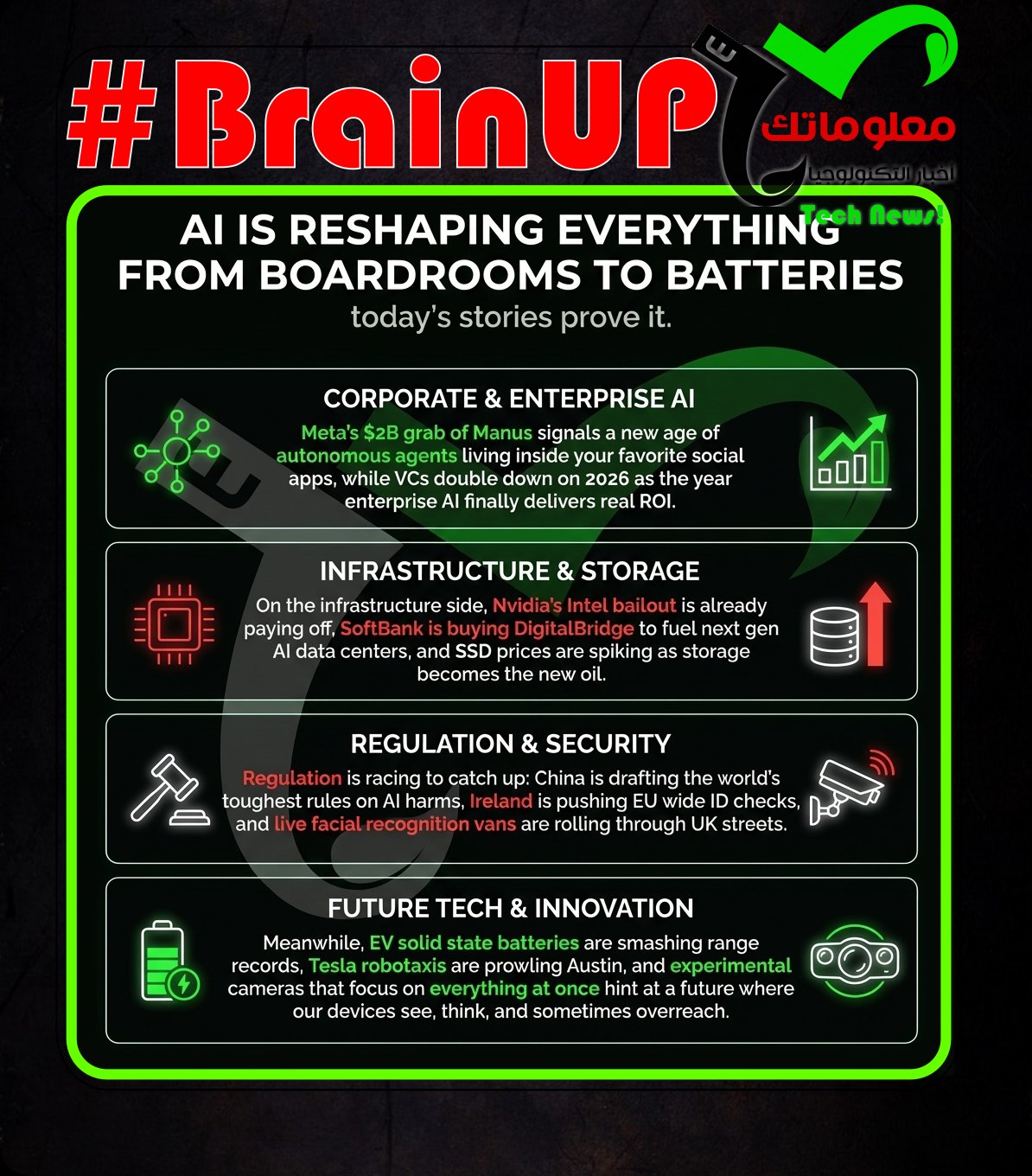
Meta Platforms is acquiring Manus, a Singapore-based AI startup, for about $2 billion, and will keep Manus running independently while weaving its agents into @Facebook, @Instagram, and @WhatsApp, where Meta’s own chatbot @MetaAI is already available. Manus rose to prominence after a viral demo showing an AI agent that could screen job candidates, plan vacations, and analyze stock portfolios, and had attracted a $75 million funding round led by Benchmark with a post money valuation around $500 million. Backers included Tencent, ZhenFund, and HSG, and Manus had crossed $100 million in annual recurring revenue before the sale. Meta says Manus will remain independent while integrating its agents into Meta’s social apps, reflecting a broader #AI push as scrutiny and geopolitics shape the deal, with Senator @JohnCornyn raising questions about American investments subsidizing a potential Chinese competitor. The article also notes Manus’s Beijing origins and its move to Singapore via Butterfly Effect, which could influence Washington’s view on foreign AI development.
2. Aflac data breach affects 22.65 million: SSNs, health info, and claims exposed
The June 2025 data breach at @Aflac affected about 22.65 million people, exposing Social Security numbers, health information, and insurance claims. Aflac detected suspicious network activity in June, promptly notified federal law enforcement, and contained the incident within hours; there was no ransomware impact and no known fraudulent use of the data. To support those affected, Aflac offers 24 months of free #creditmonitoring, #identitytheftprotection, and Medical Shield services. Notifications are being sent to customers, beneficiaries, employees, agents, and related individuals. While no misuse is yet reported, the breach underscores ongoing risks of large-scale data exposure and the importance of rapid containment and protective services, and Aflac’s response aims to mitigate harm and reassure affected individuals.
3. China drafts world’s strictest rules to end AI-encouraged suicide, violence
China drafted landmark rules to stop AI chatbots from emotionally manipulating users and to prevent AI-enabled self-harm, violence, or related harms, a move that would likely become the strictest global policy on this issue. The proposed rules would apply to any AI products or services publicly available in China that use text, images, audio, video, or other means to simulate engaging in human conversation, and would require a human to intervene as soon as suicide is mentioned, with guardians of minors and elderly users notified if suicide or self-harm is discussed. The rules would ban chatbots from generating content that encourages suicide, self-harm, or violence, from emotionally manipulating users with false promises, and from promoting obscenity, gambling, crime, or slandering users, and would prohibit #emotional-traps and designs aimed at addiction, including blasting users with pop-up reminders when chatbot use exceeds two hours. They would mandate annual safety audits for services with more than 1 million registered users or more than 100,000 monthly active users, require easier complaint reporting, and allow app stores to terminate access to non-compliant chatbots, a regime that could affect global #AI leadership and drew commentary from @Sam Altman and OpenAI. The article frames the proposals amid rising concerns about AI companions’ harms, including self-harm promotion, misinformation, abuse, and addiction, and notes that the global companion-bot market could approach $1 trillion by 2035, with growth driven by AI-friendly Asian markets.
4. Sam Altman launches job search to fill a critical role to guard against AI harms
@SamAltman, chief executive of @OpenAI, has announced that his company is seeking a new Head of Preparedness to oversee emerging risks from rapidly advancing artificial intelligence, with a salary of $555,000 per year plus equity, and he openly described the position as “stressful” with an immediate need to tackle a daunting in-tray of potential harms. The role is designed to evaluate and mitigate threats ranging from mental health impacts linked to AI interactions and cybersecurity vulnerabilities to biological misuse and concerns about autonomous, self-training systems, reflecting industry-wide anxiety even among AI leaders about where the technology is heading. Altman said that as AI models become more capable they present real challenges that demand nuanced understanding and protective measures, and that this position is part of OpenAI’s effort to build frameworks for tracking and preparing for frontier capabilities that could create severe harm, despite minimal existing regulation at national or global levels. The announcement comes against a backdrop of warnings from other AI figures, including @DemisHassabis and @MustafaSuleyman, about the risks of powerful AI going “off the rails,” and highlights tensions between rapid innovation and ensuring safety as models grow more influential in society.
Definition: Head of Preparedness role
The Head of Preparedness is a senior executive position focused on anticipating, evaluating, and mitigating risks posed by advanced AI technologies before they lead to significant harm. This role involves establishing threat models, coordinating risk assessments, developing safety protocols across domains such as mental health, cybersecurity, autonomous capabilities and biological risks, and integrating these safeguards into both product development and broader industry strategies as AI systems become more powerful and pervasive.
@Leonardo DiCaprio says AI can never be art because it lacks humanity, noting in a Time interview that while it could be an enhancement tool for young filmmakers, authentic art must come from humans. He cites mashups that sound brilliant, such as @MichaelJackson doing @TheWeeknd, or an @AlGreen-style take on A Tribe Called Quest, and argues that even when they wow, they burn bright for a brief 15 minutes and then dissipate into the ether of internet junk, with no anchoring or true humanity. This stance sits within a broader Hollywood pushback to #AI, with @GuillermoDelToro declaring ‘fuck AI,’ @JamesCameron banning generative AI from his Avatar sequels, and @EmmaThompson voicing sharp irritation at AI rewriting her work. Ultimately, the piece suggests AI should be treated as a tool that can assist creativity while preserving the human thought and connection at the heart of art and acting in #Hollywood.
6. Live facial recognition vans rolled out in Thames Valley
The Thames Valley Police have begun rolling out live facial recognition (#LFR) vans, with two new vehicles making their debut in Oxford city centre. The technology (#facialrecognition) compares a digital image of a face against a database of facial images to locate people of interest, arrest outstanding suspects and safeguard high-risk missing people, according to Det Ch Supt @Craig Kirby. Each deployment uses a bespoke #watchlist of people wanted on warrants or evading court, and faces not on the lists cannot be matched, while officers verify matches and trigger alerts. Biometric templates that do not trigger alerts are deleted within seconds, meaning no personal data is stored, and the system is said to scan crowds at speed and accuracy beyond a human. Campaign groups warn about intrusion and misidentifications, but TVP notes past use elsewhere such as London, where LFR contributed to 580 arrests in 12 months (including 52 registered sex offenders), and points to funding for 10 more vans including for Hampshire and Thames Valley jointly.
7. VCs predict strong enterprise AI adoption next year — again | TechCrunch
Twenty-four enterprise-focused VCs anticipate that 2026 will be the year enterprises meaningfully adopt AI, despite an MIT survey showing 95% of firms weren’t seeing a meaningful ROI. They caution that #LLMs are not a silver bullet and will prioritize #custom-models, #fine-tuning, #evals, #observability, #orchestration, and #data-sovereignty, as @Kirby Winfield explains. @Molly Alter says some AI product companies will pivot to #AI-consulting, expanding use cases after deploying initial workflows via a forward-deployed-engineer model. @Marcie Vu highlights voice AI as a key area, while @Alexa von Tobel predicts 2026 could reshape the physical world through AI in infrastructure, manufacturing, and climate monitoring, underscoring a broader deployment horizon. Taken together, the reactions reflect a cautious, governance-focused path to tangible enterprise value in 2026 rather than another wave of hype.
8. Nvidia invests $5B on Intel bailout, gains $2.5B
Nvidia’s $5B investment in Intel has quickly turned into a financial and strategic win, with Nvidia’s stake now valued at about $7.58B as the bailout moves forward. Nvidia locked in $23.28 per Intel share for 214 million shares, the purchase closed Dec 26, and the deal received FTC clearance on Dec 18, while Intel closed at about $36.68 per share. The partners will jointly develop multi-generation chips for datacenters and PCs, linking Nvidia’s GPUs with Intel via NVLink at up to 1.8 TB/s and enabling Intel to build #x86 CPUs and SOCs that integrate Nvidia RTX chiplets (#NVLink, #RTX, #AI). The arrangement echoes Nvidia’s earlier Arm bid and regulatory scrutiny, showing how clearance can unlock large-scale collaborations in AI and data-center computing and potentially reshape competitive dynamics between the two giants @LinaKhan.
9. Ransomware negotiations reveal evolving extortion tactics in cyber attacks
Ransomware attacks increasingly involve complex negotiations between victims and cybercriminals, highlighting sophisticated extortion methods. Recent cases show attackers demanding multi-layered ransoms, combining data encryption with threats of data exposure, which amplifies pressure on organizations to comply. This evolution stresses the importance of adaptive cybersecurity strategies and resilient incident response plans to mitigate damage and negotiate effectively. Experts recommend that companies engage specialized negotiators and legal counsel during ransom discussions to avoid playing into attackers’ tactics. Understanding these trends enables better defense preparations and informs public policy to curb ransomware’s growing threat.
10. UK accounting body to halt remote exams amid AI cheating
From March, @ACCA will stop allowing online exams and require in-person assessments, except in exceptional circumstances, to curb rising #AI cheating in professional qualifications. @Helen Brand, chief executive of @ACCA, says cheating systems are outpacing safeguards and that the rapid rise of #AI tools has pushed cheating to a tipping point. Remote testing was introduced during the Covid pandemic to keep qualifications moving, but @ACCA has concluded online tests are now too difficult to police amid evolving technology. The issue has been flagged by @FRC, with several firms facing penalties for cheating, including @EY’s US regulator settlement of $100m for ethics-exam cheating by dozens of employees. While @ICAEW still permits some online exams, high-stakes remote invigilation is increasingly rare, signaling a broader shift toward in-person assessment to protect integrity.
11. Big tech or Big Brother: Our devices don’t feel like they’re working for us
Modern digital devices, designed to streamline our lives, increasingly feel intrusive as they prioritize corporate interests and surveillance over user empowerment. The article highlights how companies embed features that gather extensive user data, reduce privacy, and nudge behaviors in ways that benefit advertising and market control rather than individual autonomy. This shift reflects broader societal concerns about the balance between convenience and control, demonstrating that what was once seen as technological advancement now often resembles surveillance and manipulation. The tension between user experience and corporate benefit challenges the notion that technology inherently serves its users, urging a reevaluation of how devices are designed and regulated. Ultimately, addressing these issues requires increased awareness and demand for technologies that genuinely prioritize user rights and privacy.
12. Tough Job Market Has People Using Dating Apps to Get Interviews
In a challenging job market, some job seekers are turning to unconventional methods like using dating apps such as Tinder and Bumble to make professional connections and score interviews. This strategy involves creating profiles that highlight career goals and networking intentions rather than romantic interests. The approach capitalizes on the wide user base of dating apps, allowing candidates to engage informally with potential employers or industry contacts. This trend reflects the difficulties in traditional job hunting and showcases adaptability in leveraging social platforms for career advancement. It represents a shift in how individuals navigate #employment challenges by merging social and professional networking channels.
13. What Are Companies Actually Doing With AI? Our Reporters Talk It Out
Companies across industries are increasingly integrating #AI technologies to enhance productivity, automate repetitive tasks, and generate insights from large data sets. Reporters highlight examples such as using AI for customer service chatbots, supply chain optimization, and content creation. They discuss both the opportunities AI presents and the challenges firms face in implementation, including ethical considerations and workforce adaptation. The conversation emphasizes that while AI offers transformative potential, practical application often involves incremental steps rather than revolutionary changes. This exploration reveals how businesses balance innovation with caution as they adopt AI solutions.
FCC Commissioner Brendan Carr advocates dismantling #consumerprotection rules, easing #media consolidation restrictions, and reducing corporate oversight, claiming these changes will benefit everyone. However, these propositions raise concerns about potential harm to consumer interests, media diversity, and accountability standards. The push aligns with broader deregulatory trends that prioritize corporate flexibility over public safeguards. This approach challenges established protections designed to limit monopolistic practices and preserve competitive markets. Consequently, the debate highlights tensions between regulatory rollback and maintaining frameworks that protect consumers and ensure media plurality.
15. Tesla Has A Robotaxi Fleet Of 34 Cars In Austin, Texas
Tesla has deployed a fleet of 34 Model 3 vehicles in Austin, Texas, equipped to operate as robotaxis under its expanding autonomous ride-hailing initiative. These cars utilize Tesla’s Full Self-Driving (FSD) software, an advanced suite aimed at enabling vehicles to drive themselves without human intervention. The fleet’s presence is part of the company’s gradual rollout of robotaxi services, which Tesla CEO @ElonMusk envisions will significantly disrupt traditional taxi and ride-sharing markets by reducing costs and increasing availability. However, the effectiveness and safety of Tesla’s FSD technology remain subjects of public and regulatory scrutiny. This deployment in Austin illustrates Tesla’s strategic approach to scaling #autonomousvehicles and challenges in integrating self-driving cars into urban transportation systems.
16. German hackers call for ‘Digital Independence Days’ to reduce US tech grip
A group of German hackers is advocating for ‘Digital Independence Days’ on March 29 and June 6 to diminish reliance on US technology platforms by promoting open source and European alternatives. They argue that Europe’s digital sovereignty is compromised due to heavy dependence on American tech firms like Google, Microsoft, and Amazon, which dominate data infrastructure and software services. The hackers emphasize that fostering local innovation and privacy-focused digital tools can enhance European citizens’ data protection and security. The campaign seeks to raise awareness about digital colonization and encourages scaling up local technological ecosystems to challenge the current US-led tech hegemony. This initiative reflects growing concerns in Europe about strategic autonomy in the digital realm amidst geopolitical tensions.
Micro Center has listed the 8TB WD Black SN850X SSD at a $2,419 MSRP, marking a 50% price increase since October, driven by growing demand for high-capacity SSDs fueled by AI workloads. This surge reflects a broader trend of rising prices for large storage solutions as AI applications require enhanced data processing speeds and capacities. The pricing shift highlights how #artificialintelligence and related technological advances are influencing hardware markets, particularly for storage components. This increased cost impacts consumers and professionals seeking large, high-performance SSDs, signaling a shift in value perceptions tied to AI-driven demand. Thus, the market for #highcapacitySSD is directly responding to evolving computational needs introduced by AI growth.
18. China’s super-cold air battery in the Gobi Desert is set to revolutionize energy storage
China is advancing a super-cold air battery system in the Gobi Desert to enhance energy storage capabilities. This innovative technology leverages the extreme temperatures of the desert to store and release electricity efficiently through cold air cycles. By integrating this system with renewable energy sources, China aims to address the intermittency issues of solar and wind power. The development reflects China’s commitment to reducing carbon emissions and achieving sustainable energy goals. This approach could transform energy storage infrastructure, making renewable energy more reliable and widespread.
19. Softbank to buy data center firm DigitalBridge for $4 billion in AI push
SoftBank agreed to buy data center investment firm DigitalBridge for $4 billion as part of its #AI push. The deal will see SoftBank acquire all outstanding DigitalBridge common stock for $16 per share in cash, a 15% premium to the Dec. 26 close, and it was unanimously approved by DigitalBridge’s board. @Masayoshi_Son said the acquisition will strengthen the foundation for next generation AI data centers and advance SoftBank’s vision to become a leading #Artificial_Super_Intelligence platform provider. The move comes amid a global boom in AI infrastructure, with DigitalBridge reporting roughly $108 billion in assets under management as of the end of September. @Marc_Ganzi said SoftBank’s capital strength and network will accelerate the mission and better serve technology companies as they scale AI ambitions, and the transaction is expected to close in the second half of next year.
20. Tesla-style retractable door handles banned in China
China has banned Tesla-style retractable door handles on new vehicles after technical assessments revealed safety risks, particularly concerning pedestrian protection. The retractable handles can complicate emergency rescue and evacuation procedures during crashes, potentially delaying help. This decision impacts automakers relying on such designs, compelling them to reconsider vehicle hardware and compliance. It highlights China’s stringent safety regulations balancing innovation in #automotive design with public safety concerns. The ban underscores ongoing regulatory scrutiny on emerging car technologies in the world’s largest auto market.
21. This experimental camera can focus on everything at once
Carnegie Mellon University researchers have created a computational lens based on spatially-varying autofocus that can bring multiple depths into sharp focus at once, making every part of a scene appear clear instead of a single focal plane, per @AswinSankaranarayanan and @MatthewO’Toole. The system blends a Lohmann lens with a phase-only spatial light modulator and uses #CDAF and #PDAF to decide which parts should be sharp. This all-in-focus result is captured in a single shot rather than by stacking multiple exposures, and the tech remains experimental, not yet available commercially. CMU researchers say it could have broad applications beyond photography, including improved microscopes, lifelike depth for #VR headsets, and clearer perceptions for autonomous vehicles. While a prototype, the work points toward future cameras that can deliver unprecedented clarity across depths.
22. Solid-state EV battery maker to go public after successful 745-mile test in $1,100,000,000 deal
Factorial Energy is moving toward a Nasdaq listing via a merger with Cartesian Growth Corporation III, valuing the company at about $1.1 billion and providing roughly $100 million to expand manufacturing and development. The milestone rests on a real-world 745-mile drive in a modified @Mercedes-Benz EQS using Factorial’s solid-state cells, a test Mercedes-Benz has called a major breakthrough. Independent testing by @Stellantis in labs confirmed the batteries work across hot and cold conditions and can charge quickly. Factorial does not build cars but supplies automakers such as @Mercedes-Benz, @Stellantis, and @Hyundai Motor, aiming to bring #solid-state #batteries to #EVs, with first appearances in high-end models around 2027 before broader adoption. The deal, expected to close mid-2026, will move the technology from lab to production as Factorial scales factories and production to meet automakers’ needs, potentially accelerating its deployment while maintaining focus on the road-tested performance.
23. Over 21% of YouTube is now AI slop, report claims
A report reveals that over 21% of YouTube content consists of AI-generated or AI-related low-quality videos, often labeled as ‘AI slop.’ This surge in AI content is attributed to the accessibility of AI tools that allow rapid video creation, leading to an increase in repetitive and shallow videos aimed at monetizing views rather than providing valuable information. The predominance of these AI-driven videos dilutes content quality and undermines user experience, as viewers encounter more misleading or less informative material. This trend also impacts content creators who focus on originality, as algorithms favor quantity and rapid output linked to AI use. Consequently, YouTube’s platform integrity may be at risk, emphasizing the need for improved content moderation and algorithmic adjustments to balance AI-generated content and genuine creator contributions.
Zephyr, a Chinese GPU manufacturer, has confirmed that its RDNA 2-based GPU dies, specifically Navi 21 cores, have encountered failures due to cracking, bulging, and electrical shorting. The company acknowledged multiple instances of dead GPUs and reported that it has replaced several defective Navi 21 cores under warranty. These hardware issues have raised concerns about the reliability of some RDNA 2 chips used in their products. Zephyr’s response to these failures highlights the challenges in maintaining GPU quality and the importance of warranty support in the industry. This situation sheds light on potential manufacturing or material faults affecting the lifespan of GPUs based on #RDNA2 architecture.
25. Ireland pushes for mandatory ID verification on social media across EU
Ireland advocates for mandatory ID verification on social media platforms across the European Union to enhance online safety and curb harmful content. The Irish Data Protection Commissioner emphasizes that verifying users’ identities could reduce anonymity-driven abuse and misinformation. This approach is seen as a potential model for EU-wide regulation, aiming to balance privacy concerns with the need for accountability. Critics acknowledge challenges such as privacy and technical implementation but agree that greater user verification could improve digital trust. Ireland’s push aligns with broader EU efforts to regulate the digital space and protect users from online harms.
26. Exploited MongoBleed flaw leaks MongoDB secrets, 87K servers exposed
A critical #MongoDB vulnerability named MongoBleed has been exploited to leak database secrets, exposing around 87,000 MongoDB servers worldwide. The flaw allows attackers to extract sensitive information such as usernames, passwords, and connection strings, enabling unauthorized access and data compromise. Researchers found that exploiting the MongoBleed bug requires sending crafted queries, which reveal confidential data from the server’s memory. This exploitation poses a significant risk to organizations relying on MongoDB for data storage, emphasizing the need for immediate patching and enhanced security measures. The MongoBleed incident underscores the critical importance of regular vulnerability assessments and swift application of security updates to safeguard database infrastructures.
27. Attackers Caused So Much Havoc Inside Rainbow Six Siege Ubisoft Shut Down The Whole Game
Ubisoft temporarily shut down its popular game Rainbow Six Siege to address a major disruption caused by attackers exploiting vulnerabilities in the game’s voice chat system. The attackers used voice spam to flood channels and directories, creating an unplayable environment that disturbed players’ experience. Ubisoft responded quickly by taking the servers offline to investigate and implement fixes, showing their commitment to maintaining quality and security in their games. This incident highlights the challenges developers face in balancing open communication features with security measures in online gaming. Ubisoft’s prompt action emphasizes the importance of protecting player communities against disruptive behaviors to sustain engagement and satisfaction.
28. LG to Unveil a Canvas-Style TV at CES 2026
LG is set to introduce a Canvas-style TV at CES 2026, blending high-end display technology with artistic design. This new TV aims to elevate home aesthetics by functioning not just as a screen but as a piece of art, displaying artwork or custom visuals when not in active use. It showcases LG’s innovation in merging technology with lifestyle, targeting consumers who prioritize both functionality and interior design. The unveiling highlights LG’s commitment to expanding the role of TVs beyond traditional entertainment. With this launch, LG positions itself at the intersection of #OLED advancements and home decor trends.
29. Google Photos and Nano Banana are coming to Samsung TVs
Samsung is expanding its smart TV ecosystem by adding support for #GooglePhotos and introducing the new Nano Banana app. This addition allows users to access their Google Photos directly on Samsung TVs, enhancing photo viewing experiences with easy navigation and sharing options. Furthermore, Nano Banana brings a fresh interactive experience, suggesting Samsung is focusing on integrating versatile media apps to attract a wider audience. These updates reflect Samsung’s strategy to enrich its smart TV platform through partnerships and innovative content delivery. Consequently, Samsung continues to position its TVs as multifunctional devices that integrate seamlessly with popular #cloudservices and entertainment apps.
That’s all for today’s digest for 2025/12/30! We picked, and processed 29 Articles. Stay tuned for tomorrow’s collection of insights and discoveries.
Thanks, Patricia Zougheib and Dr Badawi, for curating the links
See you in the next one! 🚀
