
#BrainUp Daily Tech News – (Friday, December 26ᵗʰ)
Welcome to today’s curated collection of interesting links and insights for 2025/12/26. Our Hand-picked, AI-optimized system has processed and summarized 9 articles from all over the internet to bring you the latest technology news.
As previously aired🔴LIVE on Clubhouse, Chatter Social, Instagram, Twitch, X, YouTube, and TikTok.
Also available as a #Podcast on Apple 📻, Spotify🛜, Anghami, and Amazon🎧 or anywhere else you listen to podcasts.
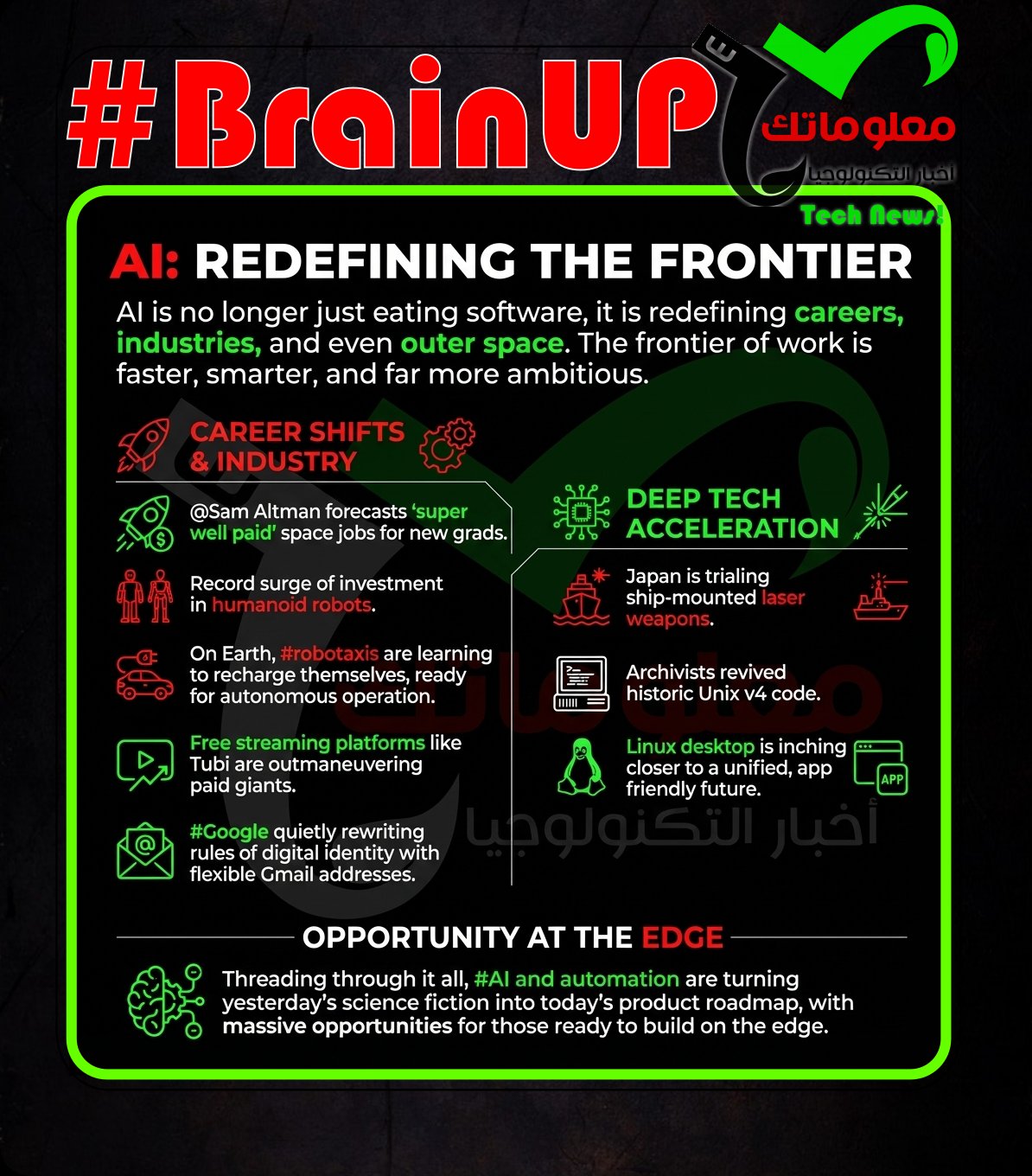
OpenAI’s @Sam Altman argues that within a decade college graduates will pursue space-related roles that are novel, exciting, and highly paid, signaling a future where #AI reshapes work beyond current paths. He predicts that by 2035 a new graduate could depart for a mission to explore the solar system, a role described as completely new and well paid. This view sits alongside other tech leaders’ predictions that AI will displace some jobs but also unlock opportunities, with @Bill Gates suggesting a shorter workweek and @Jensen Huang noting that AI has given workers superhuman capabilities, potentially reducing the need for traditional labor. The article notes that aerospace engineers earn over $130k and that aerospace careers are growing faster than the national average, with NASA’s Mars goals in the 2030s providing context for expansion. The broader implication is that AI could enable individuals to build high-value ventures with lean teams, shifting early-career trajectories toward frontier industries while redefining what counts as a successful, well-paid career #AI #space #NASA.
2. Humanoid robots attract unprecedented investment as AI capabilities advance
Investment in humanoid robots has surged dramatically in 2025 due to breakthroughs in AI, enabling these machines to perform complex tasks and interact naturally with humans. Major tech companies and startups alike have poured billions into research and development, particularly focusing on improving mobility, sensory perception, and decision-making capabilities. This influx of capital has accelerated innovation cycles, leading to more practical applications in healthcare, logistics, and customer service industries. Analysts suggest that such advancements will transform workforce dynamics and societal interactions with technology, highlighting the growing synergy between #AI and robotics. The trend indicates a pivotal shift towards integrating humanoid robots as everyday assistants, reshaping both markets and lifestyles.
3. US adds DJI, other foreign drones to national security list
The U.S. government has placed DJI and other foreign drone manufacturers on a national security list, citing concerns about data privacy and potential surveillance risks. This move restricts American companies from doing business with these drone makers without government approval, reflecting heightened scrutiny of foreign technology firms amid geopolitical tensions. The designation targets Chinese companies in particular, aiming to protect U.S. infrastructure and sensitive operations from potential exploitation. Analysts suggest this step signals increased regulatory vigilance and a strategic effort to curb foreign influence in critical tech sectors. This policy change underscores ongoing challenges in balancing technological innovation with national security priorities.
4. What the Linux desktop really needs to challenge Windows
The Linux desktop must adopt a single, containerized packaging approach to bundle dependencies and overcome distro fragmentation so it can genuinely compete with Windows. The current landscape is crowded with multiple desktops (#GNOME, #KDEPlasma, #Cinnamon, #MATE) and, as @LinusTorvalds has warned, upwards of a hundred options create paralysis; Linux desktops account for about 11% of the desktop market, much of which comes from Chromebooks rather than traditional PCs. Traditional packaging (DEB/RPM) does not scale for desktop; a universal containerized delivery model via #Flatpaks, #Snaps, and #AppImages would let developers ship one package that runs on any distro. This would reduce #libraryincompatibilities, simplify user experience, and enable vendors to deliver software more efficiently, reinforcing the goal of a unified Linux desktop to challenge #Windows and @Microsoft’s AI overreach.
Google has introduced an experimental feature allowing users to change their Gmail address, initially rolling out in India. According to an official Google support document, users can select new usernames under this feature, indicating a shift in email account flexibility. This update is significant given that Gmail addresses were traditionally permanent, which limited user options after account creation. By enabling Gmail address changes, Google enhances user control and addresses common needs for updated contact information without creating new accounts. This development reflects Google’s commitment to improving user experience within its #GoogleWorkspace ecosystem and demonstrates incremental innovation without a broad official announcement.
The University of Utah recovered the only known copy of Unix v4, the first Unix version with both its kernel and core utilities written in #C, from a 1973 nine-track tape and has it running on a system via emulation. Archivist @AlKossow of @Bitsavers and @LenShustek recovered about 40 MB of data using a head read amplifier and a high-speed analog-to-digital converter, and the data is downloadable with a README that explains booting and compiling parts in a suitable environment; the DEC PDP-11 can be emulated with @SimH or viewed as a screenshot running under #Irix. The effort highlights cross-generational archival collaboration and notes that Unix began as a lab project, with the recovered tape having been received by @MartinNewell, who designed the famous teapot. Readers are invited to explore the recovery thread and to appreciate that some historic code comments survive in the archive, underscoring the enduring quirks of early software development.
7. Free streaming service Tubi is rivaling major players for viewership. Here’s how it’s winning
Tubi, Fox’s free streaming platform, is challenging paid rivals for viewership and has reached profitability this year, signaling a new foothold in the streaming landscape. Tubi now has over 100 million monthly active users and 1 billion hours streamed per month, with 2.1% of total streaming minutes in Nielsen’s Gauge in November and YouTube holding the top spot in the tracker, ahead of NBCUniversal’s Peacock and Warner Bros. Discovery’s HBO Max; the platform also hosts NFL content including the Super Bowl, and has more than 300,000 titles, with nearly 60% of its audience being Millennials or Gen Z and about half multicultural. Its growth is driven by an ad-supported model that engages audiences who would otherwise cancel subscriptions, while ad revenue and rising view time support profitability as the service posted 27% revenue growth and an 18% rise in total view time this year. This performance validates Fox’s streaming strategy and shows ad-supported free platforms can compete with subscription giants like @Netflix and @YouTube, bolstering earnings as Fox stock has climbed over 40% this year.
8. Who will recharge all those robotaxis? More robots, one CEO says.
Automated charging and maintenance are essential to scale robotaxi fleets, and Rocsys aims to turn every charging port into a #robocharger through a robotic arm and software, according to @Crijn Bouman. He cites a headcount ratio of roughly 1:12 to 1:14 personnel per vehicle in depots in China and the US, illustrating how human labor currently limits growth. The point is that the interface to the built world is broken once the human driver is removed, so fixing charging, entry into garages, and car washes is crucial for mass adoption. Bouman’s experience at Epyon and ABB and a Cruise project highlight why automating these interfaces is central to the business case. Therefore, port level automation is a key driver for scaling #robotaxi operations.
10. Japan trials 100-kilowatt laser weapon — it can cut through metal and drones mid-flight
Japan has deployed a 100 kilowatt fiber laser system on the JS Asuka, formed by combining ten 10 kW lasers into a single beam capable of burning through metal and disabling small drones. The weapon, installed on a 6,200-ton warship and developed with @ATLA oversight, will be sent to sea for its first maritime trials after February 27, 2026, following its delivery from Kawasaki Heavy Industries to the shipyard. Officials say the system can engage targets without ammunition limits thanks to an unlimited magazine depth, limited only by available electricity, and that its cost per shot is far lower than conventional air defenses; a prototype was delivered in February 2023 and has shown success against mortar rounds and unmanned aerial vehicles in ground tests. However, sea trials will face wind, moisture, and the challenges of keeping a steady aim on a pitching deck, as well as cooling, power demands, and the typical fiber laser efficiency of about 25-35%. Japan is pursuing this technology alongside the US, France, Germany, and the UK, with China also suspected of developing similar directed-energy weapons after a 2024 sighting. #directed-energy #fiber_laser
That’s all for today’s digest for 2025/12/26! We picked, and processed 9 Articles. Stay tuned for tomorrow’s collection of insights and discoveries.
Thanks, Patricia Zougheib and Dr Badawi, for curating the links
See you in the next one! 🚀
