
#BrainUp Daily Tech News – (Thursday, December 25ᵗʰ)
Welcome to today’s curated collection of interesting links and insights for 2025/12/25. Our Hand-picked, AI-optimized system has processed and summarized 19 articles from all over the internet to bring you the latest technology news.
As previously aired🔴LIVE on Clubhouse, Chatter Social, Instagram, Twitch, X, YouTube, and TikTok.
Also available as a #Podcast on Apple 📻, Spotify🛜, Anghami, and Amazon🎧 or anywhere else you listen to podcasts.
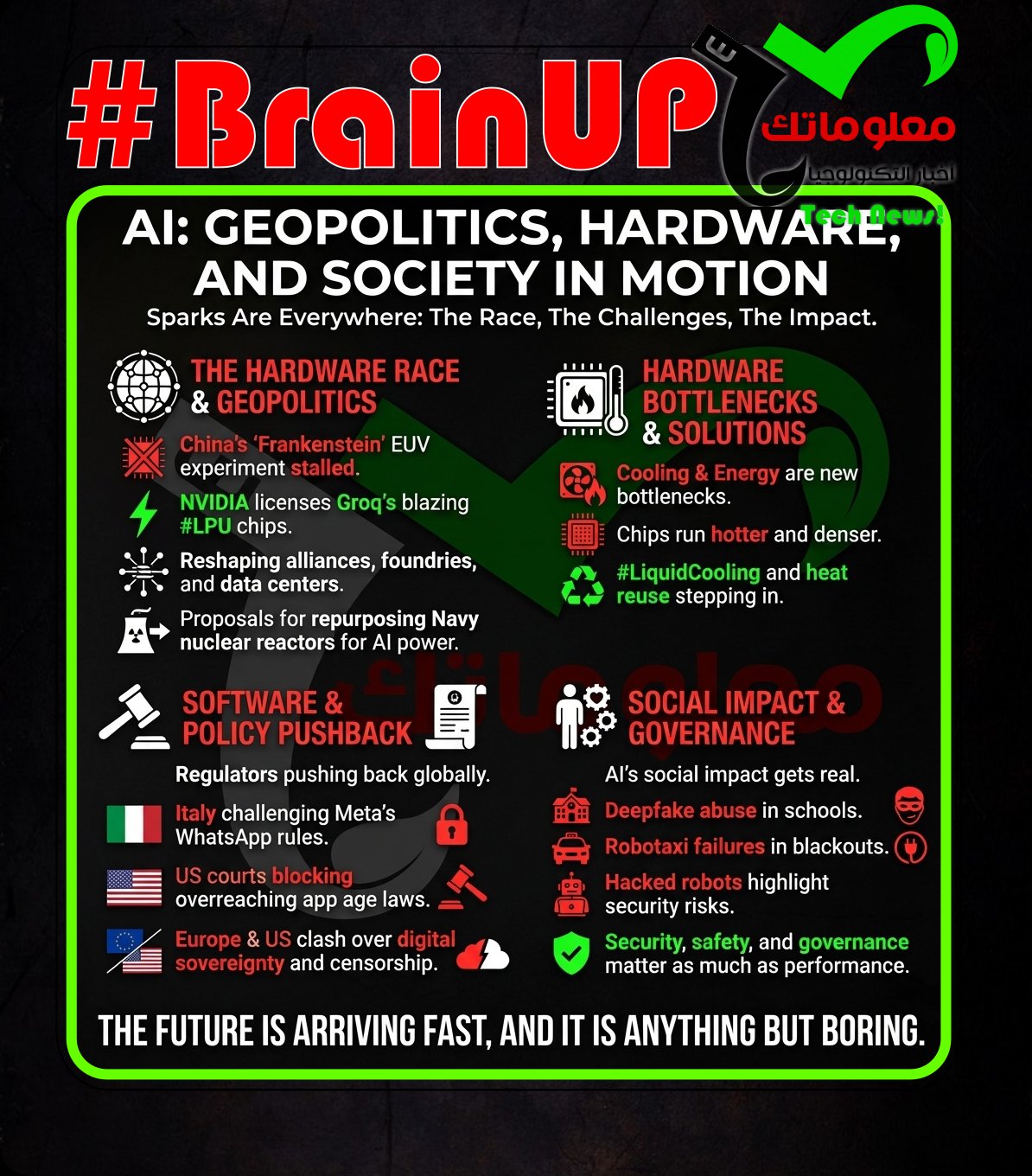
China has been attempting to create its own extreme ultraviolet (EUV) lithography machine by reverse engineering components from Dutch company ASML, aiming to bypass US sanctions on chipmaking technology. Despite assembling a Frankenstein-like EUV tool from scavenged parts, the system has not produced any chips yet due to severe technical challenges such as precision optics and vacuum environments. Experts note that replicating EUV machines is highly complex, with China’s project potentially requiring years before becoming operational, if at all. This effort underscores the difficulty of breaking into advanced chip production under restrictive export controls, highlighting the broader tensions in semiconductor technology competition between China, the US, and allied nations. Consequently, China’s current EUV tool remains a nascent experiment without practical output, indicating persistent barriers in its semiconductor self-sufficiency ambitions.
2. Nvidia to license AI chip challenger Groq’s tech and hire its CEO | TechCrunch
Nvidia signs a non-exclusive licensing agreement with @Groq and plans to hire its founder @Jonathan Ross, and president Sunny Madra, signaling a strategic expansion in AI chip capabilities. CNBC reported that Nvidia is acquiring Groq assets for about $20 billion, but Nvidia says this is not an acquisition and declined to comment on the deal’s scope. Groq touts its language processing unit #LPU, claiming it can run LLMs up to 10 times faster while using a tenth of the energy, and its founder previously helped invent @Google’s #TPU. The move comes after Groq’s $750 million funding at a $6.9 billion valuation and its deployment powering AI apps for more than 2 million developers, suggesting Nvidia could extend its dominance in chip manufacturing by pairing GPUs with Groq’s #LPU tech to meet growing AI workloads.
3. NVIDIA Tested Intel’s 18A Node but Did Not Commit to Intel Foundry
@NVIDIA recently tested Intel’s #18A node but did not commit to Intel Foundry for mass production, according to @Reuters, and NVIDIA did not comment. The testing was described as exploratory rather than a commitment, with the move framed as common for chip designers evaluating rivals before enlarging foundry capacity. The #18A process is expected to be mainly for Intel’s internal products, while future variants #18A-P and #18A-PT are aimed at attracting external customers as Intel Foundry expands. Intel’s #14A node is under development for a 2027 release, with collaboration on node design and early feedback described as competitive. Beginning in 2026, a potential Intel–@NVIDIA partnership could gradually manifest, potentially integrating NVIDIA RTX GPUs inside Intel x86 SoCs, though it’s unclear whether NVIDIA would offer foundry services and the current deal centers on product delivery; all eyes remain on the 2027 debut of #14A alongside #18A-P and #18A-PT.
4. New image sensor pushes optical limits to boost resolution
A research team developed an advanced image sensor that significantly enhances optical resolution by surpassing traditional diffraction limits. Utilizing innovative pixel architecture and enhanced light collection methods, the sensor achieves unprecedented detail capture, crucial for applications ranging from microscopy to photography. The improvements enable higher sensitivity and resolution without increasing sensor size, addressing long-standing challenges in optical imaging technology. These advancements open pathways for more precise imaging in scientific, medical, and industrial fields. The breakthrough aligns with ongoing efforts in photonics and sensor technology to push the boundaries of image clarity and performance.
5. Ukraine’s ground robot tore through Russian troops, so it’s now armed with a grenade launcher
Ukraine has enhanced its ground robotic system, initially effective in confronting Russian troops, by equipping it with a grenade launcher to increase its combat capabilities. This upgrade follows the robot’s successful deployment in disrupting enemy forces, demonstrating the tactical advantage of incorporating unmanned technology on the battlefield. The addition of the grenade launcher not only boosts firepower but also expands mission versatility, allowing remote engagement with greater precision and reduced risk to Ukrainian soldiers. This development exemplifies how technological adaptation is pivotal in modern warfare, particularly in the ongoing conflict between Ukraine and Russia. It underscores Ukraine’s commitment to leveraging innovative military solutions to maintain strategic advantage.
6. AI Image Generators Default to the Same 12 Photo Styles, Study Finds
The study shows that when two AI image generators, @StabilityAI’s Stable Diffusion XL and @LLaVA, are fed a chain of shifted prompts and descriptions, outputs converge on a small set of 12 dominant visual motifs, revealing a surprising limit to AI creativity. In a 100-round game of visual telephone using prompts like an old book, the image is described and re-encoded for generation, and across 1000 iterations the outputs steadily coalesce around these motifs, a pattern that holds across models. The motifs are described as visual elevator music, with scenes such as maritime lighthouses, formal interiors, urban night settings, and rustic architecture, showing that even varied prompts still pull from familiar patterns. Extending the game to 1000 turns yields further variation, yet those variations still tend to stay within the popular motifs, suggesting the data set and human biases shape what is easy for the AI to reproduce. The takeaway is that copying styles may be easier than teaching taste, highlighting a need for prompts or models that encourage broader creativity and a more diverse image repertoire, with implications for how AI-generated imagery is understood and used #AI #image-generation #visual-elevator-music #patterns
@AliGhodsi of @Databricks warns that valuations of #AI startups with billions in value but zero revenue are a bubble, calling it insane. He notes venture capitalists privately acknowledge the hype, with some even suggesting a six‑month break to let the market cool. Databricks’ strategy to stay private rather than rushing an #IPO is meant to weather volatility and invest in long‑term AI utility, contrasting with peers who went public in 2021 and faced corrections. He argues the real bottlenecks to enterprise AI adoption are security, data governance, and messy data architectures, with AI lawyers slowing model policy compliance. Still, he remains bullish on high‑utility applications, particularly #AIagents and #vibecoding, signaling selective value amid the hype.
@Samsung’s delay of its planned DDR4 end-of-life is driven by a long-term NCNR contract with a key customer (#NCNR), ensuring continued DDR4 supply for that client while protecting the company’s profitability. With 16GB DDR4 modules hitting about $60 in the spot market, the arrangement helps keep the DDR4 line (#DDR4) lucrative even without new consumer-focused capacity. The NCNR contract fixes volume and price for the buyer, shielding Samsung from volatility in the memory market, and reports indicate the client is primarily server-oriented, not consumer-facing (#server). Samsung had planned to shift toward #HBM and #DDR5 as AI demand rose, but surging prices for older DDR4 have prompted a delay in ending the line, a move mirrored by other memory makers who expect to serve industry clients rather than PC builders. Ultimately, end users should not expect DDR4 relief in 2026, as supplies are earmarked for servers rather than desktops or enthusiasts (#consumers).
9. Waymo explains why its robotaxis in San Francisco were stalled during a power outage
Waymo’s robotaxis in San Francisco stalled during a recent power outage due to the loss of traffic signals and power-dependent infrastructure, which their autonomous systems rely on for safe navigation. The outage affected the entire city, preventing the vehicles from safely proceeding through intersections without functioning traffic lights. Waymo highlighted the challenge of ensuring robotaxis can handle unpredictable real-world events such as large-scale outages and emphasized the importance of continual improvements in resilience and safety protocols. This incident underscores the complexities of deploying #autonomousvehicles in urban environments where external factors like #poweroutages can impact operation. Waymo’s response illustrates ongoing advancements needed to enable robotaxis to operate reliably amid diverse emergency conditions.
10. Data centres: The new tech stopping chips from overheating
Data centres are increasingly relying on advanced cooling tech #liquid cooling to prevent overheated chips as processing power surges. @Jonathan Ballon of Iceotope describes liquid cooling that baths or flows over components, often in a closed loop, enabling overclocking with minimal risk of thermal burnout. Iceotope says its approach can cut cooling energy demands by up to 80% by cooling multiple components with a water-based loop. Two-phase cooling uses refrigerants that evaporate to absorb heat, but some systems rely on PFAS-containing refrigerants with safety and greenhouse-gas concerns #PFAS. As AI-driven demand grows and communities push back over power and water use, firms seek lower-impact cooling and even heat reuse, such as a US hotel chain planning to reuse server heat for guest rooms, laundry and pools.
11. Tesla criticised over escape tools hidden behind doors
Tesla has faced criticism for placing emergency escape tools behind locked doors in many of its models, which can delay access during accidents. The concern arises because these tools are essential for quickly breaking windows to escape when doors fail. Tesla’s design choices have sparked debate regarding #automotive safety as first responders reportedly struggle to find and access these tools promptly. The controversy highlights the tension between innovative vehicle designs and practical rescue requirements. This issue underscores the importance of accessible safety measures in #electricvehicles and emergency response protocols.
Five years after @Tim Cook announced Apple’s shift from Intel to its own silicon, the M-series from M1 to M5 have set new standards for performance and efficiency and redefined what #ARM-based Macs can do. Internal testing showed how much faster the M1 was than Intel, and the M1 MacBook Air, five years on, still competes well against rivals. The switch from PowerPC to Intel in 2006 and the 2020 shift to M-series were not taken lightly, given the long partnership with Intel and the potential risks. Experience building chips for iPhone and iPad gave Apple the confidence to pursue Macs with high performance and energy efficiency, while close collaboration between software and silicon teams, guided by Mac veterans with 30 years of experience, helped ensure the design matched real Mac needs. In interviews with @Tim Millet, @Tom Boger, Mac users, and analyst @Avi Greengart, the piece outlines how the M-series reshaped workflows and points to ongoing evolution in Apple’s ARM-based strategy.
13. Italy tells Meta to suspend its policy that bans rival AI chatbots from WhatsApp
Italy has ordered @Meta to suspend its policy that blocks rival AI chatbots from accessing WhatsApp, citing concerns over anti-competitive practices. The Italian regulator believes Meta’s policy restricts fair competition in the AI and messaging app markets by preventing third-party AI tools from integrating with its popular platform. This move reflects heightened scrutiny of Big Tech companies controlling access to essential digital communication channels, potentially stifling innovation. The regulator’s intervention aims to ensure open access and a level playing field for AI developers seeking to connect their chatbots with WhatsApp. The decision highlights ongoing regulatory efforts to balance corporate control with competitive market dynamics in the evolving AI ecosystem.
Microsoft has denied claims that it is rewriting Windows 11 using artificial intelligence following a controversial LinkedIn post by an employee who suggested a single engineer could produce a million lines of code in one month. The post sparked outrage and skepticism due to the unrealistic nature of such a claim and concerns about the quality and security of AI-generated code. Microsoft clarified that while it incorporates AI in development, the entire Windows 11 operating system is not being rewritten solely by AI. The company’s response highlights the ongoing debate about the role and limits of AI in complex software projects. This incident underlines the challenges of integrating #AI in software engineering and managing public perceptions about technological advancements.
AI-generated nude images circulating at a Louisiana middle school upend a 13-year-old girl’s life, as she is expelled after attacking a classmate she believed helped create the images. The material, reportedly AI-created and showing eight female students and two adults, spread on Snapchat and triggered school discipline and an assignment to an alternative school for the girl, while two boys who shared the images were charged rather than the girl. Experts warn that digital harm from #AI and #deepfakes outpaces school and law enforcement responses, with @Sameer Hinduja of the Cyberbullying Research Center noting that harm often becomes visible only after someone breaks, and district officials emphasizing that protocols were followed amid a complex case. The episode highlights the need for proactive policies, education, and cross-agency cooperation to prevent AI-driven harassment in schools and protect victims #cyberbullying #digitalharm.
17. European leaders condemn US visa bans as row over ‘censorship’ escalates
European leaders condemn the US visa bans as coercive moves that threaten European digital sovereignty and raise questions about censorship in global tech governance, led by @Emmanuel Macron who frames the measure as an attempt to override European rules. The sanctions targeted Thierry Breton and four anti-disinformation campaigners—Imran Ahmed, Anna-Lena von Hodenberg, Josephine Ballon, and Clare Melford—drawing swift rebukes from Paris, Berlin, Madrid, London and Brussels. @Marco Rubio defended the action on X as a response to extraterritorial censorship and ideologues pressuring American platforms to punish opposing viewpoints. Macron and others insist the EU’s #DSA and related digital-space rules were democratically adopted to ensure fair competition and to curb online hate speech, not to be dictated from abroad. The dispute signals a broader US-EU clash over how #digital-sovereignty and #AI regulation should be governed, with Europe pledging to protect its digital space while clarifying it will respond decisively to what it calls unjustified measures.
18. China demo shows one whispered command could let hackers seize robots
Chinese security tests show robots can be hacked in minutes via voice or wireless flaws. Attackers could seize control using whispered commands or exploitable wireless channels, with the compromise capable of spreading to other machines. These rapid breaches raise safety concerns as robots become more prevalent in factories and everyday environments. The findings call for stronger #robotsecurity and secure-by-design practices, including robust authentication, isolation of control systems, and secure software updates, with industry leaders like @NVIDIA urged to drive improvements. Addressing these vulnerabilities is essential to prevent manipulative or cascading attacks as robots become more integrated into critical tasks.
U.S. District Judge @RobertPitman in Austin blocked Texas Senate Bill 2420, the #AppStoreAccountabilityAct, from taking effect in the new year. He granted a preliminary injunction after SEAT and two high school students argued the law would impose content-based restrictions and violate adults’ and minors’ First Amendment rights, with @KenPaxton’s office enforcing the measure. The court acknowledged the goal of reducing children’s exposure to apps and online content but said the means must be consistent with #FirstAmendment. The ruling follows Pitman’s earlier blocking of parts of the #SCOPEAct and underscores the ongoing tension between protecting kids online and preserving free speech, with supporters praising the decision as safeguarding access to information. #SEAT
20. Nuclear Developer Proposes Using Navy Reactors for Data Centers
A nuclear energy company has proposed repurposing decommissioned U.S. Navy nuclear reactors to power data centers, aiming to provide reliable, carbon-free energy for expanding digital infrastructure. The proposal highlights the potential to extend the life and value of military-grade reactors by converting them into clean energy sources, which could meet growing demand for sustainable data processing. Industry experts note this approach could address challenges in energy supply and sustainability faced by data centers, which currently rely heavily on fossil fuels. By integrating navy reactors, the plan demonstrates innovation in #nuclearenergy and #greentechnology, offering a pragmatic solution to energy and environmental concerns. This initiative showcases the evolving role of nuclear tech beyond defense and power generation towards supporting critical digital infrastructure.
That’s all for today’s digest for 2025/12/25! We picked, and processed 19 Articles. Stay tuned for tomorrow’s collection of insights and discoveries.
Thanks, Patricia Zougheib and Dr Badawi, for curating the links
See you in the next one! 🚀
