
#BrainUp Daily Tech News – (Wednesday, December 24ᵗʰ)
Welcome to today’s curated collection of interesting links and insights for 2025/12/24. Our Hand-picked, AI-optimized system has processed and summarized 17 articles from all over the internet to bring you the latest technology news.
As previously aired🔴LIVE on Clubhouse, Chatter Social, Instagram, Twitch, X, YouTube, and TikTok.
Also available as a #Podcast on Apple 📻, Spotify🛜, Anghami, and Amazon🎧 or anywhere else you listen to podcasts.
A Nebraska state court action by @NebraskaAG accuses Resideo of violating state consumer protection and deceptive trade laws by selling insecure cameras and hiding their OEM origins. The suit alleges Resideo sold Hikvision and Dahua cameras from 2021 to 2022 under its Capture brand, obscuring that these OEMs are restricted by the FCC since November 2022 for national security reasons. Security professionals have long flagged these brands for safety flaws and potential backdoors, a concern echoed by the broader scrutiny of Chinese-made smart-home devices. This case fits a wider pattern of enforcement against Chinese OEMs, with related actions against Lorex in September and other states pursuing data collection and privacy issues, highlighting ongoing regulatory risk for sellers and manufacturers. The development underscores growing attention on disclosure, security, and compliance in the #smartHome market and may influence future enforcement for Resideo and its OEM partners, including @NebraskaAG.
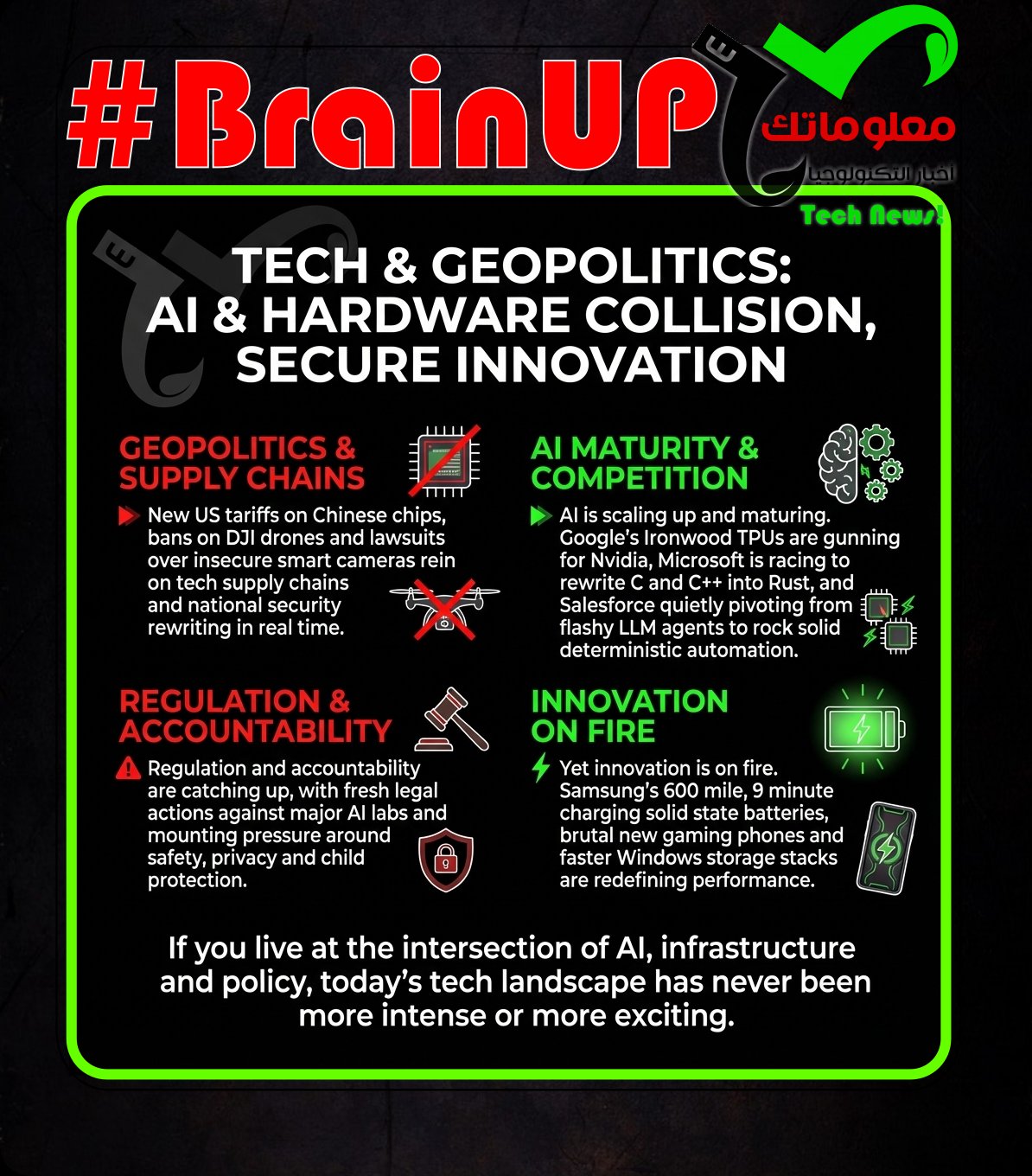
2. US says it will impose tariffs on Chinese chips, but delays action until 2027
The United States announced that it plans to impose new tariffs on semiconductor imports from #China, but will delay enforcement until June 23, 2027, with the specific tariff rates to be unveiled at least 30 days before implementation. The decision follows a year-long “Section 301” trade investigation into what the US Trade Representative says are China’s “unreasonable” efforts to dominate the global semiconductor market and burden or restrict US commerce, reflecting ongoing tensions in high-tech competition and broader geopolitical rivalry. The tariff move is tied to broader negotiations with Beijing, including discussions aimed at rolling back Chinese export curbs on rare earths and recalibrating US rules on tech exports to some blacklisted firms, and comes amid ongoing debates within US policy circles over how to balance economic leverage with diplomatic stability. China has strongly opposed the planned tariffs, calling them an unfair suppression of its industry and warning of measures to protect its interests if they proceed.
Definition: Section 301 tariffs
Section 301 tariffs refer to trade penalties the United States can impose under Section 301 of the Trade Act of 1974, which authorizes the US Trade Representative to take action against a foreign nation’s unfair trade practices that harm American industries. These tariffs are often used to address issues such as intellectual property theft, market access restrictions, or state-backed dominance in key sectors, and can cover a broad range of goods, including semiconductors, with the goal of protecting domestic economic interests and pressuring trading partners to change their policies.
3. Samsung’s 600-Mile-Range Batteries That Charge in 9 Minutes Ready for Production/Sale Next Year
Samsung’s #ASSB solid-state batteries promise a 600‑mile EV range and a 9‑minute recharge, with an energy density around 500 Wh/kg and a solid electrolyte that enhances safety and longevity #solid-state-battery. Under a trilateral agreement, @Samsung will supply ASSB cells to @BMW, which will develop modules and packs for next‑generation evaluation vehicles expected in late 2026, signaling steps toward mass production. The cells use a silver‑carbon anode and a nickel‑manganese‑cobalt cathode, with silver noted as highly conductive and more abundant in the Earth’s crust than lithium. ASSBs are claimed to last about 20 years or 2,000 charge‑discharges, equating to roughly 1.2 million miles. Samsung plans to test ASSBs in smaller devices in 2026, including the Galaxy Ring, before broader adoption in smartphones, laptops, and other devices, highlighting progress toward faster charging, higher energy density, and safer operation for future EVs and consumer tech.
4. OpenAI’s child exploitation reports increased sharply this year
OpenAI’s reports to the National Center for Missing & Exploited Children (NCMEC) spiked in the first half of 2025, with 75,027 CyberTipline reports and 74,559 pieces of content, roughly 80 times the numbers in the same period of 2024. OpenAI says investments late in 2024 to boost review capacity and the introduction of more product surfaces, including image uploads, coincided with faster reporting as user growth expanded, with @Gaby Raila noting the time frame corresponded to “the introduction of more product surfaces that allowed image uploads and the growing popularity of our products” and @Nick Turley announcing that ChatGPT had four times the weekly active users compared with the year before. The counts are subject to nuance: multiple reports can cover the same content, and reporting may reflect moderation changes rather than a pure rise in abuse, while #NCMEC and #CyberTipline data must be interpreted carefully. The spike mirrors a broader rise in #generativeAI-related reports at the CyberTipline, though 2025 data are not yet released, and other labs publish AI statistics without specifying shares. Amid regulatory scrutiny, including a letter from 44 state attorneys general, OpenAI faces ongoing attention to child safety in AI products, highlighting the complex interaction between reporting systems, rapid AI adoption, and policy oversight.
5. Samsung Executives and Employees Indicted Over Leaking 10nm DRAM Technology to China
Samsung executives and employees have been indicted for allegedly leaking sensitive 10nm DRAM technology to China. The alleged leak involves critical advances in #semiconductor manufacturing that are pivotal for maintaining technological leadership. This breach raises concerns about intellectual property security and the potential impact on Samsung’s competitive edge in the #globalchip market. The case highlights the ongoing tensions related to technology transfer and economic espionage between South Korea and China. The indictment underscores the importance of safeguarding innovation in an increasingly competitive technological landscape.
6. Google’s rolling out its most powerful AI chip, taking aim at Nvidia with custom silicon
Google is rolling out its seventh-generation #TPU, named #Ironwood, as its most powerful AI chip to date and a bid to win AI workloads away from Nvidia. The in-house chip is more than four times faster than its predecessor and can connect up to 9,216 chips in a single pod to eliminate data bottlenecks for the largest models. It is designed to handle everything from training large models to powering real-time chatbots and AI agents, underscoring Google’s aim to offer competitive price, performance, and efficiency with #AI hardware. Major customers are lining up, including @Anthropic, which plans to use up to 1 million Ironwood TPUs to run Claude. Google is also upgrading its cloud offerings and raising its full-year capital-spending forecast to $93 billion, with @Sundar Pichai noting strong demand for AI infrastructure across TPU- and GPU-based solutions as rivals like @Microsoft and @Amazon push to win cloud business.
7. US State Department imposes visa ban on former EU commissioner over Europe policy disputes
The US State Department has enacted a visa ban against a former EU commissioner due to disputes involving European policies. This decision highlights escalating tensions between the US and parts of Europe over regulatory and diplomatic approaches. The move reflects broader issues in transatlantic relations, where disagreements on technology and policy governance have strained cooperation. The visa ban serves as a symbol of the growing rift and signals potential challenges for future US-EU collaboration on key international matters. This development underscores the importance of diplomatic channels in resolving disputes within allied regions.
8. Pentagon Accelerates AI Use in Weapons as China Advances Battery Tech
The Pentagon is rapidly integrating #artificialintelligence into weapons systems to maintain strategic superiority as China significantly advances battery technology, which underpins new military capabilities. Reports indicate increased investment in AI-powered weaponry to enhance precision, autonomy, and battlefield decision-making, reflecting concerns over China’s swift technological progress. This dynamic underscores a shifting global defense landscape where cutting-edge AI and energy innovations determine military dominance. The race illustrates how technological innovation in both software and hardware is central to national security strategies. Consequently, the U.S. Department of Defense prioritizes AI and battery research to counterbalance China’s growing influence and preserve military advantages.
9. US insurance giant Aflac says customers’ personal data stolen during cyberattack | TechCrunch
Aflac disclosed that hackers accessed its network in a cyberattack earlier this month, potentially exposing customers’ personal data including claims information, Social Security numbers, and health details. The company said it could not yet determine how many customers are affected, and the breach also involved data from beneficiaries, employees, and agents. Aflac said the incident did not involve ransomware, and attributed the breach to an unnamed cybercrime group known for targeting the U.S. insurance industry, with access gained through social engineering. Industry experts, including @John Hultquist, note intrusions tied to #ScatteredSpider, a group using social engineering and other tactics to breach help desks and gain network entry, highlighting ongoing risks for insurers. This event fits a broader pattern of attacks on insurers in the U.S., underscoring the need for vigilance against social-engineering based breaches.
10. US Announces Ban on Foreign-Made Drones Including DJI Models
The US government has imposed a ban on foreign-made drones, including popular models from the Chinese manufacturer #DJI, citing national security risks linked to data privacy and potential surveillance. Officials provided evidence that these drones could send sensitive information to foreign adversaries, raising concerns about safeguarding critical infrastructure and government operations. This decision aligns with broader efforts to tighten controls on technology imports thought to pose digital vulnerabilities. The ban marks an escalation in the US-China technology rivalry, emphasizing prioritization of domestic alternatives. It further affects the commercial drone market by potentially restricting product availability and encouraging development of American-made options.
11. Some Epstein file redactions are being undone with hacks
Some Epstein file redactions are being undone with hacks, including #Photoshop techniques, and un-redacted text from released documents began circulating on social media. In a Virgin Islands civil case against executors @Indyke and @Kahn, section 85 reveals payments to young models totaling over $400,000, including a former Russian model who received over $380,000 over more than three and a half years. The Virgin Islands settled the civil #sextrafficking case in 2022 for $105 million plus half of the proceeds from the sale of Little St James, though the settlement did not include an admission of liability; Indyke has not been criminally indicted and is represented by Parlatore Law Group. Other passages allege that Epstein’s enterprise concealed crimes by paying participant-witnesses’ legal fees and by threatening victims, and by instructing witnesses to destroy evidence; redactions 184 through 192 describe Cypress’s balance sheet as of December 31, 2018 showing cash of $18,824 and no other assets, and it notes Cypress paid $106,394.60 in Santa Fe property taxes while expenses were only $301 for 2018. Taken together, the exposures illustrate how redacted material can surface and fuel public scrutiny, underscoring ongoing concerns about transparency in the Epstein case and the potential for simple edits to reveal sensitive information, a dynamic that highlights the balance between legal secrecy and public accountability.
Salesforce is dialing back its reliance on #LLM and #AI after reliability problems undermined executive confidence and is shifting to more deterministic automation in its flagship #Agentforce platform. Senior VP @SanjnaParulekar said trust in AI models has declined over the past year, while @MarcBenioff noted the company cut its global support staff from 9,000 to about 5,000 as AI agents were deployed. Engineers reported that large language models can omit directives when given more than eight instructions, and real world deployments like Vivint showed failures to trigger customer surveys, prompting the use of deterministic triggers. The drift issue, where AI loses focus when asked irrelevant questions, also emerged, signaling a move toward predictable outcomes over AI novelty. This shift marks a strategic recalibration toward reliability and predictable automation in Salesforce’s Agentforce rather than the AI-first messaging that dominated the industry earlier.
13. John Carreyrou and Other Authors Bring New Lawsuit Against Six Major AI Companies
Authors including @JohnCarreyrou have initiated a lawsuit targeting six leading #AI companies, alleging issues related to misinformation and ethical concerns in AI development. The suit highlights potential harm caused by unregulated artificial intelligence outputs, emphasizing accountability for content accuracy and transparency. This legal action underscores the growing call for stricter oversight of AI technologies to prevent misinformation dissemination and protect public interest. It reflects a broader societal demand that #AI creators maintain responsibility for their products’ societal impacts. The case sets a precedent for how authorial and technological accountability may shape future AI governance frameworks.
14. iOS 26.3 Brings AirPods-Like Pairing to Third-Party Devices in EU Under DMA
iOS 26.3 extends AirPods-like pairing to third-party devices in the EU under the #DMA, marking a step toward a more interoperable ecosystem from @Apple. The European Commission praised the interoperability changes and stated that third-party accessories must have the same capabilities as Apple’s, with developers able to test proximity pairing and improved #notifications. Proximity pairing enables one-tap setup by bringing the accessory near an iPhone or iPad, reducing steps, while third-party devices can receive #notifications from the iPhone, limited to a single connected device at a time, and enabling a third-party device’s notifications disables notifications to the Apple Watch. Developers can test TVs, smart watches, and headphones in Europe, with the functionality to be fully available there in 2026, and iOS 26.3 is expected to launch at the end of January.
15. Microsoft to Replace All C/C++ Code With Rust by 2030
Microsoft aims to eliminate all C/C++ code by 2030 and replace it with #Rust, relying on #AI and algorithms to rewrite its largest codebases. @GalenHunt outlines a North Star of 1 engineer, 1 month, 1 million lines of code, and describes a scalable code-processing and AI-enabled infrastructure that applies agents to modify code at scale. Earlier statements by @Mark Russinovich signaled that Microsoft is all-in on Rust and pursuing more automated translation of C and C++ to Rust using LLMs, including past mentions of kernel refactoring. The Rust refactoring effort is led by the Future of Scalable Software Engineering group within Microsoft CoreAI, and a Principal Software Engineer role is advertised to evolve this infrastructure, with the aim of eliminating technical debt at scale across Microsoft and the industry.
Microsoft’s native NVMe driver upgrade for Windows Server 2025 has inspired enthusiasts to activate it on Windows 11 25H2 via registry tweaks, claiming higher storage performance. In early tests, the AS SSD score increased from 10,032 to 11,344, with random 4K write workloads rising 16% and 4K-64Thrd up 22% on a SK hynix Platinum P41 2TB SSD. A second setup using a Claw 8 AI+ with a Crucial T705 4TB SSD saw modest sequential gains but dramatic random performance, with random read up 12% and random write surging up to 85%. The gains stem from removing NVMe-to-SCSI command conversions, reducing processing overhead and latency and delivering higher IOPS, aligning with @Microsoft’s goal of native #NVMe support and reduced #SCSI-era overhead. For everyday users the difference may be limited, with caveats that many SSD management tools may not yet work, and the most significant benefits likely appear in enterprise or server workloads.
17. I Tried Honor’s Win Gaming Phone: It’s Built Like a Tank and Has a Behemoth Battery
Honor’s Win gaming phone combines a flagship design with a built in cooling system and a colossal 10,000 mAh battery to enable extended high performance gaming without overheating. Its cooling system, East Wind Turbo Cooling, directs cold air onto the processor through an air duct, with the fan spinning up to 25,000 RPM and cutting temperature by as much as 7°C, aided by a 10% larger intake area than traditional fans @Honor #EastWindTurboCooling. The phone is engineered for durability with IP68, IP69 and IP69K dust and water resistance, aiming to keep dust out and water jets at bay while still housing the unusually large battery and cooling hardware, a combination that sets it apart from rivals like RedMagic and ROG Phone that rely on external coolers. However, pricing and global release details remain unannounced, and the hands-on review could not push the device to its limits, with plans to compare it to Asus and Nubia gaming phones in future testing. All told, the Win positions itself as a premium, durable gaming phone that seeks to sustain high performance through advanced cooling and battery capacity.
That’s all for today’s digest for 2025/12/24! We picked, and processed 17 Articles. Stay tuned for tomorrow’s collection of insights and discoveries.
Thanks, Patricia Zougheib and Dr Badawi, for curating the links
See you in the next one! 🚀
