
#BrainUp Daily Tech News – (Tuesday, December 23ʳᵈ)
Welcome to today’s curated collection of interesting links and insights for 2025/12/23. Our Hand-picked, AI-optimized system has processed and summarized 28 articles from all over the internet to bring you the latest technology news.
As previously aired🔴LIVE on Clubhouse, Chatter Social, Instagram, Twitch, X, YouTube, and TikTok.
Also available as a #Podcast on Apple 📻, Spotify🛜, Anghami, and Amazon🎧 or anywhere else you listen to podcasts.
1. China’s Rare Earth Export Controls Deepen Strain on U.S. Defense Industry
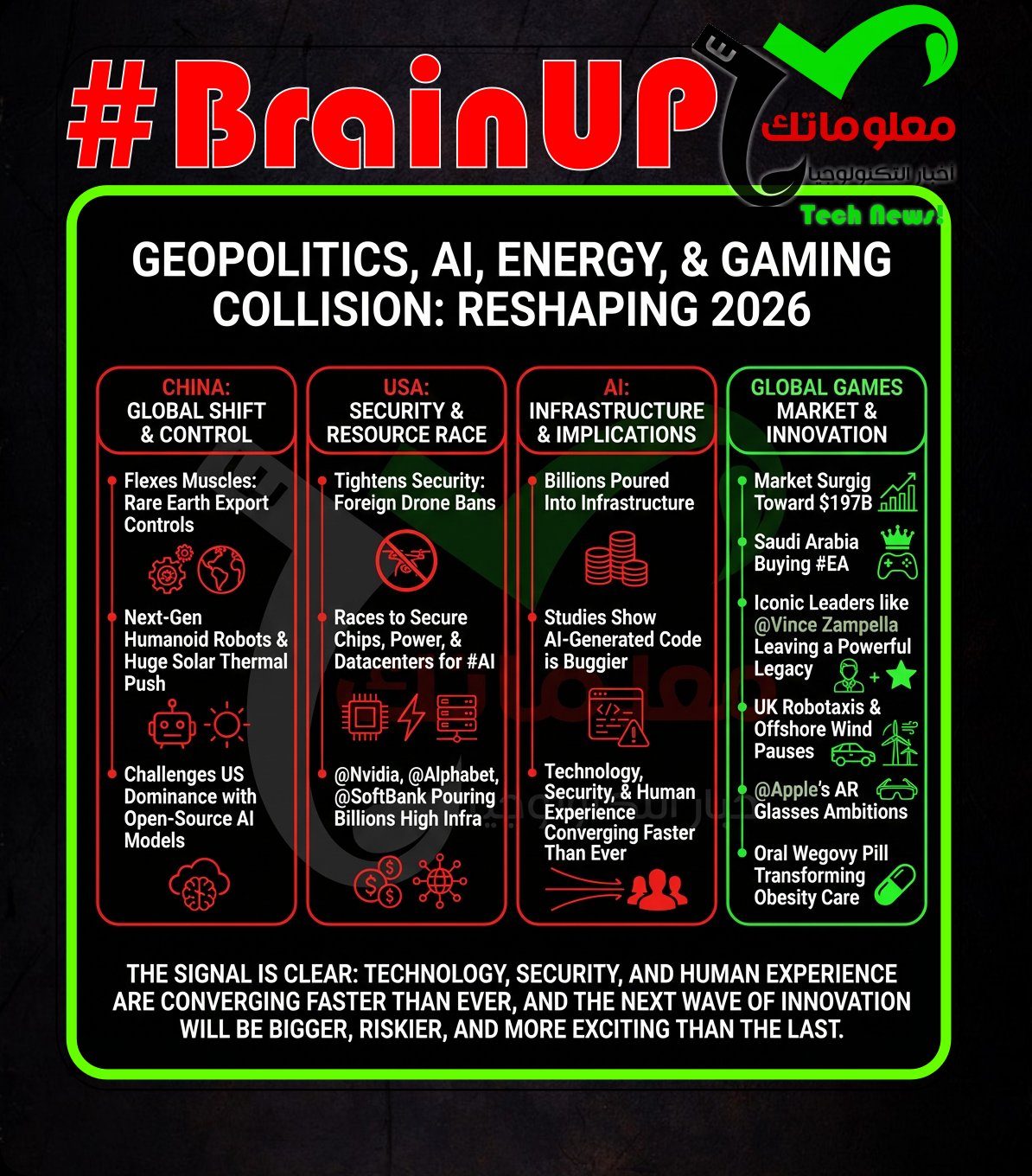
China has tightened export controls on rare earth elements, exacerbating challenges for the U.S. defense industry, which relies heavily on these materials for advanced military technologies. These restrictions have disrupted supply chains and increased costs for manufacturers of critical defense components. Analysts note that China’s move reflects broader geopolitical tensions and its strategy to leverage its dominance in rare earths for strategic advantage. In response, U.S. policymakers are accelerating initiatives to diversify sources and develop domestic production of rare earths, but these efforts face significant technical and environmental hurdles. The situation highlights the vulnerabilities in the U.S. defense supply chain and underscores the urgency of reducing dependence on China for essential materials.
2. FCC banned foreign-made drones from entering the US
The Federal Communications Commission (FCC) has implemented a ban on telecommunications equipment and technology made by foreign companies, including drones, from entering the US market. This action is part of broader efforts to counter national security risks linked to foreign manufacturers, especially those from China. The ban targets drones that could pose spying or cybersecurity threats, emphasizing the need to protect American infrastructure and data. This policy aligns with ongoing US restrictions on foreign tech imports and highlights increasing scrutiny of supply chains in technology sectors. The FCC’s decision underlines the intersection of national security and technology regulation, aiming to safeguard the US from potential vulnerabilities introduced by foreign technology.
3. The FCC’s foreign drone ban is here
Foreign-made drones are now banned from import into the US unless DoD or DHS endorses them, with foreign drones like #DJI added to the FCC’s #CoveredList. The agency says these #UAS and components present ‘unacceptable risks to the national security of the United States and to the safety and security of U.S. persons.’ A National Security Determination warns that foreign-made UAS could enable persistent surveillance, data exfiltration, and destructive operations, and that foreign-made UAS can be used to harvest sensitive data or be disabled via software updates. DJI says it is disappointed, notes it was not singled out, and that existing products can continue operating while new imports are restricted; the ban can be revised if DoD or DHS determines otherwise. FCC chairman @BrendanCarr frames the measure as protecting public safety while maintaining U.S. leadership in innovation, with the possibility of future adjustments to the list based on interagency determinations.
4. China Aims for 15 Gigawatts of Solar Thermal Power by 2030
China has set a target to reach 15 gigawatts of #solar thermal power capacity by 2030 as part of its efforts to boost renewable energy and reduce carbon emissions. The country plans to accelerate the development of solar thermal projects, which use mirrors or lenses to concentrate sunlight and produce heat for electricity generation, as a complement to photovoltaic solar power. Officials emphasize that solar thermal power can provide more stable and dispatchable renewable energy, addressing some limitations of solar PV. The push for solar thermal aligns with China’s broader clean energy goals and its commitment to peak carbon emissions before 2030 and achieve carbon neutrality by 2060. This strategy reflects China’s increasing focus on diverse and reliable #renewableenergy solutions to support sustainable growth and energy security.
5. China unveils new humanoid robot with advanced AI capabilities
China has introduced a new humanoid robot equipped with cutting-edge AI technology designed to perform a variety of tasks in diverse environments. The robot demonstrates advanced motor skills and autonomous decision-making, enabling it to interact naturally with humans and perform complex operations. This development underscores China’s commitment to becoming a global leader in robotics and artificial intelligence, leveraging substantial government investment and innovation. By integrating sensors, machine learning, and robust hardware, the robot represents a significant step forward in human-robot collaboration. This breakthrough is expected to impact industries such as manufacturing, healthcare, and service sectors, aligning with China’s strategic plans for technological advancement.
6. Chipwrecked: Can Nvidia avoid the crash?
The AI data center boom depends on @Nvidia chips and borrowed money, creating a feedback loop where GPU-backed loans fuel more @Nvidia purchases while risking the sector if chips depreciate or @Nvidia falters. @Nvidia has poured money into AI, with more than 70 investments this year, and neoclouds like @CoreWeave borrow to buy chips and use them as collateral, effectively turning $1 in @Nvidia investment into $5 in Nvidia purchases. Loans tied to depreciating GPUs can lead lenders to demand high collateral and set floating rates (@CoreWeave’s first GPU-backed loan in 2023 carried 14% interest in Q3), illustrating how lenders hedge risk via loan-to-value ratios (#LTV). That structure gives @Nvidia an incentive to bail out the industry if trouble emerges, and with rising chip competition, something could go wrong; the sustainability of the AI data center expansion depends on how depreciation and loan terms align with demand.
According to @Tianyi Gu of Newzoo, the global games market is projected to reach $197 billion in 2025, up about 7.5% year over year, driven largely by stronger-than-expected performance on #PC and #mobile. PC gaming is expected to generate $43 billion (+10.4% YoY), while mobile games are forecast to reach about $108 billion. All Top 10 PC releases by revenue were premium titles, including Battlefield 6, Schedule 1, Arc Raiders, Monster Hunter Wilds, Borderlands 4, EA FC 26, REPO, The Elder Scrolls 4: Oblivion Remastered, Sid Meier’s Civilization 7, and Dune: Awakening. Notably, Call of Duty is absent from the top 10, even as Circana places Black Ops 7 at 7th in total sales across consoles and PC. Live-service games like Counter-Strike 2, Minecraft, Roblox, Fortnite, and Valorant continue to dominate monthly active users, with Peak rounding out the ranking #live-service.
An order for #DDR5 memory from #Amazon was found to contain #DDR4 sticks hidden under the heatspreader, revealing a switcharoo scam. The kit was sold as new and dispatched by #Amazon, with no indication of used or open-box, but the PCB notch wouldn’t align, and a Reddit user @Growth (Leading-Growth-3861) documented the discovery and the refund he received. The incident sits within a broader wave of #DDR5 scams as prices rise and #supplychain issues persist, highlighting risks in online PC-component sourcing. The article advises buyers to video the package-opening process and follows @Tom’s Hardware for updates.
South Korea’s first commercial space launch attempt ended in failure when the HanbitNano rocket appeared to explode shortly after liftoff on December 23, 2025. The rocket was developed by Hanwha AeroSpace with the goal to boost Korea’s private space industry and compete globally. Early data indicated an anomaly occurred seconds after launch leading to the loss of the vehicle. Despite this setback, the endeavor demonstrates Korea’s growing ambitions in #commercialspace and highlights challenges in achieving successful orbital launches. Officials and industry experts view the attempt as a critical learning experience that will drive improvements in future missions.
10. AI-generated code contains more bugs and errors than human output
AI-generated code currently carries more bugs and security issues than human output in pull requests, signaling reliability challenges for #AI in software development @CodeRabbit. The study reports AI pull requests average 10.83 issues vs 6.45 for human pull requests, 1.7x more general issues, 1.4x more critical issues, and 1.7x more major issues, with logic errors (1.75x), maintainability (1.64x), security (1.57x) and performance (1.42x) all higher than average and examples such as improper password handling, insecure object references, #XSS and insecure deserialization highlighted. AI coding tools dramatically increase output but introduce predictable weaknesses that organizations must actively mitigate, a point echoed by @Microsoft and others who note ongoing patches and improvements in AI-assisted code. Nevertheless, the study suggests AI can improve efficiency in the initial generation phase and may shift humans toward AI management and review roles, rather than displacement, underscoring the need for careful integration of #AI in development workflows.
11. CEO of SpaceX rival United Launch Alliance resigns | TechCrunch
ULA’s Tory Bruno resigns after 12 years to pursue another opportunity, signaling a leadership change at the Boeing-Lockheed Martin joint venture. Bruno oversaw the Vulcan rocket program, intended to keep ULA competitive with @SpaceX and reduce the U.S. reliance on Russian rockets, a design that drew on Atlas and Delta heritage and depended on engines from @BlueOrigin despite lengthy delays before its first flight in 2024. As @SpaceX expanded its launch cadence and @BlueOrigin grew into a more serious competitor, ULA has sought to win NASA and DoD contracts while continuing Vulcan development. Vulcan has secured customers such as @Amazon for its Leo satellites and has ties with @Astrobotic for future missions. Interim CEO @John Elbon will lead while a permanent replacement is sought, and Bruno stated on X that it has been a privilege to lead ULA through its transformation and bring Vulcan into service.
12. Alphabet to buy Intersect Power to bypass energy grid bottlenecks | TechCrunch
@Alphabet is set to acquire Intersect Power for $4.75 billion in cash, plus the assumption of its debt, to expand its power-generation capacity and data-center footprint without overreliance on struggling local utilities #dataCenters #AI. The deal includes Intersect’s future development projects but excludes its existing operations, which will be bought out by other investors and managed as a separate company. Intersect’s new data parks, located beside wind, solar, and battery assets, are expected to be operational late next year and fully completed by 2027, helping @Alphabet secure energy for AI workloads and data-center growth #energyGrid #cleanEnergy. Google will be the primary user, and Intersect’s campuses are designed as industrial parks that can host other companies’ AI chips alongside Google’s. That move follows Alphabet’s prior minority investment and a target of $20 billion in total investments by 2030, signaling a strategy to lock in scalable energy for AI workloads. #AI #cleanEnergy
13. SoftBank races to line up $22.5B for OpenAI by year-end
SoftBank is racing to line up $22.5B in funding for @OpenAI’s Stargate datacenter initiative by year-end. Reuters notes several levers, including borrowing about $11.5B against its stake in Arm, a 4% stake in @TMobile worth about $11B, and about $27B in cash as of September. Stargate aims to dot the US and other nations with GPU-rich datacenters to fuel OpenAI’s next-gen models and the pursuit of #AGI, in collaboration with @Oracle and @MGX #Stargate. Doubts about the money persist, with @Elon_Musk questioning whether anyone has the funds, while @Oracle pushes ahead with cloud contracts and SoftBank has liquidated its Nvidia stake to fund the venture; OpenAI cleared its transition to for-profit in October, returning responsibility to SoftBank. With year-end looming, how SoftBank deploys these assets will shape Stargate’s financing and the broader #AI infrastructure push.
Apple was fined nearly 12 million euros ($12 million) by Italy’s antitrust regulator for violating privacy rules related to its ‘App Tracking Transparency’ feature on iPhones, which requires apps to get user consent before tracking them across other apps and websites. The Italian regulator found that Apple collected user identifiers and device information even when users had denied permission, which breached users’ rights and data protection laws. This penalty highlights growing scrutiny on #BigTech companies like @Apple for their handling of personal data and enforcing privacy regulations in Europe. The case underscores the tension between implementing new privacy features and ensuring compliance with stringent local laws. Italy’s decision aligns with broader European efforts to hold tech firms accountable for data privacy practices.
15. Starlink in the crosshairs: How Russia could attack Elon Musk’s conquering of space
NATO-nation intelligence services believe Russia is developing a weapon to target @Starlink satellites. The assertion centers on a potential system designed to threaten the Starlink constellation, raising concerns about the security of space-based communications. If true, the development would raise questions about the resilience of space-based comms and spur discussions on countermeasures, redundancy, and #spacebasedcomm and #defensepolicy. The report underscores the vulnerability of satellite networks and the strategic stakes for maintaining reliable connectivity for military and civilian use, including @Starlink’s role. However, details on capabilities, timelines, and verifiable evidence remain limited in the available account.
16. As US battles China on AI, some companies choose Chinese
The US-China AI rivalry is visible in how Chinese open-source models are gaining ground in the US market, offering customizable alternatives to closed systems from @OpenAI, @Anthropic, and @Google. DeepSeek’s January launch of its high-performance, low-cost open-source LLM “R1” challenged the idea that the best AI tech must come from US giants and signaled China’s rising influence. The appeal of open models is cost and flexibility; an American entrepreneur says Alibaba’s Qwen saves about $400,000 a year, and others like @Nvidia, @Perplexity, and @Stanford University are using Qwen in different projects. The US government has signaled the potential of open models in a July AI Action Plan, while major Western firms move toward closed-source models; @Meta is pivoting away from open-source and @OpenAI has released a pair of “open-weight” options. Globally, open-source models such as China’s MiniMax and Z.ai and MoonshotAI’s Kimi K2 are gaining traction, with France’s #Mistral remaining a notable open-source player, suggesting open models could shape future standards. #open-source
17. Electronic Arts Shareholders Approve $55 Billion Sale to Saudis
Electronic Arts (#EA), a major video game publisher, received shareholder approval for a $55 billion acquisition by Saudi Arabia’s Public Investment Fund (#PIF). This deal, one of the largest in the gaming industry, reflects Saudi Arabia’s strategic move to diversify its economy and invest heavily in digital entertainment. The acquisition is expected to boost EA’s resources for game development and global expansion under Saudi ownership, enhancing its competitive position in the market. Stakeholders anticipate this transition will accelerate innovation and leverage Saudi Arabia’s financial power, integrating EA more deeply into the global gaming ecosystem. The approval marks a significant shift in ownership but aims to maintain EA’s operational independence while benefiting from PIF’s investment.
18. Uber and Lyft partner with China’s Baidu to trial UK robotaxis
The collaboration aims to bring #robotaxis to London in 2026 as @Uber and @Lyft partner with @Baidu to trial their #Apollo Go autonomous taxis on UK roads. Baidu’s #Apollo Go already operates in dozens of cities with millions of rides, and regulators are being asked to approve testing that would carry passengers under a UK pilot scheme, with Transport Secretary Heidi Alexander calling it a vote of confidence in #self-driving plans. Experts warn that scaling driverless fleets is complex and safety concerns persist, while public scepticism remains high in polls about riding in a taxi with no human driver. The move is framed as part of the UK’s effort to set standards for #self-driving technology and to balance innovation with safety and congestion considerations as London could become the first region to host Baidu’s driverless taxis.
19. How online retailers are using AI to adjust prices by mining your personal data
Online retailers are using #AI to adjust prices by mining personal data, a practice known as #surveillance_pricing. Experts like @JayStanley of @ACLU say companies collect vast data about individuals and use it to determine how much they are willing to pay, effectively trying to squeeze more money out of shoppers. The logic behind these decisions is often opaque because trade secrets and AI systems obscure how prices are set. Public attention intensified after Delta Airlines discussed using AI to set prices based on personal data, triggering backlash and renewed scrutiny from Congress and the FTC. A consumer group tested Instacart and reported differential pricing on some products, underscoring concerns about fairness and consumer protection.
20. U.S. pauses leases for five offshore wind projects over military radar concerns
@Trump’s administration suspended five offshore wind lease agreements off the U.S. East Coast after the Pentagon warned that large turbine blades and tall, reflective towers could degrade radar performance by creating clutter and false targets. The affected projects are Revolution Wind and Sunrise Wind (Orsted), Vineyard Wind 1 (Avangrid and Copenhagen Infrastructure Partners), Coastal Virginia Offshore Wind–Commercial (Dominion Energy), and Empire Wind 1 (Equinor), with shares in Orsted trading down more than 11% after the announcement. The department said the pause will let federal agencies work with leaseholders and state partners to assess the possibility of mitigating the national security risks posed by these projects, and @Doug Burgum emphasized that protecting the American people is the government’s prime duty. The move reflects ongoing political headwinds to offshore wind under @Trump, who has criticized the industry as expensive and disruptive, while highlighting regulatory risks for developers. Past actions include an August halt on Revolution Wind that was later lifted by a federal court, and a stop-work compromise on Empire Wind with New York state.
21. Instacart scraps AI pricing tests that made some products more expensive
Instacart is ending its AI-powered pricing tests that had led to some customers seeing higher prices for certain items. The company says, going forward, two shoppers buying the same items at the same store location will see identical prices, and it will no longer allow retailers to use the AI-powered Eversight technology #Eversight to run pricing experiments. The move follows a Groundwork Collaborative, Consumer Reports, and More Perfect Union study that found multiple price points for the same grocery items at the same store, a finding that drew attention from lawmakers, including @ChuckSchumer, who urged FTC oversight. Instacart notes the tests were not based on supply or demand, personal data, demographics, or individual shopping behavior. The change comes amid ongoing regulatory scrutiny, including a $60 million FTC settlement over separate deceptive-tactics allegations like falsely advertising free shipping, a point that underlines why the company says it has listened to customer feedback and regrets missing the mark for some shoppers #FTC.
After a December power outage at NIST’s Boulder campus, several Internet Time Service servers may be delivering inaccurate time because a critical standby generator failed downstream of the signal distribution chain feeding the Boulder infrastructure. The outage occurred around 22:23 UTC amid high winds, triggering line damage and a generator switchover disruption that interrupted the atomic ensemble time scale feeding the Boulder ITS infrastructure, according to @NIST. Affected hosts include time-a-b.nist.gov through time-e-b.nist.gov and ntp-b.nist.gov, which may respond but reference an invalid time source or be taken offline to prevent distributing incorrect time. The time.nist.gov service uses round-robin DNS to fail over across sites, reducing exposure for many users, while those with hard-coded hostnames remain more vulnerable; UTC(NIST) drift was about four microseconds, negligible for most but potentially critical for high-precision applications #NTP #UTC #timekeeping. This incident follows a December 10 disruption at Gaithersburg with a time step of roughly -10 milliseconds, and NIST has not yet provided a firm restoration ETA for Boulder.
23. It’s finally time to retire the word ‘podcast’
The article argues that the word ‘podcast’ is becoming an outdated relic as formats pivot to video, blurring the line between audio-only shows and what many publishers now call ‘shows’. It cites YouTube’s 2025 Recap and examples like @SethMeyers’ Late Night clips and programs such as @AmyPoehler’s Good Hang, @DaxShepard’s Armchair Expert, and @ShannonSharpe’s Club Shay Shay, which sit on the same playing field as traditional podcasts. It notes that feeds are filled with host-driven video essays, food reviews, and cable-news clips, far from the narrative audio journalism that once defined #podcasts. The piece argues that calling these formats ‘#shows’ may be more marketable to advertisers and audiences, a trend observed by Bloomberg’s Ashley Carman and echoed by industry voices at FlightStory. Ultimately, fans and creators may adopt ‘#shows’ as the default term, blending video-first programs with non-podcast formats and discarding the old label.
24. Nvidia aims to begin H200 chip shipments to China by mid-February, sources say
Nvidia plans to start shipping its new H200 AI chips to China by mid-February 2026 according to sources familiar with the matter. Despite U.S. export restrictions targeting advanced AI chip technology to China, Nvidia has found ways to meet demand through alternative supply channels and local partnerships. The H200 chip is an important upgrade expected to enhance AI processing speeds and capabilities for Chinese tech companies. This move highlights Nvidia’s strategy to sustain its presence in the Chinese market amid increasing geopolitical and regulatory challenges. It also underscores the ongoing tensions between U.S. technology policies and China’s growing AI ambitions.
25. Axios-Momentive survey: C-suite more bullish on AI but cautious on security
The survey highlights increasing optimism among C-suite executives regarding the potential of artificial intelligence to drive growth and innovation, signaling a growing bullish sentiment in corporate leadership. Despite enthusiasm, these executives remain cautious about AI-related security risks, underscoring concerns about data privacy and system vulnerabilities as AI technologies become more integrated into business operations. This balance suggests that while companies are eager to leverage #AI for competitive advantage, they are also investing in robust security measures to mitigate potential threats. The trend reflects a nuanced corporate approach that prioritizes innovation alongside risk management. This careful stance ensures that AI adoption aligns with both strategic growth objectives and regulatory compliance standards.
26. Vince Zampella, video game developer behind ‘Call of Duty’ franchise, killed in Ferrari crash
@Vince Zampella, former CEO of @Infinity Ward and current head of @Respawn Entertainment, was killed in a single-car crash on Angeles Crest Highway north of Los Angeles. The southbound 2026 Ferrari 296 GTS exited a tunnel, struck a concrete barrier and caught fire, with Zampella dying at the scene and a passenger later dying at a hospital. Zampella co-founded @Respawn in 2010, which @EA acquired in 2017, and the studio is known for Titanfall, Apex Legends and STAR WARS Jedi: Fallen Order, while he also led an EA studio in Playa Vista behind the Battlefield franchise. EA called his impact on video games profound and far-reaching, while Gene Park of the Washington Post praised his ability to craft stories and experiences that hit at the heart of the human experience, underscoring his lasting influence on the industry.
27. Tim Cook’s ‘top priority’ product could finally take shape next year – 9to5Mac
Apple is pursuing true AR glasses as @Tim Cook’s top priority, with next year’s unveiling expected to provide a key glimpse into the broader AR product roadmap. Bloomberg’s @Mark Gurman reports the glasses could be unveiled in 2026 and may ship in 2027, with previews ahead of the ship date. The initial version reportedly centers on Siri, AI, and serving as an iPhone accessory rather than delivering full AR functionality, signaling a staged approach to #AR. When paired with Vision Pro and the visionOS software, the glasses would lay the foundation for Cook’s long-term ambitions and the idea of spatial computing across devices, with #VisionPro and #visionOS. Apple is expected to iterate on the design before a true AR model arrives, and by the end of next year we should have a clearer sense of what to expect from @Tim Cook’s top priority product.
28. U.S. regulators approve Wegovy pill for weight loss
The @FDA has approved a daily oral version of Wegovy, making it the first oral medication approved to treat obesity. The Wegovy pill contains 25 mg of #semaglutide, the same ingredient in the injectable form, and in trials participants lost 13.6% of body weight on average over about 15 months, compared with 2.2% on placebo, close to the ~15% seen with injectable Wegovy. In the same programs, Lilly’s #orforglipron produced about 11.2% weight loss with the highest dose, while tirzepatide (#Zepbound) achieved about 21% average loss, indicating the pills can vary in effectiveness but all leverage #GLP-1 mechanisms. The approval could broaden access and lower costs by moving obesity treatment toward more convenient oral options, and it gives @NovoNordisk an edge in a market where @Lilly’s pill is still under review. Side effects are similar across GLP-1 therapies, including nausea and diarrhea, and the Wegovy pill must be taken with a sip of water on an empty stomach with a 30-minute wait before eating to protect the medication until it is absorbed.
That’s all for today’s digest for 2025/12/23! We picked, and processed 28 Articles. Stay tuned for tomorrow’s collection of insights and discoveries.
Thanks, Patricia Zougheib and Dr Badawi, for curating the links
See you in the next one! 🚀
