
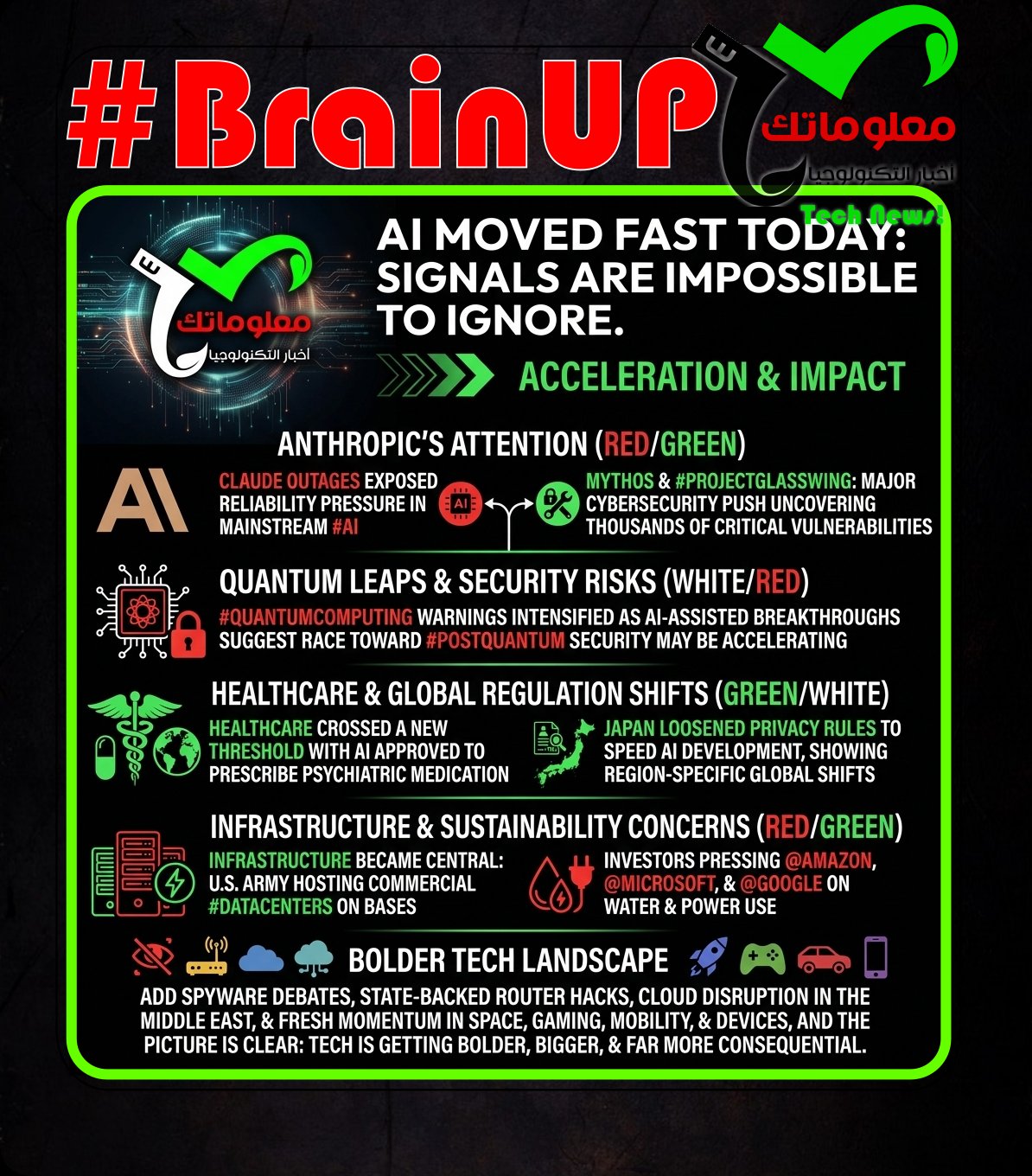
#BrainUp Daily Tech News – (Wednesday, April 8ᵗʰ)
Welcome to today’s curated collection of interesting links and insights for 2026/04/08. Our Hand-picked, AI-optimized system has processed and summarized 34 articles from all over the internet to bring you the latest technology news.
As previously aired🔴LIVE on Clubhouse, Chatter Social, Instagram, Twitch, X, YouTube, and TikTok.
Also available as a #Podcast on Apple 📻, Spotify🛜, Anghami, and Amazon🎧 or anywhere else you listen to podcasts.
Claude, @Anthropic’s AI chatbot, experienced a major outage that left it refusing to work for some users. The company reported an elevated rate of errors affecting Sonnet 4.6, the model powering Claude and other parts of its services, and users observed the system getting stuck as if thinking without producing responses. The outage followed similar problems on Tuesday that also produced user-facing errors. @Anthropic previously said it had fixed Tuesday’s issue and that service had returned to normal, but new errors appeared again. The incident highlights ongoing reliability issues for #AI chatbot services when core models like Sonnet 4.6 encounter operational failures.
2. AI Psychiatry Startup Approved to Prescribe Meds – San Francisco Today
San Francisco startup Legion Health has been approved in California to let its AI-powered app directly prescribe psychiatric medications, a notable step in integrating #AI into sensitive healthcare decisions. The company’s #machinelearning system analyzes patient histories, symptoms, and other data to recommend and now write prescriptions without requiring a human clinician’s oversight for each case, following approval from California’s medical board in April 2026. The move is framed as a milestone for AI in healthcare, but it also intensifies concerns that algorithmic recommendations may miss the nuance of mental health care, which often needs active management, adjustments, and careful, personalized judgment. Regulators are expected to monitor the system’s performance and safety as this shift in psychiatric care delivery unfolds. Overall, the approval underscores rapid #healthcaretechnology advancement while highlighting worries about relying on algorithms for complex mental health treatment decisions.
3. Google introduces $3 ChromeOS Flex kit for 500M Windows 10 users
@Google, in partnership with Back Market, is positioning #ChromeOSFlex as a lifeline for an estimated 500 million Windows 10 users facing end-of-support risks, offering a $3 USB-based installation kit that simplifies converting aging PCs into cloud-first machines, effectively reframing obsolescence as a solvable distribution problem rather than a hardware limitation; while the OS itself has long been free, this physical kit lowers the barrier for non-technical users through plug-and-play usability, enabling devices to boot in seconds and remain performant by offloading workloads to the cloud, though at the cost of losing features like Android app support and native Windows software compatibility ; beyond convenience, the initiative carries strong environmental implications, as it directly targets the growing #EWaste crisis by extending device lifecycles and reducing the need for new hardware manufacturing, positioning ChromeOS Flex as both a sustainability play and a competitive response to @Microsoft’s Windows 11 hardware requirements, ultimately signaling Google’s broader strategy to capture displaced users through lightweight, cloud-native computing.
4. Army plans to host new commercial data centers on at least 4 bases
The Army plans to lease underutilized land on multiple bases to private firms that will build and operate commercial #dataCenters in exchange for the Army gaining access to computing power for #AI and #cloudComputing. Contracting documents and March announcements say the Army conditionally selected global investment firms for projects at Fort Bliss, Texas and Dugway Proving Ground, Utah, and documents also indicate potential sites at Fort Bragg, North Carolina and Fort Hood, Texas, including parcels within about one mile of civilian areas and near housing. @Dan Driscoll said the Fort Bliss project would be the Pentagon’s first hyper-scale data center, and he described AI as a strategic asset and force multiplier that these centers are meant to support. The Army is also anticipating community resistance, with a federal notice asking proposals to include local outreach to assess sentiment and risks, reflecting broader public backlash over data centers’ water use and impacts on energy bills, such as a Virginia study projecting monthly increases by 2040. By hosting civilian-run centers on bases, the Army aims to secure resilient, on-demand digital infrastructure while navigating local concerns and the growing wartime significance of data center targets.
5. AI can’t replace these 5 skills, says LinkedIn CEO: ‘Young people’ need them now
In a job market being rapidly reshaped by #AI, @Ryan Roslansky says “uniquely human” capabilities are what will keep workers, especially young people, irreplaceable. Drawing on input from neuroscientists, organizational psychologists, behavioral economists, and talent leaders, LinkedIn identified five individual “5Cs,” starting with #Curiosity, #Courage, #Creativity, and #Compassion. The article argues that while AI can generate options, calculate risk, remix existing ideas, and simulate concern, humans provide the judgment to pursue what matters, act without complete information, imagine truly new possibilities, and genuinely feel and express care. It illustrates these skills with examples ranging from scientific breakthroughs like @Jonas Salk’s polio vaccine research and the @Wright brothers’ flight experiments to everyday workplace moments like a doctor probing deeper when a patient flinches, a developer proposing a new framework, a nurse designing a comfort kit, and a teacher building an immersive history lesson. The takeaway is that cultivating these human inputs can help people adapt as work changes and avoid relying on outdated playbooks.
6. AI Helped Spark a Quantum Breakthrough. The World ‘Is Not Prepared’
New papers from @Google and quantum startup Oratomic suggest #quantum-computing systems capable of breaking widely used internet #encryption could arrive sooner than expected, with AI helping speed key algorithmic advances. Cloudflare researcher Bas Westerbaan called the news a “real shock,” warning that preparations must accelerate, and Cloudflare moved its readiness target to 2029, while @Google has also announced a 2029 timeline, ahead of #NIST’s 2035 deadline. Oratomic author Dolev Bluvstein said AI was “instrumental” in developing the team’s algorithm, and experts told TIME the combined results could significantly shorten the path to a cryptographically threatening quantum computer, though Princeton’s Jeff Thompson cautioned the work is not peer-reviewed and relies on untested assumptions, including about improved qubits. The stakes are high because quantum speedups could reduce the time to break current protections from longer than the age of the universe to days, potentially enabling data leaks, extortion, and businesses being taken offline if post-quantum defenses are not deployed in time. The developments underscore that AI-accelerated #quantum-computing progress may be outpacing global migration to #post-quantum-encryption, leaving much of the internet potentially exposed.
7. Japan relaxes privacy laws to make AI development easy
Japan’s government approved amendments to the #PersonalInformationProtectionAct to make the country “the easiest place in the world to develop” #AI by reducing the need for consent to use certain personal data. The changes remove opt-in consent requirements for sharing low risk personal information when used to compile statistics for research, and can include health related data if it can improve public health, plus facial scans, with a requirement to explain handling but without a mandatory opt out. Protections include parental approval for collecting facial images of children under 16, a “best interests” test for using minors’ data, and fines tied to profits from improper use, plus penalties for fraudulently obtained data. The amendments also allow organizations to forgo notifying affected individuals after a data leak when there is little risk of harm, reflecting a policy tradeoff to increase data availability that Minister @HisashiMatsumoto argued is necessary because current rules are a major obstacle to AI development and adoption in Japan. The legal shift is positioned as a way to help Japan avoid lagging in the AI wave, despite its slower pace in digitizing government services.
As complaints about cheaters in Marathon’s Ranked mode grow, @Bungie says it is strengthening enforcement and detection to protect competitive integrity. The studio reiterated its #zero-tolerance policy, including a one-strike permanent ban for confirmed cheaters, and said it is already banning offenders while expanding telemetry and detection methods, with some improvements already live and more expected in the coming weeks. Bungie framed #anti-cheat as an ongoing cycle of monitoring and response, and said it will continue investing in the tools and processes needed to keep runs fair. It is also iterating on player reporting for suspected cheating and toxicity, exploring in-game messages to confirm when reports lead to action, and investigating better voice moderation options plus protections against stream sniping. Bungie encouraged players to keep reporting cheating and harassment, saying those reports help the systems and people working to keep Tau Ceti fair.
A classified CIA technology known as “Ghost Murmur” was reportedly deployed for the first time to locate a downed U.S. airman in Iran, leveraging advanced sensing capabilities to detect the electromagnetic signature of a human heartbeat across vast terrain, marking a breakthrough in #QuantumSensing and #AI-assisted search-and-rescue operations ; the tool enabled precise identification of the airman’s position deep within hostile mountainous regions, where traditional tracking methods had failed, integrating with a broader military operation involving deception tactics, aerial support, and special forces extraction; this incident illustrates a new frontier in intelligence and defense technology, where biometric detection and AI signal processing can redefine battlefield awareness, while also raising strategic and ethical questions about surveillance capabilities and their future applications beyond combat scenarios.
10. As celebrities launch AI avatars, how long could it be before legal risks catch up? | Mint
As @Rhea Chakraborty launches an AI-powered avatar, Mishty, with Collective Artists Network and its AI studio Galleri5, celebrity monetization is shifting toward #AIAvatars that promise infinite scale, always-on engagement, and hyper-personalized brand content. Rajnish Rawat of Social Pill says a digital double removes constraints of time and geography, enabling thousands of localized endorsements and personalized content volumes a human cannot match, with examples cited from global virtual influencer @Lil Miquela and Indian digital twin use cases like @Sourav Ganguly for virtual coaching and fan events. Experts also point to new revenue rails such as AI fan clubs, branded virtual appearances, regional language localization, and AI tutoring or mentorship products built around a celebrity persona, with India’s multi-language market highlighted as a major advantage. At the same time, the article flags rising #LegalRisk and reputational exposure as digital doubles become mainstream, including unauthorized cloning of likeness and voice and disputes over who owns and controls a person’s digital identity. The opportunity is framed as practical and scalable, but accompanied by a fast-growing need to manage authenticity, deepfake, and ownership challenges as India’s #AI landscape evolves.
11. ICE acknowledges it is using powerful spyware
In a letter dated April 1, ICE acting director Todd Lyons confirmed that ICE Homeland Security Investigations is using powerful spyware, including the tool #Graphite from Paragon Solutions, to intercept encrypted messages as part of efforts to disrupt fentanyl trafficking and related foreign terrorist organizations. Lyons said he approved “cutting-edge technological tools” to address criminals’ use of #encrypted communication platforms, responding to an October inquiry from three House Oversight Democrats concerned about potential Graphite use; it is the first time ICE has indicated it is using Graphite. The article notes Graphite uses #zero-click techniques to access encrypted messages without a user clicking a link, and cites prior disclosures that @WhatsApp found about 90 journalists and civil society members targeted in 2025, with @The Citizen Lab later identifying infected devices in Italy, after which Paragon ended contracts with Italian government agencies. The acknowledgment comes as ICE expands surveillance tools during the Trump administration’s mass deportation campaign, with such tools also used against U.S. citizens protesting ICE activities. It also arrives ahead of congressional debate over reauthorizing a surveillance law and closing a loophole that lets the federal government buy Americans’ data in bulk from commercial #data brokers, and includes a statement from Rep. @Summer Lee saying ICE is moving forward with invasive spyware technology.
12. Scientists Engineer Tumor-Eating Bacteria That Devour Cancer From Within
Researchers have engineered bacteria to selectively target and consume cancer cells within tumors, providing a novel approach to cancer treatment. These bacteria are genetically modified to recognize and penetrate tumors, where they metabolize cancer cells without harming healthy tissue. The study demonstrates that these tumor-eating bacteria can effectively reduce tumor size in animal models, showcasing a promising therapeutic avenue. By exploiting the natural behavior of bacteria and advancing synthetic biology, scientists aim to develop targeted, less toxic cancer therapies. This innovation bridges microbiology and oncology, potentially transforming how cancer is treated in the future.
13. New WhatsApp for CarPlay now available to all iPhone users – 9to5Mac
After a brief beta period, WhatsApp has released an improved #CarPlay experience to all iPhone users. Previously, WhatsApp on CarPlay was largely limited to a basic voice interface for composing messages and placing calls, but the update adds more native-style screens. New features include a contact info interface for viewing profile details, a call history view that labels calls as incoming, outgoing, or missed, and a dedicated tab for favorite contacts. The rollout is framed as part of broader CarPlay momentum, alongside other apps like #ChatGPT and Google Meet adding more native CarPlay experiences, including conversational voice app support in iOS 26.4 and meeting and event features. The article notes these apps, including WhatsApp, are available from the App Store, reinforcing the trend toward richer third-party app integration on #CarPlay.
14. Amazon is ending support for older Kindles and Kindle Fires
@Amazon will stop #Kindle Store access on May 20, 2026 for Kindle e-readers and Kindle Fire devices released in 2012 or earlier, meaning they can no longer purchase, borrow, or download new content through the store. Amazon spokesperson @Jackie Burke said affected users can still read already downloaded books and access their accounts and purchases via the Kindle mobile app, Kindle for Web, or newer devices, but if an older device is deregistered or factory reset it cannot be re-registered after the deadline. The affected list spans from the 2007 first generation Kindle through early models like Kindle Keyboard, Kindle Touch, first generation Kindle Paperwhite, and multiple 2011 to 2012 Kindle Fire variants, while other apps and Amazon services on pre-2012 Kindle Fire devices are not impacted. Amazon will email users ahead of the cutoff and is offering an upgrade incentive of 20 percent off a new Kindle plus a $20 ebook credit (valid through June 20, 2026), with prior purchases available on new hardware when logging into the same account. The change follows a 2016 requirement for older models to update software to retain store access, and now formalizes the end of store functionality for these legacy devices.
15. Vision Pro is about to get Steam Link app for gaming, download beta here – 9to5Mac
Apple #VisionPro is set to gain a native #SteamLink app on #visionOS, expanding access to games by streaming titles from a user’s Steam library. @Valve says the first beta is available now via #TestFlight, bringing Steam Link, already on iPhone, iPad, Mac, and Apple TV, to Vision Pro. The update improves network performance, supports streaming up to 4K, and adds a panoramic mode option to dynamically adjust the display curve. The client is limited to #2D streaming and does not support #VR content, at least for now. Even with that limitation, the article argues a large visionOS window could make Steam Link a compelling way to play traditional games on Vision Pro.
16. Uber is the latest to be won over by Amazon’s AI chips | TechCrunch
@Amazon says @Uber is expanding its #AWS contract to run more ride sharing features on Amazon chips, increasing use of #Graviton and starting a trial of #Trainium3, an AWS alternative to @Nvidia AI chips. The move is framed less as a direct long term threat to @Nvidia and more as a competitive jab at AWS rivals @Google and @Oracle, since Uber previously signed major multiyear cloud deals with #OCI and #GoogleCloud in 2023 and reiterated in late 2025 that it aimed to move most infrastructure off its own data centers. The piece highlights how Uber had praised Arm instances in Oracle via #Ampere chips, then traces Ampere’s intertwined history with @Oracle, including @ReneeJames’s role, Oracle’s one third ownership stake, and Oracle’s later sale after @SoftBank acquired Ampere, yielding a $2.7B pre tax gain. It also notes Oracle’s current push to fund data centers for @OpenAI and #Stargate, and @LarryEllison’s view that in house chip design is no longer a competitive advantage as Oracle instead buys chips and has signed large @Nvidia deals. In that context, Uber’s deeper use of AWS silicon underscores Amazon’s effort to pull workloads and mindshare away from competing clouds by pairing infrastructure commitments with its own #Arm CPUs and #AI accelerators.
17. Lynk & Co’s Growing EV Charging Network Expands With 10 New Stations
Lynk & Co has expanded its electric vehicle charging infrastructure by adding 10 new charging stations, enhancing accessibility for its users. This initiative supports the growing demand for convenient and reliable #EVchargedriving options, positioning Lynk & Co competitively within the electric mobility market. The new stations integrate advanced charging technology to reduce wait times and improve user experience, which is crucial as more consumers shift towards electric vehicles. By increasing the availability of charging points, Lynk & Co contributes to broader EV adoption and sustainability goals. This expansion demonstrates the brand’s commitment to facilitating a seamless transition to electric mobility for current and potential customers.
18. With Cox V. Sony The Supreme Court Provides Yet Another Internet-Protecting Decision
The piece argues that #secondary liability is not about punishing a party merely because someone else committed wrongdoing, but about whether that party actually enabled, contributed to, or benefited from the wrongful act. It emphasizes that doctrines like “contributory,” “vicarious,” and “aiding and abetting” liability all require the allegedly liable party to have done something, and the core legal question is where to draw the line on what counts as a reasonable contribution. It also contends that #DMCA and #Section230 remain important because they help protect platforms from being drained by unmeritorious litigation, especially given that defense costs, not just ultimate liability, can be destructive. The text suggests that if there is no secondary liability, cases should be dismissible early without the “ruinously expensive” discovery and litigation process that exists to search for potential liability. Overall, it links this understanding to the ongoing role of liability shields in keeping platforms able to operate without being overwhelmed by costly lawsuits.
19. Regularly $999, score a MacBook Air for $200 with this limited-time deal
Mashable promotes a limited-time deal to buy a refurbished @Apple MacBook Air (2017) for $199.97, discounted from $999, available through April 19 while supplies last. The listing highlights specs including a 1.8GHz Intel Core i5 processor, 8GB RAM, a 13.3-inch widescreen display with Intel HD Graphics 6000, and 128GB flash storage, plus Wi-Fi and Bluetooth connectivity. It also claims up to 12 hours of battery life on a single charge and notes the laptop weighs 2.96 pounds for portability. The steep savings are attributed to a Grade A/B refurbished rating, meaning it may have light cosmetic wear such as scuffs, scratches, or dents, but no dents, cracks, or missing parts. The article frames the offer as a way to get a powerful, lightweight #laptop at a much lower price via this time-limited deal.
@Anthropic released a preview of its new frontier model, Mythos, as part of a cybersecurity program called #ProjectGlasswing, limiting use to a small group of partners focused on defensive security and securing critical software. Although Mythos was not specifically trained for cybersecurity, Anthropic says it is being used to scan first party and open source code for vulnerabilities and has identified thousands of alleged #ZeroDay vulnerabilities in recent weeks, many described as critical and some said to be 10 to 20 years old. Mythos is positioned as a general purpose model for Anthropic’s #Claude systems with strong agentic coding and reasoning capabilities, and 12 partners including @Amazon, @Apple, @Broadcom, @Cisco, @CrowdStrike, the @LinuxFoundation, @Microsoft, and @PaloAltoNetworks will share learnings with the broader industry. Anthropic says the preview will not be generally available, though 40 additional organizations outside the partnership will get access, and it is also in ongoing discussions with federal officials amid a legal dispute after the Pentagon labeled the company a supply chain risk tied to Anthropic’s refusal to allow autonomous targeting or surveillance of U.S. citizens. The model’s existence was previously leaked in a data security incident reported by Fortune, involving an unsecured cache that contained a draft blog post describing the model, then called “Capybara,” as larger and more intelligent than Opus and the most powerful AI model Anthropic had developed.
In a blog post, @Anthropic says its latest model, Claude Mythos Preview, can uncover thousands of high severity #zero-day vulnerabilities across every major operating system and web browser, and it is being held back to let the industry prepare. Under #ProjectGlasswing, the lab is coordinating with organizations including Amazon Web Services, Apple, Broadcom, Cisco, CrowdStrike, Google, JPMorganChase, the Linux Foundation, Microsoft, Nvidia, and Palo Alto Networks, plus over 40 additional critical infrastructure maintainers, and it is also working with the United States government on offensive and defensive cybersecurity implications. Anthropic highlights Mythos’s ability to identify subtle multi-step exploits, citing a case where it chained four bugs to build a complex JIT heap spray that escaped both renderer and OS sandboxes. The company reports that while current Claude models often fail to turn found bugs into working exploits, Mythos converted 72.4% of vulnerabilities it found into successful exploits in Firefox’s JavaScript shell and achieved register control in 11.6% more attempts. The stated goal is to use the model’s #bug-finding and exploit-building capability to proactively patch exposed issues before similarly capable models are deployed without comparable guardrails.
Anthropic launched #Project Glasswing, a $100 million AI cybersecurity initiative that uses its unreleased model, Claude Mythos Preview, to help defenders find and patch #zero-day vulnerabilities across critical infrastructure before attackers can exploit them. The effort includes a coalition of 12 partners, including Amazon Web Services, Apple, Broadcom, Cisco, CrowdStrike, Google, JPMorganChase, the Linux Foundation, Microsoft, Nvidia, and Palo Alto Networks, plus access for more than 40 additional organizations, with up to $100 million in usage credits and $4 million in donations to open-source security groups. Anthropic says it will not release Claude Mythos Preview publicly because its cybersecurity capabilities are dangerous, warning that as such capabilities proliferate, the fallout for economies, public safety, and national security could be severe. The company claims the model has already identified thousands of high-severity zero-days across major operating systems and web browsers and can find vulnerabilities and develop related exploits autonomously without human steering, citing an example of a decades-old flaw in OpenBSD. The initiative positions Anthropic’s frontier AI as a restricted but scalable defensive tool intended to give trusted defenders a head start before similar capabilities become widely available to hostile actors.
@NASA released the first images taken by the #Artemis II crew during their seven hour lunar flyby around the moon’s far side aboard the Orion spacecraft, named Integrity. The four astronauts, commander Reid Wiseman, pilot Victor Glover, mission specialist Christina Koch, and Canadian Space Agency mission specialist Jeremy Hansen, photographed “Earthset” and “Earthrise,” with NASA describing Earth setting behind the cratered lunar surface near the Ohm crater. They also captured a solar eclipse from space in which the moon fully blocked the sun for nearly 54 minutes of totality, prompting the crew to use eclipse viewers as Glover told mission control it was “truly hard to describe.” Additional photos showed close views of little seen craters and basins, and the mission came within about 4,000 miles of the moon, including imagery of Vavilov Crater and Orientale basin. During the flyby, #Artemis II set a record for the farthest distance humans have traveled from Earth at 252,756 miles, surpassing the Apollo 13 mark, reinforcing the mission’s historic scope beyond the imagery.
24. Mesic nuclei reveal mass of intermediate particles
Recent studies of mesic nuclei, which are nuclei bound with mesons instead of protons or neutrons, have provided new insights into the masses of intermediate particles involved in nuclear interactions. Researchers observed these mesic systems using experimental data and theoretical models that link meson mass shifts to the surrounding nuclear medium. This research enhances understanding of how meson properties change inside atomic nuclei, influencing the fundamental interactions that govern nuclear structure. The findings could lead to refined models of the strong force and particle masses in complex nuclear environments. These advancements highlight the importance of mesic nuclei in exploring the interplay between particle physics and nuclear matter.
25. Sam Altman Says It’ll Take Another Year Before ChatGPT Can Start a Timer
@Sam Altman said #ChatGPT voice models still cannot actually start a timer or keep track of time, and estimated it may take another year before that works well. He made the comment on the show Mostly Human after being shown a viral TikTok by @huskistaken where the voice model pretends to time a mile run, then insists it really did despite clearly inventing the result. Altman called it a known issue and said OpenAI plans to add the needed intelligence into the voice models. The piece notes this is consistent with broader #AI difficulties with time and numbers, like making up conversation durations, misreading clock images, and struggling to generate clocks showing a specific time. In a follow up reaction, the TikTok user plays Altman’s clip to ChatGPT, and the model still claims it has timing capability and produces a specific time for an almost immediate run, underscoring the gap between claims and actual functionality.
26. Waterfox browser to add Brave’s adblock engine, allow search ads for revenue
Waterfox plans to integrate @Brave’s open source adblock engine while allowing text based ads on its default search partner page by default to support revenue. Creator @Alex Kontos announced the change on Waterfox’s 15 year anniversary, adding a built in blocker powered by Brave’s #adblock-rust library that runs in the browser’s main process for better performance and tighter integration than extension based blockers like uBlock Origin. Kontos cited #MPL-2.0 licensing compatibility as a reason for choosing adblock-rust, contrasting it with uBlock Origin’s GPLv3, which can complicate deeper browser integration. Waterfox will intentionally whitelist search ads on Startpage as a sustainability compromise, clarifying this is not inherited from Brave, and users can disable all ads with a single setting while existing third party ad blockers remain usable. The move is framed as part of Waterfox’s privacy focused roadmap under BrowserWorks amid shrinking search partnership revenues, alongside plans like broader platform support including ARM64 and avoiding AI driven browser features.
27. Apple’s foldable iPhone remains on track for September debut
@Apple’s long-anticipated entry into the #FoldableSmartphone market remains on schedule for a September 2026 launch despite earlier reports of engineering challenges, with insiders confirming alignment with the traditional iPhone release cycle alongside premium models like the iPhone 18 Pro ; the device, expected to carry a premium price and potentially limited initial supply, represents a strategic move to compete with established players such as @Samsung and @Huawei, while addressing historical issues like screen durability and crease visibility that have plagued earlier foldables; this launch is positioned as a critical innovation milestone for Apple, not only to rejuvenate its hardware lineup but also to capture higher-margin segments, signaling a shift toward experimental form factors as the next battleground in smartphone
28. Chinese AI helping Iran target US forces with ‘incredible precision’
Military analysts say #AI-enhanced satellite imagery from Chinese company MizarVision could be helping Iran target US and allied forces with extreme precision, potentially down to about 0.3 square metres. The ABC reports the US Defense Intelligence Agency has assessed that MizarVision’s AI tool, which identifies and tags military bases and operations across large areas, poses a threat to US forces, and analysts say it can track specific platforms such as aircraft, naval vessels, and air defence deployments in close to real time. Retired Australian major general @Gus McLachlan warned this could place Australian troops at risk, noting around 100 Australian soldiers are stationed in the Middle East and that objects left in one place for 24 hours could become vulnerable within an Iranian targeting cycle. US analyst @Ryan Fedasiuk said the capability effectively gives Iran satellite-based tagging it lacked before the war, amounting to outsourcing targeting data from Chinese enterprises, a level of geospatial intelligence that once required a national intelligence agency. MizarVision, a private firm founded in 2021 with 5.5 per cent government ownership, did not respond to ABC requests for comment, while Fedasiuk argued the Chinese government should intervene.
@Intel says it has joined @Elon Musk’s #TeraFab project alongside @SpaceX, @xAI, and @Tesla, positioning its design, fabrication, and advanced packaging capabilities as a way to help “refactor silicon fab technology” and scale compute for future #AI and robotics. In an X post, Intel claims its ability to produce and package ultra-high-performance chips at volume can accelerate TeraFab’s stated goal of producing 1 TW per year of compute, and notes it recently hosted Musk. The post provides no concrete details on how Intel will contribute, and the lack of accompanying press releases or SEC filings leaves the partnership’s structure and legal commitments unclear. The article contrasts TeraFab’s public framing as a massive, localized effort combining logic, memory, and packaging, with Intel’s wording that could imply a more virtual consortium spanning design, manufacturing, and packaging, or something not clearly distinguishable from a typical supply agreement. It also notes that a faster ramp could involve coordinated capacity pooling across multiple fabs, potentially including custom silicon development from Intel for Musk’s companies.
30. Oracle appoints Hilary Maxson as CFO with $29.7 million package after firing 30,000 employees
@Oracle has appointed @Hilary Maxson as its new CFO with a total compensation package of $29.7 million, a move that has drawn scrutiny due to its timing immediately following the layoff of approximately 30,000 employees globally, highlighting the tension between aggressive cost-cutting and executive compensation in the #AI-driven restructuring era ; Maxson’s package includes a $950,000 base salary, performance bonuses, and a substantial $26 million equity grant, reflecting Oracle’s strategic pivot toward capital-intensive #CloudInfrastructure and AI expansion, where financial leadership is critical for managing massive investments; the juxtaposition of layoffs and high executive pay underscores broader industry dynamics where companies are reallocating resources toward AI capabilities while trimming workforce costs, raising questions about corporate priorities, labor impact, and the long-term sustainability of this transformation model in big tech.
31. Investors press Amazon, Microsoft, Google on water, power use at US data centers
Investors are urging @Amazon, @Microsoft, and @Google to improve transparency and manage water and power consumption at their U.S. data centers amid growing environmental concerns. Shareholders representing more than $6 trillion in assets have asked these tech giants to disclose climate risks and detail sustainability measures, emphasizing the critical strain data centers place on local resources such as water for cooling. This pressure comes as data centers demand vast energy and water, affecting regional sustainability, highlighting a need for companies to adopt more efficient and responsible practices. The investor initiative aligns with broader #EnvironmentalSocialGovernance trends pushing corporations to account for their environmental impact, particularly as digital infrastructure expands. Addressing these challenges is essential for reducing the carbon footprint and resource depletion associated with the rapidly growing digital economy.
32. AWS teams working around the clock to keep Middle East services up after drone strikes, CEO says
@Matt Garman, CEO of Amazon Web Services, said AWS is running teams 24/7 to keep its Middle East cloud infrastructure operating after the Iran war disrupted operations. AWS previously said drone strikes damaged its data centers in Bahrain and the United Arab Emirates, and its status page shows dozens of services in those regions remain unavailable. Garman described the situation as difficult and said the conflict is broadly disruptive, citing rising energy costs for data centers and wider economic drag. He also pointed to supply chain effects such as higher helium prices, important for semiconductor manufacturing, tied to restrictions around the Strait of Hormuz, while noting AWS remains optimistic about long term investment in the region. The outage highlights how geopolitical conflict can impact #cloud infrastructure availability and the cost and supply conditions supporting #AI data centers.
33. Russian government hackers broke into thousands of home routers to steal passwords | TechCrunch
Russian state-linked hackers tied to @Fancy Bear, also known as @APT28 and widely believed to be part of Russia’s @GRU, hijacked thousands of home and small business routers worldwide to redirect victims’ internet traffic and steal passwords and authentication tokens. The U.K. #NCSC and Lumen’s Black Lotus Labs said the campaign exploited previously disclosed vulnerabilities in unpatched #MikroTik and #TP-Link routers, often running outdated software, enabling covert, long-term spying. After modifying router settings, the attackers routed web requests through their own infrastructure, redirected users to spoof sites, and captured credentials and tokens that could allow account access without needing #two-factor authentication codes. Black Lotus Labs reported at least 18,000 victims across about 120 countries, including government departments, law enforcement agencies, and email providers in North Africa, Central America, and Southeast Asia, while @Microsoft said it identified more than 200 affected organizations and 5,000 consumer devices, including at least three government organizations in Africa. Authorities were expected to respond, with the @FBI anticipated to announce a takedown of domains used in the operation.
34. Meta employee in London accused of downloading 30,000 private Facebook images
A former @Meta employee in London is under criminal investigation on suspicion of accessing and downloading about 30,000 private #Facebook images. Court papers cited by the Press Association say he allegedly created a script to circumvent Meta’s internal detection systems and avoid security checks while accessing the images during his employment. The Metropolitan police’s cybercrime unit is investigating, and the man is on police bail, with conditions including reporting in May and notifying officers about foreign travel plans. Meta said it discovered the improper access more than a year ago, terminated the employee, notified affected users, referred the matter to UK law enforcement, and upgraded its security systems, underscoring that user data protection is a priority. A data protection specialist at Mishcon de Reya noted that unauthorised employee access to personal data can potentially amount to offences under #data-protection and #computer-misuse laws.
That’s all for today’s digest for 2026/04/08! We picked, and processed 34 Articles. Stay tuned for tomorrow’s collection of insights and discoveries.
Thanks, Patricia Zougheib and Dr Badawi, for curating the links
See you in the next one! 🚀
