
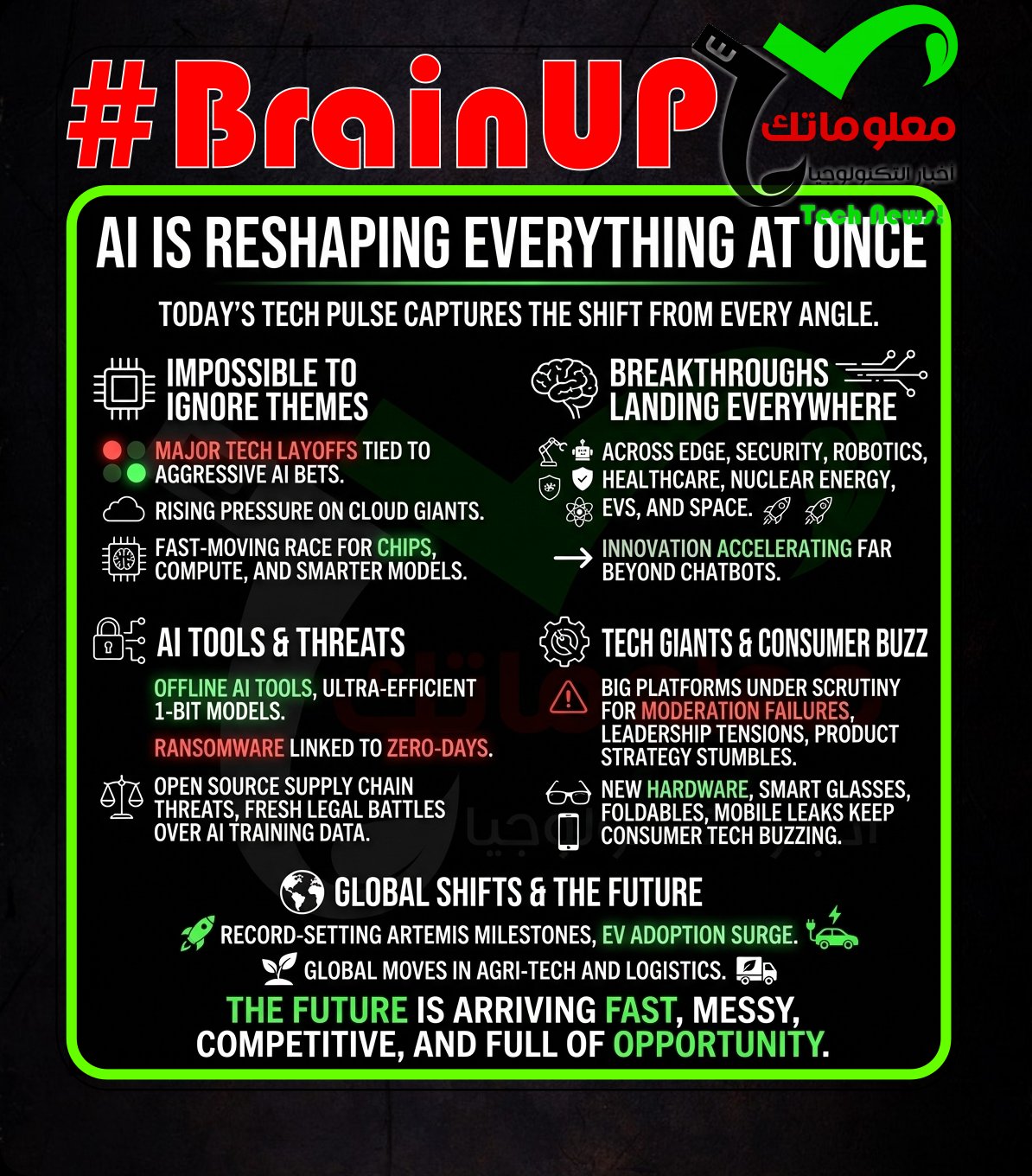
#BrainUp Daily Tech News – (Tuesday, April 7ᵗʰ)
Welcome to today’s curated collection of interesting links and insights for 2026/04/07. Our Hand-picked, AI-optimized system has processed and summarized 32 articles from all over the internet to bring you the latest technology news.
As previously aired🔴LIVE on Clubhouse, Chatter Social, Instagram, Twitch, X, YouTube, and TikTok.
Also available as a #Podcast on Apple 📻, Spotify🛜, Anghami, and Amazon🎧 or anywhere else you listen to podcasts.
1. Tech companies are cutting jobs and betting on AI. The payoff is far from guaranteed
US tech companies are cutting large numbers of jobs while ramping up investment in #AI, betting that tools like #generativeAI and #agenticAI will boost efficiency, even though the payoff and the extent of workforce replacement remain uncertain. The article cites layoffs including @Microsoft (15,000 last year), @Amazon (30,000 in six months), Block (4,000, about 40% of staff), @Meta (more than 1,000 in six months, with a reported potential 20% cut), @Oracle (thousands), and smaller cuts at Pinterest and Atlassian, with Layoffs.fyi estimating more than 165,000 tech layoffs in the past year. Researchers, economists, and workers describe the moment as an ongoing experiment that could produce more job cuts across industries, unforeseen consequences from overreliance on AI, and a fundamentally different model of work. @Ethan Mollick argues that claims that AI is already replacing people are overstated, but so is the idea that jobs are never threatened, suggesting the impact will be complicated. As companies push employees to use AI more, the early results are uneven, reinforcing the article’s point that replacing work at scale is not guaranteed.
2. New EV sales data proves fuel crisis sparks consumer shift
Australian #EV uptake accelerated in March as fuel security fears and rising petrol prices intensified a month into the war with Iran. New sales data showed 15,839 battery electric vehicles sold in March, up 42 per cent on the previous month, and the EV share of new car sales doubled compared with March last year, even as overall new car sales fell 3.3 per cent. Other indicators also jumped: Google searches for “EV” nearly tripled from the start of the year to the end of March, Carsales.com said searches tripled from February to March, and @Polestar Australia’s managing director @Scott Maynard reported tripled test drives, extra weekend staffing, and first quarter 2026 sales nearly doubling year on year. Longer term figures indicate petrol car sales are declining, down more than 25 per cent in the first quarter of 2026 versus four years earlier, while analysts note Australia’s 2025 EV share (14.3 per cent) lagged countries like Vietnam and Thailand, suggesting the fuel disruption is acting as a catalyst for a faster shift and raising urgency to address remaining barriers to the transition.
3. PrismML debuts 1-bit LLM in bid to free AI from the cloud
PrismML, an AI venture out of Caltech, released a 1-bit large language model called Bonsai 8B that it says delivers competitive 8B-class performance while being far smaller, faster, and more energy efficient for edge and mobile use, reducing reliance on cloud AI. The company claims the model fits in 1.15 GB of memory and provides over 10x “intelligence density” versus full-precision counterparts, describing it as 14x smaller, 8x faster, and 5x more energy efficient on edge hardware while remaining competitive with other models in its parameter class. The approach uses a #Transformer-style architecture but represents each weight only by its sign {-1, +1} with a shared scale factor per group of weights, building on prior #quantization research and work by @Babak Hassibi and colleagues. PrismML argues its 1-bit design avoids typical low-bit tradeoffs such as poor instruction following, weak multi-step reasoning, and unreliable tool use, and proposes “intelligence density,” defined as negative log of average error rate across benchmarks divided by model size, as a metric to emphasize compute and energy efficiency. In the company’s comparison, it notes that #Qwen3 8B scores about 0.10/GB on intelligence density and says its 1-bit architecture is intended as a starting point for a new performance-per-watt paradigm.
4. Yahoo Japan’s consolidating 164 OpenStack clusters into one
LY Corporation, formed by the 2023 merger of Yahoo! Japan and @LINE, is replacing its heavily customized #OpenStack environment with a new unified cloud called Flava that stays close to upstream releases and consolidates many clusters into one. The company described the legacy estates as LINE’s Verda with 130,000 VMs on 11,000 hosts across four OpenStack clusters, and Yahoo! Japan’s YNW running on 27,000 servers with more than 160,000 VMs spread over 160 OpenStack clusters, while Flava targets 500-plus hosts, 9,000-plus VMs, and a single OpenStack cluster. Cloud infrastructure head Ryuutarou Inoue said excessive OpenStack modifications made upgrades difficult, so Flava will minimize patches and contribute needed changes upstream to enable regular updates, security, and new features. Flava’s design assumes failures are inevitable and emphasizes stateless VMs with persistent data moved to external storage, application-driven availability rather than infrastructure-only guarantees, and faster recovery via #InfrastructureAsCode rebuilds instead of first restoring an exact prior state. LY also prioritizes observability using #Prometheus, #Grafana, and internal dashboards, drilling into kernel traces and packet captures when anomalies appear, and is automating operations because it sees hardware failures somewhere every day.
5. Google Pixel 10a finally launches in Japan with exclusive ‘Isai Blue’ color [Video]
@Google is bringing the Pixel 10a to Japan via pre-orders, adding a Japan-exclusive “Isai Blue” variant alongside the existing Lavender, Fog, Berry, and Obsidian colors. The deep, near-navy Isai Blue model is a fifth color option developed in collaboration with HERALBONY, a creative company working with artists with disabilities, and is framed as part of the 10th anniversary of #GooglePixel. This special edition is only offered with 256GB storage, includes an exclusive bumper case, stickers, special packaging, and a unique wallpaper plus an original theme pack that matches system icon colors. The Isai Blue Pixel 10a ships May 20, starts at ¥79,900 in Japan, and the Google Store offers boosted trade-ins through April 27, with the exclusive model available only while supplies last.
6. Microsoft links Medusa ransomware affiliate to zero-day attacks
Microsoft has identified a Medusa ransomware affiliate group involved in multiple zero-day vulnerabilities exploitation campaigns targeting Taiwan’s telecommunications sector and public administration entities. The attackers used five zero-day exploits, including those from products like Microsoft Exchange and Zimbra Collaboration Suite, to infiltrate and deploy ransomware, demonstrating sophisticated, multi-vector attack capabilities. This group’s activity highlights an evolving trend in ransomware operations where initial access is gained through zero-days, increasing the threat severity and evasion potential. Microsoft’s findings emphasize the critical need for organizations to prioritize patching and adopt proactive security measures against rapidly advancing ransomware tactics. The connection between ransomware affiliates and zero-day exploit usage marks a significant escalation in cyberattack complexity and impact.
7. Google quietly launched an AI dictation app that works offline | TechCrunch
@Google quietly released an offline-first iOS dictation app called Google AI Edge Eloquent that aims to compete with services like Wispr Flow, SuperWhisper, and Willow. After downloading its Gemma-based #ASR models, users can dictate locally with live transcription, automatic removal of filler words and self-corrections, and text transformations such as Key points, Formal, Short, and Long, with an optional cloud mode that uses #Gemini for cleanup. The app can import selected keywords, names, and jargon from Gmail, supports custom word lists, and provides searchable session history plus stats like recent dictated words, words per minute, and total words spoken. The App Store listing also references an Android version with “seamless Android integration,” including the ability to set it as a default keyboard for system-wide dictation and a floating access button similar to Wispr Flow, though the iOS app is described as early days. The launch positions @Google within the growing trend of #AI-powered transcription, and the article suggests a successful test could lead to improved transcription features across Android.
8. Scientists Create Healing Gel That Could Stop Chronic Wounds From Turning Deadly
Scientists have developed a novel healing gel designed to improve recovery from chronic wounds, which pose significant health risks including infections and death. The gel works by targeting biofilms, which protect harmful bacteria in wounds and make infections difficult to treat with standard antibiotics. Researchers demonstrated that the gel can disrupt these biofilms and promote faster tissue repair in laboratory and animal studies, an advance that addresses a critical challenge in wound care. This innovation could transform treatment protocols for chronic wounds, reducing medical complications and healthcare costs associated with chronic infections. The development of this gel marks a promising step toward safer, more effective therapies for patients suffering from persistent wounds.
9. Samsung is discontinuing its texting app, tells users to switch to Google Messages
@Samsung is officially sunsetting its native messaging platform, Samsung Messages, with a full shutdown scheduled for July 2026, marking the end of its long-standing in-house SMS app and accelerating its transition toward @Google’s ecosystem via #GoogleMessages; the move primarily affects newer Galaxy devices, especially those running Android 12 and above, while older devices (Android 11 or earlier) remain unaffected, reflecting a phased migration strategy rather than a universal cutoff; users are being actively prompted to switch, with Samsung highlighting advantages such as #RCS-based messaging for richer media, typing indicators, and cross-platform interoperability, alongside emerging #AI features like smart replies powered by Google’s ecosystem; notably, after discontinuation, Samsung Messages will no longer support standard texting functions except for emergency communication, underscoring a hard deprecation rather than maintenance mode; this shift represents a broader strategic realignment where Samsung reduces redundancy in core apps and consolidates around Google’s infrastructure, reinforcing Android-wide standardization and signaling a future where messaging innovation is centralized under Google rather than fragmented across OEMs.
10. ‘Grow up’: Meta censoring warnings about illicit drugs, health experts say
Australian drug-checking and harm-reduction organisations say #Meta is removing or restricting Facebook and Instagram posts that warn the public about dangerous illicit substances, potentially putting lives at risk. The @Australian Injecting and Illicit Drug Users League (AIVL) says “critical alerts” have been taken down, with groups including Pill Testing Australia, CanTEST, and KnowYourStuffNZ reporting removed posts, suspended accounts, and in some cases permanently deleted pages and personal accounts. AIVL says #Meta’s automated #contentModeration systems are flagging these alerts as promoting drug use, limiting the ability of services to share where they are operating, what is in circulation, and how to reduce harm. CanTEST clinical lead @David Caldicott says the shift from human to #AI moderation has led to health information being “withheld, altered, or censored,” arguing that drug education has advanced while social media oversight has not, and calling the approach “unacceptable.” The organisations are calling for #Meta to change how it treats educational drug posts and for the #eSafetyCommissioner to intervene so harm-reduction warnings can reach the people who need them.
During #NASA’s #Artemis2 mission, the four astronauts aboard the #Orion capsule set a new record for the farthest humans have ever traveled from Earth, surpassing the distance achieved by Apollo 13 in 1970. The previous mark of 248,655 miles (400,171 km) was exceeded on April 6 at 1:57 p.m. EDT as Orion began looping around the moon’s far side, with a planned maximum distance of about 252,760 miles (406,778 km) later that evening. Before his death, @Jim Lovell recorded a congratulatory message that Mission Control transmitted to the crew, and commander Reid Wiseman called it “awesome,” while Canadian astronaut Jeremy Hansen said the moment honors predecessors and should motivate future generations to beat the record again. The article connects this milestone to earlier Apollo history, including Lovell’s reference to Apollo 8’s “good Earth” message, and notes that Apollo 13’s record came from an unplanned trajectory after an oxygen tank explosion changed the mission.
During @NASA’s #Artemis II mission’s final approach to its lunar flyby, Commander @Reid Wiseman showcased a striking photo of the Moon’s surface captured on his iPhone 17 Pro Max. The crew has been sharing images shot on their iPhones, described by administrator @Jared Isaacman as the first time NASA has allowed astronauts to fly with the latest smartphones, alongside other cameras like a GoPro HERO 4 Black and Nikon D5 and Z 9, with photos posted to NASA Johnson’s Flickr. On the livestream, after the cabin lights were turned off for better photography, Wiseman displayed the image and later confirmed he took it using 8x zoom, with Mission Control identifying the scene as the Chebyshev crater. As the crew completed post-flyby activities and began sending images back to Earth, it was unclear whether the livestream photo would be included in the official upload, and the article points readers to follow the ongoing livestream and future Flickr updates for a full-resolution version.
13. This new framework could make networks of robots, self-driving cars safer
Researchers introduced a new #framework to improve the safety of networks of autonomous agents such as robots and self-driving cars by quantifying how much one agent should trust another. It provides a quantitative measure of the appropriate level of trust an autonomous agent should place in another agent or in a data stream when making decisions. By turning trust into a measurable factor, the approach aims to guide decision-making in multi-agent, data-driven environments where reliability can vary. The work is presented as a way to make connected autonomous systems safer by calibrating trust rather than assuming all inputs are equally dependable.
14. Apple patches critical ‘DarkSword’ iOS 18 vulnerability
15. Claude Code has become dumber, lazier: AMD director
@Stella Laurenzo, director of AMD’s AI group, filed a GitHub issue claiming #ClaudeCode has become “dumber and lazier” since around February and can no longer be trusted for complex engineering work. She says her team reviewed months of logs from a high complexity environment and analyzed 6,852 sessions, 234,760 tool calls, and 17,871 thinking blocks, with senior engineers reporting similar experiences. Their metrics show stop-hook violations associated with “laziness” jumping from zero before March 8 to about 10 per day through the end of March, average code reads before edits falling from 6.6 to 2, and an increase in rewriting whole files instead of making focused edits. Laurenzo links the change to early March deployment of #thinking content redaction in version 2.1.69, arguing that reduced or obscured thinking leads to shallow behavior like editing without reading, stopping early, and choosing simplistic fixes. She asks @Anthropic to be transparent about whether it is reducing or capping thinking tokens and to expose thinking-token counts per request so users can monitor changes, amid broader user complaints about earlier explanation truncation, token-usage surges, and a recent source-code exposure.
16. Ex-Microsoft engineer blames Azure problems on talent exodus
Former @Microsoft engineer Axel Rietschin argues that many of #Azure’s reliability and operational problems stem from a rushed 2008 launch and a subsequent talent exodus that diluted institutional knowledge. In six essays, he describes Azure as a sophisticated system kept “on life support,” with fragility driven by hurried decisions, weak quality and testing discipline, lack of architectural vision, and persistently poor execution, producing small disruptions that accumulated over time. He points to outside signals such as reported federal dissatisfaction with Microsoft 365 GCC High and @OpenAI’s $11.9 billion compute deal with CoreWeave as indicators that Azure struggled to meet demanding needs at scale, alongside Microsoft layoffs of about 15,000 in May to July 2025. Rietschin says these issues could be mitigated by investing in people, specifically bringing back senior technical leaders and strengthening mentoring, coaching, and developer training rather than cutting staff, and he frames current #AI-driven headcount reduction as worsening the risk of running complex code without enough expert oversight. Separately, Martin Alderson of catchmetrics.io adds that the #AI boom is increasing compute demand not only for training and inference but also for CI/CD testing and deployment as coding agents generate large volumes of code.
17. CNBC’s The China Connection newsletter: Why AI isn’t replacing jobs in China (yet)
Even as U.S. tech firms such as @Oracle announce major layoffs, #AI adoption has not pushed Chinese companies to cut staff as aggressively, and engineers in China appear more insulated for now. One reason is policy, Beijing targets a national urban unemployment rate around 5.5%, alongside state-directed pressure to maintain jobs, and another is economics, lower labor costs reduce the incentive to replace people with automation, according to Alex Lu of LSY Consulting. Pay data from Zhilian shows high-demand algorithm engineers average 20,035 yuan per month, far below Silicon Valley levels, and a Silicon Valley HR manager said a U.S. “level 2” software engineer earning about $300,000 could face a 50% base-pay cut if moved back to China. Cross-Pacific competition for the same talent persists, but U.S. layoffs can also jeopardize Chinese nationals’ immigration status, prompting some to return to China, where longer hours and a more competitive environment can be a shock. Structural and cultural differences such as more in-office expectations, leaders’ preference for large in-person teams, and broader job scopes for Chinese engineers make roles harder to replace fully with #AI, helping explain why job displacement looks more contained in China so far.
18. OpenAI and Anthropic Eye IPOs Amid Soaring AI Interest and Valuations
OpenAI and Anthropic are preparing to go public as investor enthusiasm for artificial intelligence surges, reflecting strong financial backing and optimistic growth prospects. Both companies have attracted significant funding from major investors like Microsoft, with OpenAI valued in the tens of billions and Anthropic achieving unicorn status. The shift toward IPOs comes amid a broader AI boom, where technological advancements and commercial potential have heightened market interest in #AI startups. OpenAI and Anthropic’s moves indicate a critical transition from private funding to public market scrutiny, which could influence AI sector valuations and innovation dynamics. These IPO plans underscore the expanding confidence in AI’s transformative impact and the appetite for investment in AI development.
19. Broadcom scores Google chip deal with Anthropic as customer
Broadcom has secured a significant chip supply agreement with Google, with AI startup Anthropic named as a customer benefiting from the deal. The arrangement highlights Broadcom’s expanding role in providing high-performance semiconductors supporting #AI infrastructure and cloud computing services. Anthropic’s involvement underscores the increasing demand for advanced chips tailored to large language models and AI workloads. This partnership demonstrates the growing collaboration between cloud providers and chipmakers to meet the surging needs of AI-driven applications. As AI adoption accelerates, such deals will be pivotal in shaping the future of computational hardware and software integration.
20. Broadcom agrees to expanded chip deals with Google, Anthropic
@Broadcom said it will produce future versions of @Google’s #AI chips and expanded its deal with @Anthropic to provide about 3.5 gigawatts of computing capacity using Google’s #TPUs, sending Broadcom shares up about 3% in extended trading. The company disclosed the arrangements in a securities filing as demand for #generativeAI infrastructure accelerates, and Anthropic said most of the new infrastructure will be located in the U.S. Anthropic also reported rapidly rising momentum, with annualized revenue exceeding $30 billion, more than 1,000 business clients spending over $1 million annually, and its Claude app ranking as the top free U.S. app in @Apple’s App Store in February. Broadcom CEO @HockTan previously said Anthropic would receive 1 gigawatt of compute in 2026 with demand expected to exceed 3 gigawatts in 2027, while analysts at Mizuho estimated Broadcom could gain $21 billion in AI revenue from Anthropic in 2026 and $42 billion in 2027, though Monday’s filing did not state dollar amounts. The deal highlights intensifying competition in custom silicon and compute sourcing, with Broadcom also collaborating with @OpenAI, and both model builders still relying heavily on #GPUs from @Nvidia via cloud providers like @Amazon, @Google, and @Microsoft, alongside OpenAI’s commitment to use 6 gigawatts of @AMD GPUs.
21. Three YouTubers accuse Apple of illegal scraping to train its AI models
Three YouTube channels, h3h3 Productions, MrShortGameGolf and Golfholics, filed a class action lawsuit accusing @Apple of illegally scraping their copyrighted YouTube videos to train its #AI models. The suit alleges Apple violated the #DMCA by improperly circumventing YouTube’s “controlled streaming architecture” and platform protections that limit how regular users access videos. The creators claim the scraped videos were used to train Apple’s #generativeAI products and argue Apple’s financial success depended in part on creators’ content. The article notes these channels have brought similar lawsuits against @Meta, @Nvidia, @ByteDance and @Snap, and situates the case among other high profile disputes over alleged unauthorized AI training data involving @OpenAI, @Microsoft, Reddit and Encyclopedia Britannica. Engadget reports it contacted Apple for comment and will update if it receives a response.
22. China’s agricultural technology makes leap forward in going global
China is pushing Shouguang’s #facilityAgriculture and greenhouse know-how overseas by turning tech-enabled cultivation into standardized, exportable solutions that are adapted to local conditions. At Lisente Agricultural Technology Co Ltd, chairman @WangShoubo described shipping steel greenhouse frames to Uzbekistan so vegetables and fruits can be grown in desert environments, while Shouguang’s systems include automatic temperature control, intelligent irrigation, and data monitoring. The company redesigned ventilation for Central Asia’s hot climate by shifting from typical side ventilation to full top ventilation, and in Guinea it created “double-slope greenhouses” with double-sided shading, no rear walls, and manual gear and pulley mechanisms to handle heat, heavy rain, and high electricity costs, expanding the project to over 1,000 mu. Lisente reports completing more than 270 projects in over 40 countries and upgrading from greenhouse construction to full industrial-chain services such as park planning, seedling cultivation, and technical guidance, alongside over 30 Shouguang enterprises and cooperatives establishing more than 300 cultivation parks abroad. With the start of China’s #15thFiveYearPlan (2026-2030) and a focus on high-standard opening up, the article links these localized agricultural technology exports to broader international agricultural cooperation.
23. India’s first 500 MWe fast breeder reactor achieves criticality
India’s first 500 MWe #fast breeder reactor has reached criticality, marking a major step forward in the country’s domestic nuclear engineering capabilities. The achievement indicates that the reactor has attained a self-sustaining nuclear chain reaction. It is presented as progress not only in building advanced nuclear systems at home, but also in the reactor’s role in generating nuclear fuel. Overall, the milestone signals momentum in India’s efforts to develop #nuclear energy technology and fuel generation capacity tied to fast breeder reactors.
24. Amazon says it has reached deal with U.S. Postal Service on package deliveries
Amazon has finalized a deal with the U.S. Postal Service to continue delivering packages through the 2026 holiday season. The agreement extends Amazon’s use of the Postal Service, which is a crucial element of its last-mile delivery network. This renewal addresses both companies’ interests in managing package volume and delivery capacity, supporting improved operational efficiency. The deal reflects Amazon’s ongoing strategy to diversify its shipping solutions and reduce reliance on traditional carriers. It also signals the Postal Service’s role as a vital partner in the growing e-commerce logistics sector.
25. The Best Anti-Meta Smart Glasses Are About to Have Tough Competition
A new entrant, Nimo, is challenging Even Realities in the niche of “anti-@Meta” smart glasses that avoid cameras and speakers while keeping a lightweight, normal-glasses design centered on #AI features. Nimo says its display glasses weigh 29g, about 7g less than the Even G2, use a binocular monochrome green display, and offer common functions like translation, web search, navigation, notifications, and reminders. The specs shown so far also claim 1,500 nits peak brightness (vs. 1,200 on the Even G2) and roughly 48 hours of battery life, while omitting accessories like Even Realities’ optional touch-sensitive smart ring. That simpler package may help explain the lower preorder price of 2,499 yuan (about $363) compared with the Even G2’s $599 MSRP. With no U.S. launch confirmed, the announcement still suggests growing competition among camera-free, speaker-free smart glasses positioned as alternatives to Ray-Ban-style @Meta offerings.
26. The problem is Sam Altman: OpenAI insiders don’t trust CEO
OpenAI insiders reportedly harbor significant distrust toward CEO @Sam Altman, which has created internal challenges as the company navigates its rapid growth in #AI development. Sources describe concerns about Altman’s leadership style and decisions, suggesting a disconnect between the CEO’s vision and staff expectations. This mistrust affects organizational cohesion and raises questions about the future strategic direction of OpenAI. The discord exemplifies how leadership struggles can impact tech firms amid escalating competition in artificial intelligence. Understanding this internal dynamic is crucial to gauging OpenAI’s potential trajectory and stability.
27. OpenAI proposal links robot taxes to public wealth fund
A policy-oriented proposal associated with @OpenAI explores the concept of taxing automation through “robot taxes” and redirecting the revenue into a public wealth fund, aiming to offset job displacement caused by #AI and #Automation while redistributing economic gains more equitably; the idea reframes technological disruption as a fiscal opportunity, where productivity gains from AI systems could fund social safety nets or universal dividends, echoing debates among economists and policymakers about the future of labor and capital ownership; this approach positions AI not only as a disruptive force but as a potential foundation for new socio-economic models, raising critical questions about governance, taxation frameworks, and the balance between innovation incentives and societal stability.
28. Tesla No.1 EV Maker For Q1 2026
Tesla retained its position as the leading electric vehicle maker in the first quarter of 2026, delivering the highest number of EV units globally. Despite increasing competition from established automakers and emerging startups, Tesla maintained a significant edge due to its extensive model lineup, advanced battery technologies, and innovative manufacturing processes. The company’s focus on expanding production capacity and optimizing supply chains contributed to its strong quarterly performance. Tesla’s continued dominance illustrates the effectiveness of its integrated approach to EV market challenges and positions it well for future growth as global demand for electrified transportation increases.
29. Signal Private Messenger review: privacy-first messaging earns top marks
In this evaluation, Signal Private Messenger is positioned as a benchmark for #SecureMessaging, earning a 4.5/5 “Outstanding” rating for delivering a rare balance between strong #EndToEndEncryption and user-friendly functionality, with @PCMag emphasizing its nonprofit model as a key differentiator that removes incentives for data harvesting and advertising; built on the widely trusted #SignalProtocol, the app secures all communications by default, including texts, voice, and video calls, while collecting virtually no user metadata, a claim reinforced by real-world legal disclosures showing minimal accessible data even under government requests ; beyond privacy, the platform offers a polished cross-platform experience across mobile and desktop, but still carries trade-offs such as requiring a phone number for registration and lacking cloud backups, which can limit convenience and accessibility compared to mainstream rivals ; overall, the review frames Signal as the gold standard for private communication, particularly for users prioritizing security over ecosystem lock-in or feature-rich social layers, reinforcing its status as the leading choice in privacy-centric messaging.
A suspected North Korean cyberattack briefly hijacked the widely used #open-source Axios project on March 31 after weeks of targeted social engineering against its maintainer, showing how compromising a single trusted developer can poison software used across the web. Maintainer Jason Saayman said the attackers spent about two weeks building rapport by posing as a real company, setting up a realistic #Slack workspace, and using fake employee profiles, then lured him into a web meeting that prompted a malware download disguised as a required update, a technique he said resembles methods highlighted by @Google researchers. After gaining remote access to Saayman’s computer, the attackers published two malicious Axios packages that were removed roughly three hours later, but they may still have reached thousands of systems, and any machine that installed them could have had private keys, credentials, and passwords stolen, enabling further breaches. The incident underscores broader #cybersecurity challenges for popular open source projects as state hackers and criminals target widely deployed components for their reach, while North Korea remains a major threat actor linked to large-scale cryptocurrency theft that helps fund the sanctioned Kim Jong Un regime. Saayman’s postmortem timeline ties the supply-chain compromise back to a long-running, trust-building campaign aimed at the project’s top developer.
31. New iPhone 18, iPhone Air 2 leaks on design, release date arrive – 9to5Mac
New leaks outline modest design expectations for the base iPhone 18 and suggest the iPhone Air 2 is still on track for a typical fall update cycle. Weibo leaker Fixed Focus Digital says the standard iPhone 18 will look virtually the same, keeping the same #DynamicIsland, with only a possible minor dimension tweak, aligning with reports that a smaller Dynamic Island would be limited to iPhone 18 Pro and Pro Max and contradicting a claim from @Ice Universe. The same leaker also reiterates that iPhone Air 2 will proceed on its normal iteration schedule and launch this fall, despite reports from The Information and @Mark Gurman pointing to a spring 2027 delay tied to adding a second rear camera. The post frames Air 2 as a routine, mostly internal upgrade, with an example possibility being an A20 Pro chip rather than major hardware changes. Overall, the leaks suggest Apple’s non Pro flagships will see iterative updates and that Air 2 timing could keep a fall lineup intact even if the base iPhone 18 is expected later.
32. One UI 8.5 beta expands to multiple Galaxy devices
@Samsung is broadening the rollout of its #OneUI 8.5 beta, extending testing beyond flagship foldables to mid-range devices like the Galaxy A series, signaling a more inclusive software strategy that accelerates feature parity across its ecosystem; built on Android 16, the update continues Samsung’s push into #GalaxyAI integration, refining system-level intelligence, UI responsiveness, and cross-device continuity, while also serving as a validation phase before wider public deployment; this expansion reflects Samsung’s evolving update philosophy, moving from tiered feature distribution to a more unified software experience that strengthens ecosystem lock-in and competitiveness against both @Apple and other Android OEMs.
33. OnePlus 16 leaks reveal major camera and design overhaul
Leaked details suggest @OnePlus is preparing a significant hardware pivot with the upcoming OnePlus 16, particularly in its camera architecture where the company may abandon prior configurations in favor of a redesigned sensor layout and potentially new imaging partnerships, reflecting the industry-wide escalation in #ComputationalPhotography competition; design-wise, the device is rumored to adopt a refined aesthetic with structural changes that could impact ergonomics and thermal management, indicating a shift beyond incremental upgrades toward a more foundational redesign; these leaks collectively point to OnePlus attempting to reposition itself more aggressively in the flagship tier by prioritizing camera innovation and differentiated hardware identity in an increasingly saturated premium smartphone market.
34. Apple’s foldable iPhone encounters engineering snags, faces potential shipment delay
Apple’s development of a foldable iPhone is facing significant engineering challenges related to the device’s design and software, according to sources familiar with the matter. These obstacles could push the product’s shipment timeline beyond the initially targeted 2025 release, potentially delaying it until 2026. The complications involve ensuring the durability and user experience of the foldable screen, a pivotal component for the success of such advanced #smartphone technology. Despite these setbacks, Apple continues to invest heavily in foldable technology development, signaling its long-term commitment to expanding its product lineup. This delay highlights the complexities tech giants like @Apple encounter when innovating novel smartphone form factors amidst intense market competition.
That’s all for today’s digest for 2026/04/07! We picked, and processed 32 Articles. Stay tuned for tomorrow’s collection of insights and discoveries.
Thanks, Patricia Zougheib and Dr Badawi, for curating the links
See you in the next one! 🚀
