
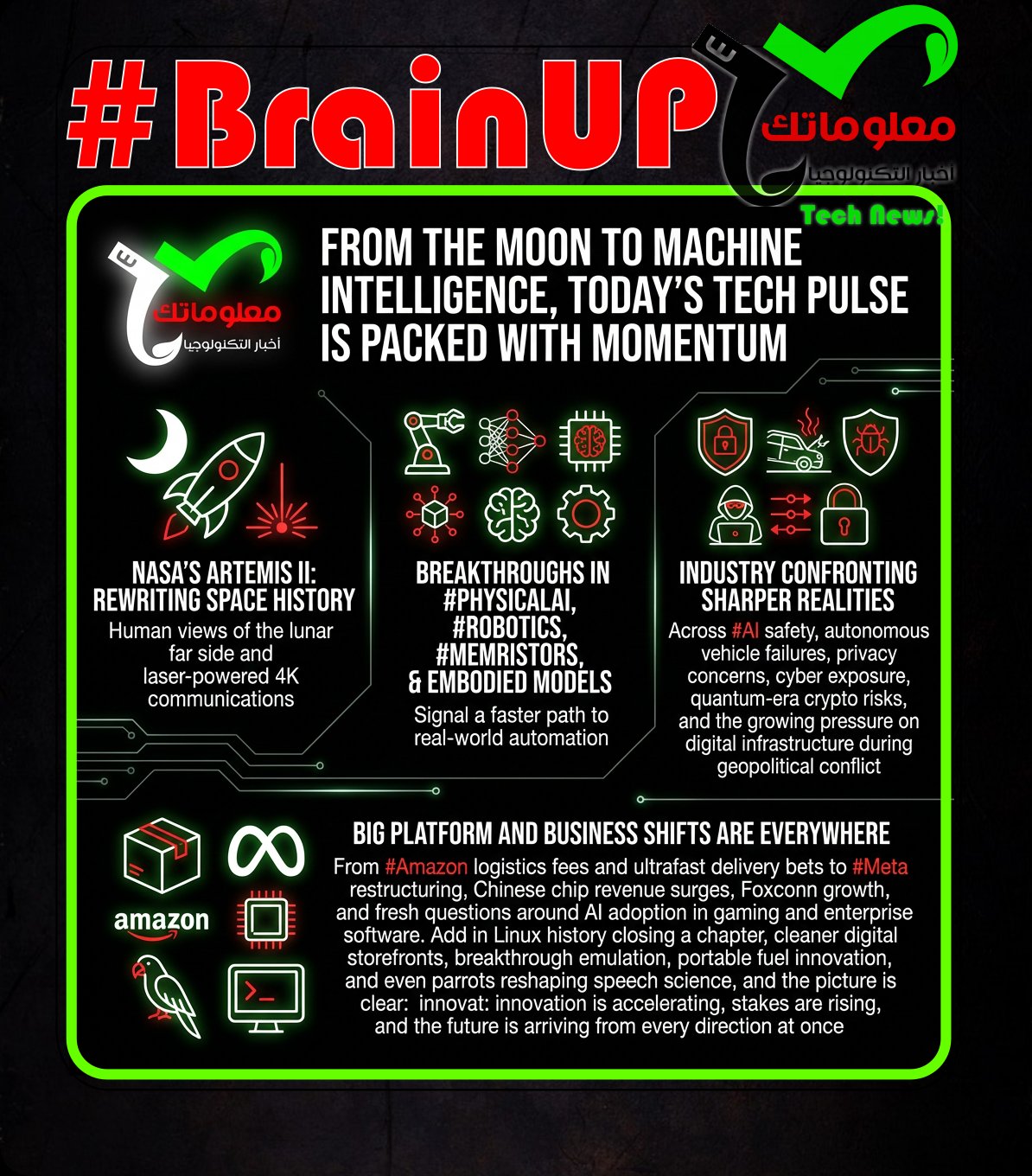
#BrainUp Daily Tech News – (Monday, April 6ᵗʰ)
Welcome to today’s curated collection of interesting links and insights for 2026/04/06. Our Hand-picked, AI-optimized system has processed and summarized 32 articles from all over the internet to bring you the latest technology news.
As previously aired🔴LIVE on Clubhouse, Chatter Social, Instagram, Twitch, X, YouTube, and TikTok.
Also available as a #Podcast on Apple 📻, Spotify🛜, Anghami, and Amazon🎧 or anywhere else you listen to podcasts.
1. A milestone for Artemis II: Astronauts enter the ‘lunar sphere of influence’
#Artemis II reached a key milestone as the @NASA Orion crew crossed into the moon’s #lunar sphere of influence, the region where lunar gravity exceeds Earth’s. Flight director @Rick Henfling said Orion entered this mathematical boundary at about 12:41 a.m. ET Monday, marking the first time humans have done so since Apollo 17 in 1972. The crew, @Reid Wiseman, @Christina Koch, @Victor Glover, and Canadian astronaut @Jeremy Hansen, sent back a final crescent view of Earth, tested newly designed orange launch and re-entry suits that can support breathable air for up to six days in a depressurization emergency, and executed a needed 14-second engine burn after earlier correction maneuvers proved unnecessary. Later Monday they are scheduled to swing around the moon, potentially setting a new distance record at about 252,760 miles from Earth, then spend about seven hours observing and photographing lunar terrain, including areas not previously seen by human eyes, with live coverage beginning at 1 p.m. ET. The milestone underscores Orion’s precise navigation and the mission’s progression toward detailed lunar observations during the flyby.
A #system malfunction caused more than 100 @Baidu Apollo Go #robotaxi vehicles to stop unexpectedly in Wuhan, China, leaving passengers stranded in active, high speed traffic on a ring road. Wuhan police said a preliminary investigation found the AI powered taxis halted Tuesday night, at least one collision occurred, and riders reported screens displaying a “Driving system malfunction” message promising staff arrival in five minutes that did not materialize, prompting some to exit. No injuries were reported, and multiple people were rescued, with local media calling it the first mass shutdown of robo taxis in China. @Baidu has not identified the cause, while commentators cited possibilities such as cloud connectivity problems or software bugs, and the incident comes as Baidu expands its fleet across China and abroad, raising the prospect of tighter regulation. The report situates the outage among other #autonomous vehicle incidents in China and the US, including prior Apollo Go and Pony.ai crashes and fires, and @Waymo stoppages and regulatory scrutiny.
3. GEN-1: Scaling Embodied Foundation Models to Mastery – Generalist AI
Generalist AI introduces GEN-1, a large multimodal, real-time action model that they claim is the first general-purpose physical AI system to cross a threshold of mastery for simple robot tasks, making commercial viability possible across many applications. Compared with prior models, GEN-1 reportedly raises average success rates to 99% on tasks where earlier systems achieved 64%, completes tasks up to about 3x faster than prior state of the art, and attains these gains with roughly 1 hour of robot data per result. The team frames this as a continuation of their GEN-0 work showing #scaling laws in robotics and argues that further scaling plus algorithmic advances yields improved reliability, speed, and emergent improvisation in unexpected scenarios. GEN-1 is described as trained from scratch on a redesigned embodied foundation model using a dataset of about half a million hours of real-world data, while still not solving all tasks. These results are presented as evidence that continued scaling with physical experience can keep advancing #embodied foundation models toward generalist intelligence for the physical world.
#Sony has again delisted multiple titles from the #PlayStation Store as part of an ongoing push against alleged #shovelware publishers and low-quality releases. According to PSNProfiles, removals include games from GoGame Console Publisher, VRCForge Studios, and Welding Byte, such as Urban Driver Simulator and several VRCForge titles including Water Blast Shooter – Wet Gun, Racing Car Chaos: Extreme Stunt Showdown, Supermarket CEO Simulator, and Jesus Simulator. The targets are described as publishers and developers whose games use titles resembling successful indie games, or that are low-effort #asset-flip or #AI slop. The article links this to a longer-running effort, noting that in January Sony removed over a thousand games from a single developer in what appeared to be a major storefront clean-up. It also points to a broader industry pattern of combating deceptive storefront content, citing @Mob Entertainment’s lawsuit alleging Google failed to remove “scam” apps mimicking #PoppyPlaytime releases.
5. Linux 7.1 is finally ending support for Intel’s 37-year-old 486 processor
Linux 7.1 is set to begin sunsetting built-in support for Intel’s i486 processors, marking the start of dropping a 37-year-old CPU architecture from modern kernels. A queued change spotted by Phoronix, authored by @Ingo Molnar and titled “x86/cpu: Remove M486/M486SX/ELAN support,” removes #x86-32 compatibility pieces by deleting CONFIG_M486SX, CONFIG_M486, and CONFIG_MELAN. @Linus Torvalds argues that the “compatibility glue” for ancient 32-bit CPUs is used by very few people, can cause problems that waste developer time, and that there is “zero real reason” to keep spending effort on i486 issues. The change is not merged yet, but the article suggests it is likely given Linus’s stance. For the rare users still running an i486, the recommended path is to use an #LTS kernel or an older Linux distro that will keep older kernel versions supported for a while.
6. Texas Republican Called Out For Sharing AI Rendering of Rescued Soldier
@Greg Abbott was criticized online after reposting an #AI-generated image that purported to show a U.S. airman, described as a colonel, being rescued from Iran. The article says a U.S. F-15 was shot down over Iran, both airmen ejected, and after one was initially recovered, @Donald Trump announced on Truth Social that the second was successfully rescued following a major search. Abbott shared a dramatic image of a service member with an American flag and a smiling rescue team, captioning it “This is so awesome,” but his repost quickly drew a community note stating the photo was synthetic and that the Pentagon had released no official images for operational security. @Billy Binion of Reason cited the incident as a troubling example of poor #media literacy, arguing the Texas governor should not share an obviously fake photo from a “slop account.” The episode is presented as a cautionary case about how easily #AI imagery can be mistaken for real documentation during fast-moving military news.
7. Amazon to slap a 3.5% surcharge on third-party sellers as Iran war drives up fuel prices
Amazon will add a 3.5% fuel and logistics surcharge to certain third-party sellers as fuel prices rise following the war in Iran. The temporary fee starts April 17 for many U.S. and Canadian sellers using #Fulfillment_by_Amazon, and it expands May 2 to sellers using #Buy_with_Prime and #Multi_Channel_Fulfillment. Amazon said elevated fuel and logistics costs have increased operating expenses across the industry, and while it has absorbed the increases so far, it is implementing a surcharge to partially recover costs, adding that its charge is meaningfully lower than those of other major carriers. The move aligns Amazon with other shippers raising fuel surcharges, including UPS, FedEx, and the USPS, which announced an 8% surcharge for packages shipped starting April 26 that would last until Jan. 17, 2027. Amazon said it remains committed to seller success and to maintaining broad selection and low prices for customers.
Developers of the open-source PlayStation 3 emulator RPCS3 say they achieved a #Cell Broadband Engine emulation breakthrough by identifying new #SPU usage patterns and generating more efficient native PC code for them. Lead developer @Elad (elad335) added new recompilation code paths that improve the emulator’s SPU translation via its #LLVM and #ASMJIT backends, with Twisted Metal showing a 5% to 7% average FPS increase between builds v0.0.40-19096 and v0.0.40-19151. Because #SPU emulation is RPCS3’s largest CPU bottleneck, tighter host-side machine code reduces CPU overhead across the board, and the project says all CPUs can benefit, including reports of improved audio and slightly better Gran Turismo 5 performance on a dual-core AMD Athlon 3000G. The article also notes Elad’s prior SPU work (June 2024) that delivered 30% to 100% gains on 4-core/4-thread CPUs, plus recent examples of recompilation efficiency (over 1,500 FPS on Minecraft PS3 Edition’s title screen) and new Arm64 SDOT/UDOT optimizations for Apple Silicon and Snapdragon X. Overall, the changes strengthen RPCS3’s approach of recompiling PS3 SPU workloads into host CPU threads more efficiently, improving performance across its game library.
Iran’s #IRGC publicly warned the U.S. that any damage to Iran’s power infrastructure would trigger retaliation, and it singled out @OpenAI’s reportedly “hidden” $30B, 1GW #Stargate AI data center in Abu Dhabi as a target. IRGC spokesperson @Ebrahim Zolfaghari said that if the U.S. proceeds with threats toward Iran’s power plant facilities, “all power plants, energy infrastructure, and information and communications technology” tied to Israel and similar regional companies with American shareholders would face “complete and utter annihilation.” In a video, the IRGC zooms from space into Abu Dhabi using Google Maps, overlays the message “Nothing stays hidden to our sight, though hidden by Google,” then shows a night-vision style view revealing the data center’s apparent footprint. The article notes questions about whether Iran can or will strike such targets, pointing out it has reportedly disrupted some #Amazon #AWS data centers via rocket strikes and has issued similar threats recently against @Nvidia, @Microsoft, @Apple, @Google, and other U.S. tech companies, suggesting escalation risk if rhetoric and force do not cool.
10. Dental student died in ICU overseen by remote ‘tele-health’ physician: Lawsuit
A lawsuit filed by Conor Hylton’s parents alleges their 26-year-old son died in 2024 at Bridgeport Hospital Milford Campus after being placed in an ICU that relied on remote #telehealth coverage and lacked an on-site ICU physician. The complaint says @Yale New Haven Health and its Northeast Medical Group were negligent because no on-site doctor assessed Hylton from ICU admission until after he showed seizure-like activity, and records allegedly show limited tele-ICU contact focused on sedation orders with missing monitoring and assessments despite alcohol-withdrawal risks. Hylton was admitted Aug. 14, 2024 with diagnoses including pancreatitis, dehydration, metabolic acidosis, and alcohol withdrawal, deteriorated overnight with agitation and mental status changes, then became unresponsive around 4:30 a.m. on Aug. 15, vomited, became bradycardic, was intubated, and could not be resuscitated. The suit claims a remote provider pronounced him dead via video and that the family was not notified as his condition worsened. The family argues that poor provider communication and reliance on off-site #teleICU care violated hospital policy and contributed to the fatal outcome.
11. Bloomberg – Are you a robot?
The provided text is a #bot-detection and access message from Bloomberg.com rather than an article. It says Bloomberg detected unusual activity from the user’s computer network and asks the user to click a box to confirm they are not a robot. It explains this can happen if the browser does not support #JavaScript and #cookies or if they are blocked, and it references Bloomberg’s Terms of Service and Cookie Policy. It also provides a support contact instruction and a block reference ID, and promotes subscribing to Bloomberg.com. No information about Ireland, a #digitalID test, or verifying the age of social media users is included in the text.
12. Internet shutdown in Iran is now the longest in world history
Iran is experiencing the longest nationwide #InternetShutdown ever recorded, reaching 37 days offline as of Sunday, April 5, 2026, according to Netblocks. The shutdown was imposed by the ruling mullah regime on February 28 after attacks by the USA and Israel, and it follows a previous record-length shutdown in January amid mass protests that were brutally suppressed, with media reports citing around 30,000 deaths. During the current blockade, only a very limited national network is available, major services such as Instagram are inaccessible, and earlier exceptions for regime loyalists and propaganda were largely halted before the Persian New Year. Netblocks reports connectivity at about 1 percent of normal, while online retail has nearly stopped and hundreds of thousands of companies and the IT industry are affected. The new record surpasses Sudan’s 36-day near-total shutdown in 2019, imposed after a deadly crackdown in Khartoum involving the military and the paramilitary RSF.
13. CBP facility codes sure seem to have leaked via online flashcards
A public Quizlet flashcard set titled “USBP Review” appeared to expose highly confidential #gate-security details and operational information for @US Customs and Border Protection facilities around Kingsville, Texas. The cards allegedly listed specific four digit combinations for checkpoint doors and gates, described immigration offenses and related charges, outlined paperwork for voluntary return, expedited removal, and warrant of removal, and included granular operational details such as the Kingsville workforce’s 1,932 square mile area, county lines, internal grid and zone structure, and the names of 11 CBP towers. It also referenced an internal system called #E3_BEST used at USBP checkpoints to record and adjudicate secondary referrals by querying subjects and vehicles across multiple law enforcement databases and creating events tied to arrests. The set was public from February until March 20, when it was made private shortly after @WIRED contacted a phone number potentially linked to the user, and CBP said its Office of Professional Responsibility is reviewing the incident while Quizlet said it acts promptly on policy violating sensitive content. WIRED could not verify the creator was an active CBP agent or contractor, but if the material came from someone associated with CBP, it would represent a serious security breach as the agency and related enforcement bodies pursue rapid hiring and incentives.
14. Russia Allegedly Swung at VPNs but Accidentally Hit Its Own Banking Sector Instead
Russia’s attempt to clamp down on #VPNs allegedly caused widespread collateral damage, including disruption to banking services. In a Telegram post reported by Bloomberg, @Pavel Durov said Russia’s blocking efforts aimed at VPNs triggered a massive banking failure, briefly making cash the only payment method nationwide, and Russian media reports cited by Bloomberg said banking apps were disrupted, possibly due to overload in filtering systems run by the communications watchdog. This incident fits a recent pattern of heavy-handed internet interference in Russia, where efforts to prune unwanted services can destabilize the network, and experts warned that major restrictions risk undermining network stability. The government has publicly pushed to reduce VPN usage and promote Max, a centralized official app described as lacking apparent encryption or privacy protections, and earlier restrictions reportedly targeted WhatsApp and Telegram to drive users there. Durov argues the Telegram crackdown has not worked because VPNs keep usage high, and he notes a similar 2018 attempt to block Telegram reportedly caused broad disruptions to online payments and other services while only modestly reducing Telegram’s Russian audience.
15. NASA’s Artemis II is using lasers to beam 4K video back from the moon
On NASA’s Artemis II flyby mission, the Orion crew module is testing #O2O, a laser based optical communications terminal intended to dramatically increase deep space data return, including sharper video such as 4K. Developers from NASA’s #SCaN program and @MIT Lincoln Laboratory say O2O uses bursts of infrared light instead of traditional microwave radio links, while Orion still relies on the #Near Space Network and #Deep Space Network as its core radio communications backbone. The system follows more than a decade of optical link demonstrations, including the 2013 Lunar Laser Communication Demonstration and later efforts like #TBIRD and #DSOC, plus a similar terminal that has operated on the #ISS for over two years, each setting new data rate records. O2O is expected to reach up to 260 megabits per second down to Earth and about 20 megabits per second back to Orion, enabling two way video with roughly a one second round trip lag. By providing higher bandwidth with smaller, lighter hardware, the test supports Artemis goals of more continuous human activity around the moon and more practical real time communication for astronauts.
16. In Japan, the robot isn’t coming for your job; it’s filling the one nobody wants | TechCrunch
Japan is moving #PhysicalAI from pilots into real deployment because shrinking labor supply is making automation a continuity requirement for factories, warehouses, infrastructure, and services. Investors and executives cited cultural acceptance of robotics, strong mechatronics and hardware supply chains, and especially demographic-driven labor shortages, with Japan’s population declining for a 14th straight year in 2024 and the working-age share at 59.6%, projected to fall by nearly 15 million over 20 years. Japan’s Ministry of Economy, Trade and Industry says it aims to build a domestic physical AI sector and capture 30% of the global market by 2040, building on an industrial robotics position where Japanese makers accounted for about 70% of the global market in 2022. A 2024 Reuters/Nikkei survey is cited as finding labor shortages are the main force pushing Japanese firms to adopt AI, reframing the goal from efficiency to industrial survival and national urgency. Companies like Mujin are highlighted as examples, with software enabling industrial robots to autonomously handle picking and logistics tasks as Japan steps up manufacturing and logistics automation.
17. AI-powered cameras on Wichita school buses raise privacy concerns for one driver
Wichita Public Schools buses are getting upgraded from on-bus recording systems to #AI-powered cameras using the #Samsara platform, prompting privacy concerns from at least one driver. Bus driver Kent Myrtle said the previous First Student system stored video on the bus, while the new system transmits footage to the cloud via #AmazonWebServices, which he believes increases the risk of technical vulnerabilities and human error compared with data that would require physical theft to access. He also said he is unsure whether parents and students received consent forms and warned that children’s privacy cannot be restored once lost. Wichita Public Schools Transportation Director Lisa Riveros said the district stands behind the technology, emphasized that student privacy remains a priority and that First Student owns and secures the footage, and added that the AI features such as real-time monitoring and hazard detection are intended to enhance safety. First Student did not respond to a request for comment by the time of the report, and families with questions are directed to the district transportation department.
18. Team builds memristor built with oxygen gradient for stability and switching speed
Researchers have developed a memristor equipped with an oxygen gradient to enhance stability and switching speed, advancing the field of #neuromorphic computing. The design controls oxygen vacancy migration, which stabilizes the memristor’s resistance states and improves switching performance. This oxygen-gradient memristor shows promising endurance and retention characteristics, crucial for memory and logic applications. The innovation could lead to low-power, high-speed devices that better emulate biological synapses, fulfilling a key challenge in artificial neural networks. This approach links material engineering with device functionality, pushing forward the practical use of memristors in next-generation computing.
19. Microsoft Allows Users to Use AI Tools on Own Terms, Emphasizing Risk Responsibility
Microsoft has clarified its stance on AI tool usage, including #Copilot, stating that users operate these tools at their own risk under their own terms of use. The company emphasizes that while it provides powerful AI capabilities designed to aid productivity, it does not guarantee the absence of errors or appropriateness of AI-generated content. This approach reflects Microsoft’s balance between offering innovative technology and managing the inherent risks of AI deployment, underlining user responsibility in oversight. Microsoft’s position signifies a shift towards empowering users with control over AI tools while highlighting potential risks in professional and creative applications. Such policies align with broader industry challenges around transparency and accountability in AI utilization.
20. Chinese chip firms hit record high revenue driven by the AI boom and U.S. curbs
Chinese semiconductor firms are posting record 2025 revenue as domestic demand for #AI infrastructure surges and #US export restrictions push China’s #self-sufficiency drive. #SMIC said 2025 revenue rose 16% to a record $9.3 billion, with LSEG estimates suggesting it could exceed $11 billion in 2026, while Hua Hong reported record fourth-quarter revenue of $659.9 million and guided $650 million to $660 million in sales. Moore Threads, positioning itself as a domestic rival to @Nvidia, forecast 2025 revenue of 1.45 billion to 1.52 billion yuan, up 231% to 247% year on year. Analysts said demand is supported by electric vehicles and mature-node chips, but advanced chip demand is “through the roof” because of #AI, and curbs on @Nvidia chip exports are encouraging purchases of domestic alternatives such as @Huawei despite performance gaps. China’s memory-chip makers are also benefiting from global shortages and price spikes, with ChangXin Memory Technologies reportedly seeing revenue jump 130% to more than 55 billion yuan, and restrictions on high-bandwidth memory exports creating further openings for local suppliers.
21. Amazon is betting on speed in a market that may not need it
Amazon is renewing its push into #quick-commerce by testing 30-minute delivery in select U.S. locations and offering one- and three-hour options across thousands of cities, despite the model’s shaky track record in Western markets. The company is drawing on experience from a 10-minute service in India (since June 2025) and a 15-minute service in the UAE, while China shows the scale possible, with a $125 billion market and about one in four people using ultrafast delivery. Experts argue demand is often “manufactured” through deep discounts, convenience marketing, and habit formation rather than urgent need, and in India quick commerce remains only 1%–2% of trade even as discounting runs higher than general trade (6%–9% vs 2%–5%). The convenience brings costs such as environmental impact from underfilled last-mile deliveries, packaging waste, and dangerous working conditions for gig workers, highlighted by protests in India and a government request that platforms stop promoting 10-minute deliveries. With global funding down sharply in 2025 versus 2021, dozens of shutdowns, and prior U.S. failures tied to unit economics and labor costs, the article suggests Amazon’s speed bet may be misaligned with what the U.S. market can sustainably support.
22. Foxconn first quarter revenue jumps 30% y/y
Foxconn’s revenue surged 30% year-over-year in the first quarter, driven by strong demand for Apple products and diversification into electric vehicles and cloud computing. The company’s expansion into new sectors alongside its traditional electronics manufacturing has fueled significant growth, highlighting its strategic shifts. This growth underlines Foxconn’s ability to adapt to changing market conditions and leverage partnerships with tech giants like @Apple. The revenue increase boosts confidence in Foxconn’s ongoing business transformation and its role in global supply chains.
A Taiwan-led team has developed a backpack-sized system designed to convert used cooking oil into fuel on site. The article describes the device as enabling local #biofuel production from waste oil, allowing fuel to be made where the oil is collected rather than transported elsewhere. By turning a common waste stream into usable energy, the system is positioned as a practical, portable approach to recycling cooking oil into fuel. The report links this development to the broader context of energy and resource use by highlighting a compact technology that supports on-site conversion of used oil into fuel.
24. The 600-mile-wide moon crater seen by humans for the first time
For the first time, humans have directly seen the Moon’s 600-mile-wide Orientale basin, a massive multi-ring crater that has been largely hidden toward the lunar far side for 3.8 billion years. @Nasa said the four astronauts on the Artemis II mission viewed the basin’s three concentric rings in full and published an image placing it on the right edge of the lunar disc, calling it “history in the making,” after the crater had previously been photographed only by robotic imagers. Scientists describe Orientale as one of the largest and best-preserved #multi-ring basins in the solar system, with one study suggesting its rings formed when a roughly 40-mile-wide asteroid blasted about 816,000 cubic miles of debris up to 62 miles high, which then fell back and sloshed for about two hours before settling into rings. The article notes that no Earth crater matches Orientale’s scale or ring structure and that experiments cannot reproduce such formations, underscoring why the basin is a key geological reference point. The observation comes as Artemis II becomes the first crewed Moon mission in more than five decades, traveling 252,000 miles to reach the Moon and about 4,000 miles beyond it, supporting future lunar landings and preparation for missions to Mars.
25. Meta layoffs deepen amid AI push; 200 more jobs cut
@Meta is cutting more jobs in California as it prioritizes #AI investment and restructures teams. State filings indicate 124 roles in Burlingame and 74 in Sunnyvale will be eliminated, effective in late May, following about 700 job losses announced in March and nearly 1,500 cuts in its Reality Labs division earlier this year. The company says some affected employees may be offered alternative roles, potentially requiring relocation, and a spokesperson described the moves as routine restructuring while seeking other opportunities for impacted staff. Under @Mark Zuckerberg’s aggressive #AI push, Meta plans to spend $115 billion to $135 billion this year, largely on data centres and servers, while operating expenses rise due to higher pay for technical talent, even as total headcount ended 2025 at nearly 79,000. Reports of potential cuts as high as 20% are dismissed by Meta as speculative, but the situation highlights the tension between expanding #AI capabilities and maintaining workforce stability while the company continues hiring for critical roles.
26. Take-Two laid off the head its AI division and an undisclosed number of staff
Take-Two, owner of Rockstar Games, appears to have laid off the head of its AI division, Luke Dicken, along with an unspecified number of team members. In a LinkedIn post, Dicken said his and his team’s time at Take-Two had ended and noted they were building “cutting edge technology” to support game development, including work related to #procedural content for games and #machine learning. Take-Two declined to comment when asked to confirm the AI-division layoffs, and the number of people affected beyond Dicken remains unclear. The move stands out because the company has said it has “actively embraced” #generativeAI to drive efficiencies and reduce costs, with CEO @Strauss Zelnick arguing that generative AI will increase employment, and it comes as Take-Two approaches the expected release of Grand Theft Auto VI.
A Japanese firm proposes the #LunaRing, a 6,800 mile belt of solar panels around the Moon’s equator to provide near continuous clean power to Earth by avoiding clouds, atmosphere, and night that limit Earth based solar. Shimizu Corporation says an equivalent array in space could generate far more power than on Earth, and @Tetsuji Yoshida of CSP Japan argued that if the lunar energy fully reached Earth it could eliminate the need to burn coal, oil, or biomass. The concept transmits electricity from lunar solar cells via cables to the Moon’s Earth facing side, then converts it into microwave beams and high energy lasers aimed at ground receiving stations, where rectennas convert microwaves back into grid electricity, with an option to produce #hydrogen fuel for storage and transport. To build it, Shimizu envisions mostly tele operated robots working continuously with limited astronaut support, using #in-situ resource utilization to turn lunar soil into water and oxygen (with imported hydrogen) and into materials such as concrete, ceramics, glass fibers, and even solar cells via self propelled production plants that fabricate and install panels as they move. Interest in the idea reportedly grew after the 2011 Fukushima disaster as Japan looked more seriously at large scale alternative energy pathways and a hydrogen based society.
28. Parrots mimic human speech by listening, then speaking
Parrots acquire human-like vocalizations by independently listening to sounds before attempting to speak, rather than learning through synchronous vocal practice. Researchers studied two African grey parrots that were taught to mimic human speech and found a delay of several seconds between hearing and repeating words, indicating separate brain processing for auditory memory and vocal production. This finding challenges the assumption that vocal imitation in parrots requires real-time coordination and suggests a cognitive mechanism involving memory retrieval. The technique has implications for understanding #vocal_learning and #speech_evolution not only in birds but also in humans. The study sheds light on the complexity of parrot vocal behavior and promotes further investigation into cross-species communication models.
29. Safeguarding cryptocurrency by disclosing quantum vulnerabilities responsibly
Google outlines a responsible disclosure model for future quantum threats, warning that cryptographically relevant quantum computers could break the #elliptic-curve cryptography used by many cryptocurrencies and urging a transition to #post-quantum cryptography (#PQC). In a new whitepaper, @Ryan Babbush and @Hartmut Neven report updated #quantum resource estimates for breaking the 256-bit elliptic curve discrete logarithm problem (ECDLP-256), including two #Shor’s algorithm circuits requiring under 1,200 logical qubits with 90 million #Toffoli gates, or under 1,450 logical qubits with 70 million Toffoli gates. They estimate these circuits could run on a superconducting-qubit CRQC with fewer than 500,000 physical qubits in a few minutes under standard hardware assumptions consistent with some of Google’s processors, about a 20-fold reduction in physical qubits versus prior expectations. To avoid enabling misuse while still enabling verification, Google says it engaged with the U.S. government and describes the vulnerabilities using a #zero-knowledge proof approach, and encourages other teams to follow similar practices. The post argues that adopting PQC and following Google’s 2029 migration timeline, alongside efforts by groups such as Coinbase, the Stanford Institute for Blockchain Research, and the Ethereum Foundation, can improve blockchain security and stability before such quantum capabilities arrive.
30. Elon Musk insists banks working on SpaceX IPO must buy Grok subscriptions
@Elon Musk is reportedly requiring banks and other advisers seeking to work on #SpaceX’s planned #IPO to buy subscriptions to #Grok, an #AI chatbot produced by xAI. The New York Times, citing anonymous sources, says some banks have agreed to spend tens of millions of dollars on Grok and have begun integrating it into their IT systems, while Musk also asked banks to advertise on X but was less adamant about that. SpaceX reportedly filed IPO paperwork with the #SEC this week, two months after SpaceX purchased xAI, linking the offering process to Grok’s enterprise push. The report notes the IPO could be extraordinarily lucrative for banks, with expectations of raising more than $50 billion at a valuation above $1 trillion, potentially generating fees over $500 million, with other reports suggesting an even higher valuation. The arrangement could boost Grok’s business adoption as it faces investigations and lawsuits over allegedly generating nude images of real people and child sexual abuse material, tying the IPO advisory process to Musk’s broader AI and social platform ecosystem.
31. Bloomberg – Are you a robot?
Bloomberg.com displays an access block message indicating it detected unusual activity from the user’s computer network and requires verification to confirm the user is not a robot. The page instructs the user to click a checkbox and to ensure the browser supports JavaScript and cookies and is not blocking them from loading. It provides links to Bloomberg’s Terms of Service and Cookie Policy, and directs users needing help to contact support with a specific block reference ID. It also promotes subscribing to Bloomberg.com for global markets news.
32. LinkedIn secretly scans for 6,000+ Chrome extensions, collects data
LinkedIn has been secretly scanning over 6,000 Chrome extensions installed on users’ devices and collecting related data without explicit consent. The discovery reveals that the professional networking platform used this covert method to gather information on browser extensions, potentially for tracking or profiling purposes. This practice raises concerns about user privacy and compliance with data protection regulations, as many users are unaware their extension data is monitored. The actions by LinkedIn highlight broader issues around surveillance and data usage in major tech platforms, emphasizing the need for transparency and stricter controls on data collection practices. Such activities risk undermining user trust and may prompt regulatory scrutiny in jurisdictions focused on digital privacy.
That’s all for today’s digest for 2026/04/06! We picked, and processed 32 Articles. Stay tuned for tomorrow’s collection of insights and discoveries.
Thanks, Patricia Zougheib and Dr Badawi, for curating the links
See you in the next one! 🚀
