
#BrainUp Daily Tech News – (Sunday, April 5ᵗʰ)
Welcome to today’s curated collection of interesting links and insights for 2026/04/05. Our Hand-picked, AI-optimized system has processed and summarized 24 articles from all over the internet to bring you the latest technology news.
As previously aired🔴LIVE on Clubhouse, Chatter Social, Instagram, Twitch, X, YouTube, and TikTok.
Also available as a #Podcast on Apple 📻, Spotify🛜, Anghami, and Amazon🎧 or anywhere else you listen to podcasts.
1. Oracle has reportedly fired 30,000 workers including employees with up to eight years of tenure
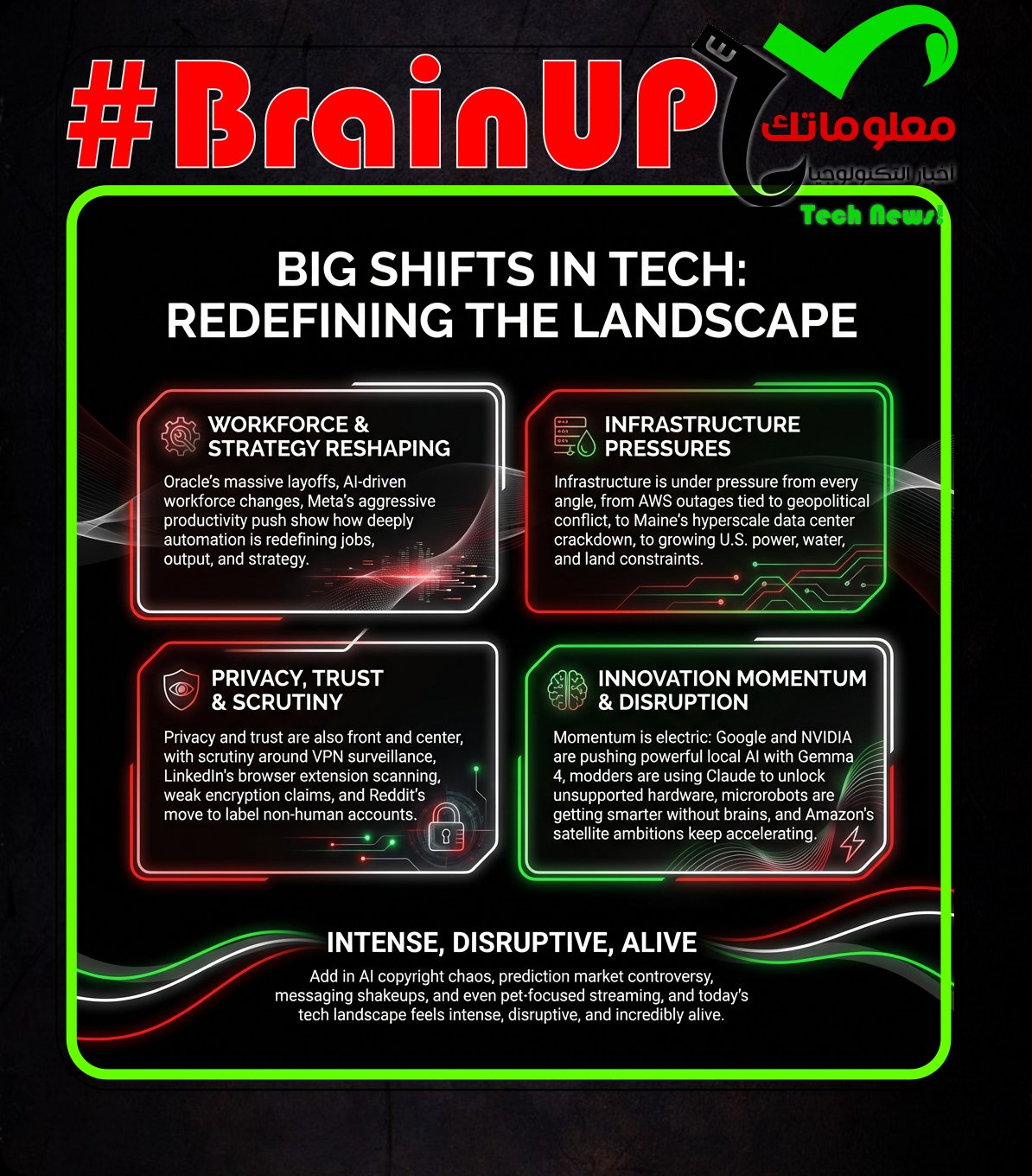
Oracle Corporation has laid off approximately 30,000 employees, including those with up to eight years of tenure, as part of a significant workforce reduction. These layoffs come amid broader cost-cutting measures and a shift in focus toward cloud computing and subscription-based services, which are reshaping the company’s business model. The extensive job cuts reflect Oracle’s strategic move to streamline operations and accelerate its transformation efforts in a competitive technology market. This substantial reduction in staff highlights the challenges traditional software giants face adapting to changing industry dynamics and customer demands. Oracle’s action emphasizes the importance of agility and innovation in maintaining market relevance amid ongoing technological evolution.
Iranian strikes have disrupted #AWS data centers in Bahrain and Dubai, with Amazon reportedly declaring multiple availability zones as “hard down,” meaning completely unavailable. Big Technology reports an internal AWS memo saying operations in both sites were disrupted and that the company is working to migrate affected customers’ workloads to other regions, warning services should not expect normal redundancy and resiliency and should scale to a minimal footprint to support migration. The memo also indicates each region has three compute zones with a mix of “hard down” and “impaired but functioning” zones, and that AWS has no timeline for when DXB and BAH will return to normal operations. The article adds that the @Islamic Revolutionary Guard Corps has conducted strikes against AWS sites since early March and that Iran has also threatened other tech firms such as @Nvidia and @Microsoft, and later struck an @Oracle data center. Beyond immediate outages, the conflict is portrayed as a broader risk to the tech industry by disrupting oil related flows through the Strait of Hormuz and constraining materials cited as important to the semiconductor supply chain, including aluminum, helium, and LNG.
3. Maine Lawmakers Pass Bill to Block Hyperscale Data Centers
Maine legislators passed a bill to ban large hyperscale data centers that consume vast amounts of electricity, reflecting environmental and economic concerns. Supporters argue that these data centers strain the state’s power grid and contribute to carbon emissions, conflicting with Maine’s clean energy goals. Critics warn the ban could deter investment and limit technological growth in the region. The legislation signals a shift in how states are balancing economic development with sustainability, notably as data centers become increasingly central to the digital economy. This move underscores Maine’s commitment to align industrial activity with its environmental priorities while navigating the challenges posed by expanding #technology infrastructure.
Senators have requested Tulsi Gabbard to inform Americans that using #VPNs (Virtual Private Networks) could expose them to #domesticsurveillance. This concern arises amid growing government scrutiny over encrypted internet traffic potentially hindering lawful monitoring efforts. The senators highlight potential risks users face when relying on VPNs, suggesting these services could inadvertently facilitate domestic spying. This call to action stresses user awareness about privacy tools that might attract government surveillance rather than fully protect privacy. The situation underscores tension between privacy technologies and national security measures in the digital age.
@Planet Labs is indefinitely restricting access to its commercial #satellite imagery over Iran and much of the surrounding conflict zone, citing a U.S. government request for “safety and operational security reasons,” according to a report referenced from the New York Times. The policy reduces a key tool used by news organizations, researchers, and independent analysts to verify strikes, assess damage, and track military developments in areas that are hard or dangerous to reach, and media outlets said it could significantly hamper documentation of the Iran war. Planet said it will shift to “managed distribution,” releasing certain images only on a limited, case by case basis when deemed mission critical or in the public interest, and it is also extending publication delays for imagery and data collected since March 9. The restricted area includes all of Iran, Gulf states, and other active regional conflict zones, expanding beyond a narrower March step that delayed Iran imagery by 14 days to deter use by “adversarial actors” while preserving some transparency. The Pentagon declined to say whether it asked satellite firms to restrict imagery, and the move is framed as part of a broader tightening among commercial imagery providers as the conflict intensifies.
6. Nearly half of US data centers planned by 2026 facing power, water, or land challenges
Nearly 50% of US data centers planned by 2026 face risks from power, water, or land constraints, posing challenges for expansion amid rising digital demand. Analysis reveals that the fastest-growing regions for data centers, like Northern Virginia and Dallas, encounter significant limitations such as high electricity costs, water scarcity, and rising land prices, which could slow development. As usage of cloud computing and AI surge, these resource constraints underscore the necessity for sustainable approaches in data center siting and infrastructure. Addressing these challenges will require strategic planning and innovation to balance growth with environmental and economic factors. This situation highlights the critical intersection of #technology, #infrastructure, and #resource_management in supporting the digital economy.
7. Polymarket removes wagers on U.S. service member rescue mission in Iran
Polymarket removed a forum that let users wager on the timing of confirmation of a rescue mission for U.S. military servicemembers after an F-15E was shot down over Iran, as political pressure intensified and scrutiny of #predictionmarkets grew. The incident followed reports that one crew member was rescued while another remained unaccounted for, and @Rep. Seth Moulton denounced the page as “DISGUSTING,” arguing it amounted to betting on whether Americans would be saved; Polymarket said it took the market down immediately because it did not meet its integrity standards and said it was investigating how it slipped past safeguards. Moulton contended the takedown happened because lawmakers called it out, criticized the #CFTC for not acting despite its authority, cited growth in Polymarket’s “war” category, and said Congress needs to act; he also barred his staff from using platforms like Polymarket or Kalshi. The article situates the episode within broader calls for oversight, including proposed Democratic legislation to bar wagers on elections, war, and government actions, senators urging the CFTC to prohibit contracts tied to an individual’s death, and the CFTC suing states over regulatory authority, alongside concerns from the NFL about “objectionable bets.” The removal underscores the tension between platform standards and external regulation as betting-style contracts expand into sensitive real-world events.
Reddit is introducing a new labeling system to help users distinguish humans from automated accounts as #AI becomes more prevalent online. Accounts that use automation in allowed ways, including apps built on Reddit’s Developer Platform and other non-violating automated accounts, will receive an “[App]” label, while spam and malicious bots will continue to be removed under existing policy, with easier reporting promised. Reddit says only rare cases of suspicious behavior, such as unusually fast posting, will trigger a privacy-first #personhood verification step intended to confirm a person is behind an account, not to identify who they are. For verification methods, it is considering #passkeys as a lightweight starting point, third-party biometric proof-of-personhood services like #WorldID that keep identity separate from account and usage data, and third-party government ID checks only when required, which it calls the least secure and least private option. Reddit also notes it is not currently planning action against humans using generative AI to write posts, arguing its voting and moderation systems already address low-quality content, even as it acknowledges the platform would prefer generative AI were not part of the landscape.
Modder kryptonfly used @Claude AI and extensive #BIOS modding to boot an OEM-exclusive 12 P-core #BartlettLake-S CPU into Windows on an Asus Z790-AYW OC Wi-Fi motherboard, despite Bartlett Lake being officially firmware-incompatible with mainstream 600 and 700 series boards. Forum posts on Overclock.net describe overcoming multiple hurdles after achieving POST, especially a memory initialization problem that blocked progress beyond early POST codes, and the eventual workaround involved tricking the Z790 board into treating the CPU system agent and PCIe graphics as if they belonged to 13th or 14th Gen #RaptorLake. The setup still has limitations, including an issue where the Bartlett Lake CPU cannot enter the BIOS, which forces CPU swapping to make BIOS changes. The achievement is presented as a step toward broader Bartlett Lake functionality on LGA 1700 consumer boards, and kryptonfly says they are looking to port the modified BIOS to additional boards such as LGA 1700 versions of the Asus Apex and Encore. The article notes Bartlett Lake-S is an unusual P-core-only lineup, with a 12 P-core flagship up to 5.9GHz aimed at embedded and edge markets, and while it may not beat comparable Raptor Lake chips broadly, it could help in niche latency-sensitive workloads that benefit specifically from 10 to 12 P-cores without E-cores.
10. LinkedIn secretly scans for 6,000+ Chrome extensions, collects data
LinkedIn has been discovered to perform secret scans of over 6,000 Chrome extensions, collecting data without users’ explicit consent. This extensive data gathering raises privacy concerns, as LinkedIn accesses browser extension information potentially revealing user behavior and preferences. The practice highlights a significant security risk linked to corporate data collection techniques that can breach user trust and regulatory standards. Despite LinkedIn’s prominence, this behavior illustrates the challenges of balancing platform utility with privacy protection in the digital age. The situation stresses the need for clearer policies and user awareness surrounding extension permissions and data privacy.
11. Astronomers confirm for the first time the existence of a giant volcanic cave on Venus
Scientists report the strongest evidence yet that a giant volcanic cave, likely a #lava tube, lies beneath Venus’s Nyx Mons, based on a reanalysis of radar data from NASA’s Magellan mission published in Nature Communications by a University of Trento team. In the #SyntheticApertureRadar images, a feature called “pit A” shows an unusual bright, asymmetric streak beyond its rim, consistent with radar entering a skylight, traveling through an underground tunnel, and scattering back, unlike typical steep pit signatures. Using methods previously applied to lava tubes on the Moon and Earth, the team estimated the void to be about 1 km wide on average, with a roof at least 150 m thick and an empty space at least about 375 m high, and radar indicates propagation inside the tube for at least 300 m from the skylight, with the broader system possibly extending around 45 km. The inferred structure would dwarf well known Earth examples such as Cueva de los Verdes, which are only tens of meters wide. Beyond being a geological curiosity, the finding matters because lava tubes preserve evidence of volcanic history and, while Venus’s extreme heat and pressure preclude near term habitation, understanding Venusian volcanism helps explain how an Earth like planet evolved into a runaway greenhouse world.
12. AI Leads All Reasons For U.S. Job Cuts In March, Report Says
Employers most often cited #AI as the reason for U.S. job cuts in March, according to Challenger, Gray & Christmas, as companies shift budgets toward #AI investments. The report says #AI accounted for 15,341 of 60,620 announced layoffs in March, or 25%, up from about 10% in February, and employers have cited #AI in 99,470 layoff announcements since 2023, or 3.5% of all cuts during that period. Overall cuts rose 25% from February to March but were far below March 2025 levels, while Q1 totaled 217,362 cuts, the lowest first-quarter total since 2022, and #AI’s share of cited cuts grew from 5% in 2025 to 13% through Q1 2026 even though it ranks fifth year-to-date behind other reasons. Technology was hit hardest, with 18,720 March cuts and 52,050 year-to-date in 2026, up 40% from the same period last year, with the report mentioning Dell, Oracle, and @Meta as examples as firms redirect resources toward #AI, alongside record or sharp increases in transportation and healthcare cuts. The article notes these are employer-stated reasons and links the figures to workforce-risk projections, suggesting search, content, and digital marketing workers should track this trend as Challenger expects more tech layoffs in 2026 as #AI changes how work is done.
13. A Secure Chat App’s Encryption Is So Bad It Is ‘Meaningless’
TeleGuard, a chat app downloaded more than a million times and marketed as #end-to-end encrypted, reportedly implements encryption so poorly that attackers can trivially obtain a user’s private key and decrypt messages. Multiple security researchers told 404 Media that the app uploads users’ private keys to a company server, meaning TeleGuard itself could decrypt users’ messages. Researchers also found the key can at least partially be derived by intercepting a user’s traffic, further weakening protections. The case underscores a “wild west” landscape for encrypted messaging where security claims do not necessarily match real-world design and implementation, despite TeleGuard’s marketing such as “Highly encrypted” and “Swiss made.”
14. Meta Pauses Work With Mercor After Data Breach Puts AI Industry Secrets at Risk
@Meta has indefinitely paused work with Mercor while investigating a major security breach at the data contracting startup, and other major AI labs are reevaluating their relationships as they assess the incident. Mercor is a key vendor that @OpenAI, @Anthropic, and others use to produce proprietary #training-data via large contractor networks, and exposure of that data could reveal sensitive details about how #AI-models are trained, though it is unclear whether the breach would materially help competitors. @OpenAI said it has not stopped current Mercor projects but is investigating potential exposure of its proprietary training data, and stated the incident does not affect OpenAI user data. Mercor told staff on March 31 that a security incident affected its systems, and contractors on Meta work were told they cannot log hours until, and if, projects resume, with internal messages referencing reassessment of a Meta project called the Chordus initiative. The breach appears connected to an attacker compromising two versions of the #LiteLLM AI API tool, while a separate claim using the Lapsus$ name circulated, but researchers suggest the likely actor is TeamPCP or an affiliated group, underscoring how vendor breaches can put closely guarded AI industry datasets and project details at risk.
15. A folk musician became a target for AI fakes and a copyright troll
Folk musician Murphy Campbell was hit by a one two punch of #AI music impersonation and questionable #copyright enforcement that misattributed ownership of her work. She found songs appearing on her Spotify profile that she had never uploaded, with vocals that seemed off, and AI detectors suggested at least one track was probably AI-generated; getting the fakes removed required persistent follow up and was incomplete, with at least one track still on Spotify under a different profile using the same name. After a @Rolling Stone piece about the incident, additional videos were uploaded to YouTube via distributor @Vydia by an uploader called Murphy Rider and were then used to file #YouTube #ContentID claims against Campbell’s videos, forcing revenue sharing even though the disputed songs were in the public domain, including “In the Pines.” Vydia later released the claims and said the uploader was banned, citing a very low invalid-claim rate across millions of Content ID filings, while Campbell remained skeptical of platform fixes like Spotify’s test for artist approval of profile uploads, given how easily the situation arose and how hard it was to unwind.
16. Telegram’s Durov says Russia triggered payment system problem by blocking VPNs
Telegram founder @PavelDurov stated that the recent payment system issues in Russia were caused by the government’s decision to block VPN services. This action disrupted access to financial platforms that depend on VPNs for secure transactions, leading to widespread payment failures. Durov highlighted that restricting VPNs, intended to control information flow, inadvertently interfered with legitimate financial operations. The situation illustrates the unintended consequences of internet censorship on critical infrastructure. These disruptions emphasize the complex relationship between state internet controls and the functionality of digital services in Russia.
Researchers at Leiden University used #3DPrinting to create microscopic, flexible microrobots that can move and navigate without a brain, sensors, motors, processors, or external control. The robots are about 0.5 to 5 micrometers long, can reach about 7 micrometers per second, and are smaller than a human hair’s thickness of roughly 70 to 100 micrometers. They begin moving when exposed to an electric field, and their soft chain-like bodies generate motion through continuous feedback between shape and movement, where the environment alters the body and the resulting motion alters the shape. Prof. Daniela Kraft and postdoc Mengshi Wei describe behaviors such as tail-waving when slowed or stopped, which appears life-like and suggests “smart” abilities can emerge without microscopic electronics. The team says the approach could be useful for medical applications like targeted drug delivery, minimally invasive surgery, and diagnostics, but more work is needed to understand the exact cause of the movement and what capabilities can be extracted.
18. Meta Pushes AI-Powered Productivity Overhaul – Menlo Park Today
@Meta is undertaking a companywide #generativeAI and #AIpoweredCoding push to raise productivity and ship features faster, including explicit targets for engineers to produce 50 to 80 percent of their code with AI assistance. In #RealityLabs, an internal tools group of about 1,000 people was reorganized in early 2026 into “AI pods” that blur job titles, rebranding employees as “AI builders” and managers as “AI pod leads,” and expecting engineers to flex into tasks like design when needed. @MarkZuckerberg is described as driving the shift, while former engineering director @ErikMeijer has warned it could translate into job cuts. Although Meta says the overhaul will not affect headcount, employees worry the restructuring may be a pretext for future layoffs as automation expands. The article argues this approach signals a broader shift in big tech toward maximizing output per employee, potentially foreshadowing similar AI-driven transformations across the industry.
19. Streaming channel for pets launched in China
@Tencent has launched “PetTV,” a 24-hour streaming channel on Tencent Video that curates programming to keep cats and dogs company while their owners are away or to watch together. The channel features pet-focused clips such as a duckling swimming in a bath and dogs patrolling a neighbourhood, and it is designed around pets’ different senses by adjusting colours, refresh rates, and audio frequencies. PetTV is available to paid subscribers, and Tencent says its research found 66 per cent of dog owners leave the television on for their pets when they are out. The service also plans to use third-party offerings, including airing America’s DogTV, as #pet-specific media expands alongside China’s growing urban pet market, estimated at 405 billion yuan by 2028 with households spending thousands of yuan per pet annually.
20. Google’s Gemma 4 Runs Frontier AI On A Single GPU
Google has developed Gemma 4, a technology that allows frontier AI models to run efficiently on a single GPU, dramatically reducing the computational resources typically required. This innovation leverages advanced hardware and software co-design to optimize AI model execution, enabling greater accessibility and scalability for AI research and applications. By integrating Gemma 4, Google addresses the high costs and complexities of running large AI models, facilitating broader experimentation and deployment across varied platforms. This breakthrough underlines Google’s commitment to enhancing AI infrastructure and democratizing advanced AI technologies. The development positions Google as a leader in optimizing resource-intensive AI workloads, fostering innovation in the AI community.
21. From RTX to Spark: NVIDIA Accelerates Gemma 4 for Local Agentic AI
@Google and @NVIDIA are optimizing the #Gemma 4 family of open models for efficient, local, context-aware #agentic AI across #NVIDIA GPUs, from data centers to #RTX PCs, #DGX Spark and #Jetson Orin Nano edge modules. The new Gemma 4 additions span E2B, E4B, 26B and 31B variants and support reasoning, coding, structured tool use via function calling, and multimodal vision, video and audio capabilities, including interleaved text and images, plus multilingual support for 35+ languages and pretraining on 140+ languages. The E2B and E4B models target ultraefficient, low-latency offline inference at the edge, while the 26B and 31B models focus on higher-performance reasoning and developer workflows suited to local agents, including compatibility with OpenClaw for assistants that can use personal files and applications as context. For getting started, @NVIDIA worked with #Ollama and #llama.cpp so users can run Gemma 4 locally via Ollama or via llama.cpp with GGUF checkpoints from #HuggingFace, and #Unsloth offers day-one optimized, quantized models for local fine-tuning in Unsloth Studio. Performance benefits are attributed to #Tensor Cores accelerating inference for higher throughput and lower latency, alongside the #CUDA software stack for broad tool and framework compatibility.
22. Anthropic is having a moment in the private markets; SpaceX could spoil the party | TechCrunch
Glen Anderson of Rainmaker Securities says the private-share #secondarymarket is exceptionally active, and that @Anthropic is currently the hardest name to buy because demand is intense and sellers are scarce, while @OpenAI shares appear to be drawing less interest. He cites reports of buyers ready to deploy billions into Anthropic, alongside large amounts of OpenAI stock that investors are trying to sell without finding takers, and says his firm sees the same pattern. Anderson attributes part of Anthropic’s surge to its public standoff with the Department of Defense, which he says boosted the app’s popularity and positioned the company as more differentiated from OpenAI. He adds that many institutional investors still want exposure to both companies because the outcome of the #AI model race is uncertain, but market momentum in secondary trading has shifted toward Anthropic. He cautions against reading it as purely binary, noting OpenAI has not collapsed, just that its market is not as vibrant as Anthropic’s right now.
23. Samsung Messages will be discontinued in July as part of Google Messages upgrade
@Samsung will discontinue Samsung Messages in the US in July 2026, positioning @Google Messages as the replacement and providing a guided transition. After the shutdown, Samsung Messages will no longer be able to send messages on phones except to emergency service numbers or device-defined emergency contacts, and the app will be removed from the Galaxy Store, with Galaxy S26 users already blocked from downloading it. The change applies to Galaxy users on Android 12 and newer, while older devices are not affected, and users will be prompted in-app to set @Google Messages as the default SMS app, with the icon automatically shifting to the dock on Android 14+ after switching. Samsung also notes Samsung Messages is being discontinued on Tizen OS watches, reducing access to full conversation history on the watch, though users can still read and send texts. The company frames the move as an upgrade highlighting #RCS messaging, AI-powered security features like scam detection and spam filters, @Gemini-powered chat features, and multi-device connectivity, while warning that devices released before 2022 may see temporary #RCS disruption during the switch.
A @United Launch Alliance Atlas V rocket launched its heaviest-ever payload, sending 29 #AmazonLeo broadband satellites to low Earth orbit. The LA-05 mission lifted off from Cape Canaveral Space Force Station at 1:46 a.m. EDT (0546 GMT) on April 4, 2026, and ULA reported that all 29 spacecraft, totaling about 18 tons, were successfully deployed into the target orbit. Amazon says the jump from 27 to 29 satellites on an Atlas V was enabled by detailed joint engineering with ULA and use of a higher-performing RL10C engine variant on the Centaur upper stage, with LA-05 marking the first time the program completed the required engineering and safety analysis for the larger payload. #AmazonLeo, previously called #ProjectKuiper, is planned to grow to about 3,200 satellites as Amazon’s answer to @SpaceX’s #Starlink, and as of this launch 241 operational satellites had reached orbit across nine launches. The mission adds momentum to the still-early deployment of the Amazon Leo megaconstellation while demonstrating a new maximum payload capability for Atlas V on this program.
That’s all for today’s digest for 2026/04/05! We picked, and processed 24 Articles. Stay tuned for tomorrow’s collection of insights and discoveries.
Thanks, Patricia Zougheib and Dr Badawi, for curating the links
See you in the next one! 🚀
