
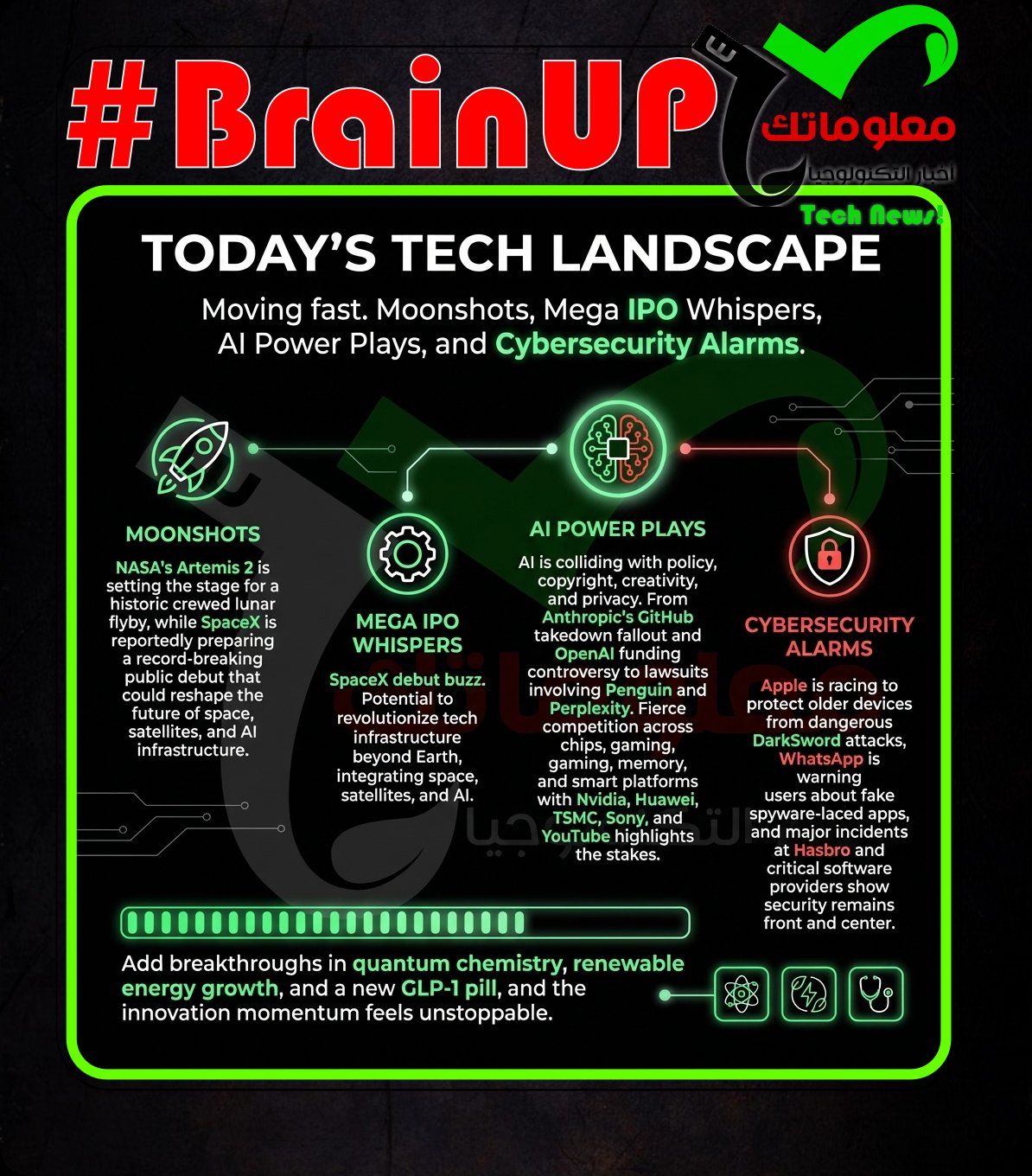
#BrainUp Daily Tech News – (Thursday, April 2ⁿᵈ)
Welcome to today’s curated collection of interesting links and insights for 2026/04/02. Our Hand-picked, AI-optimized system has processed and summarized 31 articles from all over the internet to bring you the latest technology news.
As previously aired🔴LIVE on Clubhouse, Chatter Social, Instagram, Twitch, X, YouTube, and TikTok.
Also available as a #Podcast on Apple 📻, Spotify🛜, Anghami, and Amazon🎧 or anywhere else you listen to podcasts.
1. NASA’s Artemis 2 mission prepares for historic lunar flyby launch
NASA is preparing to launch Artemis 2, the first crewed mission in its Artemis program, which aims to send astronauts around the moon and back to Earth. The mission will use the Space Launch System (SLS) rocket and Orion spacecraft to orbit the moon, marking a significant milestone after the uncrewed Artemis 1 mission. The crew includes four astronauts who will conduct various tests and scientific experiments during the mission. This flight is an essential step towards NASA’s goal of establishing a sustainable human presence on the moon and facilitating future missions to Mars. Artemis 2 showcases the advancement in space exploration technology and international collaboration necessary for deep space travel.
@Apple released iOS 18.7.7 and iPadOS 18.7.7 to protect older iPhones and iPads against #DarkSword, a leaked toolkit used in web-based attacks that can steal data. The company said the exploits affect devices running iOS 18.4 through 18.7 and can trigger simply by visiting a website hosting malicious code, including legitimate sites that were breached, then exfiltrate items like messages, browsing history, location data, and cryptocurrency to hacker-controlled servers. The tools have been observed in attacks targeting users in China, Malaysia, Turkey, Saudi Arabia, and Ukraine, and researchers warn that public release of the toolkit enables broader targeting of users on older software versions. @Apple said iOS 26 users were protected weeks earlier, and this update also covers users who cannot run iOS 26 and those who could update but have not, including some avoiding the new “liquid glass” interface. The company also noted that #LockdownMode defends against DarkSword and told TechCrunch it is unaware of any successful government spyware attack against an Apple device running Lockdown Mode.
Anthropic says it accidentally triggered takedowns of thousands of #GitHub repositories while trying to remove leaked source code for its Claude Code command line application. A software engineer found that a recent release appeared to include access to the app’s source code, and people shared and analyzed it on GitHub for clues about how Anthropic uses the underlying #LLM. Anthropic then sent a notice under U.S. digital copyright law, and GitHub’s records show enforcement against about 8,100 repositories, including legitimate forks of Anthropic’s public Claude Code repo. @Boris Cherny, Anthropic’s head of Claude Code, said the broad takedown was accidental because the targeted repo sat in a fork network, and the company retracted most notices, narrowing them to one repository and 96 forks, after which GitHub restored access to affected forks. TechCrunch notes the incident is an execution and compliance setback as Anthropic reportedly plans an IPO.
4. Nvidia rolls out its fix for PC gaming’s “compiling shaders” wait times
@Nvidia has added a beta #Auto Shader Compilation feature to the Nvidia App to reduce in-game “compiling shaders” waits by precompiling shaders while a PC is idle. With #GeForce Game Ready Driver 595.97 WHQL or later, the app can rebuild #DirectX shader data after driver updates, with user controls for enabling it, allocating disk space, and limiting resource use, plus an option to manually trigger recompilation. Nvidia notes it will not eliminate first-run shader generation after initially installing a game, it mainly prepares new shaders needed after later driver updates. The approach differs from @Microsoft’s #Advanced Shader Delivery, which lets developers provide downloadable precompiled shader databases tailored to a player’s system, and Nvidia says it is working with Microsoft to add support for RTX later this year. @Intel is also rolling out its own #Precompiled Shader Delivery and plans to integrate compatibility with Microsoft’s system later in the year.
5. Mamdani Lifts NYC TikTok Ban for City Employees, but with Some Unusual Restrictions
@Zohran Mamdani has lifted New York City’s 2023 #TikTok ban for city employees, but only under strict device and access limitations meant to keep the app quarantined from city systems. Former mayor @Eric Adams had banned TikTok on city devices over claimed security risks tied to then-owner #ByteDance, even as the article notes no evidence was presented that the Chinese government controlled the algorithm or received Americans’ data, and TikTok later sold its U.S. division to a U.S. investor consortium. Under Mamdani’s policy, agencies can use TikTok only on city-owned devices that contain no other apps, with designated communications staff, and those devices cannot store sensitive or restricted data or be used for email, internal systems, or privileged access. The rules also constrain practical workflows, for example preventing editing with external apps like #CapCut, but the article argues the tight controls may still be sensible given ongoing location-data controversies and the broader reality that social platforms function as data-harvesting systems. Overall, the change restores access while treating TikTok and similar apps as technologies that may warrant an “intense digital quarantine” inside government.
Chinese semiconductor firms are taking a larger share of China’s #AI server market, pushing @Nvidia’s share down to about 55% in 2025. IDC figures cited by Reuters say domestic vendors delivered 1.65 million #AI GPUs out of roughly 4 million total units, while @Nvidia shipped about 2.2 million, a steep drop versus the company’s claimed 95% share before U.S. sanctions. @Huawei is the leading local beneficiary with around 812,000 chips, about 20% share, and it recently launched the Atlas 350 accelerator, claimed to offer nearly three times the performance of Nvidia’s H20, with Alibaba-owned T-Head at 256,000 units; @AMD shipped 160,000 units for 4%, and Baidu’s Kunlunxin plus Cambricon each delivered 116,000. The shift accelerated after U.S. export restrictions, including a complete AI GPU export ban in April 2025, partial reversals and mixed signals later in 2025, and eventual permission for Nvidia’s H200 sales under limited conditions, while Beijing simultaneously pressures data centers toward domestic chips. Even with China still estimated to lag Nvidia and AMD by five to ten years in AI data center chips, the policy push is boosting local market share, and the article suggests Nvidia may struggle to return to pre-sanctions dominance even if H200 access expands in 2026.
7. Kathleen Kennedy Just Told an AI Conference She’s Not So Sure About AI
@Kathleen Kennedy, speaking onstage with Runway co-founder @Cristóbal Valenzuela at a Runway AI summit in Manhattan, voiced skepticism about using #AI for the core creative execution of filmmaking, arguing that “taste” comes from human life experience and education in art. She said #AI could still be useful for practical production work like previz, planning, budgeting, and scheduling, but questioned whether it can capture the “painting” a filmmaker is trying to create and preserve the “unpredictability” of the creative process, which she sees as difficult because #AI is “predictable.” Kennedy also defended Hollywood creatives by saying what is missing from Big Tech’s current #AI discussion is #transparency, especially around how language models are trained and how tools are used, and suggested greater openness would reduce distrust. While other summit speakers touted #generativeAI’s artistic potential, Valenzuela largely deferred, only noting counterpoints such as lowering barriers to entry for filmmakers. Overall, Kennedy positioned #AI as a limited aid for production logistics unless the industry can address creative limitations and transparency concerns.
8. Apple Removes iPhone Vibe Coding App from App Store
@Apple removed the iPhone #vibe coding app Anything from the App Store, citing an alleged violation of App Store #Guideline 2.5.2, in what some view as stepped-up enforcement against this category. The app marketed itself as a fast way to build apps on a phone using #LLMs like @Anthropic’s Claude and @OpenAI’s Codex, and its CEO Dhruv Amin told The Information it had been used to create App Store apps for tasks such as managing emergency workers and tracking gig-worker spending. Guideline 2.5.2 restricts apps from downloading, installing, or executing code that changes features or functionality, and the reporting suggests Apple treats generating or installing other apps, or enabling app-like functionality outside a self-contained bundle, as conflicting with that rule. Amin said his team attempted a browser-based debugging version, but the update was rejected before the app was removed. Apple did not provide a statement to Gizmodo or The Information, and Apple reportedly framed similar earlier actions against Replit and Vibecode as enforcement against unmoderatable changes in app behavior rather than a targeted ban on vibe coding.
@SpaceX, founded by @Elon Musk, reportedly filed confidential IPO disclosures with the U.S. Securities and Exchange Commission, signaling preparations for a public listing that could value the company at $1.75 trillion. Bloomberg cited anonymous sources for the valuation, while Reuters reported the IPO is internally codenamed #ProjectApex and would be managed by an unusually large syndicate of 21 banks, with SpaceX aiming to raise $75 billion, potentially the largest IPO ever, surpassing Saudi Aramco’s $29 billion listing in 2019. The move reflects heavy capital needs across the conglomerate, which operates the #Starlink satellite network and is developing #Starship, and which now also includes xAI and X after SpaceX acquired xAI in February in a deal valuing the entity at $1.25 trillion. Although Musk had long said SpaceX would not go public until reaching Mars, the article says demand for capital and updated ambitions focused on the moon, including plans for vast data center satellites, have shifted the calculus. The reported filing ties SpaceX’s potential mega-IPO directly to funding requirements for rocket development, satellite spectrum and replenishment, and the compute needed to build and run xAI’s deep learning models.
President @Donald Trump announced a new #technology council, the President’s Council of Advisors on Science and Technology (#PCAST), to advise on #AI regulations and broader emerging-technology issues. According to The Wall Street Journal, invitees include @Mark Zuckerberg of Meta, @Larry Ellison of Oracle, and @Jensen Huang of Nvidia, along with @Sergey Brin and @Michael Dell, with an official roster of 13 members expected to expand to 24 under an executive order. The White House said the council will address opportunities and challenges emerging technologies pose to the American workforce and aim to ensure Americans thrive in a “Golden Age of Innovation,” as #AI tools rapidly spread across industries with little prior regulatory oversight. The article notes potential concerns about tech giants shaping #AI policy, including reported exploitation of AI across social media involving individuals’ data, names, and likenesses, and criticism of data centers’ energy and water use that can strain local resources and raise utility bills. It adds that AI could also improve energy efficiency and support sustainable practices as some data centers explore non-polluting power, underscoring the need to balance innovation with individual rights so advancements benefit everyone.
11. Penguin to sue OpenAI over ChatGPT version of German children’s book
Penguin Random House is suing @OpenAI, alleging #ChatGPT infringed copyright by mimicking and reproducing content from @IngoSiegner’s German children’s series Coconut the Little Dragon. The publisher says that after its lawyers prompted the chatbot to write a Mars-themed Coconut story, it produced text and images that were “virtually indistinguishable” from the originals, including a book cover with the orange dragon and sidekicks, a back-cover blurb, and self-publishing submission instructions. Penguin argues this is “clear evidence” of #LLM “memorisation”, where models can reproduce substantial portions of training texts, and says protecting intellectual property is its priority even as it remains open to AI opportunities. OpenAI said it is reviewing the allegations and is in discussions with publishers, while the case could set a precedent given Penguin’s size and follows a prior Munich ruling that ChatGPT violated German copyright law in a dispute brought by music rights society Gema. The suit is filed in Munich against OpenAI’s Ireland-based European subsidiary, despite Bertelsmann, Penguin’s owner, having a 2025 collaboration deal with OpenAI that did not grant access to Bertelsmann archives.
12. Group Pushing Age Verification Requirements for AI Turns Out to Be Sneakily Backed by OpenAI
A California coalition advocating for #AI age verification laws was reportedly funded behind the scenes by @OpenAI without many supporters realizing it. According to the San Francisco Standard, members of the Parents and Kids Safe AI Coalition, formed to promote the Parents and Kids Safe AI Act requiring #ageVerification and added safeguards for users under 18, were surprised to learn @OpenAI was the group’s biggest funder and was described as entirely funding it, even though OpenAI was left off outreach messaging and the coalition’s website marketing. The article cites a Wall Street Journal report saying @OpenAI pledged $10 million to push the bill, and quotes an unnamed nonprofit leader saying the discovery felt “grimy” and that outreach emails were misleading. The reporting suggests the hidden backing may have influenced endorsements from child safety and advocacy groups that did not know they were aligning with @OpenAI, and notes a potential conflict because the bill centers on age assurance while CEO @SamAltman leads a company that provides age verification services. Gizmodo says it contacted @OpenAI for comment but did not receive a response by publication.
13. US patent office revokes Nintendo’s patent on summoning characters to make them battle | VGC
The US #USPTO has revoked a Nintendo patent granted last year that broadly covered a gameplay mechanic where a player summons a sub-character to battle on their behalf. After @John A Squires, the USPTO director, ordered a rare director-initiated re-examination, the office issued a non-final decision rejecting all 26 claims, giving Nintendo two months to respond, seek an extension, and potentially appeal to the Federal Circuit. Squires and the USPTO cited earlier patents as prior art, including Konami’s 2002 Yabe patent, Nintendo’s 2020 Taura patent, Nintendo’s 2022 Motokura patent, and Bandai Namco’s 2020 Shimomoto patent, arguing that combinations of these disclosures render the new claims invalid. The mechanic is exemplified by #Pokemon-style summoning with automatic or manual control and could have applied to other games such as Pikmin, but the decision reduces immediate fears of sweeping lawsuits, and in any case patents do not require enforcement to remain valid. Games Fray reports Nintendo may still try to salvage some claims on appeal, possibly arguing that real-world developers would not combine the cited patent ideas even though the USPTO did not need to analyze actual game implementations.
14. First Western Digital, now Sony: The tech giant suspends SD card sales
@Sony is temporarily suspending orders for nearly all of its SD and CFexpress memory cards because a global #memory and #semiconductor shortage, driven in part by rapid #AI data center expansion, is constraining supply. In a statement on its Japanese website, Sony said it expects supply will not meet demand for the foreseeable future and will stop accepting orders from authorized dealers and customers at the Sony Store starting March 27, 2026, with no clear restart date. The pause affects CFexpress Type A and Type B cards and regular SD cards, though some low end cards may still be in production, according to PetaPixel. The move underscores how the shortage is squeezing even major manufacturers, following @Western Digital’s announcement that it had sold out of hard drives for the year. It also comes alongside Sony’s recent PlayStation console price hikes, which the article suggests may stem from similar pressures.
15. PS6 Could Ditch Built-In Disc Drive, Let Players Buy External Unit for Physical
Sony is reportedly considering removing the built-in disc drive from the PlayStation 6 and instead offering an external disc drive as an optional accessory. This move could lower the base console price and appeal to digital-only users while still supporting physical media collectors. The shift aligns with industry trends towards digital distribution but maintains flexibility for gamers who prefer physical discs. Analysts suggest this design could balance cost savings and user choice effectively. Overall, Sony may be adapting to changing consumer habits while providing options to serve diverse player preferences.
A rumor claims Sony’s PS6 handheld, codenamed #ProjectCanis, will outperform the Xbox Series S in both rasterization and ray tracing, and could deliver notably better portable image quality via #PSSR3. The report cites @KeplerL2 on NeoGAF saying the GPU is slightly ahead of Xbox Series S in raster and “massively ahead” in ray tracing/path tracing, alongside leaked specs listing 4 x #Zen6c cores plus 2 x #Zen6 LP cores, 16 x #RDNA5 CUs, 192-bit #LPDDR5X (24GB), a 135mm² die, and #TSMC 3nm. It also asserts Switch 2 uses #DLSS2 and sometimes “DLSS Lite,” while #FSR5 or #PSSR3 could surpass even current #DLSS4.5 in image quality, potentially making Sony’s upscaler the feature that most elevates the handheld versus other handhelds like the Xbox ROG Ally X. The piece argues this performance and upscaling combo could translate into a high-end on-the-go experience, especially since Xbox Series S has been a baseline target for current-generation games. It adds that with component price hikes making next-gen home consoles expensive, a $399 PS6 handheld could be an attractive upgrade option compared with a $699 home system, citing @MichaelPachter on streaming becoming necessary for many and Alderon Games’ Matthew Cassells on pricing.
17. Quantum Computing Built An Impossible Molecule – With Big Implications
Quantum computing has enabled researchers to simulate the structure of a molecule previously considered impossible to model accurately using classical computers. This breakthrough was achieved by leveraging the unique capabilities of quantum algorithms that can handle complex molecular interactions at an unprecedented scale. Such advancements highlight the potential of quantum technology to revolutionize molecular chemistry by providing precise insights into chemical properties and reactions that are unattainable with traditional computational methods. The successful simulation paves the way for designing new materials and drugs by exploring previously unreachable chemical spaces. This development demonstrates quantum computing’s expanding role in solving real-world scientific problems, reinforcing its significance beyond theoretical applications.
18. Renewables to grow almost 50% of global electricity capacity by 2025 after solar boost
Renewable energy sources are projected to account for nearly 50% of global electricity capacity by 2025, driven primarily by a surge in solar power installations. According to the International Energy Agency (IEA), expanding solar capacity and falling costs have accelerated renewable energy adoption worldwide. This growth supports the transition away from fossil fuels, highlighting the importance of solar technology in meeting climate goals. The increase in renewables enhances energy security and helps reduce carbon emissions, aligning with global sustainability targets. Consequently, the renewable energy sector is set to play a crucial role in shaping the future energy landscape by 2025.
The page shows a security verification step for itsfoss.com rather than an article. It states the site uses a security service to protect against malicious bots and displays this page while verifying the visitor is not a bot. After verification, it indicates success and that it is waiting for itsfoss.com to respond, including a Ray ID. The protection and performance service is attributed to #Cloudflare, with references to privacy.
20. Google Photos app launches on Samsung TVs – here’s what it can do
#Google Photos is now available on select 2026 #Samsung TVs as both an app and a UI integration that surfaces full-screen and partial-screen photo highlights. It appears in the Daily Board widget, the Daily+ row, and as an app in the Daily+ app launcher, with the app showing full-screen “Memories” and the other placements showing smaller selections that refresh automatically. Setup requires signing in via a QR code, and users can manage what appears in #Memories by including or excluding certain people, pets, or dates, with those changes applying across devices. The functionality is limited because it focuses on Memories rather than letting users freely browse their entire photo library, and the article notes that #GoogleTV offers more capability such as searching specific photos via #Gemini even though it lacks a proper Photos app. The integration is available on 2026 Samsung TV models that are on sale now.
21. YouTube’s TV App Is Getting A New Feature That Has Been On Mobile For Years – BGR
YouTube is rolling out its conversational #AI “Ask” feature to the YouTube app on smart TVs, bringing a tool that previously arrived on mobile and web for #YouTubePremium users in 2024 and for everyone on those platforms in 2025. On TV, viewers can open video details with the remote and select the “Ask” button (four-pointed star), use the remote’s microphone button, use an on-screen microphone tied to the TV or another connected device like a #GoogleNest speaker, or choose suggested prompts if no microphone is available. The feature is available to signed-in users who meet country age requirements, but conversational AI support is limited to select languages and regions and is rolling out gradually. According to YouTube and Senior Director of Product Management @KurtWilms, people use it to ask about what they are watching, break down moments in podcasts, or learn about landmarks in travel vlogs without pausing the video. The article notes mixed reactions, framing “Ask” as either an unwanted expansion of AI in the TV app or a convenient way to dive deeper into video context while watching.
22. FDA Approves Eli Lilly’s GLP-1 Pill
The US #FoodAndDrugAdministration has approved @EliLilly’s once-daily #GLP1 weight-loss pill Foundayo, positioning it as the second FDA-approved obesity pill in this drug class and a competitor to @NovoNordisk’s Wegovy pill. Foundayo’s #GLP1 mechanism mimics a hormone that regulates blood sugar, slows digestion, and increases fullness, and Lilly says it can be taken any time of day without food or water restrictions, unlike the Wegovy pill which must be taken on an empty stomach. In a trial, people on the highest dose of Foundayo lost an average of 27 pounds, or 12.4 percent of body weight over 18 months, versus about 2 pounds on placebo, and no head-to-head trials have compared Foundayo directly with the Wegovy pill. Lilly also reported a switch study where moving from injectable Wegovy to the pill was associated with a 2-pound average regain difference, while switching from Zepbound to Foundayo was associated with an 11-pound average gain, suggesting pills may help some patients maintain much of their prior loss while addressing injection aversion and supply constraints. Foundayo will ship via LillyDirect starting April 6, expand to pharmacies and telehealth soon after, and its FDA review took 50 days under a new pilot program to speed approvals tied to national health priorities.
@WhatsApp says it notified around 200 users, primarily in #Italy, who were tricked into installing a malicious fake iOS version of the chat app that contained #spyware, which it attributes to Italian spyware maker SIO. The company said it proactively identified affected accounts, logged users out, warned them about privacy and security risks from unofficial clients, and urged them to remove the fake app and install the official one, and it plans to send a formal legal demand to stop the activity. A spokesperson said WhatsApp cannot yet share more details about who was notified, such as whether they were journalists or civil society members. The report notes that using fake apps is a well-established surveillance tactic in Italy, often involving cooperation from cellphone providers sending phishing links, and that SIO develops government spyware through its subsidiary ASIGINT, with its malware previously identified as Spyrtacus. The announcement follows earlier reporting that SIO was behind malicious Android apps and comes a year after WhatsApp alerted about 90 users targeted with spyware from Paragon Solutions, an episode that triggered an Italian scandal and led Paragon to cut ties with Italy’s spy agencies.
TrendForce projects another sharp rise in memory contract pricing in Q2 2026, with conventional DRAM up 58% to 63% quarter over quarter and NAND Flash up 70% to 75%, following Q1 increases of 90% to 95% for DRAM and about 60% for NAND. The tight market is driven by suppliers reallocating capacity toward #AI-related server memory and NAND being increasingly directed to enterprise SSDs, while cloud service providers lock up much of the available supply via long-term agreements. TrendForce says North American cloud providers are ramping #AI inference infrastructure and buying high-capacity RDIMMs in volume, and memory makers are securing multi-quarter deals to support future capacity builds, with meaningful capacity expansion not expected until late 2027 at the earliest, or late 2027 to 2028 for new fab output at scale. Even though PC DRAM demand has been revised down, suppliers have reduced shipments to PC OEMs and module makers, pushing buyers to pay higher prices elsewhere and keeping pricing elevated. On the NAND side, the eMMC/UFS segment faces the tightest supply gap due to overlapping process capacity with enterprise SSDs and lower margins, while limited bit output growth and suppliers prioritizing higher-margin products lead PC and smartphone vendors to cut storage capacities to manage costs.
25. Stellantis in Talks to Make Chinese EVs at Idled Canadian Plant
Stellantis is in discussions to produce electric vehicles (EVs) from a Chinese automaker at its idled Canadian assembly plant. The talks aim to utilize the shut plant, boosting Canadian manufacturing and supporting Stellantis’s transition toward electrification. This potential partnership could strengthen cross-border industrial ties and expand access to new EV markets. Producing Chinese EVs locally may also help bypass import tariffs and improve supply chain efficiency. Overall, this move aligns with Stellantis’s strategy to diversify production and accelerate EV adoption in North America.
26. US trade panel to probe Roku, Hisense over streaming display imports for patent violations
The US International Trade Commission (ITC) has initiated an investigation into imports of streaming media players and smart TVs from companies including @Roku and #Hisense over alleged patent violations. This probe follows a complaint by Imagination Technologies, which claims its patented graphics technology is infringed by these imports. The inquiry will examine the extent to which these products violate intellectual property rights and may affect their trade and sales in the US market. The investigation underscores ongoing tensions around #patentrights enforcement in the rapidly growing streaming and smart device sectors. The outcome could significantly impact import practices and patent licensing agreements in the technology and media industries.
27. ‘System failure’ paralyzes Baidu robotaxis in China | TechCrunch
A “system failure” paralyzed @Baidu’s Apollo Go #robotaxi fleet in Wuhan, China, with vehicles stalling across the city and some passengers reportedly trapped for up to two hours. Local police said the outage affected at least 100 robotaxis, while the technical cause remains unknown and under investigation, and @Baidu did not respond to TechCrunch’s request for comment. Reports and videos described cars freezing suddenly, sometimes in hazardous locations such as the fast lane of roadways. The incident adds to broader questions about #robotaxi safety and community impact, echoing a separate case where a California power outage caused traffic lights to fail and left @Waymo vehicles stuck. The disruption comes as @Baidu remains a major robotaxi operator in China and has been expanding internationally, including plans to deploy more than 1,000 autonomous vehicles in Dubai over the next few years.
28. Peppa Pig and Transformers owner Hasbro hit by cyber-attack
@Hasbro, owner of brands including Peppa Pig, Transformers and Monopoly, has suffered a #cyber-attack after it identified unauthorized access to its network. The company disclosed in a filing to the @US Securities and Exchange Commission that the breach was discovered on 28 March, and parts of its website and brand sites showed error messages, with the firm warning of potential delivery delays. @Hasbro said operations remain open, it has taken swift protective action including taking some systems offline, and it has implemented measures to keep taking and shipping orders that could last for several weeks. It is unclear whether attackers still have access, whether they have contacted the company, or whether customer data was compromised. The incident comes amid a wider pattern of recent attacks on major retailers and companies cited in the article, underscoring ongoing disruption risks from #cyber-attacks.
29. TSMC plans 3 nanometre chip production launch in Japan by 2028
Taiwan Semiconductor Manufacturing Co (TSMC) aims to begin production of its advanced 3 nanometre semiconductor chips at a new plant in Japan by 2028. The company plans to build the fabrication facility in Kumamoto Prefecture with the support of Japan’s government, which seeks to boost local chipmaking capabilities amid global supply chain concerns. This move highlights the growing importance of expanding #semiconductor manufacturing outside Taiwan to increase supply resilience and national security. TSMC’s investment will also strengthen collaboration between Taiwanese technology leaders and Japanese industry, marking a significant step in the global semiconductor landscape. The planned launch aligns with trends in #technological sovereignty as countries seek to secure critical supply lines for advanced chip technologies.
30. Perplexity AI sued over alleged data sharing with Meta and Google
Perplexity AI is facing a class-action lawsuit alleging it shared personal user data from chats with @Meta and @Google. The complaint, filed Tuesday in federal court in San Francisco, claims that trackers are downloaded to users’ devices upon login and allegedly allow @Meta and @Google access to conversations with the AI search engine, including when users enable #Incognito mode. The suit is filed on behalf of a Utah man who says he shared financial and tax information with the chatbot, and it could expand if the case is certified as a class action. @Meta said its policies prohibit advertisers from submitting sensitive data, while Perplexity spokesperson Jesse Dwyer said the company has not been served with such a lawsuit and @Google did not immediately comment. The case centers on whether routine website tracking crossed into alleged sharing of sensitive #chat data with third parties.
31. North Korea-linked hack hits largely invisible software that powers online commerce
A North Korea-linked hacking group targeted a relatively obscure software provider, SolarWinds, which supplies critical technology enabling online commerce and network management for thousands of organizations globally. The hackers exploited vulnerabilities in SolarWinds’ software, impacting numerous customers by gaining access to sensitive data and systems. This attack demonstrates the increasing sophistication and reach of cyber threats attributed to North Korea, highlighting the risks associated with supply chain vulnerabilities in the digital economy. The incident underscores the need for enhanced cybersecurity measures and vigilance among companies relying on third-party software solutions. These events emphasize the growing challenge nations and businesses face in protecting their digital infrastructures against state-sponsored cyber espionage.
That’s all for today’s digest for 2026/04/02! We picked, and processed 31 Articles. Stay tuned for tomorrow’s collection of insights and discoveries.
Thanks, Patricia Zougheib and Dr Badawi, for curating the links
See you in the next one! 🚀
