
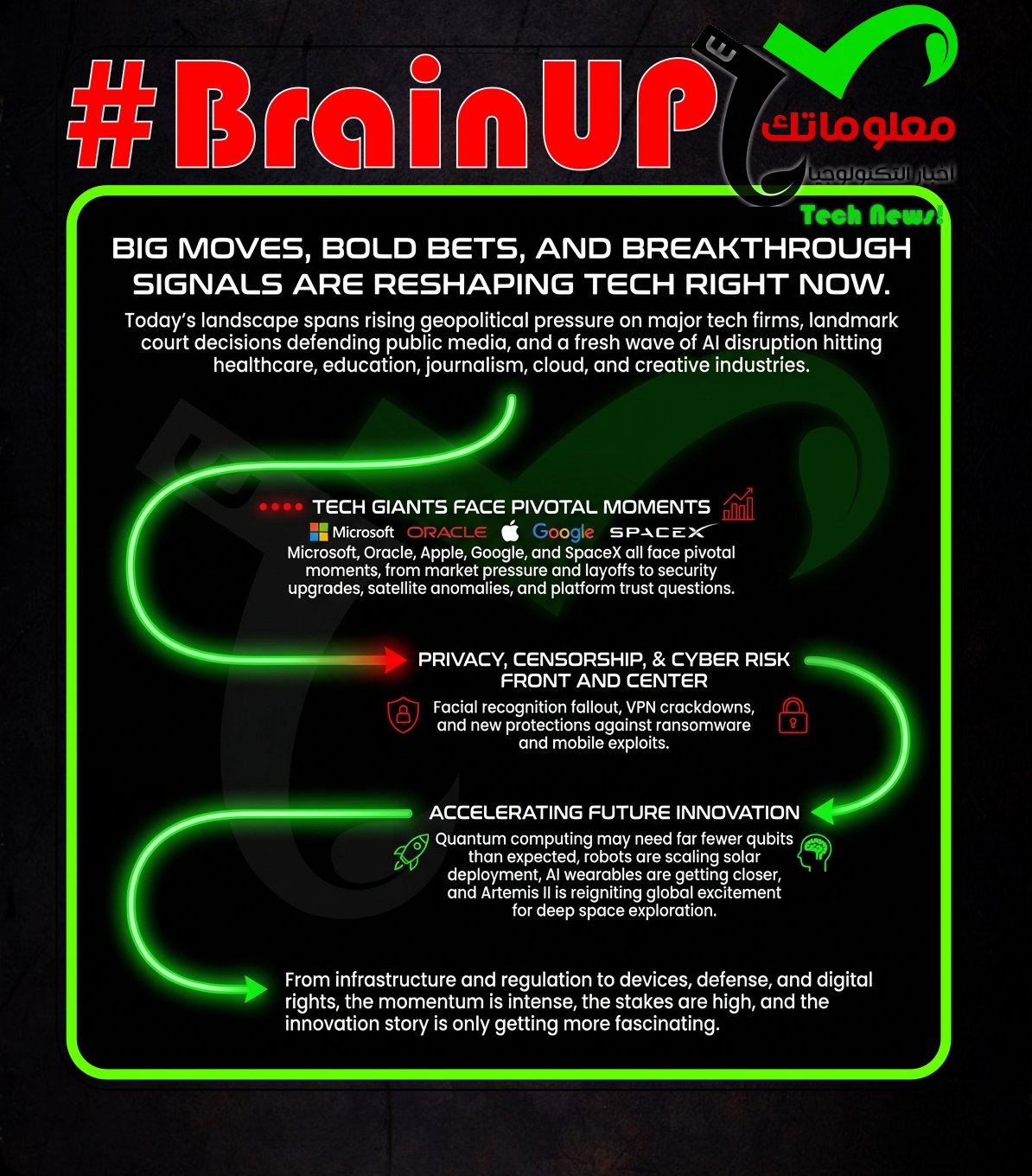
#BrainUp Daily Tech News – (Wednesday, April 1ˢᵗ)
Welcome to today’s curated collection of interesting links and insights for 2026/04/01. Our Hand-picked, AI-optimized system has processed and summarized 28 articles from all over the internet to bring you the latest technology news.
As previously aired🔴LIVE on Clubhouse, Chatter Social, Instagram, Twitch, X, YouTube, and TikTok.
Also available as a #Podcast on Apple 📻, Spotify🛜, Anghami, and Amazon🎧 or anywhere else you listen to podcasts.
1. Iran Threatens to Attack U.S. Tech Companies Starting April 1
Iran’s military, via the @Islamic Revolution Guards Corps, threatened to strike 18 U.S. companies in the Middle East starting April 1 at 8 p.m. local time, describing them as “espionage entities” tied to the U.S. government and alleging involvement in “US-Israeli terror operations.” Iranian state media reports said the list includes major tech firms like Apple, Google, Meta, and Microsoft, plus hardware and infrastructure suppliers HP, Intel, IBM, and Cisco, and warned employees to leave workplaces and residents within one kilometer to evacuate. The article notes many U.S. tech companies have offices in Jerusalem, Tel Aviv, and Abu Dhabi, which could be targets of drone and missile attacks if Iran follows through, and says Iran previously threatened firms like Palantir and Oracle, while claiming it struck two Amazon data centers in the UAE and one in Bahrain, disrupting #AWS operations. It situates the threats within a broader war that the piece says began Feb. 28, citing rising regional and energy impacts including reduced traffic through the Strait of Hormuz and reporting casualty figures from @AlJazeera for Iran, U.S. soldiers, Lebanon, and Israel. A former IRGC commander also claimed Iran has unused capabilities such as “electromagnetic weapons” that could disable a city’s power and electronics, reinforcing the message that U.S.-linked tech and infrastructure in the region may be treated as legitimate targets.
2. Judge blocks Trump’s executive order to end federal funding for PBS and NPR
A federal judge permanently blocked @Donald Trump’s executive order directing federal agencies to end funding for NPR and PBS, ruling it unlawful under the #FirstAmendment. U.S. District Judge @Randolph Moss said the directive amounted to unconstitutional viewpoint discrimination and retaliation, noting Trump had said he would like to defund the outlets because he believes they are biased, and that the order told agencies to “cut off any and all funding” to both organizations. Moss wrote that courts have not upheld executive actions barring an entity from federally funded activity based on its past speech, and concluded the order targeted viewpoints the president disliked. NPR and PBS leaders called the decision an affirmation of a free and independent press and their public-service missions, while the article notes the practical impact is uncertain because an appeal is likely and Congress and the administration have already harmed the public-broadcasting system, including the Corporation for Public Broadcasting moving toward shutdown after being defunded.
3. Gmail now lets you change your old email name without deleting account – Dexerto
@Google has rolled out a long requested update that lets users change the username portion of their #Gmail address, the text before “@gmail.com,” without creating a new account. The change affects the primary sign in used across services like Gmail, Google Drive, and Google Photos, and the rollout that started last year is now available to all U.S. #GoogleAccount users. Users can attempt the change via account settings by going to Personal info, Email, Google Account email, and selecting “Change Google Account email” if eligible, then choosing an unused, not previously deleted username and confirming the switch. @Google warns the change can cause issues with Chromebooks, third party apps using Google sign in, and Chrome Remote Desktop, and some app settings may reset, so backing up contacts, photos, and device data is recommended. After completion, the new address becomes the primary login and the old address remains linked as an alternate email.
4. CEO of America’s Largest Public Hospital System Says He’s Ready to Replace Radiologists With AI
The CEO of America’s largest public hospital system announced readiness to replace radiologists with #artificialintelligence (AI) technology, emphasizing the potential for AI to improve diagnostic accuracy and efficiency. Citing advancements in AI algorithms, he highlighted their ability to analyze medical images faster and potentially more accurately than human radiologists. This move reflects a growing trend in healthcare to integrate AI for cost reduction and enhanced patient outcomes, despite ongoing debates about AI’s reliability and impact on clinical jobs. The CEO’s stance suggests a future where AI could play a dominant role in radiology, signaling shifts in healthcare workforce and technology adoption. This development underlines how #AI is transforming medical imaging and healthcare delivery.
5. OkCupid gave 3 million dating-app photos to facial recognition firm, FTC says
The @FTC says OkCupid and parent company Match Group shared nearly 3 million user photos, plus location and other information, with facial recognition firm Clarifai without informing users or offering an opt-out, then settled with the Trump-era FTC without any financial penalty. The proposed court settlement, filed in US District Court for the Northern District of Texas and requiring a judge’s approval, includes a permanent prohibition on misrepresenting how they use and share personal data, while Match and OkCupid neither admit nor deny the allegations. The @FTC alleges OkCupid provided Clarifai access without formal or contractual restrictions on use, contrary to OkCupid’s privacy policy that promised notice and an opportunity to opt out of sharing. The complaint also alleges that since September 2014 the companies took extensive steps to conceal and deny the sharing, including actions that the FTC says attempted to obstruct its investigation, after media reports revealed Clarifai had obtained large OkCupid datasets. According to a 2019 @NewYorkTimes report cited, Clarifai’s CEO said the company built a face database using OkCupid images to power #facial-recognition features such as estimating age, sex, and race, which underpins the FTC’s #privacy and #deceptive-practices claims.
6. Another Starlink satellite has inexplicably exploded
@SpaceX says it lost contact with Starlink 34343 after an “anomaly” that appears to have created debris, described by LeoLabs as “tens of objects in the vicinity,” marking another “fragment creation event” similar to a December incident. SpaceX says its latest analysis shows no new risk to the @Space_Station, its crew, or NASA’s upcoming Artemis II mission, and that it is coordinating tracking with @NASA and the @USSpaceForce. The satellite and fragments are expected to burn up in the atmosphere within a few weeks, while SpaceX works to determine the root cause. The event happened around 560km up in #lowEarthOrbit, a crowded region where more than 24,000 objects are tracked, including debris and about 10,000 #Starlink satellites. The report also notes SpaceX’s January request to the #FCC for approval of up to one million satellites for orbital data centers, as the company nears a record-shattering IPO filing.
7. Microsoft closes worst quarter on Wall Street since 2008 on AI concerns: ‘Redmond is in a pickle’
Microsoft posted its steepest quarterly stock decline since the 2008 financial crisis as investors questioned its #AI strategy and near term payoff. The shares fell 23% in the first quarter, worse than major tech peers and the Nasdaq’s 7% drop, and the company’s earnings multiple sank to its lowest since late 2022, around the time @OpenAI introduced #ChatGPT. Concerns center on the return on heavy #cloud AI infrastructure spending, potentially higher data center costs tied to surging oil prices amid the Iran war, and limited traction for #Copilot as users turn to competitors like @Google, @OpenAI, and Anthropic, with only 3% of commercial Office customers licensed for Microsoft 365 Copilot. Analyst Ben Reitzes said “Redmond is in a pickle” because Microsoft must devote valuable #Azure capacity to improve Copilot to protect its largest, most profitable segment, while another analyst, Gil Luria, argued the sell-off is unjustified given nearly 17% revenue growth and Microsoft’s pricing power in Windows and Office, including planned price increases announced in December. The move reflects broader pressure on software valuations in an AI-driven “SaaSpocalypse,” even as Microsoft remains dominant in workplace productivity and operating systems.
8. Entire Claude Code CLI source code leaks thanks to exposed map file
Anthropic’s #Claude Code command line interface application had its entire source code leaked after a release packaging mistake exposed a source map file, giving outsiders a detailed blueprint of how the tool works. Version 2.1.88 of the Claude Code npm package reportedly shipped with the map file, enabling access to nearly 2,000 TypeScript files totaling more than 512,000 lines, which security researcher Chaofan Shou first flagged on X, after which the code spread via an archive and a public GitHub repo that was forked tens of thousands of times. Anthropic told VentureBeat the incident exposed internal source code but not sensitive customer data or credentials, and said it was human error rather than a security breach, with preventive measures being rolled out. Developers quickly began analyzing internals such as memory architecture, and others highlighted large subsystems like a plugin-like tool system and query system, reinforcing that Claude Code is more than an API wrapper. The leak could aid competitors with architectural insights and speed development of rival tools, while also giving bad actors material to look for vulnerabilities and potential ways around #guardrails, though the fast-moving market makes the longer-term impact uncertain.
9. Oracle is cutting up to 30,000 employees to pay for AI data centres
@Oracle began executing what analysts expect could be its largest layoff, sending 6 a.m. termination emails on 31 March 2026 to employees across the US, India, Canada, and Mexico, with access to systems cut immediately and the email day set as the final workday. Investment bank TD Cowen estimates 20,000 to 30,000 jobs, about 18% of Oracle’s roughly 162,000-person workforce, while @Oracle has not confirmed totals, and earlier reporting from @Bloomberg said cuts in the thousands were being planned, including roles expected to become redundant due to #AI. Employee posts on Reddit and Blind described rapid, broad reductions, including reports of at least 30% cuts in some units such as Revenue and Health Sciences and SaaS and Virtual Operations Services. The reductions are framed as a funding move for a capital-intensive #AI data centre and #cloud buildout, with TD Cowen estimating $156 billion in capex needs, $45 to $50 billion raised in 2026 for #Oracle Cloud Infrastructure, higher lending costs for some projects, and $8 to $10 billion in cash flow freed by layoffs, alongside a disclosed $2.1 billion restructuring plan in its March 2026 10-Q. Despite strong results including a 95% jump in net income to $6.13 billion and $523 billion in remaining performance obligations, the layoffs reflect an effort to close the financing gap created by its infrastructure bet, and the company has not publicly addressed the events or confirmed them on its fiscal Q3 2026 earnings call.
According to @Apple’s annual transparency reports, the company removed 190 apps from its Russian App Store between 2022 and 2024 at the request of Russia’s media regulator @Roskomnadzor, with removals surging as authorities intensified crackdowns on online freedoms. The reports show 7 apps were removed in 2022, 12 in 2023, and 171 in 2024, placing Russia second only to China for authority requested app removals. In 182 cases, @Roskomnadzor cited a single Russian law used to justify blocking websites, covering grounds such as content by “undesirable organisations” and alleged incitement to terrorism, while 7 more apps were removed under Russian financial laws aimed at illegal securities trading, online fraud, and personal data theft. Although @Apple does not list all apps by year, the 2024 removals included the Foton-2024 app linked to @Alexey Navalny’s Anti-Corruption Foundation, apps for US funded broadcasters like Radio Liberty and Current Time, and about 98 #VPN apps used to reach blocked sites. @Apple said noncompliance with local laws could force it to stop operating the App Store in Russia, and stated the US government encouraged it to keep services available because democratic principles are better supported when such services remain accessible.
11. New York Times Cuts Ties With Book Review Writer Over AI Use | Exclusive
The @New York Times cut ties with freelance book reviewer @Alex Preston after discovering he used an #AI tool to help produce a review that contained similarities to a @Guardian review of the same book. A reader flagged that Preston’s Jan. 6 review of “Watching Over Her” resembled the Guardian’s August review, prompting an internal review in which Preston admitted using the tool and failing to catch the overlapping material before publication. The Times appended an editors’ note disclosing the #AI assistance and linking to the Guardian review, and said reliance on #AI and inclusion of unattributed work violate its integrity and journalistic standards. Preston said he used an “A.I. editing tool” improperly on a draft he wrote, apologized, and stated he has not used #AI for his other stories or books. The incident is framed against the Times’s stated principles for #generativeAI, including journalist vetting, editor review, and transparency about how the technology is used.
12. Starlink satellite breaks apart into “tens of objects”; SpaceX confirms “anomaly”
SpaceX’s Starlink division says it lost communications with Starlink satellite 34343 after an on-orbit anomaly at about 560 km altitude, and is monitoring possible debris while asserting there is no new risk to other operations. LeoLabs reports it detected a “fragment creation event” and immediately tracked tens of objects near the satellite, with analysis ongoing and the breakup likely driven by an internal energetic source rather than a collision. Starlink says the event poses no new risk to the International Space Station, @NASA’s #Artemis II, or the Transporter-16 mission, and it is coordinating with @NASA and the US Space Force while working to determine the root cause and implement corrective actions. LeoLabs links the event to a similar December 17, 2025 anomaly that also generated tens of objects, and Starlink previously said that incident involved venting of a propulsion tank, a rapid orbital decay of about 4 km, and release of a small number of trackable objects, with reentry expected within weeks. The article notes SpaceX has not explained the cause of either anomaly yet and will be asked for updates, highlighting ongoing concern about rapidly characterizing such events in the #lowEarthOrbit environment.
13. OpenAI Valued at $852 Billion After Completing $122 Billion Round
@OpenAI has completed a record-breaking $122 billion funding round, pushing its valuation to an extraordinary $852 billion, making it one of the most valuable private companies in the world and underscoring the massive capital intensity of the #AI industry. The bulk of the investment came from major tech players including @Amazon, @Nvidia, and @SoftBank, with Amazon alone committing up to $50 billion, some of it contingent on future milestones such as achieving #AGI or going public. This reflects a key concept in modern AI economics: infrastructure dominance, where success is no longer just about better models but about controlling compute, data centers, and energy at massive scale. The funding is intended to support OpenAI’s rapidly growing needs for chips, talent, and global infrastructure, as the company transitions from a research lab into what it describes as the “infrastructure layer for intelligence itself.” The deal also signals a broader shift in the tech landscape, where AI companies are attracting unprecedented capital flows comparable to entire national industries, while remaining unprofitable due to extreme operating costs. Ultimately, this milestone highlights how the AI race is evolving into a capital arms race, where scale, partnerships, and infrastructure investment are becoming as algorithmic breakthroughs.
14. Art schools are being torn apart by AI
Art schools are rapidly reshaping curricula to address #generativeAI, creating tension as students and faculty fear the technology will undermine creative careers. The article cites campus backlash such as altered posters and anti-#AI flyers at CalArts, and a protest at the University of Alaska Fairbanks where a student destroyed an allegedly AI-generated display piece, alongside the accelerating capabilities of tools like Midjourney, Google’s Nano Banana, Suno, Udio, Veo 3, Bytedance’s Seedance, and @OpenAI’s Sora before it was recently discontinued. It describes a broader pressure on creators to “embrace AI or get left behind,” fueled by online evangelists who promise automation while companies like Adobe, @OpenAI, and Google frame their products as aids rather than replacements, despite prominent #copyright concerns. Schools including MassArt, CalArts, and the RCA are presented as encouraging exploration and critical engagement, emphasizing that students may not be required to use AI in their work but are expected to understand its uses, limits, and ethical and legal implications, often through new #AI usage policies. The result is an education landscape caught between preparing students for an AI-saturated industry and navigating deep opposition to the tools that are increasingly capable of replicating core creative tasks.
15. Chromebook Regrets: Kansas School Districts Wrestle With Laptop Challenges
Kansas school districts embraced #Chromebooks to enhance learning and provide equitable technology access, but many now face significant issues such as broken devices, inadequate software, and insufficient training. Reports from educators and parents highlight frustration over the devices’ fragility and the lack of resources for effective usage, which hampers student progress and teacher instruction. The challenges suggest that adopting technology without thorough support systems leads to unintended consequences that undermine educational goals. This experience serves as a cautionary tale for other districts considering similar investments, emphasizing the need for comprehensive planning and ongoing support. The Kansas case underscores that technology alone cannot fix educational inequities without accompanying infrastructure and training.
16. If You Need a Laptop, Buy It Now
A severe #RAM shortage driven by the #AI boom is making consumer electronics more expensive and harder to buy, so shoppers are being urged to purchase laptops sooner rather than later. The article describes theft and diversion of memory shipments, a Costco policy of removing memory chips from display desktops, and a price spike for a 64GB stick from about $250 in September to over $1,000 by February, alongside price hikes from Dell and Lenovo tied to the “memory crisis.” Analysts say data centers running tools like ChatGPT and Claude are consuming the supply, with major firms like Amazon, Alphabet, Meta, Microsoft, and Oracle planning roughly $500 billion in AI spending and about a third of it going to memory, while manufacturers redirect production so that about 70% of global memory output goes to data centers. Efforts to expand capacity are underway, such as Micron’s planned New York factory and @Elon Musk floating Tesla-built “fabs,” but new RAM factories can take two to five years to come online. Until then, the shortage functions like an #AI tax on everyday gadgets, undermining the expectation that tech reliably gets cheaper, faster, and better.
17. Robots have installed 100 MW of solar panels in a desert project
Robots have successfully installed over 100 megawatts of solar panels in a desert environment, showcasing advanced automation in renewable energy deployment. The project involved specialized robotic systems designed to withstand harsh desert conditions and improve installation efficiency. This development highlights the potential for robotic technology to reduce labor costs and accelerate the adoption of #solarenergy in challenging locations. By integrating robotics with renewable infrastructure, the project demonstrates a scalable model for future solar farms. The achievement emphasizes innovation in sustainable energy solutions and points to a future where automated systems play a key role in meeting global clean energy goals.
18. Russia goes after VPNs as ‘great crackdown’ gathers pace
Russia plans to further clamp down on #VPNs, which millions of Russians use to bypass internet controls and censorship, as part of what diplomats have called a broader “great crackdown” on communications. Digital Minister @Maksut Shadayev said the goal is to reduce VPN usage and that decisions have been made to restrict access to some unidentified foreign platforms, while trying to limit impact on users. Since the 2022 invasion of Ukraine, Russia has tightened censorship laws and expanded the influence of the Federal Security Service, and in recent months has gone further by blocking WhatsApp, slowing Telegram, and repeatedly jamming mobile internet in Moscow and other areas. The Kremlin says foreign platforms have not complied with Russian law and that mobile internet restrictions are needed to counter mass Ukrainian drone strikes. Kommersant reported that by mid-January Russia had blocked more than 400 VPNs, though Reuters notes enforcement is a cat-and-mouse game as new VPNs appear and some young Russians switch services daily.
19. Americans Are Using AI More, but Fear of Job Losses Is Growing
A new survey shows a clear paradox in the rise of #AI: adoption is increasing rapidly, but trust and job security fears are worsening at the same time, revealing a widening gap between usage and sentiment. According to a Quinnipiac poll, only 27% of Americans say they never use AI, down from 33% a year earlier, with the biggest growth in everyday use cases like research and curiosity-driven queries, indicating that AI is becoming embedded in daily workflows. However, this growing reliance is paired with deep anxiety, as 70% believe AI will reduce job opportunities and 30% fear their own jobs could become obsolete, a significant rise from the previous year. Trust remains a major issue, with 76% saying they only sometimes or rarely trust AI, highlighting a core concept in AI adoption: utility does not equal trust. Younger generations, especially Gen Z, are the most concerned, suggesting that those entering the workforce feel the greatest exposure to automation risk. Another notable insight is that 15% of respondents are already open to having an AI boss, reflecting early normalization of AI authority in workplaces.
The article captures a fundamental shift in the labor market known as technological anxiety, where new tools simultaneously increase productivity and perceived replaceability, and connects to a broader concept of technological unemployment, where automation threatens certain job categories while creating others. In essence, AI is following a familiar pattern seen with past technologies but at a much faster pace: people are using it because it’s useful, fearing it because it’s powerful, and distrusting it because they don’t fully understand or control it.
20. AT&T signs deal worth $2 billion to upgrade emergency cellular network
@AT&T reached an agreement to invest about $1 billion to improve the Commerce Department’s #FirstNet emergency cellular network and to deliver about $1 billion in program cost savings through reduced rates, according to a U.S. government agency. #FirstNet is the federal emergency network that helps first responders, including medical personnel, firefighters, and police, share vital information on a single system, and it is used by 31,000 U.S. agencies. @AT&T was awarded a 25-year contract to build #FirstNet in 2017, following recommendations made after the 9/11 attacks to create such a system. The National Telecommunications and Information Administration said the new agreement was enabled by @Donald_Trump’s early 2025 executive order directing federal agencies to review contracts. @AT&T public sector president @Wes_Anderson said the agreement in principle reflects the company’s continued commitment to the public private partnership supporting #FirstNet.
@Sony and @TCL have signed an agreement to create a new joint venture, Bravia, Inc, to take over Sony’s TV business and related home entertainment product lines, though it is not expected to begin operating until April 2027. The venture will be 49% owned by @Sony and 51% by @TCL, headquartered in Sony’s Osaki office in Tokyo, led by Sony veteran Kazuo Kii, and governed by a four member board split evenly between both companies, while TVs will still be sold under the Sony Bravia badge. According to Sony, the partnership combines Sony’s picture and sound technology, brand value, and operational expertise with TCL’s display technology, manufacturing scale, cost efficiency, and vertically integrated supply chain. Bravia, Inc is stated to include product development and design, manufacturing, sales and logistics, and customer service across consumer BRAVIA TVs, B2B flat panel and LED displays, projectors, and home audio equipment. The article notes uncertainty about future display direction because #OLED is a key part of Sony’s accuracy focused TV reputation, while @TCL does not use OLED in its TVs and is focused on #mini-LED, even as Sony is expected to announce more TVs in the near term including a first #TrueRGB TV.
22. Caltech Team Finds Useful Quantum Computers Could Be Built with as Few as 10,000 Qubits
Researchers from Caltech and Caltech-linked start-up Oratomic propose a new #quantum error-correction architecture suggesting that a useful, #fault-tolerant quantum computing system might be achievable with about 10,000 to 20,000 qubits rather than millions. The approach exploits #neutral atom platforms, where laser-based #optical tweezers arrange atoms into qubit arrays and can dynamically shuttle atoms across the array to directly entangle them over large distances. The article cites @Manuel Endres and colleagues’ creation of a 6,100-atom array and explains that this mobility is central to making error correction far more efficient, cutting qubit overhead by up to two orders of magnitude. Co-first authors Madelyn Cain and Qian Xu, with senior authors including @John Preskill, Hsin-Yuan (Robert) Huang, and Dolev Bluvstein, report the work in an online posting. By reducing the resource burden of error correction, the findings aim to bring fault-tolerant quantum computers closer to practical timelines, potentially within the decade.
The article describes how the U.S. military uses #ProjectMaven, an #artificialintelligence targeting system now run by @Palantir, to accelerate identifying bomb targets amid the U.S.-Israeli war on Iran. It reports the @Trump administration claims the United States has struck 11,000 targets in Iran, while critics question the accuracy of the Maven system used to speed target selection. @KatrinaManson of Bloomberg, author of a book on #AIwarfare, characterizes Maven as “Google Earth for war,” a map with data such as elevation, coordinates, what is at a location, and whether forces are friendly or hostile. The piece notes the Pentagon launched Maven in 2017, with @Google as an initial partner until the company withdrew after more than 3,000 employees opposed the work, after which @Palantir took over and has run it since. Overall, it frames Maven as a secretive, data-driven #military technology central to expanding the pace and scale of strikes, raising concerns about reliability.
24. Device Startup Nothing Technology Plans to Release AI Glasses Next Year
Nothing Technology, a device startup led by Carl Pei, aims to launch AI-powered glasses next year that will integrate augmented reality with daily life. The company’s new product is designed to offer a lightweight, stylish alternative to bulky AR headsets, focusing on seamless connectivity and smart features rather than immersive AR experiences. This move reflects a growing trend in wearable technology where user comfort and practical applications like notifications and spatial audio are prioritized. Nothing’s approach could challenge established tech giants by targeting mainstream consumers seeking subtle, functional devices over complex AR hardware. The AI glasses signify an evolution in the #wearabletech market, combining innovative design with emerging AI capabilities to enhance everyday digital interactions.
25. New Siri multitasking upgrade detailed in latest iOS 27 report – 9to5Mac
A report says Apple is developing a major #Siri upgrade in #iOS27 focused on true multitasking and more persistent understanding of user requests. @MarkGurman, reporting for Bloomberg, says Siri will be able to parse and handle multiple tasks from a single prompt, such as checking the weather, creating a calendar appointment, and sending a message in one request, rather than requiring separate commands. The article argues this would address how stagnant Siri has been, since current improvements like context between sequential requests still fall short of “actual persistent context” and Siri remains limited in handling complex commands. It also suggests a “Gemini-powered” makeover could bring more modern chatbot-like behavior and possibly even a standalone app, positioning Siri as a potential highlight of #WWDC2026. Apple is expected to preview iOS 27 on June 8 when WWDC 2026 begins.
@Apple is changing its usual update-only security stance by issuing a rare #backported patch to protect iPhones still running iOS 18 from the in-the-wild DarkSword hacking technique, rather than forcing users to move to iOS 26. An Apple spokesperson told WIRED the update will roll out Wednesday morning, addressing a DarkSword web-based takeover risk affecting certain iOS 18 devices, while iOS 26 users were already protected. The shift follows reports from @Google and firms iVerify and Lookout, plus growing criticism as DarkSword spread among hacker groups linked to espionage and cryptocurrency theft, with @Google citing intrusions in Malaysia, Saudi Arabia, Turkey, and Ukraine. Apple says iOS 18 users with auto-update enabled will receive the patched iOS 18 release automatically, and others can choose to update either to the patched iOS 18 or to iOS 26, which Apple continues to recommend for its most advanced protections. The move acknowledges that many users, possibly up to a quarter as of February, have stayed on iOS 18 due in part to dislike of iOS 26 features like the “liquid glass” interface, and Apple is now prioritizing their security while still urging upgrades.
27. Google Drive just got a powerful new security upgrade, and it’s available to all users
@Google is rolling out #ransomware detection and #file restoration to all Google Drive users, expanding a security feature that previously ran in beta. According to Google’s Workspace blog, the updated #AI detection recognizes 14 times more infections, and when ransomware is detected Drive automatically pauses syncing to stop the malicious file from spreading, then alerts users and can email connected users if needed. Drive can also restore files to a previous version to help remove the infection and recover data after an attack, which is especially useful for organizations with shared setups. The protections are enabled by default for users on Google Drive version 114 or later, but they can be turned off or tuned via Settings, including adjusting the detection level to fit a workflow.
28. Artemis II launch: crowds gather for glimpse of historic Nasa moon mission
Up to 400,000 people are expected on Florida’s space coast to watch @Nasa’s #ArtemisII launch, a fully crewed mission that would send humans beyond low Earth orbit for the first time since Apollo 17 in 1972. Scheduled for 6.24pm ET, the 10-day test flight will use the #SLS rocket and the Orion capsule to fly a crew of three Americans and one Canadian around the moon without landing, potentially reaching about 4,600 miles beyond the moon’s far side and nearly 253,000 miles from Earth, surpassing Apollo 13’s distance record. Commander @ReidWiseman said the world has waited a long time for this return, while crew members @ChristinaKoch, @VictorGlover, and Canadian Space Agency astronaut @JeremyHansen are set to become the first woman, first person of color, and first non-American respectively to travel into cislunar space, even as Koch and Glover downplayed the focus on “firsts.” The article notes @DonaldTrump’s executive order led @Nasa to drop prior website recognition of crew diversity, but emphasizes the mission’s importance as a step toward plans outlined by administrator @JaredIsaacman for a $20bn moon base by decade’s end, including photographing lunar south pole regions relevant to future landings and a base.
29. Hackers Compromise Axios npm Package to Drop Cross-Platform Malware
A major software supply chain attack targeted the widely used #Axios JavaScript library after attackers hijacked a maintainer’s npm account and published malicious versions that silently installed a cross-platform #RAT (Remote Access Trojan) affecting Windows, macOS, and Linux systems. The attackers didn’t modify Axios itself but instead injected a hidden dependency (“plain-crypto-js”), a classic technique where malicious code is executed during installation via “postinstall scripts,” meaning the infection happens at build time in developer machines or CI/CD pipelines rather than when end users run apps. This illustrates the core concept of a #SupplyChainAttack, where attackers exploit trust in widely used packages to distribute malware at scale, potentially impacting millions of downstream applications due to Axios’s massive adoption. The malware acted as a dropper that contacted a command-and-control server to fetch system-specific payloads, then self-deleted and cleaned traces to evade detection, showing advanced anti-forensics techniques. Although the malicious versions were live for only a few hours, the damage window was enough to compromise automated pipelines that install dependencies instantly, highlighting a key weakness in modern development where automatic dependency updates and trust in open-source ecosystems create systemic risk. The incident reinforces critical security lessons: lock dependencies, audit packages, secure maintainer accounts, and treat build environments as high-value attack surfaces, as a single compromised package can cascade across the entire software ecosystem.
That’s all for today’s digest for 2026/04/01! We picked, and processed 28 Articles. Stay tuned for tomorrow’s collection of insights and discoveries.
Thanks, Patricia Zougheib and Dr Badawi, for curating the links
See you in the next one! 🚀
