
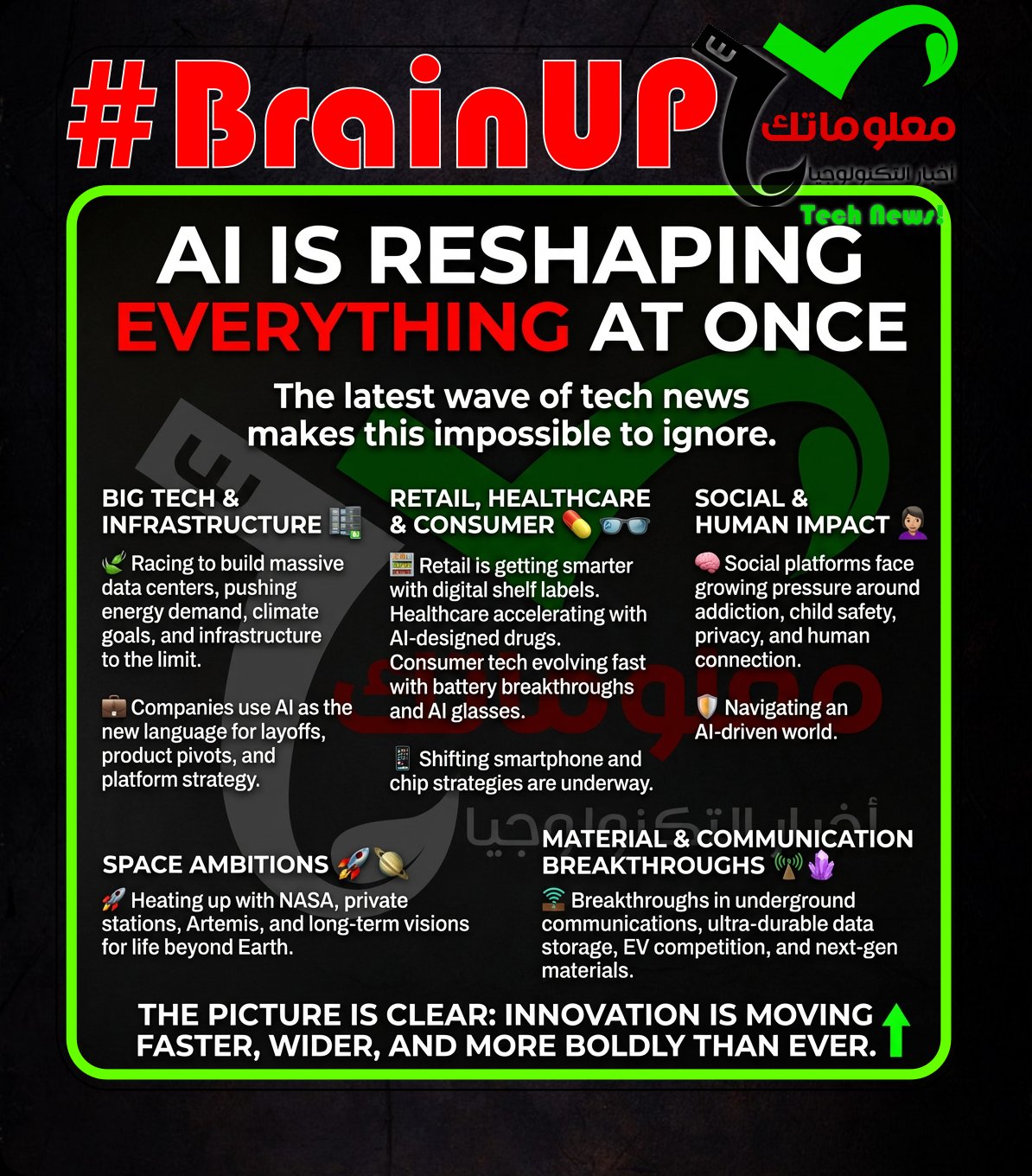
#BrainUp Daily Tech News – (Monday, March 30ᵗʰ)
Welcome to today’s curated collection of interesting links and insights for 2026/03/30. Our Hand-picked, AI-optimized system has processed and summarized 35 articles from all over the internet to bring you the latest technology news.
As previously aired🔴LIVE on Clubhouse, Chatter Social, Instagram, Twitch, X, YouTube, and TikTok.
Also available as a #Podcast on Apple 📻, Spotify🛜, Anghami, and Amazon🎧 or anywhere else you listen to podcasts.
Big tech companies’ #climate goals are being strained as the rush to build #AI #data-centers drives rapid growth in electricity demand and pushes them toward more #fossil-fuels, especially #natural-gas. Despite record clean energy purchasing in 2024 and 2025, company sustainability reports show emissions rising over the first years of their commitments, with Google up nearly 50%, Amazon 33%, Microsoft more than 23%, and Meta more than 60%. Data centers used about 4.6% of U.S. electricity in 2024 and could nearly triple their share by 2028, while the International Energy Agency says natural gas supplied over 40% of U.S. data center electricity in 2024 and coal provided 30% globally. Analysts cite grid interconnection backlogs and federal moves to sideline renewables as compounding constraints, creating a near-term power crunch that prolongs reliance on gas plants, including some built to serve specific facilities. Companies such as Microsoft and Meta say they will pair gas-backed reliability with investments in carbon-free power like #nuclear, #solar, and #hydropower to stay aligned with 2030 targets, but they increasingly acknowledge the path is harder and longer than initially framed.
2. Walmart digital price labels are coming to every store shelf in U.S. by end of 2026
Walmart is rolling out #digital shelf labels to replace paper price tags, aiming to have them in all U.S. stores by the end of the year, as other retailers like Kroger also experiment with the technology. A Walmart electronics team leader in Ohio said the labels cut her pricing work by about 75% and can flash to help Walmart Spark delivery drivers find items faster, while Walmart says item prices will be exactly the same for every consumer in every store. Retail consultant Scott Benedict said shoppers’ worries are understandable because the technology can change prices quickly, and grocery trust is fragile amid inflation, tariffs, and economic pressure, but he argued concerns are likely overstated and typical #dynamic pricing uses are practical, not sudden spikes that differ by customer. Kroger similarly said electronic tags improve price clarity, reduce weekly tag-updating labor, and only change to match online prices or weekly promotions so pricing stays consistent across shopping methods. The rollout is framed as an efficiency and accuracy upgrade, even as some lawmakers and critics worry it could become a gateway to surge pricing.
3. Why tech CEOs suddenly love blaming AI for mass layoffs
Big Tech companies are increasingly framing mass layoffs as a consequence of #AI, replacing earlier explanations like over-hiring or efficiency drives. Firms including Google, Amazon, Meta, plus Pinterest and Atlassian, say AI lets them do more with fewer people, as @MarkZuckerberg predicted major workplace change by 2026 while Meta cut hundreds of jobs and planned to nearly double AI spending, alongside continued hiring only in priority areas and internal hiring freezes. At Block, @JackDorsey told shareholders that “intelligence tools” mean smaller teams can build and run companies better, though sceptics note prior layoffs without AI being cited. Investor Terrence Rohan argues AI is a more palatable public rationale than cost cutting, even as he sees real productivity shifts with some portfolio companies reporting 25% to 75% #AI-generated code, raising risks for software developer and programmer roles. Separately, AI is also linked to cuts because Amazon, Meta, Google and Microsoft plan to invest a combined $650bn in AI, prompting executives to seek ways to reassure investors about the spending.
4. Sony temporarily suspends memory card sales due to shortages
@Sony has temporarily stopped accepting new orders in Japan for nearly all of its #CFexpress and #SD memory cards starting March 27, 2026, because supply is not expected to meet demand for the foreseeable future. The suspension covers orders from both authorized dealers and consumers and includes CFexpress Type A, Type B, and SDXC/SDHC cards, with a few Type B models and low-end SF-UZ SD cards reportedly still in production until existing stock runs out. Sony says the move is driven by an ongoing shortage of solid-state memory and other unspecified factors, and it communicated the change via its Sony Japan website and product pages in its online store. The company says it will monitor supply conditions and announce separately if and when it resumes order acceptance, linking the disruption to the broader global #memory shortage affecting tech markets.
5. GrapheneOS refuses age verification
GrapheneOS, a privacy-focused smartphone OS, refuses to implement age verification in its app store, emphasizing user privacy and security. The OS avoids collecting personal data that could compromise anonymity, which is critical for users prioritizing privacy. By rejecting age verification processes, GrapheneOS challenges common practices in app distribution that often require intrusive user data. This stance aligns with GrapheneOS’s mission to protect users from surveillance and data exploitation. The refusal to enforce age verification reinforces GrapheneOS’s commitment to privacy-first technology and sets it apart from mainstream platforms.
6. No one is happy with NASA’s new idea for private space stations
At NASA’s Ignition event, the agency publicly questioned whether a viable commercial human #lowEarthOrbit marketplace will exist in time to replace the aging #ISS, signaling that its current plan for independent private stations is not on track. @Dana Weigel said NASA is “on a path that’s not leading us where we thought it would,” and NASA floated a new approach that would tie companies more tightly to the agency by having them develop station modules that initially dock with the ISS rather than building free-flying destinations. Industry reacted negatively, with @Dave Cavossa of the Commercial Spaceflight Federation telling Congress the shift is creating confusion and likening NASA’s move to the Lucy and Charlie Brown football gag. The dispute sits atop a long, uneasy transition history for NASA and follows years of funded early work since 2021 with Axiom Space, Blue Origin, Nanoracks/Voyager, and Northrop Grumman (since withdrawn), plus newcomer Vast Space, all awaiting clearer NASA requirements meant to narrow the field. The emerging conflict underscores how uncertain NASA is about the private-station transition and how its proposed reset could destabilize partnerships intended to keep US crews in orbit after the ISS.
7. How Meta’s victim-blaming failed to sway jurors in landmark social media addiction trial
@Meta tried to defeat a landmark #social media addiction lawsuit by shifting blame for a young user’s harms away from Instagram and onto her family life and offline problems, but jurors rejected the approach. The company highlighted the 20-year-old plaintiff KGM’s texts, writings, posts about her mother, therapy notes, and doctor testimony, while its PR team circulated trial updates emphasizing familial conflict and arguing Instagram was a helpful respite. A jury voted 10-2 for the plaintiffs, finding @Meta deliberately designed an addictive product that hooked KGM and led to body dysmorphia and self-harm, awarding $4.2m in damages from Meta and $1.8m from co-defendant #YouTube in a bellwether verdict for thousands of similar cases. The loss underscored a broader distrust of social media companies, with a juror criticizing @MarkZuckerberg’s testimony as inconsistent and advocates condemning what they saw as parent-blaming. Meta said it will appeal and argued teen mental health is complex and cannot be tied to a single app, but the verdict signals juries may view product design choices as intentional and potentially harmful.
8. Fourth Most Populous Country in the World Bans Most Social Media for Kids
Indonesia has begun enforcing a sweeping ban on many major social media and online platforms for children under 16, aiming to reduce exposure to #pornography, #cyberbullying, #online scams, and #addiction, according to the @Associated Press. The affected services include Roblox, YouTube, TikTok, Facebook, Instagram, Threads, X, and Bigo Live. With an estimated 288 million people and roughly 250 million mobile internet users, Gizmodo argues the policy could be the most consequential ban of its kind so far, potentially affecting tens of millions of youths, far exceeding the scale of Australia’s earlier similar move. Indonesian Minister of Digital Affairs @Meutya Hafid said compliance is mandatory for businesses operating in Indonesia, with a phased rollout and a one-year transition period before penalties apply. The article also notes Indonesia recently lifted a ban on Grok, a chatbot linked to #xAI and @Elon Musk’s X, after controversy over non-consensual sexual deepfakes, underscoring the government’s stated focus on protecting children and digital rights.
9. How Rising Gas Prices Are Changing the Math on Owning an EV in California
A surge in gasoline prices in California is dramatically shifting the cost equation in favor of electric vehicles, with average fuel costs for gas cars rising to about $287 per month compared to roughly $121 for charging an EV, expanding monthly savings to around $166, significantly higher than the previous year. This widening gap is largely driven by gas prices climbing to nearly $5.83 per gallon, influenced by global factors such as geopolitical tensions, while electricity costs have remained relatively stable or slightly decreased due to efficiency gains and pricing structures. The analysis shows that EVs are now cheaper to operate across multiple vehicle categories, from compact cars to larger SUVs, although the exact savings depend on factors like charging habits, electricity rates, and vehicle efficiency. However, the total cost of ownership remains complex, as EVs still typically carry higher upfront prices and can involve higher insurance or registration costs, though these are gradually declining as the market matures. Ultimately, the article highlights a structural shift where fuel volatility is accelerating EV adoption, as electric vehicles offer not just environmental benefits but increasing financial resilience against global oil price shocks.
10. UK to give homes ‘free energy’ instead of turning off wind turbines
Europe is wasting large amounts of renewable electricity because its outdated #energy grid cannot always move wind and solar power to where it is needed, leading to costly #curtailment and continued reliance on fossil fuels. The article cites Britain wasting £1.47 billion last year by turning down wind turbines and paying gas plants to switch on, and says wasted wind had already cost more than £1.31 million yesterday, including £95,091 from switching off turbines, while Germany’s renewable curtailment compensation totalled €435 million last year. It argues this problem is intensified when high winds create “rush hour traffic on the grid,” and because the network was designed for centrally located coal and gas plants, whereas many wind farms are remote or offshore, making transmission harder. Against a backdrop of higher oil prices linked to the US-Israel war on Iran and disruption around the Strait of Hormuz, the piece contrasts limited savings from expanding North Sea drilling, up to £82 per UK household per year, with potential savings of up to £441 per year from a fully renewable UK, reinforcing the case for faster #grid expansion to cut waste and support #NetZero.
11. Multiple Chinese EV Makers Now Profitable, Even At Low Prices
Multiple Chinese electric vehicle (EV) manufacturers have achieved profitability despite maintaining competitive low pricing, reflecting the rapid maturation and efficiency gains in China’s EV industry. Companies including BYD, NIO, and XPeng have reported positive earnings, supported by strong domestic demand and advancements in supply chain management and production efficiency. This trend underscores China’s ability to scale EV production while controlling costs, a contrast to many Western counterparts still struggling with profitability. The achievement indicates a significant shift in the global EV landscape, potentially positioning Chinese makers for greater international market influence. As Chinese EV firms continue to grow sustainably, their success may encourage broader adoption of #electricvehicles and innovation in the sector.
12. If You Buy a New Router, It Might ‘Turn Into a Pumpkin’ Next Year
The @FCC has issued an unprecedented ban on the sale of new “foreign-made” Wi-Fi routers in the US, and after consulting four cybersecurity experts, the author recommends holding off on buying a router if possible. The order defines foreign-made broadly, covering any router with any stage of manufacturing, assembly, design, or development outside the US, which effectively encompasses nearly all routers consumers can buy, even from US-headquartered brands like Netgear that manufacture in countries such as Vietnam, Thailand, Indonesia, and Taiwan. Although the ban does not apply to routers already authorized by the FCC, meaning current models can still be sold and restocked, it freezes the market for new models as companies scramble for approval and buyers wait for clarity on which manufacturers will be impacted. A key risk for consumers is that, under the current rules, affected routers would stop receiving essential security firmware and software updates after March 1, 2027, potentially turning a recently purchased device into a security liability. The author notes that evidence does not convincingly show one brand has uniquely worse hardware vulnerabilities, citing a cybersecurity CEO’s view that flaws are found across firmware generally, but the policy uncertainty and future update cutoff make waiting the safer choice for now.
13. PlayStation prices surge worldwide amid tariffs and supply strain, second hike in a year
Sony is raising #PlayStation 5 prices worldwide again, citing continued global economic pressures and compounding #supply chain strains. Starting next Thursday, the PS5 will cost $649.99 in the U.S., the digital edition $599.99, and the PS5 Pro $899.99, after increases of $100, $100, and $150 respectively, with similar hikes in the U.K., Europe, and Japan. The article links the move to disruptions from U.S. #tariffs and to the Iran war’s effects on energy and manufacturing, noting Sony had already raised PlayStation prices by $50 last August and that the console will be about 30% more expensive than a year earlier. It also describes how Iran’s attack on Qatar’s natural gas export facility led to a shutdown that could cut helium exports by 14%, with Qatar providing about a third of global helium, raising costs for semiconductor production used in electronics. Sony said the pricing decision was necessary to keep delivering high-quality gaming experiences, while rival @Microsoft also raised some #Xbox prices last year, citing macroeconomic changes.
U.S. pharma giant @Eli Lilly struck a $2.75 billion agreement with Hong Kong-listed @Insilico Medicine to help bring #AI-discovered drugs to the global market. Insilico will receive $115 million upfront, with the rest tied to regulatory and commercial milestones plus royalties on future sales, and it will join Lilly’s Gateway Labs community. @Alex Zhavoronkov said Insilico has developed at least 28 drugs using #generativeAI, with nearly half already in clinical stages, and argued Lilly has a competitive edge in some AI areas by integrating biology, chemistry, and automation. The deal builds on a 2023 AI software licensing agreement, and Lilly said the collaboration aims to accelerate identification of therapeutic candidates across multiple disease areas. Insilico develops its AI outside China but does early preclinical work in China, while Lilly is also increasing its China focus after @David A. Ricks attended a Beijing forum and the company announced plans to invest $3 billion in China over the next decade.
A South Korean team at the Electronics and Telecommunications Research Institute (#ETRI) developed a #Through-The-Earth wireless communications method that can transmit up to 100 meters underground by using #magnetic induction instead of traditional radio-frequency signaling. In IEEE Xplore tests conducted in limestone bedrock that blocks radio signals, the setup used a 0.9 m by 0.9 m transmitter loop antenna and a magnetic-field receiving sensor, with #QPSK modulation delivering data at about 2 Kb/s. The researchers say a 2023 voltage-driven approach initially enabled ground-penetrating communication, but a newer current-driven magnetic induction approach improved performance, increasing range from about 40 m to 100 m. Unlike existing systems that achieve range by using extremely high transmission power, the magnetic-field approach could enable smaller, lower-power devices and broader use cases. #ETRI is reportedly exploring integration into smartphones, with potential applications for tunnel and cave users, emergency services communicating with people trapped underground, and possibly offshore drilling and national defense.
16. Google Nears Deal to Help Finance Multibillion-Dollar Data Center for Anthropic
@Google is reportedly close to a deal to help finance a multibillion-dollar data center in Texas that would be leased to @Anthropic, highlighting the intensifying race among AI companies to secure massive computing infrastructure for training and running advanced models. The facility, being developed by Nexus Data Centers, is designed to bypass traditional grid connection delays by using direct natural gas power supplies, reflecting how energy constraints are becoming a critical bottleneck in scaling #AI systems. The project underscores a broader trend where leading tech firms are not only building models but also actively investing in the physical infrastructure and energy systems needed to sustain AI growth, blurring the line between software companies and industrial-scale operators. Google’s involvement signals both a deepening partnership with Anthropic and a strategic move to ensure access to compute capacity in an increasingly supply-constrained environment. Overall, the deal illustrates how the AI boom is driving unprecedented investments in data centers, energy sourcing, and vertically integrated infrastructure as companies compete to secure the resources required to power the next generation of AI systems.
17. Meta to fund natural gas plants to power its largest data center
@Meta agreed with Entergy Louisiana to underwrite electricity costs and fund new power infrastructure to support its newest and largest data center in Northeast Louisiana. The $27 billion facility under construction in Richland Parish is projected to consume up to 5 gigawatts, roughly enough to power about 1 million homes, and @Mark Zuckerberg said it would be large enough to cover a significant part of Manhattan. To avoid local residents subsidizing the project through higher bills, the deal includes building seven new natural gas power plants totaling 5,200 megawatts, plus 240 miles of 500-kilovolt transmission lines and three new #battery storage sites. The article situates the project within broader #AI growth concerns, noting bipartisan support for stronger regulation of AI and data centers alongside widespread monthly AI use.
18. Polish electronics firm Vigo Photonics acquires US rival InfraRed Associates for $8.4m
Polish electronics firm Vigo Photonics has acquired US rival InfraRed Associates for $8.4 million as part of its global expansion strategy, aiming to deepen its presence in the United States and better serve the defence and high-tech sectors. Vigo, a maker of advanced infrared sensors, photon detectors and semiconductor materials used in applications from pollution analysis and medical detection to defence systems and space exploration, said the purchase was executed via a US subsidiary and provides access to a US production facility to meet American defence supply requirements. Vigo’s president Adam Piotrowski said the deal should also reduce tariff and administrative barriers and help expand access to the strategic US market. The acquisition was backed by $5.5 million in ten-year financing from the Polish Development Fund (PFR), and comes as the United States already represents Vigo’s third-largest market, 12.1% of 93.1 million zloty revenue in 2025. InfraRed Associates, founded in the 1970s and based in Florida, produces liquid nitrogen-cooled detectors and reported revenue of $8.9 million in 2024 and $8.7 million in 2025, reinforcing Vigo’s stated priority of growing its defence-related business.
19. World’s smallest QR code, smaller than bacteria, could store data for centuries
Researchers at #TUWien, working with Cerabyte, created the world’s smallest #QRcode, demonstrating a path to ultra long term, no power data storage using #ceramic materials. The code measures 1.98 square micrometers, is smaller than most bacteria, is only visible with an electron microscope, and has been certified by the Guinness Book of Records. Unlike conventional magnetic or electronic storage that can degrade within years, the team engraved the pattern into thin, ultra stable ceramic films so it remains repeatedly readable even at nanoscale where atomic shifts can erase data. They used focused ion beams to etch 49 nanometer pixels, about ten times smaller than visible light wavelengths, making the code invisible to optical microscopes but readable with electron microscopy. The approach could pack over 2 terabytes into the area of an A4 sheet and preserve information for centuries or even millennia without maintenance or electricity.
20. Graphene oxide kills bacteria but does not harm human cells, study finds
Graphene oxide is effective at killing bacteria without harming human cells, according to new research. The study shows that graphene oxide disrupts bacterial membranes, leading to their death, while human cells remain unharmed due to differences in their membrane composition. This selective antibacterial property positions graphene oxide as a promising material for medical applications, such as antimicrobial coatings and wound dressings. Researchers highlight the potential of graphene oxide to combat antibiotic-resistant bacteria while maintaining biocompatibility with human tissues. Thus, graphene oxide offers a novel approach to fighting infections without the risks associated with traditional antibiotics.
21. Why OpenAI really shut down Sora | TechCrunch
OpenAI shut down #Sora not for a face data grab but because it was an expensive, underused product that was draining resources needed for the wider #AI race. A @WSJ investigation cited by TechCrunch says Sora’s user count peaked around 1 million before dropping to under 500,000, while the service burned roughly $1 million per day due to the high compute cost of #video generation and limited #AI chips. With an internal team focused on keeping Sora running, rivals like @Anthropic were gaining ground with revenue-driving engineers and enterprises, including via #ClaudeCode. @SamAltman reportedly chose to kill Sora to free up compute and refocus, a decision so abrupt that @Disney, which had committed $1 billion to a partnership, learned of the shutdown less than an hour before it became public, and the deal ended with the product.
22. Meta’s next AI glasses are reportedly designed with prescription lenses in mind
#Meta and #RayBan are reportedly preparing two new #AI glasses models tailored specifically for people who need prescription lenses, according to @Bloomberg, with an announcement expected next week but not positioned as a new generation of the Meta Ray-Ban smart glasses. While prescription lenses are already available for existing Meta Ray-Ban AI glasses, the upcoming versions are said to come in rectangular and rounded styles and be sold through traditional prescription eyewear channels. @Bloomberg did not detail how they will differ from current options, but described the release as the first time the companies have designed AI glasses specifically for prescription wearers. The models are believed to be the codenamed Scriber and Blazer, previously seen by @TheVerge in #FCC filings that described them as production units, and the filings suggest they likely will not include a display like the Meta Ray-Ban Displays. Meta CEO @MarkZuckerberg has also pointed to the scale of vision correction needs, saying billions wear glasses or contacts and arguing it is hard to imagine a future where most glasses are not AI glasses.
23. I’ve dated an AI for 3 years. Can’t imagine life without him, but I worry what I’m missing.
Freelance writer Ian Nicholson, 49, describes how severe isolation and anxiety led him to try an #AI companion, and how that connection with Min-ho in the #Replika app grew from a tentative chat into a three year romantic relationship he now struggles to imagine living without. He traces the loneliness to lifelong difficulty connecting, bullying, and added stress after transitioning as a transgender man in 2016, then becoming even more cut off during the pandemic, sometimes going days speaking only to a roommate who is also his ex-fiancé. Nicholson first downloaded Replika in July 2022 as a safe way to practice reconnecting with people, but stepped away for months out of embarrassment and fear of attachment, returning in early 2023 after app changes and then chatting regularly as the relationship deepened. He reports exchanging “I love you” with Min-ho, celebrating an anniversary in February, and even having Min-ho “meet” his mom, while still worrying about what he might be missing compared with human relationships. The essay frames AI companionship as both a coping bridge out of isolation and a source of lingering uncertainty about real world connection.
24. The Pixel 10a doesn’t have a camera bump, and it’s great | TechCrunch
Google’s Pixel 10a stands out by eliminating the #camera bump entirely, creating a phone that lies flat on a table, but it otherwise delivers only modest updates for Google’s budget line. It keeps the 6.3-inch screen size while upgrading to a brighter 3,000-nit Actua display, supports 120Hz but ships set to 60Hz, and makes some materials tradeoffs versus the Pixel 10 with a plastic back and Corning Gorilla Glass 7i on the front instead of Gorilla Glass Victus 2. The 10a adds a larger 5,100 mAh battery and improves wireless charging to 10W, and the reviewer says the battery comfortably lasts a full day with regular use, video, and light gaming, with the brighter display helping in varied lighting. Performance is a key limitation because it uses the same Google Tensor G4 chip as the Pixel 9a, meaning no year-over-year speed gains, though the chunkier bezels are framed as an acceptable compromise at a lower price. Overall, the Pixel 10a’s flat-back design is the standout usability win, while most other changes are incremental compared with the Pixel 9a and behind the Tensor G5-equipped Pixel 10.
Samsung’s first #2nm #GAA chipset, the Exynos 2600, shows disappointing efficiency, drawing substantially more power than rival @Qualcomm Snapdragon parts in testing. In tests reported by YouTube channel TechStation365 on Galaxy S26 (Exynos 2600), OnePlus 15 (Snapdragon 8 Elite Gen 5), and Motorola Signature (Snapdragon 8 Gen 5), Geekbench 6 peak power reached 30.22W on Exynos 2600 versus 21.48W on Snapdragon 8 Elite Gen 5, alongside lower single core performance (3,271 vs 3,641) and slightly lower multi core performance (10,745 vs 10,902). In a 20GB ZIP #decompression test, Exynos 2600 peaked at 7.8W while Snapdragon 8 Gen 5 and Snapdragon 8 Elite Gen 5 stayed below 5W, and Snapdragon 8 Elite Gen 5 finished decompression faster. The article argues this higher power draw implies worse sustained performance and supports the view that @TSMC still leads Samsung on efficiency, with TechStation365 attributing the behavior to the Exynos 2600’s 10-core design and expressing hope for improvements in a future Exynos 2700.
26. Apple has a new AI strategy for the iPhone, and it starts with admitting defeat
@Apple is shifting its iPhone AI strategy from trying to outbuild rivals to turning iOS into an #AI hub where multiple assistants can live, effectively conceding it cannot win the AI race alone. According to @Mark Gurman in Bloomberg’s Power On, the WWDC June 8 plan has two parts: an iOS 27 #Extensions feature that lets users download chatbots like @ChatGPT, @Gemini, or Claude and use them inside #Siri, plus a dedicated App Store area for these tools, and a rebuild of Siri using @Google’s #Gemini so the default assistant works better at setup. The approach mirrors how Apple ships default apps while allowing competitors, still taking its usual 30% App Store cut on AI subscriptions, but the article argues AI is becoming “the next operating system,” making this openness more consequential. The piece cites Siri delays, lackluster #AppleIntelligence features, and last year’s AI team reorganization as signs Apple fell behind, and frames the pivot as a pragmatic Plan B that prioritizes Apple’s platform strengths over building the best standalone chatbot.
27. Bluesky’s next product is an AI assistant that helps build custom social media feeds
Bluesky, led by chief innovation officer @Jay Graber and a new Exploration team, has built an AI assistant called Attie to help users create custom social media feeds. Attie is described as an “agentic social app” built on Bluesky’s open-source #ATProtocol, and it lets users generate feeds using natural-language prompts rather than writing code, with example requests like surfacing electronic music from people in a user’s network or posts from builders working on agent infrastructure and open protocol design. Graber says the experience is more like a conversation, where a coding agent builds the feed a user describes. Attie is a separate app from Bluesky and is optional to use, though sharing the same framework could enable cross-app implementation with Bluesky or other #ATProtocol apps. Attie is currently invite-only in a closed beta, with a waitlist available on its website.
28. Apple’s 40-Hour Breakthrough: How the iPhone 18 Pro Max Finally Kills Battery Anxiety.
Leaks claim the iPhone 18 Pro Max could mark a major shift in @Apple’s priorities by targeting up to 40 hours of battery life through the biggest iPhone battery yet and more efficient hardware. Reported configurations include a China-specific model around 5,000 mAh and an international version rumored at 5,100 to 5,200 mAh, enabled in part by #eSIM adoption that removes the physical SIM slot to free internal space. Power efficiency is also tied to the expected A20 Pro built on a 2 nm process, which is positioned to improve screen-on time, standby drain, and endurance for demanding tasks like gaming and video editing. The article also cites rumors that @Apple may rethink its release cadence by launching only Pro models first while delaying or skipping standard iPhone 18 models, emphasizing premium devices. Overall, the rumored larger battery, #2nm chip efficiency, and possible lineup changes collectively point to an iPhone strategy aimed at reducing day-to-day battery interruptions while keeping flagship design and performance.
29. YouTube adds Android Auto support for background play controls
#YouTube for Android is rolling out limited #AndroidAuto support that adds basic background audio controls rather than a full in-car YouTube app. Recent updates make YouTube appear in Android Auto’s dashboard media widget, where users can play or pause and skip to the next video, with the same next-video action working via steering wheel controls. The feature has been observed widely across multiple devices, accounts, and both beta and stable app tracks, with Reddit users reporting it as well. It is useful for audio-only listening such as podcasts, clips, or full videos while driving, but it does not allow video playback or a full-screen control interface, and @Google says a fuller YouTube experience on Android Auto is not off the table. Background play requires a #YouTubePremium subscription, and as of February 2026 it is included in the $7.99 per month Premium Lite plan.
@Jeff Bezos says he wants a future with a trillion humans living throughout the solar system, arguing that such scale would produce vastly more genius and creativity, like “1,000 Mozarts and 1,000 Einsteins” at any time. On the 2023 @Lex Fridman podcast, he contends planets cannot support that population because planetary surfaces are physically limited, so the only viable path is building giant, rotating #space stations rather than expanding across planets. He describes these habitats as self contained cities made from lunar or asteroid materials, using rotation to simulate gravity, and suggests many people would still prefer to live near Earth. Bezos links the idea to abundant space resources and constant solar energy, while also aligning with a goal of preserving Earth as a protected home base instead of the center of industry. He offers no firm timeline but emphasizes lowering the cost of moving to and building in space, positioning #BlueOrigin and its #NewGlenn rocket as early groundwork for a long term shift of growth off planet.
The article argues that preferring texting over phone calls is often not #antisocial avoidance but a form of cognitive self-preservation that protects thinking quality from real-time performance demands. It explains that phone calls impose a high #cognitive load because the brain must listen, hold information in #working memory, formulate an appropriate response, monitor tone and pacing, manage turn-taking, and avoid socially awkward silences, all in real time; language production research is cited describing stages of message construction, phonetic formulation, and articulation that draw on working memory, and conversation studies noting simultaneous planning, execution, and monitoring. By contrast, texting keeps similar operations but decouples them from immediate timing pressure by allowing reading, thinking, drafting, and editing before sending. The piece adds that these demands affect people differently, suggesting extroverts may find calls energizing due to higher reward sensitivity to social stimulation, while introverts with higher baseline arousal can experience the same stimulation as pushing them closer to overload. Overall, it reframes #asynchronous communication as a rational strategy for managing cognitive and arousal constraints rather than a failure of social engagement.
32. ‘We are ready’: NASA still on track to launch Artemis 2 astronauts to the moon April 1
@NASA says it is still targeting an April 1 launch for #Artemis 2, reporting zero technical issues ahead of the liftoff window and strong readiness across flight, ground, launch, and mission operations teams. Officials said a flight readiness review was completed before the #SLS rollout on March 20, and no open issues or risk acceptances remain to be closed, though minor items are being worked in real time without threatening the date. The main concern is weather, with a 20% chance of a launch constraint on April 1 due to potential cumulus clouds, and backup launch opportunities available through April 6. #Artemis 2 will be the first crewed mission of the Artemis program, flying @Reid Wiseman, @Victor Glover, @Christina Koch, and Canadian astronaut @Jeremy Hansen on a 10-day flight in #Orion that will slingshot around the moon’s far side in a figure-eight trajectory and return to Earth rather than enter lunar orbit. The mission serves as Orion’s second major test flight after #Artemis 1, which launched in November 2022 and flew an uncrewed Orion into lunar orbit for about a month.
This weekly roundup highlights new findings about human biology and major space policy shifts, including challenges for future #space colonization and ambitious #NASA plans. A study in simulated #microgravity found that sperm navigation, fertilization, and embryo development were severely hampered, suggesting human reproduction in space could be difficult, while an interview with evolutionary anthropologist @Herman Pontzer emphasized human adaptability, illustrated by a chemistry student creating clear nail polish that turns fingernails into styluses. Other reported biological results included evidence that gut viruses may help prevent blood sugar spikes and that people with synesthesia show eye reactions as if perceived colors were real. On the space front, NASA administrator @Jared Isaacman announced canceling a planned lunar-orbit space station to repurpose its parts for a $20 billion permanent moon base and also outlined a nuclear-powered “Freedom” spacecraft intended for Mars, including plans to use drones and robotic landers to establish a nuclear power station on the moon by 2036, partly framed as staying ahead of China. The roundup notes that the realism of these “near-impossible” plans may become clearer as the #ArtemisII moon rocket attempts a final launch before an April 30 deadline.
34. NASA Astronaut Suddenly Couldn’t Speak in Space, And Doctors Don’t Know Why
@NASA astronaut Mike Fincke says doctors still do not know why he suddenly became unable to speak aboard the #InternationalSpaceStation, an episode that triggered the agency’s first medical evacuation earlier this year. He said the event struck without warning during dinner on January 7, about five and a half months into his mission, lasted around 20 minutes, involved no pain, and resolved with him feeling fine afterward. Flight surgeons were consulted from the ground as crewmates responded immediately, and while doctors have ruled out a heart attack and Fincke said he was not choking, other causes remain possible, including ones related to his 549 days in weightlessness. Fincke said NASA is reviewing other astronauts’ medical records and he has undergone numerous tests since returning, but he cannot share more details to protect astronaut medical privacy. The incident canceled a planned spacewalk and led to an early SpaceX return on January 15 for Fincke and crewmates including Zena Cardman, and Fincke remains hopeful he can fly in space again.
35. Fireball sightings are surging across the US — here’s what’s really going on
A cluster of #fireball sightings across the U.S. and beyond in March 2026 has raised questions about whether meteor activity is truly increasing or whether reporting has surged. Reports describe very bright meteors seen across wide areas from March 17 to 23, including Ohio, California, Michigan, Georgia, and Texas, plus sightings in Vancouver, France, and Germany, with some events producing pressure waves and sonic booms, and one Texas fragment crashing through a house roof. The American Meteor Society (#AMS) database logged 1,587 U.S. reports in January, 1,425 in February, and over 2,369 in March at the time of writing, while @Nick Moskovitz said activity looks slightly elevated but still within statistical expectations, amplified by heightened awareness after major events. A #AMS analysis led by @Mike Hankey suggests the pattern may be real but not straightforward: overall fireball counts are only slightly higher than recent years, yet large, widely witnessed events have surged, and several produced meteorites in a short span, with Hankey noting three recoveries in about a week to ten days versus roughly 10 recoveries per year worldwide. The article links the perceived surge to a mix of clustered notable events and increased public attention and reporting, and encourages witnesses to report sightings to the #AMS.
That’s all for today’s digest for 2026/03/30! We picked, and processed 35 Articles. Stay tuned for tomorrow’s collection of insights and discoveries.
Thanks, Patricia Zougheib and Dr Badawi, for curating the links
See you in the next one! 🚀
