
#BrainUp Daily Tech News – (Thursday, March 26ᵗʰ)
Welcome to today’s curated collection of interesting links and insights for 2026/03/26. Our Hand-picked, AI-optimized system has processed and summarized 22 articles from all over the internet to bring you the latest technology news.
As previously aired🔴LIVE on Clubhouse, Chatter Social, Instagram, Twitch, X, YouTube, and TikTok.
Also available as a #Podcast on Apple 📻, Spotify🛜, Anghami, and Amazon🎧 or anywhere else you listen to podcasts.
1. Bernie Sanders and AOC introduce bill to pause building of new datacenters
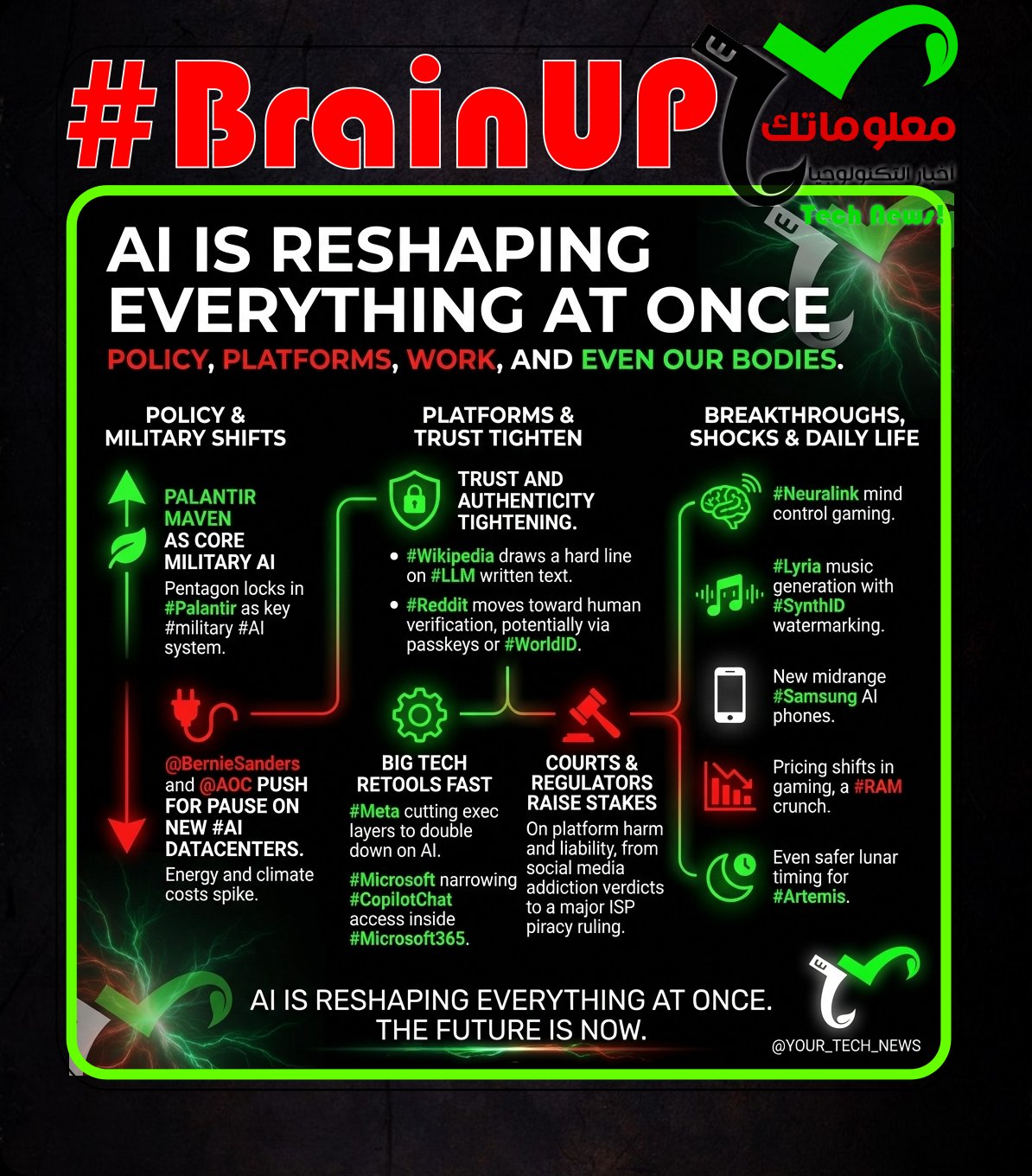
@Bernie Sanders and @Alexandria Ocasio-Cortez announced legislation to impose an immediate moratorium on new #AI datacenter construction, arguing it is needed during an energy crisis to create strong federal guardrails. @Sanders said #AI is transforming the economy, democracy, warfare, and education, and warned Congress is unprepared for the scale and speed of the changes. The Senate bill would keep the pause in place until laws are enacted to address datacenters’ climate and environmental harms, prevent higher utility costs, reduce job displacement, and ensure AI-generated wealth is shared with the US public, and it would also ban exports of computing hardware like #AI chips to countries without such protections, including China. @Ocasio-Cortez plans a companion House bill, as local and state efforts to pause datacenter growth have expanded since August 2025 and advocacy groups have urged a federal moratorium. Polling cited in the article indicates Americans are increasingly concerned about AI and want stronger regulation, which the lawmakers use to justify a federal pause tied to enforceable protections.
2. Wikipedia has banned AI-generated text, with two exceptions
The English-language #Wikipedia has adopted a policy banning the use of #LLMs to generate or rewrite article content, after earlier attempts at broader guidance failed to reach consensus on implementation. According to administrator @Chaotic Enby, prior proposals ran into disagreements over vagueness and scope, so the new rule focuses on a clear prohibition with limited carveouts. Editors may use #LLMs to suggest refinements to their own writing if they verify accuracy and ensure the tool has not changed meaning beyond what sources support, and they may use AI for a first pass at translation if they are fluent enough to catch mistakes and confirm no incorrect information was added. The policy applies only to en.wikipedia.org, while other language editions set their own rules, and the article notes Spanish Wikipedia already bans LLMs for creating or expanding entries without the same exceptions. Because detecting LLM-written text is imperfect and some human writing can resemble AI output, some AI-generated material may still slip into less-moderated pages despite Wikipedia’s guidance on spotting it.
From @Alex Karp’s view, the #AI era will reward only two broad types of people: those with vocational training in skilled trades and those who are #neurodivergent, because both are harder to replace and more likely to produce distinctive, risk-taking work. He argued that trades like electricians and plumbers are difficult to automate and are in demand as Big Tech builds data centers amid labor shortages, while neurodivergence, including dyslexia, ADHD, and autism, can foster an “artist” mindset that sees problems differently and builds something unique. A Gartner study cited in the article projects that one-fifth of sales organizations in #Fortune500 companies will actively recruit neurodivergent talent by 2027 to improve performance. Palantir reinforces this approach through a Neurodivergent Fellowship and a Meritocracy Fellowship for high school graduates not in college, offering a $5,400 monthly stipend and a path to full-time roles. Despite holding elite degrees himself, Karp criticized traditional higher education as vulnerable to #AI disruption, saying it will destroy humanities jobs and make elite humanities credentials hard to market without other skills.
4. Meta Cuts Executives as AI Shift Changes Company Focus
Meta is undergoing significant layoffs among its executive ranks as part of a strategic shift to emphasize artificial intelligence. The company is reducing roles tied to previous growth strategies that focused heavily on the metaverse and social media expansion. Executives responsible for these areas are being let go to streamline leadership towards AI-driven projects. This realignment reflects Meta’s adaptation to competitive pressures in the technology sector and increasing importance of #AI technologies in shaping future platforms. Such moves highlight the evolving priorities within large tech firms adjusting to the changing digital landscape.
5. Reddit accounts with ‘fishy’ bot-like behavior will soon need to prove they’re human
#Reddit will tighten its #bot crackdown by labeling registered automated accounts and requiring some suspicious accounts to verify they are human. @Steve Huffman says developers will be able to register automated accounts that will display an “[APP]” label, while unlabeled accounts showing “automated” or “fishy” behavior may be prompted to confirm a person is behind them, something he says will be rare and not apply to most users. Reddit is exploring privacy-preserving checks like a #passkey verification via fingerprint scan or PIN, third-party biometric options like @Sam Altman-backed #World ID, and, as a least preferred option, third-party ID verification, which Huffman notes is already required in the UK and Australia. Accounts that cannot verify humanness may be restricted, and Reddit also plans to make reporting suspected bots easier while not broadly penalizing all AI-assisted writing. The goal, according to Huffman, is to ensure there is a real, live human behind the accounts users are seeing.
6. Meta and YouTube found liable in social media addiction trial
A Los Angeles jury found @Meta and @Google liable in a landmark case brought by a 20-year-old woman, Kaley, concluding the companies intentionally built addictive platforms that harmed her mental health. The jury awarded $6m in damages, split as $3m compensatory and $3m punitive after finding the firms acted with “malice, oppression, or fraud,” with #Meta responsible for 70% and #Google for 30%. Both companies said they disagree with the verdict and will appeal, with Meta arguing teen mental health cannot be linked to a single app and Google saying the case misunderstands #YouTube as a streaming platform rather than social media. The trial highlighted evidence and testimony about age limits, including @MarkZuckerberg pointing to a policy barring under-13 users while being shown internal research indicating younger children used Meta platforms. The verdict, alongside a separate New Mexico jury decision finding Meta liable for endangering children, was portrayed by observers as reflecting intensifying public and policy pressure for tighter #child-safety restrictions on social media.
7. Neuralink Patient Confirms He’s Playing World of Warcraft with His Mind
A patient with a #Neuralink implant has confirmed he is playing #WorldOfWarcraft using only his mind, showcasing the practical application of @ElonMusk’s brain-computer interface technology. This milestone highlights Neuralink’s progress in enabling direct neural communication and interaction with digital platforms. The successful gaming demonstration underscores the potential for such technology to revolutionize how users engage with video games and digital environments. The patient’s achievement validates Neuralink’s capabilities in interpreting neural signals for complex commands in real time. This development marks a significant step forward in brain-machine interfacing with implications for gaming, accessibility, and human-computer interaction.
8. Supreme Court rejects Sony’s attempt to kick music pirates off the Internet
The @Supreme Court unanimously ruled in Cox Communications v. Sony Music Entertainment that #Internet service providers are not liable for customers’ copyright infringement unless the provider takes specific steps intended to cause infringement, rejecting Sony’s push that would have effectively required mass account terminations. Justice @Clarence Thomas wrote that merely providing a public service with knowledge some will infringe is not enough, contributory liability requires intent shown by inducing infringement or offering a service tailored to infringement, defined as lacking “substantial” or “commercially significant” noninfringing uses. The Court relied on precedents including Sony’s 1984 #Betamax win and the 2005 MGM v. #Grokster inducement framework, finding Cox neither encouraged piracy nor provided a service designed for infringement. While Cox had faced a $1 billion verdict in 2019 and an appeals court finding of willful contributory infringement even after damages were overturned in 2024, the Court reversed, with @Sonia Sotomayor, joined by @Ketanji Brown Jackson, concurring in the judgment but disputing the majority’s narrow liability approach. The decision limits attempts to force ISPs to police networks under the #DMCA by making failure to terminate accused users insufficient for secondary liability.
9. We need more plumbers and fewer lawyers in AI age, says BlackRock boss
@Larry Fink, chief executive of @BlackRock, says societies should revalue skilled trades as #AI reshapes the labour market, arguing the US overemphasised university and prestige office careers while undervaluing hands on work. He told the BBC that the AI boom could create many jobs for electricians, welders and plumbers, while reducing demand for some office roles, requiring a rethink of what work is needed and respected. Fink also warned that the US Israel war with Iran could push oil prices into one of two extremes: a settlement could send prices below pre conflict levels, but a prolonged threat from Iran could mean years of oil above $100 and closer to $150 a barrel, which he said would likely trigger a steep global recession. He urged countries to be pragmatic about their #energy mix because cheap energy underpins growth and living standards, and said rising energy prices act like a regressive tax that hits poorer people hardest. He added that if oil stayed at $150 for several years, many countries would accelerate shifts toward solar and possibly wind power.
10. Your data is everywhere. The government is buying it without a warrant
An industry of #dataBrokers collects vast data from cell phone apps and web browsers for advertising, and also sells bulk information, including location data, to law enforcement and federal agencies in ways that can expose intimate details about Americans without a warrant. Privacy advocates argue this purchasing creates a #FourthAmendment loophole, and say Congress could address it during upcoming reauthorization of #Section702 of the #ForeignIntelligenceSurveillanceAct, which is set to expire April 20, after agencies were barred from bulk collection in 2015 but could buy comparable data instead. About 130 civil society organizations urged lawmakers to close the loophole, warning of an “unprecedented expansion” of warrantless mass surveillance and the possibility it could “supercharge #AI-powered surveillance.” In a Senate hearing, Sen. @RonWyden pressed FBI Director @KashPatel to commit to not buying Americans’ location data, Patel declined and said the FBI purchases commercially available information consistent with the Constitution and #ElectronicCommunicationsPrivacyAct, while the FBI would not specify what it buys and former director @ChristopherWray had suggested the agency backed away from certain location data use. Technologists note that even if brokered location records are not directly tied to names, tools can infer where a device sleeps and works, and @DarioAmodei of @Anthropic cautioned that AI could use purchasable records to build a comprehensive picture of a person’s life at massive scale, tying the debate back to efforts to close the data-broker loophole in the #FISA702 fight.
The Pentagon plans to designate @Palantir’s Maven Smart System as an official program of record, securing multi-year funding and making the #AI-enabled targeting platform a protected line item in the Future Years Defense Program. A memo signed March 9 by Deputy Secretary of Defense @Steve Feinberg says the status will provide stable resourcing for Maven’s continued development, integration, and operational use, with the U.S. Army taking over contract management and oversight moving from the National Geospatial-Intelligence Agency to the Chief Digital and AI Officer. Maven began in 2017 under @Robert O. Work as a machine-learning effort for drone surveillance, shifted from @Google to Palantir in 2018, and is described as a command-and-control system ingesting data from 150+ sources to produce computer-vision based detections and targeting recommendations. Reported operational metrics include up to 1,000 targeting recommendations per hour, 20,000+ active users, and use in events such as the 2021 Kabul airlift, support to Ukraine in 2022, and other reported operations, alongside NATO acquiring a version in March 2025. The funding trajectory cited includes a $480 million contract in May 2024 raised to $1.3 billion in May 2025 and a $10 billion Army framework agreement in July 2025, underpinning the Pentagon’s move to institutionalize Maven as a core #military system.
12. Divide between Silicon Valley and ordinary people grows ever larger
At the #Nvidia GTC conference in San Jose, Nvidia framed #AI agents, semi-autonomous chatbots that can carry out digital tasks, as the next frontier and announced an agent toolkit including #NemoClaw, signaling how aggressively Silicon Valley is betting on AI. CEO @Jensen Huang predicted Nvidia could reach $1tn in sales through 2028, while the “Magnificent Seven” have grown far faster than the S&P 500 over the past decade, yet polling cited in the piece suggests most Americans are not living in that AI-forward reality. Pew Research found 65% of Americans do not use AI at work at all and many are wary of AI and think both major political parties are regulating it poorly, with other countries’ respondents even more skeptical; the author also notes Guardian readers gravitate more to stories about AI’s harms than positive coverage, and Guardian polling found far more Americans feel their financial security is worsening than improving. This gap echoes @William Gibson’s line that the future is unevenly distributed, with the AI industry “splitting away” from everyday life as public sentiment and economic anxiety lag behind tech’s optimism. The same AI-first tilt is reflected at #Meta, where Reuters reported it is considering layoffs of up to 20% to offset ballooning AI spending including a Manhattan-sized datacenter, while it scales back or muddles its once-central #metaverse push such as changes around Horizon Worlds.
13. Russian hackers target Americans on Signal
Russian hackers have targeted American users on the encrypted messaging app Signal by exploiting vulnerabilities to intercept communications and gather sensitive information. The attack utilizes sophisticated methods including phishing and malware to gain unauthorized access, raising concerns over digital security and privacy for U.S. citizens. This operation reflects broader cyber espionage tactics employed by Russian actors to infiltrate secure communication channels and gather intelligence. The incident highlights the ongoing challenges in protecting democratic societies from foreign cyber threats and underscores the need for enhanced cybersecurity measures. As Signal is widely used for private communication, the breach signifies a significant risk to personal and national security.
15. Microsoft backtracks on Copilot Chat access in M365 apps
#Microsoft plans to roll back in-app access to #CopilotChat inside #Microsoft365 apps, removing it for the largest enterprise customers and throttling it for smaller ones starting April 15, 2026. Copilot Chat, a freemium alternative to the paid #Microsoft365Copilot, had been expanded into apps like Word, Excel, PowerPoint, Outlook, and OneNote via a side panel, but customers with more than 2,000 users will lose Copilot Chat in Word, Excel, PowerPoint, and OneNote and will need a paid license instead, while Outlook access remains. For customers under 2,000 users, Copilot Chat will continue in Word, Excel, and PowerPoint with “standard access,” but quality and performance may be reduced during peak times, and admins may see prompts for the paid tier; Microsoft will also label tiers as “Copilot Chat (Basic)” and “M365 Copilot (Premium).” Microsoft said the changes clarify that enterprise-grade AI in core productivity apps is delivered through the paid product, citing capabilities like advanced reasoning, model choice, and Work IQ, while analyst Jack Gold suggested the move is driven by resource demands and revenue maximization and may not boost paid adoption in the short term.
16. Scientists Discover Protein That Turns Brown Fat Into A Calorie-Burning Machine
Researchers have identified a protein that activates #brownfat, enhancing its ability to burn calories and regulate body temperature. This protein plays a critical role in converting white fat into thermogenic brown fat, which is more metabolically active. The discovery offers new insights into how energy expenditure can be increased naturally, presenting potential therapeutic strategies for combating obesity and metabolic diseases. Experiments demonstrated that upregulating the protein improves metabolic function and weight management. These findings advance our understanding of fat biology and suggest novel avenues for leveraging #brownfat in weight loss and metabolic health.
17. Dell XPS 16 (2026) review: Return of the king
The 2026 Dell XPS 16 returns with a full redesign that restores the XPS line as a top-tier premium Windows productivity laptop, delivering major improvements in portability, performance, and overall polish, with the standout drawback being early keyboard issues. The new glass-and-aluminum chassis is dramatically lighter and thinner than the prior model, while keeping strong up-firing stereo speakers and adding a useful trio of USB-C ports supporting #Thunderbolt4, #DisplayPort2.1, and power delivery, though it still lacks an SD card reader. An optional 3.2K tandem #OLED display targets mobile creators with vibrant color and a variable 20 to 120Hz refresh rate, and despite a 400-nit rating, it appears brighter in real use. Input changes are mixed: the seamless touchpad is easier to find thanks to a subtle outline and capacitive function controls are replaced by physical keys, but the keyboard’s shallow feel and apparent lack of anti-ghosting or related features undermine typing. Overall, the XPS 16 is an exquisite but pricey flagship that feels like the XPS brand is back on top, provided Dell tunes the keyboard.
18. Nintendo to start charging different prices for first-party digital and physical games
@Nintendo will begin charging different prices for first-party Switch 2 games depending on whether you buy #digital or #physical. The change starts with Yoshi and the Mysterious Book on May 21, priced at $60 on the eShop and $70 at retail, whereas most first-party games previously cost $70 regardless of format. The shift benefits download-focused buyers with a lower price, but further disadvantages physical-media fans, especially since many Switch 2 cartridges reportedly come as game key cards that require downloading and have little value afterward. The article notes Nintendo has used dual pricing before in some regions, such as the UK for Donkey Kong Bananza, and suggests rising manufacturing and shipping pressures, plus shortages and tariff uncertainty, may be contributing factors. Overall, the move underscores a growing tilt toward #digital distribution while making physical purchases costlier without added benefits.
19. Samsung launches Galaxy A57 and A37 in Europe
@Samsung has launched the Galaxy A57 5G and Galaxy A37 5G in Europe, refreshing its mid-range lineup with upgraded hardware, faster charging, and new on-device #AI features, with a US release expected later. The Galaxy A57 is thinner at 6.9mm, adds a 13% larger vapor chamber, uses a 6.7-inch 120Hz Super AMOLED+ display with #VisionBooster, runs an upgraded Exynos chipset with 8GB to 12GB RAM, and improves durability to #IP68 while shipping with Android 16 and One UI 8.5 plus six years of OS and security updates, and it keeps a 50MP OIS main camera alongside 12MP ultrawide, 5MP macro, and 12MP selfie. The Galaxy A37 shares the 6.7-inch 120Hz Super AMOLED panel and 5,000mAh battery but uses an 8MP ultrawide, is expected to pair an unnamed Exynos chip with 6GB or 8GB RAM, and both phones add #SuperFastCharging2.0 for about 60% in 30 minutes and the “Awesome Intelligence” suite including #CircleToSearch with Google multi-object recognition, voice transcription, and AI Select, plus #KnoxVault and a Private Album. Sales start April 10 via Samsung.com and major retailers, with pricing at £529 for A57 256GB/8GB and £699 for 512GB/12GB, and £399 for A37 128GB/6GB, and the historical US timing suggests late April or early May 2026 after the UK launch.
20. New Free FIFA Game Pits Greek God Zeus Against Argentinian Icon Diego Maradona, Will Come to PS5
@FIFA is launching #FIFAHeroes, a free-to-play, arcade-style football game that blends real players with mythological gods and #WorldCup mascots, and it is planned to come to PlayStation, including PS5, after an initial mobile release. The game promises fast-paced, chaotic 5-a-side matches with loose rules, wild physics, superpowers, squad building, and full cross-progression across compatible devices, with examples including @DiegoMaradona facing gods like Thor. Confirmed footballers mentioned so far include @DiegoMaradona, @HarryKane, @JordanPickford, @EduardoCamavinga, @JackGrealish, @EmilianoMartinez, and @LautaroMartinez. The article frames the concept as a predictable but potentially appealing direction for FIFA post-EA rebrand, suggesting it may see downloads during the summer World Cup but might not have long-lasting staying power. It states the mobile launch date is 28th April, credits development to VR team Enver, and notes FIFA separately confirmed a different Netflix-related game being developed by Delphi.
21. Google launches Lyria 3 Pro music generation model | TechCrunch
@Google has released #Lyria 3 Pro, an upgraded #music generation model that produces longer, more customizable tracks and expands the company’s AI music tools across consumer and enterprise products. The model can generate songs up to three minutes long instead of the 30-second limit in Lyria 3, and it offers finer control by letting prompts specify structural elements like intros, verses, choruses, and bridges. Lyria 3 Pro is rolling out to the #Gemini app for paid subscribers, and also to Google Vids, ProducerAI, and enterprise surfaces including #Vertex AI (public preview), the Gemini API, and AI Studio. Google says it trained the model using partner data plus permissible data from #YouTube and Google, that it does not mimic an artist but can take “broad inspiration” if an artist is specified, and that outputs are labeled with #SynthID to indicate AI generation. The launch lands amid broader industry efforts to identify and manage AI-made music, such as new tools from @Spotify and @Deezer.
22. RAM Crisis Forces Nex To Raise Price On Playground Kids Console
Nex is raising the price of its kid-focused motion-control console, the Nex Playground, because the ongoing #RAM shortage is driving up component costs. In an open letter, CEO and co-founder @David Lee said the console will increase $50, from $250 to $300 starting April 1, citing significant recent rises in memory (DDR) and storage (eMMC) prices tied in part to AI infrastructure expansion and shifting global supply and demand. Lee said the company tried to absorb the increases but can no longer do so sustainably, and apologized that the higher price may make the console less accessible, while noting the Game Pass-like subscription price is not changing. The Nex Playground, which uses body motion instead of physical controls, launched in 2023 at $200, went viral in late 2024, previously rose to $250 in 2025, and Nex says it has sold about 1 million units and at one point briefly outsold the PS5 and Xbox. The article frames the move as part of broader #hardware price pressure affecting consoles and PCs as AI hyperscalers buy up key parts for data centers.
23. Chinese moon lander reveals giant ‘cavity’ of radiation between Earth and the moon
Data from China’s Chang’e-4 mission suggest there is a recurring “cavity” of reduced #galactic cosmic ray radiation near the moon during local morning, which could help make future lunar surface work safer. In a study published March 25 in Science Advances, researchers analyzed measurements from the Lunar Lander Neutron and Dosimetry experiment across 31 lunar cycles from January 2019 to January 2022, focusing on quiet solar periods to isolate cosmic rays and tracking repeated changes in proton counts as the moon moved through its orbit. The team reports the reduction occurs a few hours after lunar sunrise, challenging the assumption that cosmic rays are roughly uniform between Earth and the moon outside Earth’s protective magnetic field and implying Earth’s magnetic influence may extend farther than expected. Corresponding author @Robert Wimmer-Schweingruber said lunar morning appears best for excursions, potentially lowering radiation on astronauts’ skin by about 20% compared with average lunar levels. With more crewed lunar missions planned, including #NASA’s #Artemis II, better timing and mapping of radiation intensity could be used to reduce astronaut exposure during exploration.
That’s all for today’s digest for 2026/03/26! We picked, and processed 22 Articles. Stay tuned for tomorrow’s collection of insights and discoveries.
Thanks, Patricia Zougheib and Dr Badawi, for curating the links
See you in the next one! 🚀
