
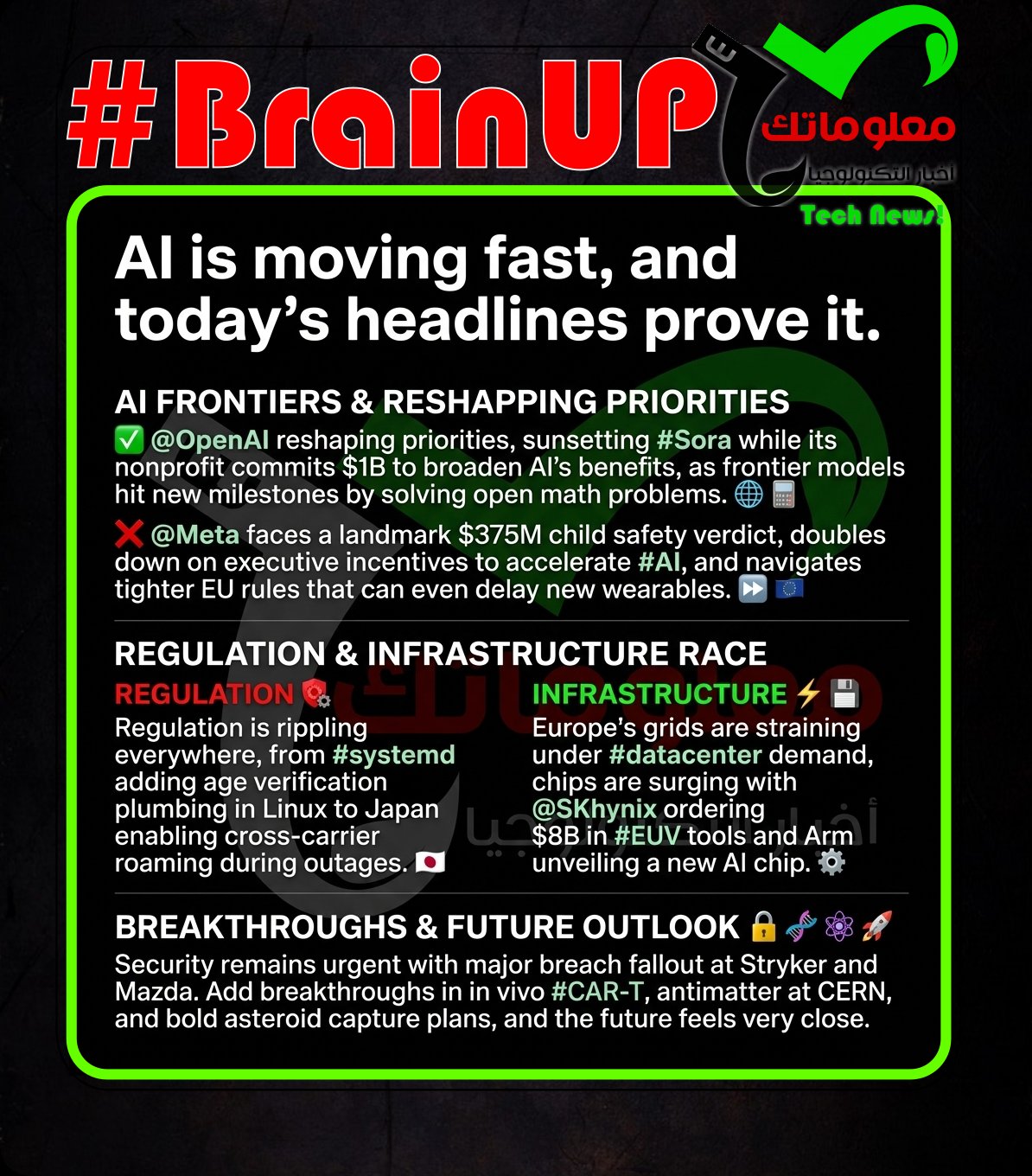
#BrainUp Daily Tech News – (Wednesday, March 25ᵗʰ)
Welcome to today’s curated collection of interesting links and insights for 2026/03/25. Our Hand-picked, AI-optimized system has processed and summarized 38 articles from all over the internet to bring you the latest technology news.
As previously aired🔴LIVE on Clubhouse, Chatter Social, Instagram, Twitch, X, YouTube, and TikTok.
Also available as a #Podcast on Apple 📻, Spotify🛜, Anghami, and Amazon🎧 or anywhere else you listen to podcasts.
1. OpenAI announces plans to shut down its Sora video generator
@OpenAI says it is preparing to shut down #Sora, its video generation app that launched in late 2024, and will share timelines for the app and API plus details on preserving users’ work. The company announced the plan in a social media post shortly after a Wall Street Journal report, acknowledging creators and saying the news will be disappointing. The decision follows reports from a leaked all-hands meeting that executives want to refocus on business and productivity applications rather than “side quests,” as OpenAI applications head @FidjiSimo reportedly framed it. The shutdown plan also raises questions about a recent $1 billion @Disney investment tied to bringing Disney characters to Sora, since it is unclear how that partnership continues. Although Sora initially impressed with early 2024 previews and later added features like new styles, more consistent worlds, voice synthesis, lip-sync, and opt-in face insertion, the AI video field has heated up with competitors such as #ByteDance’s SeeDance 2.0 and #Google’s Veo and Genie tools, which provide more advanced or interactive capabilities.
2. Meta told to pay $375m for misleading users over child safety
A New Mexico jury ordered Meta to pay $375m after finding it misled the public about how safe its platforms are for children and that its services endangered minors by exposing them to sexually explicit material and contact with sexual predators. The jury held Meta liable for violating New Mexico’s #UnfairPracticesAct, after a seven week trial featuring internal documents and testimony from former employees, including whistleblower Arturo Béjar, who described experiments showing underage Instagram users were served sexualized content and said his daughter was propositioned for sex by a stranger. Prosecutors also cited internal research indicating that at one point 16% of Instagram users reported seeing unwanted nudity or sexual activity in a single week, while the $375m penalty reflected thousands of violations with a maximum $5,000 per violation. New Mexico Attorney General Raul Torrez called the verdict historic as the first successful state lawsuit against Meta over child safety, while Meta, led by @Mark Zuckerberg, said it disagrees and will appeal, pointing to safety efforts like Instagram Teen Accounts and a parental alert feature for self harm searches. The case adds to a broader wave of US litigation alleging that #recommendationalgorithms and product design expose young users to harmful content, including a separate Los Angeles trial and thousands of similar suits.
3. Anthropic challenges Pentagon designation amid AI defense concerns
Anthropic, an AI company known for its work on large language models, is contesting the Pentagon’s designation of its technology as critical to national security, arguing the move mischaracterizes their intentions and operations. The Department of Defense labeled Anthropic a pivotal player in AI technology for defense purposes, which could impose restrictions and heightened government control over its innovations. Anthropic maintains that its developments are focused on commercial and ethical applications rather than direct military use, emphasizing its commitment to AI safety and responsible deployment. This dispute highlights ongoing tensions about the role of private AI firms in national security and the broader implications of government oversight in rapidly advancing technologies. The debate underscores the complexities in balancing innovation, ethical AI development, and defense interests in the evolving AI landscape.
4. Age checks creep into Linux as systemd gets a DOB field
systemd has merged code adding a birthDate field to its #userdb JSON user records to support #ageVerification requirements driven by new laws cited in California (AB-1043), Colorado (SB26-051), and Brazil (Lei 15.211/2025). The field is intended to store a user’s date of birth and is protected from modification except by root, and while it landed after systemd 260 it is expected to ship in systemd 261 unless reverted. The change is also justified as groundwork for draft parental controls in #Flatpak, signaling that regulatory age checks are beginning to influence core Linux plumbing and could ripple into other projects. Some communities are reacting negatively, for example a Garuda Linux maintainer said the distro will not implement age verification where not legally required, and argued backlash should focus on politicians and on boycotting organizations seen as pushing such laws. Research from the TBOTE Project, cited in the discussion, alleges @Meta is a major donor behind lobbying for age verification laws and the App Store Accountability Act (ACCA), claiming it traced more than $25 million and suggesting far larger spending, including over €10 million in Europe.
5. Meta makes ‘big bet’ on top leaders with stock options as pressure builds to catch up in AI
#Meta is granting aggressive stock option packages to top executives to retain key leaders and accelerate progress in #AI as competition intensifies. SEC filings show the plan covers CFO Susan Li, technology chief Andrew Bosworth, Chief Product Officer Christopher Cox, and operating chief Javier Olivan, while @Mark Zuckerberg is not included. The options only pay out if Meta’s share price far exceeds high strike levels on a tight 5-year timeline, with the first tranche requiring $1,116.08 per share, about an 88% jump from Tuesday’s close, and later tranches reaching as high as $3,727.12, implying a valuation over $9 trillion. The structure underscores urgency as rivals like @OpenAI, Anthropic, and Google gain momentum, while Meta has struggled with a consistent strategy despite planning up to $135 billion in capex this year and a stock price down about 4% over the past year. Meta has been revamping its AI efforts since 2025, including investing $14.3 billion in Scale AI, hiring @Alexandr Wang to lead its Meta Superintelligence Labs, and pursuing a new Llama successor frontier model codenamed Avocado.
6. Newly purchased Vizio TVs now require Walmart accounts to use smart features
After @Walmart bought @Vizio in December 2024, select newly purchased Vizio TVs now require a #WalmartAccount to complete setup and use smart TV features, expanding on the mid-2024 requirement for a #VizioAccount tied to Vizio OS offers and support. A Walmart spokesperson told Ars Technica the requirement applies to “select new Vizio OS TVs,” existing Vizio account holders can merge accounts, and they can opt out by deleting their Vizio account, but Walmart would not say which models are affected. Walmart says the integration is meant to create a “secure identity framework” that connects streaming engagement with retail interaction, and claims data use will be aggregated and permissioned, without detailing specifics. The move aligns with Walmart’s effort to leverage Vizio OS ads and tracking to grow its $6.4 billion ads business, citing Vizio’s prior ad profit versus hardware losses and Walmart’s claim of triple digit advertising growth for Vizio in fiscal Q4 2026. Walmart also announced Vizio OS ads for @LOréal that link to Walmart and other product pages, reinforcing the article’s point that Vizio TVs are increasingly positioned as an ad vehicle and that avoiding ads and tracking is getting harder, making “dumb TV” alternatives more appealing.
7. SAP already shifting away from ERP migration disaster
SAP is pivoting attention from missing its #ERP cloud migration goals to pushing “innovation” offerings, especially #AI, backed by a board-level reorganization and new commercial models. Starting next month, Thomas Saueressig’s remit expands from chief customer officer to leading a new Customer Value Group aimed at expanding SAP’s cloud and AI-powered solutions, while CEO @Christian Klein is reportedly creating a unit to drive AI adoption and introduce usage-based charging for AI consumption. The shift follows SAP being about €2B behind its plan to move customers from on-prem support to cloud subscriptions, with 2025 on-prem support revenue at €10.5B versus a previously stated €8.5B target, even as mainstream #ECC support ends in 2027 and Gartner expects over 10,000 customers to still run major business functions on ECC by 2030. Consultancy Dragon ERP says the new structure signals a focus on monetizing the installed base by upselling AI rather than prioritizing cloud lift-and-shift and #S4HANA upgrades, amid confusion after SAP stopped publishing ECC migration figures and rebranded offerings such as replacing RISE with SAP S/4HANA Cloud Private Edition with SAP Cloud ERP Private Edition. This repositioning also reflects softening from earlier messaging that future innovation, including AI, would only be available in the cloud via #RISEwithSAP, as SAP seeks growth even while many customers remain on legacy platforms.
8. Opinion: Why America Needs to Lead on Semiconductor Chips
The article argues that the United States must take decisive action to lead the global semiconductor industry due to its vital role in national security and economic growth. It highlights President @Joe Biden’s administration efforts to boost semiconductor research and manufacturing through substantial federal investments and the CHIPS Act. Despite challenges like supply chain disruptions and foreign competition, especially from #China and #Taiwan, increased investment in cutting-edge chip technology and domestic production is critical. This strategy aims to reduce dependence on overseas suppliers and maintain America’s technological edge. Ultimately, advancing semiconductor capabilities supports innovation across multiple sectors and strengthens America’s geopolitical standing.
9. Meta’s New Display Glasses Withheld From EU Over Battery Rules, Supply Shortages
Meta has delayed the release of its new display glasses in the European Union due to strict EU battery regulations and ongoing supply shortages. The company faces challenges complying with the EU’s rigorous safety and environmental standards for batteries, which has impacted the product’s launch timeline. Additionally, global supply chain constraints have exacerbated delays, complicating Meta’s efforts to introduce the glasses in this key market. These hurdles highlight the complex interplay between regulatory compliance and supply chain management for tech companies innovating in wearable display technology. Meta’s experience underscores the broader industry challenge of balancing regulatory adherence with timely product availability in the evolving EU market.
10. Several sue Stryker after cyberattack, alleging company failed to protect sensitive data
Multiple lawsuits, including one involving a current employee, have been filed against Stryker after a cyberattack, alleging the company failed to adequately protect #personal information. The Portage-based medical technology company confirmed a “threat actor” infiltrated its systems and concealed activity with a malicious file, leading to an internal investigation and system restoration, and Stryker says the breach is now contained. Plaintiffs and experts questioned the adequacy of Stryker’s #cybersecurity measures and how long the intrusion may have gone undetected, with Stack Cybersecurity CEO @Rich Miller describing the incident as severe and stating the exposure could include #PII and #PHI such as Social Security numbers. Miller said data of this kind can be exploited or sold, noting Social Security numbers can cost $5 to $10 on the dark web and warning that hidden malicious files can remain dormant for months even after a breach is declared contained. He also pointed to measures like endpoint detection and response, managed detection and response, a 24-7 Security Operations Center, and #SIM-enabled scanning as steps companies can take to better protect sensitive data, as attorneys argue the risk is not merely theoretical and seek clarity on whether employee data was accessed or exposed.
11. Call of Duty veteran’s new studio, which was just announced in 2025, is being closed by Sony
#Sony is closing Dark Outlaw Games, the new first-party studio founded by @Jason Blundell and only publicly unveiled in March 2025, continuing a recent run of studio shutdowns. Reports on Resetera and from Bloomberg’s @Jason Schreier say the studio was in early stages on an unannounced project and that Sony also laid off staff, described as a small number on Resetera and estimated by Schreier at around 50. A Sony spokesperson confirmed the closure and said SIE’s Studio Business Group made strategic adjustments for long-term sustainability that included limited workforce reductions across select teams. The move follows Sony’s earlier confirmation of closing Bluepoint Games and echoes Blundell’s prior Sony-linked effort at Deviation Games, which he left in 2022 and which closed in 2024 without releasing a game. The article frames the shutdown as part of broader #gamesIndustry disruption, noting ongoing layoffs and closures across multiple companies despite the prominence of Blundell’s #CallOfDuty background.
12. OpenAI Foundation pledges $1B in grants to ensure AI ‘benefits all of humanity’
The nonprofit that controls @OpenAI says it will expand its philanthropic role by committing to distribute $1 billion in grants over the next year to help ensure #AI benefits “all of humanity.” The article states the pledge was announced Tuesday and includes plans to build up the organization’s capacity as a grant-making funder. The commitment signals a push to scale structured philanthropy around AI-related goals, though the provided text does not specify grant recipients, eligibility, or program details. The initiative is framed as aligning OpenAI’s governance and funding with broad public-benefit outcomes in the development and deployment of AI.
13. The AI Race Is Pressuring Utilities to Squeeze More From Europe’s Power Grids
Europe’s push to add new #data centers for #AI is running into a bottleneck not in generating electricity, but in moving it through constrained power grids, limiting how many large facilities can connect without raising blackout risk. In the UK, National Grid says proposed data centers totaling more than 30 gigawatts are waiting to connect, and Ofgem reports that since the government labeled data centers “critical national infrastructure” in late 2024, connection applications have far exceeded forecasts and the queue has tripled, with some projects collapsing due to lack of grid access. Building new transmission lines is described as costly and slow, often taking seven to 14 years because of planning, legal, supply chain, labor, and construction constraints, and UK geography complicates expansion because renewables are concentrated in Scotland and the North while demand is heavier in the South and viable corridors are limited. Under government pressure to unblock connections, operators are trying to squeeze extra capacity from existing networks by changing power line materials, routing around congestion, and using weather-dependent adjustments to how much power lines carry. National Grid’s Steve Smith argues there is no single fix and that a mix of these measures is needed to connect major new customers without massive new infrastructure, as grid capacity becomes a decisive factor in whether Europe can capture AI-related investment.
14. Scientists Identify Protein That Slows Key Effects Of Aging
Researchers have identified a protein that slows down critical aging processes by regulating cellular health and longevity. Studies showed that this protein influences metabolic pathways and reduces oxidative stress, which are known contributors to aging. The protein’s role in maintaining mitochondrial function suggests it could be targeted to delay age-related diseases. Experimental interventions increasing this protein’s activity improved lifespan and healthspan in model organisms. This discovery opens avenues for developing therapies that could mitigate aging effects and improve quality of life as humans age.
15. 2 delivery robots crash into CTA bus shelters days apart; 1 incident caught on camera
Surveillance video and city officials report two separate #delivery-robot crashes into #CTA bus shelters in Chicago within days, including one incident captured on camera. In the recorded Sunday crash at the CTA Grand and Racine shelter in the 400-block of North Racine Avenue, a @Serve Robotics robot navigated the sidewalk, struck the shelter’s glass, shattered it, and then stopped. Serve Robotics said no injuries were reported, its team cleaned up quickly, and it is reviewing what happened to make improvements, while Chicago officials said the company is working with JCDecaux and will cover repair costs. A second crash occurred Tuesday at North and Larrabee in Old Town, and Coco Robotics’ vice president confirmed the company will pay for repairs. The incidents highlight operational and safety concerns around #AI powered sidewalk delivery robots as companies coordinate with local partners to address damage and stakeholder concerns.
16. Mazda discloses security breach exposing employee and partner data
Mazda has revealed a security breach that exposed personal information of its employees, business partners, and customers due to unauthorized access to an internal system. The company identified the intrusion after unusual activity was detected on the network and acted swiftly to block the attack, initiate investigations, and notify affected parties. The compromised data includes names, contact details, and employment-related information, raising concerns over privacy and potential misuse. Mazda is cooperating with cybersecurity experts and authorities to mitigate risks and enhance security measures to prevent future breaches. This incident underscores the growing threats faced by corporations and the importance of robust #cybersecurity protocols.
17. Artemis 2 is most similar to Apollo 8. What the missions had in common
NASA’s #Artemis 2 is positioned as the modern counterpart to Apollo 8 because it will send a crew around the moon and back without attempting a landing, primarily to test systems needed for later lunar surface missions. Apollo 8 launched Dec. 21, 1968, flew a six day mission orbiting the moon, and splashed down Dec. 27 in the Pacific, serving as a crucial rehearsal of trajectory and operations ahead of a landing, while also producing milestones like the first human lunar orbit and the famous #Earthrise view. Artemis 2 is targeted for April 1 from NASA’s Kennedy Space Center, flying four astronauts in a Lockheed Martin #Orion capsule atop the Boeing and Northrop Grumman #SpaceLaunchSystem, with a planned reach up to 6,000 miles beyond the moon’s far side, farther into space than any human has traveled. The Apollo 8 crew was Frank Borman, Jim Lovell, and William Anders, and the article notes Artemis 2 will include the first woman, first African American, and first Canadian to fly on a lunar mission. Like Apollo 8, Artemis 2 is framed as a pivotal, short lunar flight that prioritizes proving hardware and operations before an all important future landing mission.
18. Scientists create cancer-fighting immune cells right in the body
UC San Francisco researchers developed a way to generate #CAR-T cancer-fighting T cells directly inside the body, aiming to remove the time, cost, and chemotherapy burden of today’s bespoke manufacturing. In humanized-mouse experiments reported March 18 in Nature, their in vivo, targeted DNA integration approach produced CAR-T cells that treated aggressive leukemia, multiple myeloma, and a solid tumor, and it outperformed the standard method. The technique uses a two-particle system: one delivers #CRISPR-Cas9 gene-editing machinery to circulating T cells, and a second delivers the CAR DNA designed to insert only at a specific genomic site with a T cell specific molecular on switch. By placing a large DNA sequence at a predetermined genome location instead of random integration, the method could reduce rare risks such as secondary cancers and broaden impact beyond #CAR-T to #cell and #gene therapy. @Justin Eyquem and colleagues hope this could become an off-the-shelf, vaccine-like treatment that expands access compared with current FDA-approved therapies that can take weeks, cost $400,000 to $500,000, and require punishing chemotherapy.
20. GPT-5.4 Pro Cracks Open Math Problem
#OpenAI’s GPT-5.4 Pro produced a verified solution to an open Ramsey-style hypergraph problem from a 2019 paper, marking the first AI to solve a genuinely open problem on #EpochAI’s #FrontierMath benchmark. Epoch AI reports the model’s FrontierMath score rose from about 5% for GPT-4 in 2024 to 50% for GPT-5.4 Pro in March 2026, and says Kevin Barreto and Liam Price first elicited the solution after OpenAI released the model on March 5 as a general-purpose system. The task sought improved lower bounds on a sequence H(n) related to simultaneous convergence of sets of infinite series, and GPT-5.4 Pro’s construction removed an inefficiency in prior lower-bound methods and achieved matching lower and upper bounds, a particularly strong outcome in #RamseyTheory where such gaps can persist for decades. Problem contributor Will Brian confirmed the result, called it publishable in a specialty journal, and said the approach he suspected might work was too hard to execute until the model did it. Epoch AI also found that Anthropic Opus 4.6 (max), Google Gemini 3.1 Pro, and OpenAI GPT-5.4 (xhigh) could solve the same problem in some attempts, suggesting broader frontier-model capability beyond a single system.
Ayaneo has temporarily shelved sales of its upcoming Next 2 Windows handheld and suspended new preorders because rising component costs make the device no longer sustainable to sell at planned prices. In an update on its Indiegogo page, the company said it expected to absorb a slight loss amid shortages, but after Chinese New Year, #memory and storage vendor quotes surged, making production infeasible, with costs nearing about twice the originally set pricing. The Next 2 was announced starting at $1,999 ($1,799 early bird) for an #AMD Strix Halo based Ryzen AI Max 385 configuration with 32 GB #LPDDR5X and 1 TB storage, with higher configurations up to $4,299 ($3,499 early bird) for a Ryzen AI Max 395+, 128 GB RAM, and 2 TB SSD. Ayaneo will honor existing Indiegogo preorders and says after-sales support is unaffected with sufficient spare parts, while blocking all new sales channels until price volatility eases and the product can return. The company frames this as a provisional pause rather than an end to the line, noting features such as a 9.06-inch 2K 165 Hz #OLED display and a 116 Wh battery aimed at laptop class performance.
@Nintendo is reportedly planning to cut Switch 2 production after missing expected 2025 holiday sales, reducing planned output from 6 million to 4 million units, a 33% drop, starting April 2026, according to Bloomberg. The report notes this comes despite a strong launch weekend of 3.5 million units, and warns that weaker second year momentum could shrink the user base and discourage third-party developers versus competitors like the Sony PlayStation and the Steam Deck. Explanations cited include larger download sizes and higher microSD Express card prices, while some gamers blame more expensive games and a lack of compelling new releases, though Pokémon Pokopia reportedly sold over two million copies in four days and provided a boost. Others inside the company suggest sales were pulled forward because ample launch supply led people to buy earlier, potentially amplified by uncertainty around @Donald Trump tariffs motivating buyers to avoid future price increases. Additional pressures include rising RAM and storage chip costs that could prompt a price increase above $450, plus an EU-focused hardware revision for a removable battery to meet upcoming regulations, adding cost during broader global instability.
23. Disney Exits OpenAI Deal After AI Giant Shutters Sora
@OpenAI, led by @Sam Altman, is shutting down its standalone Sora #AI video app just months after launch, and @Disney is exiting the deal it signed last year tied to Sora. OpenAI said it is “saying goodbye to Sora” and will share timelines for the app and API plus details on preserving users’ work, while a source told The Hollywood Reporter that Disney will no longer move forward with its pledged $1 billion investment and its agreement to license some characters for use in Sora. The article notes OpenAI is not abandoning #AI video entirely, since such tools can exist within the ChatGPT app, but Sora is becoming a casualty of shifting priorities after the launch drew Hollywood attention and prompted a quick policy backtrack to give studios and talent more control over IP and likenesses. Disney said it respects OpenAI’s decision to exit the video generation business and will keep engaging with AI platforms to reach fans while respecting IP and creators’ rights, even as the collapse raises questions about Disney’s plans to integrate the tech into Disney+. The shutdown is framed as diminishing Sora’s long term impact and potentially strengthening @Google’s position in AI video generation, despite Google’s lack of IP holder deals and ongoing lawsuits.
@SK hynix disclosed a record 11.9 trillion won (about $7.9 billion) purchase of @ASML #EUV lithography tools through December 2027 to support mass production of next generation memory for AI driven demand. Analysts estimate the deal covers roughly 30 EUV scanners over about two years, to be deployed at the M15X fab in Cheongju for #HBM and at the Yongin Semiconductor Cluster for advanced #DRAM, with Yongin’s first cleanroom now targeted for February 2027 after an earlier timeline pull forward. ING noted the order likely includes a pull in element to secure ASML supply ahead of competitors, while additional spending on less advanced #DUV tools may follow separately due to shorter lead times. The context is intensifying capacity expansion across major chipmakers as AI infrastructure strains HBM and DRAM supply, with SK hynix holding over 60% of the HBM market and supplying @Nvidia while @Samsung ramps EUV based HBM production. The purchase ties directly to SK hynix’s plan to scale HBM and advanced DRAM output through 2027, complemented by a separate $13 billion advanced packaging facility in Cheongju for assembling HBM produced at M15X.
25. Britain launches satellite that can see inside buildings
Britain has launched a satellite capable of seeing inside buildings, harnessing advanced imaging technology to improve national security and intelligence capabilities. The satellite uses novel sensor technology that penetrates building exteriors to provide detailed internal views, which enhances surveillance precision compared to conventional satellites. This innovation allows for better monitoring of threats and more informed decision-making in defense and public safety sectors. The development reflects the UK’s commitment to maintaining cutting-edge space technology and intelligence advantages amid global security challenges. Such capabilities demonstrate significant progress in #satellite surveillance and reinforce Britain’s strategic position in the space intelligence arena.
26. Geneva’s CERN hails delicate antimatter production breakthrough
Geneva’s CERN has achieved a significant breakthrough in producing delicate antimatter, advancing experimental physics by enabling more detailed studies of antimatter properties. The facility successfully created and confined antihydrogen atoms by employing advanced trapping techniques, which is crucial for testing fundamental symmetries between matter and antimatter. This development allows scientists to conduct precision measurements that could illuminate why the universe is dominated by matter despite theories predicting symmetrical creation of matter and antimatter after the Big Bang. The progress at CERN demonstrates how intricate experimental methods can push the boundaries of particle physics and improve understanding of the universe’s fundamental structure. As a leading center for #particlephysics, CERN’s antimatter research contributes to addressing profound cosmological questions about the nature of matter.
27. Arm unveils new AI chip, expects it to add billions to annual revenue
Arm has introduced a new artificial intelligence chip designed to enhance performance and efficiency in AI applications. The company anticipates that this new chip will significantly boost its annual revenue by billions of dollars in the coming years, reflecting strong market demand for advanced AI technology. This development highlights Arm’s strategic focus on expanding its footprint in the AI chip segment, leveraging its technology to meet growing industry needs. The launch aligns with the broader trend of increasing investment in AI hardware across the tech sector. As a result, Arm is positioning itself as a key player in the rapidly evolving AI chip market.
28. A private space company has a radical new plan to bag an asteroid
Los Angeles company TransAstra proposes a “New Moon” mission to capture a small near-Earth asteroid by enclosing it in an inflatable #capture bag and towing it to a “safe” gathering point near Earth for in-space materials processing. CEO @Joel Sercel says an unnamed customer is funding a feasibility study to relocate a house-sized, roughly 100 metric ton asteroid, with a potential processing facility at Earth-Sun L2 and as many as about 250 candidate targets up to ~20 meters reachable by reusable robotic spacecraft over the next decade. The concept envisions aggregating dozens to hundreds of asteroids to supply water for propellant and minerals for items like solar panels and radiation shielding, with different asteroid types targeted for different resources. TransAstra has already tested a 1-meter bag on the ISS, and it won a $2.5 million #NASA contract, matched by private funding, to scale the system to a 10-meter bag it says is needed for small asteroids, while it evaluates US spacecraft providers for deep-space rendezvous capability. The study is expected to complete by May, and if fully funded the mission could rendezvous with an asteroid as early as 2028 or 2029, with analysis support from the University of Central Florida, Purdue, and JPL/Caltech.
29. Volkswagen in talks to produce parts for Israel’s missile defence system
@Volkswagen is reportedly exploring a controversial shift back toward the defense sector by repurposing a German factory to produce components for Israel’s Iron Dome missile defense system, marking a potential return to military-linked manufacturing decades after its origins in Nazi-era wartime production. The plan involves discussions with Israel’s @Rafael Advanced Defense Systems to convert the Osnabrück plant, which faces closure as car production winds down, into a facility producing support components such as transport units, launch systems, and power generators, rather than missiles themselves. The move is driven partly by economic pressure on Europe’s auto industry and excess manufacturing capacity, alongside rising defense spending across Europe, creating incentives to reuse idle industrial infrastructure. Historically, Volkswagen was founded under the Nazi regime and produced military vehicles during World War II, making any return to defense manufacturing symbolically and politically sensitive. While company leadership has emphasized that it is not planning direct weapons production, the discussions highlight a broader trend where civilian industrial giants are increasingly intersecting with the defense economy as #Geopolitics and #AI-driven warfare reshape global supply chains and strategic priorities.
30. New service in Japan to allow mobile users to use other carriers’ networks during outages
Japan’s major mobile operators will launch #JapanRoaming on April 1 so users can connect to other carriers’ networks during large-scale outages, helping keep communications available in disasters or equipment failures. Participating firms include NTT Docomo, KDDI, SoftBank and Rakuten Mobile, and the service will also cover subscribers of low-cost MVNOs that rely on major carriers’ networks. It has two emergency modes: one allows voice calls, text messages and low-speed data, while the other allows only emergency calls to police and fire departments. The initiative follows KDDI’s July 2022 outage that took over 60 hours to restore and left people struggling even to place emergency calls, and complements measures such as free public Wi-Fi and #DualSIM. While expected to strengthen emergency connectivity, the system still lacks a clear definition of a “large-scale” outage and requires inter-carrier coordination to determine coverage, meaning activation could take several hours and, as noted by @ShunichiKita of Nomura Research Institute, will require close cooperation and promotion, especially among the elderly.
31. Epic Games to Lay Off 1,000 Staffers and Cut $500 Million in Costs Amid ‘Fortnite’ Downturn
Epic Games is laying off more than 1,000 employees and cutting over $500 million in costs to stabilize finances amid a downturn in #Fortnite engagement. CEO @Tim Sweeney said the engagement slump that began in 2025 has left the company spending significantly more than it is making, prompting layoffs plus cost reductions in contracting, marketing, and by closing some open roles. The cuts amount to about 20% of headcount, leaving the company with just over 4,000 employees after the layoffs, according to an Epic representative. Sweeney also pointed to broader #gaming industry pressures, including slower growth, weaker spending, tougher cost economics, current consoles selling less than the prior generation, and increased competition for player time from other entertainment. The move follows Epic’s September 2023 layoff of about 830 jobs and comes after #Disney invested $1.5 billion in Epic in February 2024 for a minority stake.
32. iOS 26.4 Is Out Now With 10 New Features – BGR
Apple has released iOS 26.4 after a month of beta testing, alongside iPadOS 26.4, macOS Tahoe 26.4, watchOS 26.4, tvOS 26.4, and visionOS 26.4, adding notable upgrades across apps plus eight new emojis. The update’s biggest changes land in #AppleMusic: full-screen artwork for albums and playlists, an Upcoming Concerts tab with ticket links and artist discovery, a redesigned Profile area for subscription and account tasks, and the ability to add a song to multiple playlists at once, plus a U.S.-only beta feature called Playlist Playground that uses #AppleIntelligence prompts to generate playlists informed by listening history. #ApplePodcasts also expands into better video podcasts using #HLS, enabling smoother playback across Wi‑Fi and cellular, easy switching between watching and listening, and video downloads for offline viewing, while giving creators new monetization options including inserting video ads and uploading via services such as Cast, ART19, Triton’s Omny Studio, SiriusXM, AdsWizz, and Simplecast. Apple notes some tested features are not shipping in this release, including end-to-end encryption for #RCS messages, and the long-rumored Siri powered by Gemini models is still not available. Overall, iOS 26.4 focuses on media experience improvements and new platform-wide additions, while pushing certain communication and notification-forwarding experiments to later updates.
33. Apple Music 5.2 for Android adds iOS 26.4 Playlist Playground, album redesign
Apple Music 5.2 for Android moves from beta to stable alongside iOS 26.4, bringing three notable updates including #Playlist Playground, a refreshed album and playlist layout, and concert discovery. #Playlist Playground uses #generativeAI to create a playlist from a text idea in seconds, accessible from the Library tab, and the same screen also supports creating a playlist without AI plus surfaces “New Playlist Ideas” and “Suggested Songs.” The album and playlist redesign expands full-page artwork backgrounds into the track list, shifts controls for easier one-handed use with a centered Play button, a circular Shuffle on the left, Download on the right, and a Share menu in the corner. Artist pages can now show an “Upcoming Concerts” badge and an “All Upcoming Concerts” section below the Top Videos carousel, while the update also adds video subtitle customization and support for 10 new system languages. Overall, Apple is aligning its Android app with iOS 26.4 features to make playlist creation, browsing, and concert info more prominent in Apple Music.
34. Apple could give Siri a standalone app and an ‘Ask Siri’ button in iOS 27
According to @Mark Gurman, Apple’s reworked #Siri in iOS 27 and macOS 27 could shift toward a more chatbot-like experience, including a standalone Siri app and a new “Ask Siri” feature. The redesign is described as leveraging personal data from messages, emails, and notes to complete requests, while also being able to execute tasks within apps, access news, and conduct web searches. “Ask Siri” would let users make conversational, natural-language requests via text or voice, which the piece says has not been an option on Apple’s platform and suggests Apple wants Siri to resemble other #AI chatbots. The official announcement is expected at #WWDC 2026, with the event slated for June 8 to 12 and the keynote, and likely Siri news, on June 8, though the article notes repeated delays make it unclear how substantial the first release will be. Apple has confirmed only that #GoogleGemini will power the new Siri, with other details framed as reported expectations about the overhaul.
35. ‘Claude, Resize These Photos’ – Anthropic’s Agentic AI Will Run Photoshop For You
@Anthropic has updated @Claude with #agenticAI-style computer use that can carry out tedious workflows like batch resizing photos to 1200 pixels and adding a logo by opening apps and operating the desktop. The article points to demo posts describing Claude navigating apps and browsers, filling spreadsheets, and letting users assign work remotely from a phone via the Dispatch app, even if they are not near the computer. Claude says it will prioritize connectors to supported services like Google Workplace and Slack, but can still complete tasks by controlling the computer when no connector exists. Because this is a research preview, it warns users not to grant access to sensitive files, and CNET-cited experts caution that agentic AI can take drastic actions without warning and may be vulnerable to hacking. Access is initially limited to Claude Pro and Claude Max subscribers on macOS, framing the feature as convenience for repetitive photo and office tasks alongside new security tradeoffs.
36. Ultrahuman opens US pre-orders for Ring Pro
Ultrahuman has opened US pre-orders for its Ring Pro after receiving approval from the US Customs and Border Protection, ending a period where US customers could not pre-order due to legal issues with @Oura. The Ring Pro, announced in late February, promises up to 15 days of battery life, and Ultrahuman says it was designed to avoid further legal conflict after @Oura previously pursued patent lawsuits across the smart ring market and secured an import and sales ban on Ultrahuman rings in October 2025. The Ring Pro is priced at $399, with an additional $100 for a charging case, but the first 1,000 customers can buy both for $349, and later buyers may still receive a discount if they act quickly. The move highlights how competitive and litigation-prone the early #smart ring market remains as companies defend #IP and attempt to block rivals. With CBP clearance in place, Ultrahuman is again positioning the Ring Pro for US availability through a pre-order launch starting today.
37. Cloudflare’s new Dynamic Workers ditch containers to run AI agent code 100x faster
Cloudflare has launched an open beta of #DynamicWorkers, a lightweight, isolate-based sandboxing system meant to run AI agent generated code quickly and safely without relying on traditional Linux containers. It says Dynamic Workers start in milliseconds, use only a few megabytes of memory, can run on the same machine and even the same thread as the request that created them, and are roughly 100x faster to start and 10x to 100x more memory efficient than containers, with pricing of $0.002 per unique Worker loaded per day plus standard CPU and invocation charges. Cloudflare positions this as an execution layer for its “#CodeMode” approach, where LLMs write code against an API, claiming that converting an MCP server into a TypeScript API can cut token usage by 81%. The article frames the strategic bet as making sandboxing a key layer of the AI stack because agents may constantly generate small code snippets to fetch data, transform files, call services, or automate workflows, and heavy runtimes like containers and microVMs may be too costly for that scale. It also situates Dynamic Workers in a progression of isolation models from #isolates such as @Google’s v8::Isolate and Cloudflare #Workers, to #containers popularized by #Docker, and to #microVMs popularized by AWS #Firecracker, emphasizing why Cloudflare believes a lighter model is needed for short-lived agent tasks.
38. Apple Unveils ‘Apple Business’ All-in-One Platform
@Apple introduced Apple Business, an all-in-one platform that unifies #device management, productivity services, and customer outreach, intended to replace Apple Business Essentials, Apple Business Manager, and Apple Business Connect with a single interface. It includes built-in #MDM, an employee Apple Business app, and new Blueprints for preconfigured setups and #zero-touch deployment when devices are bought through Apple or authorized resellers. The service adds Managed Apple Accounts with cryptographic separation between personal and work data, automated provisioning via identity providers like Google Workspace and Microsoft Entra ID, plus roles, user groups, App Store app distribution, and an Admin API for large-scale deployments. On the customer side, it consolidates brand and location management across Apple services, offers customizable Apple Maps place cards and analytics, extends branding to Mail and iCloud Mail, order tracking in Wallet, and Tap to Pay on iPhone transaction branding, and it will add Apple Maps search ads in the US and Canada later this summer. Available April 14 in 200+ countries and regions for free to new and existing users, with some region-limited features and optional paid add-ons like additional iCloud storage and AppleCare+, while the prior business platforms will be discontinued after launch.
39. OpenAI Will Shut Down Sora Video App; Disney Drops Plans for $1 Billion Investment
@OpenAI says it will discontinue #Sora, its #generativeAI video creation app launched in late 2024, and the company has not provided a reason for the decision. The Sora team said it is “saying goodbye” and will share timelines for the app and API plus details on preserving users’ work, and the shutdown means #ChatGPT will also stop generating text-prompted video. The move comes three months after @Disney signed a three-year licensing deal that would have let Sora generate fan prompted videos using more than 200 masked, animated, or creature characters from Disney, Marvel, Pixar, and Star Wars, with Disney+ planning curated selections of Sora generated videos in early 2026. Disney has ended the partnership, including plans to take a $1 billion stake in the @SamAltman led company, saying it respects OpenAI’s exit from video generation and will keep exploring AI platforms while emphasizing responsible use that respects #IP and creators’ rights. The decision lands amid industry concerns about Sora 2, released in late September 2025, including an opt out approach that required IP owners to proactively flag exclusions, and a November letter from Japan’s CODA, whose members include Studio Ghibli, demanding OpenAI stop using their content to train Sora 2.
That’s all for today’s digest for 2026/03/25! We picked, and processed 38 Articles. Stay tuned for tomorrow’s collection of insights and discoveries.
Thanks, Patricia Zougheib and Dr Badawi, for curating the links
See you in the next one! 🚀
