
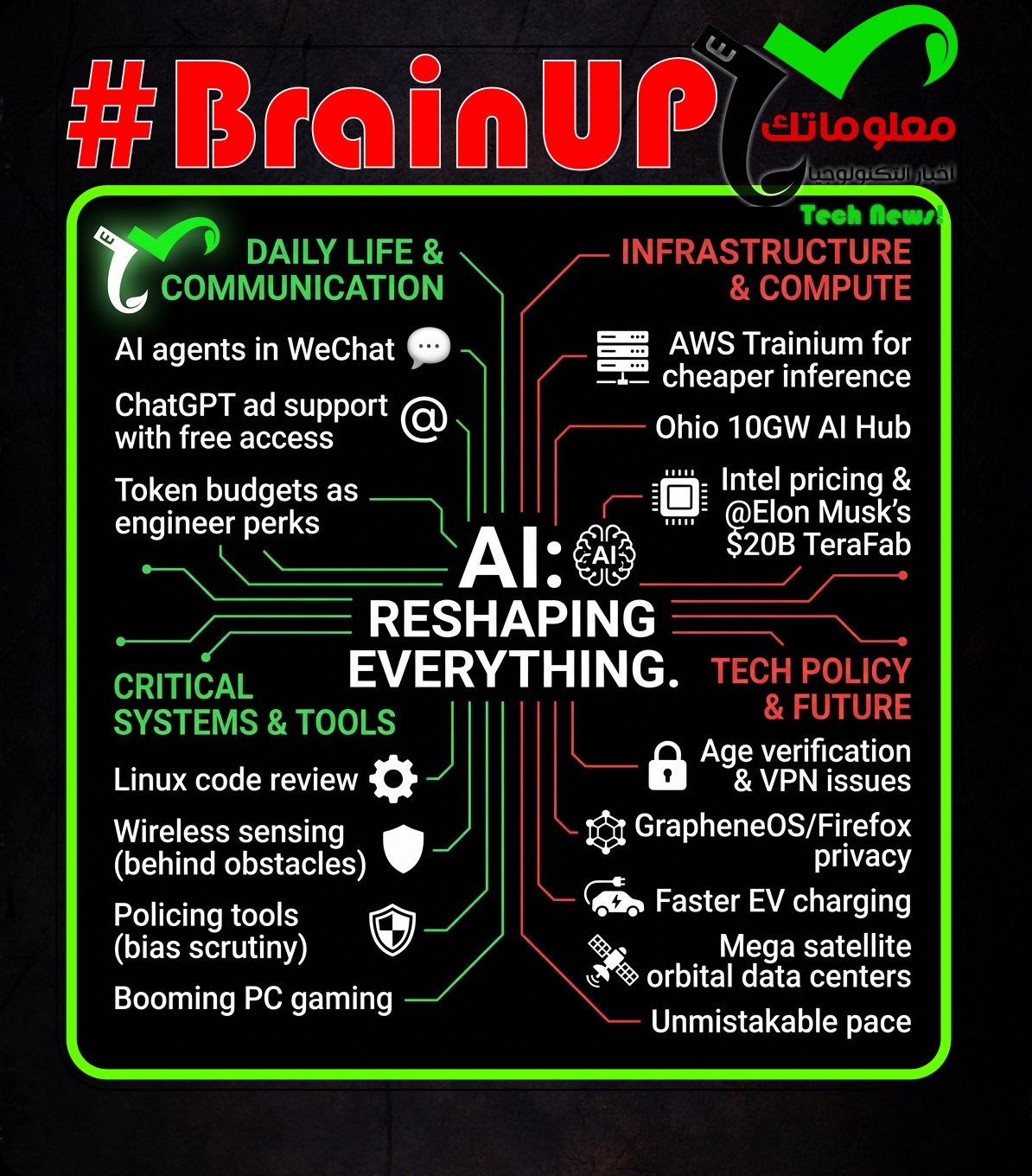
#BrainUp Daily Tech News – (Monday, March 23ʳᵈ)
Welcome to today’s curated collection of interesting links and insights for 2026/03/23. Our Hand-picked, AI-optimized system has processed and summarized 22 articles from all over the internet to bring you the latest technology news.
As previously aired🔴LIVE on Clubhouse, Chatter Social, Instagram, Twitch, X, YouTube, and TikTok.
Also available as a #Podcast on Apple 📻, Spotify🛜, Anghami, and Amazon🎧 or anywhere else you listen to podcasts.
1. OpenAI plans to expand ads on ChatGPT and offer free, low-cost user options, report says
OpenAI is planning to expand advertising on its #ChatGPT platform while continuing to offer free and low-cost options for users, according to reports. The company’s strategy aims to monetize the popular AI chatbot without restricting access, balancing revenue generation with user base growth. This approach reflects a shift from primarily subscription-based models to incorporating ad-supported content, potentially increasing OpenAI’s financial sustainability. Such changes may impact how users interact with ChatGPT but could make the technology more widely accessible. OpenAI’s evolving monetization strategy highlights the broader trend of integrating commercial advertising into AI applications.
2. Meta targeted older workers in layoffs, lawsuit by former senior director for company claims
A wrongful-termination lawsuit by former Meta senior director Nicolas Franchet alleges Meta’s 2025 #performance-based layoffs disproportionately targeted older workers. The complaint says employees 40 and older were 1.5 times as likely to be laid off as those under 40, and employees 50 and older were 2.5 times as likely, citing data the company provided to terminated employees, while Meta declined to comment or say whether it disputes the rates. Franchet, laid off at 54 after about 13 years at the company, claims he had strong performance history yet was tagged as a “lowest performer” after Meta introduced a new rating category that the lawsuit says was used to decide who would be terminated on February 10, 2025. He seeks unspecified damages and compensation for millions of dollars in unvested restricted stock units, including a 2023 special equity award accompanied by a letter from @Mark Zuckerberg praising his impact. The lawsuit situates the claims within broader, long-running allegations of #age_discrimination in Silicon Valley, referencing past cases involving HP, Google, and IBM.
3. 2,400 Kaiser mental health professionals strike in Northern California over AI concerns
About 2,400 @Kaiser Permanente mental health workers are on strike in Northern California, saying they fear the company will replace therapists with #artificial intelligence. The workers cite concerns that #AI could be used to substitute for human clinicians rather than support care. They argue this would threaten the quality and integrity of mental health treatment by reducing direct access to trained professionals. The strike is framed as a push to protect patients and preserve human-delivered therapy from being displaced by #AI-driven alternatives.
4. Online age checks came first — a VPN crackdown could be next
The article argues that as #online-age-verification expands, regulators may move to restrict #VPNs so they cannot be used to bypass age checks. It traces how VPNs evolved from 1990s business networking tools into consumer privacy and access tools, accelerated by @Edward Snowden’s 2013 revelations about mass surveillance and reflected in Pew Research findings showing many Americans took steps to protect privacy, including using VPNs. It then describes how governments are rolling out age verification rules worldwide that can require IDs, bank card details, or video selfies, which can deanonymize users and increase the risk of data breaches, prompting people to use VPNs to mask location and route traffic through jurisdictions without such requirements. The piece points to spikes in VPN searches and usage following age verification rollouts, including in Florida and the UK, where rules affected access to adult sites and platforms like Reddit, Bluesky, and Discord. By framing VPN adoption as a response to the age-gated internet, it links rising enforcement pressure to the likelihood of a future crackdown aimed at preventing circumvention of #age-check systems.
5. UK cops suspend live facial recog as study finds racial bias
Essex Police paused its use of #liveFacialRecognition after an academic study of its deployment suggested demographic performance differences, including indications of racial imbalance. @Cambridge University researchers ran a controlled field experiment during a real deployment with 188 volunteers, finding the system at its operational setting correctly identified about half of watchlist subjects who passed cameras, with false positives described as extremely rare. Of six false positives observed, four involved Black individuals despite Black subjects being 23.8 percent of observations, though the researchers said this was suggestive rather than conclusive given the small number of false positive events; the study also reported the system was more likely to correctly identify men than women and statistically significantly more likely to correctly identify Black participants than other ethnic groups. Essex Police said it had commissioned two independent academic studies, one indicating potential bias and another finding no statistically relevant bias, and chose to pause deployments while working with the algorithm provider, later revising policies and procedures and stating it is confident to resume while monitoring for bias. The pause and planned resumption come as the UK Home Office has urged expanded police use of #LFR and #AI, including funding additional LFR-equipped vans and investing in national facial recognition and LFR capabilities.
6. Samsung Brings AirDrop Support to Quick Share With Galaxy S26 Series
@Samsung has announced that its #GalaxyS26 lineup will now support AirDrop-style cross-platform file sharing through #QuickShare, marking a major step toward interoperability between Android and Apple ecosystems by allowing users to send files directly between Galaxy devices and iPhones without third-party apps. The feature, rolling out first in Korea before expanding globally, integrates Apple-compatible sharing into Samsung’s existing Quick Share system, which already uses Bluetooth and Wi-Fi Direct to enable fast peer-to-peer transfers. With this update, users can seamlessly exchange photos, videos and documents across devices as long as visibility settings such as “Everyone” are enabled, effectively removing one of the longest-standing friction points between Android and iOS ecosystems. The move follows similar efforts by Google and reflects growing regulatory and market pressure to improve cross-platform compatibility, especially under frameworks like the #DigitalMarketsAct that encourage interoperability. Ultimately, the update signals a broader shift in the mobile industry where ecosystem lock-in is gradually weakening and seamless data exchange is becoming a competitive expectation rather than a differentiator.
7. Google Leaning More Into Pentagon AI Contracts Despite Employee Concerns
@Google is increasingly doubling down on #AI partnerships with the Pentagon, signaling a major strategic shift as executives confirm the company is “leaning more” into national security contracts despite ongoing internal employee concerns. Leadership at Google DeepMind, including @Demis Hassabis, argued that working with democratically elected governments on areas like cybersecurity and biosecurity is justified, even as the company moves further away from its earlier stance that avoided military applications of AI. This change follows a quiet but significant update to Google’s AI principles in 2025, which removed previous commitments not to use AI for weapons or surveillance, effectively opening the door to deeper defense collaborations. The move marks a clear reversal from 2018, when internal protests over #ProjectMaven forced Google to step back from Pentagon work, highlighting how industry attitudes toward military AI have evolved as geopolitical competition intensifies. The situation underscores a broader shift across Big Tech where ethical resistance is giving way to strategic alignment with government priorities, reflecting how #AI is becoming a central pillar of national security and global power dynamics.
8. Tencent integrates WeChat with OpenClaw AI agent amid China tech battle
Tencent has integrated its messaging app WeChat with OpenClaw’s AI agent, enhancing user interaction within the platform. This development leverages OpenClaw’s advanced AI capabilities to offer more personalized and efficient services to WeChat users. The integration highlights the competitive landscape in China’s tech sector, where major companies like Tencent are adopting innovative AI solutions to maintain leadership. By embedding AI directly into WeChat, Tencent aims to strengthen user engagement and stay ahead in the tech battle driven by #artificialintelligence and digital transformation. This move reflects Tencent’s strategy to blend social communication with AI technologies for a more intelligent user experience.
9. Are AI tokens the new signing bonus or just a cost of doing business? | TechCrunch
#AI tokens are being discussed as a new component of engineering compensation, alongside salary, equity, and bonuses, giving engineers a budget of compute to run tools like #Claude, #ChatGPT, and #Gemini and boost productivity. @Jensen Huang suggested at Nvidia’s GTC that engineers could receive token budgets worth about half their base salary, with top engineers potentially consuming $250,000 per year in AI compute, framing it as a recruiting tool that could become a Silicon Valley standard. VC @Tomasz Tunguz argued startups are already treating inference costs as a “fourth component” of pay, citing Levels.fyi data that a top-quartile engineer at $375,000 plus $100,000 in tokens implies roughly 20% of total cost is compute. The rise of #agenticAI, accelerated by the late-January release of #OpenClaw, is driving token use higher because autonomous agents can burn millions of tokens per day in the background. The New York Times also highlighted “tokenmaxxing,” reporting that engineers at companies including #Meta and #OpenAI compete on internal leaderboards tracking token consumption, and that generous token budgets are becoming a job perk similar to benefits like free lunch.
10. Linux kernel engineer introduces Sashiko code review system
@Roman Gushchin, a @Google Linux kernel engineer, introduced Sashiko, a #Rust-based #AI code review tool aimed at spotting bugs and screening patches for the Linux kernel rather than generating code submissions. In tests on 1,000 recent upstream issues identified via ‘Fixes:’ tags using #Gemini 3.1 Pro, Gushchin said Sashiko found 53 percent of the bugs, and noted that all of those issues had been missed by human reviewers. Sashiko ingests patches from a mailing list, analyzes them, and returns feedback to maintainers and developers, with authors claiming high review quality and an estimated false positive rate within about 20 percent based on limited manual checks, with many cases falling into a gray zone. The project acknowledges privacy and code-sharing tradeoffs because it sends data and code to the configured #LLM provider, has been most tested with Gemini Pro 3.1 but is intended to work with #Claude and others, and carries usage costs, which @Google is covering for the Linux Kernel Mailing List. Positioned as a potentially less controversial application of agentic #AI than AI-generated code submissions, Sashiko is said to have been used internally at Google to uncover many real issues and is associated with the #LinuxFoundation.
After @Andy Jassy announced AWS’s $50 billion investment deal with @OpenAI, AWS invited TechCrunch on a private tour of its chip development lab, where the #Trainium chips behind the deal are built, amid industry attention for potential lower cost #AI inference and a possible challenge to @Nvidia’s dominance. AWS leaders Kristopher King and Mark Carroll described how AWS’s long relationship with @Anthropic has held even as Anthropic added @Microsoft, while the new agreement makes AWS the exclusive provider for @OpenAI’s AI agent builder, Frontier, though that exclusivity may be contested given a Financial Times report that Microsoft believes the arrangement conflicts with its own access rights to OpenAI models and technology. AWS’s appeal is tied to scale: the company says it has deployed 1.4 million Trainium chips across three generations, with @Anthropic’s Claude running on over 1 million #Trainium2 chips, and AWS has committed to supplying @OpenAI with 2 gigawatts of Trainium computing capacity despite demand already outpacing production. The article notes Trainium’s focus has shifted from cheaper, faster training toward inference, now the major industry bottleneck, and that #Trainium2 carries most inference traffic for AWS #Bedrock, whose customer base is growing as fast as AWS can add capacity. King argues Bedrock’s growth could make it as big as #EC2, linking Trainium’s lab work directly to AWS’s broader strategy to expand AI infrastructure and services.
12. Generative AI helps wireless networks see through physical obstructions
Generative AI is being applied to improve wireless network signals by enabling them to ‘see through’ physical obstructions, enhancing communication in complex environments. Researchers at #MIT have developed a system that uses generative models to reconstruct visuals of obstructed areas based on wireless signal patterns, demonstrating improved accuracy in scenarios where direct line-of-sight is blocked. This approach allows wireless signals not only to communicate data but also to sense surroundings, which could revolutionize applications in autonomous vehicles, smart cities, and emergency response. The advancement leverages the interplay between AI and wireless technologies to overcome limitations imposed by physical barriers, offering more reliable connectivity. By integrating generative AI with wireless vision, this innovation addresses critical challenges in signal penetration and environmental awareness for next-generation wireless systems.
13. Elon Musk Formally Launches $20 Billion TeraFab Chip Project
Elon Musk has officially launched TeraFab, a $20 billion semiconductor manufacturing initiative aimed at transforming the chip industry. The project seeks to leverage advanced technologies to dramatically increase chip production capacity and reduce supply chain dependencies. Musk emphasizes the strategic importance of domestic manufacturing to ensure technological sovereignty and resilience amid global chip shortages. The launch signals a significant investment into #chipfabrication and innovation, potentially reshaping the industry’s competitive landscape. By initiating TeraFab, Musk aims to accelerate the development and availability of high-performance chips critical to future technological advancements.
14. Chinese Orbiter Crushes Starlink With a 2-Watt Laser From 36,000km Above Earth
Researchers in China report a #laser-communications downlink from a geostationary satellite about 36,000 km above Earth that achieved 1 Gbps using only a 2-watt transmitter, a result described as about five times faster than #Starlink. The test used a purpose-built ground receiver at Lijiang Observatory featuring a 1.8 m telescope and a 357 micro-mirror #adaptive-optics stage to counter atmospheric turbulence, followed by #mode-diversity reception via a multi-plane light converter that split the signal into eight base-mode channels and combined the three strongest for decoding. Led by Wu Jian and Liu Chao and published in Acta Optica Sinica, the work emphasizes recovering clean data after the beam is distorted in the atmosphere rather than treating turbulence as a minor issue. The experiment’s significance is framed by delivering gigabit-class performance from far higher orbit than low Earth systems while using very low transmit power. Overall, it presents a working approach for pushing low-power optical links by rebuilding the beam at the ground to survive the turbulent last stretch of the downlink.
Chinese tech giant @Huawei is crowdfunding the WiFi Mesh X3 Pro in Japan, pitching it as the world’s first router with a “metal mesh crystal antenna” and a glowing, ornamental design intended to be displayed rather than hidden. The router and matching mesh nodes feature configurable lighting with touch controls and app control via HUAWEI AI Life, and the design choice may also help Wi-Fi coverage by encouraging more central placement. As a #Wi-Fi 7 dual-band mesh router, it supports #MLO, #4K-QAM, and #Multi-RU, uses a custom Huawei Gigahome SoC, includes six internal antennas, and provides two 2.5 Gbps Ethernet ports (WAN and LAN). Huawei also highlights a “Shark Fin Heat Exhaust System” aimed at preventing thermal throttling during long gaming sessions or large transfers, and the Japan-only campaign is reportedly far over target, suggesting a potential wider release.
16. Trump officials announce 10-gigawatt data center, gas plants for former Ohio uranium site
@Trump administration officials said the U.S. Department of Energy is launching a public-private partnership to build a 10-gigawatt #AI data center and power complex at a former uranium enrichment site in southern Ohio. The project is described as involving SoftBank and AEP Ohio, pairing a massive #data center with new #gas plants to supply electricity. By siting the development at a former nuclear-related industrial location and coupling computing with dedicated generation, the plan aims to create a large-scale, purpose-built hub for power-intensive AI workloads. The announcement frames the effort as a federal-industry collaboration to expand AI infrastructure and energy supply in one integrated project. The initiative highlights how rising AI demand is driving combined investments in data centers and new generation capacity.
17. How BYD Got EV Chargers to Work Almost as Fast as Gas Pumps
Chinese automaker BYD says its upgraded #FlashChargers can bring some EV batteries from about 10 to 70 percent in five minutes and from 10 percent to full in roughly nine, pushing charging closer to gas-pump expectations but with important constraints. The chargers deliver up to 1,500 kW, far above typical US 350 kW “hyper-fast” units, and BYD has built more than 4,000 in China with plans for about 16,000 more there by year end and 2,000 in Europe, though it does not sell in the US due to tariffs and national security concerns. In Europe, only BYD’s Denza Z9GT is expected to use the top speed initially because it pairs the chargers with BYD’s newest #BladeBattery, whose reported #LMFP chemistry and redesigned battery elements are meant to raise energy density by 5 percent and enable very high-current charging. BYD also says it will ease rollout by integrating with existing charging banks and using on-site storage batteries to supplement the grid, since delivering more than a megawatt is complex. Even so, @GilTal of UC Davis characterizes it as a marginal improvement that may not change most people’s daily lives, underscoring that faster hardware alone does not automatically resolve broader charging and adoption challenges.
GrapheneOS, a privacy-focused Android fork run by the GrapheneOS Foundation, says it will not comply with emerging #age verification laws that require operating systems to collect user age data during setup, stating it will remain usable worldwide without personal information, identification, or accounts even if that means devices cannot be sold in some regions. The stance follows Brazil’s Digital ECA (Law 15.211) taking effect March 17 with fines up to R$50 million per violation for OS providers that fail to implement age verification, and California’s Digital Age Assurance Act (AB-1043), effective January 1, 2027, requiring OS providers to collect a user’s age or date of birth during account setup and pass it to app stores and developers via a real-time API, with Colorado’s SB26-051 cited as similar. Although these laws are not Canadian, the article notes jurisdiction questions and points to a prior U.S. extradition and conviction of the developers of @Samourai Wallet as an example of cross-border enforcement risk, while AB-1043 includes civil penalties enforced by California’s attorney general. The refusal creates practical pressure for partners, since @Motorola and GrapheneOS announced a long-term partnership to bring the hardened OS to future Motorola hardware, meaning preinstalled GrapheneOS devices may need geographic sales restrictions or local compliance. The article adds that other open-source projects have also refused or restricted use in response to such laws, including calculator firmware DB48X and #MidnightBSD, and notes California’s law relies on self-reported age rather than photo ID or biometrics.
19. Firefox 149 adds built-in free VPN with 50GB monthly data – OMG! Ubuntu
@Mozilla says #Firefox 149 will add a free built-in #VPN that provides 50GB of monthly data but protects only browser traffic, not the whole device. Access requires a Mozilla account, and the feature routes traffic through a proxy to hide IP address and location, positioned as aligned with Mozilla’s data principles amid skepticism about “free VPN” tools that can monetize personal data. Unlike Mozilla’s paid VPN offered in partnership with @Mullvad, the free VPN is expected to be hosted on Mozilla servers worldwide based on late-2025 beta testing. The update is due March 24 and will initially be limited to the United States, France, Germany, and the United Kingdom. The article suggests this could serve as a “freemium funnel” to attract users and upsell the paid Mozilla VPN as Firefox’s desktop market share has fallen from 6.3% to 4.2% over the past year.
20. Intel Is Reportedly Preparing A 10% Price Increase For Consumer CPUs
Intel plans to implement a 10% price increase on its consumer CPUs in response to rising costs. Sources indicate that this adjustment aims to counteract inflation and supply chain expenses impacting production. The price hike is expected to affect a broad range of Intel’s CPU lineup, potentially influencing pricing strategies within the CPU market. This anticipated change reflects ongoing challenges within the semiconductor industry related to economic factors, compelling Intel to adjust its pricing models. Consequently, consumers and PC builders should anticipate higher costs for Intel processors in the coming months.
@Capcom reports that FY 2025 marked its 12th consecutive year of increased operating profit and continued record highs across profit indicators, and it credits the rising importance of #PC gaming to that performance. In its annual report, the company says PC increasingly accounts for a large share of its game sales: after PC made up around 60% of digital sales in 2024, FY 2025 was approximately 50% while overall sales increased, and Capcom says it expects the PC share to keep growing, with 19.1 million PC games sold over the nine-month period covered. CEO @Kenzo Tsujimoto argues PC will further establish itself as the world’s leading gaming platform, and says Capcom will deepen its understanding of PC users to strengthen development and sales strategies. The article links this to Capcom’s shift toward faster, more prioritized PC releases compared with past delayed Steam launches, and notes the company plans to apply technical lessons from addressing Monster Hunter Wilds’ PC performance challenges to future titles. It also cites improved Steam sentiment after recent patch work, reinforcing Capcom’s view that investing in PC quality and strategy supports continued growth.
SpaceX has surpassed 10,000 active #Starlink satellites in orbit and has filed with the FCC to add up to one million more satellites as #orbital data centers to support its #AI ambitions, a move astronomers warn could seriously worsen impacts on astronomy and the upper atmosphere. @Jonathan McDowell is cited for the active-satellite milestone, while dark-sky consultant @John Barentine says the new plan undermines years of mitigation work, prompting him and a consortium to challenge the FCC filing. Barentine warns the proposed satellites would be in high-inclination orbits and remain fully sunlit even at midnight from the ground, increasing bright streaks in observations beyond earlier problems that black paint and mirror film have not fully solved. He also argues that disposing of large numbers of satellites via atmospheric reentry could add substantial pollutants, with calculations suggesting a reentry as often as every three minutes, aligning with research concerns about aluminum oxides, lithium, and potential effects such as slowing ozone-layer recovery. The article notes SpaceX only vaguely states it will minimize atmospheric impacts and has asked the FCC to fast-track environmental assessments, escalating fears that #megaconstellations could become a more severe and rapid challenge for astronomy and environmental oversight.
That’s all for today’s digest for 2026/03/23! We picked, and processed 22 Articles. Stay tuned for tomorrow’s collection of insights and discoveries.
Thanks, Patricia Zougheib and Dr Badawi, for curating the links
See you in the next one! 🚀
