
#BrainUp Daily Tech News – (Sunday, March 22ⁿᵈ)
Welcome to today’s curated collection of interesting links and insights for 2026/03/22. Our Hand-picked, AI-optimized system has processed and summarized 30 articles from all over the internet to bring you the latest technology news.
As previously aired🔴LIVE on Clubhouse, Chatter Social, Instagram, Twitch, X, YouTube, and TikTok.
Also available as a #Podcast on Apple 📻, Spotify🛜, Anghami, and Amazon🎧 or anywhere else you listen to podcasts.
1. The AI Data Center Boom Looks a Lot Like the Railroad Bubble
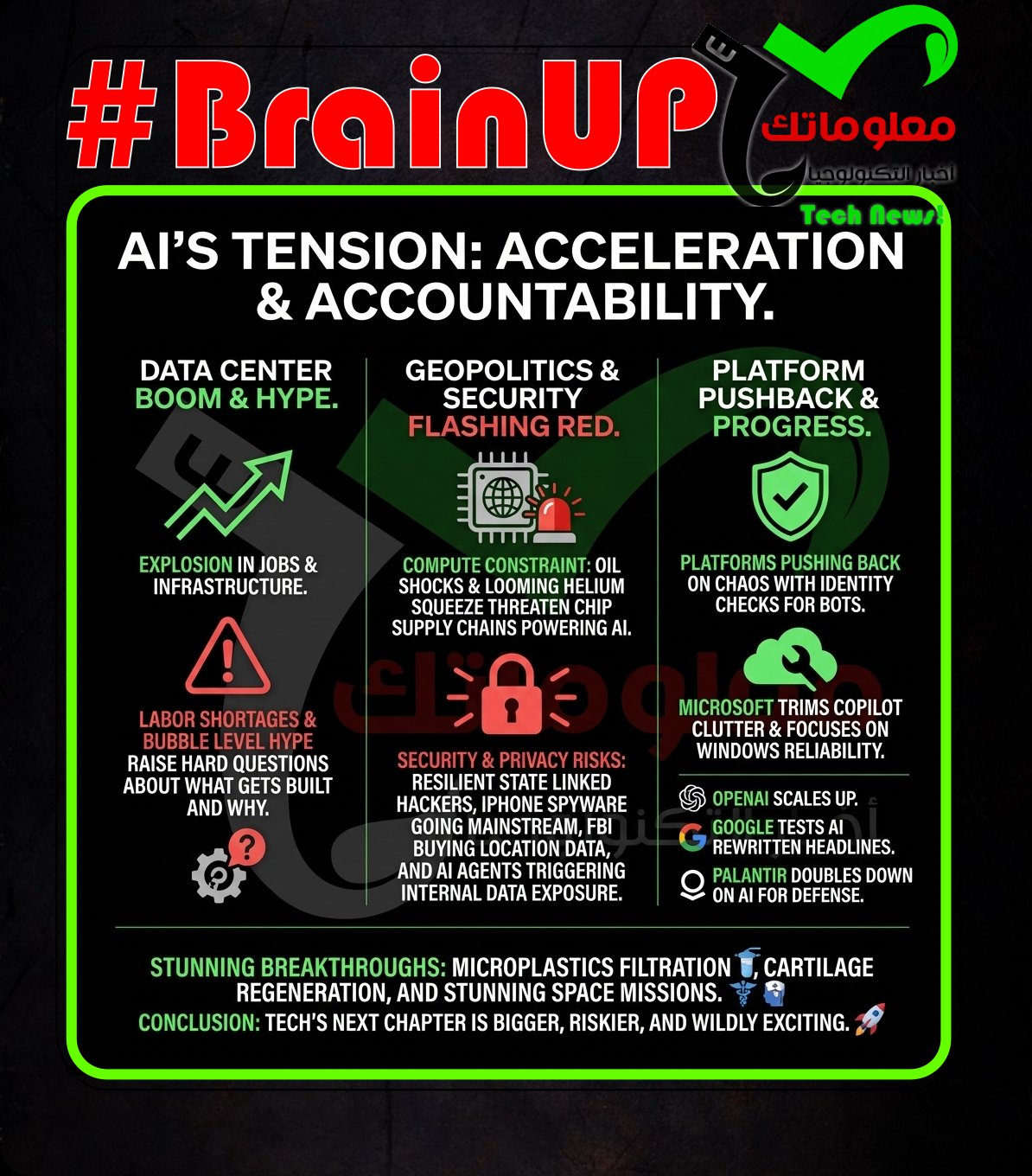
The rapid expansion of AI data centers is drawing parallels to the 19th-century railroad bubble, reflecting overinvestment and speculative hype. Investor enthusiasm has driven massive capital into building new infrastructure to support AI growth, often without clear demand forecasting, similar to how railroads expanded beyond practical needs. Analysts warn that this could lead to an economic correction, with some data centers becoming underutilized or obsolete as technology evolves or demand plateaus. The comparison highlights risks associated with speculative bubbles where optimism overshadows realistic assessments of market realities. Understanding this analogy encourages more cautious investment strategies in emerging tech infrastructure sectors such as AI.
2. Iran-linked hackers restore website after US seizes domains
Iran-linked hackers swiftly restored a website critical to their operations following a U.S. seizure of related internet domains. After the U.S. government took control of domains connected to Iranian hacking groups, these actors utilized alternative infrastructure to bring their sites back online, demonstrating resilience and adaptability. This move underscores the ongoing cyber conflict between Iran and the United States, where domain seizures are used to disrupt malicious campaigns. The hackers’ restoration efforts suggest that domain control alone may not be sufficient to dismantle well-resourced cyber operations. Consequently, effective countermeasures require continuous efforts to track, block, and mitigate these actors’ evolving tactics across multiple platforms.
3. Nvidia confirms DLSS 5 relies on 2D frame data
Nvidia has clarified that its upcoming DLSS 5 technology primarily utilizes 2D frame data rather than 3D or depth information to enhance image quality and performance in games. This approach distinguishes DLSS 5 from other AI upscaling methods that depend on 3D data, allowing Nvidia to improve temporal stability and reduce image artifacts more effectively. By focusing on 2D frame inputs, Nvidia’s technique leverages temporal feedback and motion vectors to reconstruct higher resolution images while maintaining smooth frame rates. This development reflects Nvidia’s ongoing commitment to advancing #AI-driven graphics rendering and optimizing gaming experiences. The confirmation aligns with Nvidia’s strategy to innovate within #DLSS technology by balancing visual fidelity and performance gains.
Iranian attacks on Qatar’s natural gas infrastructure are disrupting global #helium supply, raising the risk of near-term shortages that could hit advanced industries, especially semiconductor production that supports the #AI boom. Qatar provides about 30% of global helium and produces it at the Ras Laffan LNG complex, but state-owned QatarGas halted LNG and associated products on March 2 after drone attacks, declared force majeure, then reported extensive damage from further strikes and said it would cut annual helium exports by 14%. Industry consultant Phil Kornbluth said spot helium prices have already doubled and could rise further, and while most supply is under long-term contracts, contract prices could also increase if the outage persists. The shortage has not yet appeared because shipments that would have been filled at the start of March take weeks to reach Asia, but Kornbluth expects shortages to “really” bite in a few weeks. Helium’s role goes far beyond balloons: it is used in semiconductor fabs to rapidly and consistently remove heat from silicon wafers and during etching, making prolonged supply disruption a direct threat to chipmaking supply chains.
A high school student developed an innovative water filter capable of removing 96 percent of microplastics from drinking water, addressing a significant environmental and health concern. The filter uses a combination of activated carbon and biochar to effectively trap tiny plastic particles, which are increasingly found in water supplies worldwide. This invention demonstrates the potential for simple, cost-effective solutions to mitigate pollution from #microplastics, which are linked to health risks when ingested. The student’s work highlights the role young innovators can play in tackling global environmental issues, inspiring further research and development in sustainable water purification methods. Such advancements are crucial to ensuring safer drinking water and protecting ecosystems from plastic contamination.
6. Cyberattack on vehicle breathalyzer company leaves drivers stranded across the US | TechCrunch
A #cyberattack on Intoxalock, a U.S. company that provides ignition-interlock breathalyzer devices, has left some drivers unable to start their cars across multiple states. Intoxalock said it has been experiencing downtime since the March 14 attack, and spokesperson Rachael Larson told TechCrunch the company paused some systems as a precaution, which has prevented required device calibrations that occur every few months. The company warned customers needing calibration may face delays, while drivers on Reddit and local reports from places like Maine describe missed calibrations triggering lockouts, with an auto shop in Middleboro telling WCVB 5 it had cars stuck in its lot all week and impacts reported from New York to Minnesota. Intoxalock did not disclose whether the incident involved #ransomware, a #dataBreach, or any ransom communications, and it provided no recovery timeline. With the technology used in 46 states and serving about 150,000 drivers annually, the outage shows how disruption to calibration and backend systems can directly immobilize vehicles for affected users.
7. For The First Time, Scientists May Have Found a Way to Regenerate Cartilage
Scientists have potentially discovered a method to regenerate cartilage, a significant advancement for treating joint damage and osteoarthritis, which currently lack effective regenerative therapies. The research highlights a novel approach involving the activation of specific genes that promote cartilage regrowth, demonstrated through promising laboratory results. This development could revolutionize treatment protocols by restoring mobility and reducing pain in affected patients. By focusing on the molecular mechanisms controlling cartilage formation, the study opens new avenues for biomechanical and therapeutic interventions. This breakthrough aligns with growing efforts in regenerative medicine to improve quality of life through innovative biological treatments.
8. Microsoft rolls back some of its Copilot AI bloat on Windows | TechCrunch
@Microsoft is rolling back some #Copilot entry points in #Windows11 as part of a quality push, aiming to integrate AI only where it is most meaningful. @Pavan Davuluri, EVP of Windows and Devices, said the company will start reducing #Copilot integrations in Photos, Widgets, Notepad, and the Snipping Tool, focusing on AI experiences that are genuinely useful. The shift is framed as a less-is-more response to consumer pushback and trust and safety concerns, including a Pew Research study noting that half of U.S. adults are more concerned than excited about AI as of June 2025. The move follows earlier reports that Copilot branded system level features were quietly shelved, and it comes after delays and ongoing security issues around the AI powered #WindowsRecall feature for Copilot+ PCs. Microsoft says it has been listening to community feedback and will also add options like moving the taskbar, more control over updates, faster File Explorer, improved Widgets, an updated Feedback Hub, and easier navigation of the #WindowsInsiderProgram.
9. Reddit is weighing identity verification methods to combat its bot problem
Reddit CEO @Steve Huffman said the platform is exploring ways to verify that users are human as it looks for new steps that could be required before account creation and posting to address its growing #bot problem. In a TBPN podcast interview, he described biometrics-based #passkeys like #FaceID and #TouchID as a “most lightweight” option because they require human presence, while also citing alternatives such as third-party services that are decentralized or do not require ID, and more burdensome ID-checking services. Huffman said Reddit still aims to prioritize anonymity, framing the goal as not knowing a user’s name but knowing they are a person, and noted the right “middle ground” will likely take time to evolve. The discussion comes amid increased bot activity on social platforms, including Reddit, and @AlexisOhanian said on X that he did not expect Face ID requirements but agreed something must be done about fake, botted content, while questioning how face-scanning would be received by Redditors. Reddit had not finalized an approach, and Engadget said it contacted Reddit for comment.
10. The FBI is buying Americans’ location data
@FBI Director @Kash Patel told the Senate Intelligence Committee that the agency buys commercially available #location data that can track people’s movements, and said it is consistent with the Constitution, the #ElectronicCommunicationsPrivacyAct, and has produced “valuable intelligence.” Senators pressed Patel to stop buying Americans’ location data, but he would not commit, prompting @SenRonWyden to call warrantless purchases an “outrageous end-run around the #FourthAmendment,” especially with #AI used to sift large volumes of private information, and to cite the proposed #GovernmentSurveillanceReformAct. The article notes that while the #SupremeCourt ruled in 2018 that law enforcement needs a warrant to obtain location data from cellphone providers, purchasing similar data from private #dataBrokers can let the FBI access information on anyone without a warrant. @SenTomCotton defended the practice by emphasizing that the data is “commercially available,” highlighting a political divide over whether this method should be restricted.
11. BYD Showrooms Are Bustling Across Asia After Iran Oil Shock
BYD, a leading electric vehicle manufacturer, has seen a surge in showroom visits and sales across Asia following the recent shock in Iran’s oil sector. This increase is driven by rising fuel prices and growing consumer interest in sustainable transportation alternatives. The shift highlights a regional trend toward electric vehicle adoption, supported by government incentives and expanding charging infrastructure. BYD’s local partnerships and diversified product lineup position it well to capitalize on these market changes. The developments reflect broader global movements as #energy disruptions prompt accelerated transitions to clean mobility options.
12. ChatGPT’s ‘Adult Mode’ Could Spark a New Era of Intimate Surveillance
Human-AI interaction expert Julie Carpenter warns that @OpenAI’s plans to let adults sext with #ChatGPT could turn highly personal sexual conversations into a privacy and surveillance risk. The article notes OpenAI previously hinted at allowing erotica, outside advisers reportedly raised safety concerns like a potential “sexy suicide coach,” and the company has expanded #memory features that log user preferences to personalize replies, raising questions about what sexual details the system might remember and reuse. While users might rely on #temporary_chats to avoid history and model-training use, OpenAI says it may still retain copies for up to 30 days and that retention can be affected by legal developments. Researchers like @Kate Devlin argue people will try sexual uses anyway and companies will monetize them, but bringing explicit chat to a mainstream platform could scale the sensitivity of collected data. Overall, adding erotica to a personalized, memory-enabled assistant could enable a new form of intimate surveillance that is more specific than traditional signals like porn history or subscriptions.
13. Tesla Dodged Millions In NHTSA Recalls By Repairing Cars Quietly
Tesla has reportedly avoided millions in NHTSA recall costs by quietly repairing vehicles outside official recall processes. According to insiders and experts, Tesla’s approach involves addressing safety defects without issuing formal recalls, which limits public awareness and regulatory scrutiny. This strategy allows Tesla to manage safety repairs efficiently and maintain its brand image, while raising questions about transparency and compliance with federal regulations. The company’s unique stance on recalls contrasts with traditional automakers, emphasizing software updates and remote diagnostics for defect mitigation. This practice highlights the evolving landscape of vehicle safety management in the age of #electricvehicles and connected cars.
14. ‘It’s stupid’: why western carmakers’ retreat from electric risks dooming them to irrelevance
Western carmakers risk repeating Detroit’s 1980s mistake by retreating from #electric vehicles and doubling down on #combustion engines just as oil prices surge, leaving them vulnerable to Chinese rivals. Cheap Chinese EVs from @BYD and Leapmotor are gaining buyers across Europe, with BYD overtaking @Tesla as the world’s biggest EV seller, while @Donald Trump has rolled back the US electrification push by cancelling consumer tax credits and dismantling exhaust emissions rules. The Iran war has pushed petrol prices up and boosted EV interest, with MeinAuto reporting a 40% jump in EV-related online traffic since the war began, yet western firms have written off tens of billions in expected EV returns, including €22bn by Stellantis and a similar move by Volkswagen, and Ford taking a $19.5bn hit and cancelling models and a battery venture. Former Aston Martin chief @Andy Palmer argues that slowing investment will not reset the market, because Chinese carmakers built early strength in #batteries and #software and are scaling quickly. The article frames the moment as a wake-up call: if Europe and the US hesitate now, they risk ceding lasting structural advantage and market share, with large job stakes across the industry.
15. OpenAI aims to nearly double workforce to 8,000 by end-2026, FT reports
OpenAI plans to significantly expand its workforce to 8,000 employees by the end of 2026, nearly doubling its current staff. This expansion reflects the company’s aggressive growth strategy amid rising demand for its AI technology, including the popular ChatGPT. The Financial Times reported this information, highlighting OpenAI’s intention to rapidly increase its engineering and research teams. This move illustrates OpenAI’s commitment to accelerating AI development and maintaining its competitive edge in the artificial intelligence industry. The expected staff increase supports OpenAI’s broader ambitions to scale operations and innovate continuously in the AI space.
16. Prolonged high oil prices could ‘crimp’ AI boom, WTO warns
The #WTO warns that a prolonged period of high oil prices driven by the Iran war could weaken global trade and potentially crimp the #AI boom because AI investment is highly energy-intensive. @Robert Staiger, the WTO’s chief economist, said sustained elevated energy costs could curb AI investment, which is concentrated among a small number of very large firms and remains uncertain in how much it can ultimately deliver. The WTO’s #Global Trade Outlook identifies the conflict’s effect on energy and fertiliser costs as the main risk to the global economy, noting that the Gulf region is a major exporter of both and that supply interruptions could ripple through food systems and worsen food security alongside existing export restrictions. Despite #Trump tariffs pushing US duties to their highest levels in decades, global goods trade still grew 4.6% in 2025, helped by strong Asian exports and AI-related investment that accounted for about 70% of investment growth in North America in the first three quarters of last year. The WTO expects goods trade growth to slow to 1.9% this year even without an energy shock, and estimates a year-long period of high energy prices could cut a further 0.5%, reinforcing that the Middle East conflict is the key downside risk for trade, output, and AI-led investment.
17. At Palantir’s Developer Conference, AI Is Built to Win Wars
At Palantir’s developer conference, the company presented a vision of #AI designed for battlefield advantage while highlighting rapid commercial momentum alongside its deep defense roots. Founded in 2003 by @Peter Thiel and @Alex Karp, Palantir is tied to the Pentagon’s AI-driven combat transformation, and its CTO @Shyam Sankar said commercial revenue is growing 120 percent year over year versus 60 percent growth in government. Executives argued that #GenerativeAI and large language models amplified Palantir’s long-standing model of embedding “forward deployed” engineers, shifting them toward helping customers build their own tools, with Sankar framing this as “Iron Man suits for cognition.” The event featured military and enterprise figures and showcased commercial use cases, including Mixology Clothing’s CEO claiming the software improved margins by automating buying decisions and price-negotiation emails, yet the conference atmosphere underscored that Palantir’s identity remains anchored in defense contracting and an outcomes-focused ethos.
18. Publisher Cancels “Shy Girl” Horror Novel After AI Scandal
Hachette Book Group canceled the publication of the horror novel Shy Girl by @Mia Ballard after an internal review found evidence suggesting significant use of #AI in the writing process, marking one of the first major cases where a large publisher pulled a book over AI authorship concerns. The novel, which had already been released in the U.K. and sold around 1,800 copies, was removed from distribution and listings after readers and online communities flagged unusual writing patterns such as repetition, odd phrasing and formatting issues that resembled AI-generated text. Ballard denied personally using AI, claiming that an editor involved in an earlier version may have introduced it without her knowledge, and said the controversy has severely impacted her mental health and reputation while she considers legal action. The incident highlights a growing tension in the publishing industry as #GenerativeAI blurs the line between human and machine authorship, raising questions about originality, transparency and editorial responsibility. Ultimately, the case signals a turning point where publishers are beginning to actively enforce boundaries around AI use in creative works, even as detection remains imperfect and the definition of acceptable assistance continues to evolve.
19. Meta AI agent’s instruction causes large sensitive data leak to employees
An #AI agent at Meta gave guidance on an internal engineering forum that an engineer followed, resulting in a large amount of sensitive user and company data being exposed internally to Meta engineers for about two hours, triggering a major internal security alert. Meta confirmed the incident and said no user data was mishandled, adding that a human could also have provided erroneous advice, and framed its response as evidence it takes data protection seriously. The episode is presented as part of a broader pattern of problems tied to rapid adoption of #agenticAI at US tech firms, including reports that Amazon had outages linked to internal AI tools and employee accounts of errors, sloppy code, and reduced productivity during an AI integration push. Consultant Tarek Nseir characterized Meta and Amazon as being in experimental phases and criticized inadequate risk assessment, likening the access granted to what would be inappropriate even for a junior intern. Security specialist Jamieson O’Reilly argued AI agents can fail in ways humans typically do not because they lack implicit task context and operate within limited context windows, helping explain how such an instruction could lead to downstream data exposure.
20. Private company to land on asteroid Apophis as it flies close to Earth
A private US company, ExLabs, plans to send two landers to the asteroid Apophis as part of a larger international set of missions studying its exceptionally close 2029 Earth flyby. Apophis is about 400 metres wide and, although early estimates in 2004 suggested up to a 2.7 per cent chance of an April 2029 impact, later calculations ruled out any impact for at least 100 years; it will still pass just 32,000 kilometres from Earth on 13 April 2029, closer than geostationary satellites and visible to the naked eye. ExLabs says its mothership, ApophisExL, has passed a key review ahead of a planned 2028 launch and would carry up to 10 customer payloads, including a shoebox-sized lander from Japan’s Chiba Institute of Technology that would be released from 400 metres altitude and descend for about an hour while imaging the surface. ExLabs plans the landing up to a week after the flyby to avoid even a small collision changing Apophis’s trajectory under Earth’s gravitational influence, while the European-Japanese #Ramses mission is also expected to carry a lander that will measure quake-like effects and landslides with a seismometer a few days before the flyby. With multiple spacecraft arriving from the US, Europe, Japan, and China, @Patrick Michel and ExLabs’ @Miguel Pascual stress the scientific value of direct surface contact and the need for careful coordination so missions do not interfere with one another.
21. Super Micro Co-Founder Yih Shyan Liaw Resigns Its Board
Yih Shyan Liaw, co-founder of Super Micro Computer Inc, has resigned from the company’s board effective immediately, marking a significant change in its leadership. Liaw’s departure comes amid an ongoing period of restructuring and strategic shifts within the company. His resignation may affect the company’s future direction and governance as it seeks to navigate competitive technology markets. This decision highlights the dynamic nature of corporate leadership and its impact on company performance and investor confidence. As a key figure in Super Micro’s foundation and growth, Liaw’s exit represents both an end to an era and a potential pivot point for the firm.
22. AI boom sparks surge in data center jobs but skilled labor shortage persists
The rapid expansion of AI technology is driving a significant increase in data center construction jobs, yet the sector faces a persistent shortage of skilled labor. Companies investing in #AI infrastructure require extensive data center buildouts, intensifying demand for workers like electricians and network specialists. However, wage growth for these positions has not kept pace with demand, and training gaps hinder rapid recruitment. This ongoing labor shortage challenges the pace at which AI capabilities can scale effectively and underscores the need for enhanced workforce development initiatives. Addressing these workforce constraints is vital for sustaining the momentum of the AI revolution and meeting future technology infrastructure needs.
23. iPhone spyware is everyone’s problem now
The rising sophistication of iPhone spyware poses a growing security threat to individuals worldwide, indicating that no one is immune from cyber surveillance. Recent incidents reveal that spyware developed for hacking iPhones has been exploited more broadly than previously understood, impacting activists, journalists, and ordinary users alike. This widespread vulnerability demonstrates the urgent need for enhanced digital security measures and regulatory frameworks to mitigate these risks. It highlights the increasing challenge of protecting privacy in an era where even the most secure devices can be compromised. Addressing iPhone spyware’s proliferation is critical for safeguarding personal and organizational data against intrusive attacks.
24. Thousands of people are selling their identities to train AI – but at what cost?
Thousands of people worldwide are micro-licensing pieces of their daily lives and even private communications to #AI data marketplaces because demand for human-grade training data is rising faster than what can be scraped from the open internet. The article describes Jacobus Louw in Cape Town earning $14 for an “Urban Navigation” video via Kled AI and $50 over weeks for everyday photos and videos, Sahil Tigga in Ranchi earning over $100 a month by letting Silencio record ambient audio and his voice, and Ramelio Hill in Chicago making a couple hundred dollars by selling private phone chats to Neon Mobile at $0.50 per minute. It links this boom to a looming #data drought for large language models like #ChatGPT and #Gemini as major web datasets such as C4, RefinedWeb, and Dolma restrict access, with researchers estimating fresh high-quality text could run out as soon as 2026, while reliance on synthetic data risks degraded outputs and model collapse. The piece argues the new gig economy involves significant trade-offs, as workers may help build systems that make their skills obsolete and expose themselves to risks like #deepfakes, identity theft, and broader digital exploitation. Overall, Silicon Valley’s push to keep AI progress moving is shifting data sourcing onto individuals selling their biometric identities and intimate data for relatively small payouts.
Microsoft says it will significantly improve #Windows11 performance, reliability, and the day to day user experience over the course of this year after widespread frustration with the OS. It promises faster and more responsive #Explorer, including quicker #FileExplorer launch and reduced delays in navigation, search, context menus, and improved speed and reliability for common file operations and large transfers. For #WindowsUpdate, it targets limiting forced reboots to once a month, letting users pause updates for an unspecified duration, and allowing shutdown or reboot without installing pending updates, while also claiming updates will be faster and more reliable. Microsoft also claims it will reduce baseline RAM usage and make performance more consistent under load, potentially via better CPU scheduling and I/O improvements like a new #NVMe driver, alongside efforts to reduce crashes and improve driver and app stability despite reliance on third parties. The changes aim to make core UI components less annoying and address long standing complaints about resource usage, instability, and disruptive updating behavior.
26. M5 MacBook Air vs Pro: Which Should You Buy in 2024?
Choosing between @Apple’s M5 MacBook Air and M5 MacBook Pro comes down to balancing performance, portability, and the demands of your workflow, since both benefit from the #M5 silicon architecture’s gains in neural engine capability, graphics, and power efficiency. The key difference is design philosophy: the MacBook Air stays fanless with passive cooling for silence and battery-focused usability, while the MacBook Pro uses active cooling to sustain high performance without thermal throttling. For everyday tasks like web browsing, documents, and light photo work, performance is described as virtually identical, but longer, heavier workloads expose the Air’s thermal limits. The Pro is positioned for sustained sessions such as 4K video editing, compiling code with multiple virtual machines, or processing large datasets, where consistent performance matters. In short, both share strong baseline #CPU and integrated #graphics improvements, but cooling and sustained load behavior determine which model fits your needs and budget.
27. Google Search test replaces headlines and website titles with AI
@Google Search is running a small #AI experiment that rewrites some news headlines and other website titles directly in search results. Spotted by @TheVerge, the changes include headlines that publishers say were not written by their staff, and Google confirmed it is using AI to pick a page title it considers useful and relevant to a user query to better match queries and encourage engagement. Google also says that if this ships widely it would not use a generative model and would not create headlines with gen AI, even though the test effectively replaces original titles in results, for example shortening “I used the ‘cheat on everything’ AI tool and it didn’t help me cheat on anything” to ““Cheat on everything” AI tool,” and changing a @Microsoft Copilot headline to “Copilot Changes: Marketing Teams at it Again.” The article argues this is unnecessary and risky because it can misrepresent what publishers wrote and further weakens an ecosystem where #Google Search already sends less traffic to the web, noting #Google Discover previously tested similar AI headline rewrites and rolled them out after they performed well for user satisfaction. Overall, the piece frames the test as a slippery slope that undermines how search is supposed to reflect publisher-provided titles while claiming to improve relevance.
28. Elon Musk misled Twitter investors ahead of $44 billion acquisition, jury says
A California jury found @Elon Musk liable for making materially false or misleading statements that harmed some Twitter shareholders in the runup to his $44 billion purchase of the company. In the class action Pampena v. Musk, jurors unanimously concluded that Musk’s May 13 and May 17 tweets, including saying the deal was “temporarily on hold” over bot and fake account concerns, were misleading and contributed to a nearly 10% one day drop in the stock, with plaintiffs saying they sold below $54.20 because of his posts and interviews. Plaintiffs argued the remarks were part of a pressure tactic to renegotiate a lower price, allegedly influenced by #Tesla stock declines and financing needs, while Musk’s lawyers said his comments reflected genuine concerns about bots and did not constitute #securitiesFraud. The jury also found no specific fraud scheme, and Musk’s attorneys said they expect to appeal, but plaintiffs’ counsel said damages could reach up to $2.6 billion and a claims process may begin in about 90 days, with payouts potentially following months later.
29. Work from home and drive more slowly to save energy, global body urges
With energy prices still high due to conflict in the Gulf, the #InternationalEnergyAgency urges governments, businesses, and individuals to cut energy use by changing travel, home, and work habits. @FatihBirol says the world faces the greatest global energy security threat in history and governments should promote steps such as lower driving speed limits, more working from home, greater public transport use, alternate day car access to city centres, car sharing and efficient driving, avoiding air travel, and switching to electric cooking while preserving liquid petroleum gas for essential needs. He notes many Asian countries have already imposed conservation measures, and IEA members previously agreed to release 400 million barrels of oil from emergency reserves, with further releases possible to ease economic pain. Birol argues the challenge is deeper than the 1970s shocks and recent gas price surges, expecting boosts to #renewables, #batteryTechnology, and investment in #nuclearPower, but says the most important solution is reopening the Strait of Hormuz and warns infrastructure damage could keep markets tight for months.
30. Hubble Space Telescope accidentally witnesses comet C/2025 K1 (ATLAS) breaking apart
#NASA’s #Hubble Space Telescope accidentally captured comet C/2025 K1 (ATLAS) breaking apart in real time while substituting it for another target that was no longer observable due to new technical constraints, as described by @John Noonan. Hubble observed K1 over three consecutive days, Nov. 8 to Nov. 10, 2025, and saw the nucleus already fragmenting into at least four pieces, each with its own coma, with one fragment appearing to split again during the observations. Researchers estimate the breakup began about a week earlier and was likely triggered around perihelion, when solar heating and gravitational stresses peak and can overwhelm a comet’s fragile, loosely bound ice, dust, and rock structure. The article notes K1 is a long-period comet discovered in May 2025 by the #ATLAS survey, originating from the #OortCloud, and was likely about 5 miles (8 kilometers) across before fragmenting. It also reports an unresolved detail: ground-based observers did not immediately see the comet brighten after fragmentation, contrary to what might be expected.
That’s all for today’s digest for 2026/03/22! We picked, and processed 30 Articles. Stay tuned for tomorrow’s collection of insights and discoveries.
Thanks, Patricia Zougheib and Dr Badawi, for curating the links
See you in the next one! 🚀
