
#BrainUp Daily Tech News – (Wednesday, March 18ᵗʰ)
Welcome to today’s curated collection of interesting links and insights for 2026/03/18. Our Hand-picked, AI-optimized system has processed and summarized 18 articles from all over the internet to bring you the latest technology news.
As previously aired🔴LIVE on Clubhouse, Chatter Social, Instagram, Twitch, X, YouTube, and TikTok.
Also available as a #Podcast on Apple 📻, Spotify🛜, Anghami, and Amazon🎧 or anywhere else you listen to podcasts.
1. OpenAI chief executive Sam Altman accused of sexual abuse by sister in lawsuit
The sister of @Sam Altman, CEO of #OpenAI and the company behind #ChatGPT, filed a lawsuit alleging he repeatedly sexually abused her over several years starting in childhood. The complaint, filed 6 January in a US district court in the Eastern District of Missouri, alleges the abuse began when Ann Altman was three and @Sam Altman was 12, and says the last incident occurred after he became an adult while she was still a child. @Sam Altman posted a joint statement on X signed by his mother and brothers denying the allegations as “utterly untrue,” saying the family is concerned about Annie’s wellbeing and citing mental health challenges. The lawsuit seeks a jury trial, damages over $75,000 plus legal fees, while the family statement also accused her of demanding more money and said they offered monthly financial support and attempted to get her medical help but she refuses conventional treatment. The article notes @Sam Altman’s prominence in tech and references his brief removal and reinstatement as OpenAI CEO in November 2023.
2. Nvidia CEO Jensen Huang says OpenClaw is ‘definitely the next ChatGPT’
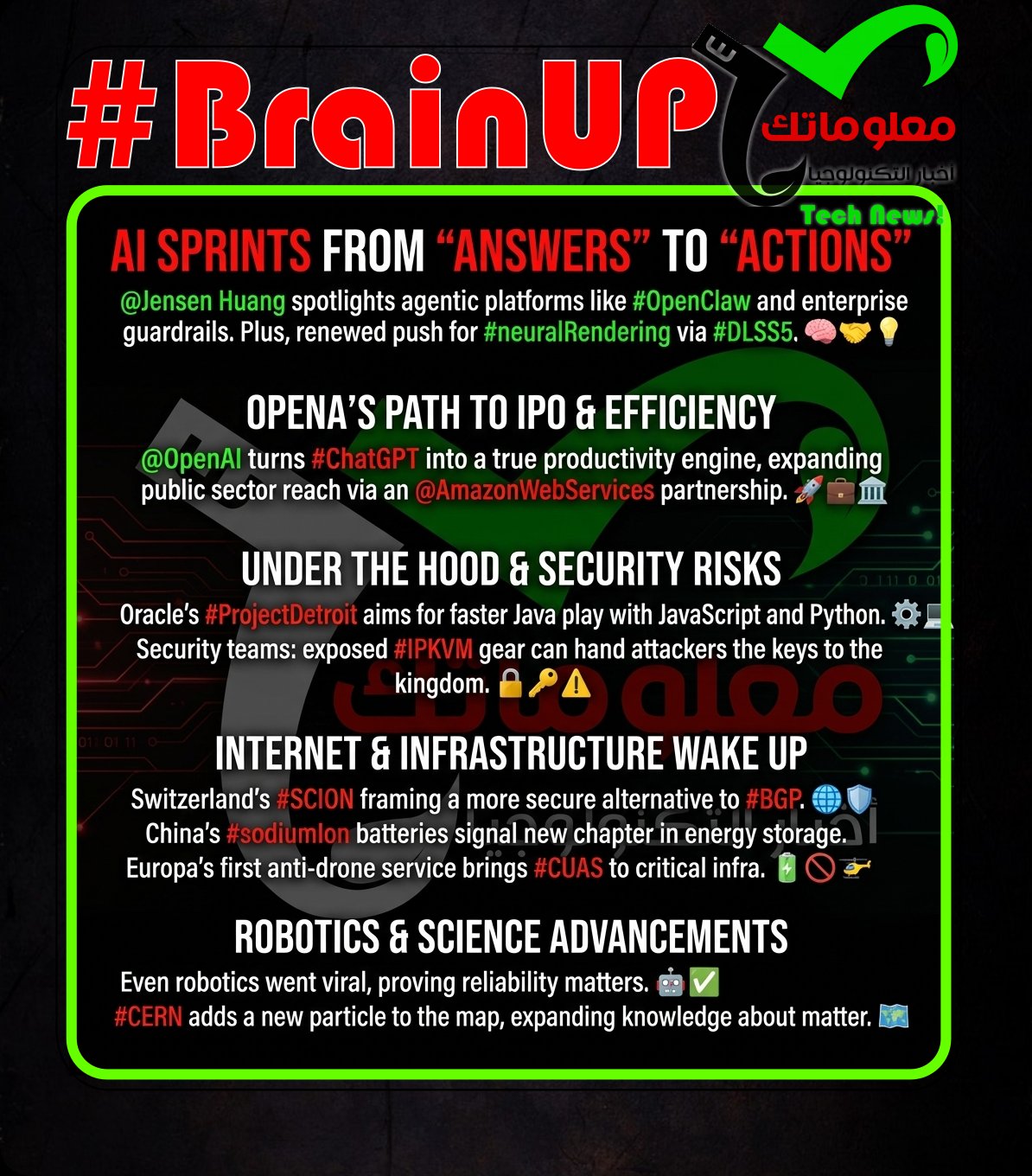
@Nvidia CEO @Jensen Huang said the open-source #AI agent platform #OpenClaw is “definitely the next ChatGPT” because AI is shifting from answering questions to taking actions on a user’s behalf. He told @Jim Cramer at Nvidia’s GTC event that OpenClaw has become the largest and most successful open-source project, and described how its autonomous agents can complete tasks, make decisions, and iterate with minimal user input, including an example of an agent learning tools to design a kitchen and refining its own output. Nvidia is moving to productize and secure this trend by launching #NemoClaw, an enterprise-grade layer that adds Nvidia’s software stack plus guardrails such as privacy protections, oversight tools, and enterprise security. Huang argued that such agents could broadly elevate individual capabilities, but acknowledged concerns about security, privacy, and control as autonomy increases, which Nvidia positions NemoClaw to address for safe, scalable deployment.
3. Project Detroit: Java interop with JavaScript and Python
Oracle introduced #ProjectDetroit alongside Java 26, aiming to deliver faster interop between Java, JavaScript, and Python, and plans to propose it as an #OpenJDK project, starting with JavaScript and Python and adding more languages later. The approach builds on the #FFM API introduced in Java 22, using very thin layers for cross-language calls, and differs from prior efforts like Project Nashorn and alternatives such as GraalWasm by embedding the @V8 and @CPython runtimes directly inside the JVM process. Oracle argues this avoids ecosystem mismatch and hard-to-implement corner cases in less tightly specified languages by using the most popular native runtimes, while also improving performance and enabling a clearer security model via heap isolation between Java, V8, and CPython. Oracle also said it will contribute #ProjectHelidon to #OpenJDK and align its versions with the #JDK, and announced the Java Verified Portfolio, a supported enterprise set including Helidon, #JavaFX, and the Java platform extension for #VSCode, with commercial support for JavaFX reintroduced due to AI and analytics visualization interest. Additional learning-focused updates include Java support in VS Code #Jupyter notebooks and code snippet sharing in the Java Playground.
4. Switzerland built an alternative to BGP. Nobody noticed
The article argues that #BGP, the internet’s inter-domain routing protocol, was built to scale rather than be secure, leaving predictable vulnerabilities that still enable route hijacks, leaks, and large-scale interception. It says add-ons like #RPKI, #BGPsec, and #ROA mitigate problems only marginally because they do not change BGP’s lack of native ownership verification for address blocks. As an alternative, it presents #SCION, an internet routing architecture developed at ETH Zürich under @Adrian Perrig, which aims to replace rather than patch the existing foundation and provide truly secure paths in an adversarial network. Perrig contends security cannot be bolted onto legacy design, comparing today’s defenses to patching a “boat full of holes,” and an independent view from @Kevin Curran similarly characterizes decades of internet security as workarounds and “Band-Aids.” The piece positions SCION as a proven but not widely noticed approach, emphasizing the gap between known architectural flaws in BGP and the slow adoption of more fundamental redesigns.
5. CEO Asks ChatGPT How to Void $250 Million Contract, Ignores His Lawyers, Loses Terribly in Court
A judge ordered the reinstatement of a video game developer after Krafton pursued a plan, allegedly devised with #ChatGPT, to take over Unknown Worlds Entertainment and force out its founder amid a dispute over a potential $250 million payout tied to Subnautica 2. Court records describe how Krafton bought Unknown Worlds in 2021 for $500 million and agreed to pay an additional $250 million if Subnautica 2 met sales targets, while Krafton’s internal projections suggested the bonus was likely to be owed. The ruling says Krafton CEO @Changhan Kim, fearing he had agreed to a “pushover” contract, consulted an AI chatbot to contrive a corporate “takeover” strategy as the relationship between the parties fractured approaching the sequel’s release. The court’s Monday decision characterized the episode as a scheme to avoid paying the developers and resulted in the fired developer being reinstated. The case ties the attempted leadership ouster directly to the contract’s incentive structure and Krafton’s efforts to avoid the contingent payment.
7. Worldcoin’s newest pitch: scan your eyeballs to get free cryptocurrency
Worldcoin has introduced an ambitious initiative to onboard billions of users to cryptocurrency by scanning their eyeballs, promising free tokens in return. The project uses biometric technology to verify individuals uniquely and combats fraud, aiming to create a global identity network. Critics raise concerns over privacy, data security, and ethical implications of mass biometric data collection. Despite these issues, Worldcoin argues that the technology can provide financial inclusion for the unbanked and serve as a new verification method in digital economies. This approach illustrates the growing intersection of biometrics and blockchain technologies, highlighting both potential benefits and risks.
8. In China, battery makers bet big on sodium in move away from lithium
Chinese battery manufacturers are investing heavily in #sodium-ion batteries as they seek alternatives to lithium-based technology due to lithium’s high cost and supply risks. The transition is driven by China’s abundant sodium resources, making sodium batteries a more sustainable and economical choice. These batteries offer advantages such as lower raw material costs and better resource availability, though their energy density is currently lower than lithium counterparts. The push aligns with China’s broader strategy to reduce dependency on imports and advance clean energy technologies, positioning sodium-ion as a key component in the future energy storage landscape. This shift reflects global trends toward diversification of battery chemistries to improve energy security and cost-effectiveness.
9. Researchers disclose vulnerabilities in IP KVMs from four manufacturers
Researchers warn that low-cost Internet-exposed #IPKVM devices, used for remote administration, can provide attackers BIOS/UEFI-level access that can undermine otherwise secure networks if misconfigured, connected by insiders, or compromised via firmware flaws. @Eclypsium disclosed nine vulnerabilities across products from GL-iNet, Angeet/Yeeso, Sipeed, and JetKVM, including issues that enable unauthenticated root access or remote code execution, which the researchers describe as basic failures in #inputValidation, #authentication, cryptographic verification, and rate limiting. Patch status varies, with several issues fixed or planned for GL-iNet, Sipeed, and JetKVM, while the most severe flaws in Angeet/Yeeso devices had no fix available as of Tuesday. Beyond device bugs, exposure risk is amplified by deployment choices, and @HDMoore reported an Internet scan finding a little more than 1,300 such devices, up from about 1,000 last June. Moore emphasized that if an IP KVM is compromised, it is often easy to take over the attached system even when that system is otherwise secure from network attacks, echoing longstanding concerns about #BMC-like remote management hardware.
10. Arizona Becomes First State to Criminally Charge Kalshi
Arizona has filed criminal charges against the online prediction market Kalshi, alleging it let people bet on elections and operated an illegal gambling business in the state. Arizona Attorney General @Kris Mayes brought 20 misdemeanor counts in Maricopa County Superior Court, arguing that despite its “prediction market” branding, Kalshi is taking bets on Arizona elections in violation of Arizona law. Kalshi, a New York based company, called the case “paper-thin,” said it is not a casino or sportsbook, and argued it should fall under federal oversight as a conduit for federally regulated swaps governed by the #CommodityFuturesTradingCommission, not a patchwork of state rules. If found guilty, Kalshi could face fines of $10,000 to $20,000 per violation, and the case is expected to be watched nationally as a test of whether #predictionMarkets can be reined in or regulated.
11. OpenAI preps for IPO by end of year, tells employees ChatGPT must be ‘productivity tool’
@OpenAI is steering the company toward its enterprise business as it prepares for a potential IPO that could come as soon as the fourth quarter of this year. In an all-hands meeting, @Fidji Simo said the company is “orienting aggressively” toward high-productivity use cases and aims to turn ChatGPT’s more than 900 million weekly active users into “high-compute users” by making #ChatGPT a #productivity tool, as it competes with rivals like @Google and @Anthropic. To ready for a market debut, CFO @Sarah Friar is building out the finance function, including hiring Ajmere Dale as well as former @DocuSign CFO Cynthia Gaylor, who will oversee investor relations. The company is also sharpening its spending and revenue narrative after late-2025 infrastructure ambitions, telling investors it is targeting about $600 billion in total #compute spend by 2030 and projecting more than $280 billion in 2030 revenue split nearly evenly between consumer and enterprise. Taken together, the push reflects a renewed urgency to focus execution and translate massive consumer scale into enterprise adoption and monetization ahead of going public.
12. OpenAI preps for IPO by end of year, tells employees ChatGPT must be ‘productivity tool’
OpenAI is pushing harder into its enterprise business as it prepares for a potential IPO, possibly as soon as the fourth quarter of this year. At a recent all-hands, Fidji Simo, OpenAI’s CEO of Applications, told employees the company is “orienting aggressively” toward high-productivity use cases and aims to turn #ChatGPT into a “productivity tool” that converts its more than 900 million weekly active users into “high-compute users,” as competition from @Google and @Anthropic intensifies. CFO Sarah Friar is building out the finance function ahead of a market debut, including hiring Ajmere Dale and Cynthia Gaylor, with Gaylor overseeing investor relations. After a December “code red” to improve #ChatGPT and a pullback from other areas such as health, shopping, and advertising, Simo emphasized urgency paired with focus and execution. OpenAI has also sought to clarify spending and revenue expectations by telling investors it is targeting about $600 billion in total compute spend by 2030 and projecting more than $280 billion in 2030 revenue, split nearly evenly between consumer and enterprise, to better link infrastructure commitments to expected growth.
13. Jensen Huang says Nvidia has received orders from China and is ‘restarting our manufacturing’
At #GTC, @Jensen Huang said Nvidia is preparing to resume selling its #H200 processors to customers in China after a prolonged delay caused by U.S. and Chinese restrictions. He told reporters the company has received purchase orders and is restarting manufacturing, adding that Nvidia now has clearance from both sides and that its supply chain is ramping up. Nvidia had been largely shut out of China since an April Trump administration rule required export licenses, prompting a planned $5.5 billion charge, and earlier controls had led Nvidia to create the lower capability #H20 for the market. Although sales of H200 to China were conditionally allowed in December with the U.S. receiving 25% of sales, Nvidia’s CFO @Colette Kress said in late February that only a small number of H200 products had been approved and the company had not yet generated revenue, with delays linked to security scrutiny and ongoing licensing burdens such as shipment caps and third-party testing. The update signals a potential reopening of a market that previously represented at least one-fifth of Nvidia’s data center revenue, even as the company has continued rapid growth while assuming no China data center revenue in its guidance.
At a GTC 2026 press Q&A, @Jensen Huang rejected backlash to #DLSS 5, saying critics who argue it makes games look worse, more homogenous, or reflective of Nvidia’s preferences are “completely wrong.” He said #DLSS 5 combines developer-controlled geometry and textures with generative AI, and that studios can fine-tune the generative model to match their own style, so it does not take away artistic control. Huang emphasized it is not frame-level post-processing but “generative control at the geometry level,” which he described as “content-control generative AI” and called #neural rendering. He added that developers can experiment with different looks, such as a toon shader or glass-like materials, and decide how to use the tool. The article notes DLSS 5 is planned for a fall launch and suggests more demos could influence skeptical gamers as the technology appears in more complete form.
Viral footage from a San Jose Haidilao restaurant shows a service robot malfunctioning and dancing nonstop, causing chaos and breaking tableware. Staff intervened to stop it, with one employee trying to drag the robot away while two others joined in and another appeared to use her phone to find a way to shut it down. The restaurant chain reportedly uses robots to take orders and deliver ingredients, highlighting how #robot automation in dining can still have serious glitches. With three employees working together, they managed to disable the robot before it caused more damage, and it did not appear to become more physical than dancing. The incident is presented as a vivid example of the remaining kinks in increasingly common restaurant robotics.
16. Orange Drone Guardian, first anti-drone as-a-Service
Orange Business has launched Orange Drone Guardian, presented as Europe’s first #Counter-Unmanned Aircraft System (#CUAS) offered in an “as a Service” model to protect critical sites and major events as civilian drone use and malicious incidents increase. The solution detects, identifies, and classifies intrusive drones in low-altitude airspace across France, with the ability to extend to other European countries, targeting #OIV and #OES operators, major event organizers, and public institutions safeguarding critical infrastructure. It combines sovereign infrastructure operated by Orange Business, including fully managed secured connectivity, the Cloud Avenue SecNum trusted cloud platform qualified SecNumCloud 3.2 by #ANSSI and hosted in a Grenoble data center, and a France-based secure operations center that consolidates field data in real time. A nationwide footprint of 19,700 #TOTEM tower and rooftop sites provides high points for detection sensors, while advanced sensors and Command and Control #C2 software support operation in complex urban environments, with #AI enhancements and planned evolution to integrate additional sensors and #5G radio-sensing plus digital twins. Delivered by subscription, Orange positions the offer as reducing upfront investment while improving agility and scalability through an open architecture, with @Nassima Auvray stating it is a first for France and Europe and aligned with the Defense and Security division’s ambition to deliver sovereign, scalable solutions.
A senior Pentagon official showcased how Palantir’s #ProjectMaven helps the US military compress the process of finding and striking targets into a single workflow. During a presentation at Palantir’s #AIPCon, @CameronStaley, the Department of Defense chief digital and AI officer, demonstrated using satellite imagery and multiple data feeds, including flight tracking, to narrow potential targets down to a specific car and then use #AI to recommend the “best asset” to execute a strike, in the demo a mounted .50-caliber #M2Browning on a #Stryker vehicle. Staley said tasks that once required eight or nine separate systems and could take hours to move from detection to decision to engagement have been significantly sped up, calling the integrated process “revolutionary.” The article notes @AlexKarp has been guarded about classified details but has said Project Maven provides the US and allies a battlefield advantage by enabling faster and more precise targeting, and it adds that the Army’s data literacy guide describes Maven as a cutting-edge capability troops rely on to assist in targeting and executing strikes.
18. OpenAI Lands AWS Partnership to Sell AI Tools Across US Government: Report
OpenAI has formed a partnership with @AmazonWebServices (AWS) to sell its AI tools to the US government, enhancing federal access to advanced #artificialintelligence capabilities. According to a report, this collaboration integrates OpenAI’s technology with AWS’s established cloud infrastructure, facilitating smoother deployment within government agencies. This partnership highlights a strategic move to accelerate AI adoption in the public sector, leveraging AWS’s government cloud expertise and OpenAI’s cutting-edge models. The deal is expected to streamline procurement processes and expand usage across various federal departments, supporting innovation and efficiency. By combining their strengths, OpenAI and AWS aim to advance US governmental AI capabilities significantly.
19. CERN Discovers New Particle After Upgrading Large Hadron Collider
Europe’s #CERN announced that the #LargeHadronCollider has discovered a new particle, the 80th identified so far, named Xi-cc-plus, a baryon similar to a proton but about four times heavier. Detected by the #LHCb experiment after detector upgrades completed in 2023, the particle is composed of two charm quarks and one down quark, unlike a proton’s two up quarks and one down quark, and it is only the second observed baryon with two heavy quarks. CERN said its lifetime is expected to be six times shorter than a related double-charm baryon reported by LHCb in 2017, making it harder to spot, and the measurement relies on observing decay patterns from high-energy collisions. The result is intended to help test #quantumchromodynamics, the theory of the strong force that binds quarks into baryons, mesons, and more exotic hadrons such as tetraquarks and pentaquarks. The finding also comes as CERN pursues plans for the larger #FutureCircularCollider to further probe fundamental physics.
That’s all for today’s digest for 2026/03/18! We picked, and processed 18 Articles. Stay tuned for tomorrow’s collection of insights and discoveries.
Thanks, Patricia Zougheib and Dr Badawi, for curating the links
See you in the next one! 🚀
