
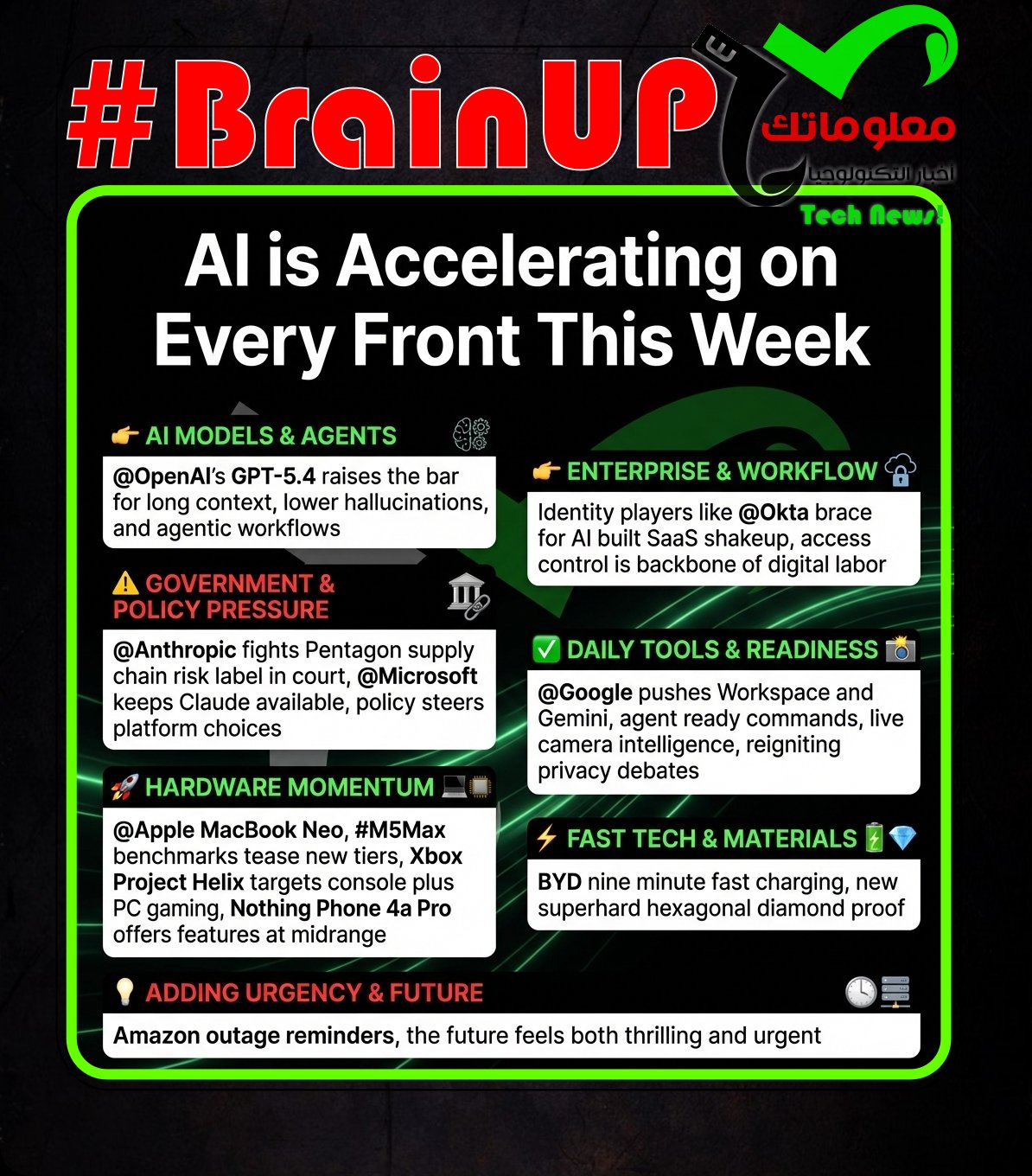
#BrainUp Daily Tech News – (Friday, March 6ᵗʰ)
Welcome to today’s curated collection of interesting links and insights for 2026/03/06. Our Hand-picked, AI-optimized system has processed and summarized 28 articles from all over the internet to bring you the latest technology news.
As previously aired🔴LIVE on Clubhouse, Chatter Social, Instagram, Twitch, X, YouTube, and TikTok.
Also available as a #Podcast on Apple 📻, Spotify🛜, Anghami, and Amazon🎧 or anywhere else you listen to podcasts.
Senior Chinese semiconductor leaders from SMIC, YMTC, Naura, and EDA developer Empyrean argue China needs a consolidated national push to build a domestic alternative to @ASML because the current chip equipment sector is too small, fragmented, and weak to overcome U.S. export controls. They identify three choke points: #EDA software, silicon wafers, and manufacturing equipment, especially #EUV lithography needed for sub-7nm production that China cannot currently replicate, and they criticize dispersed public funding that spreads resources across competing efforts without results. With China drafting its 15th #Five-Year Plan for 2026 to 2030, the industry expects national targets around lithography and EDA, and the state-backed #BigFundIII, about $47.5 billion, is shifting capital toward lithography and EDA substitutes for @ASML and @Synopsys tools. The article notes China’s most advanced domestic #DUV system from Yuliangsheng is comparable to @ASML’s older Twinscan NXT:1950i design for 32nm-class processes, and even a projected 28nm integration by 2027 would still leave sub-10nm requiring new scanners and years more development. It adds that while a prototype #EUV machine is reportedly complete in Shenzhen, commercial viability depends on yield and ecosystem challenges that took @ASML decades and a supply chain of 5,000-plus subcontractors and extensive manufacturing data to master, reinforcing the executives’ call to concentrate national resources.
2. OpenAI launches GPT-5.4 with Pro and Thinking versions | TechCrunch
@OpenAI released #GPT-5.4, describing it as its most capable and efficient frontier model for professional work, offered in standard form plus #GPT-5.4 Thinking for reasoning and #GPT-5.4 Pro for high performance. The API version supports context windows up to 1 million tokens and the company says the model solves similar problems with fewer tokens than GPT 5.2, alongside strong results like record scores on OSWorld-Verified and WebArena Verified, 83% on its GDPval knowledge work test, and a lead on Mercor’s APEX-Agents benchmark for law and finance. Mercor CEO @Brendan Foody said GPT-5.4 performs well on long-horizon deliverables such as slide decks, financial models, and legal analysis, while running faster and at lower cost than competitive frontier models. OpenAI also reports reduced hallucinations and factual errors, with 33% fewer errors in individual claims and an 18% reduction in overall responses containing errors versus GPT 5.2, and it introduced #Tool Search to cut token overhead in tool calling by fetching tool definitions only when needed. A new safety evaluation focused on #chain-of-thought suggests deception is less likely in the Thinking variant, indicating it may be less able to hide its reasoning and that CoT monitoring remains an effective safety tool.
3. Khamenei’s fall exposes China’s military AI lag versus US: Beijing adviser
Beijing adviser @Zheng Yongnian argues China must accelerate military applications of #AI and deepen #civil-military-fusion to narrow a strategic gap with the United States. He cites US-Israeli precision strikes that killed @Ayatollah Ali Khamenei as a demonstration of how deeply #AI is embedded in US military operations, warning China against repeating historical mistakes by confining AI mainly to civilian or entertainment uses instead of converting frontier technologies into hard power. As evidence of the US edge, he points to American firms like @Palantir, @Anthropic, and @Anduril as part of a “tech right” driving intelligence gathering, data processing, and operational execution within the US military-industrial complex. He also references a January US operation in Venezuela that used AI-driven targeting and #drone-swarms and resulted in the capture of then-leader @Nicolas Maduro. Taken together, these cases are presented as proof that the US has achieved tight integration of advanced technology and military action, and that China needs to respond by translating AI capability into decisive military effectiveness.
4. Okta CEO ‘paranoid’ as vibe coders stir SaaS-pocalypse fears
@Todd McKinnon says Okta is “paranoid” about competition from #LLMs and AI coding tools, even if an LLM alone would struggle to match the hardened, secure, scalable quality of mature #SaaS software. He told investors Okta is adopting the latest #LLMs and coding tools to build resilient, secure products quickly, aiming to win an “agentic future” where #digital labor expands the total addressable market. The wider market shares similar concerns, with the so-called #SaaSpocalypse tied to the rise of tools like Anthropic’s Claude Code and cited as contributing to double digit stock declines over six months for Microsoft, Oracle, SAP, Salesforce, and others. Okta positions #identity access as central to AI agent adoption, says its 20,000 customers use its tools for agents in sensitive areas, and describes two agent billing models: per agents per human, or by the agent’s system connections. McKinnon reports surging demand for Auth0 for AI Agents and Okta for AI Agents, notes new product lineup bookings were about 30% of Q4 bookings, and projects the identity market could grow from about $20B to up to $80B as enterprises seek the security, privacy, and visibility needed to deploy AI agents.
5. Microsoft says Anthropic’s products remain available to customers after Pentagon blacklist
@Microsoft said it will keep @Anthropic’s AI models available in its products for customers, except for the U.S. Department of War, after the Pentagon moved to designate Anthropic a #supply-chain risk. The company said its lawyers reviewed the planned designation and concluded Anthropic products, including #Claude, can remain accessible through #M365, #GitHub, and #MicrosoftAIFoundry, and that Microsoft can continue non-defense projects with Anthropic, while Anthropic plans to challenge the designation in court. The decision comes amid broader U.S. government pressure, including @Donald Trump urging agencies to drop Anthropic and Secretary of War @Pete Hegseth saying Anthropic services would continue for no more than six months, as well as reports that Anthropic models were used in recent U.S. airstrikes on Iran. Microsoft is the first major company to publicly maintain its Anthropic use after the Pentagon’s actions, even as some defense tech firms have told employees to stop using Claude and switch to alternatives, and as @OpenAI said the Pentagon agreed to run its models for classified workloads. The episode underscores Microsoft’s emphasis on #model-choice across its products and the stakes of its large Azure and investment ties with both Anthropic and OpenAI.
@Dario Amodei said #Anthropic has “no choice” but to challenge in court the U.S. government’s decision to designate the company a #supply chain risk, arguing the action is not legally sound. The dispute stems from negotiations with the Department of Defense over access to Anthropic’s #Claude models: Anthropic sought exceptions for fully autonomous weapons and mass domestic surveillance, while the DOD wanted unfettered access for all lawful purposes. The official designation requires defense vendors and contractors to certify they do not use Anthropic models in work with the Pentagon, a label typically used for entities linked to foreign adversaries, and it has created uncertainty about contractors’ non-military use. Amodei said the designation cannot limit Claude’s use or Anthropic business relationships outside specific defense contracts, and @Microsoft said its lawyers concluded Anthropic products can remain available to customers other than the DOD. Anthropic previously signed a $200 million DOD contract and integrated models into classified mission workflows, but as talks stalled, rivals like @Sam Altman’s @OpenAI and @Elon Musk’s xAI moved to deploy models in classified capacities, underscoring how the designation is reshaping government AI partnerships.
7. Google makes Gmail, Drive, and Docs ‘agent-ready’ for OpenClaw
@Google has published a Google Workspace command-line interface on GitHub to make Gmail, Drive, Docs, and other Workspace services more accessible to agentic AI tools like @OpenClaw. The CLI includes explicit instructions for #OpenClaw integration and also supports #MCP, enabling MCP-compatible apps such as the Claude Desktop app, VS Code, and the Gemini CLI to connect more easily to Workspace. Previously, AI agents could integrate with these services but often had to juggle multiple APIs, which the CLI aims to streamline, though it is positioned as a developer sample rather than a consumer tool. The repository documentation warns it is not an officially supported Google product, so developers use it at their own risk, but its release signals Google is preparing its ecosystem for an #agent-ready future. The move comes in the wake of @OpenClaw’s viral success, which highlighted how users might employ AI agents to manage email, documents, meeting notes, and other productivity tasks.
8. Where things stand with the Department of War
Yesterday (March 4) Anthropic received a letter from the Department of War designating it a supply chain risk to US national security, a move @Dario Amodei says Anthropic believes is not legally sound and will challenge in court. The letter’s language and the narrow statute cited, #10USC3252, are described as limiting the designation to use of Claude directly within Department of War contracts, leaving most customers unaffected and preventing restrictions on unrelated uses or business relationships, including for contractors. Amodei says Anthropic has been in productive discussions with the Department about continued service within two narrow exceptions, avoiding involvement in operational decision-making while drawing boundaries around fully autonomous weapons and mass domestic surveillance, and he highlights prior support for warfighters in areas like intelligence analysis, modeling and simulation, operational planning, and cyber operations. He apologizes for a leaked internal post written amid rapid public developments, calling its tone regrettable and its assessment outdated, and emphasizes Anthropic did not leak it. Anthropic’s stated priority is avoiding disruption during major combat operations, offering to provide its models at nominal cost with engineering support for as long as necessary and permitted, while framing its relationship with the Department around shared commitment to US national security and accelerating #AI adoption in government.
9. Why Diabetic Wounds Refuse to Heal: Scientists Uncover the Immune System’s Hidden Role
Chronic wounds in diabetic patients persist due to the immune system’s impaired response, which scientists have recently elucidated. Research shows that diabetic wounds exhibit persistent inflammation driven by malfunctioning immune cells, particularly macrophages, which fail to transition from a pro-inflammatory to a healing state. This defective immune regulation disrupts the normal healing cascade, leaving wounds open and vulnerable to infection. Scientists have uncovered specific molecular pathways responsible for this immune dysfunction, highlighting potential therapeutic targets to restore proper immune activity and promote wound closure. Understanding this hidden role of immunity in diabetic wound healing informs future treatments, aiming to reduce complications and improve recovery for diabetic patients.
10. Netflix just bought an AI startup founded by Ben Affleck
Netflix has acquired InterPositive, an AI filmmaking startup founded by @Ben Affleck in 2022 that operated in stealth, with undisclosed deal terms. Affleck will stay involved as a senior advisor, and Netflix will absorb the full staff while offering the company’s tech to creative partners without plans to sell it commercially. InterPositive builds #generativeAI tools that create AI models from a production’s dailies, enabling post-production work like mixing and color, relighting, and adding VFX, which Affleck frames as supporting existing footage rather than text prompting something from nothing. Netflix says it will keep filmmakers at the center, and the company has already used AI to produce a VFX shot for The Eternaut, though the article notes Netflix has also used AI to make ads more intrusive and questions whether creators will remain central. Affleck argues that human judgment and creativity must be protected, but the piece emphasizes that InterPositive is now under Netflix’s control with him serving only as an advisor.
11. Anthropic Chief Back in Talks With Pentagon About AI Deal
@Dario Amodei, CEO of @Anthropic, has resumed discussions with senior Pentagon officials to negotiate terms for how the company’s #AI technology might be used by the U.S. military after previous disagreements over safety restrictions and operational limits, with both sides reportedly exploring compromises that could allow deeper integration of Claude models into classified defense systems while upholding ethical guardrails. The talks come amid broader tensions between AI developers and government agencies seeking powerful generative models for national security tasks without compromising safety or control, and federal officials have signalled that a workable agreement might hinge on clarifying usage policies, accountability mechanisms and oversight frameworks that satisfy both operational needs and model alignment priorities. This development suggests that Washington and Anthropic are trying to find common ground after earlier disputes over military deployment conditions — particularly around autonomous systems and sensitive use cases, and reflects how strategic AI partnerships are increasingly shaped by negotiations over risk, control and the balance between innovation and governance.
12. There’s A New Claw In Town: Ironclaw And AI Agent Security
Ironclaw introduces a novel approach to AI agent security by creating advanced safeguards that protect autonomous agents from manipulation and attacks. The platform employs proactive threat detection mechanisms and adaptive defense strategies to ensure the integrity and reliability of AI operations. This innovation addresses the increasing security challenges posed by sophisticated cyber threats targeting AI systems. By integrating robust security layers, Ironclaw enhances trust and safety in AI deployments across various industries. These developments signify a crucial step toward securing AI agents in an evolving digital landscape.
13. First MacBook Neo Benchmarks Are In: Here’s How It Compares to the M1 MacBook Air
Early benchmarks indicate the MacBook Neo’s CPU performance closely matches the iPhone 16 Pro because it uses the same 6-core #A18Pro chip, albeit with one fewer GPU core. In Geekbench, the MacBook Neo scored 3461 single-core and 8668 multi-core, plus a 31286 #Metal score, compared with iPhone 16 Pro at 3445 and 8624 with 32575 Metal, and the M1 MacBook Air at 2346 and 8342 with 33148 Metal. The slightly lower Metal score versus iPhone 16 Pro aligns with the reduced GPU core count, while multi-core performance is roughly M1-level and single-core performance is substantially higher, closer to M3 or M4-class single-core results. The article notes this profile suits everyday tasks like web browsing, documents, and streaming, rather than multi-core-heavy workloads such as video editing or 3D work, and adds that @Apple markets the $599 MacBook Neo against similarly priced Windows PCs and Chromebooks, with preorder available now and launch set for March 11, with the caveat that only one benchmark has appeared so far.
14. Here’s how the new M5 Max chip did on early Geekbench tests – 9to5Mac
An early #Geekbench listing suggests the upcoming 18-core #M5Max in a MacBook Pro could set new performance highs, though the results should be treated cautiously until more tests appear. The entry, reportedly for model Mac17,7 (linked to the 16-inch MacBook Pro), shows 4,268 single-core and 29,233 multi-core CPU scores, about 9% and 13.7% higher than the 16-core #M4Max in the 2024 16-inch MacBook Pro (3,915 and 25,702). The same results also exceed both 14-core and 16-core M4 Max Mac Studio averages, and include a Metal score of 232,718 that would rank second on Geekbench’s Metal chart behind the #M3Ultra (32-core CPU, 80-core GPU) in the 2025 Mac Studio. If these numbers hold once Macs ship on March 11 and more user results average out, the M5 Max could lead Geekbench’s Mac benchmarks in both single-core and multi-core. The post also notes early #A18 benchmarks for a new MacBook Neo at 3,461 single-core and 8,668 multi-core, roughly a 0.5% gain over the iPhone 16 Pro’s A18.
15. Trump gets data center companies to pledge to pay for power generation
The @Trump administration announced a voluntary #Ratepayer Protection Pledge in which major data center companies, including Amazon, Google, Meta, Microsoft, @OpenAI, Oracle, and xAI, say they will pay for the new power generation and transmission needed for any additional data centers they build. The pledge’s core commitments are to fund new generating capacity (by building it or paying as part of new or expanded plants), cover transmission hookups, pay even if the power is not ultimately used by their facilities, and consider letting on-site backup generators support the local grid during emergencies, plus local hiring and training. The agreement provides no enforcement mechanism, so the main guaranteed consequence for noncompliance is bad publicity, though the article notes @Trump has used pressure tactics on companies in the past. The piece argues the pledge may be hard to fulfill because many companies plan to rely on natural gas generation that faces equipment shortages and long turbine wait times, and it cannot shield consumers from higher prices because increased natural gas demand would raise costs and push utilities toward less efficient, more expensive plants. It also cites that rising US liquefied natural gas exports have already driven some utilities toward costly coal generation and contributed to a 6 percent rise in consumer electricity costs in 2025, undercutting claims that the pledge will lower long-term consumer electricity prices.
16. Cluely CEO Roy Lee admits to publicly lying about revenue numbers last year | TechCrunch
@Roy Lee, co-founder and CEO of Cluely, admitted on X that the $7 million #ARR figure he gave TechCrunch last summer was false and issued a formal retraction, calling it the only blatantly dishonest thing he has said publicly online. He also claimed he had received a random cold call and gave “some bs,” but TechCrunch reports the interview was arranged after Cluely’s PR representative emailed reporter Marina Temkin, offered access to Lee, shared his number, and confirmed he was expecting the call. TechCrunch notes it sought the interview because Cluely had gone viral in 2025 as a “cheat-on-everything” startup that let users secretly look up answers during video calls, following Lee’s post about being suspended from @Columbia University for building a tool to cheat on software engineering job interviews. The company raised $5.3 million in seed funding from Abstract Ventures and Susa Ventures to commercialize the product, and later raised a $15 million Series A from @Andreessen Horowitz. The episode underscores how Cluely’s headline-driven, provocative growth tactics intersected with public claims about traction, and how the origin story of the revenue figure was misrepresented in Lee’s retraction.
17. Nation-State Actor Embraces AI Malware Assembly Line
Security researchers report that the Pakistan-linked cyber-espionage group APT36, also known as Transparent Tribe, has begun using #AI coding tools to mass-produce malware in what analysts describe as an “AI malware assembly line,” shifting the economics of cyberattacks from crafting sophisticated code to generating huge volumes of mediocre but diverse malicious programs. Investigators at @Bitdefender observed the group using conversational “vibe-coding” techniques to prompt AI tools to generate malware components in multiple programming languages such as Nim, Zig, and Crystal, allowing attackers with modest technical skill to rapidly create new variants that can overwhelm detection systems through sheer quantity rather than technical sophistication. Many of the samples contain obvious logic errors or unfinished features, including placeholder command-and-control addresses and broken reporting functions, illustrating that the strategy prioritizes scale and experimentation over quality, with thousands of variants potentially flooding defenses and complicating detection pipelines. Analysts describe the tactic as a form of “Distributed Denial of Detection,” where the defensive burden shifts from stopping a single advanced threat to identifying waves of automatically generated malware, highlighting how generative AI is reshaping the cyber threat landscape by lowering the barrier to entry for state-aligned hackers and accelerating the speed at which new attack tools can be produced.
18. Copilot swallows your browser. You’re welcome
Microsoft is previewing a Windows Insider update to #Microsoft Copilot that embeds web browsing inside the assistant, opening links in a side panel instead of launching the user’s default browser, with the stated goal of keeping users in context. Microsoft says Copilot can, with permission, access the context of tabs opened in a conversation, save those tabs with the chat for later return, and optionally sync passwords and form data. The Register notes this appears to use #WebView2 to embed #Edge and potentially steer users away from their chosen browser, and says Microsoft did not answer questions about whether the behavior will be opt-in or which browser is used. Browser vendors have raised concerns, with Vivaldi’s Bruce Lawson calling non opt-in link handling bad behavior that undermines users’ preferred settings and questioning possible implications for #DMA and competition rules. Microsoft says other Copilot features are also being adjusted, adding items like Podcasts and Study and Learn mode while pulling back others during iteration, and the browsing change is a preview subject to change as rollout to Insider channels proceeds gradually.
19. Oracle plans thousands of job cuts in next two months, WSJ reports
Oracle is planning significant workforce reductions, with thousands of job cuts expected in the next two months, according to a report from The Wall Street Journal. This move is part of a broader effort by Oracle to streamline its operations and increase efficiency amidst growing competition in the cloud computing sector. The job cuts will impact various departments as Oracle aims to optimize costs while continuing its investment in cloud and software services. This restructuring reflects wider industry trends where major technology firms are adjusting workforces to align with strategic priorities. Oracle’s actions underscore the challenges faced by tech companies balancing growth ambitions with operational efficiency.
20. Proton Mail Helped FBI Unmask Anonymous ‘Stop Cop City’ Protester
A court record reviewed by 404 Media says privacy-focused email provider Proton Mail provided Swiss authorities with payment data that was then passed to the FBI and used to identify who was allegedly behind an anonymous #StopCopCity related email account. The account was affiliated with the Defend the Atlanta Forest (#DTAF) group, and authorities were investigating the movement for alleged links to arson, vandalism, and doxing connected to protests against a large police training center planned near Intrenchment Creek Park in Atlanta. The record illustrates that despite Proton Mail’s end-to-end encryption and emphasis on being governed by Swiss privacy law, it can still disclose certain non-content data such as payment information through Swiss legal channels. The protests also included camping in the forest and lawsuits, and the article notes that charges against more than 60 people have since been dropped. Overall, the case shows how financial or account metadata can be leveraged to unmask anonymity even when message content is protected by #encryption.
21. A Technology for a Low-Trust Society
Using #prediction-markets such as #Kalshi and #Polymarket, major news events become financial instruments, inviting people with exclusive information to profit and fueling suspicion that outcomes are being steered. Before @DonaldTrump’s State of the Union, a viral report from PBS correspondent @LisaDesjardins that he might speak for up to 180 minutes coincided with a jump in a Kalshi market about speech length, then Trump spoke only 1 hour and 47 minutes, meaning traders who followed that “insider” signal lost. The piece notes other incidents that have raised alarms about insider trading or manipulation, including a Polymarket bet on @NicolásMaduro being ousted that netted $400,000 and prompted Rep. @RitchieTorres to propose banning federal workers from using prediction markets, Israeli charges over bets allegedly informed by classified data, and a trader reportedly earning over $550,000 by betting on the timing of U.S. and Israeli strikes on Iran and the fate of its supreme leader. Although these platforms market themselves as capturing the “wisdom of crowds” and are being treated by some media partnerships as information tools, the article argues they instead incentivize exploiting information asymmetries, financialize everything from elections to pop culture, and intensify a low-trust, paranoia-driven view of reality.
22. Amazon down for thousands of users in US, Downdetector shows
Amazon experienced a widespread outage affecting thousands of users in the United States, as reported by Downdetector. The disruption impacted users’ ability to access Amazon’s services, leading to a significant volume of complaints. The outage highlights the challenges faced by major online platforms in maintaining continuous service. This incident underscores the growing reliance on #e-commerce and the importance of robust infrastructure for tech giants like @Amazon. Ensuring reliable service is critical to preserving customer trust and operational stability in the digital economy.
23. Scientists prove hexagonal diamond is harder than real diamond
Scientists have demonstrated that hexagonal diamond, also known as lonsdaleite, is harder than conventional cubic diamond. This conclusion was reached through experimental compression tests and detailed analysis of the crystal’s atomic structure, revealing its unique hexagonal lattice arrangement. The hexagonal structure allows for stronger bonding and less structural weakness compared to cubic diamonds. These findings confirm earlier theoretical predictions and suggest potential applications of lonsdaleite in industries requiring ultra-hard materials. Understanding the superior hardness of lonsdaleite could lead to the development of new superhard materials with improved performance over traditional diamonds.
24. Xbox Confirms ‘Project Helix’, Its Next-Gen Console That Will Also Play PC Games – IGN
Microsoft Gaming CEO @Asha Sharma confirmed Xbox’s next-generation console is codenamed Project Helix and said it will play both Xbox and PC games. In a post on X, Sharma wrote that the team discussed their commitment to the return of Xbox and stated that Project Helix will “lead in performance” while supporting Xbox and PC titles, with more discussion planned with partners and studios at #GDC next week. The announcement validates long-running rumors about a fifth-generation Xbox and its ability to play PC games, while the article notes uncertainty about whether it would extend to first-party PlayStation games on PC given reports that Sony has pulled back on first-party PC support. Overall, the update positions Project Helix as a high-performance next-gen Xbox focused on broader game compatibility, with more details expected soon.
25. GrapheneOS: Microsoft Authenticator does not support secure Android OS
@Microsoft says its #MicrosoftAuthenticator app will remove #EntraID access from mobile devices it detects as rooted or jailbroken, which could affect users of #GrapheneOS despite its security focused design. GrapheneOS has a strong reputation for privacy and security on Pixel phones, supports many apps that often fail on other custom ROMs, and its rapid vulnerability fixes sometimes feed back into the Android project; @Motorola also announced official support at #MWC in Barcelona to bring GrapheneOS beyond Pixels. In response to heise security, a Microsoft spokesperson stated that Microsoft Authenticator is not officially supported on GrapheneOS and that Entra accounts may be impacted in the future on GrapheneOS devices detected as rooted. It remains unclear whether Microsoft Authenticator will generally flag GrapheneOS as rooted, but if it does, corporate users relying on Entra based two factor login could be locked out. Alternatives exist because other authenticator apps can be linked to Microsoft accounts, but setup is more complicated, lacks Microsoft specific security extensions, and may face IT department approval issues.
26. Gemini Expands to Live Camera Feeds: What It Means for Your Privacy
#Google’s #Gemini for Home is expanding from analyzing stored security camera clips to answering questions using live camera views through a new #Live Search capability. @Anish Kattukaran said users will be able to ask questions about the current state of the home, such as whether a car is in the driveway, and the feature will be limited to Google Home Premium Advanced subscribers starting at $20. The change raises #privacy concerns because it broadens AI access from video history to on demand live feeds, and it is unclear whether Live Search can be disabled or how live feeds would be handled in scenarios like law enforcement requests. The article notes Google Nest has shared footage with police in the past, including recovered cloud footage in the Nancy Guthrie case, while also stating Google Nest has not had contracts with surveillance companies like #Flock Safety. Google also indicates that when Gemini for Home accesses a Nest camera, footage may be used for #AI training, but details on activation and management are not fully disclosed, and access requires the appropriate subscription and enabled settings.
27. 10–97% in nine minutes: BYD presents second generation of Blade Battery – electrive.com
BYD unveiled the second generation of its #BladeBattery, an in-house #LFP prismatic cell design aimed at higher pack-level efficiency and extremely fast charging, alongside matching “Flash Chargers.” Compared with the first generation, BYD says cell-level energy density rises by more than 5%, the cells are now installed longitudinally while keeping a #CellToPack or #CellToBody approach, and the company adds a lifetime warranty while claiming safety at least on the prior level, including passing a nail penetration test after 500+ fast-charge cycles and other stress tests, though these claims are not independently verified. The headline feature is charging speed: across ten planned vehicle launches, BYD states 10–70% charging takes about five minutes and 10–97% takes about nine minutes, with model examples ranging from 4:54 to 5:11 for 10–70% and 8:45 to 9:24 for 10–97%. @WangChuanfu explained the 97% cutoff as an energy-saving choice that leaves 3% capacity for regenerative braking to reduce consumption. The article frames the new Blade Battery as BYD’s next step in combining #fastCharging, safety claims, and packaging changes across multiple models, including a cited Denza Z9 GT CLTC range figure of 1,036 km.
28. Nothing’s Phone 4a Pro picks up flagship features and an even brighter display for $499
Nothing has unveiled the midrange Phone 4a and Phone 4a Pro as successors to the Phone 3a line, leaning into updated designs, brighter #AMOLED displays and upgraded telephoto cameras. The Phone 4a Pro shifts to a metal unibody in black, silver or pink with a larger, brighter #Glyph Matrix, adds IP65 water resistance and includes a 6.83-inch 144Hz display rated up to 5,000 nits, a 5,080mAh battery claimed for up to 17 hours, and a four-camera setup featuring a 50MP wide, 32MP selfie, ultra-wide and 50MP periscope telephoto capable of 140x zoom; it runs on Qualcomm Snapdragon 7s Gen 4 to support AI features. The Phone 4a keeps Nothing’s translucent look in new colors, adds IP64 protection and a brighter straight-line “Glyph Bar,” and pairs a 6.78-inch 120Hz display up to 4,500 nits with Gorilla Glass 7i plus a new 50MP tetraprism periscope offering 3.5x optical, 7x lossless and up to 70x zoom. Both ship with Nothing OS 4.1 based on Android 16, adding Essential Search, Memories in Essential Space for personalized results, and Nothing Playground for AI widget creation, alongside a promise of three years of Android updates and six years of security patches. Pre-orders for Phone 4a begin today in regional configurations starting at €349, while the Phone 4a Pro is the only model confirmed for the US with pre-orders starting March 13.
That’s all for today’s digest for 2026/03/06! We picked, and processed 28 Articles. Stay tuned for tomorrow’s collection of insights and discoveries.
Thanks, Patricia Zougheib and Dr Badawi, for curating the links
See you in the next one! 🚀
