
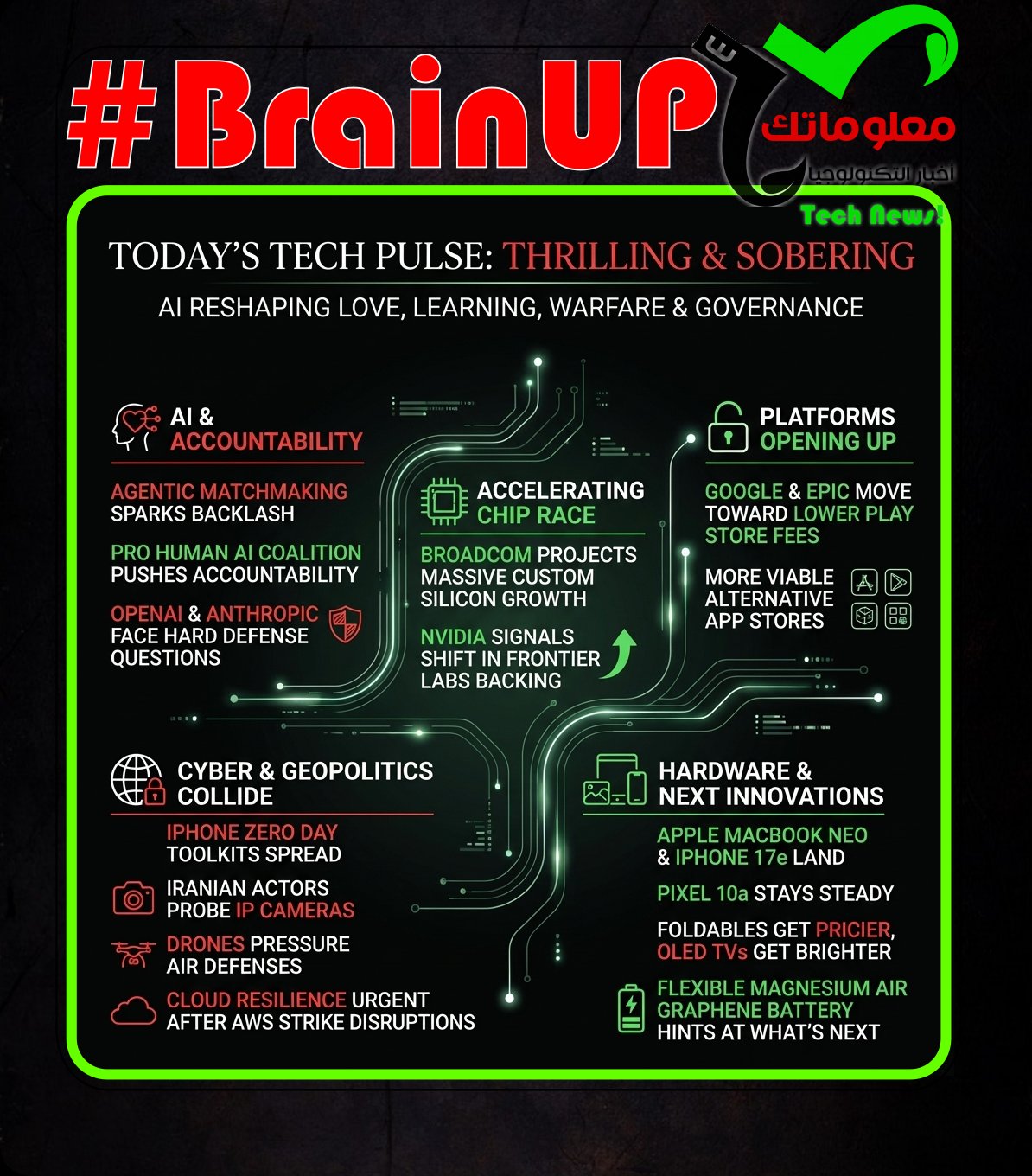
#BrainUp Daily Tech News – (Thursday, March 5ᵗʰ)
Welcome to today’s curated collection of interesting links and insights for 2026/03/05. Our Hand-picked, AI-optimized system has processed and summarized 27 articles from all over the internet to bring you the latest technology news.
As previously aired🔴LIVE on Clubhouse, Chatter Social, Instagram, Twitch, X, YouTube, and TikTok.
Also available as a #Podcast on Apple 📻, Spotify🛜, Anghami, and Amazon🎧 or anywhere else you listen to podcasts.
1. As we enter the age of the AI-rranged marriage, here’s why I hate Fate | Van Badham
Van Badham argues that “agentic AI” dating apps like #Fate turn love into an automated consumer transaction, signaling a tech-driven defeat of human connection. She describes how Fate’s AI “interviews” users, runs data matches on hopes and dreams and proposes five matches using language-pattern “complementarity,” and notes similar US platforms such as Sitch and Keeper that extend this logic with granular preference inputs and AI coaching. Badham says users did not ask for this kind of #AI matchmaking, citing European studies suggesting people primarily wanted AI to weed out fake profiles and flag toxic users, but instead got a broader, imposed “AI-ification” of daily life that flattens human weirdness. She links this shift to wider patterns where AI delivers more intrusive or distortionary outcomes than requested, and to the social consequences of a “mass digital surveillance state” and internet culture that encourages oversharing. The result, she suggests, is a dystopian “AI-rranged” intimacy that replaces mutual self-reflection and growth with data-driven narcissism, making the techlords the winners and people the diminished participants.
2. Google and Epic announce settlement to end app store antitrust case
@Google and @Epic have announced an updated settlement to end their long-running Android app store antitrust dispute, pending approval by US District Judge @James Donato, with the core changes being lower #PlayStore fees and more support for competing app stores. The agreement allows developers to steer users to other payment methods and sets new billing terms: a 5 percent Google billing fee plus service fees of 15 percent for new installs and 20 percent for existing installs, 15 percent total for flat-rate app and game purchases for new installs, and 10 percent for ongoing subscriptions. These rates replace the traditional 30 percent cut and will roll out in the US, UK, and Europe by June 30, with global rollout continuing until September 2027. The settlement also revives a broader remedy by creating reforms for alternative app stores, including a registration and verification approach intended to make third-party stores feel more like first-class Android distribution rather than basic sideloading, with @Tim Sweeney confirming the Epic Games Store will participate. Overall, the deal seeks to resolve the dispute globally and move Android toward a more open app distribution model while addressing court concerns that earlier settlement terms might have favored Epic over other developers.
3. US Air Defenses Face Challenge from Iran Attack Drones
US air defense systems are increasingly challenged by advanced Iranian attack drones, complicating military operations in the region. These drones exhibit sophisticated designs and tactics that evade traditional detection and interception methods, threatening security and strategic stability. The escalation indicates Iran’s commitment to enhancing its unmanned aerial capabilities to counterbalance US military presence. This development forces the US to innovate and adapt its defense measures to mitigate emerging aerial threats effectively. Understanding this dynamic is crucial for maintaining operational superiority and regional security amid evolving technological warfare.
4. Broadcom CEO Hock Tan sees AI chip revenue ‘significantly’ above $100 billion next year
@Hock Tan said @Broadcom expects its #AI chip revenue next year to be significantly above $100 billion, citing accelerating demand from large customers for help designing #custom silicon and claiming the company has secured the supply chain to reach the 2027 target. The company reported #AI revenue more than doubled year over year to $8.4 billion in its fiscal first quarter, while total sales rose 29% to $19.3 billion, and it guided to $10.2 billion in AI semiconductor revenue for the current quarter as shares rose over 5% after hours. Tan said custom AI deployment is entering a next phase as Broadcom supports six key customers, naming @Google, @Meta, @Anthropic, and @OpenAI, with @Fujitsu and @ByteDance likely rounding out the list, and he highlighted expected strength from next-generation Google chips in 2027 while saying Meta’s MTIA program remains on track. Pressed on the $100 billion projection, Tan pointed to capacity assumptions including 3 gigawatts each at Anthropic and Google, at least 2 gigawatts at Meta, and 1 gigawatt from OpenAI, noting dollars per gigawatt vary widely but saying his estimate was not far off. The outlook underscores Broadcom’s expanding role in translating customer designs into manufactured silicon even as the broader chip industry faces headwinds like high-bandwidth memory shortages and advanced manufacturing and packaging constraints.
5. Anthropic Chief Back in Talks With Pentagon About AI Deal
@Dario Amodei, CEO of @Anthropic, has resumed discussions with senior Pentagon officials to negotiate terms for how the company’s #AI technology might be used by the U.S. military after previous disagreements over safety restrictions and operational limits, with both sides reportedly exploring compromises that could allow deeper integration of Claude models into classified defense systems while upholding ethical guardrails. The talks come amid broader tensions between AI developers and government agencies seeking powerful generative models for national security tasks without compromising safety or control, and federal officials have signalled that a workable agreement might hinge on clarifying usage policies, accountability mechanisms and oversight frameworks that satisfy both operational needs and model alignment priorities. This development suggests that Washington and Anthropic are trying to find common ground after earlier disputes over military deployment conditions — particularly around autonomous systems and sensitive use cases — and reflects how strategic AI partnerships are increasingly shaped by negotiations over risk, control and the balance between innovation and governance.
6. The US military is still using Claude — but defense-tech clients are fleeing | TechCrunch
After @Anthropic’s dispute with the #DepartmentOfDefense, its #Claude models remain in active U.S. military use during the ongoing U.S. and Iran conflict, even as many defense-industry customers move away from them. President @Trump directed civilian agencies to discontinue Anthropic products, but the company received a six-month wind-down period for DoD work, and the subsequent U.S. and Israel strike on Tehran left the directive only partially implemented. Reporting cited by TechCrunch says Anthropic systems, used alongside #Palantir’s #Maven, suggested hundreds of targets, produced precise coordinates, and prioritized targets in what was described as real-time targeting. Meanwhile, Reuters reports #LockheedMartin and other contractors began replacing Anthropic models, and a @J2Ventures managing partner told CNBC that 10 portfolio companies are backing off Claude for defense use cases and seeking alternatives. The unresolved issue is whether Secretary of Defense @PeteHegseth will formally designate Anthropic a #SupplyChainRisk, which could trigger legal conflict, but for now Claude is simultaneously being used in combat operations and being phased out across defense tech.
Google researchers report that “Coruna,” a highly sophisticated #iPhone #zero-click style web-based exploitation toolkit, has been used in multiple mass campaigns to hijack iOS devices when users visit booby-trapped websites, and it now appears to be circulating beyond its original operators. Google says Coruna includes five full exploit chains leveraging 23 distinct iOS vulnerabilities, and traces its evolution from a February campaign attributed to a “customer of a surveillance company,” to a later suspected Russian espionage operation targeting Ukrainians via a visitor-counting component on Ukrainian sites, and then to a criminal campaign on Chinese-language crypto and gambling sites that deployed malware to steal cryptocurrency. Mobile security firm iVerify, which analyzed a Coruna sample from one of the infected Chinese sites, argues the toolkit may have originated as a capability built for or bought by the US government, citing English-language coding cues and overlap with components from the “Triangulation” operation that Russia claimed was linked to the @NSA. The story highlights how a rare, expensive #zero-day toolkit can proliferate through a “second hand” exploit market and end up usable by adversaries and cybercriminals, leaving iPhone users exposed even after the tools escape their first owner.
8. Kaspersky: No signs Coruna iPhone exploit kit made by US
@Kaspersky says there is no evidence that Google-identified Coruna iPhone exploit kit was created by the same authors as the #OperationTriangulation zero-days that Russia alleged were linked to the @NSA. Some commentators drew a connection because Coruna includes vulnerabilities that overlap with those used in the 2023 campaign, and iVerify cofounder @RockyCole told Wired that Coruna’s sophistication and code hallmarks suggest likely US government origins and possible reuse by adversaries and criminals. Kaspersky GReAT researcher @BorisLarin told The Register he sees no evidence of actual code reuse in published reports to support that attribution. Google’s Threat Intelligence Group described Coruna as a sophisticated kit with 23 vulnerabilities targeting #iOS 13 through 17.2.1, assembled into five exploit chains, tracked since February 2025 after parts were captured from a surveillance-company customer. GTIG said Coruna appeared in varied campaigns including summer 2025 targeting Ukrainian sites via hidden iFrames and late 2025 hosting on many fake Chinese finance and cryptocurrency sites, suggesting a market for second-hand #zero-days among well-resourced buyers.
@Jensen Huang said @Nvidia’s recent investments in @OpenAI and @Anthropic will likely be its last, arguing that once the companies go public as anticipated later this year, the chance to invest privately closes. Nvidia pointed to Huang’s earlier earnings-call comment that its investments are strategically aimed at expanding and deepening its ecosystem reach, and that prior stakes in both companies have arguably achieved that goal while Nvidia continues to profit from selling the chips that power them. The article suggests other forces could be at play, including concerns about circular #AI financing, highlighted by criticism that Nvidia investing in OpenAI while OpenAI commits to massive Nvidia chip purchases can look like a “wash,” alongside Nvidia’s OpenAI check shrinking to $30 billion in a $110 billion round after an earlier up to $100 billion pledge. Nvidia’s ties with Anthropic also appear strained, with @Dario Amodei likening U.S. chipmakers selling high-performance processors to approved Chinese customers to “selling nuclear weapons to North Korea,” and the article noting the Trump administration’s move to blacklist Anthropic for federal use after it refused to allow its models for autonomous weapons or mass domestic surveillance. Taken together, Huang’s IPO-based explanation may be incomplete, as ecosystem strategy, bubble fears, deal optics, and geopolitical or policy conflicts could all be influencing Nvidia’s pullback.
10. FCC Chair to Europe: If You Restrict US Satellite Providers, We’ll Ban You Here
@FCC Chair Brendan Carr warns the #EU that if it restricts U.S. satellite companies in Europe, he will push to restrict European satellite providers in the U.S., framing the stance as “reciprocity” rather than retaliation. He argues the U.S. has long welcomed foreign satellite operators, while other countries keep or add barriers for U.S. firms, citing proposed EU efforts like the draft #EU Space Law and the #Digital Networks Act. The FCC has already started a process and is soliciting public comment on “#satellite market access reciprocity” that could limit foreign satellite players domestically. The dispute unfolds as #SpaceX promotes Starlink Mobile at Mobile World Congress and Europe simultaneously looks for alternatives, investing billions in the IRIS² system to bolster “digital sovereignty” while that constellation remains years away. Carr specifically points to the EU’s proposed Space Act regulating both EU and non-EU space service providers, including stricter rules on safety, debris mitigation, environmental impacts, and reducing satellite brightness, as a potential threat to U.S. operators’ access.
11. ‘Hundreds’ of Iranian hacking attempts hit IP cameras
Check Point researchers say multiple Iran-linked crews have made hundreds of attempts since February 28 to hack internet-connected surveillance cameras in Israel and other Middle Eastern countries, using activity they warn could precede follow-on physical operations. The attempts targeted Hikvision and Dahua devices in Israel, Qatar, Bahrain, Kuwait, the UAE, Cyprus, and Lebanon, and used scanning infrastructure built from commercial VPN exit nodes such as Mullvad, ProtonVPN, Surfshark, and NordVPN plus VPS hosts, with no observed interaction with other camera vendors. The exploitation focused on known, patched flaws including #CVE-2017-7921, #CVE-2021-36260, #CVE-2023-6895, and #CVE-2025-34067 in Hikvision products and #CVE-2021-33044 affecting Dahua products. Check Point links the pattern to Iran’s established use of compromised cameras for digital reconnaissance, citing a June 2025 incident tied to Iran’s @MOIS accessing live Jerusalem CCTV streams ahead of missile strikes and similar camera targeting during the June 2025 Israel-Iran war for battle damage assessment. Defenders are advised to patch firmware and software, remove direct WAN exposure, isolate cameras on a dedicated VLAN, and watch for repeated login failures or unexpected remote logins, while Check Point says it has not yet observed US targeting but assesses expansion is possible.
12. Global Coalition Publishes 6G Security and Resilience Principles
A global alliance of governments has published a set of #6G security and resilience principles aimed at guiding the development and deployment of future 6G networks. These principles emphasize the importance of security, trustworthiness, privacy, data protection, and resilience against threats in 6G technologies. The coalition underscores the need for international collaboration to ensure that 6G networks are robust, secure, and uphold human rights and values. By establishing these guidelines early, stakeholders aim to foster a secure and trustworthy 6G ecosystem that supports digital transformation globally. This initiative highlights the proactive approach taken by governments to address emerging cybersecurity challenges associated with next-generation wireless technologies.
14. Duolingo stock is falling as investors react to dramatic collapse on Nasdaq
Duolingo’s stock price has experienced a sharp decline recently, raising concerns among investors about the company’s future performance. The drop is linked to recent earnings reports that fell short of market expectations, highlighting issues with user growth and engagement metrics. Analysts suggest that this downturn could impact Duolingo’s ability to expand and maintain its technological edge in the competitive #languagelearning app market. The stock’s volatility reflects broader market sensitivities toward tech companies facing growth challenges. This situation underscores the importance of sustained innovation and user acquisition strategies for Duolingo’s long-term success.
15. Using Lenovo’s Yoga Book 3D Laptop Felt Like Borrowing Tools From the Future
The Lenovo Yoga Book 3D stands out as an innovative laptop that merges traditional computing with cutting-edge 3D creation tools, offering a glimpse of future technology. Its dual-display design combines a conventional screen with a high-resolution, pressure-sensitive E Ink panel that transforms into a drawing tablet or virtual keyboard, enabling versatile workflows. Through hands-on use, it proved especially effective for artists and designers, facilitating natural sketching and sculpting experiences enhanced by #3Dsoftware compatibility and stylus precision. This blend of hardware and software integration highlights Lenovo’s commitment to pushing the boundaries of portable creative tech. Consequently, the Yoga Book 3D exemplifies how future computing devices might seamlessly combine productivity with immersive creative capabilities.
16. Amazon’s Bahrain data center targeted by Iran for support of U.S. military, state media says
Iranian state media said @Amazon’s #AWS data center in Bahrain was targeted by Iran’s Islamic Revolutionary Guard Corps over claims it supported U.S. military and intelligence activities. #AWS reported that a Bahrain facility was damaged by a nearby drone strike and that two data centers in the UAE were directly struck, leaving all affected facilities offline per the AWS health dashboard. The company said the incidents caused structural damage, power disruptions, and some water damage from firefighting efforts, and some AWS applications saw elevated error rates and degraded availability. AWS advised customers to back up data, consider migrating workloads to other regions, and route traffic away from Bahrain and the UAE as the disruption continues. The strikes followed joint U.S.-Israel attacks on Iran and occurred amid Iranian retaliation against Israeli and U.S. bases across the Gulf, while Amazon declined to comment and told Middle East corporate staff to work remotely.
17. Tech vendors urge failover from hit Middle East AWS regions
After aerial strikes damaged @AWS datacenters in the UAE and Bahrain, several AWS hosted vendors including Snowflake, @RedHat, and IoT platform EMQX urged Middle East customers to enact #disaster_recovery and fail over to other AWS regions rather than wait for recovery. @RedHat said its products were degraded, many underlying AWS services remained offline, and it recommended restoring from remote backups into alternate regions, ideally in Europe, while @AWS advised restoring to the US, Europe, or Asia Pacific and routing traffic away from the affected regions via plans and backups. Snowflake warned customers may be unable to sign in, run queries, or manage data across core services, said there was no restoration ETA, and recommended customers using replication initiate failover. EMQX reported its regional services were interrupted but it successfully failed over from two impacted availability zones to a remaining one, leaving UAE deployments running in temporary single #Availability_Zone mode until multi AZ high availability can be restored. The incident is linked to missile and drone attacks by Iran following US and Israeli strikes, with @Amazon citing structural damage, power disruption, and additional water damage from fire suppression.
18. The Stupidest Glitch Imaginable Killed a $72 Million Lunar Mission in a Single Day
NASA’s $72 million Lunar Trailblazer mission failed almost immediately because a software error aimed its solar panels 180 degrees away from the Sun, starving the spacecraft of power and leading to a cold, low-power state with no attitude control and ultimately lost communications. A NASA review panel report obtained by NPR via #FOIA says the incorrect solar array pointing, combined with many erroneous onboard fault-management actions, created a cascade where no single issue was fatal on its own but the combination was unrecoverable. Lunar Trailblazer flew as a science payload on the IM-2 mission, launched February 2025 on a #SpaceX Falcon 9, established communications after separation, then went silent the next day; recovery attempts continued for months until NASA ended the mission in August after abandoning efforts in July. The report also faults insufficient prelaunch testing by @Lockheed Martin, stating a true end-to-end solar-array phasing test should have caught the flight-code error before launch, while Lockheed noted that lower-cost #ClassD missions accept higher risk. Had it survived, the probe would have used two instruments to map and study lunar water’s form, abundance, distribution, and change over time, data that would have supported NASA’s #Artemis goals.
19. Apple Unveils MacBook Neo with Enhanced Features at 2026 Event
Apple introduced the MacBook Neo at its 2026 event, showcasing significant enhancements in design and performance. The new MacBook features a slimmer chassis, improved battery life, and the latest M-series chip, delivering faster processing speeds and better energy efficiency. The laptop also incorporates a high-resolution display with advanced color accuracy, targeting creative professionals and power users. This release reflects @Apple’s commitment to innovation and competitiveness in the #laptop market. The MacBook Neo is set to impact user experience positively and uphold Apple’s reputation for cutting-edge technology.
20. macOS Will Alert You to MacBook Neo’s USB-C Port Limitation
The MacBook Neo has two #USB-C ports with different capabilities, and macOS will guide users if they try to use the wrong one for an external display. The left port supports #USB 3 speeds up to 10 Gb/s, while the right port near the trackpad is limited to #USB 2 at 480 Mb/s, and @Apple says external display connectivity works only on the left port. Because the ports are not labeled, this could confuse users, but @John Gruber reports macOS will display an alert instructing you to use the other port if you plug a display into the incorrect one. Apple says the MacBook Neo supports one external display up to 4K at 60Hz. The MacBook Neo is available for pre-order starting at $599 ($499 for college students) and launches March 11.
21. Apple’s New Launches: MacBook Neo and iPhone 17e Announced
Apple has announced its latest products including the MacBook Neo and iPhone 17e, introducing significant upgrades to their lineup. The MacBook Neo features a redesigned chassis, improved processing power, and extended battery life, catering to both professional and casual users seeking enhanced performance. The iPhone 17e showcases advanced camera capabilities, a faster chipset, and improved display technology, aiming to strengthen Apple’s presence in the smartphone market. These launches demonstrate Apple’s commitment to innovation and maintaining competitive advantage in the #tech industry. The updates align with consumer demand for high-performance devices that blend functionality with cutting-edge technology.
22. China sets its lowest growth target since 1991 as economy struggles to keep momentum
China has set an economic growth target of around 5% for 2023, the lowest since 1991, reflecting the challenges faced by the world’s second-largest economy amid global and domestic pressures. Evidence from the recent government briefing highlights sluggish consumer demand, ongoing impacts of the COVID-19 pandemic, and regulatory crackdowns on key sectors as factors dampening momentum. Analysts suggest the target balances aspirations with realism, aiming to avoid triggering policy overreaches or market anxiety while signaling cautious confidence. The government’s approach includes stabilizing key sectors, fostering innovation, and encouraging consumption to sustain recovery. This measured growth goal underlines China’s effort to navigate complex internal and external economic headwinds while maintaining stable development.
23. LG’s C6H OLED Gets Brighter Than Ever. Here’s When You Can Buy One
LG is launching two 2026 C-series OLED lines, the C6 and the brighter, large-size C6H, with the C6 spanning 42 to 65 inches and the C6H offered only in 77 and 83 inches starting at $1,399. The C6H adds #Hyper Radiant technology, including a Tandem system with two OLED panels and improved color processing, and LG says it can reach up to 3.9 times the brightness of its B series while keeping OLED strengths like contrast, motion clarity, and shadow detail. Smaller C6 sizes do not get these upgrades and are expected to perform similarly to earlier panels like the C5 and C4, while the C6H addresses criticism that the C line lacks meaningful yearly improvements. Pricing also positions the C6H as a value alternative to the higher-end G6 using the same tech, with the 77-inch G6 costing $800 more than the 77-inch C6H ($4,499 vs $3,699). Both the C6 and C6H are slated to be available in March, with C6H prices at $3,699 (77-inch) and $5,299 (83-inch), and C6 prices ranging from $1,399 (42-inch) to $2,699 (65-inch).
24. Google Pixel 10a review: cheaper Android is great, but no real advance
The #Google Pixel 10a delivers a strong mid-range #Android phone with an excellent camera, polished software, and long battery life, but it is so close to the Pixel 9a that it is hard to justify as an upgrade. At £499, it keeps the same #Tensor G4 chip, memory, storage, and cameras as the 9a, adds a slightly brighter 6.3in OLED screen, and introduces a flat back without a camera bump. It feels well built with aluminium sides, offers 2D face recognition, an in-screen optical fingerprint reader, rare emergency satellite messaging, and battery life of about 52 hours with roughly seven hours of screen use, plus 30W wired and 10W Qi wireless charging. Software support runs to March 2033 with prompt updates and #Gemini features, but it misses some on-device AI tools found on the rest of the Pixel 10 line, including #MagicCue and the #PixelScreenshots app. The 48MP main and 13MP ultrawide cameras remain best-in-class for the price with easy point-and-shoot results, plus new auto best take and a Gemini-powered camera coach, reinforcing that it is a great cheaper Pixel, just not a meaningful step beyond the 9a.
25. Motorola’s Razr Fold price is finally confirmed, and it’s… not as low as expected
Motorola has now effectively confirmed European pricing for its first book-style foldable, the Razr Fold, and it is higher than earlier hopes for a much cheaper US launch. The phone is listed at €1,999 in Europe, which the author says makes a $1,500 US starting price very unlikely, with $1,899 to $1,999 seeming more realistic. Motorola still slightly undercuts the rumored European pricing of the #GalaxyZFold7, and the €1,999 package is said to include a Moto Pen Ultra plus 512GB storage and 16GB RAM, which is more than the base Z Fold 7 configuration mentioned. The article frames this as a solid but not outstanding value proposition given the high price, despite premium specs like dual LTPO P-OLED displays, a #Snapdragon8Gen5 chipset, a triple 50MP rear camera setup, and a 6,000mAh silicon-carbon battery. In Europe, pre-orders are scheduled to start April 13, ahead of an April release window, while availability is also referenced for select countries in Latin America and other regions.
Researchers have developed a new #AI system that matches or exceeds human performance on core visual perception tasks, such as recognizing objects and interpreting scenes, without needing traditional labeled training data, a breakthrough that could significantly reduce the time, cost and human effort required to train advanced computer vision models. The architecture uses self-supervised learning to extract meaningful patterns and features from raw visual inputs, enabling the model to learn from vast quantities of unlabeled images and generalize across contexts with minimal supervision. Early tests show this approach can rival supervised models on benchmarks while requiring fewer curated datasets, highlighting a shift toward systems that learn more like biological vision and less like conventional engineered pipelines reliant on extensive manual annotation. The work suggests potential applications in robotics, autonomous vehicles, medical imaging and scientific discovery where adaptable, efficient perception is critical, and it underscores the growing trend of combining unsupervised methods with powerful architectures to push AI closer to versatile, human-like understanding of visual information.
27. Sam Altman Tells Staff OpenAI Has No Say Over Pentagon Decisions
OpenAI CEO @SamAltman clarified to his staff that the organisation does not influence Pentagon decisions despite its technology being adopted by the military. This statement came amid growing concerns over the military use of #AI and the ethical implications of such collaborations. Altman emphasised that OpenAI provides technology but does not control or direct how the Pentagon utilises it, separating the company’s role from government policy-making. The clarification reflects ongoing debates on the responsibilities and limits of private AI developers in defence sectors. Altman’s communication seeks to assure OpenAI employees of their company’s stance while acknowledging the complex realities of AI deployment in national security.
28. Pro-human AI declaration brings together unlikely group calling for trustworthy tech
An ideologically diverse group of business, religious, government and academic leaders signed the Pro-Human AI Declaration, a new statement arguing that #AI should remain aligned with human rights and values as it grows more powerful and humanlike. Signatories include @Steve Bannon, @Glenn Beck, @Richard Branson, @Ralph Nader, @Susan Rice, Nobel-winning economist @Daron Acemoglu, and AI pioneer @Yoshua Bengio, and the declaration is backed by more than 40 organizations. The preamble warns of a “race to replace” that could displace humans in roles from creators and caregivers to most jobs and decision-making, concentrating power in unaccountable institutions and machines, and instead calls for trustworthy, controllable tools that amplify human potential, dignity, liberty, communities and self-governance. Convened by the #FutureOfLifeInstitute and drafted through in-person meetings, it outlines five topic areas, including “Keeping Humans in Charge,” “Responsibility and Accountability for AI Companies,” and “Avoiding Concentration of Power,” with specific planks such as “No AI Monopolies,” “Democratic Authority Over Major Transitions,” and “Shared Prosperity.” Organizer and signer Joe Allen of Humans First described it as a painstaking consensus spanning techno-optimists to quasi-Luddites, united by the view that people, including ideological opponents, should have a say over a fundamentally anti-human technology.
29. Solid-state magnesium-air battery bends 120 degrees without leaks
Researchers in Japan built a solid-state #magnesium-air battery that can bend to 120 degrees without leaking, aiming to improve safety and durability. The design uses a #graphene cathode and a solid-state construction to avoid leakage associated with liquid electrolytes. The combination is presented as a way to boost robustness while maintaining the characteristics of magnesium-air chemistry. This suggests the device is intended for applications where flexibility and resistance to damage matter. Overall, the work links #solid-state battery design with a graphene-based cathode to address safety and durability limits in magnesium-air batteries.
That’s all for today’s digest for 2026/03/05! We picked, and processed 27 Articles. Stay tuned for tomorrow’s collection of insights and discoveries.
Thanks, Patricia Zougheib and Dr Badawi, for curating the links
See you in the next one! 🚀
