
#BrainUp Daily Tech News – (Monday, March 2ⁿᵈ)
Welcome to today’s curated collection of interesting links and insights for 2026/03/02. Our Hand-picked, AI-optimized system has processed and summarized 24 articles from all over the internet to bring you the latest technology news.
As previously aired🔴LIVE on Clubhouse, Chatter Social, Instagram, Twitch, X, YouTube, and TikTok.
Also available as a #Podcast on Apple 📻, Spotify🛜, Anghami, and Amazon🎧 or anywhere else you listen to podcasts.
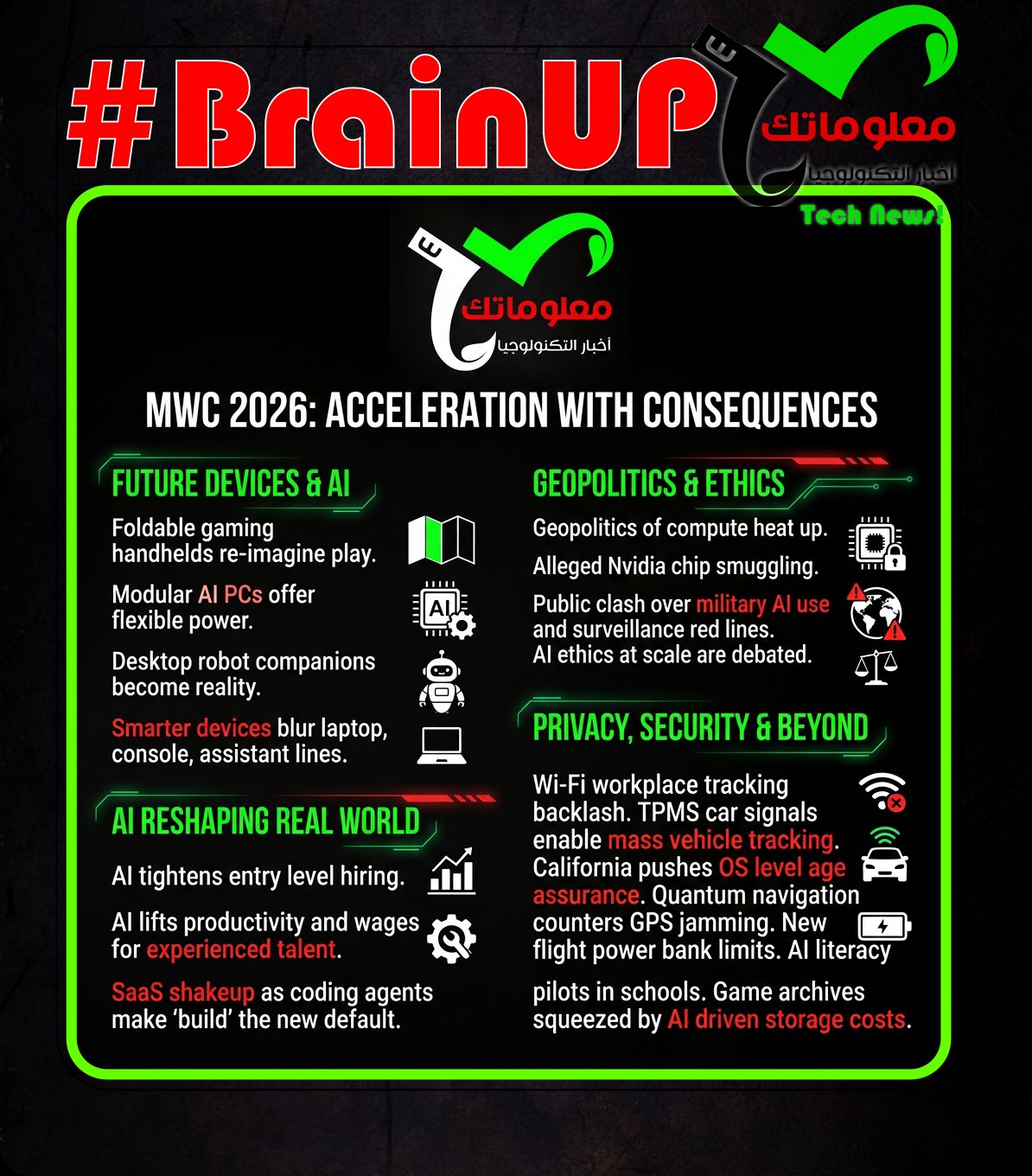
MWC 2026 announcements are arriving ahead of the show’s March 2 to March 5 run, and Engadget is highlighting early hands-on standouts such as the Xiaomi 17 Ultra and Honor’s Robot Phone while tracking new devices and #AI news from Barcelona. Lenovo’s biggest attention-grabber is the Legion Go Fold, a concept #foldable gaming handheld with a flexible display that expands to 11.6 inches or folds to 7.7 inches, with detachable controllers, multiple mounting points for landscape or portrait use, a kickstand-style folio, and a laptop mode that connects to a wireless keyboard via pogo pins. Lenovo also showed the Modular AI PC concept, a dual-display laptop with a detachable keyboard and secondary display that can be repositioned, plus #hot-swappable ports demonstrated with USB-C, USB-A, and HDMI, though Lenovo says it will remain a concept. Alongside concepts, Lenovo refreshed shipping products including the Yoga 9i 2-in-1 Aura Edition Gen 11 starting at $1,949, the 15.3-inch Yoga Pro 7a starting at $2,099, and the IdeaPad Slim 5i Ultra at $799, all with #Copilot+ features, plus a student-focused 13-inch Idea Tab Pro Gen 2 starting at $419 with the Quira AI assistant. Overall, the early MWC slate mixes ambitious concept hardware with incremental 2026 lineup updates, and Engadget will keep updating its roundup as more announcements land.
2. AI is simultaneously aiding and replacing workers, wage data suggest
#AI’s labor market impact appears to be both #automation and #augmentation, depending on whether tasks rely on codified knowledge or tacit, experience-based knowledge. Since @ChatGPT’s release in fall 2022, total U.S. employment rose about 2.5%, but employment fell 5% in computer systems design and declined about 1% in the top 10% most #AI-exposed sectors (using an exposure index by Edward W. Felten, Manav Raj and Robert Seamans), with the drop concentrated among workers under 25. @Tyler Atkinson argues the weakness for under-25 workers reflects low job-finding rates for new entrants rather than layoffs, implying tougher hiring conditions for new graduates in AI-exposed fields. At the same time, wages are not falling in AI-exposed sectors, nominal weekly wages rose 16.7% in computer systems design versus 7.5% nationally and 8.5% in the most-exposed industries, and across 205 occupations there is essentially no relationship between AI exposure and wage growth. Together, these patterns fit the idea that AI can substitute for entry-level, codifiable tasks while complementing experienced workers’ tacit knowledge, supporting wages even as employment growth lags in highly exposed sectors.
3. Inside Google’s Plan to Power a Minnesota Data Center With Wind, Solar, and Rust
Google is building a major new data centre in Pine Island, Minnesota intended to run almost entirely on clean energy by pairing about 1.9 GW of wind and solar generation with innovative iron-air batteries that store up to 30 GWh for up to 100 hours — a radically different approach from conventional lithium-ion storage that could provide long-duration backup power. The project, developed in partnership with utility Xcel Energy, uses a novel “Clean Energy Accelerator Charge” model where Google covers costs for new renewables and long-duration storage while enabling broader grid reliability improvements and helping Minnesota advance its carbon-free goals, illustrating how hyperscale tech companies are experimenting with next-generation energy systems to meet the enormous power needs of #AI and cloud infrastructure.
4. Chasing the Chip Smugglers – The Wire China
A U.S. Justice Department case, revealed the same day @Donald Trump said Washington would allow @Nvidia to sell advanced H200 chips to China, highlights how a domestic smuggling network tried to move restricted AI chips to China and raises doubts about export-control enforcement and customer due diligence by major sellers. Prosecutors say ‘Operation Gatekeeper’ disrupted an effort to illegally export or attempt to export at least $160 million in advanced @Nvidia chips, involving about 7,000 GPUs, with two defendants, Fanyue Gong and Benlin Yuan, pleading not guilty and Alan Hao Hsu pleading guilty, and court filings identifying a Chinese company that sought many of the chips. Federal investigators allege the scheme ran from October 2024 for eight months, with Hsu using his Houston shell company, Hao Global LLC, to buy thousands of chips from @Lenovo’s infrastructure solutions business, which reported $17.7 billion in 2025 revenue. Analysts argue the case is notable for operating inside the U.S., and for what it suggests about how many similar schemes may exist, especially as the key issue shifts to preventing smuggling of even more advanced, still-banned chips. @Lenovo said it made a standard U.S. domestic sale and that the customer falsified identity, paperwork, and compliance assurances, underscoring the challenge of tracing ultimate end users under #export-controls for #H100 and #H200 class #AI-chips.
5. The Pentagon’s Claude Use in Iran Is a Reminder that Anthropic Never Objected to Military Use
@Pete Hegseth publicly attacked #Anthropic on X, calling its stance “duplicity” and a “betrayal,” declaring it a supply chain risk and banning its products among military contractors, while still saying the Pentagon would keep using its services for up to six months during a transition. Reporting cited by Gizmodo says CENTCOM uses #Claude for “intelligence assessments, target identification and simulating battle scenarios,” suggesting real military operations are already informed by Claude-based modeling and research, not just hypothetical future uses. The piece argues Anthropic’s objections focus on red lines like mass surveillance and fully autonomous weaponry, rather than current military uses, and it says all indications are that @Dario Amodei approves of Pentagon work that stays within those limits. Separately, the consumer #Claude app rose to #1 in the US App Store, surpassing #ChatGPT, amid political controversy, though Anthropic’s spokesman says daily signups have tripled over four months. The article contrasts this with #OpenAI publicizing an expanded Pentagon relationship for classified use cases, while noting both companies describe many future risks as hypotheticals even as Claude is reportedly already used in active military analysis.
6. Inside Anthropic’s Killer-Robot Dispute With the Pentagon
The Pentagon’s relationship with Anthropic collapsed after a contract renegotiation in which the government sought to remove #ethical restrictions and expand how Anthropic’s #AI could be used. According to a source familiar with the talks, @Pete Hegseth’s team initially signaled a concession by agreeing to remove loophole language like “as appropriate” from pledges not to use the model for mass domestic surveillance or fully autonomous killing machines, but still insisted on using the AI to analyze bulk data collected from Americans, including chatbot queries, search history, GPS movements, and credit-card transactions. Anthropic’s leadership rejected that demand as unacceptable, the deal fell apart, and Hegseth then directed military contractors, suppliers, and partners to stop doing business with Anthropic, affecting even firms like Amazon that support Anthropic’s computing infrastructure. The dispute also covered #autonomous weapons: Anthropic did not oppose their existence and offered to help improve reliability, but argued its models are not yet safe enough to be used in systems that select and engage targets without a human final call. One proposed compromise was to keep Anthropic’s AI in the cloud and out of “edge” weapon systems so it could support intelligence synthesis without making kill decisions, framing the broader conflict as where to draw operational lines for military and domestic-data uses of advanced AI.
@Dario Amodei said @Anthropic was exercising #free_speech and #First_Amendment rights by refusing the Pentagon’s terms for using its frontier model #Claude, arguing that “disagreeing with the government” is patriotic and aligned with American values. He wrote that the company could not accept the Defense Department’s demands because of red lines against deploying its AI for mass domestic surveillance or fully autonomous weapons. Defense Secretary @Pete Hegseth responded with an ultimatum to accept the terms or be blacklisted, later calling Anthropic a supply chain risk and saying the US military would not do business with the company, while @Donald Trump ordered federal agencies to stop using Anthropic products and labeled the firm “radical left” and “woke.” Amodei said Anthropic has received no formal notice beyond social media posts, and that it would review any formal action and challenge it in court. He added Anthropic remains open to working with the Defense Department if it aligns with its red lines, as @OpenAI separately finalized a Defense Department deal announced by @Sam Altman.
8. Teams’ new Wi‑Fi tracking tool is not landing well with users
A planned #MicrosoftTeams feature that updates a user’s work location based on connecting to office Wi-Fi is drawing strong backlash because many see it as workplace surveillance rather than a productivity aid. The author notes Microsoft revised the feature after earlier controversy so it is off by default, controlled by tenant admins, and requires end-user opt-in, and suggests it could align with Microsoft’s #return-to-office expectations for employees near an office to be onsite three days a week. The rollout has also shifted multiple times, from an initial December 2025 target to January 2026, then to mid-March, without an explained reason. In a Windows Central poll, 47% said it should be removed entirely, 27% called it invasive and like surveillance, and 12% said it is useful for workplace efficiency and safety, with social media comments warning it lowers the barrier for managers to track employees directly in Teams. Overall, the reaction highlighted in the article is that even with opt-in and admin controls, the feature is widely perceived as eroding trust and blurring collaboration with IT oversight.
9. AI Complicates Old Internet Privacy Risks
#AI adds new dimensions to longstanding internet privacy challenges by making it easier for chatbots to collect sensitive personal information — including details people voluntarily share that might later be exposed or resurface — and by amplifying issues like data aggregation, re-identification and long-forgotten digital traces that once felt “deleted” or unreachable, undermining assumptions many users held about past online content and privacy controls. The piece underscores that while AI tools are powerful and convenient, they can inadvertently intensify traditional risks like data permanence, cross-service tracking and surveillance, complicating consent, control and user understanding of how personal information is used across platforms.
10. Polymarket saw $529M traded on bets tied to bombing of Iran | TechCrunch
Prediction market users on Polymarket placed and profited from large wagers tied to the timing of the U.S. and Israeli military bombing of Iran, with $529 million traded on related contracts. According to @Bloomberg and an analysis by Bubblemaps SA, six newly created accounts made about $1 million by correctly betting the U.S. would strike Iran by February 28, activity Bubblemaps said could suggest #insiderTrading. Bubblemaps CEO @NicolasVaiman noted the combination of conflict related information flows and Polymarket anonymity can incentivize informed participants to act early, though the bets could also reflect broader speculation about U.S. intentions. Separately, analytics firm Polysights flagged a January spike in bets about whether Iran’s now deceased Supreme Leader @AliKhamenei would no longer hold that role by the end of March, raising ethical concerns about markets touching on death. In response, @TarekMansour said Kalshi does not list markets directly tied to death, designs rules to prevent profiting from death where outcomes involve death, and would reimburse all fees from these bets.
11. SaaS in, SaaS out: Here’s what’s driving the SaaSpocalypse | TechCrunch
TechCrunch describes a “#SaaSpocalypse” in which #AI coding agents and automation are pushing companies to build software in house instead of buying traditional SaaS, undermining the idea that incumbents like @Salesforce are the default choice. Investors including Lex Zhao say the #build-versus-buy decision is shifting toward build because tools like Claude Code lower software creation barriers, while Abdul Abdirahman argues the per seat pricing model weakens when a small number of AI agents can do work employees once did. The piece cites rapid #AI progress, including Claude Code and @OpenAI’s Codex, as enabling replication of core SaaS functions and revenue generating add ons, and giving customers more leverage in renewals because they can credibly threaten to build alternatives. As evidence of the shift and its market impact, it notes @Klarna’s late 2024 move away from Salesforce CRM to a homegrown AI system and reports sliding SaaS giant stocks plus an early February sell off that erased nearly $1 trillion in software and services market value. While some analysts frame this as FOBO investing, venture investors like Aaron Holiday contend it is not the death of #SaaS but a transition that requires SaaS businesses to adapt their models.
After @OpenAI signed a deal with the US Department of War, a growing number of #ChatGPT users are canceling subscriptions and switching to alternatives like #Claude, accusing the company of having “no ethics at all” and “selling their soul” to the military. The backlash follows @Anthropic walking away from a similar agreement due to safety and security concerns, specifically wanting safeguards to prevent use in #mass-surveillance and #fully-autonomous-weapons, which the DoW would not accept. Social media and Reddit include guides for removing accounts and data, and investor Aidan Gold highlighted that OpenAI had previously backed Anthropic’s safety stance before signing its own deal, while the US government reportedly intends to remove Claude from its departments. OpenAI says its agreement has more guardrails than the one Anthropic rejected, including “red lines” on surveillance and autonomous weapons, but critics point to the contract’s “all lawful purposes” language as a major trust issue. The controversy is reshaping user choices in the chatbot market, with Claude reaching the top spot in the Apple App Store amid the debate over #AI-ethics.
13. Every Car Made After 2008 Has the Same Digital Security Risk
A study from the Madrid-based IMDEA Networks Institute warns that #TPMS sensors, required on new U.S. cars since the 2008 model year, create a widespread #cybersecurity and privacy risk because they broadcast a unique ID that can be tracked. Researchers showed that with a network of about $100 radio receivers they could collect roughly six million signals from around 20,000 cars over 10 weeks, receiving signals from more than 160 feet away, even with receivers inside buildings. They also demonstrated methods to link signals to individual tires, intercept tire-pressure readings, and potentially infer details like vehicle type or whether it is carrying a heavy load. The vulnerability persists because current regulations do not require protections such as #encryption or #authentication, since TPMS was designed for safety rather than security. The findings argue that regulators should account for these risks because inexpensive receiver networks could quietly monitor vehicle movement patterns and routines without relying on license plates.
14. A New Threat to Power Grids: Data Centers Unplugging at Once
Sudden simultaneous disconnections of clusters of data centres — such as events in Virginia where dozens of facilities automatically switched to backup power during grid disturbances — are emerging as a power grid stability risk, troubling regulators and grid operators because the rapid drop in demand can make balancing supply and demand harder and potentially strain infrastructure as data centres grow into dominant electricity consumers, especially in regions where AI-driven workloads are pushing facility buildouts to unprecedented scales.
15. Nvidia bid to open source 6G may rattle Ericsson and Nokia
Nvidia’s initiative to open source #6G technology aims to accelerate development and promote innovation in the wireless industry. This move could challenge established players like #Ericsson and #Nokia by shifting the development paradigm towards collaborative, #open standards. Industry experts suggest this strategy might lead to increased competition and a faster timeline for 6G deployment. Open sourcing could also enable smaller companies and #research institutions to contribute, diversifying the innovation ecosystem. Ultimately, Nvidia’s approach has the potential to reshape the competitive landscape of future wireless technologies.
16. Lynk & Co introduces voice-controlled headlights
Lynk & Co has launched voice command functionality for headlights, enhancing driver convenience and safety. The system allows users to activate, deactivate, or adjust headlights through @voice commands, reducing the need for manual intervention. This feature aligns with #smartcar technologies aimed at integrating #AI and #connectivity to improve driving experiences. The implementation reflects Lynk & Co’s commitment to innovation and customer-centered design, emphasizing ease of use. This development contributes to the broader trend of #automotiveautomation and #driver-assistance systems, promising safer and more intuitive vehicle operation.
Japan’s transport ministry will tighten rules on #power banks on flights starting in mid-April, effectively ending their onboard use to reduce fire risk. The ministry began taking public comments on Feb. 27 on revisions to #Civil Aeronautics regulations, timed ahead of expected international rules from the International Civil Aviation Organization. Under the proposed changes, passengers will be limited to two spare batteries in total and power banks will be capped at two units regardless of capacity, power banks over 160 watt-hours will still be prohibited, onboard charging will be banned, and passengers will be recommended not to use them at all. The move follows incidents including a January fire believed to have started near an overhead bin on an Air Busan aircraft that injured 27 people, plus Japan-related cases of a battery fire on a Hawaiian Airlines flight and smoke on an ANA flight. With domestic airlines expected to enforce stopping power bank use, the revision links recent cabin safety incidents to stricter carry-on limits and a practical in-flight usage ban.
18. Newark Schools Pilot AI Chatbots to Improve Literacy
Newark public schools have introduced @AI chatbots in classrooms to enhance #literacy instruction. The initiative aims to provide students with personalized reading support, addressing diverse learning needs. Educators believe that integrating #technology like @chatbots can boost engagement and comprehension. Early results show increased student participation and improved reading scores. This approach reflects a broader trend of incorporating #AI tools in education to foster equitable learning outcomes.
Myrient, described as one of the largest online video game archives, says it will shut down on March 31, 2026 because it cannot sustain its operating model amid rising costs and misuse. The archive’s Telegram announcement cites insufficient funding, steadily increasing RAM, SSD, and HDD prices tied to the #AI infrastructure build-out, required storage and caching upgrades it cannot afford, and abusive download managers, with the creator saying donations do not keep up and they personally cover over $6,000 per month. The operator also says some users monetized Myrient’s content by bypassing donation messages and protections and placing a paywall, violating the site’s rules against commercial use and paywalls. The site estimates it hosts at least 390TB of data and notes that until the end of March users can download what they want, though doing so would require significant storage and a fast connection. While the archive itself is closing, its Discord and Telegram communities will remain, and the article suggests any revival would likely require substantial backing due to the scale of the data.
20. COBOL modernization no longer requires years of consultant work
Modernizing legacy #COBOL systems, once dominated by months or years of consultant-led workflow mapping and dependency documentation, can be accelerated by #AI tools such as @Anthropic’s Claude platform. The article says Claude Code can map dependencies across thousands of lines of COBOL, trace data flows, document forgotten workflows, and flag tightly coupled, duplicated, or fragile code, helping teams identify risks and prioritize which components to modernize first by technical risk and business value. It also describes using AI to generate preliminary function tests to check that migrated components produce identical outputs, with human teams deciding what requires manual verification and which benchmarks must be maintained. AI can additionally translate COBOL into modern languages, create API wrappers, and build scaffolding so old and new code run side by side, enabling incremental, validated changes that reduce failure risk. Framed against the reality that hundreds of billions of COBOL lines still power critical banking, government, and airline systems while expertise is scarce, the piece argues AI shifts the heavy exploration and planning burden from large specialist teams to automated analysis with human oversight.
#California’s Digital Age Assurance Act (#AB_1043), signed by @Gavin_Newsom in October 2025, requires operating system providers to collect users’ age information during OS account setup and provide it to app developers through a real time API starting January 1, 2027. The law defines an operating system provider broadly, covering Windows, macOS, Android, iOS, Linux distributions, and #SteamOS, and mandates an API that returns one of four age brackets: under 13, 13 to under 16, 16 to under 18, or 18 or older when an app is downloaded or launched. Developers who request the signal are deemed to have actual knowledge of a user’s age range, shifting liability for age appropriate content decisions onto them, with penalties up to $2,500 per affected child for negligent violations and $7,500 for intentional ones, enforced by the California Attorney General. AB 1043 does not require photo ID or facial recognition, relying on self reported age, and @Buffy_Wicks said this avoids constitutional concerns by focusing on age assurance rather than content moderation, though Newsom urged amendments due to complexities like multi user family accounts and cross device profiles. The article notes enforcement against many Linux distros may be difficult because they lack centralized accounts and can be freely modified, making a California use disclaimer more likely than compliance for smaller projects.
22. Quantum tech beats Russian satellite jamming in new arms race
As #GPS jamming and spoofing rise and threaten military and civilian navigation, #quantum sensors are being positioned as an alternative and backup that does not rely on satellites. U.S. government contractor Q-CTRL says it will deploy its quantum sensors and enabling software commercially later this year, and its CEO Michael Biercuk cites NATO accusations of Russian jamming and disruption maps over Ukraine, along with incident counts growing from dozens per day in late 2023 to over 1,000 daily incidents, plus a GPS spoofing event that temporarily shut the port of Doha. The company argues onboard quantum navigation, based on trapped atoms measuring tiny shifts in Earth’s magnetic field and gravity via lasers, cannot be jammed or spoofed and is also less susceptible to noise and interference than sound or light based systems, though the underlying #quantum technology is fragile and has faced hype and technical hurdles. Q-CTRL says its key advances are in software alongside sensor hardware, and it is developing and validating systems for difficult platforms like vibrating helicopters while working with the U.S. government and partners including #LockheedMartin, the Defense Innovation Unit, #DARPA, Airbus, and the Royal Australian Navy. The push reflects a broader prioritization of #quantum technologies by @DonaldTrump’s White House and the Pentagon, framed as maintaining U.S. leadership as interference with satellite navigation grows.
23. Problematic TikTok use correlates with social anxiety and daily cognitive errors
Researchers reported that #problematic TikTok use is associated with #social anxiety and everyday #cognitive errors. The article describes a link between a constant #fear of missing out, addictive TikTok habits, and daily memory mistakes. These findings suggest that short-video platforms may have a distinctive relationship with how people maintain focus. Overall, the reported pattern connects higher reliance on TikTok with greater anxiety-related concerns and more frequent everyday cognitive slips.
24. SpaceX Weighs Confidential IPO Filing as Soon as March
Elon Musk’s @SpaceX is reportedly preparing to file confidentially for an initial public offering (IPO) as soon as March 2026 that could value the aerospace and satellite giant at more than $1.75 trillion, possibly setting up one of the largest IPOs in history as it advances next-generation Starship launches and expands its Starlink satellite internet business, with plans still potentially targeting a public debut in June and rival tech firms like @OpenAI and @Anthropic also eyeing major listings this year.
25. MWC 2026: Lenovo debuts Legion Go Fold Concept handheld
Lenovo unveiled the Legion Go Fold Concept at #MWC 2026, a foldable take on its Legion Go 2 handheld meant to combine portable gaming and light laptop use in one device. It uses a hinged POLED display that expands from 7.7 inches to 11.6 inches, plus detachable controllers and a detachable wireless keyboard so it can function like a Windows laptop, and Mashable’s @Timothy Werth said the foldable screen looks impressive and the unit feels surprisingly light. Lenovo outlined multiple use modes, including Handheld Mode, horizontal Full Screen Mode, vertical Split-Screen Mode for running two apps at once, and an expanded Desktop Mode where the right controller can act like a vertical mouse with a small screen for touchpad functions, metrics, settings, or a hotkey. The press materials also show an additional upright, tabletop-style setup with controllers used separately or joined like a traditional gamepad, though the concept lacks a built-in rear kickstand. Lenovo shared some specs, including an Intel Core Ultra 7 258V (#LunarLake) processor, 32GB RAM, and a 48Whr battery, but no pricing and no launch commitment, positioning it as a concept that could become real given Lenovo’s history of bringing prototypes to market.
26. A robot arm with puppy dog eyes is just one of Lenovo’s new desktop AI concepts
At MWC 2026, Lenovo introduced two standalone desktop #AI productivity companion concepts aimed at streamlining office work while adding a sense of companionship. The AI Workmate Concept is a small robotic arm with a swiveling base and an expressive screen, using local AI so users can interact via voice commands and physical gestures, scan physical documents with an onboard camera, generate summaries, organize ideas, and even turn notes into presentations, plus project content onto a desk or wall. The AI Work Companion Concept resembles a bedside alarm clock and uses AI to sync tasks and schedules across devices to create a balanced daily plan, monitor screen time, suggest breaks to reduce burnout, and provide animated interactions and end of week task reports. It also functions as a desktop hub, docking a laptop to multiple monitors via HDMI while offering USB ports for charging and decluttering. Lenovo notes it has previously turned concepts into products, but has not confirmed whether either of these devices will be released.
27. Xiaomi unveils Vision GT electric supercar concept, with a twist
@Xiaomi unveiled its Vision Gran Turismo electric supercar concept at MWC 2026 in Barcelona, becoming the first Chinese automaker to join the Gran Turismo concept car program in its 28-year history. Built on Xiaomi’s in house #900V #SiliconCarbide platform, the low slung concept features scissor doors, a large carbon fiber rear wing, center lock wheels with carbon ceramic brakes, and an aerodynamics first design with extensive ducting, a shark fin roofline, T shaped headlights, and a prominent rear diffuser. Xiaomi executives @LeiJun and chief designer Li Tianyuan said full specs would follow the initial leak and confirmation, and described a goal of achieving aerodynamic performance without bolt on add ons, alongside a tech heavy cabin with a butterfly steering wheel, panoramic display, and “cocoon shaped sofa” driver seat. While power output is unconfirmed, the brakes are reportedly sized for a powertrain around 1,900 hp, which, if accurate, would place it among the most powerful Gran Turismo concepts and underscores Xiaomi’s rapidly expanding EV push after 410,000 deliveries in 2025 and a 550,000 target for 2026. The concept links back to Xiaomi’s broader momentum in cars, including the SU7’s strong China sales, a 1,500+ hp SU7 Ultra that set a Nürburgring production EV lap record, and plans for overseas expansion starting in 2027.
28. Motorola has a tiny new black box at MWC that wants to kill Android Auto cables
At MWC 2026, @Motorola unveiled the MA2, a successor to the MA1 that turns a car’s wired #AndroidAuto system into a wireless one. The flatter square black adapter uses 5GHz Wi-Fi for wireless Android Auto while #Bluetooth handles pairing and automatic reconnection, and it adds multipoint support so two phones can be paired and drivers can switch with a button press. Practical updates include an on/off switch to prevent unwanted connections and battery drain in always-on USB ports, an LED connection indicator, and included detachable USB-A and USB-C cables for broader vehicle compatibility. It remains plug-and-play: plug into the car’s Android Auto USB port, pair once, then connect wirelessly thereafter. @Motorola is targeting a roughly $40 price, with an official launch planned for May and US availability expected in Q3 2026.
That’s all for today’s digest for 2026/03/02! We picked, and processed 24 Articles. Stay tuned for tomorrow’s collection of insights and discoveries.
Thanks, Patricia Zougheib and Dr Badawi, for curating the links
See you in the next one! 🚀
