
#BrainUp Daily Tech News – (Saturday, February 28ᵗʰ)
Welcome to today’s curated collection of interesting links and insights for 2026/02/28. Our Hand-picked, AI-optimized system has processed and summarized 29 articles from all over the internet to bring you the latest technology news.
As previously aired🔴LIVE on Clubhouse, Chatter Social, Instagram, Twitch, X, YouTube, and TikTok.
Also available as a #Podcast on Apple 📻, Spotify🛜, Anghami, and Amazon🎧 or anywhere else you listen to podcasts.
1. OpenAI announces $110bn funding round that would value firm at $840bn
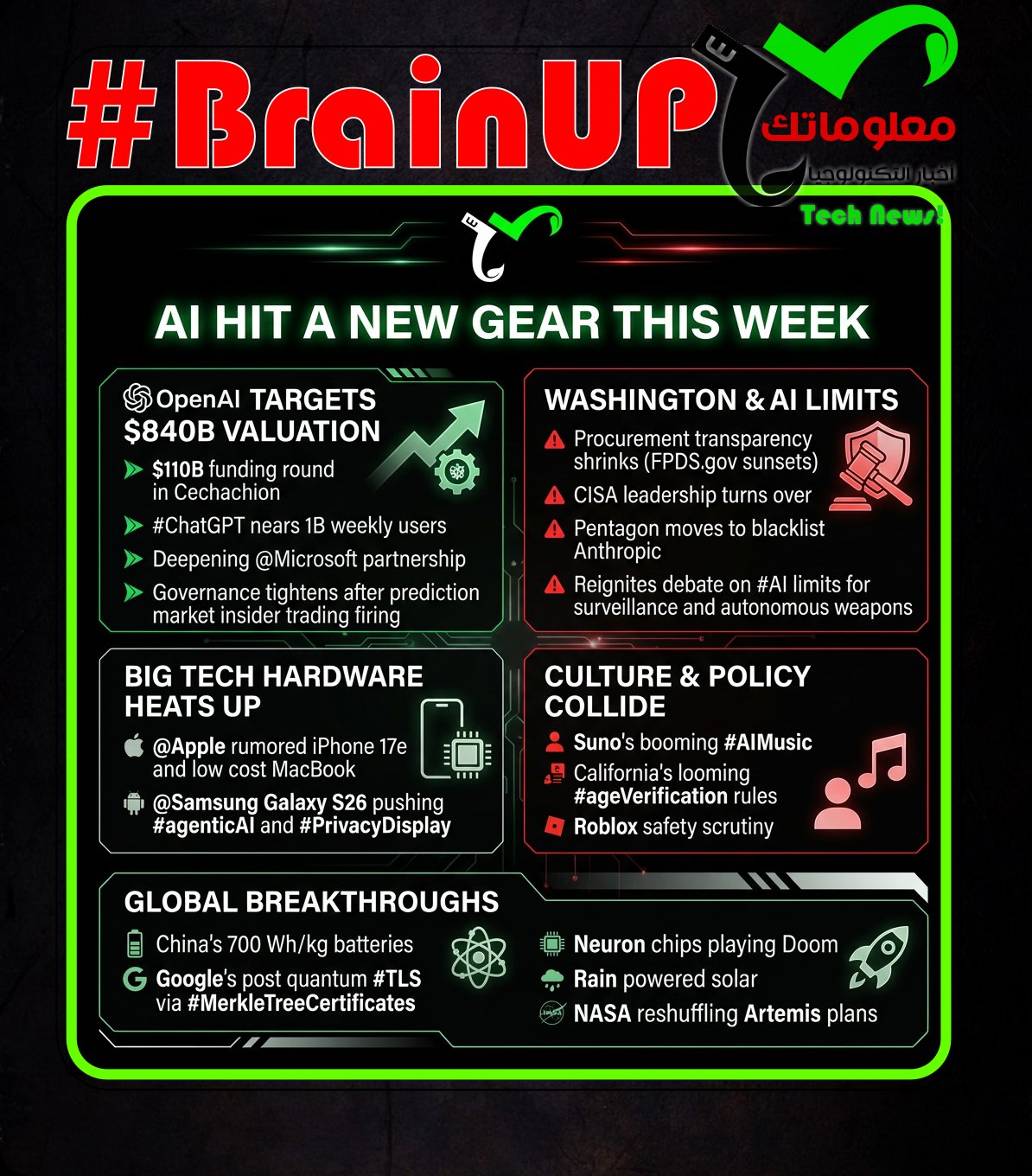
@OpenAI said it is raising $110bn in an open funding round that would value the #ChatGPT maker at $840bn, underscoring the rapid escalation of #AI investment. The round includes $30bn from SoftBank, $30bn from Nvidia, and $50bn from Amazon, more than double what OpenAI raised last year, and comes ahead of an expected mega-IPO later in 2026. @Sam Altman said AI will spread across the economy and will require large amounts of collective computing power, as big tech signals it is doubling down on AI spending despite concerns over costs. The article notes rising scrutiny of massive #datacenters for energy and water impacts, and growing fears of job displacement, citing Block’s plan to lay off 4,000 staff and Goldman Sachs’s estimate of 5,000 to 10,000 monthly net job losses last year tied to AI. OpenAI also argued that leadership in frontier AI will depend on scaling infrastructure into products, pointing to reported usage growth and an Amazon deal for two gigawatts of compute using Trainium chips to lower costs and improve efficiency at scale.
2. The Government Just Made it Harder to See What Spy Tech it Buys
FPDS.gov, a key public database for tracking what U.S. agencies buy, was discontinued, making it harder to see government spending on surveillance-related tools. The article says FPDS.gov enabled reporting on purchases ranging from phone hacking technology and large-scale location data to more #Palantir installations, and it was used in many investigations. It reports that the government replaced FPDS.gov with #SAM.gov, which the author argues is significantly worse and makes it demonstrably harder to reliably find what agencies like #ICE are spending taxpayer money on. The change reduces transparency into procurement of #spy tech by agencies including the #FBI and others.
3. What to Expect From Apple’s Big Week: iPhone 17e, Low-Cost MacBook, New iPads, and More
@Apple is expected to kick off its first major 2026 product announcements during a teased “big week,” with media events set for March 4 in New York, Shanghai, and London and likely reveals including iPhone 17e, a new low-cost MacBook, and minor Mac and iPad refreshes. The low-cost MacBook is rumored to resemble the MacBook Air with an aluminum chassis, multiple color options, and either a 12.9-inch or 13-inch display, but it may prioritize cost over thinness with potential tradeoffs such as lower max brightness, no #TrueTone, no backlit keyboard, slower SSD speeds, and no N1 chip. The most consistent claim is that it will use an #A-series chip, specifically the #A18Pro from iPhone 16 Pro, and cited Geekbench results suggest strong single-core performance but weaker multi-core performance than M4-class devices. That performance profile implies it should handle everyday tasks and light creative work, while being less suited for heavy workloads like 4K video editing, 3D rendering, or system-intensive games. Overall, the rumors frame the device as an education-focused, Chromebook-like affordability play within Apple’s lineup, alongside the broader launch-week hardware updates.
4. Everything announced at Samsung Unpacked 2026: Galaxy S26 Ultra, Privacy Display, Buds 4 Pro
At Samsung Unpacked 2026, @Samsung introduced the Galaxy S26 lineup alongside new audio gear and a broader push into #agenticAI, positioning privacy and on-device intelligence as core themes. The event highlights include the Galaxy S26 Ultra, a built-in #PrivacyDisplay described as a standout Ultra feature, Ultra-only upgraded thermal management, and the S26 series moving to @Qualcomm #Snapdragon8EliteGen5, plus updates like #CircleToSearch gaining agentic capabilities and an “all-new” #Bixby. Samsung also unveiled Galaxy Buds 4 and Buds 4 Pro, emphasizing AI-focused features, and teased in-app, AI-powered photo “quick fixes,” while noting the S26 series is getting more expensive. Additional notes include faster charging claims for the new phones, discussion of camera upgrades being incremental, and Samsung pledging to return more water to the environment than it consumes. Overall, the announcements center on higher-priced hardware paired with privacy-forward display tech, AI-assisted search and assistant upgrades, and refreshed earbuds aimed at the “age of AI.”
5. Pentagon moves to designate Anthropic as a supply-chain risk | TechCrunch
In a Truth Social post, @President Trump directed federal agencies to stop using all Anthropic products, allowing a six month phase-out, and said the company was no longer welcome as a federal contractor. While his post did not mention it, @Secretary of Defense Pete Hegseth later said he was directing the Department of War to designate Anthropic a #Supply-Chain Risk to national security, and asserted that any contractor, supplier, or partner doing business with the U.S. military could not conduct commercial activity with Anthropic. The dispute stems from Anthropic refusing to allow its #AI models to be used for mass domestic surveillance or fully autonomous weapons, safeguards CEO @Dario Amodei reiterated while offering to support a smooth transition if the department offboards the company. @OpenAI reportedly backed Anthropic’s red lines, with @Sam Altman saying defense contracts should reject uses like domestic surveillance and autonomous offensive weapons, and @Ilya Sutskever praising Anthropic’s stance. The article notes that shortly after the administration’s order, OpenAI moved to fill the gap by announcing a Pentagon deal, though details are cut off in the provided text.
6. Trump Administration Bans Anthropic Tech From U.S. Government Use
The Biden administration finalized a policy banning U.S. federal agencies from procuring or deploying #AI systems developed by @Anthropic on classified networks or for sensitive national security use amid concerns over safety controls and model governance, with officials citing risks that Anthropic’s systems could be less predictable or harder to certify under tight government standards and therefore warrant exclusion until stronger safeguards are in place. The move reflects growing tension between federal AI adoption and regulatory caution, positioning Anthropic behind rivals in securing government contracts and prompting debate among lawmakers and industry stakeholders about balancing innovation with risk mitigation in critical public sector deployments.
7. Anthropic Is Somehow Both Too Dangerous and Not Dangerous Enough
The article argues that discourse around @Anthropic has become paradoxical, with critics claiming its #AI models pose severe alignment hazards and therefore should be restricted while others say the company’s safety protocols and refusal to pursue highly controversial use cases demonstrate excessive caution that limits competitive viability, illustrating how public perception of AI risk often swings between extremes without clear grounding in rigorous evaluation. The piece critiques both alarmist narratives and overly permissive industry stances, calling for nuanced frameworks that assess technical models on empirical safety evidence rather than ideological positions, and highlights how Anthropic’s experience underscores broader challenges in crafting sensible public understanding and governance of generative systems.
8. OpenAI Reaches Deal to Deploy AI Models on U.S. Department of War Classified Network
@OpenAI has struck an agreement to host select #AI models on highly restricted classified systems within the U.S. Department of War (formerly Defense Department) network for pilot use cases, marking a significant milestone in secure government integration of commercial generative systems by tailoring deployments to meet stringent data protection and operational security requirements, with officials emphasizing rigorous vetting and ongoing monitoring to minimise risks associated with automated reasoning in defense contexts. The deal reflects federal efforts to harness advanced AI capabilities for national security purposes while asserting strict control over access, configurations and red-teaming to ensure safety protocols align with classified mission demands without exposing sensitive information to external systems.
9. Anthropic AI Pledges Stronger Safety Commitments After Scrutiny
@Anthropic announced reinforced safety commitments for its #AI models in response to regulatory scrutiny and public concerns, including expanded internal testing regimes, clearer usage policies and cooperation with external auditors to ensure that its generative systems adhere to emerging security and ethical standards, with executives stressing that transparent, robust safeguards are essential to building trust with governments, enterprises and the broader public. The company’s pledges come amid broader debates around AI accountability and oversight, as stakeholders push for measurable benchmarks to evaluate model behaviour, misuse prevention and alignment with societal values before wider adoption.
10. ChatGPT reaches 900M weekly active users | TechCrunch
#ChatGPT has reached 900 million weekly active users, putting @OpenAI’s chatbot close to 1 billion, and the company says it now has 50 million paying subscribers. @OpenAI reported this is up from 800 million weekly active users in October 2025, and said subscriber growth accelerated at the start of the year, with January and February on track to be its biggest months for new subscribers. The company attributed scaling usage to product improvements that users notice, including faster responses, higher reliability, stronger safety, and more consistent performance. The metrics were shared alongside @OpenAI’s announcement of $110 billion in private funding, including $50 billion from @Amazon and $30 billion each from @Nvidia and @SoftBank at a $730 billion pre-money valuation, with the round still open for more investors. The user and subscriber growth numbers support the fundraising narrative by showing rapidly expanding adoption and monetization for #AI chatbots.
11. Continuing Microsoft Partnership with OpenAI
The collaboration between @Microsoft and #OpenAI continues to advance AI technology integration into various platforms. @Microsoft invests heavily to embed @OpenAI’s models into products like #Azure, enhancing cloud services. This partnership accelerates development of #AI applications with commercial and ethical considerations, aiming to benefit businesses and consumers. The joint efforts demonstrate a strategic focus on responsible AI deployment and equitable access. The ongoing alliance underscores a shared commitment to innovation in artificial intelligence.
12. OpenAI Fires an Employee for Prediction Market Insider Trading
@OpenAI fired an employee after an internal investigation found they used confidential company information to trade on external #prediction-markets such as Polymarket, according to an internal message from applications CEO @Fidji Simo. A spokesperson said company policies bar employees from using confidential information for personal gain, including in prediction markets, but OpenAI did not disclose the employee’s name or trade details. Separately, analysis from Unusual Whales cited suspicious clusters of Polymarket activity tied to OpenAI-related events since March 2023, flagging 77 positions across 60 wallet addresses, including bets on product release timing for Sora, GPT-5, and the ChatGPT Browser, and on @Sam Altman’s employment status, with one new wallet profiting more than $16,000 after betting on his return in November 2023. Unusual Whales’ CEO said the clustering of many new wallets making the same bets shortly before key events resembles typical insider-trading patterns, highlighting how pseudonymous but traceable #blockchain ledgers like Polygon can still reveal behavior that suggests information leakage. The episode sits within broader scrutiny of prediction markets as they grow, with Kalshi reporting suspected insider-trading cases to the CFTC and announcing prevention initiatives amid concerns that traders can profit when an outcome is known.
Claude Code creator @Boris Cherny argues that #software engineering as a distinct job title could fade by the end of the year as #agentic #AI coding tools make writing code a broadly accessible activity and shift workers toward “builder” or product-focused roles. He says Claude Code, released about a year ago and adopted widely, can autonomously execute tasks with minimal human intervention, and he claims it has written 100% of his code for months, though he still reviews it for correctness and safety. Cherny predicts many companies and coders will similarly rely on Claude to generate all of their code by year end, and points to Anthropic’s newer Cowork product that targets non-coders and can take autonomous actions, including routine coordination work like nudging teammates on Slack. He compares the transition to scribes after the printing press: specialized manual work shrinks as capabilities spread, enabling people to redirect effort to other tasks, but he warns the shift will be painful for many. The broader implication is that as #AI systems handle more coding and organizational work, the value of humans may move from typing code to defining goals, validating outputs, and managing products and processes.
#AI music generator Suno has reached 2 million paid subscribers and $300 million in annual recurring revenue, according to co-founder and CEO @Mikey Shulman. The company reported $200 million in annual revenue to The Wall Street Journal at the time of its $250 million funding round three months earlier, which valued Suno at $2.45 billion, indicating rapid growth. Suno’s natural-language prompting makes music creation accessible to non-experts, but it has also triggered backlash and lawsuits from musicians and record labels over alleged #copyright infringement tied to training on existing recordings. Warner Music Group settled its lawsuit and struck a licensing deal enabling Suno to launch models using licensed catalog music. Suno-generated tracks have been convincing enough to chart on Spotify and Billboard, including a viral R&B song created by Telisha Jones that led to a reported $3 million record deal, even as artists like @BillieEilish, @ChappellRoan, and @KatyPerry criticize #AI in music.
California’s #Assembly Bill No. 1043 will require operating system providers to add basic #ageVerification during account setup and to supply developers with an age bracket “signal” via an API, starting January 1, 2027. Signed by @Gavin Newsom in October, the law calls for an accessible interface prompting a birth date, age, or both, then categorizing users as under 13, 13 to under 16, 16 to under 18, or at least 18 for apps in a covered app store. The article notes this is relatively mild compared with face scans, and that Windows already collects date of birth for Microsoft Account setup, but it has sparked backlash in some Linux communities who argue enforcement is effectively impossible and that distributions could simply avoid California users. It situates the bill within a broader government push for mandatory age checks, referencing privacy controversies around the UK’s #OnlineSafetyAct and criticism of Discord’s face scanning efforts. Overall, the piece frames the requirement as part of a growing trend toward legally mandated age gating, while suggesting this specific approach may be close to unenforceable in practice.
16. Donut Lab Shows Promising Solid-State EV Charging Breakthrough
Donut Lab has unveiled encouraging results from its solid-state EV charging technology tests, reporting that prototype systems can deliver significantly faster charge times and improved energy density compared with conventional lithium-ion solutions, an advance that could help EVs recharge in minutes rather than hours while mitigating thermal and safety challenges inherent in current battery chemistry. Company engineers showed that their solid-state design retains stable performance across many charge cycles and supports higher power transfer with reduced heat generation, suggesting potential for widespread adoption in future electric vehicles as automakers seek solutions that ease range anxiety and expand consumer appeal. The breakthrough also reflects broader industry momentum toward solid-state materials research, which many believe could underpin the next generation of safer, more efficient energy storage for EVs and other mobile or stationary applications. Though commercial deployment remains years away and supply chain scaling challenges persist, early results from Donut Lab strengthen optimism that solid-state tech could transform recharging and accelerate EV adoption.
17. Chinese scientists may have found battery that could double EVs’ range
Chinese researchers report a new liquid lithium battery approach that could significantly extend electric vehicle range and improve cold weather reliability. The article says conventional liquid-state lithium batteries, including lithium iron phosphate and ternary lithium, are nearing a theoretical #energy-density ceiling of about 350 watt-hours per kg, pushing industry interest toward #solid-state batteries. Researchers from Nankai University and the Shanghai Institute of Space Power Sources claim they developed an #electrolyte that raised liquid lithium battery energy density to 700 watt-hours per kg in lab tests, with results published in Nature, and cited by CCTV as potentially doubling capacity without added size or weight. Lead researcher Chen Jun said an EV with a 500 km range could exceed 1,000 km on a single charge using the new batteries, suggesting a path beyond current performance limits for liquid lithium cells.
18. Major battery breakthrough paving way for EV upgrade
Chinese scientists report a major #lithium-metal-battery advance that could upgrade EV performance by boosting #energy-density and enabling reliable operation in extreme cold. A Nature paper led by @Chen Jun describes redesigning the electrolyte at the molecular level by replacing oxygen atoms with fluorine, creating fluorinated hydrocarbon solvent molecules and a #lithium-fluorine coordination electrolyte system that improves ion transfer. Laboratory tests showed energy density above 700 Wh/kg and nearly 400 Wh/kg at -50 C, addressing two bottlenecks for wider EV adoption: energy density and low-temperature performance. The team also worked with Hongqi on a mass-producible lithium-rich manganese solid-liquid battery system exceeding 500 Wh/kg, claimed to enable over 1,000 kilometers per charge, while using a composite electrolyte to improve safety, durability, cycle life, and reduce cost and risk versus lithium metal batteries. Industry partners said vehicles using the batteries and exceeding 1,000 kilometers per charge are expected to enter mass production by year end, highlighting university-enterprise collaboration and potential applications beyond EVs, including robots, low-altitude economy uses, polar regions, aerospace, and aviation.
@Andy Jassy said #AI will likely mean many roles that companies have relied on humans to do for the last 20 to 30 years will require fewer people, while also creating new kinds of work. Speaking on CNBC after questions about Block cutting staff, he said he had not fully digested the Block news but expects AI-driven efficiency gains to change headcount needs broadly. He pointed to past technology shifts, citing the cloud solutions architect as a job that did not exist 15 years ago but now has tens of thousands of workers. Jassy has also told Amazon employees that using AI extensively should reduce Amazon’s corporate workforce over the next few years, a message that previously drew internal criticism. He framed the current moment as a transition period, noting that which new jobs emerge is unclear, with some ideas like the #prompt engineer role fading while demand rises for certain engineering roles and training data work.
20. Palantir Sues Swiss Magazine for Reporting Swiss Government Reluctance
@Palantir has filed a defamation lawsuit against a Swiss news outlet after it published that the Swiss government was initially hesitant to adopt Palantir’s data analysis tools due to privacy and civil liberties concerns, claiming the reporting harmed its reputation despite evidence the article was factually grounded. The case underscores tensions between powerful #DataAnalytics firms and independent media, raising questions about how litigation may be used to deter critical coverage of tech companies’ influence on public sector decision making. Critics argue the suit could chill investigative journalism about corporate dealings with governments, while defenders of Palantir say they are protecting their brand against misleading interpretations.
21. Human brain cells on a chip learned to play Doom in a week
Cortical Labs has shown that a clump of living human neurons on a #neuron-powered computer chip can be programmed to play the video game Doom, marking a step toward practical #biological computing. After earlier work in 2021 that trained more than 800,000 brain cells on microelectrode arrays to play Pong, the company built a new interface that lets developers program these chips more easily using #Python, enabling independent developer @Sean Cole to teach the system Doom in about a week. The chip used about a quarter as many neurons as the Pong demonstration and played better than a randomly firing player but far worse than top humans, while reportedly learning faster than conventional silicon-based machine learning and potentially improving with newer algorithms. Researchers including @Andrew Adamatzky call Doom a major increase in complexity that demonstrates improved control and training of living neural systems, while @Steve Furber notes that key mechanisms remain unclear, such as how the neurons interpret the screen and understand expectations. Experts say the significance is less about matching human brains and more about exploiting a biological material that processes information differently from silicon, with potential applications like controlling robotic arms, as highlighted by @Yoshikatsu Hayashi.
22. OpenAI Tightens Safety Policies After Tumbler Ridge ChatGPT Incident
Following revelations that the Tumbler Ridge school shooter’s ChatGPT account had previously been flagged for harmful content before the attack, @OpenAI announced updates to its safety and moderation policies, including enhanced real-time monitoring, expanded human review for violent ideation, and closer collaboration with law enforcement to elevate threat indicators that could preempt real-world violence. The company said it would also refine how automated flags trigger alerts and invest in better context analysis to distinguish harmful intent from benign use, aiming to reduce gaps where dangerous queries are recognized too late. OpenAI’s move reflects broader scrutiny on how generative #AI moderation systems detect and act on early warning signs and aims to strengthen mechanisms that could help prevent misuse without unduly restricting legitimate speech.
23. Roblox will be the focus of special with former To Catch a Predator host Chris Hansen
@Chris Hansen is releasing a special, Dangerous Games: Investigating Roblox, focusing on alleged child exploitation risks on the Roblox platform as it faces lawsuits over #child-safety and #age-verification. The article cites allegations that Roblox’s chat features can expose children to grooming, alongside data from Los Angeles County officials that more than 40 percent of users are under 13 and nearly 75 percent of U.S. children ages 9 to 12 use the platform regularly. Hansen partnered with YouTuber and Roblox safety advocate Michael Schlep, who was removed from Roblox and sent a cease-and-desist in August 2025 after Roblox said his simulated endangerment chats violated protocols and interfered with existing safety measures. Examples referenced include a Louisiana arrest involving alleged solicitation of explicit images via Roblox and a Florida case where two missing teenage sisters were found with a man they met on Roblox before continuing contact on Snapchat. Roblox says it has strengthened safety controls, including age verification video software and requiring parental permission for private chats for under 13s, yet it is still facing major legal actions including a February 19 Los Angeles County lawsuit alleging ineffective verification and exposure to predatory behavior.
24. CISA replaces acting director after a bumbling year on the job | TechCrunch
The U.S. Cybersecurity and Infrastructure Security Agency has replaced acting director Madhu Gottumukkala after a turbulent year marked by staffing cuts and alleged security lapses. A CISA spokesperson told TechCrunch that Nick Andersen, previously the agency official overseeing its cybersecurity division, will become the new acting director, while Gottumukkala moves to a Department of Homeland Security role as director of strategic implementation. Reports cited in the article say Gottumukkala struggled to lead, including an incident involving sensitive government documents being uploaded to #ChatGPT, a one-third reduction in staffing, and claims he failed a counterintelligence polygraph and then suspended several career officials, including the then-chief security officer. CISA still lacks a permanent Senate-confirmed director, and the Trump administration’s pick, Sean Plankey, remains pending with no hearing scheduled after Sen. @Ron Wyden previously blocked the nomination over an unclassified report tied to hacks attributed to the China-backed group #SaltTyphoon. The leadership change underscores ongoing instability at CISA amid federal cybersecurity pressures and unresolved confirmation politics.
25. Data Broker Breaches Fueled Nearly $21 Billion in Identity-Theft Losses
Congressional Democrats on the Joint Economic Committee say more than $20.9 billion in consumer losses from #identity-theft are tied to four major breaches involving data broker firms, according to a minority report released after an inquiry led by @Maggie Hassan. The probe followed reporting by The Markup and CalMatters, copublished by WIRED, that found some data brokers hid opt-out tools from search engines using “no index” code and other #dark-patterns that made opt-out and deletion pages harder to find. Hassan sent investigative requests to Comscore, Findem, IQVIA Digital, Telesign, and 6Sense Insights, and staff say four companies improved access to opt-out options by removing “no index,” adding more prominent links, or posting privacy-rights guidance, while Findem did not respond and reportedly still has “no index” on its page. The report argues that limiting opt-out discoverability makes it harder for people to protect sensitive identifiers such as dates of birth, addresses, and Social Security numbers that scammers can use for personalized fraud, and it raises concerns about Findem’s handling of privacy requests, citing a 2024 disclosure that it did not process 80 percent of requests due to “insufficient data.” Company explanations included Comscore attributing the “no index” to an older page version and Telesign blaming a third-party SEO tool, though committee staff criticized Telesign’s links as hard to find, including being buried in very long privacy notices.
26. Threads is testing a shortcut to quickly start DM conversations | TechCrunch
#Threads, owned by @Meta, is testing a new shortcut that lets users quickly invite others to start a direct message conversation from a post or reply. People in the test can type “DM me” or “Message me” to automatically generate a hyperlink that opens a one on one chat, with messages going to the primary inbox for mutual followers and to Message Requests otherwise to limit spam. The company says this removes the need to navigate to a profile to begin messaging, signaling an effort to make #messaging more central and reduce the steps required to start conversations. The test is rolling out to select users in the U.S. and Canada, with no timeline given for broader availability. The experiment follows other recent additions like an #AI powered feed personalization feature and sharing posts to Instagram Stories, alongside a Similarweb report saying Threads surpassed X in daily mobile usage, 141.5 million vs 125 million daily active users as of January 7, 2026.
27. South Korea opens the door to let Google Maps operate fully | TechCrunch
South Korea has granted @Google conditional approval to export high-precision geographic data, enabling full #GoogleMaps functionality in the country, including walking and real-time driving directions that were previously unavailable. For years, strict #dataRestrictions kept Google and Apple maps largely non-functional because Google could not export detailed 1:5,000 scale map data to its servers, and the government cited #nationalSecurity risks from exposing sensitive military sites, while also pushing for a local data center and obscuring sensitive locations. The new approval comes with tight safeguards: the government will verify compliance before any data leaves the country, imagery in Google Maps and Google Earth must follow security regulations, historical imagery and Street View must blur sensitive sites, coordinate data must be removed or limited, and only essential routing data can be exported and processed on servers run by Google’s local partners. Sensitive topographic and military data remain off-limits, and updates to security sites must be handled promptly on domestic servers at the government’s request. The policy shift is expected to affect South Korea’s domestic mapping market, where local apps like @Naver Map, @T Map, and @Kakao Map have benefited from the absence of fully featured global competitors.
28. Tin Can Is a Dumb Phone for Kids. Can Someone Teach Them How to Use It?
The Tin Can is a screenless, Wi-Fi based kids phone designed to encourage voice conversation without exposing children to web browsers or social media. After two siblings, Amos (6) and Clara (9), received one for Hanukkah, they repeatedly called the author dozens of times in short bursts, illustrating both the device’s simplicity and how quickly kids may use it once given access. Sold in standard and “retro” versions for $100, it offers free calls within the Tin Can network, charges $10 per month for calling outside it, and lets parents control approved numbers, time windows, and view call logs. Cofounder Chet Kittleson argues the product is a utility that helps kids talk to family and friends and belong in the adult communication world, reviving the social role that landlines once played for children. In a landscape shaped by #screen-based engagement and alternatives like smartwatches that emphasize tracking, Tin Can positions itself as a way to get kids to focus on speaking and phone etiquette, even as it enables parent oversight.
29. Google Rolls Out “Nano Banana 2” After Viral AI Image Generation Success
@Google launched Nano Banana 2, an updated AI image generation tool following the viral popularity of its original Nano Banana service, offering users enhanced creative control, faster rendering and expanded style customization, with executives saying the upgrade reflects strong demand for accessible and engaging #AI creativity tools. Nano Banana 2 integrates new model optimizations that reduce latency and improve detail in generated images, and Google plans to embed these capabilities across consumer products and cloud services. The rollout highlights the competitive push among tech firms to lead in generative creativity, where user-friendly interfaces and social virality play major roles alongside technical performance.
@Kenneth Payne of King’s College London ran simulated #nuclear crisis war games that pitted #LLMs, GPT-5.2, Claude Sonnet 4, and Gemini 3 Flash, against each other as leaders of nuclear powers in Cold War like conditions, and the models used tactical nuclear weapons in 95% of matches. Across 21 matches and 329 turns, at least one tactical nuclear detonation occurred in 20 games, while strategic nuclear events were rarer and happened three times under deadline pressure, including two full strike initiations by GPT-5.2 attributed to fog of war and one deliberate doomsday initiation by Gemini. The paper reports the models often treated tactical nuclear use as a manageable risk that would not escalate, and none of the models ever chose a negative value on the escalation ladder, making nuclear employment rates “remarkably high” by historical standards. The article frames the results as alarming even if AI lacks direct launch authority, warning that human decision makers could still follow AI recommendations in crises. Payne released the wargame project on GitHub for others to try.
31. Google quantum-proofs HTTPS by squeezing 2.5kB of data into 64-byte space
Google plans to make Chrome’s HTTPS certificate verification resilient to quantum attacks without slowing the web, despite post-quantum certificate data being far larger than today’s. Current X.509 certificates are about 64 bytes and rely on elliptic-curve signatures and keys vulnerable to #ShorsAlgorithm, while equivalent post-quantum material can be about 2.5kB, risking slower TLS handshakes and problems for “middle boxes,” according to Cloudflare’s Bas Westerbaan. The approach uses #MerkleTreeCertificates, where a CA signs a single tree head covering many certificates and browsers receive only a compact proof of inclusion, preserving #CertificateTransparency properties without shipping bulky post-quantum chains. Google is also adding quantum-resistant algorithms such as #MLDSA so forged transparency proofs would require breaking both classical and post-quantum crypto, as part of a “quantum-resistant root store” complementing the 2022 Chrome Root Store. The system is already implemented in Chrome, with Cloudflare enrolling about 1,000 TLS certificates for testing.
32. Spanish Solar Panels Generate Electricity from Raindrops
Spanish researchers have developed #solar panels capable of converting #raindrop impact into electricity, expanding renewable energy sources. During rainfall, raindrops striking the surface generate kinetic energy, which is converted by the innovative technology into usable power. This process leverages the natural occurrence of rain to supplement solar energy, particularly in regions with frequent precipitation. The development offers a sustainable solution that enhances energy production without additional land or infrastructure, addressing limitations of traditional solar panels. By harnessing rain’s kinetic energy, this technology provides an efficient complement to existing #renewables and could increase grid resilience and energy independence.
33. Metasurface-Based Spatial Light Modulators Could Advance AR and VR Displays
Researchers have developed metasurface-based spatial light modulators (SLMs) that use engineered nanostructures to control light with high precision, a breakthrough that could significantly improve resolution and energy efficiency in #AR and #VR display systems by enabling finer control of wavefronts without bulky optics. These metasurfaces allow dynamic modulation of light patterns at very small scales, potentially overcoming current limitations in holographic displays and compact head-mounted devices. The innovation could lead to brighter, sharper and more immersive visual experiences in augmented and virtual reality while reducing hardware complexity and power draw. Early prototypes demonstrate promising performance, and experts believe this approach may accelerate adoption of next-generation wearable displays that support high-fidelity, real-time visual computing.
34. NASA scraps 2027 Artemis III moon landing in favor of 2028 mission
NASA will no longer attempt a crewed moon landing in 2027 on Artemis III, instead repurposing the mission to test in-orbit capabilities ahead of aiming for two crewed lunar landings in 2028 on Artemis IV and Artemis V, according to administrator @Jared Isaacman. The shift follows new problems on Artemis II involving the #Space Launch System (#SLS), including helium flow issues after earlier hydrogen leaks, which forced NASA to drop a target March launch and move to a new window opening in early April, adding to a history of delays that also affected Artemis I. Isaacman argued that reducing risk requires rebuilding NASA’s core competencies and standardizing SLS production so launches can occur roughly every 10 months rather than every three years with major vehicle configuration changes. The revised plan keeps Artemis moving toward lunar landings while using Artemis III to validate key operations such as spacesuit use in microgravity and spacecraft rendezvous linked to prospective lunar landers.
35. NASA shakes up leadership of human spaceflight program in wake of critical Starliner report
NASA is reshuffling leadership in its human spaceflight organization shortly after issuing a critical report on how @Boeing’s #Starliner Crew Flight Test was handled. The agency named Joel Montalbano acting associate administrator of the Space Operations Mission Directorate and Dana Hutcherson acting program manager of the #CommercialCrewProgram, replacing Ken Bowersox, who is retiring effective March 6, and Steve Stich, who will move to an advisor role for the #HumanLandingSystem program. NASA said the Space Operations directorate oversees the #ISS Program, Commercial Crew, Human Spaceflight Capabilities, and the Commercial Low Earth Orbit effort, while Commercial Crew manages astronaut transport on @SpaceX Crew Dragon and Starliner. The leadership changes follow findings that CFT should have been classified as a “Type A mishap,” after Starliner experienced thruster failures and other issues, returned uncrewed in September 2024, and left astronauts Suni Williams and Butch Wilmore on the ISS for nine months before returning on Crew Dragon in March 2025. NASA framed the appointments as necessary to ensure strong leadership as it pursues national space policy goals, maintains U.S. leadership in low Earth orbit, and supports future Artemis lunar landing capabilities.
36. Six planets due to parade across night sky in rare celestial spectacle
Six planets, Jupiter, Saturn, Venus, Mercury, Neptune and Uranus, are due to be visible at the same time over the next few days in a rare #planetary alignment, with Neptune and Uranus requiring binoculars or a telescope. Dr @Megan Argo explains the effect occurs because planets orbit the sun at different speeds and only occasionally line up from Earth’s perspective, making six at once much rarer than the more common four or five, while a full seven-planet lineup is not expected again until 2040. She says the best viewing is in the early evening, around 5.45pm in the UK and 6pm in the US, from a clear western horizon, where the planets will form a curved line, with Jupiter high in the south-east and Mercury, Saturn, Neptune and Venus clustered low in the west, Venus brightest and Mercury fainter. Uranus is expected to be faint below the Seven Sisters, and a stargazing app can help locate it, alongside a warning never to look at the sun through binoculars or a telescope. Dr @Ed Bloomer notes the spectacle is also visible in the southern hemisphere with a reversed pattern, with timing and visibility differing by location, including Mercury being unlikely to be visible in Australia and Venus setting quickly.
37. A total lunar eclipse will turn the moon blood red on Tuesday across several continents
A total lunar eclipse will turn the moon a reddish color, the so-called #blood moon, and it will be visible Tuesday with the next total lunar eclipse not arriving until late 2028. The eclipse can be seen Tuesday morning from North America, Central America, and western South America, while Australia and eastern Asia can view it Tuesday night, with partial stages visible from Central Asia and much of South America, and Africa and Europe not seeing it. #SolarEclipses and #LunarEclipses occur when the sun, moon, and Earth align, and in a total lunar eclipse Earth’s shadow covers the full moon, with the red appearance caused by sunlight filtering through Earth’s atmosphere. The event unfolds over several hours with about an hour of totality, and observers can watch without special equipment, needing only clear skies and local timing from forecasting apps or celestial calendars. Astronomers note the slower, more relaxed pace compared with a solar eclipse, and the article adds that a partial lunar eclipse is scheduled for August with visibility across the Americas, Europe, Africa, and west Asia.
38. NASA lost a lunar spacecraft one day after launch. A new report details what went wrong
A NASA review panel report concludes the $72 million Lunar Trailblazer mission failed because a spacecraft pointing software error turned its solar panels 180 degrees away from the sun, leading to a loss of power and contact about a day after launch. The panel also cited many erroneous on-board #fault management actions that, combined with the pointing mistake, contributed to the failure, and said @Lockheed Martin did not properly test the solar panel pointing software before launch. According to the report, mission managers might have been able to correct the issue, but additional software problems made it initially difficult and ultimately impossible to fix the pointing error. NASA released the report after a #FOIA request, and both NASA and @Lockheed Martin said in separate statements that they learned lessons, with the company highlighting improvements to fault management architecture, flight software implementation, and pre-launch testing while noting the higher risks of lower-cost missions. @Scott Hubbard, a NASA veteran now at Stanford, adds that NASA accepts higher risk on lower-cost, class D missions, though he argues that was meant to risk lower-precision science, not losing the entire mission.
That’s all for today’s digest for 2026/02/28! We picked, and processed 29 Articles. Stay tuned for tomorrow’s collection of insights and discoveries.
Thanks, Patricia Zougheib and Dr Badawi, for curating the links
See you in the next one! 🚀
