
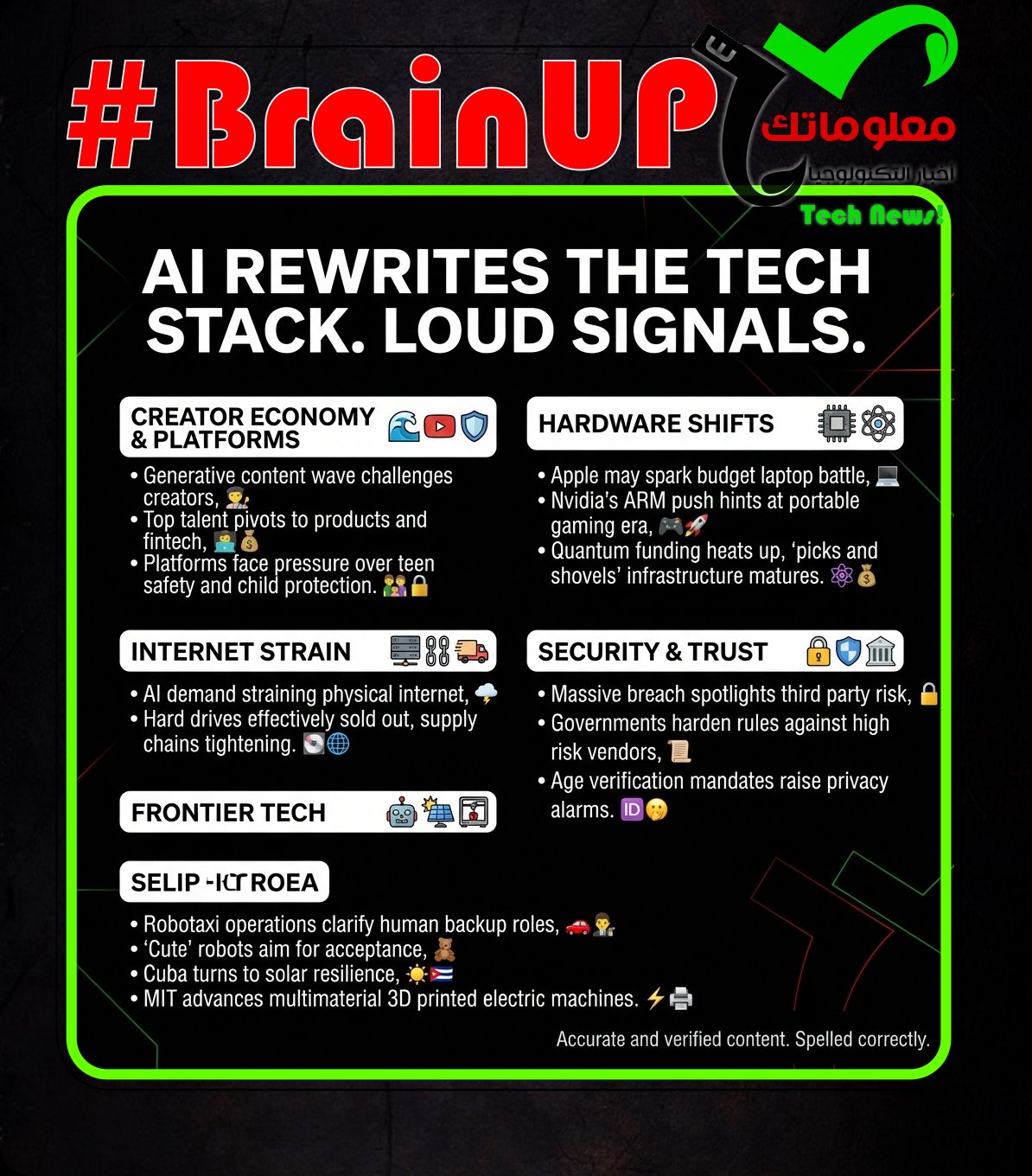
#BrainUp Daily Tech News – (Monday, February 23ʳᵈ)
Welcome to today’s curated collection of interesting links and insights for 2026/02/23. Our Hand-picked, AI-optimized system has processed and summarized 23 articles from all over the internet to bring you the latest technology news.
As previously aired🔴LIVE on Clubhouse, Chatter Social, Instagram, Twitch, X, YouTube, and TikTok.
Also available as a #Podcast on Apple 📻, Spotify🛜, Anghami, and Amazon🎧 or anywhere else you listen to podcasts.
1. Can the creator economy stay afloat in a flood of AI slop? | TechCrunch
The piece discusses how the #creator economy is being reshaped as top creators diversify beyond ad revenue while #generativeAI raises new threats and opportunities. It points to @MrBeast’s company buying fintech startup Step and Hollywood studios sending cease-and-desist letters to ByteDance over its video generation model Seedance 2.0 as signs of broader media upheaval. On TechCrunch’s Equity podcast, the hosts debate whether creator monetization has hit a saturation point, noting that many leading YouTubers are expanding into e-commerce and other revenue streams. As an example, @MrBeast’s food products, including chocolate, reportedly generated hundreds of millions of dollars and were profitable in 2024 while his media business lost money, prompting questions about who can succeed if even the biggest creator cannot rely on media profits. The conversation frames the central uncertainty as whether success will concentrate among fewer creators or whether new technologies or mediums will open paths for the next generation to stand out.
2. Apple’s rumored new MacBook sounds like a nightmare for budget Windows laptops — here’s why
Apple is rumored to unveil a new low-cost #MacBook at its next Apple Event, creating a more affordable entry point into the Apple ecosystem that could pressure budget #Windows laptops and #Chromebooks. According to @MarkGurman at Bloomberg, it may start at $599 or $699 for an 8GB RAM and 256GB SSD configuration, and use a smaller LCD display than the 13.6-inch MacBook Air to keep costs down. A key rumored tradeoff is performance hardware, as it may run an iPhone chip, the #A18Pro from iPhone 16 Pro models, instead of an #M-series chip. The article argues this fills a gap in Apple’s lineup, which since 2019 has effectively offered only #MacBookPro for creative professionals and #MacBookAir for portability, neither positioned as truly entry-level, and it could attract first-time buyers and students who would otherwise choose cheaper Google or Windows options.
3. NVIDIA N1X SoC and CPU Plans Transform the Future of Gaming Laptops | NoobFeed
Nvidia’s N1X #SoC is presented as the company’s first serious push into laptop CPUs for gaming, pairing a power-efficient #ARM CPU with @Nvidia #Blackwell graphics to create a self-contained platform aimed at portable gaming laptops. The article argues attention has shifted to this CPU effort because consumer GPU launches are slowing and the RTX 50 Super is described as likely canceled, with a global memory shortage and difficulties producing high-capacity GPUs cited as key market constraints. It highlights that bringing a non-x86 processor to Windows could enable real-time x86 translation on ARM, offering future benchmarks and developer learnings about performance bottlenecks, energy efficiency, and cross-platform compatibility. By integrating CPU and GPU in a purpose-built chip, the N1X is framed as a way to address gaming laptop thermal and power limits, potentially enabling consistent performance in thin-and-light designs and new form factors like ultra-small gaming boxes or a refreshed Shield-like device. The piece concludes that even amid delayed desktop GPUs, @Nvidia is still innovating through both software features like #DLSS 4.5 and dynamic multi-frame generation and strategic hardware moves that could broaden options for portable and small-form-factor gaming.
4. Chaos, confusion and $200 billion dreams: What I saw at India’s AI summit
India’s AI Impact Summit in New Delhi showcased the country’s ambition to be a major #AI player, but was undermined by severe logistical chaos and unclear organization. CNBC’s Arjun Kharpal describes impossible traffic, confusing and conflicting media access instructions at the Bharat Mandapam venue during @Narendra Modi’s inauguration, and widespread delegate frustration, prompting IT minister @Ashwini Vaishnaw to apologize for day-one problems. The event also faced controversies, including uncertainty around @Bill Gates’ planned keynote after his withdrawal was communicated, and a reported incident in which Galgotias University was kicked out following claims about a robot dog that online users said was made by China’s Unitree, with the university denying it claimed to have built the robot. Despite these issues, enthusiasm from U.S. tech firms remained strong, with leaders like @Sundar Pichai and @Sam Altman highlighting India’s large talent pool and consumer market and making announcements, suggesting global companies still view India’s #AI potential as compelling even when execution falters on the ground.
5. Tech companies are making their robots cute to try to win over humans
Tech companies are increasingly designing consumer facing #AI powered robots to look cute and petlike so people feel comfortable interacting with them in public and at home. In Los Angeles, social media users expressed sympathy for a delivery robot struggling through floodwater, reflecting how sidewalk robots with names and facial expressions can draw affection, help from bystanders and other prosocial behavior. Robot designer Ellie Sanoubari says developers avoid threatening designs and instead use features like larger heads, big eyes and cute sounds that can trigger deep biological responses, a shift from earlier factory robots that required technical operators. DoorDash built its autonomous delivery robot Dot to foster human acceptance by using a round body, large circular eyes that look where it plans to steer and make eye contact to signal pedestrians, plus sounds to announce its presence, with Dot operating in the greater Phoenix area and plans to expand. Similar efforts are described with Interaction Labs, which recruited @Alec Sokolow to help design its interactive desk lamp Ongo, showing a broader push to give robots character and build trust as they become more common in everyday spaces.
6. Conduent data breach could be largest in U.S. history
The Texas Attorney General is calling a #data breach involving Conduent Business Services potentially the largest in U.S. history, with affected residents including people in the CSRA. Conduent, a third-party provider of printing, mailroom, and back-office support, discovered a #cyberattack on Jan. 13, 2025, and investigators determined hackers accessed sensitive data from Oct. 21, 2024, to Jan. 13, 2025; the Oregon Department of Justice count has surpassed 10 million impacted, including people in Georgia, South Carolina, and several other states. Exposed information varies by person and can include addresses, Social Security numbers, and in some cases medical and health insurance information, while notification letters do not identify which client company used Conduent, complicating efforts to trace the original source. People receiving letters are urged not to discard them and can enroll in one year of free credit monitoring by April 30, 2026, using the instructions in their letter, with questions directed to 877-332-1658. Officials and experts recommend steps such as freezing credit with Equifax, Experian, and TransUnion, monitoring credit reports and financial statements, and watching for phishing attempts tied to the breach.
7. Quantonation’s double-sized second fund shows quantum still has believers | TechCrunch
Investor interest in #quantum computing is rising even though it is not expected to replace supercomputers or reach industrial scale in 2026. Quantonation Ventures closed an oversubscribed second fund of €220 million, more than twice its first fund, countering fears that hype and limited outcomes would trigger a quantum funding collapse as governments and Big Tech continue to invest despite unclear timelines for breaking modern encryption. The sector has matured since 2018 with technological progress and early demand from academic and industrial labs, shifting opportunities toward “picks and shovels” companies that supply enabling tools, such as Dutch startup Qblox, which sold control hardware and software before Quantonation co-led its Series A. This expanding ecosystem is also drawing more specialized funds, and highlights why early-stage quantum investing remains difficult due to technical complexity, new markets, and specialized teams. Public market momentum has added fuel, with Bloomberg citing a “quantum frenzy” partly tied to #Nvidia and @Jensen Huang’s 2025 comment that quantum is nearing an inflection point, even as quantum chips have not yet beaten classical computers beyond purpose-built benchmarks.
8. Xbox President Explains Why She Left the Company Suddenly and Gives Update on Next-Gen Xbox
The outgoing President of @Xbox revealed that her abrupt departure was driven by personal priorities and a desire to focus on family and long-term health after years in the high-pressure gaming industry, while she used her final communications to reassure fans that the next-gen Xbox remains on track with its roadmap and will emphasise performance, ecosystem integration and developer support. She highlighted that current Xbox leadership and teams are fully committed to delivering the next console’s capabilities, including enhanced backward compatibility, cloud integration, and AI-assisted tools for developers to create deeper gameplay experiences, and that the shift in her role will not slow development momentum. Community reactions show mixed feelings, with appreciation for her transparency but curiosity about how new leadership will shape Xbox’s strategic focus amid intense competition from @PlayStation and cloud gaming services.
9. Training a Human Takes 20 Years of Food Says Sam Altman on How Much Power AI Consumes
@Sam Altman, CEO of @OpenAI, compared the energy consumption of training #AI models to the amount of food a human metabolises over two decades, using this analogy to illustrate the vast quantities of computational power and electricity required for large-scale model training. He stressed that as AI systems grow in size and capability, efficiency and sustainability must be central design considerations, with the industry seeking ways to reduce carbon footprints via hardware optimisation, renewable energy sourcing and software techniques that cut redundant computation. Altman’s remarks come amid broader discussions about the environmental impact of AI infrastructure and the need for responsible practices that balance innovation with ecological stewardship.
10. AI Music Is Flooding Streaming — But Who’s to Blame? | Neon Music
AI-generated music is flooding streaming platforms at a scale that is reshaping discovery, payouts, and what listeners think they are hearing, with tools like #Suno enabling clean, instantly playlist-ready tracks that are easy to consume without scrutiny. The piece describes how Suno output often lands in predictable structures and consistently polished vocals, lacking the audible traces of human constraint, small timing imperfections, and hard choices that emerge in real recording sessions. It argues that common “authenticity” critiques are mostly misguided, pointing to historical precedents like @Carole King, the Brill Building system, Northern Soul’s reliance on professional songwriters, and hip-hop ghostwriting, where origin alone did not determine artistic value. The meaningful difference is framed as structural: human creators interpret and make arguments through choices, while AI lyrics function as #pattern-completion at scale that reproduces familiar emotional shapes without the friction of trying to say something difficult. The more urgent issue raised is not depth but volume, AI music overwhelms an ecosystem already struggling to surface work, and the article notes Suno’s rapid growth, including near-100 million users by late 2025 and $250 million raised, while asserting the company built its business on music it never licensed.
11. Big Tech’s Lobbying Pushed Social Media Bans into Political Crosshairs
Executives from major #BigTech companies have significantly shaped how social media content bans are debated in U.S. politics by funding campaigns, advisory groups, and lobbying efforts that frame regulatory proposals as threats to free speech or national competitiveness, influencing both legislators and public perception. According to political observers, this concerted effort has made it harder for federal and state lawmakers to pass uniform restrictions on harmful online content, leading to a patchwork of laws and heightened partisan tensions around platforms like @Meta’s Facebook and Instagram. Critics argue that the industry’s strategic spending on political advocacy has overshadowed independent research and civic concerns, reinforcing corporate influence over digital policy at a time when constituents are increasingly worried about misinformation, extremism and data privacy. The narrative highlights how financial power and political access can steer policy outcomes on digital governance and public safety.
12. AI blamed again as hard drives are sold out for this year
Hard drive makers have effectively sold out their 2026 production, with demand from #AI and cloud infrastructure driving hyperscalers to soak up high-capacity HDD supply. @Western Digital’s Tiang Yew Tan said the company is “pretty much sold out for calendar ’26” with firm purchase orders from its top seven customers and long-term agreements extending into 2027 and 2028, while @Seagate’s Dave Mosley said nearline capacity is fully allocated through 2026 and that cloud customers are already discussing demand into 2028. Analysts said this leaves little open production for discretionary buyers and prioritizes manufacturing for large AI and cloud players with predictable, high-volume demand, squeezing mid-size markets and hurting general-purpose enterprise servers and enterprise storage forecasts. Despite weaker outlooks for standard enterprise infrastructure, Omdia increased its 2026 server spend forecast to $590 billion and datacenter capex to more than $1 trillion because top cloud providers keep expanding investment plans. The HDD crunch also fits into a broader AI-driven supply strain that includes DRAM and NAND flash shortages affecting SSDs, along with constraints in other silicon like CPUs, complicating corporate IT storage plans that relied on HDDs as a capacity tier.
An internal @Meta research project, “Project MYST,” conducted with the University of Chicago, found that #parental supervision and controls like time limits and restricted access had little association with teens’ reported ability to moderate or stay attentive to their social media use. The survey, based on responses from 1,000 teens and their parents, reported no association between parental supervision, whether reported by parents or teens, and teens’ measures of attentiveness or capability to regulate use, and it also found teens who experienced stressful life events were more likely to struggle with moderation. These findings were highlighted in testimony in a Los Angeles County Superior Court jury trial where a teen plaintiff, “Kaley,” alleges social media products are “addictive and dangerous” and contribute to harms such as anxiety, depression, body dysmorphia, eating disorders, self-harm, and suicidal ideation, with claims targeting @Meta, YouTube, @ByteDance’s TikTok, and Snap, though ByteDance and Snap reportedly settled before trial. The plaintiff’s lawyer argued the study suggests built-in #parental-controls in apps like Instagram and phone time limits may not meaningfully reduce compulsive use, alongside allegations that #algorithmic-feeds, variable rewards, and notifications are designed to keep teens engaged. In testimony, Instagram head @AdamMosseri said he was not familiar with Project MYST despite a document that appeared to show his approval to proceed with the study.
14. How Tenaciously Palantir Courted Switzerland
@Palantir engaged in an extensive and persistent campaign to secure government contracts in Switzerland by tailoring its analytics platforms to meet the specific needs of Swiss federal agencies, leveraging local partnerships and regulatory navigation to overcome early skepticism about foreign tech influence and privacy concerns. The article describes how Palantir’s teams repeatedly presented case studies, compliance assurances and technical workshops to demonstrate that its data-fusion tools could enhance efficiency in areas such as intelligence, border security and public administration without compromising Swiss legal standards. Despite critics who raised alarms about centralized data processing and potential civil liberties implications, Swiss officials ultimately awarded contracts that include safeguards and oversight obligations, framing them as a balance between leveraging advanced #DataAnalytics capabilities and upholding stringent national data protection laws. This account illustrates the broader trend of advanced analytics firms embedding themselves within European public sector modernization efforts while navigating complex political, legal and cultural landscapes to win trust and adoption.
UK users are increasingly being forced through #age-verification gates across major platforms due to the #OnlineSafetyAct, creating privacy and practicality concerns. The writer says they cannot access @Bluesky direct messages without Epic Games-owned #KWS checking a bank card, ID, or face, and notes similar checks appearing on Reddit, Discord, and even an Xbox in their household. The Act aims to stop children accessing broadly defined “harmful content,” and while a survey found nearly 70% support for the law, 64% doubted its effectiveness, with VPNs cited as an easy workaround. The article argues that handing sensitive data to third-party verification vendors is risky, pointing to a recent Discord security breach that may have leaked 70,000 age-verification ID photos and highlighting how these UK measures could set precedents beyond Britain.
16. Waymo denies using remote drivers after Senate testimony goes viral
@Waymo says its overseas staff are #remote assistance agents who advise its #automated driving system, not remote drivers who control robotaxis, after viral @Sen. Ed Markey questioning of chief safety officer @Mauricio Peña. In a letter to Markey, head of global operations @Ryan McNamara said Waymo has about 70 remote assistance agents on duty at any time, split roughly half in the US and half in the Philippines, who provide advice only when the system requests help in specific, event-driven situations. McNamara wrote that agents do not steer, drive, or continuously monitor live camera feeds, and that these brief interactions usually last seconds as a safety redundancy when the system wants more context. He added that the Philippines-based agents are licensed drivers, English speakers, drug-screened, trained on local road rules, and that reported latency is about 150 milliseconds in the US and 250 milliseconds abroad. Waymo framed the clarification as a response to reporting and social media posts that mischaracterized the Senate testimony as proof that vehicles were being driven remotely from overseas.
Los Angeles County sued #Roblox on February 19, alleging the platform fails to protect children and is a largely unsupervised social space that enables predators. The county press release says Roblox markets itself as safe but is actually an unsafe environment, and county counsel @Dawyn R. Harrison argues the company gives pedophiles powerful tools for grooming, exploitation, and assault. The article notes this lawsuit follows earlier actions and claims, including a 2023 class action arguing there is a misperception Roblox is safe for children, reports of widespread sexual content and grooming, a case involving the abduction and sexual assault of a 15 year old after grooming via Roblox, and lawsuits by states such as Kentucky, Louisiana, Tennessee, and Texas. It adds that while Roblox has pushed back on portrayals of the platform as a predator haven and has improved safety features over time, it has also taken steps that critics say undermine those gains, including @David Baszucki proposing a dating hub despite the young player base. The piece frames the LA County suit as part of a broader, ongoing conflict over whether Roblox’s #safety measures are sufficient to prevent child predation.
18. Poland tightens cybersecurity rules targeting non-NATO suppliers
President @Karol Nawrocki signed a law tightening Poland’s #national cybersecurity system by creating a “high-risk” vendor category that bars certain suppliers, especially those tied to non-#NATO states such as China, from providing goods or services to sectors deemed vital to the state. The bill, which implements the EU’s #NIS2 directive and passed with rare cross-party support, is framed as a response to a sharply rising number of cyberattacks, including findings in the @Microsoft Digital Defense Report that Poland suffered the most attacks in the EU and a December incident that nearly caused a blackout. The rules apply across sectors such as wastewater, postal services, space, and chemical and food production, requiring stricter incident reporting, risk assessments, and management accountability, and mandating removal of existing high-risk products within seven years. The legislation has drawn criticism from some business groups over compliance costs and has been informally dubbed “Lex Huawei” amid debate that #Huawei could be targeted, with the company warning it may seek arbitration if harmed. While signing, Nawrocki also referred the law to the Constitutional Tribunal for review, citing concerns including obligations placed on businesses.
19. Cubans fight blackouts with solar as US extends oil chokehold
Cubans are increasingly adopting @solar technology to combat frequent #blackouts caused by unreliable #electricity supply. The government promotes @renewable energy projects to reduce dependence on imported #oil, which faces continued sanctions and supply disruptions. These efforts aim to improve energy resilience amid ongoing US restrictions that limit fuel imports and exacerbate energy shortages. The shift towards solar demonstrates local initiative to ensure electricity access and stability. This move aligns with broader strategies to diversify energy sources and decrease reliance on external oil imports in Cuba.
20. 3D-printing platform rapidly produces complex electric machines
MIT researchers developed a #multimaterial #3D-printing platform that can fully print complex electric machines in a single step, aiming to make it faster and cheaper to fabricate parts onsite instead of relying on distant suppliers. The system uses four extrusion tools to process multiple functional materials, including electrically conductive and magnetic materials, switching between extruders to deposit layers through a nozzle. Using five materials, the team produced a fully 3D-printed electric linear motor in a matter of hours, requiring only one post-processing step to become functional. The resulting motor performed as well or better than comparable motors made with more complex fabrication methods or additional post-processing. Led by @Luis Fernando Velásquez-García with lead author Jorge Cañada, the work suggests the approach could enable rapid, customizable electronic components for robots, vehicles, or medical equipment while reducing waste and supply-chain dependence.
After decades of expanding #laptops and #tablets in schools, experts argue the U.S. has weakened, not strengthened, student learning, leaving Gen Z less cognitively capable than prior generations despite unprecedented access to information. Maine pioneered statewide school laptops in 2002 under then-Governor @Angus King, scaling from 17,000 Apple laptops for seventh graders to 66,000 devices by 2016, mirroring a national push that reached more than $30 billion in school device spending in 2024. In testimony to the U.S. Senate, neuroscientist @Jared Cooney Horvath cited #PISA and other standardized-test data showing Gen Z as the first modern generation to score lower than the previous one, and he highlighted a correlation where more in-school computer time aligns with worse scores. He argues that unfettered, indiscriminate digital expansion, accelerated after the 2007 iPhone, can atrophy learning and that educational tools should match how humans learn, noting Fortune previously reported Maine scores did not improve over 15 years and then-Governor Paul LePage labeled the initiative a “massive failure.” Horvath warns the consequences extend beyond jobs, especially as #generativeAI reshapes entry-level work, because declining cognitive capability could undermine society’s ability to handle complex challenges like overpopulation, disease, and moral drift.
22. The FBI Says These Wi-Fi Routers Are Unsafe, And Here’s Why – SlashGear
The @FBI warns that certain end of life Wi Fi routers, mainly late 2000s to early 2010s models that no longer receive #security patches, are unsafe because they are being actively exploited in cyberattacks. In a public advisory, the agency says threat actors use known flaws to install #malware, gain root access, and enroll these devices into #botnets that can be used for coordinated attacks or sold as proxy access, naming vulnerable legacy #Linksys models such as the E1200, E2500, E4200, WRT320N, and M10. The attacks often leverage exposed #remote administration features, letting criminals scan for these routers online, upload malware, and have the device check in with command and control servers, sometimes as often as every 60 seconds. Once compromised, the router can be turned into a proxy by opening network ports, helping others hide their online activity, and the infections are hard to detect because traditional antivirus tools do not scan networking hardware and the malicious code resides in the router OS. If a router is on the cited list or no longer gets updates, the article advises replacing it with a newer, supported model.
23. This is why you should stop connecting your Smart TV to WiFi and what you should do instead
Connecting a #Smart TV to WiFi can cause buffering, lag, or failed playback if the wireless signal is not strong enough, so using #Ethernet is presented as a better option. The article cites @Netflix guidance that 15Mbps is enough for 4K streaming and 25Mbps can help content load faster, and says Ethernet can provide up to 100Mbps, with TV makers like @Samsung and @Sony recommending wired connections for a stronger, more stable link. It also claims Ethernet can cut ping time by as much as 50 percent compared to WiFi, improving gaming and app performance. Setup is described as simple: choose a cable such as Cat5e (up to 1Gbps) or Cat 8 (up to 40Gbps), plug it from the TV’s Ethernet port to the router’s LAN port, then select Wired Connection in settings. As context on future connectivity, it notes researchers in Japan transmitted 1.02 petabits over 1,118 miles using 19-core optical fiber, but such speeds are still limited in distance, so Ethernet remains the practical fix for now.
That’s all for today’s digest for 2026/02/23! We picked, and processed 23 Articles. Stay tuned for tomorrow’s collection of insights and discoveries.
Thanks, Patricia Zougheib and Dr Badawi, for curating the links
See you in the next one! 🚀
