
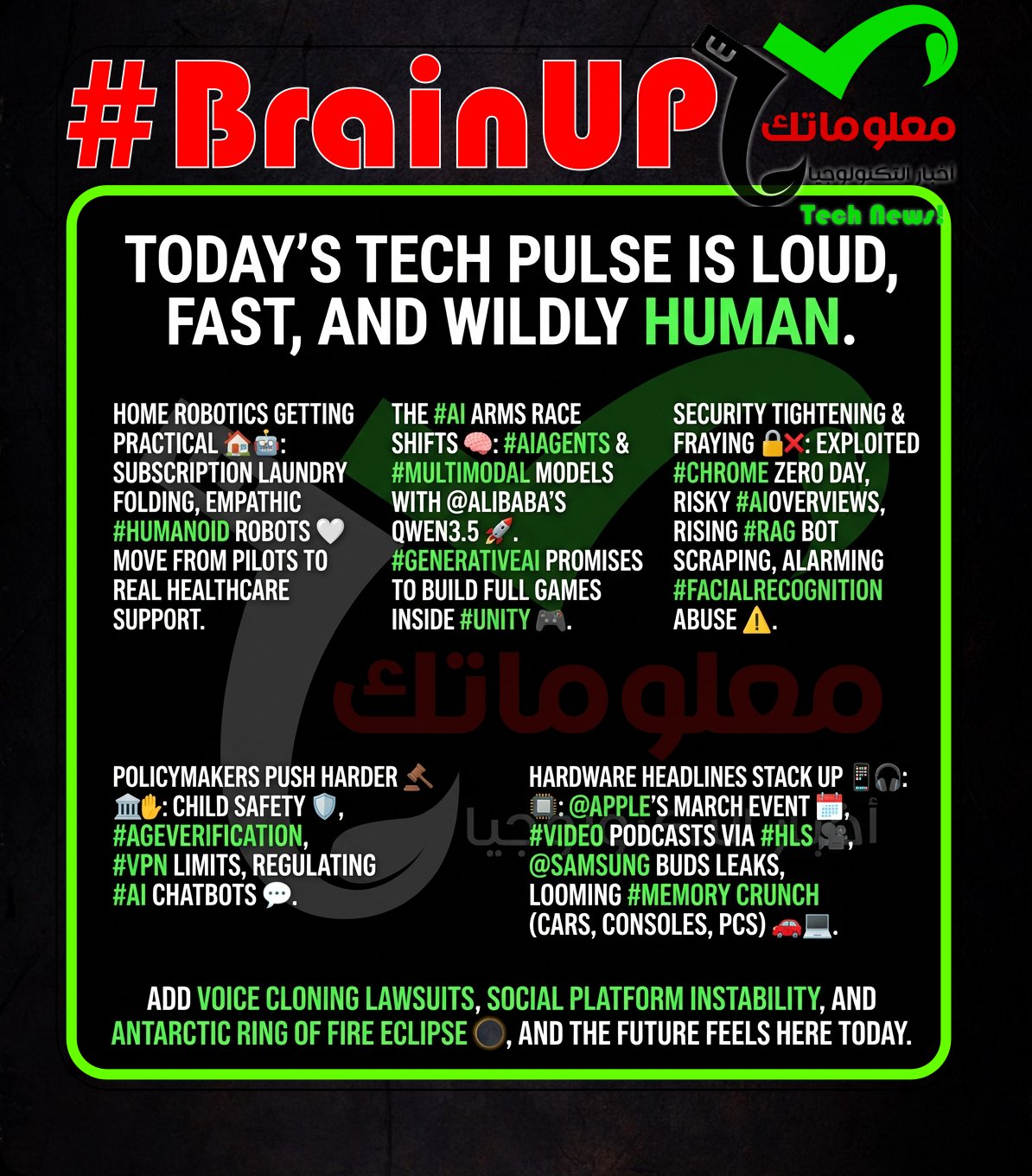
#BrainUp Daily Tech News – (Tuesday, February 17ᵗʰ)
Welcome to today’s curated collection of interesting links and insights for 2026/02/17. Our Hand-picked, AI-optimized system has processed and summarized 31 articles from all over the internet to bring you the latest technology news.
As previously aired🔴LIVE on Clubhouse, Chatter Social, Instagram, Twitch, X, YouTube, and TikTok.
Also available as a #Podcast on Apple 📻, Spotify🛜, Anghami, and Amazon🎧 or anywhere else you listen to podcasts.
1. US firm’s laundry-folding robot launches with monthly subscription
Weave Robotics is launching a laundry-folding robot called Isaac 0 via a monthly subscription. The article states that Isaac 0 folds clothes using #AI and that its operation is supported by remote human assistance. That human-in-the-loop support is used to help improve the robot’s performance over time. Overall, the piece frames Isaac 0 as a home robot service that combines automated folding with ongoing remote help to get better with use, aligning with the subscription-based launch described in the title.
2. Alibaba unveils Qwen3.5 as China’s chatbot race shifts to AI agents
Alibaba Group released its Qwen3.5 AI model series in both open-weight and hosted API forms, positioning it for a Chinese market increasingly focused on #AIAgents. Alibaba says Qwen3.5 improves performance and cost versus earlier versions, adds native #multimodal capabilities across text, images, and video, and supports coding and agentic features compatible with open-source agents such as OpenClaw. The company also stated that its 397 billion parameter open-weight model and its cloud-hosted Qwen-3.5-Plus show benchmark performance on par with leading models from @OpenAI, @Anthropic, and @GoogleDeepMind, though these comparisons were self-reported and CNBC could not independently verify them. Qwen3.5 expands language coverage to 201 languages and dialects, and Counterpoint’s Marc Einstein said the push reflects preparations for agents that could upend traditional internet business models and indicates Alibaba’s global ambitions. Alibaba’s launch follows a week of upgraded model releases by local rivals like ByteDance and Zhipu AI, and the company signaled more open-weight releases during the Chinese New Year.
3. Homeland Security Wants Social Media Sites to Expose Anti-ICE Accounts
4. Instagram boss: 16 hours of daily use is not addiction
@Adam Mosseri defended Instagram in a California court, arguing that even very heavy social media use should be distinguished from clinical #addiction, calling a reported 16-hour day on Instagram by the plaintiff “problematic” rather than addiction. He testified in a six-week Los Angeles trial brought by a minor identified as K.G.M, which is positioned as a test case for holding tech firms accountable for harms to young people, with #Meta arguing her mental health struggles were driven by other life challenges and that Instagram was not a substantial factor. Mosseri agreed Instagram should do everything within its power to keep users safe, especially minors, but said it is not possible to define how much use is “too much” because it varies by person, and he noted he is not an addiction expert. The plaintiff’s lawyer cited an internal Meta survey of 269,000 users reporting 60% had seen or experienced bullying in the prior week and said K.G.M made over 300 bullying reports to Instagram, which Mosseri said he did not know. He was also questioned about a 2019 internal email thread raising concerns about appearance-altering image filters, and said Instagram banned filters beyond makeup effects but acknowledged the ban was later modified, as broader lawsuits against major platforms continue across the US.
5. Could an empathic robot be a part of your future healthcare team? – UVic News
UVic researchers review how social, empathic humanoid #robots are already being used in health care and what their future potential, effectiveness, and limitations may be. The article describes real-world examples involving #Pepper and #NAO: a child doing cochlear-implant auditory rehabilitation at home in Toulouse, another child in Toronto using Pepper to reduce anxiety before surgery, and a diabetic adolescent in Australia receiving motivational interviewing coaching from a NAO robot named Andy during an eight-week feasibility trial. It notes that these deployments have occurred in research and hospital initiatives since 2018 and 2021, showing the technology is in active use rather than speculative. It also cites external forecasts, including a @Morgan Stanley estimate of one billion AI-enabled humanoid robots by 2050 in a $5 trillion market and a 2025 @World Economic Forum report predicting #AI will radically transform health care. To address how health care might move from today’s pilots to broader adoption, the Global Lab for Digital Health and AI Innovation at UVic conducted two 2025 scoping reviews focusing on Pepper’s uses in health care and NAO’s uses in health care and education.
6. The Next Car Chip Shortage Is Coming. Blame AI
A global #memory chip shortage is starting to hit the auto industry, with Ford warning it is already pushing costs up and could raise vehicle prices or disrupt production. @Ford CFO @Sherry House said the company is actively managing constrained supply, believes it currently has sufficient access, but is “seeing pressure on pricing” that has been built into its forward plan, and analysts cited signs of panic buying in the sector. The article attributes the crunch to major suppliers #Samsung, #SKHynix, and #Micron shifting capacity toward chips for #AI data centers, leaving less #NAND and #RAM for consumer tech and increasingly memory-heavy modern vehicles with #ADAS and self-driving features. With vehicles already using large and rising amounts of memory, and with other headwinds like tariffs and reduced federal incentives, the shortage is framed as likely to worsen affordability and potentially gum up manufacturing through 2026. The piece concludes that this adds another reason buyers may be pushed toward used, older, lower-tech vehicles as new-car prices continue climbing.
7. Former NPR Host Accuses Google Of Copying His Voice For AI Offering
@David Greene, a former @NPR host, is suing @Google, alleging the company used his voice without permission for the male co-host in #NotebookLM’s #AudioOverviews, a feature added in late 2024 that turns notes and documents into short AI-generated podcast episodes. The complaint filed in Santa Clara County claims Google replicated Greene’s distinctive delivery, cadence, and persona without consent or compensation, and says an AI forensic firm reported a 53% to 60% confidence the voice matched Greene, which it characterized as relatively high. Greene says he learned of the similarity from colleagues and argues the alleged use misappropriated his career and identity for profit. Google spokesperson @José Castañeda denied the claims as baseless, stating the male voice is based on a paid professional actor the company hired. The dispute is framed within broader #AI controversies over training data, authorization, compensation, and the risks of #voice cloning, echoing other high-profile complaints such as @Scarlett Johansson’s 2024 concerns about @OpenAI.
8. Mazda Finally Admits Its Infotainment System Is the Worst
Mazda is reversing course on its scroll wheel, touchless infotainment philosophy by adopting full touchscreens, effectively conceding its prior approach was misguided. The author describes recent time in the CX-50 Hybrid, CX-70, and CX-90 PHEV, where a dashboard-mounted tablet is mainly controlled by a console scroll wheel and back button, making basic navigation clunky and distracting, even pushing drivers to rely on wireless #AppleCarPlay and #AndroidAuto that were not designed for wheel control. Upper-trim 12.3-inch systems are technically touch-capable, but touch works only when parked and only within #CarPlay, and the screen placement is awkward for comfortable use while driving. Mazda’s new 2026 CX-5 replaces the wheel and buttons with a 15.6-inch touchscreen and no physical controls, claiming safety via a persistent bottom bar for core functions like climate control. The shift moves Mazda from a cumbersome wheel-driven interface into a buttonless touchscreen era, raising the question of whether it will actually be better or safer, especially since current models’ physical knobs and toggles are praised as effective.
9. World’s first AI dating café opens in New York: How AI lets users date their phones
A pop-up in New York City, billed as the world’s first AI dating café, showcased #AI companionship by having guests “date” via their phones using the EVA AI relationship app. For one evening a regular bar became EVA Café, where visitors ordered drinks, wore headphones, and chatted with virtual partners through video and voice calls instead of sitting across from other people. Organisers said the setup reduced awkward small talk and fear of rejection, letting users control how long and how deeply to interact while AI companions responded emotionally and conversationally, including flirting and sharing a meal. The event was framed as a real-world demonstration of how app-based AI companionship can extend beyond screens. Cited survey data in the piece links the pop-up to a broader rise in AI romance, reporting 28% of US adults and 42% of teenagers have used AI for romance or companionship.
10. Scientists restore knee cartilage using targeted injection
A targeted injection that inhibits the age-linked enzyme #15-PGDH regrew knee cartilage in older mice and reduced osteoarthritis outcomes after knee damage, suggesting a potential alternative path beyond pain control and joint replacement. In work led by @Nidhi Bhutani at Stanford Medicine, cartilage thickness increased across the knee surface in aged mice after either belly or joint injections, and an injury model using twice-weekly injections for four weeks preserved cartilage and cut osteoarthritis-associated pain. The study links the effect to restoring the repair signal prostaglandin E2 by blocking 15-PGDH, which rises about twofold in aging cartilage and normally destroys prostaglandin E2, thereby shifting chondrocytes away from inflammatory breakdown and toward rebuilding normal joint-like cartilage rather than scar-like tissue. Cell-by-cell analyses indicated the inhibitor rebalanced gene expression across the joint lining toward repair instead of simply patching a localized defect. In human knee cartilage samples from replacements cultured in the lab, the same inhibitor prompted recovery within a week, including fewer 15-PGDH-positive chondrocytes and lower signals tied to cartilage breakdown, supporting translational potential.
11. More leaked Galaxy Buds 4 images show Samsung is going back to basics
Newly leaked retailer images suggest @Samsung’s Galaxy Buds 4 are reverting to a more basic, familiar design ahead of the expected February 25 Samsung Unpacked launch alongside the Galaxy S26 lineup. The images show the earbuds and case from multiple angles, including the Buds 4 charging in the case, with a simplified stem (dropping the prior triangular profile), no silicone eartips (reserved for the Pro model), a larger circular top microphone port, and a square case with a transparent lid and USB-C on the back. The design shift appears aimed at easier access and a return from the prior vertical storage style, though the simplified look is described as reminiscent of cheaper late-2010s earbuds. The listing also mentions support for “two AI assistants” (likely Bixby and Gemini), adaptive sound with #3D sound customization, head gesture controls, #IP55 water resistance, and 24 hours total playback, with rumors pointing to a slightly smaller battery but similar life. The report adds that traces of the previous Galaxy Buds 3 model have reportedly been removed in the US ahead of the event, while Buds 4 pricing is rumored to stay similar to last year.
@Valve says #Steam Deck OLED stock is intermittently limited in some regions because of #memory and #storage shortages tied to the wider #RAM and #SSD supply crisis. It added this note to the Steam Deck store page and linked the issue to the same shortages that have increased RAM and SSD prices, delayed its upcoming Steam Machine plans, and are said to threaten many electronics manufacturers. The article claims the shortage is being driven by the #AI industry’s demand for memory, and notes that even @Sony and @Nintendo are being impacted, with Sony reportedly considering delaying its next generation console as far as 2029 and Nintendo reportedly weighing a price increase for the Switch 2. As of writing, Steam Deck OLED models were still available in the UK and Australia, while Valve said it must revisit shipping schedule and pricing for Steam Machine and Steam Frame despite still targeting the first half of 2026 for Steam Machine.
13. Future MacBooks may borrow a Samsung privacy feature
Future #MacBooks may adopt Samsung’s new #PrivacyDisplay technology to address an “ironic” privacy issue created by modern wide viewing angle screens. Early laptop displays had narrow viewing angles that made side viewing difficult, but Apple helped popularize wide angle displays so screens could be seen clearly from many angles. That improvement can be a drawback in public settings because nearby people can read sensitive content, leading some users to buy third party privacy screen filters. Samsung’s #PrivacyDisplay, promoted for the Galaxy S26 Ultra, aims to keep wide angle viewing by default while allowing narrow angle privacy modes for specific apps or sensitive elements like passwords, notifications, and pop ups, with adjustable settings and the ability to switch off. A report citing @IceUniverse and market research firm Omdia says this OLED based approach could reach #MacBooks by 2029, likely after Apple moves more laptops to #OLED and as Samsung scales the feature to larger laptop displays.
14. Google fixes exploited Chrome CSS zero-day
@Google issued an emergency update to fix an in-the-wild exploited #Chrome zero-day, CVE-2026-2441, a high-severity (CVSS 8.8) use-after-free flaw in #CSS handling. The bug could let a remote attacker use a specially crafted HTML page to run arbitrary code inside the browser’s sandbox, meaning a malicious webpage alone could trigger execution in a victim’s browser. Patches are in Chrome 145.0.7632.75 for Windows and macOS, and 144.0.7559.75 for Linux, with rollout expected over the coming days and weeks; researcher Shaheen Fazim reported the issue on February 11, and @Google said it observed exploitation two days later. @Google is withholding technical details until most users are updated, citing its usual approach to reduce rapid weaponization and noting third-party dependencies could extend the embargo. The incident echoes 2025, when @Google patched eight actively exploited Chrome zero-days, and arrives shortly after reports that hundreds of Chrome extensions were siphoning browsing histories, underscoring multiple avenues for browser compromise and data leakage.
15. Over 300 Malicious Chrome Extensions Caught Leaking or Stealing User Data
Security researchers found a large network of malicious #Chrome extensions that were quietly leaking browsing histories, search activity and other sensitive data from millions of users, with analysis showing more than 300 extensions connected to tracking, data monetization or outright theft operations and a combined install base exceeding 37 million, while some extensions exposed data through insecure channels and others intentionally transmitted it to collection servers linked to spyware distribution networks. The investigation identified hundreds of extensions sharing suspicious developer links, suggesting coordinated infrastructure rather than isolated scams, and a separate campaign uncovered AI themed extensions that injected remote content into pages to manipulate interfaces and harvest information such as email content from services like Gmail. Researchers noted that many of these tools appeared legitimate and sometimes delivered promised features, making detection difficult for ordinary users and even for platform vetting systems, which highlights ongoing weaknesses in extension marketplace governance and the growing abuse of #AI branding to attract installs. Community reactions emphasized frustration that malicious add ons continue to bypass review processes despite widespread reporting, reflecting broader concerns about trust and oversight in browser ecosystems. The findings reinforce cybersecurity guidance that users and organizations should audit installed extensions regularly, limit permissions, and remove tools from unknown developers to reduce exposure to surveillance and data exfiltration risks.
16. Get ready for new Macs and iPads: Apple announces “Special Experience” on March 4
@Apple has announced a March 4 event in New York City, branded a “Special Apple Experience,” without confirming what will be unveiled, but recent reporting and rumors point to multiple #hardware updates. The event starts at 9AM ET, and Ars Technica will cover it on site, with speculation including an iPhone 17e that uses an A19 chip like the base iPhone 17, may add #MagSafe charging, and is expected to remain a budget model without a multi-camera array, making pricing the key variable given current $600 to $800 clustering. संभावित iPad updates include a base iPad with an A18 chip and an iPad Air with an M4 chip, though the article suggests changes may be mostly processor-only and potentially limited by @Apple’s practice of disabling CPU or GPU cores on low-end variants. The most prominent expected announcements are Macs, particularly 14- and 16-inch MacBook Pros with M5 Pro and M5 Max chips after last fall’s M5 MacBook Pro lacked Pro and Max options, alongside rumors of a cheaper MacBook using an A18 Pro chip and a MacBook Air with an M5 chip. Overall, the piece frames March 4 as a likely refresh cycle focused on chips across iPhone, iPad, and Mac lines, with definitive details to come at the event.
17. Unity says its AI tech will soon eliminate the need for coding
@Unity CEO @Matthew Bromberg said the company is expanding its push into #generativeAI with an upgraded #UnityAI beta aimed at AI-driven authoring that can let developers create full casual games using natural language, reducing or eliminating the need for coding. On an earnings call, he said the beta will be unveiled at the #GameDeveloperConference in March and will be native to Unity to make it easy to move from prototype to finished product, using project context and runtime knowledge alongside “frontier models.” Bromberg argued this will democratize development for non-coders and increase productivity for experienced developers, with Unity positioning itself as a bridge from initial creative ideas to scalable digital experiences. He also predicted AI-enabled tools could lead to tens of millions more people creating interactive entertainment, and said Unity intends to lead that shift. The article notes that the current Unity AI assistant uses #OpenAI and #Meta large language models, and that Unity’s AI asset generators rely on a mix of first-party and partner models including Scenario and Layer AI built on foundations such as #StableDiffusion, FLUX, Bria, and GPT-Image.
18. A top Salesforce executive says Benioff’s ICE jokes were ‘not OK’
At an internal meeting, Salesforce CTO @Parker Harris said @Marc Benioff’s jokes about #ICE were “not OK,” calling them a “very bad joke” and reflecting internal outrage. A recording of @Benioff’s keynote was posted on Salesforce’s internal site, but the ICE jokes were not included. The incident drew further internal criticism, with Slack’s new head denouncing the jokes in internal messages. The reactions show the comments became a significant internal controversy at a pivotal time for Salesforce, prompting leaders to distance the company from the remarks.
19. SpaceX Enters Pentagon’s Contest to Build Voice Controlled Military Drone Swarms
@SpaceX and its AI subsidiary @xAI are reportedly participating in a classified Pentagon competition offering a $100 million prize to develop #AI systems capable of translating spoken battlefield commands into instructions that coordinate autonomous drone swarms, reflecting a broader U.S. defense push to accelerate deployment of autonomous technologies and reduce operational friction in military decision making. The six month challenge, launched in January by the Defense Innovation Unit, focuses on creating software that allows humans to command multiple drones through natural language rather than manual programming, signaling a major shift toward human machine interaction models built around voice driven orchestration and scalable autonomy. The development follows SpaceX’s acquisition of xAI and aligns with growing Pentagon partnerships across leading AI firms, including previous contracts awarded to @OpenAI, @Google and @Anthropic, highlighting how #GenerativeAI capabilities are increasingly intersecting with national defense priorities and strategic competition. Reports indicate that neither the companies nor defense officials have fully confirmed details publicly, yet the effort illustrates how commercial AI and aerospace innovation are converging within the emerging defense technology ecosystem where speed, automation and software integration are becoming core strategic assets. The story underscores rising global interest in autonomous drone systems and the policy debate around safety, oversight and the future role of AI enabled military operations as governments pursue more adaptive battlefield technologies.
20. A ‘ring of fire’ solar eclipse will dazzle people and penguins in Antarctica
The year’s first #solar eclipse is imminent, but it will be seen by very few people because its path is limited to Antarctica. The article says Tuesday’s event is an #annular solar eclipse, often called a “ring of fire.” Because the visibility is confined to Antarctica, most of the world will not be able to watch it directly. As a result, the eclipse’s spectacle is expected to be primarily for those in Antarctica, including wildlife such as penguins.
The article reports claims attributed to Phison CEO @Pua Khein-Seng that an #AI-driven #memory crunch will push many consumer electronics system vendors to fail, with bankruptcies or exits from product lines by the end of 2026. An X user summarizing a Chinese interview says he expects severe #DRAM and #NAND shortages, with unprecedented demands for three years of prepaid orders and an imbalance potentially lasting to 2030 or longer. The same summary alleges major production cuts, including 200 to 250 million fewer mobile phones, plus significant reductions in PC and TV output due to lack of memory. It also cites a warning that @Nvidia next generation Vera Rubin #AI GPUs could consume huge storage resources, with tens of millions of units each needing over 20TB of SSD and potentially using about 20% of the prior year’s global NAND capacity. PC Gamer notes it cannot confirm his exact wording because the full interview is in Chinese with no English subtitles, but frames the remarks as further evidence that the #AI memory boom is driving price spikes and constraining device manufacturing.
22. How dark web agent spotted bedroom wall clue to rescue girl from abuse
A specialist online investigator, Greg Squire from the US Department of Homeland Security Investigations, pursued a case involving a 12-year-old girl known as Lucy whose sexual abuse images were being shared on the #dark web, but the abuser cropped or altered identifying details, leaving investigators stuck. A BBC World Service team filming over five years with Squire and units in Portugal, Brazil, and Russia shows that such cases are often solved by small clues in images and forums rather than advanced #technology. In Lucy’s case, investigators could only infer North America from visible light sockets and outlets, and an attempt to get help from Facebook, despite its facial recognition, failed when it said it did not have the tools to assist. The team then scrutinised items in Lucy’s room, narrowed a sofa to a regionally sold product, and finally pursued an exposed brick wall as a lead by contacting the Brick Industry Association and brick experts, including brick salesman @John Harp, who identified distinctive features of the brick. The story links the painstaking, detail-driven method of online child-exploitation investigations to the effort to locate and rescue Lucy from ongoing harm.
23. Government Set to Restrict UK Children’s Use of Internet VPNs and Social Media
[@Kier Starmer] has proposed last minute amendments to the #Children’s Wellbeing and Schools Bill and the #Crime and Policing Bill to enable the UK government to set a minimum age limit for social media, expand #AgeVerification, and consider age restricting or limiting children’s use of #VPNs where it undermines safety protections and affects the age of digital consent. The plans build on the #OnlineSafetyAct, which already requires “highly effective” age checks aimed at blocking children from harmful adult content, and would also add measures such as restricting features like infinite scrolling, consulting on preventing children from sending or receiving nude images, closing a loophole so all #AI chatbots must comply with illegal content duties, and preserving key data after a child’s death where relevant. The government says these powers would allow faster action after a forthcoming Children’s Digital Wellbeing Consultation, rather than waiting for new primary legislation as technology changes, though the announcement suggests decisions may already be forming. Several specifics remain unclear, including what the minimum social media age would be and how broadly “social media” would be defined, which could extend beyond major platforms to other user to user services. Overall, the amendments seek to broaden and operationalize child safety enforcement across platforms and technologies by embedding flexible powers into near final legislation.
24. Google’s AI Overviews Can Scam You — Here’s How to Stay Safe
Main idea: Google’s AI-generated overview pages, designed to assist users, may sometimes present misleading or manipulated information. Evidence: Some overviews contain false details, biased content, or are manipulated by malicious actors to influence opinions or spread misinformation. Analysis: Users need to verify AI-derived information through multiple sources, remain skeptical of overly confident responses, and report inaccuracies to #Google to improve accuracy. Link back: Understanding AI limitations and exercising caution ensures safer interaction with AI summaries, reducing the risk of being misled by potential scams.
25. Underground Facial Recognition Tool Unmasks Camgirls
An underground site called camgirlfinder uses #facial recognition to help people identify where a cam model streams across platforms, including by uploading a woman’s photo from social media to potentially out her sex work. The article says this creates a serious privacy risk for sex workers who may not want stalkers, harassers, or employers to discover their profiles. The site’s creator told 404 Media that the service gets millions of searches each month and defended it, saying: “If that is a problem for you then the sad reality is this job is not for you.” By enabling cross-platform identification and linkage from everyday photos to adult streaming accounts, the tool can facilitate doxxing and exposure. The piece centers on how this use of #facial recognition undermines anonymity and safety for cam performers.
26. AI bot traffic closing in on human web visits, study finds
TollBit reports #AI bot traffic is rapidly approaching human browsing levels, driven increasingly by #RAG bots used by AI tools as substitutes for traditional web search. By Q4 2025 it observed about one bot visit per 31 human visits, up from one per 200 in Q1, and said the figures are likely conservative because many scrapers are hard to distinguish from humans, while human visits fell 5 percent from Q3 to Q4 2025. Model-training scrapes fell 15 percent between Q2 and Q4 2025, but #RAG bot traffic rose 33 percent and AI search indexer traffic rose 59 percent, with @OpenAI identified as the heaviest scraper via its ChatGPT-User bot, averaging five times as many scrapes per page as the next highest scraper from @Meta. The shift aligns with user behavior data cited in the piece, including Eight Oh Two finding 37 percent of active AI users start searches in AI platforms like ChatGPT or Gemini, and Pew Research reporting 62 percent of US adults use AI several times a week. TollBit says B2B and professional sites, national news, and lifestyle content are most scraped, with the biggest scraping growth since Q2 2025 in tech and consumer electronics, up 107 percent, and warns referral clickthrough from AI apps to source sites is declining.
27. Apple introduces a new video podcast experience on Apple Podcasts
Apple announced a spring update to Apple Podcasts that adds an advanced #video podcast experience powered by #HLS (#HTTP Live Streaming). Users will be able to switch between watching and listening, view in a horizontal full display, download video for offline viewing, and get automatic quality adjustment for smooth playback on Wi-Fi or cellular, with video episodes also working with existing recommendations and editorial curation. Apple says the update gives creators full control of content and monetization through participating hosting providers and ad networks, and for the first time enables dynamic insertion of video ads, including host read spots, while supporting sponsorships and dynamic advertising without disrupting existing followers or downloads. Launch partners supporting HLS video include Acast, ART19 (an @Amazon company), Triton’s Omny Studio, and @SiriusXM (including SiriusXM Media, AdsWizz, and Simplecast), with more providers expected later. Apple will not charge hosting providers or creators to distribute podcasts on Apple Podcasts via RSS/MP3 or HLS video, but will charge participating ad networks an impression-based fee for delivery of dynamic ads in HLS video starting later this year.
28. UK targets all AI chatbots after Grok uproar
The UK government plans to close a loophole in the #OnlineSafetyAct by making all #AI chatbots responsible for preventing their systems from generating illegal or harmful content, following backlash over @ElonMusk’s Grok being used to create and share sexualized #deepfakes of women and children. @KeirStarmer said the government will extend duties that currently focus on user to user social media content so that chatbot providers must comply with illegal content obligations or face legal consequences. The law, in force since July, already requires strict age verification and makes AI generated non consensual intimate images and child sexual abuse material illegal, but regulator @Ofcom has warned that some chatbots fall outside the current scope when they only allow interaction with the bot and not other users. Starmer linked the change to faster moving technology and wider child online safety efforts, including a consultation on banning social media for under 16s, while Ofcom is probing X over safety obligations and the European Commission is examining whether Grok spreads illegal content, as X introduces new restrictions to block explicit images of real people.
29. A fluid can store solar energy and then release it as heat months later
#Molecular solar thermal (MOST) energy storage may become practical thanks to a DNA-inspired molecule that stores sunlight in chemical bonds and later releases it as heat on demand. Researchers at the University of California, Santa Barbara, and UCLA, led by Han P. Nguyen, took inspiration from UV-induced DNA damage where thymine forms a (6-4) lesion that can transform into a heat-releasing “Dewar” isomer, a reversal that biology repairs with the enzyme photolyase. They synthesized a 2-pyrimidone derivative, related to thymine, engineered to reliably fold into the Dewar isomer under sunlight and then unfold when triggered, returning to a relaxed state so it can be recharged. Compared with prior MOST candidates like norbornadiene (about 0.97 MJ/kg) and azaborinine (about 0.65 MJ/kg), the pyrimidone-based system reached 1.65 MJ/kg, nearly double typical Li-ion battery gravimetric energy density cited in the article. By addressing earlier MOST limitations such as low energy density, rapid degradation, or reliance on toxic solvents, the work points toward a reusable, liquid-like solar-charged heat fuel for longer-term thermal storage.
30. X was down again – here’s what happened in its latest outage
X experienced two outages on February 16, 2026, with many users seeing error messages and posts failing to load. Reports on #Downdetector first spiked around 8:02am ET, peaking at about 41,000 in the US and nearly 12,000 in the UK around 8:41am ET, and the disruption lasted for over an hour before returning to baseline. Afterward, reports surged again around 1:22pm ET, rising to tens of thousands in the US and thousands in the UK, before resolving within about an hour. No official cause was provided, and while the liveblog notes no concurrent major issues visible at services like Cloudflare or AWS, any suggestions about internal failures, DNS problems, or anti-bot systems are described as speculation. Overall, the incident reflects recurring instability for X that day, with service eventually returning after each spike.
31. Told one minute at a time, micro dramas are soap operas designed to fit in your hand
Micro drama apps like ReelShort, FlickReels and DramaBox are reshaping mobile entertainment with vertically filmed, under-one-minute episodes that autoplay into movie-length #soap opera style stories designed for quick consumption. Series such as Fake Married to My Billionaire CEO, Return of the Abandoned Heiress and The Quarterback Next Door deliver rapid plot payoffs in minutes, but after a few free episodes viewers typically must buy coins or passes, costing about $10 to $20 a week or up to $80 a month. These companies rely on lesser-known actors, tight budgets and fast production schedules rather than blockbuster franchises to attract large audiences and revenue. The format rose in China during COVID, reaching a reported $5 billion industry by 2023, then faced government crackdowns that removed over 25,000 titles for “violent, low-style or vulgar content” and a crowded market that slowed growth, pushing expansion abroad. The business is now surging in app store rankings, with ReelShort, DramaBox and DramaWave together downloaded 34 million times last month and grossing $78 million, and audiences skewing female, with Crazy Maple Studio reporting women are 70% of ReelShort’s 45 million monthly active users.
That’s all for today’s digest for 2026/02/17! We picked, and processed 31 Articles. Stay tuned for tomorrow’s collection of insights and discoveries.
Thanks, Patricia Zougheib and Dr Badawi, for curating the links
See you in the next one! 🚀
