
#BrainUp Daily Tech News – (Monday, February 16ᵗʰ)
Welcome to today’s curated collection of interesting links and insights for 2026/02/16. Our Hand-picked, AI-optimized system has processed and summarized 18 articles from all over the internet to bring you the latest technology news.
As previously aired🔴LIVE on Clubhouse, Chatter Social, Instagram, Twitch, X, YouTube, and TikTok.
Also available as a #Podcast on Apple 📻, Spotify🛜, Anghami, and Amazon🎧 or anywhere else you listen to podcasts.
1. Rufus blames Microsoft for allegedly blocking latest Windows 11 ISO downloads
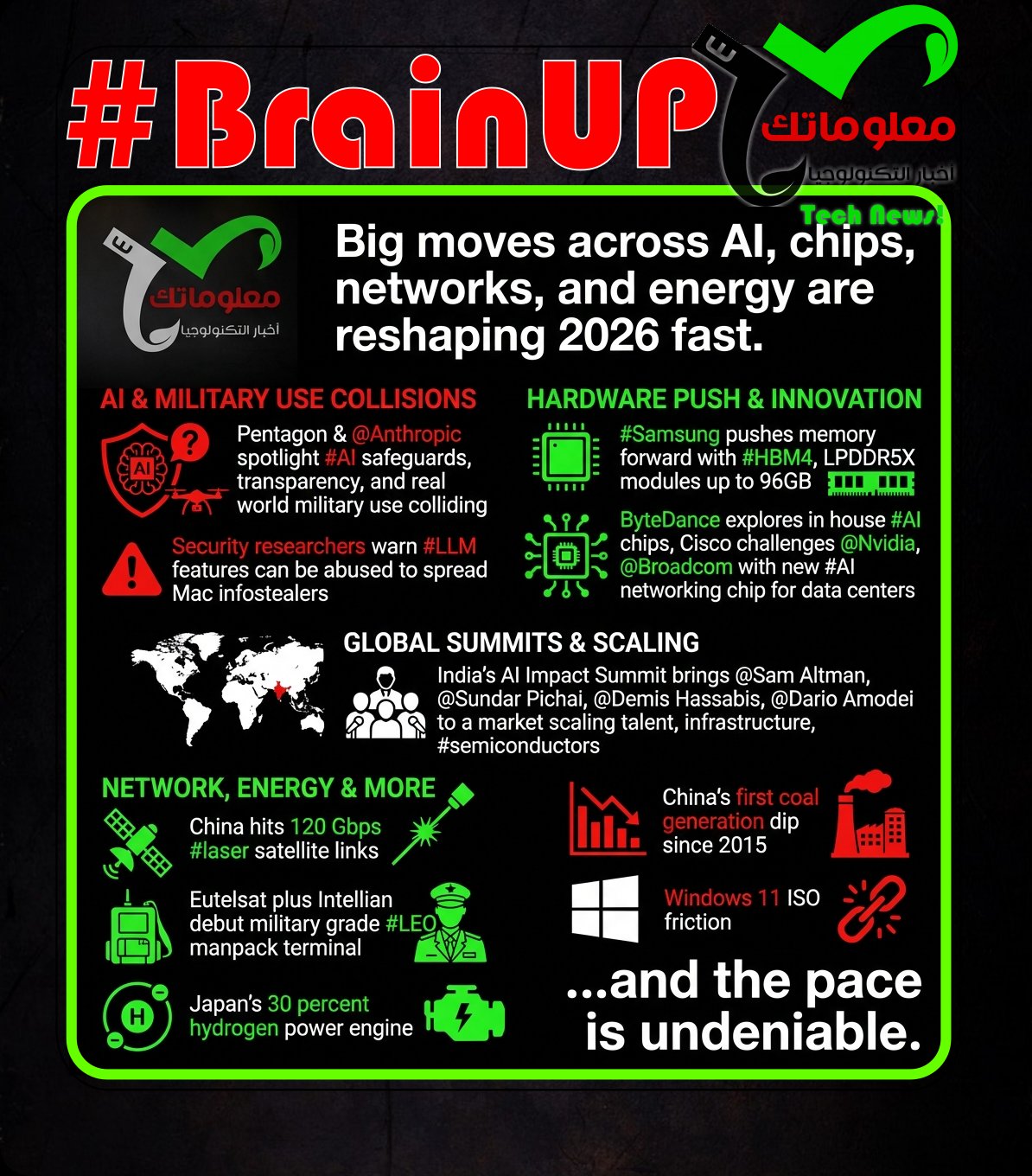
Rufus, a popular third-party utility for creating bootable USB drives, claims that @Microsoft has been actively blocking access to the latest #Windows11 ISO files. The tool experienced difficulties in downloading the official images, which it attributes to Microsoft’s intentional restriction efforts. This move potentially affects users attempting to install or upgrade @Windows11, raising concerns over #softwaredistribution policies. Microsoft has not officially confirmed these allegations, but users report consistent download failures. The situation highlights ongoing tensions between third-party utilities and @Microsoft policies impacting user flexibility.
2. Japan Has Created the World’s First Engine That Generates Electricity on 30% Hydrogen
Kawasaki Heavy Industries has started taking orders for what it says is the world’s first commercial gas engine that can generate power while co-firing up to 30% hydrogen by volume with natural gas, sold with a warranty, service schedule, and retrofit potential. The #KG series hydrogen co-firing engine followed an 11 month verification program at Kawasaki’s Kobe works (October 2024 to September 2025) that tested real-world operation issues such as hydrogen supply integration, maintainability, and safety, including leak detection and nitrogen purge systems. Kawasaki frames the 30% blend as a transition level that allows adoption with minimal changes to existing natural-gas pipeline, storage, and facility infrastructure, and it notes that earlier KG engines with over 240 orders since 2011 can be converted, extending asset life while gradually reducing carbon intensity. The article also emphasizes constraints, particularly that hydrogen fuel remains scarce and Japan imports nearly all its energy, with commercial-scale hydrogen supply chains still years away. In parallel, Kawasaki, Yanmar, and Japan Engine Corporation reported the first land-based operation of marine hydrogen engines using a newly developed liquefied hydrogen supply system, pursuing dual-fuel designs that can switch between hydrogen and diesel to cope with limited #bunkering infrastructure.
3. Pentagon threatens to cut off @Anthropic AI safeguards in dispute, @Axios reports
The @Pentagon is considering cutting @Anthropic’s access to #AI safeguards due to disagreements over @AI safety protocols. Documents reviewed by @Axios reveal that the conflict centers on @Anthropic’s transparency commitments and the @US Defense Department’s concern over #AI risks. This move underscores growing tensions between national security interests and @AI development firms. The dispute highlights the challenge of balancing #AI innovation with effective safeguards to prevent misuse, with the @Pentagon emphasizing the importance of safety measures for operational security. The outcome could influence future collaborations and regulations within the #AI industry, reflecting broader concerns about #AI safety and military applications.
4. US military used Anthropic’s AI model Claude in Venezuela raid, report says
A report says the US military used Anthropic’s #AI model Claude in an operation in Venezuela, highlighting how the US defence department is integrating #artificialIntelligence into military activities. The Wall Street Journal, citing anonymous sources, said Claude was used via Anthropic’s partnership with @Palantir Technologies, while Anthropic and the US defence department declined to comment on the claim and Palantir also refused comment. Venezuela’s defence ministry said the raid involved bombing in Caracas and the killing of 83 people, and Anthropic’s terms of use prohibit Claude from being used for violent ends, weapons development, or conducting surveillance, leaving unclear how the tool was deployed. The article situates the claim within broader military use of #AI, noting examples such as Israel’s autonomous-capable drones and AI targeting in Gaza, and US AI targeting for strikes in Iraq and Syria, alongside critic warnings about targeting mistakes and autonomous weapons. It also notes tension between AI company caution and defence demands, citing Anthropic CEO @Dario Amodei’s calls for regulation and wariness about autonomous lethal use, contrasted with the secretary of war @Pete Hegseth’s comment that the department will not employ AI models that would not allow it to fight wars, as the Pentagon also works with @Elon Musk’s xAI and uses custom versions of Google’s #Gemini and #OpenAI systems.
5. China shatters space-ground transmission record with 120 Gbps laser link
The Aerospace Information Research Institute under the Chinese Academy of Sciences reports a new domestic record for #satellite-to-ground #laser-communication, achieving a peak 120 Gbps link and surpassing the 100 Gbps mark. The test connected a self-developed 500 mm aperture laser ground station on the Pamir Plateau in Xinjiang with the AIRSAT-02 satellite, improving on prior AIR milestones of 10 Gbps in 2023 and 60 Gbps in 2025. The increase from 60 Gbps to 120 Gbps was achieved without hardware changes to the satellite, instead using in-orbit software reconfiguration to better utilize the existing payload. Reported results include link acquisition in seconds with over 93% success, up to 108 seconds of continuous communication, and 12.656 terabits transmitted during the pass. Senior engineer Li Yalin said the jump in speed is exponentially harder than earlier steps, likening 10 Gbps to a single-lane bridge and 120 Gbps to a multi-lane highway requiring efficient parallel traffic.
6. Altman and Pichai among tech CEOs heading to India for major AI summit in a key market
India is hosting the AI Impact Summit in New Delhi as major global tech companies look to expand in a key growth market with young, tech-forward consumers and deep talent. Expected attendees include @Sam Altman, @Sundar Pichai, Anthropic CEO @Dario Amodei and Google DeepMind CEO @Demis Hassabis, while @Jensen Huang reportedly withdrew due to unforeseen circumstances. The summit follows similar government-hosted #AI events in the U.K., South Korea and France, and coincides with a broader push by Prime Minister @Narendra Modi to position India as a major tech hub, including approving about $18 billion in #semiconductor projects and encouraging more manufacturing by firms like Apple. Discussions are expected to center on #AI from infrastructure, users and talent angles, with potential announcements on #data center investment as computing demand rises and with prior commitments from Amazon, Microsoft and Intel to build AI infrastructure and chips in India. With India described as a place that cannot be ignored and a top market for #ChatGPT, the summit underscores how companies see India as crucial for scaling AI adoption, investment and access to skilled workers.
7. Acer and ASUS Banned from Selling PCs and Laptops in Germany Following Nokia HEVC Patent Ruling
A court decision in Munich has forced @Acer and @ASUS to suspend direct sales of PCs and laptops in Germany after @Nokia won a patent case related to the #HEVC (H.265) video codec, with judges concluding that the companies were not operating as willing licensees under the FRAND framework that governs standard essential patents, leading to an injunction that blocks official manufacturer sales while existing retailer stock can still be sold until supplies run out. The dispute centers on whether devices shipped by the brands used Nokia’s patented video coding technology without an agreed licensing arrangement, highlighting how critical #VideoCodec standards remain in modern computers for media playback and content creation workflows. The ruling does not affect all product categories, meaning accessories and other non impacted devices continue to be available, but it introduces uncertainty for future supply and pricing in one of Europe’s biggest PC markets if licensing negotiations or appeals do not resolve the issue quickly. Industry observers and community discussions emphasize that this case may accelerate interest in open alternatives such as #AV1 to reduce exposure to patent licensing conflicts, while also showing how codec intellectual property can influence hardware availability far beyond software alone. The situation illustrates the growing intersection between patent law, global hardware distribution and the competitive dynamics of the PC industry as companies balance compliance costs against access to essential media technologies.
8. L’Oréal and NVIDIA collaborate to supercharge beauty with next-generation AI
@L’Oréal Groupe and @NVIDIA are collaborating to unlock #AI across multiple aspects of beauty, aiming to create new consumer experiences and improve engagement through creativity and technology. The partnership will leverage #NVIDIAAIEnterprise to speed development and deployment of AI, including scaling 3D digital rendering of L’Oréal products and combining physical AI with #GenerativeAI and #AgenticAI for expanded creative possibilities. A key initiative is L’Oréal’s CREAITECH, a #GenerativeAI content platform that uses 3D product rendering to accelerate marketing and advertising creation, improve quality control, and enable hyper-scalable campaigns across social media, e-commerce, and influencer marketing. Another effort is Noli, an AI-powered multi-brand marketplace backed by @L’Oréal that uses diagnostics built from over 1 million skin data points and analysis of thousands of product formulations to match users with product recommendations, supported by an AI Refinery developed with @NVIDIA and @Accenture on #MicrosoftAzure. Together, these projects connect the collaboration’s technology stack to L’Oréal’s goal of scalable innovation, personalized marketing, responsible AI deployment, and more seamless consumer beauty discovery and shopping.
9. China Turns to Robots as Population Decline Accelerates
China is increasingly relying on automation and robotics to offset the economic impact of a shrinking and aging population, as official data shows the country’s population has continued to decline and birth rates have reached historic lows, pushing policymakers and manufacturers to accelerate investment in #Robotics and #AI driven production to maintain industrial output and long term competitiveness. The shift is visible across factories where large scale deployments of industrial robots are helping fill labor shortages, with China now leading global robot installations and operating the world’s largest robotic workforce according to industry data, reflecting a strategic effort to preserve manufacturing capacity despite demographic pressure. Analysts say this approach aligns with national goals to modernize industry, support elder care and reduce dependence on human labor for repetitive tasks, while raising broader questions about productivity, employment and social adaptation as automation expands. Community discussions online reflect mixed reactions, with some viewing robotics as a practical solution to demographic decline while others worry about job displacement and long term workforce restructuring as intelligent systems become more capable. The story illustrates how demographic challenges are pushing China to accelerate its transition toward an automation heavy economic model where technology increasingly compensates for missing human workers.
10. Samsung Readies LPcAmM2 LPDDR5X Modules Up to 96GB and 9600Mbps
Samsung is developing #LPcAmM2 #LPDDR5X modules capable of reaching 96GB capacity and data transfer rates of 9600Mbps. This advancement targets high-performance computing and AI workloads, emphasizing increased memory density and speed. The new modules are expected to enhance #system efficiency and support the growing needs for #data processing. These developments demonstrate Samsung’s commitment to pushing #memory technology boundaries and meeting future #industry demands.
ByteDance is reportedly developing an in-house #AI chip and is in talks with @Samsung Electronics to manufacture it, a move that could deepen the challenge for @Nvidia in China as local firms pursue self-sufficiency. Reuters said the project, code-named #SeedChip, targets sample chips by the end of March, production of 100,000 units this year, and an eventual ramp to as many as 350,000 annually. The effort is framed as part of a broader push by Chinese tech companies to build advanced chips domestically in response to U.S. restrictions on high-end semiconductors from @Nvidia and @AMD. If successful, ByteDance’s progress, alongside rivals like @Alibaba and @Baidu advancing their own AI silicon, could further complicate @Nvidia’s attempts to revive its China business while it still awaits approval to resume H200 sales. The report ties ByteDance’s manufacturing discussions with @Samsung to the wider shift toward homegrown #semiconductors that may reduce reliance on U.S. chipmakers.
12. Samsung shows confidence in HBM, portrays next-gen road map – The Korea Times
@Song Jai-hyuk said @Samsung Electronics’ #HBM4 is achieving good manufacturing yield and that customers are very satisfied with its performance, positioning it as a return to world-class responsiveness to customer needs. The company plans to start mass production and shipments later this month, using a 1c process for the DRAM cell die and a 4-nanometer foundry process for the base die, reaching up to 11.7 Gbps versus the #JEDEC 8 Gbps standard. Song argued Samsung’s combined strengths in memory, foundry, and packaging enable a Samsung-only semiconductor synergy through co-optimization for #AI-driven products, while noting portfolio management is a business question. He outlined next steps including custom HBM with compute-in-base-die architecture that could improve power efficiency up to 2.8 times, and a vertical stacking concept called #zHBM that targets 4x bandwidth and one-quarter the power use. At #SEMICONKorea 2026, SK hynix’s Lee Sung-hoon echoed that the next decade will bring unprecedented challenges and called for AI-driven research and data collaboration across the chip ecosystem.
13. Amazon’s Ring and Google’s Nest Unwittingly Reveal the Severity of the U.S. Surveillance State
The article argues that consumer security products like @Amazon Ring and @Google Nest are reshaping everyday life into a distributed surveillance network, where features promoted as convenience and safety increasingly blur the line between personal protection and large scale monitoring powered by #AI and connected cloud infrastructure. It highlights public backlash after new neighborhood level camera coordination capabilities were showcased, with critics warning that opt in systems and automated recognition tools could normalize biometric tracking and expand surveillance beyond individual households into broader social spaces. The discussion also points to concerns around data retention and law enforcement access, suggesting that even users who avoid paid storage plans may not fully understand how footage can still be recovered or accessed under certain circumstances. The piece frames these developments as part of a wider post Snowden evolution in which corporate technology ecosystems and government security interests gradually align through infrastructure rather than explicit policy, making surveillance feel passive and ordinary rather than exceptional. Overall, the author contends that the combination of smart cameras, cloud services and automated analysis is accelerating a cultural shift where privacy becomes harder to preserve, and where seemingly benign home devices contribute to a larger debate about civil liberties and digital power.
14. AI can’t make good video game worlds yet, and it might never be able to
Generative AI is being positioned as the next way to create video game worlds, but current tools like Google’s #ProjectGenie show how far it still is from producing compelling, playable environments, and may never match what human-designed systems already achieve. The article contrasts long-standing procedural world generation in games like Minecraft and 1980’s Rogue, where developers carefully craft rules and parameters to make worlds engaging and replayable, with today’s push by major publishers toward #GenerativeAI despite backlash from gamers and many developers. Companies like Krafton, EA, and Ubisoft are investing in AI to streamline increasingly expensive development, even as the author notes the risk of job losses in an industry already marked by layoffs. Google’s #ProjectGenie, available only to US subscribers of its $249.99 per month AI Ultra plan and powered by the Genie 3 “AI world model” pitched as a stepping stone toward #AGI, generated in the author’s testing mostly uninteresting 60-second sandbox snippets where you can only wander with arrow keys and only download a recording afterward. As an early glimpse of AI world generation, it drew attention like #DALL-E and @OpenAI’s #Sora did for images and video, but the experience described suggests AI-made worlds currently lack the depth, interactivity, and integration needed to function as real game worlds.
15. Claude LLM Artifacts Abused to Push Mac Infostealers in Click-Fix Attack
Attackers exploited #Claude, an #LLM, by manipulating its artifacts to distribute Mac #infostealers. Malicious prompts used to deceive users into installing the malware. This demonstrates the vulnerability of AI models when interacting with malicious inputs, raising concerns about #cybersecurity risks. The incident underscores the need for improved #AI security measures and vigilance against adversarial exploits, especially in platforms handling sensitive data.
16. China’s coal-fired power generation declines for the first time since 2015
China’s coal-fired power generation fell 1.9% in 2025, the first decline since 2015, because new #non-fossil generation growth finally outpaced electricity demand growth, according to @Wood Mackenzie. Even as power demand rose 5% in 2025, or 494 TWh, incremental demand was met by carbon-free supply as wind and solar capacity expanded to 1842 GW over the past decade, helped by sharp #LCOE declines of 77% for utility solar and 73% for onshore wind, while nuclear rose from 27 GW in 2015 to 62 GW and nuclear plus hydro totals 445 GW. Massive grid buildout, including 340 GW of inter-regional transmission corridors, has been critical to moving remote renewable output to major load centres, reinforcing the shift away from coal as a baseload source. Coal plants are increasingly becoming flexibility providers, with capacity factors dropping to 48.2% in 2025 and about 600 GW completing flexibility retrofits, with utilisation projected to fall to 32% by 2035 as parts of the fleet move to reserve status. The report cautions that emissions may have peaked in 2024 if the trend holds, but demand shocks such as #AI and #data-centre growth, expected to lift data-centre capacity to 78 GW by 2030 from 38 GW in 2024, could keep coal on an “undulating plateau” to support grid reliability and align with China’s 2030 peak carbon commitment.
17. Cisco Unveils New AI Networking Chip Taking on Broadcom and Nvidia
Cisco has introduced a new #AI-networking chip designed to enhance data center performance. The chip targets #cloud computing and IoT applications, aiming to reduce latency and power consumption. It competes with existing solutions from @Broadcom and @Nvidia, potentially disrupting the current market. Cisco’s innovation aligns with its strategic shift towards integrated hardware and software solutions, strengthening its #position in the #AI technology sector. This development could influence the future landscape of #AI hardware deployment and market competition.
19. Dr. Oz pushes AI avatars as a fix for rural health care. Not so fast, critics say
As head of the Centers for Medicare and Medicaid Services, @Mehmet Oz is promoting #AI-based avatars and other #automation tools as a major strategy to address rural health care shortages within the Trump administration’s $50 billion modernization plan. He argues avatars could expand doctors’ reach severalfold and cites possible uses such as digital agents conducting basic medical interviews, robotic systems for remote diagnostics, drones delivering medications, and even AI-guided devices for obstetric care like robot-assisted ultrasounds that output digitized insights rather than images. CMS told NPR Oz was urging responsible exploration to extend clinicians’ reach, not replace them, and said it supports #AI-enabled tools only when they are evidence-based, patient-centered, and used under clinical oversight. The push comes amid worsening rural access, including steep cuts tied to the #OneBigBeautifulBillAct that reduces federal Medicaid spending by about $1 trillion over 10 years, and a long trend of rural hospital closures: KFF reports more than 190 closures from 2005 to early 2024, contributing to longer travel for care and higher rural death rates from leading causes flagged by CDC. Critics warn that relying on avatars risks eroding essential human connection in care, raising doubts that technology alone can resolve rural health system strain.
Eutelsat, working with Intellian Technologies, has launched what it describes as the first military-grade manpack terminal for the #OneWeb #LEO network, targeting government and defence users needing portable, resilient connectivity. The Intellian OW7MP is designed to provide secure access to Eutelsat’s global LEO service when terrestrial communications are unavailable, degraded, or denied, supporting front-line operations, emergency response, disaster relief, and remote government missions. It fits in a standard military rucksack, offers one-touch network acquisition, and can operate in GPS-denied environments, and Intellian highlights features such as #TxMute and #R-GNSS plus support for #COTM and #COTP. @Steve Mills said governments need instantly deployable connectivity “without compromise,” framing the device as an expansion of Eutelsat’s global government offering, while @Eric Sung said the design addresses evolving defence demands by reducing trade-offs between connectivity and safety. Overall, the terminal is positioned as a practical way for mission-critical users to access high-speed, low-latency LEO connectivity across contested and demanding environments.
21. UK economy faces slowdown amid rising inflation and policy tightening
The UK economy is experiencing a slowdown due to rising inflation, which erodes consumer purchasing power and increases costs for businesses. Evidence shows that #interest rates have been increased to curb inflation, impacting borrowing and investment. Analysts suggest that the growth rate may dip below expectations as #consumer spending weakens and #manufacturing output declines. Despite efforts to control inflation, concerns persist about a potential recession if the slowdown persists. The situation underscores the challenge policymakers face in balancing #inflation control with economic growth.
That’s all for today’s digest for 2026/02/16! We picked, and processed 18 Articles. Stay tuned for tomorrow’s collection of insights and discoveries.
Thanks, Patricia Zougheib and Dr Badawi, for curating the links
See you in the next one! 🚀
