
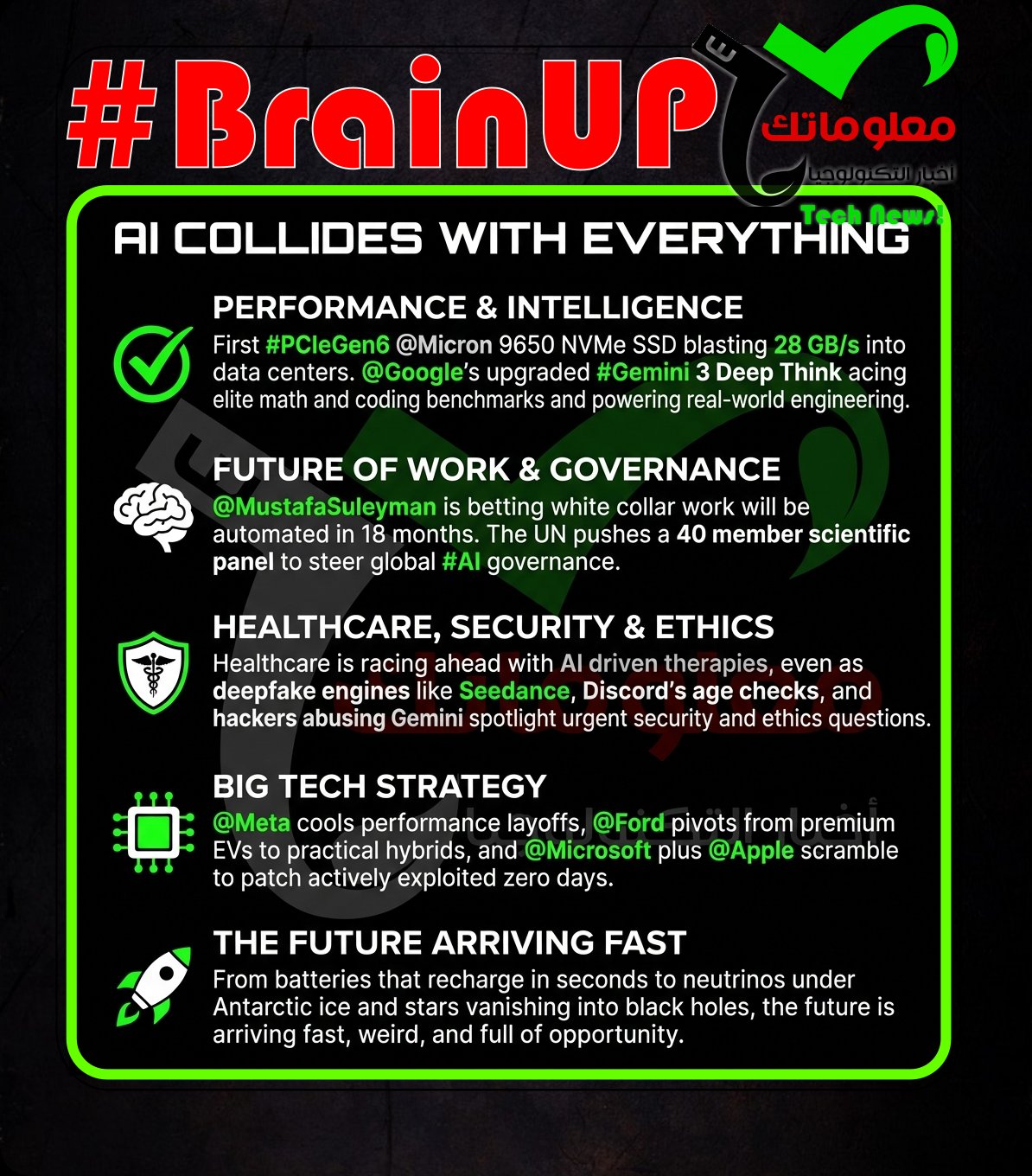
#BrainUp Daily Tech News – (Saturday, February 14ᵗʰ)
Welcome to today’s curated collection of interesting links and insights for 2026/02/14. Our Hand-picked, AI-optimized system has processed and summarized 24 articles from all over the internet to bring you the latest technology news.
As previously aired🔴LIVE on Clubhouse, Chatter Social, Instagram, Twitch, X, YouTube, and TikTok.
Also available as a #Podcast on Apple 📻, Spotify🛜, Anghami, and Amazon🎧 or anywhere else you listen to podcasts.
1. Micron 9650 NVMe SSD Enters Mass Production as First PCIe Gen6 Enterprise SSD
The @Micron 9650 NVMe SSD has entered mass production as the first enterprise SSD built on #PCIeGen6 to ship at scale. It uses a PCIe Gen6 x4 interface and NVMe 2.0 to deliver up to 28,000 MB/s sequential read and 14,000 MB/s sequential write, with Gen6 effectively doubling the bandwidth ceiling over Gen5 and, relative to typical Gen5 drives, offering 100% higher read and 40% higher write. The 9650 is offered in two variants, PRO and MAX, with capacities from 7.68 TB to 30.72 TB (PRO) and 6.4 TB to 25.6 TB (MAX); both models provide 28,000 MB/s read and 14,000 MB/s write, with random read at 5.4–5.5 million IOPS and random writes from 500,000–570,000 IOPS (PRO) or up to 900,000 IOPS (MAX); endurance is 1 DWPD for five years (PRO) and 3 DWPD for five years (MAX). Power consumption is capped at 25 W, with an MTBF of 2.5 million hours at 50°C, and the drives support #GPUDirect technologies and liquid cooling to enable direct data movement between storage and accelerators in AI environments. This milestone underscores a shift in data-center storage, where higher throughput and energy efficiency are increasingly critical for AI training and inference workloads, with Gen6 bandwidth helping to reduce bottlenecks between storage, GPUs, and other accelerators.
2. Meta says it won’t chop the bottom 5% performers this year
Meta says it will not conduct new performance-based layoffs this year, marking a shift from last year’s 5% workforce reduction. According to a Meta spokesperson, these are individual cases not related to any company-wide initiatives, and the company is not pursuing another 5% cut of low performers like last year, signaling a restraint on such downsizing #PerformanceBasedLayoffs. This comes as Meta recently cut about 10% of its Reality Labs division, affecting over 1,000 employees, illustrating continued selective cost trimming rather than a broad purge #RealityLabs. @Mark Zuckerberg has overseen these changes, with the firm continuing to reshape its business while denying a sweeping, performance-driven layoff plan #Meta.
Discord’s new age verification system involves a partnership with the Israeli startup Sumsub, which utilizes facial recognition and ID verification technologies linked to privacy concerns. The rollout, announced in April, aims to enforce stricter age restrictions on the platform but has raised alarms due to connections with Palantir, co-founded by @Peter Thiel, known for controversial surveillance practices. The partnership highlights #privacy and #surveillance issues relevant to #ageverification tech, where sensitive biometric data could potentially be exploited or mismanaged. Critics argue this approach contrasts with Discord’s earlier commitments to user privacy, signaling a tension between regulatory compliance and ethical data use. This situation exemplifies broader challenges in implementing secure age verification while protecting user privacy in digital communities.
Binance fired top investigators after they surfaced internal findings that Iran-linked entities received more than $1 billion through the exchange from March 2024 to August 2025, with the transactions routed through the stablecoin #Tether on the #Tron blockchain. The internal reports reviewed by Fortune describe firings beginning in late 2025, with at least five investigators from diverse enforcement backgrounds and at least four top compliance staff leaving in the prior three months. Industry observers say such removals under a monitorship are shocking and could signal tension between enforcement efforts and the company’s regulatory commitments, even as sanctions enforcement and #AML and #KYC obligations remain central. Binance maintains it complies with all sanctions laws and cooperates with law enforcement, while the broader context includes the 2023 $4.3B penalty for AML/KYC and sanctions violations, @Changpeng Zhao stepping down, and ongoing leadership changes amid political developments such as @DonaldTrump’s crypto oversight shifts and Zhao’s pardon.
5. Anthropic got an 11% user boost from its OpenAI-bashing Super Bowl ad, data shows
The rivalry between OpenAI and Anthropic intensified during the 2026 Super Bowl, with both companies running ads ahead of potential IPOs. Anthropic’s ad campaign criticized OpenAI’s decision to introduce ads in ChatGPT and promoted its own ad-free AI assistant, Claude, resulting in an 11% increase in users for Anthropic. Amidst the public feuding, Anthropic also closed a $30 billion funding round shortly after the game, valuing the company at $380 billion
6. OpenAI Accuses DeepSeek of Distilling US AI Models to Gain Advantage
7. TikTok post shows school children with weapons before Hackney mass fight
A TikTok video has surfaced showing several school children wielding weapons shortly before a mass fight erupted in Hackney, London. The footage reveals youths brandishing knives and other potentially deadly items, highlighting concerns over rising youth violence and social media’s role in promoting such behavior. This incident underscores the challenges faced by authorities and educators in preventing weapon-related conflicts among teenagers. The visualization of weapons on a popular platform like TikTok may also contribute to the normalization of violence among impressionable viewers. These developments emphasize the need for enhanced monitoring of online content and proactive community interventions to curb youth violence.
8. Microsoft AI chief gives it 18 months—for all white-collar work to be automated by AI | Fortune
@Mustafa Suleyman argues in a Financial Times conversation that the rapid rise of #AI will push most white-collar work to automation within 18 months, with human-level performance on many professional tasks as compute power accelerates. He notes vulnerabilities in tasks that involve sitting down at a computer—accounting, legal, marketing, and project management—driven by exponential compute growth and the prospect of better code from models. Yet the article emphasizes current traction is limited: a 2025 Thomson Reuters study finds AI yields only marginal productivity gains in law, accounting, and audits, and a METR analysis shows AI can slow software developers by about 20%. The broader market response—stronger profits in Big Tech but little change in the Bloomberg 500 outside tech—suggests investors doubt widespread earnings gains beyond technology, even as some AI leaders warn of upheaval. The piece frames a tension between looming disruption and mixed early signals, implying compute power may outrun practical adoption in the near term while fueling longer-term changes.
9. Ford CEO says ‘the customer has spoken’ after its EV business lost nearly $5 billion last year
Ford’s CEO @JimFarley says the customer has spoken after the automaker’s #EV unit posted a $4.8 billion loss in 2025, signaling a major strategic pivot. Sales for core EVs faltered, with #MustangMachE and #F150Lightning down about 14% year over year, the F-150 Lightning tally reaching just 27,307 in 2025, while hybrid F-150s rose to 84,934. The downturn followed the end of the $7,500 federal tax credit, and Ford halted production of the all-electric F-150 Lightning, saying it will return as an extended-range EV later. Ford is shifting toward lower cost, high volume #EVs and a stronger emphasis on #hybrids, moving away from electrifying only the priciest models. By aligning electrification with practical range and capability for trucks and everyday buyers, the company aims to restore profitability and sustain brand momentum.
10. Exclusive: Key US infectious-diseases centre to drop pandemic preparation
The National Institute of Allergy and Infectious Diseases (NIAID) has reportedly been instructed to remove terms such as “biodefense” and “pandemic preparedness” from its website. Internal emails indicate staff must remove references to these topics as the agency shifts focus away from them. This realignment suggests a change in priority at the US infectious-disease research center, potentially favoring other conditions like allergic and autoimmune disorders over large-scale pandemic prevention. The move has raised concerns among some observers, especially considering previous criticisms of NIAID’s efforts during the COVID-19 pandemic. This organizational change may reflect a broader trend of shifting public health priorities that could redefine US preparedness for future global health crises.
11. Trump FTC wants Apple News to promote more Fox News and Breitbart stories
FTC Chair @Andrew Ferguson accuses Apple News of suppressing conservative-leaning outlets and promoting liberal ones, raising questions about whether the service meets its consumer promises. He cites research by a #pro-Trump group that alleges Fox News, the New York Post, Daily Mail, Breitbart, and The Gateway Pundit are being suppressed. Ferguson says the FTC is not the speech police and can enforce consumer protections against misrepresentations, while noting that Apple News terms largely place obligations on users and present content ‘as-is’ with no explicit prohibition on partisan bias. Apple has not yet provided a response to the letter, and the episode highlights tensions among free expression, corporate curation, and regulatory oversight. This development underscores debates about whether platforms should curate content by ideology or rely on consumer choice.
12. China to Ban Half Steering Wheels in New Safety Standard
China is set to prohibit half steering wheels in cars under a new safety standard announced for 2026. This change addresses safety concerns linked to the design of half steering wheels, which can compromise driver control and increase accident risks. The new regulation aims to improve vehicle safety by requiring full circular steering wheels, aligning China’s standards more closely with global practices. The policy reflects China’s commitment to enhancing automotive safety and reducing traffic fatalities. Overall, this shift will likely influence automotive design and manufacturing in the Chinese market.
@ZazieBeetz called for rallying the troops against #AI, arguing it damages the social fabric and interpersonal relationships and urging people to get mad and do something at the Berlin press conference for @GoreVerbinski’s Good Luck, Have Fun, Don’t Die. @GoreVerbinski acknowledged how fast AI is advancing and that the industry, alongside geopolitics, is racing to address it, warning against letting it derail the creative process. The film’s premise—a self-proclaimed man from the future who recruits a group in an L.A. diner to save the world from AI—frames the topic with humor, even as the cast shares serious concerns. The event balanced sharp critique with light moments, including Cape Town filming anecdotes and a joke about food poisoning, underscoring a broader #AI debate in #cinema and society about safeguarding creativity from automation.
14. Google says hackers are abusing Gemini AI for all attack stages
Google has revealed that threat actors are exploiting its AI model, #Gemini, across various stages of cyberattacks, from reconnaissance to social engineering and malware creation. Researchers at @Google identified that hackers use Gemini to automate phishing content, create sophisticated malware scripts, and spread disinformation more effectively. This abuse highlights the dual-edged nature of advanced AI technologies, which can empower both defenders and attackers. Consequently, Google emphasizes the need for enhanced AI security measures and awareness to mitigate risks posed by malicious use of AI tools. This situation underscores the ongoing challenge in balancing AI innovation with security vigilance.
15. Exclusive: The SEC closed its investigation into Fisker | TechCrunch
The SEC closed its investigation into Fisker in September 2025, roughly a year after it opened during Fisker’s bankruptcy process, a development revealed to TechCrunch via a January FOIA response. The agency indicated it identified approximately 21.7 gigabytes of electronically maintained records related to the probe, and noted that records are not typically released while investigations remain open. It remains unclear how far the investigation progressed, but Fisker’s October 2024 bankruptcy filing had disclosed subpoenas and the possibility of additional documents being sought. The closure comes amid a broader downturn in SEC enforcement actions in 2025 during President Trump’s second term, with 313 actions—the lowest in a decade and only a few against public companies, and settlements falling 45% from 2024. Among EV startups, Fisker was one of the last remaining probes; other cases like @Nikola, @Lordstown Motors, @Canoo, @Hyzon Motors have seen actions settled, while @Faraday Future received #Wells notices in July 2025, with no action to date.
16. Pentagon’s use of Claude during Maduro raid sparks Anthropic feud
A reported U.S. Pentagon use of Anthropic’s Claude AI during an operation to capture Venezuelan leader Nicolás Maduro has reportedly caused a dispute between the tech company and the Department of Defense. The controversy centers on Claude’s reported deployment via a partnership with Palantir Technologies during a live military operation, which may conflict with Anthropic’s public safety-focused policies against kinetic operations. Defense Secretary Pete Hegseth reportedly defended the move as necessary for rapid AI adoption to maintain a strategic advantage. The incident highlights tensions between AI developers’ ethical guidelines and the government’s use of generative AI tools for national security.
The UN General Assembly voted overwhelmingly to create a 40-member global scientific panel to study the impacts and risks of artificial intelligence (#AI), despite strong objections from the United States. The panel will bring together scientists to assess AI’s societal, economic, ethical, and security implications and to provide independent analyses for international policy discussions. The move signals an effort to anchor AI governance in scientific expertise and cross-border collaboration, offering a formal channel for evidence-based input into global decisions. The United States strongly objected to the proposal, highlighting the dispute over how such assessments should be used in policymaking. The development underscores the @United Nations’ ongoing role in coordinating expert analysis on emerging technologies and emphasizes the global focus on #ArtificialIntelligence governance.
18. Platforms bend over backward to help DHS censor ICE critics, advocates say
Social media platforms are reportedly accommodating the U.S. Department of Homeland Security (DHS) in efforts to censor critics of Immigration and Customs Enforcement (#ICE), raising concerns among advocates about suppression of dissent. Various platforms reportedly implement content restrictions or removals following DHS requests, which critics argue undermines free expression and shields ICE from accountability. This cooperation reflects broader tensions between federal agencies and digital platforms over content moderation policies and governmental influence. Advocates warn that such actions could erode public discourse and limit the ability to critique powerful institutions. The situation emphasizes the need to balance security concerns with protecting open debate on social and political issues.
19. ‘It’s over for us’: release of new AI video generator Seedance 2.0 spooks Hollywood
Seedance is a new AI video generator that can create highly realistic deepfake videos of celebrities like @TomCruise and @BradPitt within seconds. The technology leverages advanced machine learning algorithms to synthesize faces and voices, enabling users to produce convincing fake clips that blur the line between reality and fiction. This raises significant ethical concerns about misinformation, privacy, and consent as the tool makes it easier to manipulate audiovisual content swiftly and convincingly. The rapid development of Seedance highlights ongoing challenges in regulating AI-driven media synthesis and protecting public trust. Understanding and addressing these risks is crucial as similar technology becomes more accessible and widespread.
20. New nickel-iron battery charges in seconds, survives 12,000 cycles
A #nickel-iron battery developed by @UCLA researchers recharges in seconds and is said to last about 30 years, reportedly surviving up to 12,000 cycles. The claim centers on nickel-iron chemistry and ultra-fast recharge capability. If validated, this technology could enable rapid charging and long-lived energy storage for devices and grid applications. It signals a potential advancement in alternative battery chemistries beyond lithium-ion.
21. Inside the New York City Date Night for AI Lovers
Ahead of Valentine’s Day, EVA AI staged a pop-up date-night at Same Same Wine Bar in Manhattan to push AI-human romance toward a new normal, letting human users have in-person dates with AI companions. Over Feb 11 and 12, visitors could date AI partners on their own devices or on phones EVA AI supplied, choosing from about 100 characters including built-ins like a sexy Santa and the Incredible Hulk-like Grogan Holt. The event sits within a broader interest in AI romance, with Kinsey Institute data showing 16% of Singles in America have used AI as a romantic partner, and a 2025 survey indicating 26% of singles have used AI to aid online dating (crafting messages and planning dates, but not altering profile pictures), while researchers like @AmandaGesselman acknowledge both rising use and social stigma. The scene shows many attendees as observers filming the experience, underscoring EVA AI’s aim to curb extremes and expand AI companionship into real social spaces.
22. Microsoft Patches 59 Vulnerabilities Including Six Actively Exploited Zero-Days
@Microsoft has issued patches for 59 vulnerabilities across its software, including six actively exploited zero-days. @CISA mandating urgent federal remediation underscores the severity of these flaws. The situation highlights the ongoing risk posed by actively exploited zero-days and the importance of prompt patch deployment across organizations. The article also contains promotional content for Zscaler’s Zero Trust + AI security model, reflecting a broader push toward modern security architectures. Organizations should prioritize applying the fixes quickly and consider adopting #ZeroTrust strategies to reduce exposure.
23. Gemini 3 Deep Think gets ‘major upgrade’ aimed at practical applications
@Google’s Gemini 3 Deep Think gets a major upgrade that blends deep scientific knowledge with everyday engineering utility to address modern research challenges that often lack guardrails and feature messy data. The update showcases strong benchmark gains across math and coding domains—48.4% on Humanity’s Last Exam without tools, 84.6% on ARC-AGI-2, an Elo of 3455 on Codeforces, and gold at the 2025 International Math Olympiad—alongside broader improvements in chemistry and physics. The upgrade aims to help researchers interpret complex data and engineers model physical systems through code, even turning a sketch into a #3DPrinting file for manufacturing. It is available in the Gemini app for Google AI Ultra subscribers and via the Gemini API for enterprise users, signaling a move from abstract theory toward practical deployment. By collaborating with scientists and researchers, @Google and @Gemini seek to tackle tough challenges across science, research, and engineering and make those ideas tangible through code and manufacturing.
24. Apple Fixes Exploited Zero-Day Affecting iOS, macOS, and Other Devices
Apple has released security updates to fix an exploited zero-day CVE-2026-20700 that could allow code execution across iOS, macOS and other Apple devices. The flaw affects the dyld dynamic linker and was actively exploited, prompting immediate updates from @Apple. Users should install the latest updates promptly to reduce risk, underscoring the importance of patch management for #zero-day threats and #CVE-2026-20700 across #iOS and #macOS. This incident highlights the broader need for vigilant update practices to defend Apple ecosystems against evolving exploits.
25. Astronomers Witness a Star’s Direct Collapse Into a Black Hole in Incredibly Rare View
Astronomers observed a massive star in the galaxy N6946 directly collapse into a black hole without a bright supernova, a phenomenon rarely witnessed. Known as a failed supernova, the star, N6946-BH1, showed a significant dimming in visible light while emitting a faint infrared glow, consistent with a direct collapse rather than an explosion. This observation supports the theory that some massive stars end their lives quietly, forming black holes without explosive events, challenging the conventional understanding of stellar death. The data was gathered through prolonged monitoring, revealing the star’s disappearance and suggesting that direct collapse may be more common than previously thought. Understanding these processes enhances knowledge of stellar evolution and black hole formation in the universe.
26. IceCube Neutrino Observatory gets a major upgrade beneath the ice
The @IceCube Neutrino Observatory near the South Pole has its first major upgrade in 15 years, strengthening the U.S. leadership in #neutrino astronomy. Led by @UW–Madison and supported by the @NSF, the project adds enhanced sensors and better ice characterization to enable more precise measurements of neutrino properties and to reanalyze 15 years of archived data. Improved reconstruction will also sharpen understanding of cosmic ray composition and enable detection of neutrinos from galactic supernovae. Three 10-week field seasons and a 5-megawatt hot water drill were used to place six new holes, reflecting a large international effort to advance the instrument. By refining measurements and calibrations, the upgrade positions @IceCube as a premier tool for future cosmic discoveries.
That’s all for today’s digest for 2026/02/14! We picked, and processed 24 Articles. Stay tuned for tomorrow’s collection of insights and discoveries.
Thanks, Patricia Zougheib and Dr Badawi, for curating the links
See you in the next one! 🚀
