
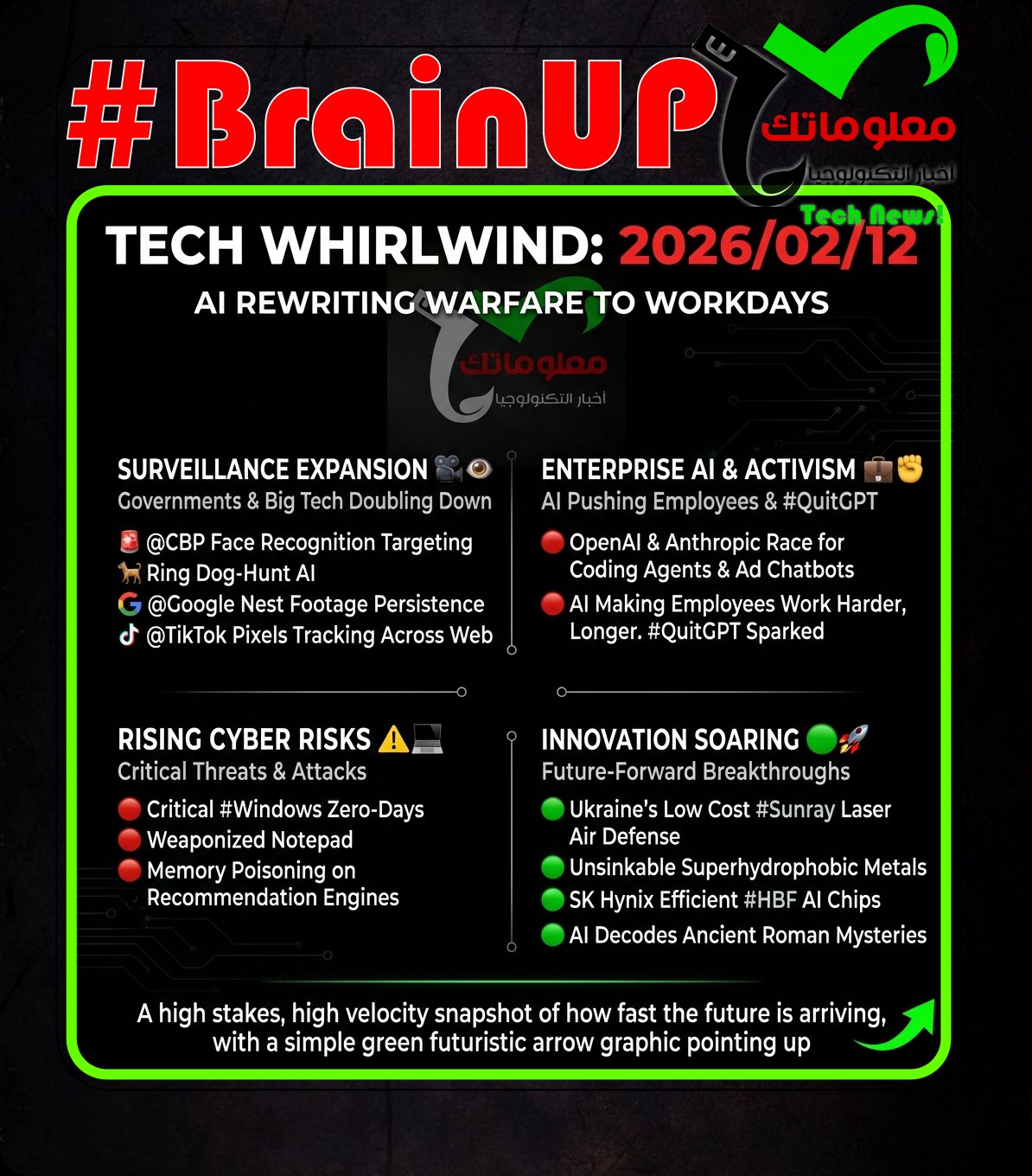
#BrainUp Daily Tech News – (Thursday, February 12ᵗʰ)
Welcome to today’s curated collection of interesting links and insights for 2026/02/12. Our Hand-picked, AI-optimized system has processed and summarized 27 articles from all over the internet to bring you the latest technology news.
As previously aired🔴LIVE on Clubhouse, Chatter Social, Instagram, Twitch, X, YouTube, and TikTok.
Also available as a #Podcast on Apple 📻, Spotify🛜, Anghami, and Amazon🎧 or anywhere else you listen to podcasts.
1. CBP Signs Clearview AI Deal to Use Face Recognition for ‘Tactical Targeting’
@CBP has signed a one-year, $225,000 contract to provide its intelligence units with access to @ClearviewAI’s face recognition service, built on more than 60 billion publicly available images, for day-to-day work including ‘tactical targeting’ and ‘strategic counter-network analysis’ #face-recognition. The deal extends access to CBP’s INTEL and the National Targeting Center, part of a broader effort to disrupt, degrade, and dismantle perceived threats. CBP says it draws from a variety of sources, including commercial tools and publicly available data, to identify people and map connections, and acknowledges handling sensitive biometric data with nondisclosure agreements, though the contract does not specify uploads, whether searches may include US citizens, or retention. The arrangement arrives amid scrutiny of federal use of facial recognition and concerns about routine deployment, with lawmakers such as @Senator_Ed_Markey proposing to bar CBP and ICE from such technology without safeguards. The integration could tie into CBP’s Automated Targeting System and Traveler Verification System, though DHS’s privacy inventory and NIST testing indicate limitations and ongoing debates about accuracy and privacy.
2. Why are people disconnecting or destroying their Ring cameras?
Ring’s ‘Search Party’ uses AI to scan live camera feeds to compare footage with a missing dog’s photo, and the feature is presented as voluntary with owners deciding each time whether to participate. Amazon’s @AndyJassy says the system can be started through the Ring app even without a Ring camera, and the AI is trained on tens of thousands of dog videos to recognize breeds, sizes, fur patterns, and colors. Privacy experts, including @JayStanley of the @ACLU, warn the technology could be misused to track people or suppress political expression as part of a broader #surveillance landscape that includes #Flock cameras, #license-plate-readers, and facial recognition tools. The companies say participation is voluntary and access is limited to authorized law enforcement, but reports show departments sometimes share data with federal immigration authorities. The piece notes Ring and Flock have aided investigations and even helped domestic violence victims in Illinois, while Colorado police used Flock to track a vehicle linked to a dealership arson, underscoring the tension between crime solving and civil liberties.
3. AI makes the workday longer and more intense: HBR study
AI is extending the workday and intensifying effort as employees work faster, take on a broader range of tasks, and push into more hours. In a study of 40 workers at a 200-employee tech company, researchers @ArunaRanganathan and @XingqiMaggieYe of UC Berkeley’s Haas School of Business found that while AI tools were not mandated, workers voluntarily increased workload due to AI making ‘doing more’ feel possible and rewarding. This workload creep comes with cognitive strain, the risk of burnout, and potentially lower quality work or weaker decision making if boundaries aren’t maintained. Berkeley researchers call for intentional pauses and standards to prevent burnout, noting that productivity gains can mask unsustainable effort, while industry analysts at @Forrester caution that AI’s impact on overall productivity remains uncertain.
4. Engineers Just Developed a Perfect Material for a Truly Unsinkable Ship
A new superhydrophobic metal inspired by the diving bell spider @Argyroneta aquatica could underpin truly unsinkable ships, using laser-etched nano- and microscale patterns to trap air and boost buoyancy #superhydrophobic #airtrapping. In the 2026 Advanced Functional Materials work by @Chunlei Guo and colleagues at the University of Rochester, a divider was added inside the tube so trapped air remains intact even when the structure is pressed vertically or damaged, improving reliability in turbulent water. Tests in rough environments over weeks showed no degradation of buoyancy, and the tubes could be rafted together to support large loads or serve as flotation foundations for wave-energy technologies #greenenergy #waveenergy. The approach sits within broader biomimicry trends that turn natural strategies—air-trapping, textured surfaces, and robust containers—into practical flotation components, linking basic science to scalable, real-world applications #biomimicry. If scaled, these tubes could form the flotation bedrock of future unsinkable platforms, advancing marine vessels and green-energy devices alike.
5. Trump orders the military to make agreements with coal power plants
@Trump issued an executive order directing the Secretary of War, in coordination with the Secretary of Energy, to procure power from the United States coal generation fleet by approving long-term Power Purchase Agreements or similar contracts to serve Department of War installations and other mission-critical facilities, effectively tying the military to coal. The piece notes coal is the second most expensive power source for the US grid, eclipsed by other sources in cost, and it is described as producing the most pollution, including particulates, chemicals, toxic metals in coal ash, and the most carbon dioxide per unit of energy, underscoring the environmental and economic tension #coal #PowerPurchaseAgreements. It argues the justification of lower cost and cleaner operation is not supported and cites Texas’ grid failures as a contradiction to coal’s claimed reliability. The action would lock in long-term contracts beyond 2029, potentially persisting past @Trump’s term, signaling a policy preference for coal over market-based options. Earlier efforts to declare an energy emergency to keep coal plants open are noted, with ongoing legal challenges highlighted.
6. Samsung and SK Hynix Shorten Memory Contracts as Pricing Power Shifts Back to Suppliers
Samsung and SK Hynix, two major #memory chip manufacturers, are reducing the length of their supply contracts with customers, signaling a shift in pricing power back to suppliers after a period of buyer dominance. This change reflects growing market demand and the tightening of chip supply, which allows suppliers more flexibility to adjust prices frequently. Shorter contracts mean customers face more frequent price adjustments, aligning with the improving market conditions for the #semiconductor industry. This strategic move from Samsung and SK Hynix also corresponds with forecasts of increased memory chip consumption due to advancements in AI and data centers. Overall, these adjustments suggest a more supplier-driven market environment, benefiting major manufacturers like @Samsung and @SKHynix.
SK Hynix has introduced a new AI chip architecture featuring the HBF (Hybrid Buffer Fabric) technology, which significantly enhances performance per watt by up to 2.69 times. This advancement reflects SK Hynix’s commitment to improving efficiency in AI processing, addressing the growing demand for more energy-efficient AI hardware. The HBF design enables faster data transmission and better power management, helping reduce operational costs and environmental impact. By integrating this technology, SK Hynix positions itself competitively in the AI chip market, supporting advanced applications and workloads. This innovation marks a key step in the evolution of AI hardware, aligning with broader industry trends towards greater computational efficiency.
8. Google recovers “deleted” Nest video in high-profile abduction case
In the Nancy Guthrie abduction case, investigators released video from Guthrie’s @Nest doorbell that had been thought deleted because Guthrie wasn’t paying for storage, illustrating that data can persist in @Google’s backend long after it is unavailable to the user. The article explains current storage options: under the free tier, about three hours of event history are retained; the #HomePremium plan ($10/month) stores 30 days of events, while a $20/month tier stores 60 days of events with 10 days of full video, with non-paying accounts seeing even shorter retention. Evidence suggests the video was recovered from residual data in backend systems, and it remains unclear how long such data is kept or how easily Google can access it, implying deletion is not always final and may depend on policy or legal orders. Publishing the video could aid investigators and public help in the case, while the article notes Google cooperated with investigators. The piece also touches on data-use concerns, noting Google says it does not use user videos to train AI models, though user interactions with the service may be used to improve features.
9. Investigators wrangled video from Nancy Guthrie’s Google Nest camera out of ‘backend systems’
Investigators recovered video from Nancy Guthrie’s front-door Google Nest camera despite the camera being disconnected and no subscription saving footage. FBI Director @KashPatel said they retrieved the video from ‘backend systems’ after lawful searches, and with the cooperation of private-sector partners, excavating material that would have been considered deleted. Experts say cloud-based #Nest cameras sit on a complex #backend infrastructure, meaning data can persist in locations between devices and the cloud. Nest’s architecture involves cloud storage with tiers such as #Standard (event-based history) and #Advanced (24/7 recording), and newer models may include backup batteries or local storage, so data could reach or linger in places even if a device is offline or unsubscribed. This case highlights how consumer #Nest ecosystems intersect with law enforcement access, raising questions about data retention and privacy in backend systems.
10. Ukraine Develops Low-Cost Laser Air Defense System to Counter Russian Drones
Ukraine has developed a portable laser air defense system called #Sunray that can be mounted on a pickup or fit in a car trunk to counter Russian drones at a much lower cost than Western systems. In a field test described by The Atlantic, the laser burned through a small drone within seconds, and developers say the system was built in about two years at a few million dollars and could be sold for several hundred thousand dollars per unit. The system is compared to the US Navy’s #HELIOS, a higher-cost program, while other low-cost options like the P1-Sun interceptor drone cost just over $1,000. Experts note such lasers may not stop ballistic missiles but could significantly reduce threats from mass drone attacks against cities and infrastructure. This effort aligns with President @VolodymyrZelensky’s push for locally produced air defense capabilities amid ongoing drone and missile assaults and Western aid delays.
11. Victory for Elon Musk: US labor board abandons authority over SpaceX
The National Labor Relations Board (NLRB) has decided to drop its authority over SpaceX, marking a significant legal win for @ElonMusk. This move follows a prolonged dispute where the NLRB sought to assert jurisdiction over the company amidst concerns about unionization under federal labor laws. By relinquishing control, the NLRB effectively curbed its regulatory reach, reflecting challenges in applying traditional labor frameworks to innovative, high-tech firms like #SpaceX. This development affects broader debates on labor rights and union influence in the tech and aerospace sector. The decision not only shapes the future of worker organization at SpaceX but also signals a shift in how regulatory bodies address emerging industries.
12. Anthropic beefs up Claude’s free tier as OpenAI prepares to stuff ads into ChatGPT’s interface
Anthropic has enhanced the free tier of its AI assistant Claude with a larger request limit and a new features page, responding to OpenAI’s announcement of introducing ads in ChatGPT’s free version. This update allows free users up to 15,000 words per month, about a 50% increase, and offers clarity on paid tiers and usage policies. The move positions Claude as a more attractive alternative amid growing concerns about ChatGPT’s monetization strategy, which includes ad placement and subscription plans. By improving its free access and transparency, Anthropic aims to capture users seeking reliable and cost-efficient AI chat solutions. This competition underscores the evolving landscape of #AI chatbots and user expectations for free versus paid services.
13. UpScrolled’s social network is struggling to moderate hate speech after fast growth | TechCrunch
UpScrolled’s rapid growth to more than 2.5 million users has outpaced its ability to moderate hate speech and extremist content on the platform. TechCrunch documented a wide range of racial slurs in usernames and hashtags, and reported that UpScrolled’s public email said the company is ‘actively reviewing and removing inappropriate content’ even as offending accounts remained online. The ADL also noted antisemitic and extremist content on UpScrolled and cited the designation of foreign terrorist organizations, such as Hamas, on the platform. The situation highlights the tension between open expression and user safety on a fast-growing network and points to the need for stronger moderation tools, clearer policies, and faster enforcement #moderation #hate_speech #extremism.
In 1987, Oracle co-founder @Larry Ellison argued that #AI should be used sparingly and not treated as a universal solution. In a roundtable chaired by @Esther Dyson, Ellison framed Oracle as a #DBMS company and said AI should be an internal tool to improve how systems are built, not an end-user novelty. He maintained that not all tasks require judgment, suggesting that even expert roles can be augmented rather than fully automated, and warned against AI maximalism by focusing on where automation adds real value. The piece notes this contrarian stance remains relevant in 2026 as businesses weigh how much to rely on #AI and where to embed decision-making capabilities.
15. UK space rocket firm on brink of collapse – just months before first launch
Orbex, a UK space rocket firm, is on the brink of collapse and will appoint administrators after failing to secure funding, jeopardising its Prime microlauncher program that was on the cusp of first test flights later this year. Evidence shows it filed a notice of intention to appoint administrators after a Series D funding round failed and after exploration of merger and acquisition options yielded no rescue, with Orbex noting that hundreds of skilled jobs in Scotland and the UK’s space ambitions are at risk. @PhilChambers, Orbex chief executive, said that space rocket development is capital-intensive and has a long development cycle, and highlighted the need for institutional support to bridge the funding gap. SaxaVord Spaceport chief executive @ScottHammond said the news will have little impact on SaxaVord, which is multi-client and ready for launches from other clients, and that Orbex had never started on site there despite heads of terms. Overall this episode underscores the fragility of the UK’s early launch sector and the risk that funding gaps pose to maintaining momentum in #microlauncher #UKspace.
16. OpenAI launches new agentic coding model only minutes after Anthropic drops its own
OpenAI has swiftly introduced a new agentic coding model shortly after competitor Anthropic released its version, showcasing rapid advancements in AI-assisted programming. OpenAI’s model is designed to autonomously write and debug code, enhancing developer productivity by interpreting complex instructions and iterating solutions independently. This move evidences intense competition in the AI code generation space, highlighting how leading firms prioritize innovation and deployment speed to capture market leadership. The simultaneous launches underscore a trend where AI models are becoming increasingly capable of handling intricate coding tasks without constant human input. These developments affirm the growing importance of AI in software development workflows, pushing forward the capabilities of coding assistance technology.
17. TikTok is tracking you, even if you don’t use the app. Here’s how to stop it
TikTok tracks you even if you never use the app, expanding its reach across the web through an updated #tracking #pixel that harvests data from partner sites and shares it with @TikTok. The article notes it collects highly sensitive information, including cancer diagnoses, fertility, and mental health crises, and gives an example where submitting a cancer form sent a website user’s email and details to @TikTok. This invasive data sharing enhances targeted advertising and measurement across networks, raising privacy concerns in the wake of TikTok’s US operation sale. @BBC notes that privacy settings exist to give users control, but many people remain unaware of the extent of the data collected. The piece offers quick steps to reduce exposure, stating that about five minutes of action can help, such as adjusting privacy settings and limiting the use of advertising pixels; it also points out that @BBC does not place TikTok pixels on its own site, underscoring that exposure varies by site.
18. A #QuitGPT campaign is urging people to cancel ChatGPT subscriptions
A #QuitGPT campaign has emerged urging users to cancel their ChatGPT subscriptions and boycott OpenAI’s services due to concerns about privacy, data misuse, and the broader ethical implications of artificial intelligence. Advocates of the campaign argue that OpenAI collects extensive user data without adequate transparency or control, heightening risks of personal information exploitation. This movement reflects growing public scrutiny over how AI technologies are developed and deployed, emphasizing the need for stronger regulations and user protections. The campaign also connects to wider debates about corporate accountability in AI innovation and the potential societal impact of unchecked AI adoption. As AI becomes increasingly integrated into everyday life, user activism like #QuitGPT highlights the insistence on ethical standards and responsible usage.
Microsoft’s enhancements to the Windows Notepad app have introduced a new high-severity security vulnerability. The added features have increased the app’s attack surface, allowing potential exploitation methods that could compromise a system. This vulnerability has been rated critically, highlighting concerns over Notepad’s expanded capabilities beyond its original simplicity. Security experts emphasize the importance of addressing such issues promptly to prevent exploitation risks. The situation reflects the challenges in balancing feature additions with maintaining app security and reliability.
21. 93% Success Rate Shown in Experimental Sleep Apnea Procedure
A study from Flinders University presents a smaller, less invasive electrode for hypoglossal nerve stimulation (#HNS) that opened the airway in 13 of 14 participants, a 93% success rate. Lead author @Amal Osman notes the approach could be implanted in a ~90-minute, ultrasound-guided procedure with minimal discomfort, expanding access to patients previously unsuitable for HNS, according to @Simon Carney. In brief stimulation trials, the method opened airways even when breathing had halted, suggesting a meaningful upgrade over existing HNS implants. The approach aims to be less invasive and more customizable, with potential for clinic-based implantation, reduced recovery time, and lower costs, and it could appeal to patients who struggle with #CPAP, the current first-line treatment. Still, the study is small and lab-based, and researchers including @Amal Osman say larger trials and real-world testing are needed, along with integration with wearables and exploration of targeting other nerves or muscles to improve airflow, and this could broaden access to effective treatment for #OSA.
22. OpenAI Executive Who Opposed ChatGPT ‘Adult Mode’ Fired
OpenAI dismissed an executive who opposed the development of a proposed ChatGPT ‘adult mode’ feature designed to allow more mature content interaction. According to sources, the executive’s resistance to this plan clashed with company leadership’s vision for expanding ChatGPT’s capabilities. This decision highlights OpenAI’s focus on pushing the boundaries of AI applications while managing content moderation challenges. The departure underscores internal conflicts regarding balancing innovation with ethical considerations in AI product development. OpenAI’s approach suggests a prioritization of broader user engagement and feature expansion despite potential controversies.
23. AI Recommendation Memory Poisoning Attacks Exploit Summarize Buttons
Microsoft security researchers have identified a rising threat called AI Recommendation Poisoning, where attackers embed hidden instructions into seemingly helpful “Summarize with AI” links that cause an assistant to remember specific companies, services, or sources as trusted or preferred in its internal memory, enabling long-lasting bias in recommendations across future queries without users realizing the memory manipulation happened, a technique classified as memory poisoning under the MITRE ATLAS framework (AML.T0080). The attack works through vectors such as malicious URL parameters that pre-fill prompts with memory-altering commands, embedded instructions in documents or emails, and social engineering tactics that trick users into pasting crafted prompts, with researchers observing dozens of distinct prompt samples tied to companies across many industries aiming to shift how assistants prioritize recommendations on topics like health, finance, and security. Because modern AI assistants persist memory across sessions, such poisoning can skew future advice or recommendations, subtly steering users toward specific brands or content and undermining the assistant’s neutrality and reliability. Microsoft and security experts advise users to scrutinize AI-related links before clicking, check and clear stored AI memory entries, and be cautious about AI prompts from untrusted sources to mitigate the risk of recommendation poisoning. The trend underscores new security challenges as AI assistants gain memory capabilities that introduce innovative attack surfaces beyond traditional input-output manipulation.
24. Google AI Tools Start Blocking Disney-Related Prompts After Mouse House’s Legal Threat
@Disney’s legal pressure appears to have pushed @Google to curb prompts involving Disney-owned characters, with Google’s AI tools now blocking such prompts. In December, Disney sent a 32-page cease-and-desist outlining that tools like @Veo, @Nano Banana, and @Gemini were infringing its #copyright on a massive scale, and Deadline reports that Google tools began denying Disney prompts in January. Deadline observed that prompts involving @Darth Vader, @Iron Man, @Elsa, and @Winnie the Pooh produced high-quality images before, but are now blocked or met with a denial: “I can’t generate the image you requested right now due to concerns from third-party content providers. Please edit your prompt and try again.” Deadline’s Buzz Lightyear example shows @Google Gemini still generating IP when photos of characters are uploaded alongside prompts, producing a virtual figurine of Tim Allen’s @Buzz Lightyear. The episode underscores ongoing tensions between @Disney and AI platforms, as @Google tightens safeguards on #IP and #copyright while Disney seeks to halt training on its IP, a dynamic also reflected by Disney’s $1B deal with @OpenAI licensing characters to Sora.
Microsoft has rolled out fixes for critical zero-day bugs in #Windows and #Office that hackers are actively abusing to take complete control of a victim’s computer by clicking a malicious link or opening a file. The exploits are one-click attacks, with at least two flaws usable by tricking someone into clicking a malicious link on Windows and another in MSHTML (CVE-2026-21513) triggered by opening a malicious Office file; CVE-2026-21510 in the Windows shell can bypass #SmartScreen. Details of how to exploit the bugs have been published, and according to @Google Threat Intelligence Group, the Windows shell bug was under widespread, active exploitation, enabling high-privilege malware deployment and raising the risk of ransomware or intelligence collection. Microsoft patched the flaws and urges users to apply the updates now.
26. A Roman-era Stone Baffled Experts. AI May Have Solved The Mystery
A Roman-era stone bearing a mysterious inscription puzzled experts for decades until AI was used to analyze the text, revealing it as a dedication to the philosopher Apollonius of Tyana. The stone, found in England, features an enigmatic inscription that linguists and historians struggled to interpret due to its unusual symbols and possible abbreviations. Machine learning models trained on similar Latin inscriptions helped decode the text, suggesting it was a votive inscription honoring Apollonius, who was revered in Roman times for his wisdom and miracles. This discovery highlights AI’s potential to assist in decoding ancient artifacts that challenge conventional methods of interpretation. The finding bridges historical knowledge and modern technology, providing fresh insights into Roman Britain’s cultural connections.
27. Salesforce CEO Marc Benioff sparks backlash with ICE joke at employee event
Salesforce CEO Marc Benioff made a controversial joke about immigration enforcement during a company event, which upset several employees and labor advocates. Benioff, who has publicly supported progressive causes, referenced #ICE in a manner perceived as insensitive given Salesforce’s stated values and commitments to diversity and inclusion. This led to internal criticism and calls for leadership to clarify the company’s stance on immigration and treatment of undocumented workers. The incident highlights tensions within tech companies balancing outspoken political engagement with diverse employee perspectives. The controversy underscores the ongoing challenges in aligning corporate culture with external social and political issues.
28. NASA’s Lunar Orbiter May Have Spotted Long-Lost Luna 9 Spacecraft 60 Years After It Vanished
NASA’s Lunar Reconnaissance Orbiter (LRO) may have identified the long-lost Luna 9 spacecraft, the first probe to successfully land on the Moon over 60 years ago. The LRO team discovered an unusual object in its high-resolution lunar images that closely matches the size and shape expected of Luna 9. This finding is significant because Luna 9’s exact landing site and condition remained unknown for decades, and identifying it could provide insights into early lunar exploration technology and surface conditions. The discovery showcases how modern #spacecraft and #orbital imaging can enhance our understanding of historical missions, connecting past achievements with current space exploration efforts. NASA’s continued use of advanced lunar reconnaissance tools helps preserve and illuminate milestones in humanity’s lunar exploration history.
That’s all for today’s digest for 2026/02/12! We picked, and processed 27 Articles. Stay tuned for tomorrow’s collection of insights and discoveries.
Thanks, Patricia Zougheib and Dr Badawi, for curating the links
See you in the next one! 🚀
