
#BrainUp Daily Tech News – (Wednesday, February 11ᵗʰ)
Welcome to today’s curated collection of interesting links and insights for 2026/02/11. Our Hand-picked, AI-optimized system has processed and summarized 25 articles from all over the internet to bring you the latest technology news.
As previously aired🔴LIVE on Clubhouse, Chatter Social, Instagram, Twitch, X, YouTube, and TikTok.
Also available as a #Podcast on Apple 📻, Spotify🛜, Anghami, and Amazon🎧 or anywhere else you listen to podcasts.
1. Russia Begins Restricting Telegram to Enforce National Internet Control
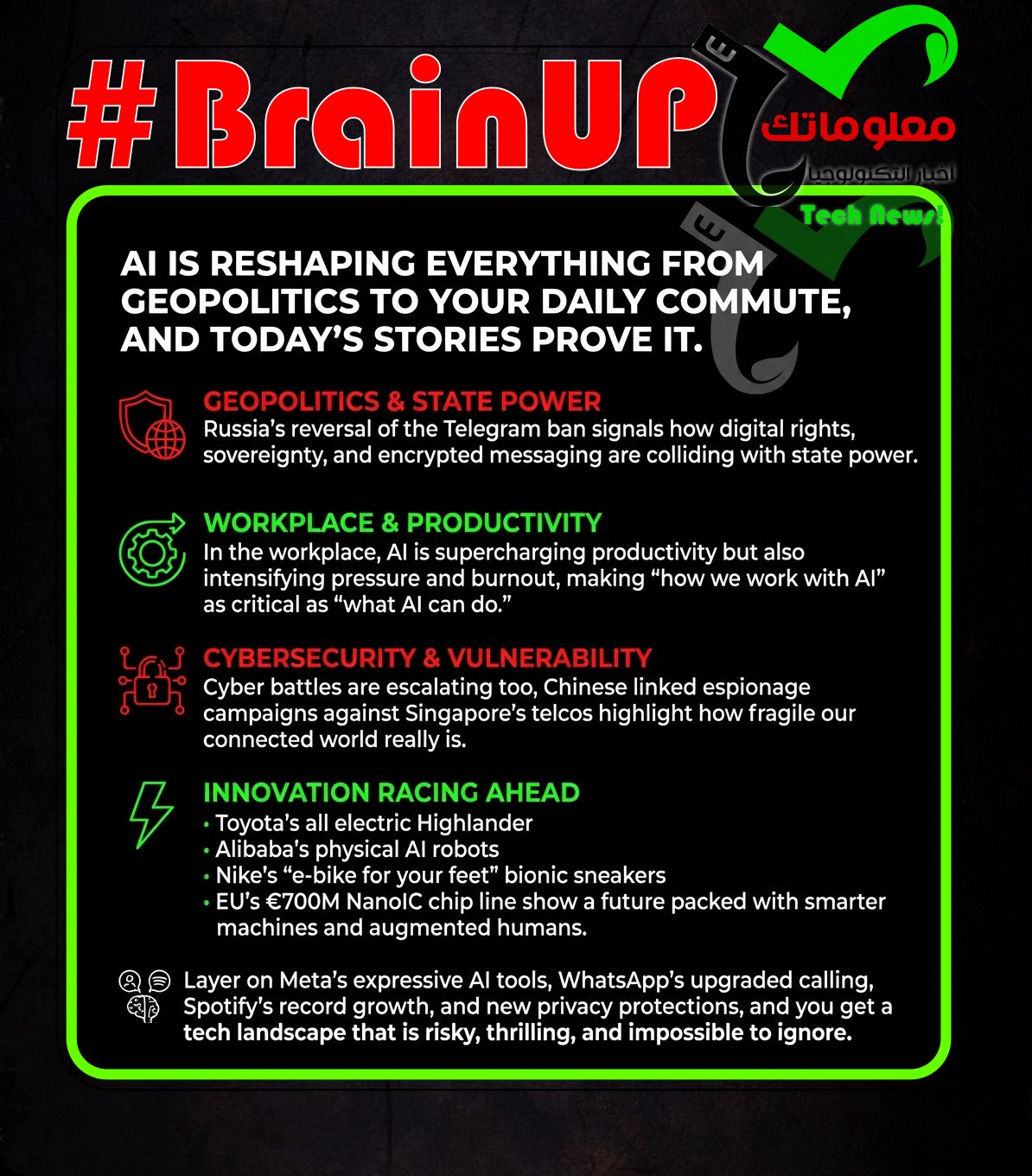
Russia’s state internet regulator, Roskomnadzor, has started throttling and restricting access to the #Telegram messenger service nationwide as of February 10, 2026, citing Telegram’s alleged non-compliance with legal requirements on data protection, fraud prevention and criminal activity moderation — moves widely seen as part of a broader Kremlin effort to tighten control over online communications and steer users toward a state-backed alternative app called Max. 🇷🇺 Reports from multiple Russian and international outlets indicate that users across major cities have experienced slower load times for messages, media and downloads as the restrictions roll out, and Roskomnadzor has publicly stated it will continue phased limitations until Telegram fulfills its obligations under Russian law. Critics and digital rights groups argue these actions are less about public safety and more about expanding censorship and surveillance powers, tightening the state’s grip on digital expression during ongoing political tensions and information control efforts linked to the Ukraine war. Telegram’s founder, @Pavel Durov, has condemned the measures as attempts to force citizens onto a monitored platform and reiterated his commitment to privacy and freedom of speech despite pressure from authorities, while Russian officials defend the restrictions as necessary for legal compliance and citizen protection.
2. AI Doesn’t Reduce Work, It Intensifies It
Artificial intelligence (#AI) often increases rather than decreases work intensity by shifting the nature of tasks rather than eliminating them. Rather than automating complete jobs, AI tools typically automate parts of work processes, which leads to increased expectations for productivity and multitasking. The article discusses how AI’s integration in workplaces can create a feedback loop where enhanced technological capabilities drive demands for faster, more complex outputs. This intensification can contribute to worker stress and burnout, highlighting a paradox where technology meant to ease workloads ends up magnifying them. Understanding this dynamic is essential for developing sustainable AI implementations that balance productivity with employee well-being.
3. What digital sovereignty really means in a fragmented world
Europe’s digital sovereignty is framed as achievable through the trusted adoption of #cloud and #AI within an EU law framework that favors harmonized regulation and accountable governance. The sponsorship by @SAP is highlighted as promoting these ideas to enhance security, competitiveness, and strategic autonomy across the bloc. The piece implies that openness to global innovation, coupled with clear governance, underpins a resilient digital economy in a fragmented global landscape. In linking #digitalsovereignty to concrete policy directions, the article invites readers to view SAP as a driver of Europe’s digital future.
4. Toyota Reboots the 2027 Highlander as an EV
The all-electric 2027 Highlander is Toyota’s re-imagining of the midsize three-row SUV, balancing rugged proportions with high-tech electric performance, a vision voiced by Chief Designer @Masayuki Yamada. It sits on a 120-inch wheelbase and spans 198.8 inches, longer than the Grand Highlander, yet its cargo space mirrors the gas Highlander due to battery placement. Two battery options are offered: a 77 kWh XLE pack with an estimated 287 miles of range (EPA-like figures expected), with AWD reducing range by 17 miles; and a 95.8 kWh pack available on XLE AWD and Limited AWD delivering about 320 miles. It comes with a native #NACS charging port and a dual-voltage Level 1/2 cable, while the onboard AC charger handles Level 2 up to 11 kW. Inside there is a 12.3-inch digital gauge cluster, a 14-inch infotainment screen, standard wireless charging, heated front seats and steering wheel on XLE, versatile second-row access to the third row, optional driver aids, an 11-speaker JBL system, 22-inch wheels, and a choice of bench or captain’s chairs; Toyota still sells ICE Highlanders but aims to shift volume toward the Grand Highlander hybrid and the new EV, hoping to recapture some demand even as some buyers move to other midsize SUVs.
Facebook is expanding its AI features on @Facebook to boost self-expression, adding animated profile photos, restyle tools for Stories and Memories, and animated backgrounds for text posts. Animated profile pictures apply motion effects such as waving, a heart shape, or a party hat, with best results from a clear, single-person photo sourced from the camera roll or existing images. Restyle uses #MetaAI to reimagine user-uploaded images with prompts or presets like anime, illustrated, glowy, and ethereal, plus adjustable mood, lighting, colors, and new backdrops such as beach or cityscape. For text posts, a rainbow ‘A’ icon offers still and animated backgrounds like falling leaves or waves, with seasonal options coming soon, as @Facebook aims to appeal to #GenZ and maintain relevance for its ~2.1B daily users.
7. Fear Of AGI Is Driving Harvard And MIT Students To Drop Out
Pressure from rapid AGI advancement is driving Harvard and MIT students to leave college and pursue full-time AI safety work, as MIT freshman Alice Blair takes a permanent leave to join @CenterForAISafety after starting in computer science. She isn’t alone: Adam Kaufman left Harvard to work at @RedwoodResearch, and his brother, roommate and girlfriend have also left to join @OpenAI, reflecting a shift from academia to frontline safety work. The piece notes that extinction level risk is cited in policy literature and that safety efforts by @CenterForAISafety and companies like @Anthropic have surged, even as some researchers doubt the likelihood of human extinction. NYU professor emeritus @GaryMarcus argues extinction is unlikely but concedes that safety work remains noble and unanswered. At Harvard, about half of 326 students surveyed by the undergraduate association and AI safety club were worried about AI’s impact on job prospects, illustrating a concrete career fear behind the trend.
8. Singapore spent 11 months evicting suspected telco spies
Singapore mounted its largest coordinated cyber defense operation to date, taking almost a year to evict a suspected China-linked espionage crew, UNC3886, from all four major telecom providers. The @CSA_Singapore described UNC3886 as targeting telecom infrastructure with deep access, using a previously unknown flaw to breach perimeter defenses and then deploying custom rootkits to hide inside networks. The operation, branded ‘Operation Cyber Guardian,’ involved more than 100 personnel across government, military, intelligence, and industry, focusing on sealing off attacker paths, patching vulnerabilities, and increasing monitoring while keeping networks and services running. Investigators say the attackers aimed to siphon technical network information to support long-term intelligence collection, and UNC3886 was known to exploit zero-day flaws in #FortiGate, #VMware_ESXi, and #VMware_vCenterServer. The incident underscores how telecom networks sit at the nexus of government, enterprise, and consumer traffic, making them prime targets, and officials warned that sophisticated actors are likely probing defenses, urging operators to assume continued risk, much as in earlier campaigns like #SaltTyphoon.
9. Chinese cyberspies breach Singapore’s four largest telcos
Chinese cyberspies orchestrated cyberattacks that compromised Singapore’s four largest telecommunications firms, targeting their infrastructure and customer data. The breach was attributed to a sophisticated state-sponsored group using advanced persistent threat (APT) techniques, emphasizing the scale and precision of the intrusions. These attacks compromised sensitive communications and posed significant risks to national security and data privacy, highlighting vulnerabilities in critical telecommunication networks. The incident underscores the increasing geopolitical tensions in cybersecurity and the urgent need for enhanced defense mechanisms within vital infrastructure sectors. Consequently, Singapore’s cybersecurity authorities have ramped up efforts to detect intrusions and fortify telco defenses against future state-backed cyber threats.
10. Cadence opens the door to chips designed for AI by AI
Cadence has unveiled ChipStack AI “Super” Agent to automate chip design and verification tasks, signaling a move toward AI-assisted AI chip creation within #EDA. The platform comprises sub-agents for IP design, verification, sign-off, debugging, and SoC layout, ingests specs to form a mental model, generates code and debug material, and can call additional EDA tools as issues arise. It can run on-prem with customers’ open-weight models or cloud-based models, including @Nvidia’s NeMo framework to customize models, and Cadence claims productivity gains of up to 10x. The system includes guardrails to limit hallucinations and is not intended to automate the entire semiconductor supply chain, keeping human oversight essential. Interest from @Qualcomm, @Nvidia, and @Altera underscores the industry’s push toward AI-assisted design, with ChipStack positioned as a bridge between AI models and traditional EDA workflows #ChipStack #SuperAgent #AI #chipdesign.
11. Microsoft Explores High-Temperature Superconductors for Datacenter Power
Microsoft is publicly discussing its investigation into using #high_temperature_superconductors (HTS) to improve power delivery efficiency in its cloud datacenters by reducing electrical resistance and heat loss, which could in theory allow more compact power infrastructure and higher electrical density without enlarging physical facilities, responding to escalating #AI compute power demands that increasingly stress traditional copper and aluminum wiring systems. HTS cables can carry electricity with virtually no resistance when cooled, potentially cutting wasted energy and helping datacenters meet growing demand within a smaller footprint, but experts note that this technology is still in early development and not commercially ready since cooling systems, material costs and scalability challenges remain significant obstacles that keep widespread deployment in the future rather than the present. Microsoft has partnered with superconductor specialist VEIR, which demonstrated a prototype HTS power delivery system that moved a few megawatts in a simulated environment, but actual adoption at Microsoft’s scale is under evaluation and requires more testing, validation and confidence building with partners. The company frames this exploration as part of studying long-term power infrastructure solutions for cloud and AI workloads rather than an imminent product rollout, highlighting the tension between visionary engineering and the practical reality that HTS technology must overcome cost and integration constraints before it can transform datacenter power systems. Overall, Microsoft’s HTS research signals that as AI and cloud workloads surge, hyperscalers are looking far beyond incremental optimizations toward transformative materials science approaches to break through conventional power delivery limits
12. Scientists may have found the brain network behind Parkinson’s
A brain network called #SCAN, which links thinking with movement and resides in the motor cortex, may be the core driver of Parkinson’s disease as it becomes overly connected and disrupts movement, thinking, and other bodily functions. In a non-invasive approach, targeting #SCAN with transcranial_magnetic_stimulation (#TMS) yielded more than twice the symptom improvement compared with stimulation of nearby brain areas. The researchers report that this network’s hyperconnectivity with the brain’s subcortex underpins central PD features, and that precise personalization of stimulation could slow or even reverse progression. The study, described in @Nature on Feb. 4, was led by an international team including @NicoUDosenbach of WashU Medicine. If validated, this network-targeted approach could reshape PD diagnosis and treatment, moving beyond conventional medications and invasive DBS, and may alter the course of #Parkinsons_disease care.
13. Is Discord finished? Searches for alternatives up 10,000% overnight.
@Discord’s global #Teen-by-Default age verification rollout has triggered user backlash and heightened interest in alternatives. In 48 hours, searches for ‘Discord alternatives’ jumped about 10,000% versus the monthly average, and ‘Delete Discord’ rose as well. Stoat, the new name for Revolt, leads the surge with roughly 9,900% gains and 4,100% for the old name, described as an open-source, privacy-focused platform. Other rising options include @Matrix, IRC, and Mumble, with Matrix up 2,133%, IRC 1,500%, and Mumble 1,000%, signaling a broader move away from Discord’s model. The controversy centers on privacy and data security, as users would face facial scans or government IDs, and tests in the UK and Australia suggest a global rollout could intensify the shift toward privacy-first ecosystems like @Stoat.
14. Google Fulfilled ICE Subpoena Demanding Student Journalist’s Bank and Credit Card Numbers
The Intercept reports that Google fulfilled an ICE subpoena demanding a broad set of personal data from student activist and journalist Amandla Thomas-Johnson, including bank and credit card numbers #surveillance. The subpoena sought usernames, addresses, itemized service lists (including any IP masking services), telephone numbers, subscriber numbers or identities, and other identifiers, with ICE saying the request was connected to enforcing U.S. immigration laws and asking Google to withhold the summons’ existence for an indefinite period #privacy. Thomas-Johnson, who has been in hiding and is now in Dakar, says he was not given a chance to fight the request, a contrast to a prior case involving his friend Momodou Taal that was successfully challenged, a climate shaped in part by the @Donald Trump administration. The Electronic Frontier Foundation and the ACLU of Northern California sent a letter to Google, Amazon, Apple, Discord, Meta, Microsoft, and Reddit urging resistance to DHS subpoenas without court intervention, to provide notice to targets when possible and to push back against gag orders, warning that DHS surveillance threatens user privacy and speech, an issue echoed by other cases such as a Meta subpoena to unmask identities #privacy #surveillance
15. ‘E-bike for your feet’: How bionic sneakers could change human mobility
Nike’s Project Amplify is a bionic sneaker system designed to energize everyday movement, effectively acting like an e-bike for your feet. The system combines standard sneakers with a carbon fiber plate and back-mounted, 3D-printed titanium leg shells that cinch to the calves, powered by motors and sensors controlled by a phone app that toggles between walk and run speeds. It learns how the wearer’s ankles move to tailor the algorithms so activation feels natural and smooth, reflecting a long quest to increase speed in footwear as noted by experts like @Elizabeth Semmelhack. Nike plans to commercialize Amplify in 2028, illustrating how digital technology and biomechanics are converging to extend human mobility for everyday athletes and stars such as @Serena Williams, @Jerry Rice, and @Mia Hamm.
16. With Ring, American Consumers Built a Surveillance Dragnet
Ring’s ‘Search Party’ uses AI to turn neighborhood cameras into a dragnet intended to locate a lost dog, showing how consumer devices can enable widescale surveillance under a friendly veneer #SearchParty #AI. Privacy expert @Chris Gilliard described the rollout as a dystopian reality masked by a cuddly façade, highlighting concerns that the tool could be repurposed to target suspects or undocumented immigrants. The piece traces Ring’s shift from heavy police partnerships to a softer consumer brand, branding the camera network as a tool for viral moments and even producing the Ring Nation reality show. Taken together, the article frames Ring as part of a broader trend where private platforms form expansive surveillance networks connected to #police partnerships, contributing to an increasingly pervasive surveillance state.
17. ‘Manfluencers’ are filming themselves trying to pick up women using smart glasses | CNN
An examination of the rise of #manfluencers who film themselves approaching women in public with smart glasses, turning ordinary encounters into content and raising concerns about consent and safety. Toluwa describes being approached in an airport lounge, discovering the man posted footage of her without her knowledge after she shared her number, and the piece notes such POV videos on TikTok and Instagram can rack up thousands or millions of views. Experts, including @Stephanie_Wescott, warn that smart glasses magnify gendered patterns of seeing women as conquest and threaten bodily autonomy by letting men watch, record, and control images in public spaces. A DJ/producer known as @ManicMuse recounts a Texas grocery-store encounter that seemed genuine until she suspected the man was wearing Meta AI smart glasses, illustrating how these devices can normalize surveillance. The article casts this as part of a broader, troubling trend in online culture where misogynistic content can flourish when technology provides new ways to observe and broadcast women without consent, with real-world implications for safety and agency.
18. Google expands removal of sensitive personal data from search results
Google is enhancing its policies to allow removal of sensitive personal data such as scanned identity documents, private keys, and explicit images from search results to better protect user privacy. This update follows rising concerns about personal data abuse and addresses previous gaps where such content could remain visible despite being harmful. The company provides a clear process for individuals to request removal, emphasizing transparency and user control. These efforts align with growing regulatory pressure and societal demand for stronger data protection measures. By refining its approach, Google aims to reduce risks of identity theft and privacy violations linked to search disclosures.
19. EU invests €700 million in newly opened NanoIC, Europe’s largest Chips Act pilot line
The EU has invested €700 million in the newly opened NanoIC pilot line, which is the largest in Europe under the #ChipsAct initiative. This investment aims to secure Europe’s technological sovereignty in semiconductor manufacturing by supporting advanced chip production capabilities. The NanoIC facility provides essential infrastructure for developing and testing innovative chips, fostering competitiveness in the global semiconductor market. By enhancing Europe’s capacity to produce cutting-edge microchips, the EU strengthens its strategic autonomy amid rising geopolitical tensions. This development aligns with broader EU goals to reduce dependencies on external suppliers and drive innovation within the digital economy.
20. Flickr emails users about data breach, pins it on 3rd party
Flickr reports a data breach on Feb 5 tied to a third-party email service provider, and it shut down access to the affected system within hours. The incident potentially exposed PII and Flickr activity, including names, email addresses, usernames, account types, IP addresses, and general locations, while passwords and financial data were not affected. Flickr says it notified data protection authorities and is conducting a thorough review, strengthening security with #third_party_providers, and warning users about phishing attempts referencing their accounts. Users are urged to review their account settings and change passwords if they reuse the same password elsewhere, as the breach could affect users across its 190 countries and 35 million monthly users (@SmugMug-owned Flickr). The company aims to prevent similar issues by improving system architecture and monitoring of third-party services, reinforcing its commitment to user privacy.
21. Kalshi will offer a Super Bowl prop betting market
Kalshi plans to launch a prop betting market for the Super Bowl on its federally regulated prediction platform. Kalshi, co-founded by Tarek and Luana Elgouhary, allows users to make bets on various events by predicting outcomes with real money. The platform’s Super Bowl market will include bets on specific events during the game, providing fans with new ways to engage and interact with football. This launch signifies a growing trend of integrating legal prediction markets into mainstream sports betting, leveraging regulatory approval to attract a larger audience. Kalshi’s move highlights how technology and regulation are expanding opportunities in the betting industry.
22. China’s Alibaba launches AI model to power robots as tech giants talk up ‘physical AI’
Alibaba’s new #RynnBrain AI model is designed to power robotics by helping machines understand the physical world and identify objects. A DAMO Academy video shows a robot identifying fruit and placing it in a basket, illustrating practical object recognition and manipulation. The move is part of a broader push into #physicalAI, with @Nvidia and @Google pursuing similar world models such as Cosmos and Gemini Robotics-ER 1.5. Alibaba emphasizes #open-source, making #RynnBrain available for free and leveraging its #Qwen family to broaden developer adoption. The development underscores China’s push into #physicalAI as it competes with the U.S. for leadership in robotics.
23. The first signs of burnout are coming from the people who embrace AI the most
As AI rapidly integrates into workspaces, early adopters who enthusiastically embrace the technology are exhibiting the first signs of burnout. These users, driven by constant connectivity and the pressure to leverage AI tools effectively, face increased cognitive load and blurred boundaries between work and personal life. The phenomenon highlights a paradox where the benefits of AI’s efficiency come with mental exhaustion for those over-relying on it. This trend underscores a growing need for managing AI adoption responsibly to sustain productivity without compromising well-being. Understanding this early burnout is crucial for organizations aiming to foster healthy AI integration among their workforce.
24. Spotify hits a record 751M monthly users thanks to Wrapped, new free features
Spotify reached a new milestone of 751 million monthly active users, driven by the popularity of its Wrapped campaign and the addition of new free features that enhance user engagement. The Wrapped feature, which summarizes listeners’ activity yearly, has become a cultural phenomenon, boosting user interaction and retention. Spotify also expanded its free-tier offerings, including improved playlists, better ad experiences, and more personalized content, which attracted a broader audience globally. These developments highlight Spotify’s strategy to balance growth between paid subscribers and free-tier users while maintaining strong market leadership in streaming. The record user count solidifies Spotify’s positioning as a dominant player in audio streaming, adapting effectively to evolving consumer preferences.
25. Apple and Google Agree to App Store Changes to Appease UK Regulator
Apple and Google have reached agreements with the UK Competition and Markets Authority (CMA) to modify their app stores, addressing concerns over competition and consumer choice. The companies will introduce changes allowing app developers to use third-party payment systems, reducing reliance on their own in-app payment methods. This move follows regulatory pressure aimed at increasing market fairness and transparency, potentially lowering fees for developers and improving options for users. By agreeing to these modifications, Apple and Google aim to comply with UK regulations while maintaining strong control over their platforms. These adjustments reflect growing global scrutiny of major tech companies and their marketplace practices.
26. WhatsApp is getting web calls
WhatsApp is rolling out support for voice and video calls on its web and desktop apps, allowing users to make secure calls through their computers. This new feature extends the app’s encrypted calling capabilities beyond mobile devices, enhancing user convenience without compromising privacy. Users will have to link their WhatsApp mobile app to their web or desktop app to enable calling, maintaining end-to-end encryption as on mobile. This update marks a significant step in WhatsApp’s evolution, integrating desktop functionality more deeply into its service. By adding web calls, WhatsApp aims to compete more directly with other platforms like #Zoom and #MicrosoftTeams in personal and professional communication.
That’s all for today’s digest for 2026/02/11! We picked, and processed 25 Articles. Stay tuned for tomorrow’s collection of insights and discoveries.
Thanks, Patricia Zougheib and Dr Badawi, for curating the links
See you in the next one! 🚀
