
#BrainUp Daily Tech News – (Tuesday, February 10ᵗʰ)
Welcome to today’s curated collection of interesting links and insights for 2026/02/10. Our Hand-picked, AI-optimized system has processed and summarized 36 articles from all over the internet to bring you the latest technology news.
As previously aired🔴LIVE on Clubhouse, Chatter Social, Instagram, Twitch, X, YouTube, and TikTok.
Also available as a #Podcast on Apple 📻, Spotify🛜, Anghami, and Amazon🎧 or anywhere else you listen to podcasts.
1. Dijkstra’s algorithm won’t be replaced in production routers
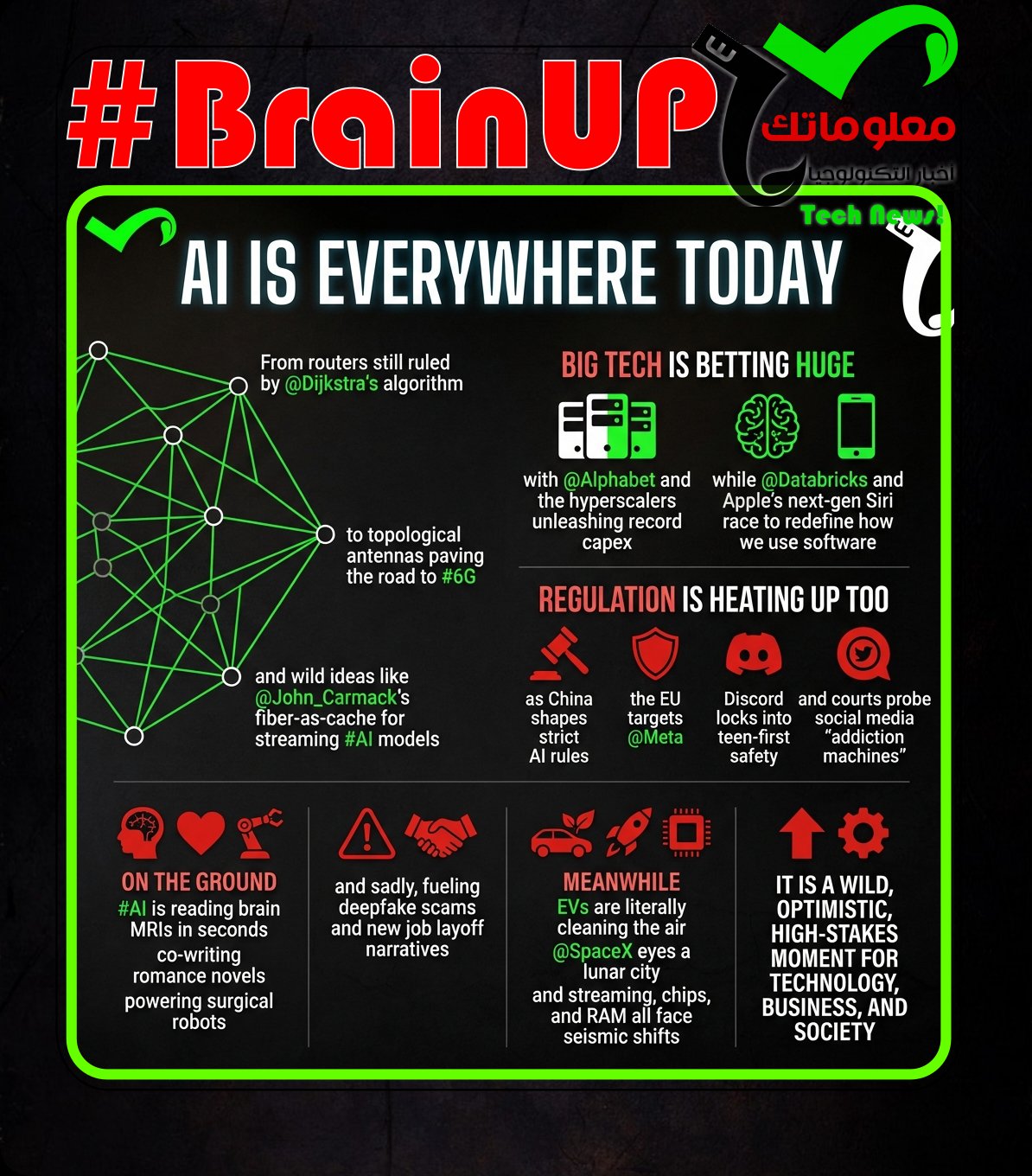
@Dijkstra’s long-standing role in routing is challenged by a new method that claims to break the sorting barrier by avoiding sorting, potentially delivering better performance bounds for shortest-path computations in networks. The approach has passed peer review at the ACM Symposium on the Theory of Computing, indicating theoretical validity and marking it as a substantially different direction from conventional Dijkstra-based routing. In practice, however, production routers are constrained by real-world scaling limits and #OSPF guidance that relies on Dijkstra, so the new method is unlikely to displace current implementations soon. Past experiences with scalable packet switches show that large theoretical gains can be offset by integration, stability, and ecosystem constraints in networks of thousands of devices. Therefore, Dijkstra’s algorithm is unlikely to be replaced in production routers in the near term, and adoption would require broad ecosystem changes, including updates to routing protocols like #OSPF and #IS-IS and substantial software modernization.
2. Novo Nordisk sues Hims & Hers over copycat versions of Wegovy drugs; Hims stock falls 18%
Novo Nordisk @Novo Nordisk is suing @Hims & Hers to permanently ban compounded versions of its drugs that infringe #patents and to recover damages. Hims & Hers had planned to offer an oral copycat obesity pill for as little as $49 for the first month, about $100 cheaper than #Wegovy, but will stop offering the product after regulatory scrutiny and legal threats from @Novo Nordisk. Novo contends the compounded medicines are untested and unsafe because their safety and efficacy are not verified by #FDA regulators, while Hims says its versions are personalized to improve access. The path of the dispute reflects Novo’s push to reclaim share in a booming #GLP-1 obesity drug market amid competition, and notes that #semaglutide supply is no longer in shortage thanks to increased manufacturing capacity, with as many as 1.5 million Americans using compounded GLP-1 drugs. Investors reacted with stock moves: @Novo Nordisk shares rose more than 3%, while @Hims & Hers fell more than 18%.
RAM shortages are unlikely to be eased by Chinese memory makers in the near term due to fundamental tech and political hurdles. CXMT lacks access to EUV lithography and relies on SAQP, aggressive binning, and higher voltage, resulting in 40 to 50 percent larger die sizes than @SK hynix or @Samsung Electronics and higher unit costs, especially at volume. High clock rates up to 8,000 MT/s come only with heavy binning and thermal penalties, complicating system integration that requires validation, firmware tuning, and long-term support, areas where CXMT and YMTC have limited global experience, making OEMs like @Apple, @HP, and @Dell wary. Prices are not dumped as claimed; reports say CXMT pricing is aligning with Korean suppliers, and YMTC has not demonstrated large cuts, while political factors loom large: both are restricted by the US Entity List and Section 1260H, complicating use in US-market products. Consequently, even if Chinese memory chips reached parity on specs, supply stability and market acceptance remain uncertain, so the near-term impact on the RAM shortage will likely be small. In short, reliance on established players remains the practical expectation for most buyers.
4. Instagram and YouTube owners built ‘addiction machines’, trial told
Two of the world’s largest social platforms are facing a landmark trial in California over alleged mental health harms from teen use, with prosecutors saying Instagram and YouTube built addiction machines to manipulate behavior. In opening statements, Mark Lanier argued Kaley G.M., a minor at the time, suffered mental health issues due to social media addiction, pointing to internal documents and emails, including a 2015 directive from @Mark Zuckerberg to increase time spent by 12%. He also claimed that YouTube deliberately targeted young users to boost ad revenue and functioned as a digital babysitting service for busy parents. Meta’s lawyers countered that Kaley’s struggles stemmed from family turmoil and preexisting issues, citing domestic abuse, neglect, and therapy since early childhood. The trial, expected to last around six weeks, will feature testimony from experts, family members of affected children, and top executives such as @Adam Mosseri and @Neal Mohan, with potential implications for damages and platform accountability #socialmedia #addiction #mentalhealth.
Australia is tightening oversight of Roblox after its teen social media ban, citing ongoing concerns about online child grooming and exploitation. In letters to Roblox, @AnikaWells and @JulieInmanGrant of the @eSafetyCommissioner’s office asked how the platform combats exploitation and self-harm content and urged a review of Roblox’s PG rating by the #AustralianClassificationBoard. The @eSafetyCommissioner says it will directly test Roblox’s implementation and effectiveness of the nine safety commitments Roblox made under the #OnlineSafetyAct, noting that some measures—such as private accounts for under-16s and prohibiting voice chat for 13- to 15-year-olds—are already in place or have global counterparts, including facial age checks for chat access. If issues are found, Roblox could face fines of up to AU$49.5 million. This move shows regulators’ ongoing push to protect children on online platforms and could influence Roblox’s safety approach going forward.
6. China Isn’t Ignoring AI Regulation. The U.S. Shouldn’t Either.
China is actively developing AI regulations, countering the misconception that it is ignoring the issue. The Chinese government has introduced measures addressing AI’s risks, such as data privacy, content management, and ethical standards, reflecting a methodical approach to oversight. These regulations emphasize state control and social stability, differing from U.S. approaches that focus more on innovation and market-driven frameworks. Understanding China’s regulatory strategy is crucial for the U.S. to shape effective AI policies that balance risk and opportunity. Acknowledging this dynamic helps align U.S. regulation with global AI developments and ensures competitiveness and safety in AI advancement.
7. Chinese AI company unveils $173K ‘biometric’ robot built for human companionship – Dexerto
@DroidUp of Shanghai unveils Moya, a highly biometric humanoid robot designed for human companionship, notable for emitting body heat and skin-like padding. Moya stands about 165 cm tall and 31 kg, with modular parts allowing a male or female build, hair customization, extra flesh-like padding including a ribcage, and a camera behind its eyes to track surroundings and communicate. It runs at human body temperature, 32-36 C, to mimic warmth, and Chinese outlets have described it as ‘the world’s first highly bionic robot.’ DroidUp says Moya could be sold to healthcare firms as a social companion, with a projected price around $173,000 and a late-2026 release. This development highlights a trend in #humanoid robotics toward near-human interaction, raising questions about the role of warmth, realism, and companionship in machines.
8. Discord puts everyone in teen mode by default
Discord is rolling out teen-by-default settings for all users, putting everyone into a teen mode unless they prove they are not a minor. In early March, new and existing accounts will have communication restrictions, limits on access to age-gated spaces, and content filtering enabled by default, with loosened settings requiring age verification. Adults may need to submit ID to a verification vendor or upload a video selfie, or rely on a background age-inference model to determine if they are an adult. Privacy concerns persist: a third-party vendor used by Discord was breached last October, exposing roughly 70,000 government ID scans, and while Discord says identity documents are deleted quickly and video selfies stay on the device, details remain vague. @SavannahBadalich said the move builds safety for teens while allowing verified adults flexibility, highlighting it as a major shift in Discord’s safety architecture #Discord #privacy #ageverification #AIageinference
9. Discord faces backlash over age checks after data breach exposed 70,000 IDs
Discord is facing criticism after a data breach exposed approximately 70,000 identity documents collected through its age verification process. The platform had implemented age checks requiring users to submit government-issued IDs, aiming to enforce age restrictions and comply with regulations. However, this security failure has raised concerns about privacy and data protection, with users and experts questioning the necessity and safety of such invasive verification methods. Discord’s approach highlights the tension between regulatory compliance for #online platforms and safeguarding user data. The incident may prompt discussions on better balancing age verification and privacy safeguards in digital communities.
The article questions whether the reported 1,100% year-on-year rise in AI-driven layoffs in 2025 reflects real disruption or is used to placate investors by blaming AI for broader business weakness. Challenger data shows over 1.2 million total layoffs in 2025, with around 55,000 cases naming AI as the reason and about 72,000 AI-related layoffs since 2023, indicating a sharp rise in AI-linked dismissals but not necessarily widespread automation. Research from LSE found some agriculture firms claimed AI use that wasn’t real, and even where AI is used it often augments rather than replaces workers; CNBC and Forrester point to macro factors and a modest automation forecast of 6% by 2030. The pattern suggests some ‘AI-washing’ where corporate financials and implementation hurdles drive layoffs more than technical capabilities, implying the broader narrative of imminent mass AI displacement may be overstated. Investors should critically assess AI claims and look for actual AI impact, underscoring the importance of #AI and #automation considerations; the article also notes high-profile examples like the short-lived DOGE initiative headed by @Elon_Musk in context of government redundancies.
US employers cut 108,435 jobs in January 2026, the highest January tally since 2009, reflecting a notably cautious start to the year. Challenger, Gray & Christmas data show the monthly total up 118% from January 2025 and 205% from December 2025, with transportation leading at 31,243 cuts, driven by UPS’s 30,000 layoffs after ending its partnership with Amazon, and technology accounting for 22,291 cuts. The release frames the month as part of a broader first-quarter pattern, suggesting many plans were set late in 2025 in anticipation of a softer 2026 outlook. Industry observers tie the trend to automation and AI, with discussions around AI’s potential impact on employment cited by industry voices such as @AndyChallenger and @AndyJassy. The figures point to a cooler labor market across sectors as firms reassess growth and cost structures within the evolving #AI and #technology landscape.
@John_Carmack proposes using a long #single-mode_fiber loop as an #L2_cache for streaming #AI data, effectively placing model weights near the accelerator as an alternative to #DRAM and aiming for near-zero latency and gigantic bandwidth. Evidence shows single-mode fiber speeds of 256 Tb/s over 200 km imply ~32 GB of data could be in flight at once, with ~32 TB/s bandwidth, enabling deterministic weight references for inference and training and suggesting potential power savings versus DRAM. Analysis: while the idea could cut RAM activity and energy, practical hurdles such as fiber cost, energy spent by amplifiers and DSPs, and the need for standard interfaces if using flash memory temper its appeal, and some observers reference mid-century delay-line concepts to illustrate potential limits. Link back: the concept sits among ongoing AI-memory research, alongside #Behemoth, #FlashGNN, #FlashNeuron, and the #Augmented_Memory_Grid, underscoring a broader effort to rethink data locality for AI workloads.
13. Databricks CEO says SaaS isn’t dead, but AI will soon make it irrelevant | TechCrunch
Databricks argues that AI won’t kill SaaS but will change how we interact with software, making traditional interfaces less central and possibly driving greater usage. It reported a $5.4B revenue run rate with more than $1.4B from AI products and closed a $5B funding round at a $134B valuation plus a $2B loan facility. Genie, an LLM-based UI, shows how natural-language interfaces can replace complex queries, expanding access beyond specialized users. CEO @AliGhodsi warns the real threat is that, once interfaces are language-based, millions become less trained in specific products, allowing AI-native competitors to emerge and pushing firms toward platforms like #Lakebase. Now is not a great time to go public, so Databricks aims to stay well capitalized.
14. Oracle gains 9%, Microsoft climbs 3% as tech tries to bounce back from $1 trillion sell-off
Big Tech stocks attempted a bounce after a week when more than $1 trillion was wiped from their market caps, led by @Oracle as investors weigh #AI-driven capex. @Oracle climbed 9%, @Microsoft gained 3%, and @NVIDIA and @Meta added more than 2% each, while @Alphabet inched higher and @Amazon slipped slightly. The rally followed disclosures of huge capex plans for 2026 amid the AI boom, with about $120B of capex in Q4 and a potential near $700B in 2026 for the #hyperscalers. D.A. Davidson upgraded @Oracle, and @JimReid of Deutsche Bank called last week the Magnificent 7’s worst in months, underscoring the tension between demand forecasts and macro headwinds. Analysts from @BankOfAmericaSecurities cautioned cloud margins while management teams expect demand to be forecastable and capacity fully utilized in 2026, and @MorganStanley noted that growing monthly token processing and cloud revenue will keep #hyperscalers’ capex estimates rising.
15. ‘Godfather of AI’ shortens odds of the technology wiping out humanity over next 30 years
@Geoffrey Hinton warns #AI could wipe out humanity within 30 years as the technology advances much faster than expected, leaving humans like toddlers beside vastly more intelligent systems. He cites a 10% to 20% chance of existential risk in the coming decades and reiterated the figure during a BBC Radio 4 Today appearance. The pace of development, he says, is very fast, and he argues that leaving safety to profit-driven companies won’t suffice, calling for government regulation to compel more safety research and oversight. This perspective reinforces his status as one of the three ‘godfathers of AI’ and highlights the tension between rapid innovation and managing #existentialrisk. In sum, the interview frames risk awareness and policy action as essential to steer AI toward beneficial uses rather than existential threats.
16. How TikTok 2.0 Became a Weapon for ICE
TikTok 2.0 has shifted from a platform beloved by Gen Z to a tool feeding domestic surveillance, tying user data to ICE data streams and a privatized enforcement dragnet. In Portland, an ICE agent photographed a constitutional observer and warned she was being added to a ‘database’ of ‘domestic terrorists,’ illustrating how data can be weaponized for targeted enforcement. The architecture rests on #MAID and GPS data shared with thousands of private bidders, and TikTok data sits on @Oracle cloud infrastructure, tied to @LarryEllison’s enterprise, with data brokers like Venntel and Babel Street turning ‘bid-stream’ crumbs into movement histories that can map a person’s life. ICE’s ELITE app, developed by @Palantir, fuses government and private data to generate neighborhood maps and dossiers with a ‘confidence score,’ tapping into @Ring cameras and @Flock license plate readers to track targets without warrants. Ironically, fears about China’s data use feed a system where private data flows fuel civil-liberties erosion under the banner of #security, highlighting how #surveillance capitalism intersects with government power and #FourthAmendment concerns.
17. Russian military scrambles to find Starlink alternative after access blocked
The Russian military is scrambling to find an #Starlink alternative after access to the network was curtailed, disrupting a key battlefield communications system they had been using illicitly. Ukraine says deactivation followed talks between its defence minister and @ElonMusk, and the move has begun to affect operations, including #drones, with thousands of contraband Starlink terminals smuggled into Russia enabling coordination along the frontline. Analysts say alternatives exist but are slower and less capable; Russia also operates its own satellite systems via #GazpromSpaceSystems, which offer patchy coverage and lower data capacity, making a direct substitute difficult in mobile operations. Ukraine has introduced a whitelist to allow only verified Starlink terminals to connect, effectively locking out devices believed to be in Russian hands, and the shift has sparked anger among pro-war bloggers while highlighting how central digital links have become in modern warfare.
18. BeyondTrust Warns of Critical RCE Flaw in Remote Support Software
BeyondTrust has identified a critical remote code execution (#RCE) vulnerability in its remote support software, posing a significant security risk to affected users. The flaw allows attackers to execute arbitrary code on impacted systems, potentially leading to full system compromise if exploited. BeyondTrust has issued patches to address this vulnerability, urging users to update their software immediately to mitigate potential exploitation. This highlights the ongoing risks associated with remote support tools and the importance of timely software updates to maintain security. Organizations using BeyondTrust’s solutions should prioritize applying the fixes to avoid malicious attacks leveraging this critical flaw.
The US Air Force has implemented a ban on the use of smart glasses among its personnel, limiting earbuds and other Bluetooth devices strictly to official duties to enhance operational security. This policy change addresses concerns over data security and vulnerabilities that connected devices like smart glasses and wireless earbuds might introduce in sensitive environments. The restrictions aim to prevent potential espionage or cyberattacks facilitated through wireless communication channels on wearable technology. By controlling device usage, the Air Force seeks to safeguard classified information and maintain troop readiness. This move reflects a broader trend in military protocols to tightly regulate emerging #technology to uphold information security.
20. Apple is killing the old HomeKit tomorrow
Apple is discontinuing support for the original HomeKit technology, requiring users and developers to transition to its updated protocols. The company announced that as of June 2023, old HomeKit accessories will no longer function, emphasizing the shift to modernized, more secure smart home standards. This change affects devices using legacy protocols and encourages adoption of new HomeKit Accessory Protocols that improve interoperability and security. The move reflects Apple’s commitment to enhancing the user experience in the smart home ecosystem by retiring outdated infrastructure. Consequently, users are urged to update or replace incompatible devices to maintain their HomeKit setups.
21. AI Novelists Are Envisioning a New Era for Romance Books
AI tools like Anthropic’s #Claude are transforming the romance novel industry by helping authors overcome writer’s block and generate creative content quickly. Authors report that Claude assists with plot development, character dialogue, and world-building, leading to faster writing processes and innovative narratives. This technological advancement raises questions about creativity and originality in literature, yet many embrace AI as a collaborative partner rather than a replacement. The integration of AI into romance writing exemplifies broader shifts in how #AI is reshaping creative industries and suggests new models for human-machine co-creation. These developments could redefine traditional notions of authorship and storytelling in popular fiction.
22. Taiwan says 40% shift chip capacity US is impossible
Taiwan’s Vice President Lai Ching-te stated that shifting 40% of advanced chip capacity to the United States by 2026 is impossible, emphasizing the challenges in relocating complex semiconductor production. He highlighted that establishing foundries and supply chains in the US requires significant time and investment, and Taiwan’s semiconductor industry remains critical globally. This comment follows US efforts to boost domestic chip manufacturing via the CHIPS Act, aiming to reduce dependency on Taiwan amid geopolitical tensions with China. Lai’s remarks underline the intricacies in #semiconductor supply chains and the limits of rapid reshoring strategies, reinforcing Taiwan’s pivotal role in the global chip market. The situation suggests that while supply diversification is a US goal, practical constraints make drastic shifts in chip capacity challenging in the near term.
23. AI model can read and diagnose brain MRI in seconds
An AI model developed by researchers at Michigan Medicine can rapidly and accurately read and diagnose brain MRIs within seconds, improving efficiency in medical imaging. The AI uses deep learning algorithms to identify various brain abnormalities, achieving diagnostic accuracy comparable to expert radiologists. This technology has the potential to expedite patient care and reduce the workload on medical professionals by automating the interpretation of complex brain scans. The model exemplifies the growing integration of #artificialintelligence in healthcare, enhancing diagnostic processes and enabling faster clinical decisions. It represents a significant advancement in leveraging #machinelearning for neurological diagnosis.
24. Alphabet Embarks on Global Bond Spree to Fund Record Spending
@Alphabet Inc. is borrowing aggressively to fund its #AI ambitions, tapping a global bond spree that includes a record US dollar sale and planned debut deals in Switzerland and the UK, including a rare 100-year issue. Investors placed more than $100 billion of orders, signaling strong demand despite concerns about the AI arms race and debt burdens. Alphabet expects up to $185 billion in capital expenditures this year, more than its total spend in the previous three years, underscoring the scale of data center investments needed for its AI push. With other hyperscalers like @Meta and @Amazon increasing spend, capital expenditures among the four biggest US tech firms are forecast to reach about $650 billion in 2026, a trend that could reshape #credit markets. Some analysts view this as a major transition in corporate financing for high-growth tech, as debt financing is used to accelerate growth while markets weigh risks and returns.
25. Apple Readies iPhone 17e, New Siri, Entry-Level iPad, iPad Air and MacBook Pro
Apple is preparing to launch the iPhone 17e, along with updates to Siri, a new entry-level iPad, a refreshed iPad Air, and an updated MacBook Pro. The next-generation Siri is expected to enhance user interaction and integrate more deeply with Apple’s ecosystem, reflecting the company’s commitment to AI. The entry-level iPad and iPad Air upgrades aim to strengthen Apple’s position in the highly competitive tablet market by offering improved performance and features at accessible price points. The new MacBook Pro model is designed to deliver increased power and efficiency for professional users, supporting Apple’s strategy to cater to both casual and pro consumers. These product updates demonstrate Apple’s continuous innovation and its effort to consolidate its market share across multiple device categories.
26. AI enters operating room, reports arise of botched surgeries, misidentified body
AI technologies are increasingly used in operating rooms to assist surgical procedures, but reports of critical errors such as botched surgeries and misidentified patients have emerged. Investigations reveal that reliance on AI systems without adequate human oversight can lead to dangerous outcomes, complicating accountability and trust in medical settings. The integration of AI into surgery highlights both the potential benefits of precision and efficiency, and the risks of technological failures when safeguards are insufficient. This underscores the urgent need for stringent regulatory frameworks and comprehensive training to ensure AI aids rather than endangers patient care. As hospitals adopt more AI tools, balancing innovation with patient safety is crucial to prevent harm and maintain confidence in healthcare advancements.
27. Electric Cars Are Making It Easier To Breathe: Study
A study in @The Lancet Planetary Health finds that California neighborhoods with more EVs and plug-in hybrids experience lower NO2 levels #NO2 #airquality #EVadoption. From 2019 to 2023, for every 200 added EVs or plug-in hybrids, NO2 declined by 1.1 percent, based on satellite data across 1,692 neighborhoods with a typical neighborhood gaining 272 plug-in vehicles and EVs. Researchers used DMV registrations to count plug-in vehicles and validated satellite NO2 measurements against ground monitoring data from 2012 to 2023, while controlling for gas prices and work from home patterns and excluding 2020 due to the pandemic. The study claims to be the first to conclusively link increased EV adoption with lower pollutant levels, though debates about adoption pace and infrastructure persist. If California proceeds with its plan to end sales of most new gasoline cars by 2035, future residents may breathe easier.
28. Topological antenna design to pave the way for 6G networks
The development of a novel topological antenna design could revolutionize #6G networks by enhancing signal robustness and data transmission efficiency. Researchers have created antennas inspired by #topological physics that maintain stable signal propagation despite defects or environmental interference. This innovation leverages unique wave propagation properties to reduce signal loss and improve communication reliability in next-generation wireless networks. By addressing challenges inherent in current antennas, such as sensitivity to imperfections, this approach promises to facilitate more resilient and high-performance 6G technology infrastructure. Consequently, the topological antenna design represents a significant advancement for future wireless communication systems.
29. AI deepfake romance scam steals woman’s home and life savings
An AI deepfake romance scam used a convincing impersonation of @SteveBurton to fool Abigail into believing she was in a private, loving relationship, leading to the loss of more than $81,000 and the sale of her paid-off home. Evidence shows the deception began with a Facebook message, moved to WhatsApp, and featured a lifelike video and voice that addressed Abigail by name as “Abigail, my queen”. The scheme relied on grooming and secrecy, isolating her from family until she confronted the possibility of going to police. This case highlights how #AI and #deepfake technology can enable financial ruin in online dating, underscoring the need for skeptical verification and rapid reporting of suspicious messages.
30. New tool blocks imposter attacks disguised as safe commands
Attackers often disguise malicious commands as safe ones to bypass security measures, posing a significant threat to organizations. To counter this, a new tool has been developed that can detect and block imposter attacks by analyzing command characteristics and distinguishing legitimate commands from fake ones. This solution enhances defense against sophisticated threats that exploit command impersonation to execute harmful actions unnoticed. By leveraging this tool, security teams can better protect systems from these covert intrusions and reduce the risk of damage or data breaches. The advancement offers a promising approach to strengthening cybersecurity against deceptive command-based attacks.
31. China and Iran deepen technology ties to tighten internet control
China and Iran are expanding their collaboration on technology to enhance internet surveillance and censorship capabilities. Reports indicate that China is exporting sophisticated digital tools and expertise to Iran, allowing Tehran to monitor and restrict online activity more effectively. This cooperation aligns with both countries’ efforts to consolidate political power by controlling the flow of information and suppressing dissent. The strategy reflects a shared interest in promoting authoritarian governance through advanced #internet control technologies. This growing partnership reveals a significant development in how regimes manage digital spaces to stifle opposition and maintain influence.
32. YouTube reaction videos could face lawsuits over ripped game cutscenes
YouTube reaction videos featuring ripped game cutscenes may face legal challenges from publishers who claim copyright infringement. Popular channels that post these videos often include unaltered or lightly edited footage from games, which publishers argue violates their intellectual property rights. This raises important questions about fair use and the balance between content creation and copyright protections. The issue could impact creators who rely on such footage for commentary or reactions, potentially leading to a crackdown on certain types of game-related content. The situation highlights ongoing tensions between #copyright law enforcement and #creator communities on platforms like @YouTube.
33. Illinois Man Pleads Guilty to Snapchat Nude Photo Hacks
An Illinois man pleaded guilty to hacking Snapchat accounts to steal nude photos and videos from victims. The individual used stolen usernames and passwords to access private media, which he then shared or kept for personal use. The case highlights vulnerabilities in social media account security and the exploitation of private content. Authorities emphasized the importance of safeguarding online accounts to prevent similar breaches. This incident underscores the broader issue of digital privacy and the consequences of unauthorized access to personal data on platforms like #Snapchat.
34. Netflix’s Warner Bros. merger puts rival streamers in survival mode
The $82.7 billion Warner Bros. acquisition will sharpen @Netflix’s control over streaming content and push rival services to adapt through #live-sports rights, #advertising, and pricing strategies to stay competitive. The piece traces a 2019–2021 #streaming renaissance that brought new entrants and originals, followed by a 2022 profitability crunch that prompted price hikes, the shift to ad-supported models, and password sharing controls. By 2025 @Netflix added about 25 million subscribers to reach 325 million globally, while rivals like @Peacock, @ParamountPlus, and @DisneyPlus saw growth slow and some stopped quarterly reporting, leaning on exclusive sports (UFC on @ParamountPlus, NBA on @Peacock) and ads to drive signups. The consolidation could squeeze smaller platforms and widen the value gap between @Netflix and its rivals as the landscape shifts. In short, the move signals a Netflix-dominated future where #live-sports, #advertising, and #pricing will be key battlegrounds for survival.
35. Musk says SpaceX to prioritise building self-growing city on Moon
Elon Musk announced that #SpaceX will focus on establishing a self-sustaining city on the Moon by 2026, aiming to create an autonomous lunar settlement. Musk highlighted the importance of this effort for humanity’s long-term survival and expansion into space, emphasizing the use of SpaceX’s Starship rockets to transport materials and people. The initiative plans to leverage in-situ resource utilization to support the city, reducing reliance on Earth-based supplies. By prioritizing a lunar city, SpaceX seeks to advance human presence beyond Earth while fostering technological innovation and sustainable space colonization. This lunar endeavor aligns with Musk’s broader vision of multiplanetary habitation and underlines SpaceX’s commitment to pioneering extraterrestrial development.
36. EU threatens Meta with interim measure blocking AI rivals on WhatsApp
The European Union has threatened to impose an interim measure against @Meta to prevent the company from blocking AI rivals on its WhatsApp platform. This move follows concerns about Meta’s control potentially limiting competition in the AI messaging space. The EU’s proposed action aims to maintain a level playing field for AI developers by ensuring they can operate on WhatsApp without restrictions. This intervention reflects the EU’s broader effort to regulate dominant tech firms and promote digital market fairness under upcoming regulations. Ensuring competition within AI technologies on widely used platforms like WhatsApp aligns with the EU’s digital sovereignty and innovation objectives.
That’s all for today’s digest for 2026/02/10! We picked, and processed 36 Articles. Stay tuned for tomorrow’s collection of insights and discoveries.
Thanks, Patricia Zougheib and Dr Badawi, for curating the links
See you in the next one! 🚀
