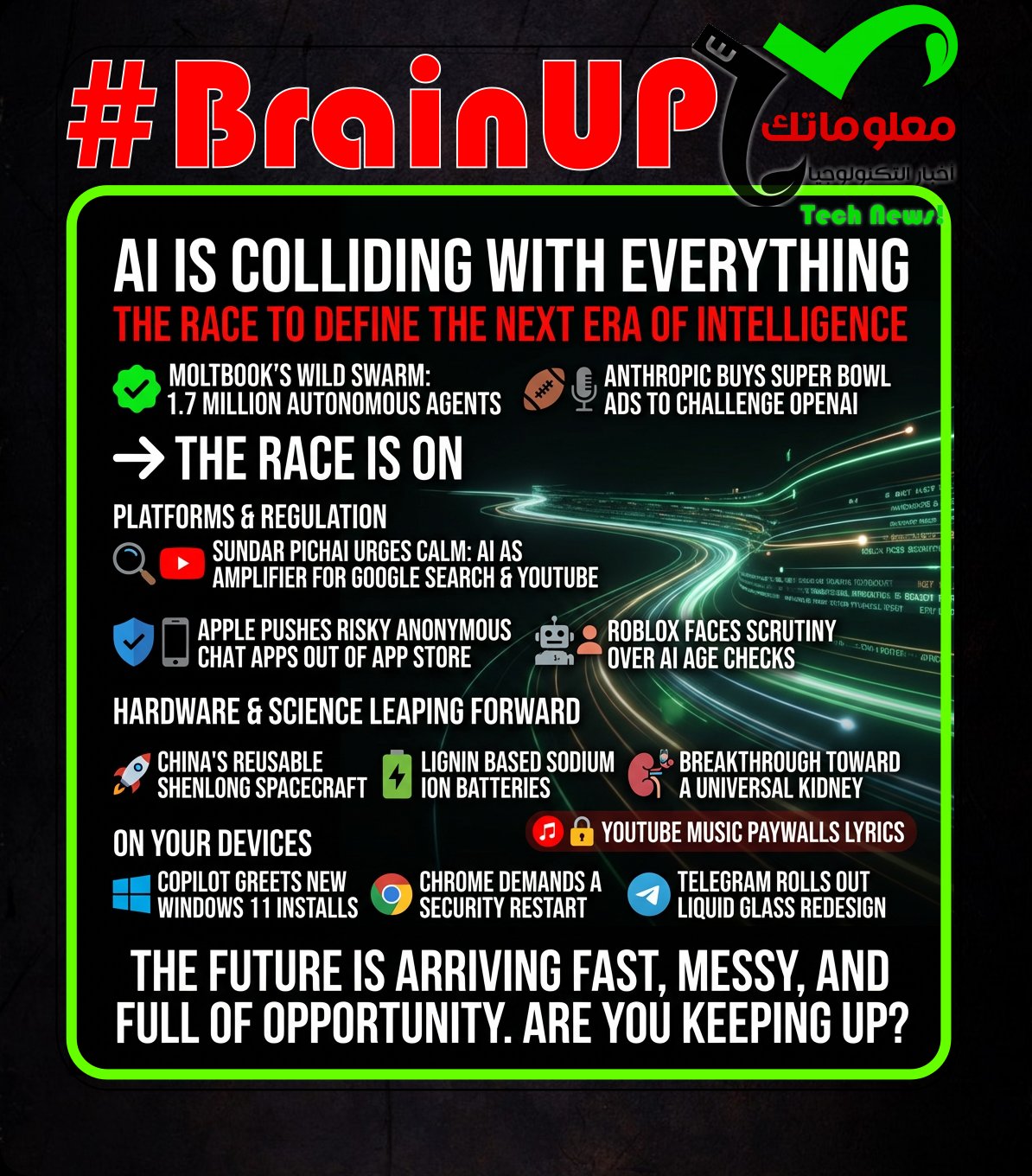
#BrainUp Daily Tech News – (Sunday, February 8ᵗʰ)
Welcome to today’s curated collection of interesting links and insights for 2026/02/08. Our Hand-picked, AI-optimized system has processed and summarized 17 articles from all over the internet to bring you the latest technology news.
As previously aired🔴LIVE on Clubhouse, Chatter Social, Instagram, Twitch, X, YouTube, and TikTok.
Also available as a #Podcast on Apple 📻, Spotify🛜, Anghami, and Amazon🎧 or anywhere else you listen to podcasts.
1. Moltbook was peak AI theater
Moltbook was peak AI theater, a viral, vibe-coded Reddit clone that became a public stage for millions of bot agents, revealing the feverish #AI mania and its limits. OpenClaw ties an LLM to everyday tools and, through an open-source ecosystem, lets agents operate nonstop, posting, upvoting, and coordinating at scale, with 1.7 million agents, 250,000 posts, and 8.5 million comments. A post highlighted by @AndrejKarpathy on X about private spaces where humans would not observe the bots turned out to be fake—written by a human pretending to be a bot—yet it underscored how Moltbook often feels like a performance. Vijoy Pandey of Outshift by @Cisco notes that these agents are pattern-matching social-media behaviors rather than truly autonomous intelligence. In the end Moltbook reads as a mirror of our AI obsessions and a reminder that we are still far from general-purpose AI.
3. China sends fourth Shenlong reusable spacecraft mission into orbit
China successfully launched its fourth mission of the Shenlong reusable spacecraft, marking significant progress in its space technology capabilities. The Shenlong, a small reusable spaceplane, was sent into orbit atop a Long March 2F rocket from the Jiuquan Satellite Launch Center. This mission highlights China’s advancement in developing #reusable spacecraft, which could reduce space launch costs and increase operational flexibility. Analysts note that such progress places China alongside other nations developing next-generation space technologies to support longer-term space exploration and potential commercial ventures. The successful launch of Shenlong underscores China’s growing ambitions in the #space industry and its commitment to expanding its presence in low Earth orbit.
4. Roblox’s AI age checks are backfiring, spark fresh concerns for UAE parents
@Roblox’s mandatory #AI age verification, designed to strengthen safety, is drawing criticism from UAE parents and regulators. Evidence includes technical flaws and privacy concerns, as the system uses facial age estimation from a short selfie video to assign users to age brackets, while UAE restrictions have included temporary chat suspensions during reviews. This comes amid global regulatory pressure and regional bans or restrictions in the GCC and beyond, with Russia and Egypt taking actions over concerns about minors’ exposure to harmful material. The ongoing safety overhaul underscores the need to balance effectiveness with #privacy and #safety goals as regulators scrutinize @Roblox’s approach to protecting children online.
5. A new way to control light could boost future wireless tech
A nonlinear metasurface-based optical device can generate and switch between two stable, donut-shaped light patterns called skyrmions in free-space toroidal terahertz pulses, enabling on-demand electric and magnetic modes. The researchers demonstrated that more than one vortex pattern can be produced on a single integrated platform and that switching between electric and magnetic configurations is controllable with laser pulses. Skyrmions are resilient light vortices that maintain their shape under disturbance, making them attractive for robust wireless data encoding in future terahertz communications. Metasurfaces are ultra-thin, nanoscale-patterned structures that enable these manipulations and could support practical light-based information processing and signal routing. The work, reported in Optica, advances controllable skyrmions toward robust information encoding for terahertz wireless tech, as noted by @Xueqian Zhang and co-authors including @Yijie Shen.
6. Breakthrough: Scientists Created a ‘Universal’ Kidney To Match Any Blood Type
Researchers have demonstrated an enzyme-based method to strip type A blood antigens from a kidney, creating an enzyme-converted type O kidney that could be accepted by recipients of any ABO blood type, a milestone highlighted by @Stephen Withers. In a human-model study, the ECO kidney survived and functioned for several days in a brain-dead recipient, illustrating feasibility in a real-world setting. Despite promise, the organ began re-expressing type A markers by day three, triggering an immune response, though it was milder than typical and hints at potential tolerance; the scarcity of type O kidneys drives urgency, with about 11 people dying daily in the US waiting for a kidney. If refined, it could broaden donor options and shorten wait times, complementing other strategies like pig kidneys and new antibodies, advancing the idea of a #universal kidney and #ABO-compatible transplants.
7. Tesla reveals new Roadster logos in trademark filings
Tesla has filed eight new trademark applications for logos related to the Tesla Roadster, signaling upcoming branding efforts for the vehicle. The filings include various stylized designs of the word ‘Roadster’ and a number ‘2’ symbol, all consistent with Tesla’s branding style. These trademarks suggest Tesla’s intention to refresh or expand its visual identity for the Roadster, indicating ongoing development and marketing strategies for the model. The registrations are recent, reflecting Tesla’s continued focus on innovation and maintaining brand relevance in the electric vehicle market. This move aligns with Tesla’s broader efforts to trademark logos for its expanding vehicle lineup and technology.
8. State Department to purge pre-Trump X posts in “one voice” policy
The State Department will require all public X accounts to delete posts made before @DonaldTrump returned to office, aiming to speak clearly and with one voice #OneVoicePolicy. The main account @StateDept has over 6.6 million followers, and archived content shows at least 300 feeds across 11 languages dating from 2009 to 2017, with all archived posts preserved under Federal Record Act requirements. The move follows broader debates about transparency, noting that agencies have pruned or revised material, such as the CIA sunsetting its #WorldFactbook and White House pages on Capitol events and the origins of COVID. A State Department spokesperson said the change is intended to limit confusion on policy and to advance the President, Secretary, and Administration’s goals while speaking with one voice, and that archived material will be preserved in line with Federal Record Act requirements to preserve history while promoting the present #AmericaFirst. The policy’s scope, including whether posts from the president’s first term or other platforms are affected, remains unconfirmed as officials move to purge older content.
9. German researchers develop sodium-ion battery based on lignin
German researchers have developed a sodium-ion battery that uses lignin-based hard carbon as the negative electrode, with a 1 Ah cell showing no significant degradation after 100 charging and discharging cycles. Lignin, a by-product of the wood and pulp industry, is thermally converted under inert conditions into hard carbon that can reversibly store sodium ions. The project, led by @Fraunhofer IKTS and @Friedrich-Schiller-University Jena, assembled and tested 1 Ah cells at Fraunhofer IKTS centers and in Jena, with a goal of 200 cycles by project end for applications in #stationaryStorage and #mobileStorage. Hard carbon derived from lignin offers high electrochemical performance, good cycle stability, and potentially lower costs when sourced from sustainable materials #lignin #hardCarbon. The work aims to reduce dependence on critical raw materials and to foster cheaper, safer batteries for storage applications #criticalRawMaterials
10. Nearly a thousand Google workers sign letter urging company to divest from ICE, CBP
More than 900 Google employees signed an open letter urging the company to divest from #ICE and #CBP, disclose all contracts with these agencies, and address what they call Google’s role in violence and surveillance. The letter contends #GoogleCloud aids CBP surveillance and powers Palantir’s #ImmigrationOS used by ICE, notes that Google’s #AI is used by CBP, and says the Google Play Store has blocked ICE-tracking apps. It quotes a post by @JeffDean encouraging leadership to speak up and states the group is vehemently opposed to Google’s partnerships with DHS, CBP, and ICE. The letter calls for disclosure of all contracts, divestment from these partnerships, acknowledgement of the danger workers face from ICE, an internal Q&A on DHS and military contracts, and safety measures such as flexible work-from-home policies and immigration support. Google has not commented, and the move sits within a broader wave of tech-worker pressure as employees at other firms press similar actions against ICE.
11. Microsoft brings Copilot to the Windows 11 setup experience
The main idea is that Microsoft is integrating #Copilot into the Windows 11 setup experience, letting users chat with Copilot during the OOBE while the PC installs the latest OS version. Evidence shows a ‘try now’ button in the setup flow that opens the Copilot chat interface within the OOBE, and it does not require a Microsoft account to use, a detail spotted by @WithinRafael on X. Evidence also shows you can ask questions and even generate images while the setup progresses, and the feature appears when the PC is downloading an update such as a day one firmware update. This option was previously shown during the OOBE as a separate interactive experience with Edge Surf, and now Copilot combines that idea with the setup flow #EdgeSurf. Link back: by embedding Copilot in the setup, Microsoft expands Copilot across Windows and may influence how users engage with the AI assistant during initial PC use.
12. Google CEO Pichai Says Market Overreacted to Anthropic’s AI Launch
At Google’s quarterly earnings update, @Sundar_Pichai argued that the market overreacted to @Anthropic’s AI launch, urging a view of AI as an opportunity to augment existing products rather than cause instant disruption. He pointed to the sell-off in cloud and software stocks being driven by fear rather than real disruption from AI. AI should enhance products like #Google_Search and #YouTube, and as more firms weave AI into their offerings, similar opportunities will emerge across industries. The broader tech response, including cautions from @Jensen_Huang and analysts noting that the current moves reflect uncertainty about AI’s long-term value, underscores the need for calm and steady integration as the tech landscape evolves.
13. Anthropic buys Super Bowl ads to confront OpenAI over ChatGPT advertising
Anthropic, an AI startup, purchased Super Bowl advertising slots as a direct challenge to OpenAI’s marketing of ChatGPT, highlighting competition in the AI industry. This move reflects Anthropic’s strategy to increase brand recognition and critique OpenAI’s approach to advertising its generative AI products. By securing high-profile ads during a major event, Anthropic aims to assert its presence and influence in the AI space amid growing interest and investment. The decision illustrates the intensifying rivalry among AI companies vying for consumer and enterprise adoption of their language models. Such advertising efforts signify the increasing commercialization and public visibility of #AI technologies in mainstream media.
14. Random or anonymous chat apps no longer welcome on the App Store – 9to5Mac
@Apple has updated its #AppStore #AppReviewGuidelines to expand safety protections by allowing removal of apps with user-generated content that are deemed risky, including random or anonymous chat experiences, without notice. The update adds “random or anonymous chat” to a list that already covers pornographic content, Chatroulette-style experiences, objectification of real people, threats, and bullying in the #Safety section under #UGC. This change may widen @Apple’s ability to remove apps and could reflect efforts to shield minors and reduce harassment in anonymous chat environments, a move seen after prior removals like OmeTV. By clarifying these rules, @Apple appears to carve out a broader justification path for removing apps that violate the guidelines, potentially shaping enforcement across the platform and signaling a more proactive stance against risky UGC.
15. New Chrome Browser Security Alert: Restart Now, Google Says
Google has issued an urgent security alert prompting users to restart their Chrome browsers immediately due to a critical vulnerability. This vulnerability poses significant risks as it allows attackers to exploit a flaw in the browser’s code, potentially leading to unauthorized access or data breaches. Google quickly patched the issue and recommends users update to the latest version to ensure protection against any exploits. The swift response highlights Google’s commitment to user security and the importance of timely software updates in mitigating cyber threats. Users are advised to adhere strictly to the restart and update instructions to maintain safe browsing.
16. Microsoft is pulling the plug on old printer drivers — here’s what it means
Microsoft is removing support for legacy V3 and V4 printer drivers in Windows 11, starting with the January 2026 non-security update, and this shift will affect devices running versions 24H2 and 25H2. The deprecation, announced in September 2023, gave hardware partners and users more than two years to prepare, and printers that rely exclusively on V3 or V4 drivers may fail to install or stop working. Most printers are unaffected because newer driver architectures and modern printing frameworks remain in use, but the change weakens legacy hardware in small offices or schools unless drivers are updated. If no supported driver exists, users should contact the printer manufacturer to update to a supported driver or switch to a current printing solution before installing the non-security update KB5074105 or the February 2026 Security Update, a move aligned with @Microsoft’s broader push for modern printing on #Windows11 and #modernPrinting.
17. YouTube Music lyrics now require a Premium subscription
@YouTube Music is rolling out a Premium paywall for lyrics after months of testing, limiting access to Premium subscribers. Users get five free lyric views, and once exhausted you’ll only see the first lines with the rest blurred and unscrollable, while the Now Playing screen shows a card stating the remaining views and a prompt to unlock lyrics with Premium. Pricing information notes YouTube Music Premium in the US costs $10.99 per month with ad‑free playback, background listening, offline downloads, and AI features, while YouTube Premium at $13.99 extends benefits to the YouTube app. The piece also cites @Google’s broader monetization efforts, including over 325 million paid subscriptions and more than $60 billion in revenue in 2025, framing the lyric paywall as part of a wider strategy to monetize services.
18. Telegram for Android redesign goes all-in on Liquid Glass, rolling out now
Telegram for Android has a major redesign centered on #LiquidGlass, rolling out with v12.4.0 via the Play Store. It adds a four-tab bottom bar for Chats, Contacts, Settings, and Profile that stays visible while you scroll, and it replaces the hamburger menu with a three-dot overflow menu at the top right of the chats screen, reinforcing #Android design cues. The look borrows from @Apple’s design language with more transparent elements, signaling a shift toward #iOS-style aesthetics while building on the late 2025 update that already refreshed some parts of the app. Users have reacted less favorably to the change, as Telegram continues to push a unified visual language across platforms. Overall, the update aims to harmonize the Android experience with the broader Telegram ecosystem.
That’s all for today’s digest for 2026/02/08! We picked, and processed 17 Articles. Stay tuned for tomorrow’s collection of insights and discoveries.
Thanks, Patricia Zougheib and Dr Badawi, for curating the links
See you in the next one! 🚀
