
#BrainUp Daily Tech News – (Saturday, February 7ᵗʰ)
Welcome to today’s curated collection of interesting links and insights for 2026/02/07. Our Hand-picked, AI-optimized system has processed and summarized 29 articles from all over the internet to bring you the latest technology news.
As previously aired🔴LIVE on Clubhouse, Chatter Social, Instagram, Twitch, X, YouTube, and TikTok.
Also available as a #Podcast on Apple 📻, Spotify🛜, Anghami, and Amazon🎧 or anywhere else you listen to podcasts.
1. Sixteen Claude AI agents working together created a new C compiler
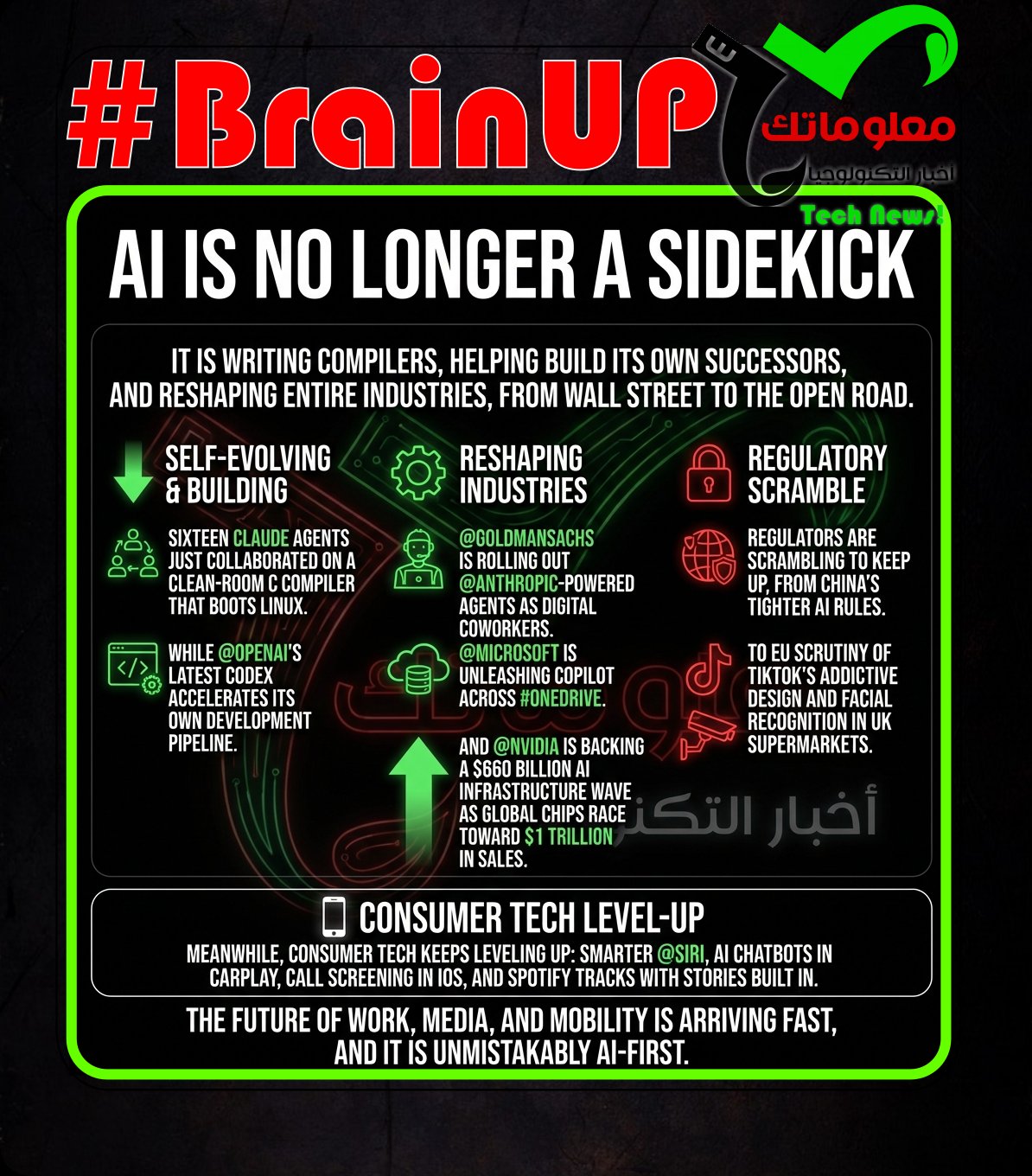
An experiment with 16 Claude Opus 4.6 agents set loose on a shared codebase with minimal supervision to build a C compiler from scratch, illustrating a significant push toward #agent teams in AI coding. Over two weeks and nearly 2,000 Claude Code sessions costing about $20,000 in API fees, the system produced a 100,000-line Rust-based compiler able to build a bootable Linux 6.9 kernel across x86, ARM, and RISC-V. Each instance ran in its own Docker container, claimed tasks by writing lock files, and pushed code upstream without a central orchestrator, resolving merge conflicts autonomously. It passes most #GCC torture tests at 99 percent and even boots Doom, but it lacks a 16-bit x86 backend for real mode, its assembler and linker are buggy, and Rust code quality does not rival an expert programmer. @Carlini notes that, despite progress, fixes often broke existing functionality, signaling a practical ceiling around 100,000 lines for autonomous coding and highlighting the fragility of semi-autonomous AI agents as coherence erodes. The project is described as a clean-room implementation since the agents had no internet access, yet the underlying model was trained on vast data, underscoring both the promise and caveats of current AI coding approaches.
2. It Turns Out That When Waymos Are Stumped, They Get Intervention From Workers in the Philippines
Waymo’s self-driving fleet, marketed as autonomous, relies on human input from overseas fleet response agents, including workers in the Philippines, to guide tricky situations while the vehicle remains in charge of driving tasks, illustrating ongoing human involvement in #autonomousdriving. At a Congressional hearing, @Mauricio Peña, Waymo’s chief safety officer, was pressed about overseas operators; he said they provide guidance but do not remotely drive, with some operators living in the US and others far away, including in the Philippines. Senator Ed Markey cautioned that having overseas influence could pose safety and cybersecurity risks, questioning whether those operators hold US licenses, and suggesting offshore work could erode domestic jobs. Waymo argues its fleet response teams are located both in the US and abroad and must hold a passenger-car license, pass background checks, and undergo random drug tests, while a May 2024 blog post frames operators as a phone-a-friend resource that contextualizes the environment but does not replace the autonomous system’s control. In case of atypical driving scenarios, a fleet response agent can view live camera feeds and advise on lane choice, underscoring that even advanced #AI-driven systems still depend on human intellect and oversight, a point that highlights regulatory and governance questions for #Waymo and the broader industry.
3. NBC appears to cut crowd’s booing of JD Vance from Winter Olympics broadcast
The NBC broadcast of the Milan Winter Olympics opening ceremony appears to have omitted the crowd’s boos toward @JD Vance, leaving US viewers unaware of the hostile reception. The boos were captured on the CBC feed, with observers noting jeers and whistles as @JD Vance appeared with his wife @UshaVance, while NBC’s on‑air team did not acknowledge the moment. The White House posted a clip of Vance applauding on NBC’s broadcast without the boos, highlighting a pattern of curbing dissent in US sports coverage that critics compare to past actions at the #USOpen. The article situates the moment amid Milan protests against ICE at the Games and broader questions about representing the US, illustrating how media choices can shape public perception of #dissent at major events.
4. Microsoft sets Copilot agents loose on your OneDrive files
Microsoft has made OneDrive agents generally available, enabling @Microsoft Copilot to query across up to 20 documents at once and save the setup as a .agent file in OneDrive. Users can ask cross-document questions such as ‘What decisions have we made so far?’ or ‘What risks keep coming up?’ and receive grounded responses based on the documents’ content, with agents that can be searched for and shared as long as collaborators have access to the source files. Microsoft says the agent helps keep everyone aligned without extra handoffs. Administrators may worry about privacy and data handling since Microsoft did not share details on what happens to user data or where it ends up. The feature expands #Copilot-enabled collaboration in #OneDrive, but users must ensure that all shared participants have access to the same source files, or Copilot may become confidently wrong.
Global semiconductor sales are projected to reach about $1 trillion in 2026 after a record $791.7 billion in 2025, propelled by AI demand and higher prices. In 2025, logic devices generated $301.9 billion and memory $223.1 billion, while Q4 2025 sales rose 37.1% year-over-year to $236.6 billion, signaling strong demand and pricing effects. Regional growth was led by Asia Pacific (+45%), followed by the Americas (+30.5%), with China up 17.3%, Europe up 6.3%, and Japan as the only major region to decline (-4.7%). SIA president John Neuffer says semiconductors support nearly all modern technology, and that AI, IoT, #6G, and autonomous driving will continue to drive chip demand, fueled by AI infrastructure such as @Nvidia GPUs, #HBM, networking gear, and storage. This end-of-year momentum underscores that both demand and pricing will shape the 2026 outlook and the broader AI-driven growth of the industry.
7. Nvidia rises 7% as CEO says $660 billion capex buildout is sustainable
Nvidia’s stock rose 7% after CEO Jensen Huang emphasized the sustainability of the company’s $660 billion capital expenditure buildout focused on AI infrastructure. Huang highlighted that the investment is backed by strong demand for AI chips and data center growth. This significant capex reflects Nvidia’s commitment to maintaining its leadership in #AI and #semiconductor technology. The CEO’s confidence in the market potential and strategic spending reassured investors, boosting the stock. Nvidia’s approach signals a major shift in tech industry investment trends, underlining the importance of AI-driven infrastructure.
8. China Tightens AI Regulations to Control Growth and Influence
China has implemented new stringent regulations on AI development to assert greater control over the rapidly growing technology sector. The government introduced policies requiring companies to obtain government approval for certain AI innovations, aiming to mitigate risks related to misinformation and societal impact. These measures include enhanced monitoring of AI-generated content and stricter data privacy protections, reflecting Beijing’s desire to maintain social stability and national security. Industry experts note these regulations could slow innovation but ensure AI aligns with Chinese Communist Party priorities. The updated regulatory framework underscores China’s broader strategy to leverage #ArtificialIntelligence while tightly managing its influence on society and the economy.
9. Randomly quoting Ray Bradbury did not save lawyer from losing case over AI errors
A lawyer’s attempt to defend themselves in a case involving AI-generated errors by randomly quoting author Ray Bradbury failed to prevent a loss. The case centered on the consequences of relying on AI technology that produced inaccurate or problematic outputs. Despite the lawyer’s creative approach to citing literary sources, the court emphasized the importance of accountability and careful review when using #artificialintelligence tools in professional contexts. This outcome reinforces the need for users to verify AI-generated content and not depend solely on such systems for critical tasks. The judgment highlights ongoing challenges and legal precedents in the interface between #law and emerging #AI technologies.
10. Dirty afterlife of a dead satellite spotted in orbit around Earth
The afterlife of a defunct spacecraft in orbit around Earth has been observed as a cloud of debris, revealing significant challenges posed by space #junk. The satellite, which had ceased functioning, fragmented unexpectedly, scattering particles and increasing collision risks in an already crowded orbit. This event highlights the growing danger of space debris, which threatens operational satellites and future space missions by creating hazardous conditions for navigation and satellite safety. The incident underscores the urgency of improved #spaceDebrisManagement and strategies to mitigate cascading collisions. Observations like these emphasize the need for international cooperation and development of technologies aimed at cleaning space to preserve the orbital environment essential for communication, navigation, and earth observation systems.
11. Microsoft to shut down Exchange Web Services in cloud in 2027
Microsoft announced it will retire the Exchange Web Services (EWS) API for Microsoft 365 in 2027, encouraging developers to transition to Microsoft Graph API. EWS, introduced in 2007, supports legacy Exchange client applications but is now considered outdated compared to Microsoft Graph, which offers enhanced features and better integration with Microsoft 365’s ecosystem. This change affects organizations and developers relying on EWS for mailbox data access, requiring them to plan migration strategies well before the 2027 deadline. Microsoft aims to streamline and modernize access to Exchange Online, improving security and functionality through Microsoft Graph. This transition aligns with Microsoft’s broader strategy to consolidate APIs and boost cloud service efficiency.
12. US, China Opt Out of Joint Declaration on AI Use in Military
The United States and China have decided not to participate in a joint declaration aimed at establishing norms for the use of artificial intelligence in military applications, signaling divergent approaches to #militaryAI governance. Other countries involved in the negotiations expressed concerns about how to effectively regulate AI technologies while preserving national security interests. The refusal by these two major powers, both heavily invested in AI research and military modernization, highlights the geopolitical complexities and lack of consensus surrounding #AI ethics and accountability in warfare. This development complicates international efforts to create shared frameworks that could help mitigate risks associated with autonomous weapons and AI-driven combat systems. The decision emphasizes the challenges of balancing technological innovation, strategic advantage, and global stability in an era of rapidly evolving #AI capabilities.
13. CEO Bets $1.25 Billion on AI to Transform Infrastructure Sector
A CEO is investing $1.25 billion to leverage #AI technologies for transforming the infrastructure sector, aiming to improve efficiency and sustainability. The investment reflects growing confidence in AI’s ability to optimize project planning, construction management, and maintenance operations, potentially reducing costs and environmental impact. Industry experts highlight that integrating AI can streamline processes, enhance safety, and provide data-driven insights that lead to smarter infrastructure development. This move aligns with broader trends where AI adoption is accelerating across various sectors to drive innovation. It demonstrates a significant shift in infrastructure strategy, emphasizing technology’s role in addressing complex challenges.
14. New York Is the Latest State to Consider a Data Center Pause
New York is considering a moratorium on new data center projects due to concerns over energy consumption and environmental impact. The proposed pause responds to the rapid growth of #dataCenters, which demand significant electricity, threatening the state’s climate goals and energy grid stability. Advocates worry that ongoing construction could outpace renewable energy development and strain local resources. This measure follows similar actions in states like Virginia and Maryland, reflecting growing regulatory attention on balancing tech infrastructure expansion with sustainability. The pause aims to encourage more strategic, environmentally conscious planning for future data center development in New York.
15. YouTube Revenue for Full-Year 2025 Topped $60 Billion, Making Video Platform Bigger Than Netflix
YouTube’s full-year 2025 revenue topped $60 billion, including ads and subscriptions, making the platform larger than Netflix and a clear pillar of Alphabet’s media strength. In Q4 2025, YouTube ad revenue reached $11.38 billion, up 8.7% year over year but below Wall Street expectations of about $11.84 billion, while Netflix posted $45.18 billion for the year and Disney $95.7 billion. Alphabet reported over 325 million paid subscriptions across YouTube Premium, YouTube TV and Google One, and @SundarPichai highlighted the role of #AI investments and large content deals such as the exclusive global rights to the #Oscars from 2029-2033, plus a BBC partnership to create original content. Overall, the results illustrate how YouTube reinforces Alphabet’s growth strategy by expanding subscriptions and content deals, signaling a bigger, more diversified video platform business.
16. Goldman Sachs taps Anthropic’s Claude to automate accounting, compliance roles
Goldman Sachs is teaming with @Anthropic to build @Claude-based AI agents to automate back-office roles in trade #accounting and client #onboarding, aiming to speed processes and contain future #headcount growth as part of a broader #AI transformation. For six months, embedded @Anthropic engineers have co-developed autonomous agents in at least two areas, and Goldman expects to launch the agents soon, noting that @Claude is strong beyond coding and can handle large data, rules-based tasks. Executives describe the technology as a digital co-worker for scalable, complex processes, with expected benefits in faster client onboarding and quicker resolution of trade reconciliation and accounting issues. The project reflects a broader shift to #generativeAI in finance and the potential to automate more tasks such as onboarding, compliance, and even pitchbooks, while executives say job losses remain premature. CEO @DavidSolomon has framed a multi-year plan to reorganize around AI, and Goldman may reduce reliance on external AI providers as it expands automation.
17. OpenAI says new coding model helped build itself
OpenAI’s latest coding model, GPT-5.3-Codex, is described as the first to help build itself, speeding up its training, deployment, and evaluation by using early Codex versions to debug and diagnose results. The model, built on insights from GPT-5.2-Codex and designed for natural-language driven coding, reportedly runs 25% faster and uses fewer computing resources while delivering state-of-the-art performance, and it is the first to be labeled ‘high-capability’ for #cybersecurity tasks under internal #risk-management guidelines. Coding models like @OpenAI’s Codex, @Anthropic’s Claude Code, and Cursor are changing how developers write software by outsourcing line-by-line coding to AI, enabling higher-level instructions from humans. This creates a tighter feedback loop where AI systems help design their successors and even validate training data and code, raising questions about safety and the future role of human engineers. In parallel, OpenAI released a Codex desktop app to orchestrate multiple autonomous coding agents, a tool that has already drawn more than 500,000 downloads and signals how these assistants are becoming central to building and managing software tasks.
18. Mercedes Worried About EU Gas Ban By 2035
Mercedes-Benz has expressed concerns about the European Union’s proposal to ban new gasoline and diesel cars by 2035, fearing it may be unrealistic and detrimental to the industry. CEO @Ola Källenius highlighted the challenges in supply chains and raw material availability needed for electric vehicles, emphasizing that abrupt transitions could harm automakers and consumers. The company prefers a more flexible approach allowing for fuel-efficient hybrids and alternative fuel technologies, ensuring technological neutrality. The debate underscores tensions between aggressive environmental targets and practical industry capabilities, reflecting the complexity of transitioning to full electric fleets within the EU. Mercedes’ stance illustrates the balancing act between innovation, regulation, and market readiness in the automotive sector.
19. TikTok’s ‘addictive’ design breaches EU law, European Commission says
The European Commission says TikTok’s addictive design, including infinite scroll, breaches the #DSA and fails to adequately protect users. The infinite scroll continuously feeds new content, putting users on autopilot and encouraging compulsive scrolling. The Commission also questions TikTok’s #DailyScreenTime feature and its parental controls, noting warnings are easy to dismiss and that managing safety settings requires additional time and skill. To comply, TikTok must change the basic design of its service by disabling infinite scroll, implementing more effective screen-time breaks, and adjusting video recommendations. The findings underscore heightened regulatory scrutiny of social platforms to protect young users, a point echoed by TikTok’s response that it disputes the conclusions and points to tools like sleep hours and well-being missions, while @HennaVirkkunen emphasizes the need for robust safeguards.
20. ‘Orwellian’: Sainsbury’s staff using facial recognition tech eject innocent shopper
A London shopper was wrongly identified by Sainsbury’s staff using the #Facewatch facial recognition system and told to leave, an incident he described as Orwellian and likened to @MinorityReport. Warren Rajah says three staff approached him mid-shop; one appeared to affirm that he was the person pictured on a device, while #Facewatch flagged someone else in the store, prompting a QR-code link to the firm’s site; Facewatch later told him he was not on its database and had no alerts. Sainsbury’s apologised, saying the issue was not with the technology but with targeting the wrong person, and #Facewatch said the incident stemmed from human error in-store and that Rajah was not on the database. Rajah worries about the possible creation of a permanent record and questions how his personal data handed to #Facewatch is stored or deleted, noting the lack of clear processes for challenging such decisions and the vulnerability of others who may not navigate QR codes. The episode underscores broader concerns about #privacy and accountability in retail #facialrecognition use, highlighting the need for transparent procedures and robust safeguards.
21. Substack confirms data breach affecting email addresses and phone numbers
Substack recently confirmed a data breach that compromised email addresses and phone numbers of some users. The breach did not affect payment information or passwords, as those remain secured through third-party services. Substack identified the issue after noticing suspicious activity and took immediate steps to contain the incident and notify impacted users. This breach highlights ongoing challenges in protecting personal data on #subscription platforms. Substack’s response underscores the importance of transparency and prompt action in managing data security incidents.
22. Russian Inspector Satellites Suspected of Intercepting European Communications
Russian inspector satellites have been reportedly used to intercept European satellite communications, raising concerns about espionage activities in space. These satellites, originally intended to monitor other Russian spacecraft for treaty compliance, appear to be repurposed for gathering intelligence on European nations. Experts suggest this reflects a broader trend of militarizing space and using dual-purpose satellites for surveillance. The activities highlight the growing tension and mistrust in space operations between Russia and Western countries. This situation underscores the challenges in maintaining transparency and trust under the current geopolitical climate.
23. AWS Revenue Continues to Soar as Cloud Demand Remains High
Amazon Web Services (#AWS) reported a significant increase in revenue, driven by sustained high demand for cloud computing services. The company’s latest financial results reveal robust growth, with revenue outperforming previous quarters and expectations. This growth reflects the broader industry trend where businesses continue migrating workloads to the cloud for scalability and efficiency. AWS’s strong performance highlights its leading position in the cloud market, supported by continuous innovation and expansion of its service offerings. As demand for cloud solutions grows, AWS is poised to maintain its trajectory, solidifying its role in the digital transformation era.
24. Uber found liable for sexual assault in first of thousands of similar lawsuits
A federal jury in Phoenix found @Uber liable for the sexual assault of a rider and ordered $8.5 million in damages, the first decision in a set of more than 3,000 centralized cases that could shape future outcomes. The plaintiff, Jaylynn Dean, said she was raped by an Uber driver during a ride to her hotel in November 2023. The verdict challenges Uber’s long-standing position that it cannot be responsible for drivers’ criminal actions and could serve as a bellwether for thousands of similar lawsuits across the system. Uber says it plans to appeal, while citing its safety investments after reporting 12,522 sexual assault reports from 2017-2022, with almost 70% involving drivers. Overseen by US district judge Charles Breyer, the ruling underscores a push for accountability and rider safety in the ride-hailing economy, signaling how courts may treat safety responsibilities across platforms #riderSafety.
25. Apple Preparing to Allow Third-Party Chatbots in CarPlay with Upcoming iOS 17 Update
Apple is planning to enable third-party #chatbots integration in CarPlay with iOS 17, providing users access to various AI chat assistants while driving. The update will allow developers to create apps that bring AI chatbots like ChatGPT directly to the CarPlay interface, enhancing in-car digital assistance. This move aligns with Apple’s gradual expansion of CarPlay’s functionality beyond basic navigation and media, aiming to enrich the user experience with advanced AI capabilities. The addition of chatbots could assist drivers with information retrieval, reminders, and conversational support safely within the car environment. By incorporating third-party AI tools, Apple is responding to increased demand for intelligent voice and text interaction while driving, reinforcing CarPlay’s role as a comprehensive in-car operating system.
26. BA and Ingram to Stop Mass Market Paperback Distribution
The mass market paperback format is being phased out as major distributors #BA and #Ingram cease its distribution starting next year, reflecting changing market demands. This decision follows a steady decline in sales for mass market paperbacks, which were once popular for their affordability and portability. The shift highlights the rise of other formats like trade paperbacks, ebooks, and audiobooks, which better meet current reader preferences. The move also impacts publishers, retailers, and authors who must adapt to a market less reliant on the traditional mass market paperback. This change underlines a broader evolution in publishing, where distribution channels and consumer habits are continuously reshaped by technology and market forces.
28. iOS 26’s new Phone app has a feature I don’t ever want to go without – 9to5Mac
iOS 26 overhauls the #Phone app with a new design and features, highlighted by a call screening option that the author says they don’t want to live without. The feature, named ‘Ask Reason for Calling’, sits in Screen Unknown Callers with options Never, Ask Reason for Calling, and Silence, giving users a middle ground between letting all unknown calls ring and silencing them. It prompts unknown callers to reveal who is calling and why before the iPhone rings, helping users decide whether a call is worth answering. This approach addresses the long-standing spam-vs-important-calls trade-off by offering upfront context rather than a binary filter. Apple continues to push updates to its communication apps like @Messages and #Phone, with refinements such as Live Translation and new ringtones that accompany the broader redesign.
Spotify’s new feature, About the Song, from @Spotify, lets premium listeners in the U.S., U.K., Canada, Ireland, New Zealand, and Australia explore the stories behind the music through short, swipeable story cards summarized from third-party sources #AboutTheSong. Users access it from the Now Playing screen by scrolling to the About the Song card and can rate each card with a thumbs up or down. Spotify says the feature helps fans understand what inspired a track and its meaning, deepening their connection to the music, and notes it isn’t yet available on rival platforms like Apple Music. In addition to About the Song, @Spotify recently announced other features including audiobook Page Match and Audiobook Recaps, and improvements to lyrics, while revamping Developer Mode APIs.
30. iPhone 17e Reportedly Set to Launch This Month With 4 Major Upgrades
@Apple’s upcoming iPhone 17e is slated to launch this month with four major internal upgrades while keeping the iPhone 16e’s design. According to @Macworld citing @MacOtakara, the 17e will use the A19 chip for faster performance and improved power efficiency, along with the #C1X modem for #5G and #LTE and the #N1 chip for #WiFi7 and #Bluetooth6 connectivity. The report also suggests MagSafe support, with wireless charging rising from 7.5W on the 16e to about 25W with MagSafe. These upgrades would boost speed and connectivity without a redesign, reflecting Apple’s pattern of iterative improvements. In sum, the 17e aims to enhance performance and wireless features while preserving the familiar look of the 16e.
31. Why Apple’s iOS 26.4 Siri Upgrade Will Be Bigger Than Originally Promised
Apple’s @Apple iOS 26.4 upgrade will overhaul how we interact with @Siri by introducing an #LLMs-based core that everything else is built around. The upgrade won’t be a full chatbot like ChatGPT or Claude, but it marks a shift from multiple task-specific models to an integrated reasoning system. This enables the assistant to understand nuances, follow multi-step requests, use pronouns, and leverage personal context and screen-aware information to act across apps, with a move toward a short-term memory for follow-up tasks. These changes align with the #AppleIntelligence goals described for iOS 18—personal context, onscreen awareness, and deeper in-app capabilities—suggesting a broader roadmap for Siri beyond 26.4.
That’s all for today’s digest for 2026/02/07! We picked, and processed 29 Articles. Stay tuned for tomorrow’s collection of insights and discoveries.
Thanks, Patricia Zougheib and Dr Badawi, for curating the links
See you in the next one! 🚀
