
#BrainUp Daily Tech News – (Friday, February 6ᵗʰ)
Welcome to today’s curated collection of interesting links and insights for 2026/02/06. Our Hand-picked, AI-optimized system has processed and summarized 20 articles from all over the internet to bring you the latest technology news.
As previously aired🔴LIVE on Clubhouse, Chatter Social, Instagram, Twitch, X, YouTube, and TikTok.
Also available as a #Podcast on Apple 📻, Spotify🛜, Anghami, and Amazon🎧 or anywhere else you listen to podcasts.
1. Introducing OpenAI Frontier
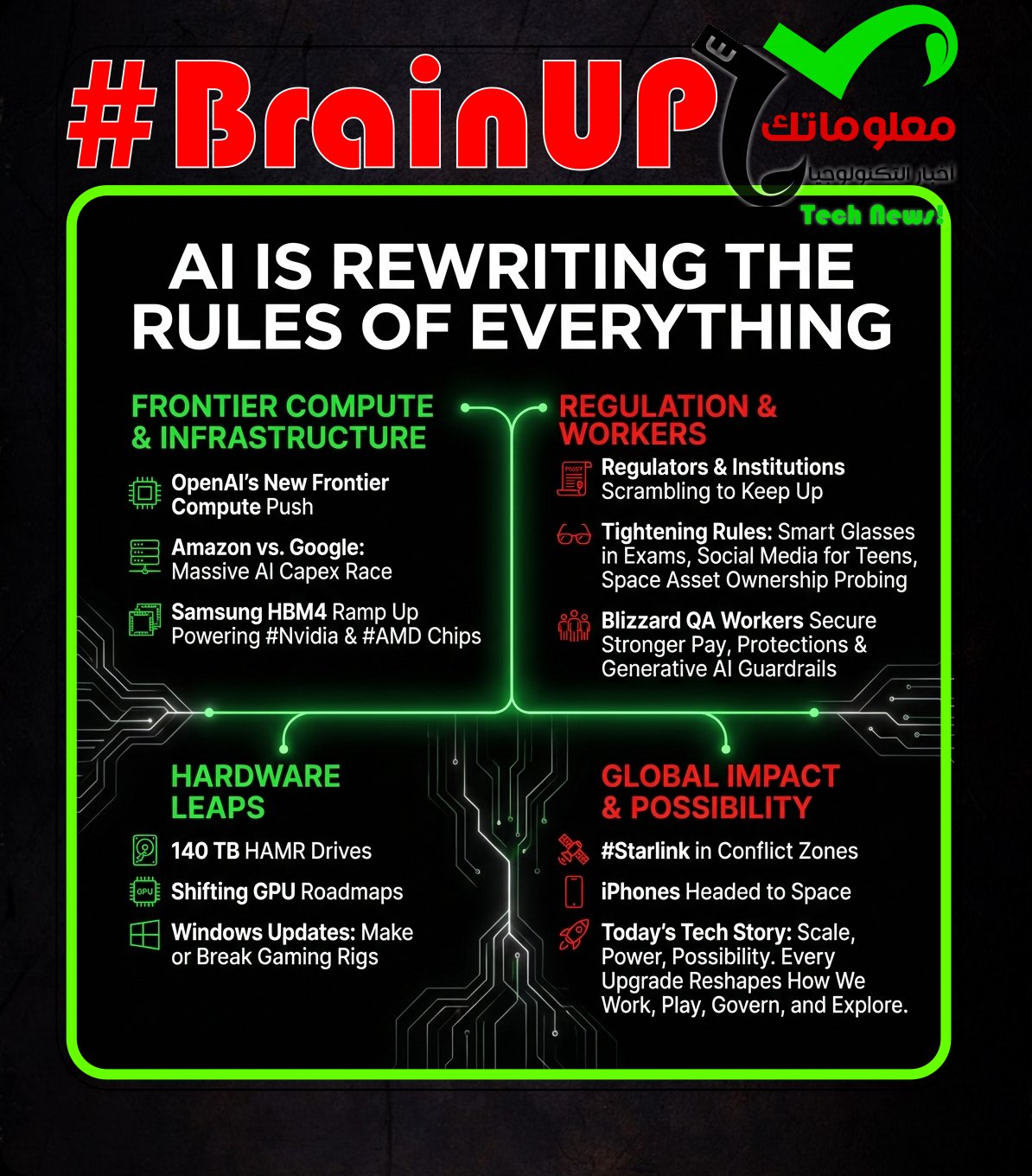
OpenAI Frontier is a new initiative designed to accelerate AI development through increased compute access and collaborative research. The program aims to enable researchers and organizations to leverage cutting-edge compute resources to push the boundaries of AI capabilities. By providing substantial compute credits and infrastructure, Frontier facilitates experimentation with large-scale models and fosters innovation in AI applications. This initiative underscores OpenAI’s commitment to broadening participation in AI advancement and addressing global challenges with the latest technologies. Frontier exemplifies a step forward in democratizing powerful AI tools and expanding the ecosystem for AI progress.
2. The College Board Is Banning Students From Using Smart Glasses During the SATs
The College Board has banned #smart glasses during #SATs starting in the spring to curb cheating with wearable tech. The official policy states, ‘Smart glasses are prohibited during testing. Students with prescription smart glasses will need to remove them or test another day with standard glasses.’ The piece argues these devices are uniquely capable of cheating, not only through voice assistants but via connected @ChatGPT and @Gemini, cameras, and even POV video calls, making detection harder than with phones. Discreet design, as with the #Ray-BanDisplay, raises privacy concerns and makes it harder for admins to spot cheating. Ultimately, the author suggests a ban is justified but unlikely to solve the broader cheating problem or its consequences, such as insurmountable student debt.
The Department of Homeland Security has quietly used administrative subpoenas to force tech companies to disclose data about critics of @Trump, signaling a shift in how investigations can access user information without judicial oversight. These self-signed subpoenas seek identifiable details from users behind anonymous accounts that document ICE operations and criticize Trump officials, including when and from where a user logged in, what devices were used, and email addresses, while not demanding email contents or location data. In at least one case, DHS sought the identity of the @montocowatch account in Montgomery County, PA, and eventually withdrew the subpoena. The American Civil Liberties Union argues there is no evidence of wrongdoing and that recording or sharing such material, even anonymously, is protected under the First Amendment, highlighting civil-liberties concerns about these subpoenas. This episode underscores broader tensions in a federal immigration crackdown between security interests and civil liberties, as critics warn that administrative subpoenas can bypass judicial review and chill dissent #administrative_subpoenas #FirstAmendment.
A problematic Windows 11 January security update, KB5074109, is causing gaming instability on some machines with @Nvidia GPUs. Users report framerate drops of 15 to 20 FPS, graphics artifacts, and occasional black screens, leading @Nvidia to describe uninstalling the update as a temporary workaround while it investigates. Microsoft acknowledged boot issues tied to KB5074109, noting the update is mandatory to address 114 vulnerabilities and, among other fixes, battery drain on systems with NPUs, but the release has left many #GeForce players affected while #Radeon users seem less impacted. During January, Nvidia released two drivers (582.28 and 591.86) in an attempt to mitigate the problems, yet many affected users found that removing KB5074109 restored performance and stability. For unaffected systems, the update enhances security, but for those experiencing issues the recommended short term fix is to uninstall KB5074109 while Nvidia and Microsoft continue investigating.
5. Microsoft quietly locks Storage settings behind admin rights in Windows 11
Microsoft is tightening Windows 11’s security by requiring full administrator rights to open the Storage settings, a core tool for managing disk space, cleanup tools, and system files. The change triggers a User Account Control (UAC) prompt when the Storage settings page is opened, intended to ensure that only authorized @Windows users can access system files as part of the February 2026 @SecurityUpdate and the notes for KB5074105. This adds a protective layer but creates friction for everyday maintenance on shared or family PCs. The update also coincides with other changes, including the ability to resume Android apps on @Windows and a major upgrade to @WindowsMIDI Services featuring broader support and cross-app MIDI ports, plus enhancements to @WindowsHello with external fingerprint readers and improved management of #SmartAppControl. Whether this balance between protection and usability will satisfy households moving forward remains to be seen.
Blizzard’s QA workers in Albany and Austin ratified a union contract after nearly three years of negotiations, yielding a new agreement that promises a better working environment with increased pay, benefits, and layoff protections. The Communications Workers of America states the deal covers 60+ workers and includes guaranteed wage increases, strengthened protections around #AI and generative tools to prevent replacement of workers, fair crediting protections, disability accommodations, immigrant worker protections, and limits on mandatory crunch time. According to @BrockDavis, a Blizzard Albany QA analyst, the contract represents a meaningful advancement at a moment when layoffs are reshaping the industry, providing wages to live on, improved job security, and guardrails around AI in the workplace. The agreement stands as a notable win for videogame workers and could influence other studios, including Raven’s QA teams which took about three years to secure theirs, signaling a broader shift toward sustainable careers in game development.
Russia reportedly utilized @SpaceX’s #Starlink satellite internet to control strike drones that targeted Kyiv, successfully bypassing traditional communication defenses. Evidently, SpaceX’s emergency response to disable Starlink services in Ukraine inadvertently disrupted Ukraine’s entire drone command system. This disruption critically affected Ukraine’s defense operations, highlighting the complex dependencies on commercial satellite technology in modern warfare. The incident underscores the vulnerabilities and unexpected consequences when private sector technology is employed in active conflict zones. It raises concerns about the role and risks of using commercially operated satellite networks in military contexts.
8. NASA will finally allow astronauts to bring their iPhones to space
NASA will allow astronauts to bring iPhones and other #smartphones into orbit and beyond, starting with Crew-12 and #ArtemisII, to capture moments and share images, per @JaredIsaacman. The move is presented as not just about better photos but also about challenging long-standing processes and expediting the qualification of modern hardware for spaceflight, a step @JaredIsaacman says is a small step in the right direction. The piece notes the many qualification hurdles—radiation characterization, battery thermal and vacuum tests, outgassing, vibe testing and other checks—while Isaacman urges reassessing which requirements are still needed today. Smartphones have flown before, including two iPhone 4s on the final space shuttle mission in 2011, though it’s unclear whether the crew touched them; now modern smartphones will be available on Artemis II.
9. Amazon Boosts Spending Far Ahead of Estimates on AI Build-Out
Amazon significantly increased its investment in artificial intelligence, outpacing analyst expectations as it accelerates its AI infrastructure development. The company has allocated considerable resources towards enhancing its #AI capabilities, including expanding data centers and advancing machine learning tools. This aggressive spending reflects Amazon’s strategy to compete more effectively with rivals like @Google and @Microsoft, who have also heavily invested in AI technologies. The move indicates Amazon’s commitment to integrating sophisticated AI solutions into its services and products, positioning itself as a leader in the rapidly evolving tech landscape. This financial commitment underscores the growing importance of AI in shaping the future of cloud computing and e-commerce.
10. Amazon and Google are winning the AI capex race — but what’s the prize? | TechCrunch
In 2026, the AI capex race centers on who can build the most data-center compute, and @Amazon appears to lead after projecting $200B in capex for 2026 across #AI, chips, robotics, and low earth orbit satellites. @Google is close behind with a projection of $175B to $185B for 2026, up from 2025, while @Meta is looking at $115B to $135B and @Oracle about $50B; @Microsoft has indicated about $150B for 2026 based on a recent quarterly figure of $37.5B, assuming the pace continues. The underlying logic is that control of compute will determine AI product leadership, but investors have balked at the scale of the investments, with stock prices slipping as spends rise. The piece notes Amazon’s capex also includes substantial non-AI spending tied to a large physical footprint that is being repurposed for robotics, so not all expenditure is AI-specific. Taken together, the article frames a winner-takes-most race for #AI infrastructure, but the prize remains uncertain and the market remains wary of the costs.
11. Volkswagen overtook Tesla as Europe’s top EV seller in 2025: report
Volkswagen has surpassed Tesla to become the leading electric vehicle (#EV) seller in Europe for 2025, marking a significant shift in the competitive landscape of the electric automotive market. According to recent sales data, Volkswagen’s strategic investments in electrification and diversified EV lineup helped it capture greater market share across the continent. The company’s focus on a wide range of affordable and premium EV models has attracted a broader customer base compared to Tesla’s more limited product range. This change highlights the intensifying competition in the European EV space, as manufacturers ramp up efforts to meet increasing consumer demand and regulatory pressure. Volkswagen’s rise indicates its strengthening position in the transition towards sustainable transportation in Europe.
12. Pentagon asked to probe SpaceX over potential Chinese ownership issues
The U.S. House Armed Services Committee has asked the Pentagon to investigate whether #SpaceX has violated national security rules due to potential Chinese ownership interests. This inquiry follows concerns about foreign investments in critical defense companies, as SpaceX plays a pivotal role in U.S. space and missile defense programs. The investigation aims to ensure there are no security risks stemming from undisclosed foreign influence or control. Given SpaceX’s significance in national defense infrastructure, oversight of foreign ownership safeguards is crucial. This move underscores increased vigilance over foreign investments in key technology and defense sectors.
13. Spotify to let users buy physical books in app through Bookshop.org partnership
Spotify is expanding its commerce ventures by allowing users to purchase physical books directly within its app through a partnership with Bookshop.org, an online bookstore that supports independent bookshops. This integration will enable Spotify to offer book recommendations linked to its podcasts and content, enhancing user engagement through cross-platform experiences. By leveraging Bookshop.org’s affiliate platform, Spotify provides a new revenue stream both for itself and independent bookstores, highlighting a strategic move beyond audio streaming. The move indicates Spotify’s ongoing efforts to diversify its offerings and deepen content monetization through digital-physical commerce connections. This partnership aligns with Spotify’s broader goal of building a creator-centric, entertainment-driven ecosystem.
Samsung plans to raise HBM4 output capacity by about 70%, expanding its next-generation DRAM lines to meet rising demand from @Nvidia and @AMD for AI memory. The company has confirmed it will mass-produce and ship HBM4 to clients from Q1, with shipments to @Nvidia as early as February. This comes as Samsung reports Q4 2025 profit at a record high, underscoring its momentum in the memory market. Samsung is in talks to supply customized HBM4 to major AI chipmakers, including @Nvidia, @Broadcom, and @Google, and is pursuing a joint development with @TSMC for HBM4 AI chips. Taken together, the expansion signals Samsung’s intent to solidify its leadership in #HBM4 and #HBM3E and to deepen its role in AI hardware ecosystems.
15. After social media ban, teens in France may move to encrypted apps
France is considering legislation to ban social media use for children under 16 without parental consent, aiming to protect youth from negative online impacts. Following this, teenagers may increasingly turn to encrypted messaging apps like Signal and WhatsApp, which offer more privacy but pose moderation challenges. Experts suggest this shift could complicate content regulation and expose teens to unmonitored environments, raising concerns about the efficacy of the ban. The debate highlights the trade-offs between protecting minors and preserving privacy in digital communication. France’s policy reflects a broader global struggle to find balanced approaches to youth social media usage.
16. Western Digital Details 14-Platter 3.5-Inch HAMR HDD Designs with 140 TB and Beyond
Western Digital has revealed designs for next-generation 3.5-inch HAMR (Heat-Assisted Magnetic Recording) hard drives featuring 14 platters, capable of exceeding 140 TB storage capacity. The innovation leverages #HAMR technology to significantly increase data density by heating the disk surface to enable more precise magnetic writing, allowing for more platters and thus higher capacities. This advancement pushes the limits of traditional hard drive storage, promising larger drives for data centers and enterprise applications. Western Digital’s approach demonstrates a commitment to evolving #HDD technology amid rising demand for high-capacity storage solutions. These developments reinforce Western Digital’s role in shaping the future of magnetic storage by addressing scalability challenges through engineering enhancements.
Nvidia is reportedly not planning to release any new #RTX gaming GPUs in 2026, with the anticipated RTX 60 series likely debuting in 2028. The report suggests a gap in Nvidia’s product launch cycle where no new RTX cards will be introduced, possibly due to shifts in GPU architecture or market strategy. This delay indicates that current RTX lines, including RTX 40 and 50 series, may see extended support or iterative improvements until the next generational leap. The RTX 60 series, expected to bring significant advancements, is now projected to arrive two years later than typical product cadence. This development will impact gamers and professionals relying on Nvidia’s high-end graphics solutions, emphasizing a transitional period before the next major release.
18. Apple AirTag Tips and Tricks
Apple AirTags provide a convenient way to track and locate personal items using the Find My network. Key features include Precision Finding with U1 chip technology for accurate location guidance, Lost Mode notifications when an AirTag is detected nearby by other Apple devices, and customizable AirTag alerts to help prevent unwanted tracking. Users can also utilize Siri commands to locate lost items quickly and pair AirTags with keychains or luggage through accessories. These tips enhance the everyday utility of AirTags, leveraging #Apple’s ecosystem to keep valuable items secure and easily retrievable.
19. Bitcoin prices see significant fluctuation amid market uncertainty
Bitcoin experienced notable price volatility recently, reflecting ongoing market uncertainty. Data from major exchanges showed sharp ups and downs within a 24-hour period, influenced by shifting investor sentiment and macroeconomic indicators. Analysts noted that regulatory developments and global economic conditions continue to impact #cryptocurrency valuations significantly. This fluctuation highlights the inherent risks and opportunities in cryptocurrency investment. Understanding Bitcoin’s price movements is crucial for investors navigating the evolving digital asset landscape.
20. Black holes could illuminate new physics beyond Einstein’s theory
Physicists are exploring how black holes might reveal physics beyond the current understanding of Einstein’s theory of general relativity. Recent research suggests that modifications to gravity theories could lead to observable differences in the properties and behaviors of black holes, such as in their mergers or radiation emissions. These theoretical developments leverage black holes as natural laboratories to test fundamental #physics concepts under extreme conditions. By analyzing gravitational wave data from black hole collisions, scientists hope to detect deviations that would indicate new physics, potentially unifying gravity with quantum mechanics. This approach offers a promising path to expand our comprehension of the universe by probing where Einstein’s theory might break down.
That’s all for today’s digest for 2026/02/06! We picked, and processed 20 Articles. Stay tuned for tomorrow’s collection of insights and discoveries.
Thanks, Patricia Zougheib and Dr Badawi, for curating the links
See you in the next one! 🚀
