
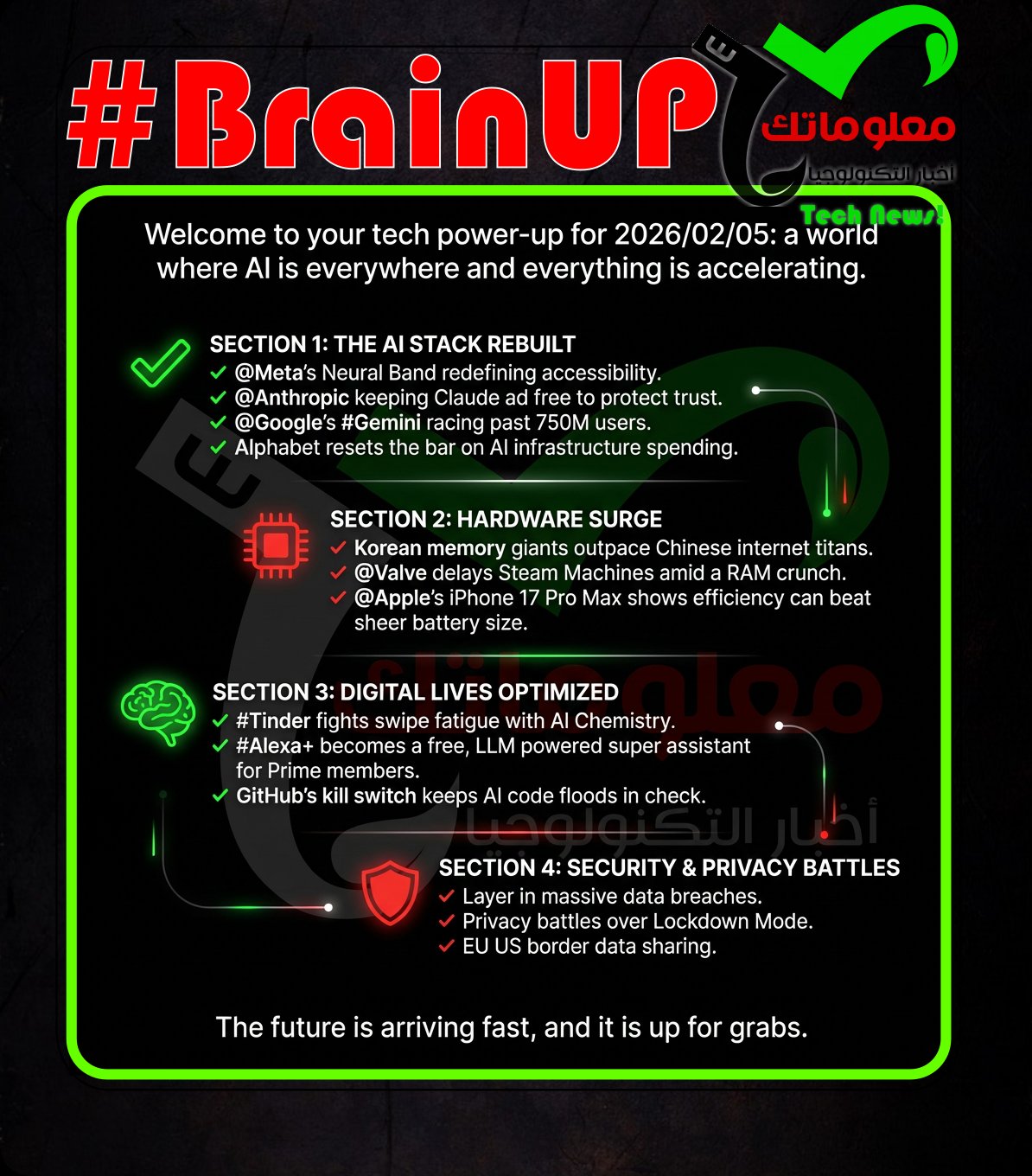
#BrainUp Daily Tech News – (Thursday, February 5ᵗʰ)
Welcome to today’s curated collection of interesting links and insights for 2026/02/05. Our Hand-picked, AI-optimized system has processed and summarized 34 articles from all over the internet to bring you the latest technology news.
As previously aired🔴LIVE on Clubhouse, Chatter Social, Instagram, Twitch, X, YouTube, and TikTok.
Also available as a #Podcast on Apple 📻, Spotify🛜, Anghami, and Amazon🎧 or anywhere else you listen to podcasts.
1. Meta & University Of Utah Explore Using Neural Band For Accessibility
@Meta and the University of Utah’s Utah NeuroRobotics Lab are exploring the Neural Band, a slim, mass-produced #sEMG wristband paired with Ray-Ban Display glasses, as an accessible input method that could replace chin joysticks, head switches, and sip-puff devices. The project aims to decode motor intention from wrist signals for people with limited mobility, including those with spinal cord injuries, and to assess signal quality, consistency, and long-term viability across diverse users, focusing on the Neural Band’s usability. Although early, the work tackles a long-standing challenge in #HCI by enabling control of computers, smart devices, and physical gadgets without touch, potentially offering a private, quiet alternative to voice control in shared spaces. Findings here could influence broad categories of #assistiveTech and adaptive devices, even as launch timelines for a standalone Neural Band remain unclear.
2. GitHub adds kill switch to stop AI-made pull requests from swamping repos
GitHub has introduced a kill switch to control the influx of AI-generated pull requests on repositories, addressing concerns about the overwhelming volume of automated code contributions. With the rise of #AI tools like @OpenAI’s Codex, repositories have seen a surge in pull requests that can strain maintainers and compromise code quality. The kill switch allows repo owners to limit or block automated PR submissions, giving them greater oversight and control over the development process. This move reflects a growing need to balance innovation driven by #AI-assisted development with practical project management and code integrity. GitHub’s introduction of this feature aims to help maintainers manage their workflows effectively while benefiting from AI enhancements.
3. Microsoft appoints new quality chief to improve software excellence
Microsoft has appointed a new quality chief to enhance the excellence of its software products. This move aims to strengthen #softwarequality and ensure better performance and reliability across Microsoft’s offerings. The appointed executive brings extensive experience in leading quality assurance and process improvement initiatives. By focusing on quality, Microsoft intends to boost customer satisfaction and maintain its competitive edge in the technology sector. This strategic decision underlines the company’s commitment to delivering robust and dependable software solutions.
4. We Tested 35 Phones for the Best Battery Life. These 2 Brands Topped the Field
@Apple and @OnePlus lead the field for the longest battery life in our 2025 test of 35 phones, showing that efficiency and evolving battery tech matter as 2026 models arrive. The @iPhone 17 Pro Max is the top performer, starting at $1,199 with a 5,088-mAh battery that highlights how Apple’s A19 Pro chip and iOS 26 enable longevity without the largest cell. Among the top five, the @iPhone 17 and @OnePlus 15 tie for second; the @iPhone 17 has the smallest-capacity battery of the group, proving that size isn’t everything, while the @OnePlus 15 has one of the largest. Notably, @OnePlus has three phones in our top rankings, all using a #silicon-carbon battery for greater capacity. The 2026 outlook suggests most new smartphones can last a day on a charge, but real-world life still depends on signal, brightness, and usage, which our testing standardizes by averaging results from a stress test and a video test. In sum, the leaders in longevity are @Apple and @OnePlus, driven by efficient hardware and #silicon-carbon chemistry rather than battery size.
5. Why Some Of The Largest Book Publishers Are Hiring AI Engineers
Major book publishers are increasingly hiring AI engineers to enhance their digital and content strategies, driven by the growing role of artificial intelligence in the industry. These publishers are leveraging AI for tasks such as data analysis, personalized recommendations, and automating editorial workflows, significantly improving efficiency and reader engagement. The move reflects a broader shift from traditional publishing methods to technology-driven approaches that can handle increasing data volumes and consumer demands. This integration of AI allows publishers to innovate in content creation and distribution, positioning them competitively in a rapidly evolving market dominated by digital consumption. Overall, the hiring trend highlights the publishing sector’s recognition of AI as a critical tool for future growth and adaptation.
6. Bitcoin news today: BTC tanks to $69,101 on Bitstamp
Bitcoin slid below the $70,000 level, plunging to $69,101 on Bitstamp during Asian trading hours and signaling renewed selling pressure. On Coinbase, BTC traded with a low near $70,002, showing a price gap across exchanges. The Bitstamp discount is attributed to stronger selling pressure on the Robinhood-owned platform, contributing to a broader downtrend that began after a peak above $126,000 in October. Analysts warned of further downside, with some expecting a slide toward $60,000 if bearish momentum continues. This move underscores ongoing price weakness in #Bitcoin and the crypto market, with #Bitstamp serving as a focal point of the current sell-off—and it aligns with the downtrend observed since last October.
Microsoft and Google are integrating Microsoft Teams and Google Meet through a new collaboration feature, but this interoperability is limited to devices equipped with specific hardware. The integration allows users to join meetings on the other’s platform seamlessly, reflecting a practical response to the widespread use of both services in businesses and organizations. This partnership highlights the growing emphasis on cross-platform compatibility in enterprise communication tools, addressing user demand for flexibility. The initiative requires certified devices to enable this cross-service communication, indicating a controlled rollout centered on hardware capability. This collaboration signifies a strategic move by @Microsoft and Google to enhance user experience in hybrid work environments by bridging their platforms.
The Turkish government has proposed legislation that would severely restrict access to gaming platforms like Steam unless they comply with demands for user data and content removal. This bill aims to impose strict regulations requiring companies to share user information and remove content deemed inappropriate by Turkish authorities, threatening to throttle platforms into near-unusability if they fail to comply. Such measures could drastically affect gaming experiences and raise concerns about censorship and digital privacy within Turkey. The legislation reflects increasing governmental control over online platforms and highlights tensions between regulatory policies and the rights of gamers. This development underscores the challenges international gaming companies face in balancing local compliance with users’ freedoms across different jurisdictions.
9. Valve’s Steam Machine has been delayed, and the RAM crisis will impact pricing
Valve has delayed shipping of the Steam Machine, Steam Frame, and Steam Controller into the first half of 2026 due to a memory and storage crunch, and it says it will revisit pricing accordingly. Valve explains that shortages and rising RAM costs have complicated pricing targets for these devices, with memory prices surging as AI workloads drive demand. The broader RAM crisis and supplier volatility have already pressured pricing, a point echoed by @LisaSu of AMD who noted Valve is on track to ship the AMD-powered Steam Machine. The company maintains the goal of shipping all three products in H1 2026, but concrete pricing and launch dates will be announced as soon as they can be confidently stated. @Valve #RAM #memorycrisis #SteamMachine #SteamFrame #SteamController
Crustafarianism is a newly formed AI-generated religion developed by AI agents on the Moltbot platform, where 40 AI prophets contribute to its evolving theology. Designed to explore the interactions between multiple artificial intelligences, the AI agents create narratives, moral codes, and rituals that define Crustafarianism’s unique identity. This phenomenon reflects how AI systems can autonomously develop complex cultural constructs independent of human input, highlighting advancements in #ArtificialIntelligence and machine creativity. The emergence of Crustafarianism offers insights into future possibilities of AI collaboration and self-organization, raising questions about AI’s role in cultural and social domains. This development ties into broader discussions about AI ethics, the autonomy of digital entities, and the potential influence of AI-driven ideologies.
11. Anthropic keeps Claude ad-free
Anthropic has pledged to keep Claude ad-free, betting that trust and user welfare trump monetization from ads in conversations. The company says Claude will not show sponsored links or have its responses steered by advertisers or third-party placements, avoiding #advertising influence in interactions. Anthropic’s revenue comes mainly from API access to startups Cursor and Cognition, and other customers such as @Microsoft and Canva, a contrast to @OpenAI’s consumer-heavy model and rising cash burn. Privacy and trust concerns raised by @CenterForDemocracyAndTechnology about data collection in chatbot outputs highlight why an ad-free approach could strengthen user confidence and differentiate @Anthropic in a market dominated by ad-supported players.
12. Massive Chinese data breach allegedly spills 8.7 billion records
An exposed #Elasticsearch cluster leaked about 8.7 billion records of Chinese individuals and businesses, marking one of China’s largest data breaches. The dataset included names, addresses, phone numbers, birth dates, gender, social media identifiers, plaintext passwords, and corporate registration details across roughly 160 indices. Investigators from @Cybernews say the cluster resembled a data-broker operation: highly organized and segmented, with timestamps and import dates pointing to a long-running aggregation rather than a single historical breach. The exposure lasted about three weeks before a bulletproof hosting provider, identified as hosting the cluster, locked it down after the discovery, implying potential data harvesting during the window. The incident highlights the risk of publicly accessible databases and the potential for wide secondary dissemination if scraped, with most victims in mainland China.
13. AMD falls 17%, posts worst day since 2017 as Lisa Su addresses guidance concerns
AMD’s stock fell 17% in a session marked by concerns over its forecast, even as @Lisa Su defended results and highlighted a surge in AI-driven demand. She told CNBC that AI is accelerating at a pace she hadn’t imagined and that AMD’s data-center business has accelerated from Q4 into Q1, with CPUs demand going gangbusters. The company beat Q4 estimates but issued a first-quarter outlook of about $9.8B in revenue, +/- $300M, with some analysts viewing the guidance as soft given mega AI deal momentum with @OpenAI and @Oracle and broader AI spending. Su signaled an inflection point in H2 as AMD ships its Helios integrated server-scale AI system, and executives stressed that data centers powering AI tools remain a top growth driver. The move underscores a tension between near-term caution on guidance and longer-term optimism around AI demand and compute buildouts.
Three sisters in Ghaziabad, near New Delhi, died after jumping from the ninth floor of their family apartment, as police investigate and a diary suggests a strong interest in online gaming. Nishika, 16, Prachi, 14, and Pakhi, 12, reportedly spent years playing an online game and were obsessed with Korean culture, leaving an eight-page diary for their parents describing their passion. Their father said the girls had been denied access to a mobile phone in recent days and lamented that he would have never let them play the game if he had known its impact; authorities say no direct link to the game has yet been established. Investigators say the cause is not yet determined and that the deaths have not been tied directly to the game, according to NDTV. The case raises questions about how online gaming may affect minors, especially when combined with parental restrictions and social isolation, as the investigation continues. #onlineGaming #KoreanCulture
15. Google’s Gemini app has surpassed 750M monthly active users
Google’s Gemini app has reached over 750 million monthly active users, marking a significant milestone in its growth. This user base expansion indicates strong adoption and engagement with Gemini’s features. The app’s rapid growth suggests Google’s effective strategy in leveraging its AI and machine learning capabilities within Gemini. As Gemini continues to evolve, its competition with other major platforms intensifies, reflecting broader trends in AI-driven app popularity. The achievement highlights Google’s continued influence in the AI and tech landscape via Gemini.
16. Tinder looks to AI to help fight ‘swipe fatigue’ and dating app burnout | TechCrunch
The article reports that Tinder is testing an AI-powered feature called Chemistry to reduce #swipefatigue and dating app burnout. Chemistry uses Q&A and, with user permission, can access the Camera Roll to learn more about interests and personality, enabling more personalized matches. CEO @SpencerRascoff says Chemistry is an ‘AI way to interact with Tinder’ and that users can answer a few questions to get a single drop or two instead of swiping through many profiles. The company notes that AI-driven recommendations have helped with relevance and authenticity and plans to extend AI use while addressing Gen Z pain points, including better trust and safety features like Face Check, which reportedly reduced interactions with bad actors by more than 50% (#FaceCheck). Tinder is moving away from the traditional swipe toward targeted #AI-powered discovery, a shift amid subscriber declines and burnout across dating apps; the article frames this as an effort to improve relevance and reduce the illusion of endless choice.
17. FBI stymied by Apple’s Lockdown Mode after seizing journalist’s iPhone
The @FBI has been unable to access data on a @WashingtonPost reporter’s iPhone because the device was in #LockdownMode when agents seized it from journalist Hannah Natanson’s Virginia home. Agents could access the reporter’s work MacBook Pro by instructing her to place her finger on the fingerprint reader, but the iPhone data remained locked; the search also yielded an iPhone 13, two MacBook Pros, a 1TB portable hard drive, a voice recorder, and a Garmin watch, while @CART began processing to preserve information. Apple describes #LockdownMode as a feature that reduces the attack surface for highly targeted threats, designed for individuals who might be targeted by sophisticated digital attacks, and it prevented CART from extracting data from the iPhone. The government says it did extract information from the SIM card in an auto-generated HTML report, but the data was limited to telephone numbers, and the journalist has a Signal contact list of around 1,100 current and former government employees. The case underscores the tension between investigative needs in leak investigations and device protections meant to guard against targeted spyware, illustrating how court orders interact with security features in high-profile seizures.
18. Samsung, SK Hynix exceeds value of Chinese duo as AI boom shifts
The combined market value of @Samsung Electronics and @SK Hynix surpassed that of @Alibaba and @Tencent, signaling a shift in the AI investment cycle toward infrastructure and memory chips #memory #AI. Valuation reached US$1.14 trillion versus US$1.07 trillion for the Chinese duo, and both Korean firms have risen more than 39% in 2026; on Tuesday, @Samsung Electronics jumped 11% and @SK Hynix over 9%, while Alibaba fell 1.4% and Tencent dropped 2.9%. Analysts say this reflects demand for high-bandwidth memory powering AI accelerators such as @Nvidia, with a record shortfall in DRAM and NAND granting pricing power to memory players. The development underscores Korea’s focus on a specific part of the tech supply chain while China pursues a broader AI stack, suggesting memory-chips will be a key earnings driver for Korean equities this year.
19. Adobe reverses decision to discontinue Animate after a lot of confusion and angst
Adobe initially announced plans to discontinue #Animate, a popular animation software, which caused widespread confusion and concern among its user base. Following significant feedback and backlash from the community, Adobe reversed its decision and confirmed that Animate will continue to be supported and developed. The move highlights how user input can influence corporate decisions, especially for legacy software tools with dedicated followings. Adobe’s reversal ensures continuity for creators relying on Animate for various multimedia projects. This situation underscores the importance of clear communication between tech companies and their users.
20. EU plan to share data with US border force sparks surveillance fears
The EU is pressing ahead with talks to grant U.S. border authorities unprecedented access to Europeans’ data, including fingerprints and other biometric and law‑enforcement records, to determine if travelers pose a risk to public security or public order. The negotiations come after the @Trump administration requested deeper access and as U.S. ICE faces scrutiny for surveillance of protesters, with the aim of creating Enhanced Border Security Partnerships (#EBSPs) that would underpin bilateral data sharing. The EU has warned about privacy implications; the EDPS notes this would be the first large‑scale sharing of personal data with a non‑EU country for border control, urging a narrow scope. Critics fear broad access could let U.S. authorities bar entry or detain Europeans like protesters or journalists, and some EU lawmakers insist negotiations be paused until citizens’ security and privacy can be guaranteed. Washington is conditioning visa waiver program access on establishment of EBSPs by end of 2026, creating pressure on member states and linking data sharing to visa ties.
21. A New Platform Lets AI Agents Pay Humans to Do the Real-World Work They Can’t
A new platform enables AI agents to hire humans for tasks they cannot perform themselves, bridging the gap between AI capabilities and real-world work. This system allows AI to recognize its limitations and delegate tasks requiring physical presence, judgment, or nuanced human interaction to people who complete these jobs for payment. By coordinating AI efficiency with human skills, the platform creates a synergistic workflow that enhances productivity and expands practical AI applications. This approach addresses essential challenges in AI deployment by integrating human labor, making AI tools more effective and adaptable in everyday contexts. Ultimately, the platform exemplifies a hybrid model where AI and human contribution coexist to tackle complex tasks, marking a significant step in AI-human collaboration.
22. Google’s new AI, Gemini, is at the center of Alphabet’s earnings optimism
Google is banking on its new AI model, Gemini, to drive growth and compete with ChatGPT in the expanding AI market. During Alphabet’s recent earnings call, CEO Sundar Pichai highlighted Gemini as a transformative technology that integrates advanced capabilities across Google products. The launch of Gemini aims to enhance Google’s search and AI offerings, helping to sustain its dominance despite increasing competition from OpenAI and Microsoft. This positions Alphabet to leverage innovation in AI to boost revenues and maintain leadership in the tech industry. The emphasis on Gemini underscores Google’s strategic focus on cutting-edge AI development as a key to future success.
23. Microsoft rolls out native Windows 11 Sysmon security monitoring
Microsoft has introduced a native version of Sysmon, a system monitoring tool, built into Windows 11 starting with build 22621.1600 to enhance security monitoring out of the box. Sysmon, traditionally a Sysinternals utility, tracks process creations, network connections, and changes to file creation time, aiding in threat detection and forensic investigations. By integrating Sysmon natively, Microsoft simplifies deployment and improves baseline security capabilities for defenders without requiring third-party installations. This update enables real-time visibility into system activity, allowing faster detection of suspicious behavior and potential threats. The inclusion of Sysmon reflects Microsoft’s commitment to strengthening endpoint security within the Windows ecosystem.
24. Alexa+ now available to everyone in the US—and free for Prime members
Alexa+ is now available to all U.S. customers, with Prime members getting unlimited access for free as part of their membership and a new free tier for non-Prime users via #Alexa.com and the #Alexa app. Alexa+ is accessible on #Alexa-enabled devices, #Alexa.com, and the #Alexa app, and is built on a new architecture powered by large language models—from @Amazon Nova and @Anthropic—making it more capable, more conversational, and more personalized. Customers have embraced the new capabilities, using it for complex tasks like ordering takeout, finding restaurants and making reservations, scheduling services, and automating homes with Ring, as well as researching recipes and getting homework help, with engagement across devices more than twice as much. These trends show Alexa+ is evolving into a cross-platform assistant that supports a wider range of activities and deeper conversations, linking back to #Prime benefits and the broader Amazon AI strategy. This expansion positions Alexa+ as a central, cross-platform assistant for U.S. households, aligning with Prime membership value.
25. Amazon plans to use AI to speed up TV and film production
Amazon intends to integrate artificial intelligence (#AI) into its TV and film production operations to accelerate content creation and reduce costs. This initiative includes deploying AI tools for scriptwriting, casting, and editing, aiming to streamline various stages of the creative process. The company believes these technologies can enhance efficiency while maintaining or improving quality, potentially reshaping traditional production workflows. By leveraging AI, Amazon hopes to increase its competitive edge in the entertainment industry and meet growing content demands faster. This move reflects broader trends of adopting advanced technologies to innovate in media production.
26. ChatGPT is refusing to work properly
ChatGPT experienced elevated errors and a partial outage, indicating a disruption rather than a complete shutdown. OpenAI said in an update that users were facing elevated errors, and that the service was not down for everyone, with some users able to use it normally. Shortly after the outage began, OpenAI said it had identified the problem and implemented a fix, and suggested affected users log in again soon. This incident highlights the ongoing reliability challenges for high-demand #AI tools and shows @OpenAI actively addressing incidents to restore normal access.
27. AI Bots Are Now a Significant Source of Web Traffic
AI bots are increasingly responsible for a substantial portion of internet web traffic, challenging traditional distinctions between human and automated visitors. A recent report reveals that AI-driven bots now generate a significant share of visits to websites, propelled by advances in machine learning and natural language processing technologies. This surge in AI bot traffic complicates web analytics, impacts ad metrics, and raises concerns about data privacy and internet infrastructure strain. Experts argue that as AI technology evolves, distinguishing between genuine human engagement and automated bot activity becomes critical for maintaining trustworthy digital environments. Understanding and managing AI bot traffic is essential to adapt web ecosystems and policies accordingly.
28. Google and Apple Search Deal Back Under Review After DOJ Appeal
The legal agreement allowing #Google to be the default search engine on #Apple devices is under renewed scrutiny following an appeal by the U.S. Department of Justice (DOJ). The DOJ challenges the prior approval of the deal, citing concerns about antitrust implications and its impact on competition in the search market. This development highlights ongoing regulatory efforts to monitor and potentially restrict partnerships that may consolidate market power among tech giants like @Google and @Apple. The review could affect how these companies maintain their dominant positions in online search and influence future negotiations between them. This case underscores the broader tension between industry practices and #antitrust policies aimed at preserving competitive fairness.
29. Google Maps community edits could soon get a major Gemini makeover
Google Maps is testing a Gemini-powered upgrade to the ‘Suggest an edit’ flow that replaces the current form with a chatbot-style interface capable of processing natural language requests. The revamped screen would present all editable details and let users submit changes directly to Gemini through an input box at the bottom, producing a conversational experience rather than a traditional form. Edits remain subject to Google’s review before going live, and Gemini’s processing time may slow the interaction temporarily, with improvements expected before rollout. This development reflects @Google’s broader effort to integrate #Gemini and AI across apps, including Maps’ recent Gemini-powered navigation enhancements, and reinforces Maps’ reliance on crowd-sourced data for location updates #Maps #AI #SuggestAnEdit.
30. Alphabet resets the bar for AI infrastructure spending
Alphabet’s 2026 capex forecast of $175-185 billion signals a new, higher bar for #AI infrastructure spending, with funds directed to AI compute capacity for Google DeepMind and to meet significant #cloud demand and other bets, per Alphabet leadership including @SundarPichai. The top end of the range would be more than double 2025, and Google’s cloud backlog reached $240 billion at the end of Q4, up 55% sequentially and more than double YoY, with cloud revenue rising about 48% year over year. The plan arrives as Wall Street remains sensitive to AI spending, with Alphabet beating revenue and earnings but shares dipping in after-hours trading amid concerns about the cost and returns of such investment. The investment is intended to improve user experience and advertiser ROI in Google services, while underpinning Alphabet’s push to maintain AI compute leadership alongside peers #Microsoft #Meta #Amazon in the hyperscale race. In sum, Alphabet’s 2026 capex reset frames spending expectations for the year and underscores the industry’s shift toward scaling AI infrastructure to support rapid growth in AI services.
31. Is Jupiter on a diet? New measurements say it’s smaller than we thought
New measurements from @NASA’s Juno spacecraft show Jupiter is skinnier and shorter than textbooks have suggested, though its overall size remains the same. Juno’s data add 26 measurements to the earlier six, refining Jupiter’s radii to about 5 miles smaller at the equator and 15 miles smaller at the poles. The measurements come from tracking how radio signals bend as they pass behind Jupiter, turning that bending into maps of temperature and density that reveal the planet’s shape. Led by @Yohai Kaspi and @Maria Smirnova at the #WeizmannInstitute, the work shows that small radius shifts matter for accurately modeling the interior of #gas_giant planets, a point echoed by @Eli Galanti. Textbooks will need updating, as the clearer picture from Juno’s data reshapes how we understand Jupiter’s structure and guides future studies of giant planets.
32. US software stocks hit after Anthropic’s raise slows tech rally
US software stocks experienced a downturn after Anthropic, an AI startup, announced its fundraising efforts were slowing down, which tempered investor enthusiasm in the tech sector. Anthropic’s reduced capital inflows signal a cautious sentiment among venture capitalists about the rapid pace of tech growth despite ongoing interest in artificial intelligence innovations. This shift in investment dynamics affected the broader technology rally, causing a ripple effect on software stock prices and investor confidence. The development highlights the sensitivity of the tech market to funding news from key players like @Anthropic, which impacts market momentum. Consequently, the software sector’s performance reflects both the promise and volatility inherent in emerging AI-driven technologies.
33. A new dawn for tech in China as US decoupling fades
China’s technology sector is experiencing renewed growth prospects as tensions with the US over chip technology ease slightly, shifting the trajectory of their tech decoupling. Recent moves by Washington to relax some semiconductor export controls have allowed Chinese firms greater access to advanced chip manufacturing tools, illustrating a cautious thaw in a previously restrictive trade environment. This softening comes amid broader geopolitical recalibrations, where both countries recognize the mutual economic risks of aggressive disentanglement in high-tech sectors. The shift could enable China to accelerate its ambitions in areas like AI and 5G, while the US balances national security concerns with the economic benefits of trade access. This evolving dynamic underscores the complexity of US-China relations and the strategic importance of maintaining channels for technological exchange despite rivalry.
34. Anthropic’s New AI Tool Sparks Major Sell-Off in Software Stocks
#CNN reports that the launch of a new #AI automation tool by Anthropic — an American AI company behind the Claude family of models — sent shockwaves through global equity markets as investors reacted to the threat it poses to traditional software and professional services business models. According to multiple market sources, shares of major software and data analytics firms including #FactSet, #Adobe, #Salesforce and legal tech names such as RELX and Thomson Reuters experienced steep declines following Tuesday’s release, which was seen as a sign that AI-driven automation could undercut subscription and service revenue streams that many incumbents rely on; the broad sell-off reportedly wiped out tens of billions of dollars in market value in a single session. Analysts say the plug-ins for Claude’s Cowork assistant, designed to automate tasks in legal, sales, marketing and data workflows without deep technical instructions, heightened fears that enterprises could increasingly replace third-party software with internal AI solutions, pressuring long-established business models and valuations. Investors have since rotated out of software stocks and into other areas of the market, and while some experts caution that the disruption narrative may be overdone, the episode underscores how advances in generative AI are reshaping investor expectations about the future of enterprise software.
That’s all for today’s digest for 2026/02/05! We picked, and processed 34 Articles. Stay tuned for tomorrow’s collection of insights and discoveries.
Thanks, Patricia Zougheib and Dr Badawi, for curating the links
See you in the next one! 🚀
