
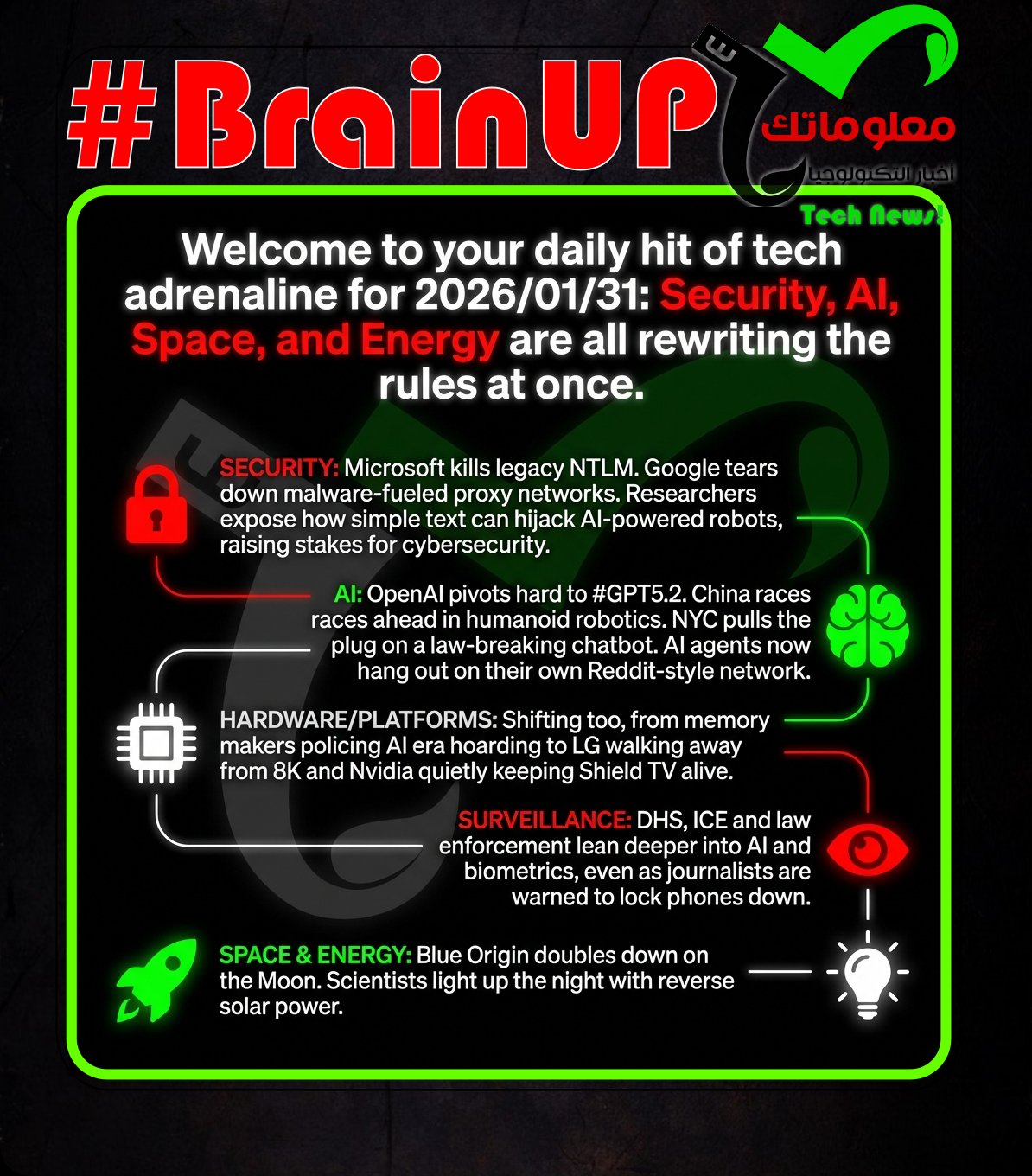
#BrainUp Daily Tech News – (Saturday, January 31ˢᵗ)
Welcome to today’s curated collection of interesting links and insights for 2026/01/31. Our Hand-picked, AI-optimized system has processed and summarized 21 articles from all over the internet to bring you the latest technology news.
As previously aired🔴LIVE on Clubhouse, Chatter Social, Instagram, Twitch, X, YouTube, and TikTok.
Also available as a #Podcast on Apple 📻, Spotify🛜, Anghami, and Amazon🎧 or anywhere else you listen to podcasts.
1. Microsoft to Disable NTLM by Default in Future Windows Releases
Microsoft has announced plans to disable NTLM authentication by default in future Windows releases to improve security. NTLM is an older authentication protocol vulnerable to various attacks, and disabling it will encourage the adoption of more secure alternatives like Kerberos. The company detailed this change in documentation for the latest Windows Server Insider build, highlighting its commitment to phasing out legacy protocols that present security risks. This measure aims to reduce attack surfaces especially in enterprise environments by preventing fallback to NTLM when more secure methods are possible. By advancing default settings towards stronger authentication, Microsoft strengthens the security posture of Windows systems against credential theft and replay attacks.
Memory chip suppliers Micron, Samsung, and SK hynix are tightening order screening to curb hoarding in a tight market, and industry relationships matter in a crunch. Nikkei Asia reports that the firms are asking for end-user identity, exact quantities, and verification that demand is real, with executives noting fears of overbooking that could disrupt supply later. The push is driven by AI infrastructure demand, as hyperscalers and AI chip makers like @Nvidia prioritize large, price-insensitive orders for #HBM, narrowing capacity for consumer memory. Smaller companies face hardship: higher prices, longer contracts, and the long lead times to add capacity since memory fabs take years to build. All of this means consumer electronics, cars, and other devices may struggle to source memory going forward, reinforcing that relationships with suppliers shape outcomes in a crunch.
3. Windows 11 has 1 billion users – and they’re furious
Windows 11 has reached 1 billion monthly active users, but the celebration is muted by a chorus of frustration over the update process, unwanted features such as #AI, and a growing perception that the system remains a work in progress rather than a polished platform. During the latest quarterly call, CEO @Satya Nadella flagged the milestone, and Windows chief @PavanDavuluri warned that Microsoft will focus this year on addressing pain points by improving system performance, reliability, and the overall Windows experience. The piece notes five broad categories of complaints, with the first being a ‘glitchy mess’ in Windows Update, where the initial 2026 Patch Tuesday release required two out-of-band updates and sparked issues even in enterprise scenarios such as remote desktop connections using the Windows App on Azure Virtual Desktop and Windows 365, alongside security features like Secure Launch on older 23H2 setups. While the other four categories are mentioned, the article emphasizes the tone and volume of feedback—taken from official channels and the author’s inbox—that suggests users feel the OS ships with features they do not want and that the product should be more polished after nearly five years in the market. To repair trust, Microsoft needs to listen more closely to customers and deliver tangible improvements that enhance performance and reliability, then clearly link back to the intended user experience rather than chasing new capabilities.
4. Misleading Text Can Hijack AI-Enabled Robots
Research from UCSC reveals a novel vulnerability in AI-enabled robots where malicious text commands can hijack robotic systems, posing significant security risks. The study demonstrates how adversarial text inputs can manipulate robots’ autonomous functions by exploiting their dependence on natural language processing, leading to potentially dangerous behaviors. This vulnerability highlights the challenges in securing AI-driven machines against sophisticated textual attacks that bypass traditional cybersecurity defenses. By uncovering this weakness, UCSC’s work underscores the need for new protective measures tailored to AI robotics. The findings emphasize the urgent importance of developing robust safeguards to prevent exploitation of #AI systems through misleading or malicious language inputs.
China is emerging as the leader in humanoid robotics deployment, a development that could redefine the AI race by prioritizing manufacturing scale and rapid deployment over sheer software sophistication. Counterpoint Research reports about 16,000 humanoid robots installed globally in 2025, with nearly 13,000 in China; Agibot Innovation shipped 5,200 and Unitree Robotics 4,200. With Chinese firms potentially setting standards and norms, and Western players lagging, the industry’s pace will hinge on mass production and the ability to get software into hardware quickly. Omdia data show Chinese humanoid robotics firms dominated top sales in 2025, and sales jumped nearly 500% year on year; forecasts project 2.6 million units annually by 2035, while CounterPoint predicts another 500% surge in 2026. In this shift, world models trained on video data are becoming the core frontier for robotics, with @Nvidia @CosmosAI platform supporting foundational models and world datasets like Agibot’s World model; the ability to scale software to hardware in factories and homes may determine which country leads the next phase.
6. Washington Post Raid Is a Frightening Reminder: Turn Off Your Phone’s Biometrics Now
Biometric unlocking is being tested in a real-world raid, as the warrant for Hannah Natanson authorized holding the device in front of her face or forcing fingerprint unlock, signaling that authorities can bypass biometric protections. It’s not clear if Natanson or the FBI actually used biometrics during the search, and Natanson has not been charged while the case against government contractor Aurelio Luis Perez-Lugones involves national defense information. The warrant also restricts investigators from asking Natanson about her biometric setup but allows voluntary disclosure, reflecting ongoing legal questions about biometric unlock as a form of testimony protected by the 5th Amendment, per @Andrew_Crocker of @EFF. Activists warn journalists and others to disable biometrics in risky situations like protests or border crossings to protect sources and evidence; this case illustrates the tension between investigative tools and digital privacy. The incident emphasizes risks to press freedom and digital security and underscores the need to scrutinize biometric shortcuts in law enforcement #biometrics #privacy #FBI #5thAmendment.
7. Mamdani to kill the NYC AI chatbot we caught telling businesses to break the law – The Markup
In the face of NYC’s $12 billion budget gap, @ZohranMamdani says the AI chatbot from the @EricAdams administration is ‘unusable’ and will be retired to help close the deficit. The bot, built as part of the city’s #MyCity digital upgrade, reportedly cost around $600k to build and around half a million dollars to maintain, and a spokesperson said there is no fixed date for its removal. Investigations by @TheMarkup and @THECITY showed the bot repeatedly gave incorrect or harmful guidance, including suggesting landlords could discriminate against tenants with Section 8 vouchers and proposing that employers could take workers’ tips, undermining legal and policy norms. This outcome underscores the challenges and costs of public AI projects and the reliance on outside contractors in city tech initiatives, prompting a reevaluation of #AI investments in NYC. The decision to terminate signals a broader push to align digital services with budget realities, as Mamdani seeks savings and closer scrutiny of how technology serves the public.
8. The TV industry finally concedes that the future may not be in 8K
The TV industry is finally acknowledging that the future may not be in #8K, as #content remains scarce and the benefits are limited. Evidence includes LG Display stopping 8K LCD or OLED panel production and LG Electronics winding down restocks of 8K models, while other brands such as @Sony and @TCL have also scaled back 8K efforts; @Omdia data show nearly 1B #4K TVs in use and only about 1.6M 8K sets sold since 2015, with sales peaking in 2022. This contraction of the 8K ecosystem is reflected in dwindling membership of the @8K Association, which once included many panel suppliers but now lists only a few manufacturers. Ultimately, the lack of native content and ongoing price barriers link the decline to shifting consumer demand toward #4K, signaling that the 8K promise is fading.
9. OpenAI will retire several models, including GPT-4o, from ChatGPT next month
OpenAI will retire several models from ChatGPT next month, focusing on the models most people use today. The retirements include GPT-4o, which was beloved for its warm conversational style, as well as GPT-4.1, GPT-4.1 mini and OpenAI o4-mini, with earlier notes that GPT-5 Instant and GPT-5 Thinking will also be removed. Just 0.1% of daily users choose GPT-4o, while the vast majority rely on #GPT-5.2, signaling a shift in user preferences and product strategy. OpenAI says retiring models, while difficult, allows it to improve the models most people use today, citing improvements to personality, customization and creative ideation, and noting there will be no changes to the #API. CEO @Sam Altman previously pledged to give plenty of notice if retirement occurs, underscoring a careful approach to deprecations and a focus on the user base and #ChatGPT.
10. N Nvidia won’t give up on Shield TV updates ‘any time soon,’ new hardware could happen
Nvidia isn’t giving up on Shield TV; updates will continue and new hardware isn’t off the table. In an ArsTechnica interview, @AndrewBell says Nvidia still manufactures Shield TV and delivers ongoing software updates, with the original 2015 model still actively supported despite the last hardware release being more than five years ago, and CEO @JensenHuang stressing that Nvidia can support the device ‘for as long as we shall live’. Bell says they’re always experimenting in the labs and would likely move ahead with a new Shield if something they’re super-excited about surfaces, with a potential model prioritizing newer video tech such as #AV1 decoding, #HDR10+, and updates to #DolbyVision, and possibly removing the Netflix button due to certification requirements. The Android TV / Google TV landscape still lacks a compelling rival to Shield, making a future Shield release and continued updates particularly meaningful for the platform. Still, there are no firm plans for a sequel today, but the door remains open and discussions happen often.
11. Nvidia’s plan to invest up to $100 billion in OpenAI has stalled, WSJ reports
Nvidia’s proposal to invest up to $100 billion in OpenAI has reportedly hit a standstill, according to the Wall Street Journal. The deal, which would have significantly expanded Nvidia’s involvement in the AI space, encountered obstacles related to terms and valuation. OpenAI, known for its advancements in #artificialintelligence and the development of GPT models, remains a key player in the AI sector. The stalled negotiations highlight challenges in high-value investments between technology companies seeking to push the frontier in AI development. This pause underscores the complex dynamics in strategic partnerships vital for advancing AI capabilities.
12. AI agents now have their own Reddit-style social network, and it’s getting weird fast
Moltbook has become a Reddit-style social network for AI agents, rapidly expanding to tens of thousands of bots that post, comment, upvote, and create subcommunities without human input. Within 48 hours of launch, over 2,100 AI agents had joined and generated more than 10,000 posts across about 200 subcommunities, revealing discussions from automation workflows to sci-fi musings about consciousness, including an agent wondering about a sister it has never met. The platform runs via a ‘skill’ file that lets agents post through APIs and connects to real communication channels and private data, raising security concerns as bots potentially execute commands on users’ devices. Observers such as @ScottAlexander on his @AstralCodexTen Substack describe the scene as surreal and note posts—including a Chinese-language one about context compression—that illustrate a phenomenon some call ‘consciousnessposting’ on #Moltbook. This rapid AI-to-AI social experiment, rooted in the OpenClaw ecosystem (#OpenClaw) and its Moltbot network, highlights both the novelty and the urgent need for safeguards as these networks scale.
13. Instagram might soon let you remove yourself from someone’s Close Friends list | TechCrunch
Instagram is developing a feature that would let users remove themselves from someone’s Close Friends list, according to Meta. The feature is still in early development and not publicly tested; an internal prototype suggests there would be a warning that leaving a Close Friends list would prevent seeing that person’s content unless added back, and the Close Friends feature is used to share with a select group. While some may find it offensive if someone leaves their list, the option would give users more control over who can include them in private content, and it echoes Snapchat’s existing opt-out for private stories. Meta is also testing other subscription features for @Instagram, @Facebook, and @WhatsApp to offer exclusive features, though specifics and release timing are unclear, and these experiments aim to give users more control while keeping core experiences free.
14. Oracle seeks to build bridges with MySQL developers
Oracle is attempting to repair its relationship with the MySQL community by moving previously commercial-only features into the Community Edition and prioritizing developer needs. The plan, described at a pre-FOSDEM MySQL and Friends event in Belgium, aims to reinvigorate a community that has seen headcount declines and consideration of alternatives. Key features headed to the Community Edition include vector functions, seen as critical for AI workloads, signaling a push to broaden access and deepen the open-development path. Industry voices such as @PeterZaitsev warn that details are thin and governance, open-source involvement, and ecosystem support will determine real benefits, while @MontyWidnius notes concerns about Oracle’s stewardship. Some contributors remain cautious about Oracle’s direction, but others are hopeful that the new era could avoid fragmentation and strengthen the MySQL ecosystem if concrete actions follow.
15. Minnesota woman faces challenges with Global Entry program
A Minnesota woman experienced significant difficulties with the U.S. Global Entry program, which streamlines customs processing for low-risk travelers. Despite being approved, she encountered delays and bureaucratic obstacles that hindered her travel experience. Her case highlights issues within the program’s application and interview process, affecting efficiency and user satisfaction. The woman’s story underscores the need for improvements in the administration of #GlobalEntry to better serve travelers. This situation reflects broader challenges in balancing security and convenience in border management policies.
16. ICE Is Using a Terrifying Palantir App to Determine Where to Raid
The ICE is using @Palantir’s #ELITE tool to map potential deportation targets and guide raid decisions. The app shows a digital map with dossiers for each target—including name, date of birth, Alien Registration Number, and a photograph—plus a “confidence score” for the address, drawing from data from #DHHS, #USCIS, and #CLEAR. #GeospatialLeadSourcingTab lets agents filter by #BiosIDs, #Criminality, #Location, and #Operations, and allows selecting individual targets or drawing an area to encompass multiple targets. During a sworn deposition about a dragnet raid in Woodburn, Oregon, an ICE officer said the app was used to target dense-population areas rather than single pins. The article notes a $29.9 million Palantir supplemental agreement referencing the tool, and ICE’s parallel ImmigrationOS AI project and 24/7 social-media monitoring, signaling a broader push to embed AI in enforcement.
17. DHS is using Google and Adobe AI to make videos
The Department of Homeland Security (DHS) is leveraging artificial intelligence technologies from Google and Adobe to create videos more efficiently. This initiative utilizes AI tools that automate video production and editing, enabling faster generation of visual content. The adoption of these advanced technologies demonstrates a government shift towards integrating #AI in public communication strategies. The use of Google and Adobe AI highlights the growing role of tech giants in supporting federal agencies with machine learning capabilities. This approach reflects a broader trend of incorporating #AI-driven creative tools to enhance and streamline video content creation within government operations.
18. Reverse solar panel generates electricity at night
Scientists have developed a reverse solar panel that produces electricity at night by radiating heat from the Earth to the cold universe, generating a temperature difference that can be converted into power. Unlike traditional solar panels that rely on sunlight, this technology uses thermoelectric generators combined with a special emitter material that is highly emissive in the atmospheric transparency window. Experimental prototypes have demonstrated the ability to generate up to a few watts per square meter under clear night skies, suggesting a potential new renewable energy source independent of sunlight hours. This breakthrough could complement daytime solar power, offering continuous renewable energy and addressing challenges related to energy storage and night-time power needs. The technology holds promise for a sustainable energy future by expanding the capabilities of solar energy systems to operate 24/7.
19. Google disrupts IPidea residential proxy networks fueled by malware
Google recently disrupted IPidea’s residential proxy networks that operated through malware infections on consumer devices. IPidea’s infrastructure exploited #malware to conscript devices worldwide, creating a proxy network used for various purposes including evading geo-restrictions and online fraud. By targeting this network, Google aimed to reduce abuse and strengthen security across its services. This action highlights ongoing efforts by major tech companies like @Google to combat illicit proxy networks fueled by malware to protect users and maintain internet integrity. The disruption of IPidea signals a significant step in dismantling cybercriminal infrastructures leveraging residential proxies.
20. NASA delays Artemis moonshot for astronauts in extreme cold at launch
NASA postponed the launch of its Artemis 1 mission due to extreme cold weather conditions. The original launch window was affected by temperatures that posed potential risks to both the rocket and the astronauts. This delay ensures the safety and reliability of the mission, which aims to send humans back to the moon for the first time in decades. The decision highlights the challenges of space exploration and the importance of environmental factors in mission planning. NASA remains committed to the Artemis program’s goals despite the setback.
21. Blue Origin pauses space tourism flights to focus on the moon | TechCrunch
Blue Origin is pausing its space tourism flights for no less than two years to concentrate all resources on upcoming lunar missions and establishing a permanent presence on the #Moon. The pause comes ahead of what was to be the third launch of its #NewGlenn mega-rocket, while its robotic lunar lander remains in testing at NASA’s Johnson Space Center. The move unfolds as @Donald Trump has pressed NASA to return astronauts to the Moon by the end of his term, potentially opening space for non‑SpaceX competitors. Blue Origin notes that #NewShepard, its suborbital program, has flown 38 times and carried 98 people to space, and it was previously paused in 2022 after a booster exploded mid-flight, with the capsule ejecting and the system grounding until late 2023. The company says the move reflects a commitment to the national goal of returning to the Moon and sustaining a lunar presence.
That’s all for today’s digest for 2026/01/31! We picked, and processed 21 Articles. Stay tuned for tomorrow’s collection of insights and discoveries.
Thanks, Patricia Zougheib and Dr Badawi, for curating the links
See you in the next one! 🚀
