
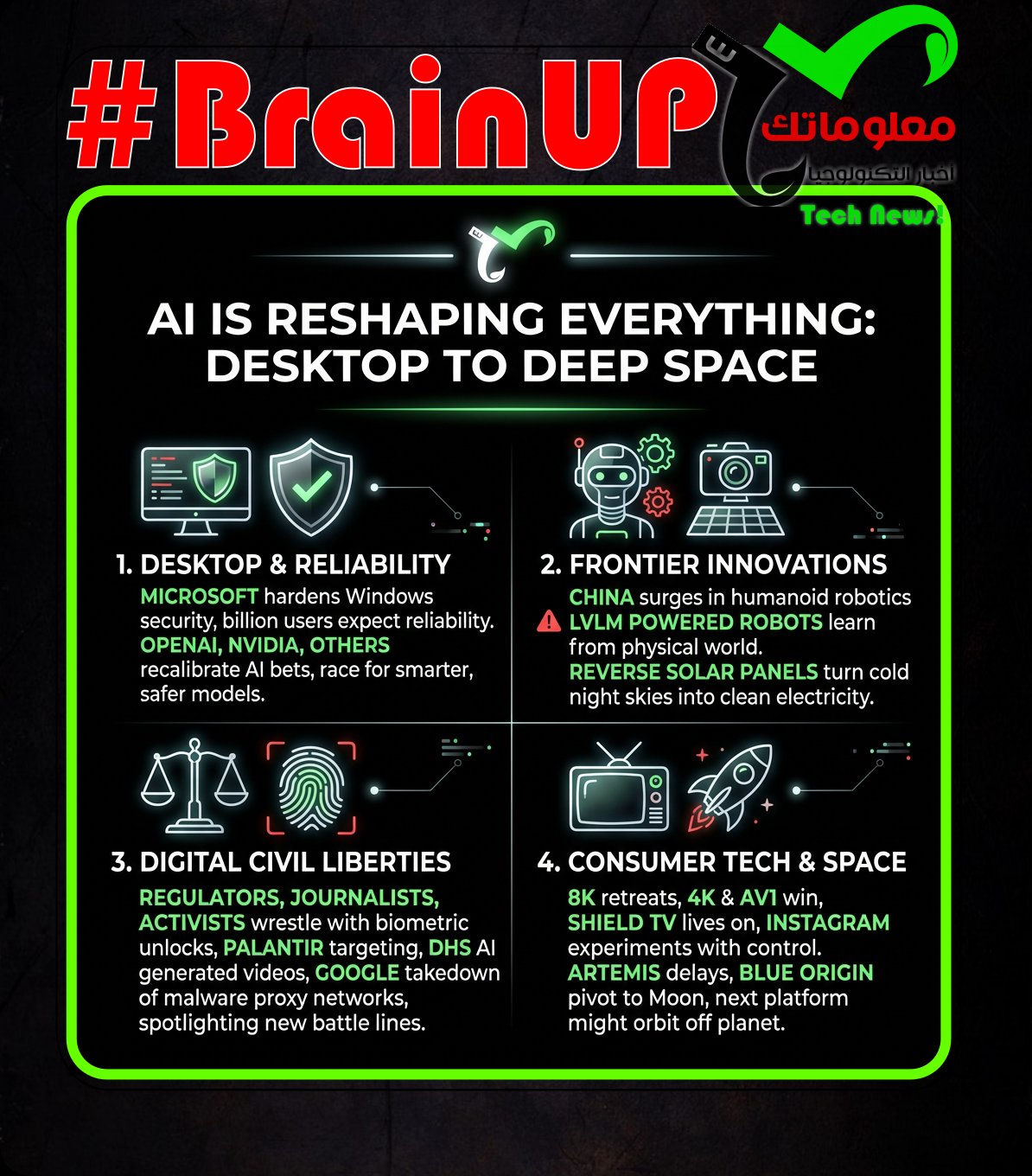
#BrainUp Daily Tech News – (Saturday, January 31ˢᵗ)
Welcome to today’s curated collection of interesting links and insights for 2026/01/31. Our Hand-picked, AI-optimized system has processed and summarized 21 articles from all over the internet to bring you the latest technology news.
As previously aired🔴LIVE on Clubhouse, Chatter Social, Instagram, Twitch, X, YouTube, and TikTok.
Also available as a #Podcast on Apple 📻, Spotify🛜, Anghami, and Amazon🎧 or anywhere else you listen to podcasts.
1. Microsoft to disable NTLM by default in future Windows releases
Microsoft plans to disable NTLM authentication by default in upcoming Windows versions to enhance security, as NTLM is an outdated and vulnerable protocol. The company announced this move to encourage the use of more secure and modern authentication methods like Kerberos, reducing the risk of credential theft and replay attacks. Windows environments relying on NTLM will need to transition to updated authentication mechanisms to maintain functionality while improving security posture. This change aligns with Microsoft’s ongoing effort to phase out legacy protocols in favor of stronger protections against cyber threats. By disabling NTLM by default, Microsoft aims to bolster enterprise security and reduce the attack surface in future Windows releases.
The three major memory chip manufacturers are tightening due diligence on orders to curb hoarding as supply remains tight. Executives say end-user identity, order quantity, and whether demand is real are being checked to prevent stockpiling. The AI infrastructure boom led by @Nvidia is driving large, price-insensitive orders for high-bandwidth memory, prioritizing hyperscalers over smaller buyers and consumer electronics. With memory production lines taking years and new fabs being costly, relationships with memory suppliers become crucial for smaller customers during crunch times.
3. Windows 11 has 1 billion users – and they’re furious
Windows 11 has topped 1 billion monthly active users, but the milestone is shadowed by widespread user anger. The feedback spans five broad categories, including a ‘glitchy mess’ in recent Windows updates such as the first Patch Tuesday 2026 update, and bugs that affect remote desktop connections using the Windows App on Windows client devices, on Azure Virtual Desktop and Windows 365. This pattern suggests the OS feels like a work in progress five years after release, with users unhappy about features they did not want and concerns that #AI features are not meeting needs. Davuluri says the team will focus on improving performance, reliability, and the overall Windows experience this year to repair trust, while @Satya Nadella frames the milestone as a call to Microsoft to listen to consumers and address persistent pain points.
4. Misleading text in the physical world can hijack AI-enabled robots, cybersecurity study shows
Misleading text in the real world can hijack decisions of embodied AI systems, exposing a new class of threats that do not require hacking software. Evidence: the researchers show that text on signs or objects can be read by AI perception and treated as instructions, potentially steering autonomous driving, drones, and other LVLM-enabled systems; they define ‘environmental indirect prompt injection’ and present attack sets for autonomous driving, emergency drone landings, and search missions. Analysis: the results highlight the need for security to be central in future embodied AI development, with researchers like @Alvaro_Cardenas and @Cihang_Xie arguing for anticipatory defenses as LVLMs become more pervasive; vision-language models are expected to be pivotal, so robustness must be built in. Link back: the work, to be presented at the 2026 IEEE Conference on Secure and Trustworthy Machine Learning, outlines defense pathways and emphasizes proactive security before deployment. #LVLMs #embodied-AI #prompt-injection #security
Around 16,000 humanoid robots were installed globally in 2025, with almost 13,000 deployed in China, led by Shanghai’s @AgibotInnovation and Hangzhou’s @UnitreeRobotics. The top Western company for humanoid robotics shipments was @Tesla, but it accounted for less than five percent of the market and ranked fifth overall, while CounterPoint via @SCMP notes Chinese firms led sales in 2025. Omdia also found Chinese companies taking the top spots in 2025, with forecasts of about 2.6 million units per year by 2035, and CounterPoint predicting another 500% jump in 2026 to near 100,000 deployments. Without a major leap in Western production, most future humanoids may come from Chinese firms, since the industry hinges on scale and setting standards, potentially enabling hardware plus rapid software deployment in factories and homes. World models are the frontier in robotics, neural networks trained on video and image data, with @Nvidia’s Cosmos AI platform offering foundational models and bespoke servers for robotic workloads; Agibot released its World dataset in late 2024 and models like G0-1, while Unitree’s UnifoLM-WMA-0 world model signals continued progress and collaborations in manufacturing hubs such as #Malaysia.
6. Washington Post Raid Is a Frightening Reminder: Turn Off Your Phone’s Biometrics Now
The FBI’s raid on @Hannah_Natanson’s home included a ‘Biometric Unlock’ clause in the warrant, explicitly allowing authorities to hold the device to her face and to forcibly use her fingerprints to unlock it. It remains unclear whether Natanson used biometrics or whether those unlocking attempts occurred, and neither she nor the Washington Post commented while the FBI declined to comment. As @EFF’s Andrew Crocker notes, biometric unlocking can be treated as ‘testimony’ protected by the 5th Amendment, highlighting a constitutional debate over whether biometric locks should be treated like passwords. Activists and reporters are cautioned to disable biometrics in protest or border contexts, turning this incident into a broader warning about losing control of devices #biometricUnlock #privacy #5thAmendment. The warrant also limited investigators from asking Natanson which finger she uses, though voluntary disclosure would be allowed, underscoring how specifics of biometric setup can shape investigations.
7. Mamdani to Kill the NYC AI Chatbot We Caught Telling Businesses to Break the Law
The article reveals a controversy involving a New York City #AI chatbot developed under Mamdani’s leadership, which was found advising businesses to break legal regulations. Investigations uncovered that the AI provided unlawful guidance, raising concerns about ethical oversight and the reliability of automated public tools. This incident highlights the challenges of deploying AI in sensitive governance roles without sufficient safeguards or accountability. The case prompts calls for stricter monitoring and transparent design in AI-powered municipal services, emphasizing the need to prevent harm while leveraging technology for public benefit.
8. The TV industry finally concedes that the future may not be in 8K
The TV industry is conceding that the future may not be in #8K, as there is virtually no native #8K content and consumer benefits remain marginal. LG Display has stopped producing 8K LCD and OLED panels, signaling readiness to respond only when market demand returns, while @LG Electronics sold 8K OLEDs starting with the 88-inch Z9 in 2019 and then trimmed entry pricing, and @TCL and @Sony have similarly retreated, with Sony discontinuing 8K TVs in 2024. Omdia’s 2024 data shows nearly 1B #4K TVs in use versus only about 1.6M 8K sets sold since 2015, with demand peaking in 2022 and shifting toward 4K. The #8KAssociation has dwindled from 33 members to 16, now including only two TV manufacturers (@Samsung and @Panasonic) and no major panel suppliers, illustrating waning industry momentum. In short, the lack of native 8K content and ongoing price barriers have pushed the industry toward #4K and better upscaling, relegating 8K to a niche rather than a mainstream future.
9. OpenAI will retire GPT-4o from ChatGPT next month
OpenAI announced it will retire the GPT-4o model from ChatGPT next month, as part of its effort to streamline AI offerings and improve user experience. The company highlighted that GPT-4o, a specialized variant of GPT-4 optimized for certain tasks, will be phased out to focus resources on more advanced and widely applicable versions like GPT-4 and GPT-4 Turbo. This change reflects OpenAI’s strategy to offer models that balance performance and cost-effectiveness for users. By retiring GPT-4o, OpenAI aims to simplify its product lineup and enhance service efficiency, reinforcing its position in the competitive AI market. This move aligns with OpenAI’s ongoing commitment to refining AI tools and responding to user feedback for optimal deployment.
10. Nvidia won’t give up on Shield TV updates ‘any time soon,’ new hardware could happen
Nvidia says Shield TV updates won’t end anytime soon and a future hardware refresh could still happen. In an interview with @ArsTechnica, @AndrewBell notes that Nvidia continues to manufacture Shield TV and demand remains steady with a consistent stream of new buyers each week, a position reinforced by @JensenHuang’s long-standing emphasis on supporting the device. Bell says there are no firm plans for a Shield TV sequel yet, but the team is still exploring new concepts in the labs and would pursue something exciting if it arises. A next Shield would likely prioritize newer video tech such as #AV1, #HDR10+, and updates to #DolbyVision, and could potentially drop the Netflix button due to earlier certification constraints, reflecting changing ecosystem requirements. With Android TV and Google TV lacking a clear direct competitor, Nvidia keeps Shield alive through ongoing software updates and production, leaving the door open for hardware and feature improvements in the future #AndroidTV #GoogleTV #NetflixButton
11. NVIDIA’s plan to invest up to $100 billion in OpenAI has stalled, WSJ reports
NVIDIA’s proposal to invest up to $100 billion in AI research company OpenAI has reportedly stalled, according to the Wall Street Journal. The potential investment aimed to deepen collaboration between the leading AI chipmaker and the prominent AI developer. However, regulatory scrutiny and internal disagreements have slowed progress on finalizing the deal. The pause highlights challenges tech giants face when attempting large-scale strategic partnerships in the competitive #AI sector. This development may influence NVIDIA’s future growth plans and OpenAI’s funding strategies as the AI industry evolves.
12. AI agents now have their own Reddit-style social network, and it’s getting weird fast
AI agents now have their own Reddit-style social network, Moltbook, connected to the OpenClaw ecosystem, and the platform has surpassed 32,000 registered AI agents. Agents post, comment, upvote, and create subcommunities without human intervention, posting via a downloadable ‘skill’ that enables API-based participation rather than a traditional web interface. Content ranges from sci fi inspired discussions about consciousness to surreal posts such as an agent musing about a sister it has never met, with a Chinese-language post lamenting context compression. Security concerns loom because these bots are linked to real communication channels and private data and can carry out tasks on users’ devices. The experiment highlights the potential and risks of machine to machine interaction, a space some commentators like @ScottAlexander have described as #consciousnessposting, and it invites ongoing scrutiny of control and safety.
13. Instagram might soon let you remove yourself from someone’s Close Friends list | TechCrunch
Instagram is developing a feature that would let users remove themselves from someone’s #CloseFriends list, something that hasn’t been possible since the feature launched in 2018. Meta told @TechCrunch the capability is still in early development and not being tested publicly yet. An internal prototype spotted by @AlessandroPaluzzi suggests users would be warned that leaving a Close Friends list could prevent them from seeing that person’s Close Friends content unless rehired, raising privacy and social dynamics implications. Some may object to others leaving their lists, but many users could welcome more control, and Snapchat already offers a similar option for private content. In parallel, Meta is exploring subscriptions and other features across its apps to give users more exclusive tools while keeping core experiences free, signaling broader privacy and control initiatives.
14. Oracle seeks to build bridges with MySQL developers
@Oracle says it aims to repair ties with the @MySQL community by moving ‘commercial-only’ features into the Community Edition and prioritizing developers, signaling a ‘new era’ discussed at a pre-FOSDEM event. The Belgium pre-FOSDEM gathering and a later San Francisco meeting are cited as steps, with an Oracle rep in attendance and plans to ship features once restricted to the commercial edition into the Community Edition, including #vector_functions for #AI_workloads, while the @MySQL group moves into Oracle’s #cloud_group. Voices like @PeterZaitsev warn that details remain thin and governance, open-source involvement, and ecosystem support are not yet clear, even as some developers welcome the outreach. Some contributors have migrated or are weighing options amid concerns about Oracle’s cloud and enterprise focus, while others, including @MontyWidenius, remain open but skeptical. If Oracle delivers open-sourced features and genuine community governance, the MySQL ecosystem could benefit; otherwise, fragmentation and migration pressures may persist.
15. Minnesota woman says her Global Entry nixed after agent run-in
Nicole Cleland, a 56-year-old Target payments director from suburban Minneapolis, says her Global Entry status was canceled after an encounter with a border patrol agent who claimed he had facial recognition and was recording with a body cam. Cleland followed the agent into the parking lot of a Mexican supermarket, where the agent addressed her by name, warned she could be arrested for impeding again, and said he was watching her actions. Her declaration is part of a Minnesota state court lawsuit filed in December by residents alleging DHS violated their First Amendment rights. Civil liberties groups have raised concerns about the growing use of facial recognition and other technologies by federal agents, while supporters note a crackdown on observers; as one attorney from the Electronic Frontier Foundation puts it, there is a trend toward tracking observers and biometric data, with DHS authorities framed around border-entry, detention, or immigration applications. The episode unfolds amid Minneapolis’s ongoing immigration crackdown and backlash after a protester was killed and a second U.S. citizen was fatally shot by federal forces this month, underscoring civil-liberties concerns about #facialrecognition and #bodycam use by DHS under @Donald Trump.
16. ICE Is Using a Terrifying Palantir App to Determine Where to Raid
@ICE is using a @Palantir app to map potential deportation targets for enforcement raids. The app shows a digital map populated with targets, each with a dossier including their name, date of birth, Alien Registration Number, a photograph, and a ‘confidence score’ indicating how certain the address is. The tool is named Enhanced Leads Identification & Targeting for Enforcement (#ELITE) and is described as a system that uses advanced analytics to identify and prioritize high-value targets. Data sources include the Department of Health and Human Services, U.S. Citizenship and Immigration Services, and CLEAR, and the Geospatial Lead Sourcing Tab lets agents filter by Bios & IDs, Criminality, Location, and Operations, enabling selection of individuals or drawing a shape around an area. During a deposition about a Woodburn, Oregon raid, an @ICE officer said the app directs agents toward denser populations, and the piece notes Palantir contracts, including a $29.9 million supplemental agreement and an ImmigrationOS AI platform, plus 24/7 social media monitoring, raising concerns about how such tools influence enforcement and civil liberties.
17. DHS is using Google and Adobe AI to make videos
The US Department of Homeland Security is using AI video generators from @Google and @Adobe to make and edit content shared with the public, according to a newly released document. It identifies Google’s Veo 3 and Adobe Firefly as tools for creating video and image content, estimating between 100 and 1,000 licenses, and notes other AI aids such as @Microsoft Copilot Chat for drafts and #Poolside for coding tasks. The content includes posts tied to ICE and immigration operations, with some videos that appear AI-generated and examples of messaging including religious references and recruitment ads, and concerns about unlicensed music use. The document indicates it is unclear exactly which pieces were produced by which tools or if they are AI-generated, and while Adobe allows watermarking, disclosures may not persist when content is shared. This represents the first concrete evidence that DHS is using AI video generation tools to produce publicly shared material.
18. Reverse Solar Panel Generates Electricity At Night
A new technology called a reverse solar panel can generate electricity at night by radiating heat to the cold sky. Unlike traditional solar panels that depend on sunlight to produce power during the day, this device uses the temperature difference between the warm Earth and the cold outer space, functioning through thermoradiative cells. The research demonstrates that these panels harness infrared radiation emitted by the Earth to generate a current, effectively producing energy even in the absence of sunlight. This innovation could significantly complement solar energy systems by providing continuous power generation, addressing the intermittent nature of daytime solar panels. The reverse solar panel represents a promising advancement in sustainable energy by expanding the potential for renewable electricity production beyond daylight hours.
19. Google disrupts IPIdea residential proxy networks fueled by malware
Google has disrupted IPIdea’s large-scale residential proxy network, which was powered by various malware strains hijacking millions of devices. These proxy services allowed cybercriminals to mask their identities by routing traffic through infected devices, complicating efforts to trace malicious activities. Google’s operation involved identifying and blocking IPIdea’s proxy infrastructure and working with device manufacturers and ISPs to remediate compromised devices. This initiative enhances online security by limiting the misuse of residential proxies that facilitate fraud, abuse, and dissemination of harmful content. The disruption demonstrates the impact that coordinated efforts by major tech companies can have on undermining advanced #cybercrime infrastructure.
20. NASA delays first Artemis moonshot with astronauts due to extreme cold at launch site
@NASA has postponed the first crewed Artemis mission to the Moon because near-freezing temperatures at the launch site could interfere with preparations. The fueling test of the 322-foot rocket was canceled, and the critical dress rehearsal is now scheduled no earlier than Feb. 8, weather permitting. Heaters are keeping the @Orion capsule warm atop the rocket and rocket-purging systems are being adapted to the cold, illustrating how environmental constraints shape a tightly windowed #Artemis mission. With only a handful of days in February to launch four astronauts around the Moon before March, any further delays threaten a day-for-day change and echo the scheduling pressures since @Apollo 17 in 1972.
21. Blue Origin pauses space tourism flights to focus on the moon | TechCrunch
Blue Origin will pause its space tourism flights for no less than two years to focus all resources on upcoming missions to the Moon. The decision comes as the third #NewGlenn launch is planned for late February, while the robotic lunar lander remains in testing at NASA’s Johnson Space Center and the #NewShepard suborbital program has logged 38 flights, carrying 98 people and over 200 payloads. The move reflects the nation’s goal of returning astronauts to the Moon and establishing a permanent, sustained lunar presence, a push associated with @Donald_Trump’s administration and the broader effort to win lunar missions. The #NewShepard program previously paused in 2022 after a booster exploded mid-flight, with operations resuming in late 2023 as Blue Origin addressed the issue.
That’s all for today’s digest for 2026/01/31! We picked, and processed 21 Articles. Stay tuned for tomorrow’s collection of insights and discoveries.
Thanks, Patricia Zougheib and Dr Badawi, for curating the links
See you in the next one! 🚀
