
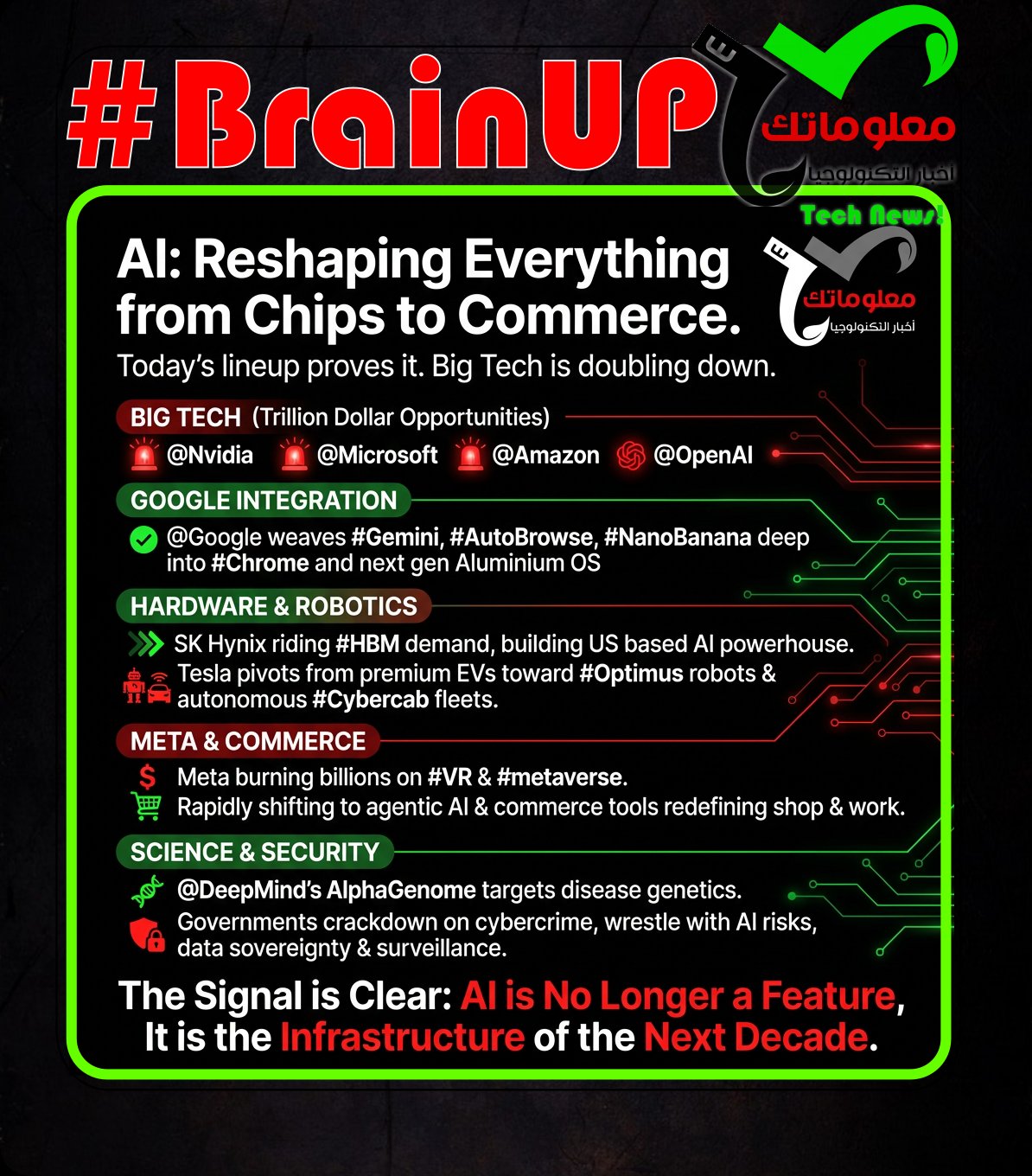
#BrainUp Daily Tech News – (Thursday, January 29ᵗʰ)
Welcome to today’s curated collection of interesting links and insights for 2026/01/29. Our Hand-picked, AI-optimized system has processed and summarized 32 articles from all over the internet to bring you the latest technology news.
As previously aired🔴LIVE on Clubhouse, Chatter Social, Instagram, Twitch, X, YouTube, and TikTok.
Also available as a #Podcast on Apple 📻, Spotify🛜, Anghami, and Amazon🎧 or anywhere else you listen to podcasts.
1. Google Aims Knockout Blow at Chinese Company Linked to Massive Cyber Weapon
Google is targeting a Chinese company believed to be behind a massive cyber weapon, seeking to disrupt its operations and reduce its global threat. The Chinese company has been connected to widespread cyberattacks that have impacted numerous organizations worldwide, leveraging sophisticated hacking tools. By exposing and countering the company’s infrastructure, Google aims to diminish its ability to conduct surveillance and cyber espionage. This move aligns with broader efforts in the tech industry to combat state-backed cyber threats and protect users. Google’s initiative highlights the growing tension in cyber warfare and the importance of private sector defense strategies.
2. Tesla profits slumped 46% last year, as it lost its crown as the top EV seller
Tesla posted a 46% year-over-year profit drop and relinquished its title as the world’s top EV maker to BYD, which sold over 2.25 million battery-powered vehicles in 2025 while Tesla sold 1.65 million. In a strategic shift, the company is discontinuing the higher-end Model S and Model X, and is repurposing the Fremont factory lines to mass-produce the #Optimus humanoid robot and to scale the #Cybercab, a steering-wheel- and pedal-free vehicle intended for its nascent robotaxi service. CEO @Elon Musk said most future miles would be autonomous, with likely less than 5% driven by humans. Tesla warns of heavy capital spending, planning about $20 billion in the coming year, more than double 2025 capex, to fund these investments. The company maintains it is transitioning from a car company to a ‘physical AI company’ as energy-storage growth has not fully offset weaker car sales.
3. Nvidia, Microsoft, and Amazon in Talks to Invest $60 Billion in OpenAI
Leading technology companies Nvidia, Microsoft, and Amazon are engaged in discussions to collectively invest $60 billion in #OpenAI, the artificial intelligence research lab known for developing #ChatGPT. This funding round aims to accelerate AI advancements and expand OpenAI’s computational capabilities. Microsoft, a major backer of OpenAI, is reportedly seeking to increase its stake to strengthen its position in the AI market, while Nvidia and Amazon see strategic value in partnering with OpenAI’s cutting-edge AI models. The potential investment would significantly boost OpenAI’s resources and help maintain its leadership in the rapidly evolving AI landscape. These developments reflect the growing importance of AI and cloud computing in the tech industry, with key players vying to shape the future of AI applications and services.
4. Amazon’s AI push raises employee climate, layoff concerns
Amazon is accelerating its focus on #artificialintelligence, prompting concerns among employees about workplace culture and potential layoffs. The company’s push is evident through newly launched AI products, including AI-enhanced shopping tools and internal tools for developers. Workers express unease about the pressure to adapt quickly and the possibility that AI-driven changes could lead to job cuts. This shift reflects broader trends in the tech industry, where AI adoption often leads to workforce restructuring, raising questions about job security. Amazon’s AI initiatives highlight the tension between innovation and employee welfare, underscoring challenges in balancing technological advancement with maintaining a stable workforce.
5. Microsoft sells Copilot to the world — but its own engineers don’t use it
The article reveals that despite @Microsoft championing #Copilot as the future of developer productivity, its own teams are being directed to use external AI solutions from rivals, challenging the traditional dogfooding approach. This irony is explained by factors like simplicity and smoother user experience offered by competitor models, which can provide easier integration for developers and non-technical staff, making them prefer external tools for efficiency. The practice mirrors a broader industry trend where large tech companies benchmark competitors’ offerings to gauge strengths and identify improvements, with @Microsoft, @Apple, and @Google engaging in such evaluations. Leadership decisions and partnerships play a crucial role, with groups promoting alternative AI adoption led by veterans from other major tech firms, and business agreements and investments shaping the tool landscape. In sum, the situation shows a tension between internal product evangelism and real-world workflow needs, underscoring that enterprises continually test and reevaluate AI ecosystems to stay productive.
6. SK Hynix beats Samsung for 2025 profit lead on AI memory, HBM demand
SK Hynix is projected to surpass Samsung in profits for 2025 due to strong demand in AI memory and high bandwidth memory (#HBM) products. The company is capitalizing on the growing AI market by expanding its #DRAM and #NAND offerings tailored for AI workloads and data centers. Experts note that SK Hynix’s strategic focus on advanced memory technology positions it ahead of competitors, supported by increasing adoption of #AI chips requiring specialized memory solutions. This profit shift reflects broader trends in semiconductor priorities as AI-driven applications continue to grow rapidly. SK Hynix’s success underscores the pivotal role of tailored memory technologies in sustaining competitive advantage amidst the #AI revolution.
7. Highguard manages almost 100k Steam players on day one, amidst over 13k negative reviews | VGC
Highguard debuted on Steam with a strong early playerbase, peaking at 97,249 concurrent players on launch day. However, reviews tell a different story, with 6,027 positive and 13,363 negative reviews, about 32.05% positive. Critics cite a very large map (#largeMap) and 3v3 matchmaking (#3v3) as major factors in the mixed reception. Wildlight Entertainment, based in California, includes @Respawn veterans who worked on @Apex Legends and @Titanfall, along with former @Call of Duty developers, and the launch followed its reveal as the final game at @TheGameAwards.
9. Microsoft edges past cloud growth expectations
Microsoft surpassed cloud growth expectations by expanding its Azure platform and integrating advanced AI capabilities, which drove stronger-than-anticipated revenue gains. The company showcased robust demand for #cloud computing services as businesses increased their digital transformation efforts. This performance highlights Microsoft’s competitive positioning against rivals like Amazon Web Services, leveraging AI innovations to differentiate its offerings. The results signal a positive outlook for Microsoft’s continued growth in the evolving tech landscape. Overall, Microsoft’s strategic focus on cloud and AI technologies has positioned it to exceed market projections.
10. Scientists Identify an Epigenetic Switch That Can Slow Production of Fat Cells
An epigenetic switch in the #Hippo pathway can slow adipogenesis by dampening PPARγ’s fat‑cell program in mouse cells. YAP and TAZ are central to this mechanism, enabling a chemical cascade that suppresses fat‑cell activation genes targeted by #PPARγ, keeping cells in a less specialized state. When the Hippo brakes were released in mice, YAP and TAZ became hyperactive and existing fat cells lost many fat‑cell features, behaving more like precursors. As @Dae-Sik Lim notes, adipocyte differentiation is controlled at the epigenetic level through reprogramming rather than simple gene regulation. Although demonstrated in mice for now, the findings lay a foundation for targeted approaches to curb fat buildup and metabolic disease, awaiting further research.
11. FBI seizes RAMP cybercrime forum used by ransomware gangs
The FBI has taken control of RAMP, a major cybercrime forum facilitating ransomware attacks and other illicit activities. The forum was widely used by ransomware gangs to obtain malware, hosting services, and stolen data, making it a critical hub for cybercriminal operations. By seizing RAMP, authorities aim to disrupt these criminal networks and impede ransomware campaigns globally. This action highlights the increased efforts by law enforcement to target the infrastructure that supports cybercrime and reduce the threat posed by coordinated ransomware attacks. The FBI’s intervention demonstrates a proactive approach to weakening cybercrime ecosystems by dismantling their online marketplaces.
12. Nvidia helped DeepSeek hone AI models later used by China’s military: lawmaker
Nvidia played a role in assisting the Chinese company DeepSeek to refine artificial intelligence models that were subsequently employed by China’s military, according to a U.S. lawmaker. This involvement raises concerns about the transfer of advanced AI technology to foreign military applications amid growing geopolitical tensions. DeepSeek’s use of Nvidia’s technology illustrates how commercial AI advancements can be leveraged by national defense sectors, prompting scrutiny from policymakers. The development exemplifies the complexities of regulating AI technology exports and maintaining strategic advantages. The case underlines the challenges in balancing technological collaboration with national security interests.
13. SpaceX sends list of demands to US states giving broadband grants to Starlink
The article reports that @SpaceX is asking state governments to structure broadband grants so #Starlink receives funding even if residents do not subscribe to the service. SpaceX says it will provide all necessary equipment at no upfront cost to subscribers requesting service, removing initial hardware fees, while pledging to offer broadband for $80 or less per month to low-income residents in subsidized areas, a price still higher than some advertised #Starlink residential rates. The demands would also guarantee government payments regardless of how much network capacity is reserved for those areas and would not require SpaceX to ensure proper installation, with a rider SpaceX asked states to apply to BEAD grants. The letter argues that grant payments should not depend on independent purchasing decisions, and the @NTIA overhaul under the Trump administration would broaden satellite funding rules for #BEAD, while SpaceX aims to dynamically allocate capacity rather than leaving large portions idle. Analysts from the Benton Institute criticize the concessions as illustrating policy problems in the rewritten rules, noting that SpaceX is slated to receive about $733.5 million to deploy #Starlink across 472,600 locations while other satellite services also receive funding, shaping a landscape where satellite networks claim a share of grant money.
14. Meta burned $19 billion on VR last year, and 2026 won’t be any better | TechCrunch
Meta’s #RealityLabs burned about $19.1B in 2025, continuing a multiyear pattern of losses that dwarfed 2024’s around $17.7B. In Q4 alone, the unit posted a $6.2B loss on $955M in sales for the quarter and about $2.2B for 2025. Earlier this month, @Mark Zuckerberg and the company laid off 10% of Reality Labs staff, up to 1,000 employees. Zuckerberg said losses this year are expected to be similar to last year, likely the peak, as investments shift toward glasses and wearables and efforts to make #Horizon a big success on #Mobile to build a profitable #VR ecosystem, while reports also indicated Meta planned to shutter several VR studios and retire its standalone Workrooms app. Taken together, the company is pivoting more toward #AI while hoping to turn VR into a sustainable line over the coming years, though progress remains uncertain.
15. Meta’s Reality Labs posts $6.02 billion loss in fourth quarter
Meta’s Reality Labs posted a $6.02 billion operating loss in Q4 on $955 million in sales, continuing its costly push into #metaverse. The loss rose 21% year over year while revenue rose 13%; analysts expected a $5.67 billion loss on $940.8 million in revenue, and the segment has nearly $80 billion in cumulative losses since late 2020. CEO @MarkZuckerberg says losses this year are likely to be similar to last year and should peak as the company gradually pivots toward #AI and #wearables, including a January layoff of over 1,000 Reality Labs employees and a refocus away from VR toward AI-enabled devices. The layoffs include continuing Ray-Ban Meta smart glasses developed with EssilorLuxottica, and Tech chief @AndrewBosworth has said VR isn’t dead, but growth has been slower than expected. Last fall, Meta did not debut a new Quest headset but launched the AI-powered Ray-Ban Display glasses at $799 with a digital screen on one lens, illustrating how the company’s #metaverse bets remain costly and its strategy is to lean into AI and wearables to offset losses.
16. Zuckerberg teases agentic commerce tools and major AI rollout in 2026
Meta CEO @MarkZuckerberg announced plans for a significant expansion of AI features in 2026, highlighting the development of agentic commerce tools designed to enhance user interaction and automate shopping experiences. These tools aim to empower users to engage with AI agents capable of handling complex tasks in e-commerce, signaling a shift towards more autonomous digital assistants. The rollout reflects Meta’s strategy to integrate AI deeply into its platforms for improved personalization and efficiency, aligning with broader trends in the tech industry. This move is expected to impact how consumers shop online, offering more dynamic, AI-driven options tailored to individual preferences. As AI becomes more embedded, Meta positions itself to lead in the evolving intersection of technology and commerce.
17. If you don’t control your keys, you don’t control your data
The article argues that when providers hold the keys to encrypted data, control over that data and thus #dataSovereignty is diluted. A Forbes investigation claims @Microsoft has handed over BitLocker recovery keys to law enforcement under warrants, and Microsoft says about 20 such requests occur annually, while advising users to back up keys to a @Microsoft account, which can give the company ongoing access. This shows that the real issue is where keys reside, not the strength of #encryption, and centralized key access creates systemic points of failure, as seen in breaches such as the Equifax incident. Companies like @Apple and @Google show alternative models, with Apple limiting access to customer data and Google offering client-side encryption, so not holding keys is a deliberate design choice rather than obstruction. There is no risk-free key escrow, and defaults matter; if access is always available on demand, lawful access becomes a standing feature rather than an exceptional outcome, especially amid persistent nation-state cyber activity #keyEscrow.
18. Here’s the Company That Sold DHS ICE’s Notorious Face Recognition App
The @DHS inventory shows that @CBP and @ICE have deployed Mobile Fortify, a #facialrecognition app from NEC intended to identify people in the field, including citizens. The 2025 AI Use Case Inventory lists two deployments for Mobile Fortify, with @CBP saying it became operational at the start of May last year and @ICE gaining access on May 20, 2025. The vendor is NEC, which markets a facial recognition solution called Reveal that supports one-to-many or one-to-one matching; @ICE notes some development was in-house, and a $23.9 million contract from 2020–2023 covered NEC biometric matching products. The app can capture faces, contactless fingerprints, and photos of identity documents, transmit data to @CBP for submission to government biometric systems, where #AI matches against records and returns possible matches with biographic information; @ICE says it does not own or interact with the AI models, which belong to @CBP. The inventory notes that Vetting/Border Crossing Information/Trusted Traveler Information data were used to train, fine-tune, or evaluate Mobile Fortify, and references to programs like #GlobalEntry and #TSAPreCheck illustrate potential real-world impacts; reports of revocation or detainment after encounters with federal agents highlight the urgency of monitoring and AI impact assessments per #OMB guidance issued before deployment.
19. Anthropic Founder Warns AI Entering Dangerous Adolescence, Urges Urgent Guardrails
Anthropic founder @DarioAmodei warns that artificial intelligence is entering a dangerous adolescence phase, necessitating urgent regulatory guardrails to prevent potential risks. He highlights rapid AI advancements that surpass expectations, creating unprecedented challenges in managing safety and ethics. Amodei stresses that without proper oversight and comprehensive safety measures, AI could lead to significant societal disruptions. The call for immediate action emphasizes collaboration between industry, policymakers, and researchers to establish effective frameworks. This approach aims to harness AI benefits while mitigating possible harms, ensuring responsible development and deployment.
20. CISA’s Madhu Gottumukkala on ChatGPT, AI risks, and cybersecurity’s future
@Madhu Gottumukkala, the acting head of the U.S. Cybersecurity and Infrastructure Security Agency, was flagged after uploading government documents marked “For Official Use Only” into the public version of #ChatGPT, triggering internal security alarms inside the Department of Homeland Security and raising concerns about how commercial #AI systems handle sensitive state data. The files were not classified, but their protected status matters because content shared with public AI tools can be retained and influence future outputs, creating potential exposure risks across federal networks and critical infrastructure protection workflows managed by #CISA. The incident happened after Gottumukkala received limited permission to use ChatGPT at a time when most DHS staff were blocked from it, and automated monitoring systems detected the uploads and escalated them for review. Officials examined whether the action violated information handling policies and whether any material could have been indirectly disclosed through model training or logging. The case highlights the growing tension between government experimentation with #GenerativeAI and the need for strict operational security, showing how even senior cybersecurity leaders can unintentionally create governance gaps when adopting consumer AI tools inside public sector environments.
21. Android just got a trio of powerful anti-theft upgrades — here’s how they work
Google has introduced three robust anti-theft enhancements for Android devices running Android 16 and above that improve security before, during, and after a theft, starting with an expanded Identity Check feature that now applies to all apps using biometric authentication and requires confirmation of your identity outside trusted places such as home or work, meaning a thief cannot easily access sensitive apps without your fingerprint or face scan. Android’s Remote Lock has been improved so users can secure a lost or stolen device from a browser by completing a security challenge that confirms ownership, making it harder for unauthorized users to activate remote lock functions. Finally, screen lock protection has been strengthened to reduce unauthorized attempts to guess your PIN, pattern, or password by increasing lockout time after failed unlock tries and ensuring repeated identical incorrect entries do not count toward retry limits, giving your data and hardware much stronger defenses against theft-related misuse.
22. Tesla is killing off the Model S and Model X
Tesla has decided to discontinue its Model S and Model X vehicles as it shifts focus toward newer models and technologies. The company plans to concentrate on the more affordable Model 3 and Model Y, which have higher sales volumes and more production efficiency. This strategic move reflects Tesla’s effort to streamline its product lineup and prioritize electric vehicles that appeal to a broader market. By ending Model S and Model X production, Tesla aims to accelerate innovation and reduce costs linked to manufacturing multiple platforms. This transition underscores the evolving priorities within the EV industry, emphasizing accessibility and scalability over luxury and niche segments.
23. Tesla says production-ready Optimus robot is coming soon
Tesla says the production-ready Gen 3 Optimus will be unveiled in the first quarter of 2026 and pushed toward mass production. The earnings report notes major upgrades from version 2.5, including a new hand design, and outlines a first production line to begin before the end of 2026 with a target capacity of 1 million robots per year. @Elon Musk has floated uses beyond factories, including home assistants and even surgeons, and says public sales could start next year, but the project has faced missteps and the departure of the head of robotics, highlighting uncertainty around scale. Ultimately, whether the mass production plan succeeds will shape Tesla’s strategy and the role of #Optimus in its future.
24. Linux after Linus? The kernel community finally drafts a plan for replacing Torvalds
@LinusTorvalds may remain in place for now, but the kernel community has drafted a project-continuity plan that outlines how to replace @LinusTorvalds without naming a single heir. The plan instead prescribes an explicit process to select one or more maintainers to take over the top-level Linux repository in a worst-case or orderly-transition, including a conclave to weigh options. Drafted by longtime contributor @DanWilliams and discussed at the Linux Kernel Maintainer Summit in Tokyo, the plan highlights the classic #busFactor risk and aims to protect long-term project health. Currently, the top maintainer would almost certainly go to @GregKHartman, the stable-branch maintainer, though the plan does not name a single successor and reinforces the Linux Foundation’s governance context.
25. Amazon to pay $1 billion in settlement over return refunds
Amazon has agreed to a $1 billion settlement to resolve claims regarding refunds on returned items. The settlement addresses issues where customers allegedly did not receive full refunds for returned products, raising concerns about Amazon’s return policies and transparency. This resolution reflects increased scrutiny on online retailers and their customer service practices, highlighting the importance of clear refund processes. The settlement may prompt Amazon and other e-commerce companies to improve their return and refund mechanisms to maintain consumer trust. This case underscores ongoing efforts to enforce fair practices in digital marketplaces.
26. Apple to Soon Take Up to 30% Cut From All Patreon Creators in iOS App
Apple will require Patreon creators to switch from Patreon’s legacy billing to the App Store’s in-app purchase system in the Patreon iOS app by November 1, 2026, enabling Apple to take a 30% commission on in-app purchases (15% after the first year). Apple initially set a 2025 deadline that was postponed to 2026, and TechCrunch notes most creators have already migrated, leaving only about 4% on legacy billing. Patreon offers creators a choice to raise prices within the iOS app or absorb the fee to keep prices consistent across platforms, while patrons can still pay through Patreon’s website to bypass the App Store commission. Apple classifies Patreon payments to creators as digital goods subject to the commission, a point of contention for @Patreon and @Apple. The policy highlights ongoing tensions over #AppStore #commission structures and the impact on creators’ revenue models, with @Patreon expressing disappointment in how the policy has been navigated by Apple.
27. Google’s New Chrome ‘Auto Browse’ Agent Attempts to Roam the Web Without You
Google unveiled Auto Browse, a Gemini 3-powered AI agent that can take control of the Chrome browser to help complete tasks such as booking flights, finding apartments, and filing expenses, signaling a shift toward AI-powered browsing. In a prelaunch demo by @CharmaineDSilva, Auto Browse demonstrated reordering a jacket and searching for a discount code by sending a message to the Gemini sidebar, while the agent executes ghostly clicks in its own tab. A prominent disclaimer warns that users are responsible for Gemini’s actions, and for sensitive tasks like posting on social media or entering credit card details, the bot will still require user oversight. For now, the automation is limited to the US for subscribers of @Google AI Pro and AI Ultra plans, with no clear timeline for nonpaying users or other regions. Despite security concerns such as prompt-injection attacks, the move reflects a broader push to weave #AI and #AutoBrowse into #Chrome, signaling a more autonomous browsing future while emphasizing safeguards and user control.
28. Leak shows Google’s new Aluminium OS in action for the first time
Google is developing Aluminium OS to replace #ChromeOS by combining #Android16 and ChromeOS features into a single cross‑platform system. Leaked images from a Google bug report show a desktop-like interface with split-screen, seamless in‑app updates, and the @Gemini AI assistant highlighted among pre-installed apps on an @HP Elite Dragonfly Chromebook. The OS is designed to run on more devices, including tablets and smartwatches, suggesting a unified cross-platform experience that could reshape @Google’s ecosystem strategy. Google has not announced a launch date for Aluminium OS, and ChromeOS will continue to be supported for a while after its arrival.
29. The FCC Wants to Let Broadcasters Turn Off Your TV
The FCC is considering a proposal that would allow broadcasters to remotely disable televisions during emergency alerts or public safety situations, raising concerns about overreach and consumer rights. This measure involves #AdvancedTV and #Broadcasting standards that could give broadcasters unprecedented control over viewers’ devices, possibly overriding user settings and leading to privacy and autonomy issues. Critics argue this could be exploited and affect how people receive important information, emphasizing the need for strict safeguards and transparency. The debate highlights the tension between enhancing public safety communication and protecting individual control over personal technology. Public Knowledge advocates for cautious regulatory approaches that balance safety benefits without compromising user rights or technology openness.
30. South Korea’s SK Hynix to establish a special ‘AI Company’ in the U.S.
SK Hynix will establish a U.S.-based company focused on artificial intelligence solutions, committing at least $10 billion, and will restructure its California subsidiary Solidigm into Solidigm Inc to create the new entity, tentatively named ‘AI Company’ or ‘AI Co.’ #AI. The AI Co will serve as a hub for SK Group’s AI strategies and push the technology into global markets, leveraging SK Hynix’s leadership in high-bandwidth memory chips used in AI platforms such as @Nvidia #HBM. Investments for AI Co are planned to be deployed on a capital-call basis, with further strategic investments in American AI firms to create synergies across SK Group affiliates #AI. This move comes as SK Hynix accelerates its AI push, including nearly $13 billion to build an advanced chip packaging plant in South Korea and plans for a $3.87 billion Indiana facility to produce HBMs for AI, with operations slated to begin in 2028 #packaging #HBM. The initiative aligns with U.S. policy signals, as the Trump administration has threatened tariffs on semiconductors unless investments are made in the U.S., though officials have signaled potential resolution #tariffs #policy.
Apple has launched the Creator Studio app as a subscription service for $12.99 per month, offering tools for video creators to manage, edit, and monetize their content more efficiently. The app includes features like video editing, performance analytics, monetization options, and audience engagement tools, designed to support creators on Apple’s ecosystem. This move reflects Apple’s growing focus on empowering and attracting content creators, aiming to compete with platforms that offer similar creator-centric services. By providing an integrated platform, Apple hopes to streamline content creation and enhance revenue opportunities for creators. The introduction of Creator Studio solidifies Apple’s commitment to expanding its services and supporting the creator economy.
32. Google brings its Nano Banana image generator to Chrome
@Google is bringing Gemini-powered tools to Chrome via a new sidebar that lets users access Gemini from any tab, enabling a more integrated browsing experience. The sidebar supports cross-tab conversations and multitasking, with testers noting uses like comparing options across too-many-tabs, summarizing product reviews across sites, and finding time for events in chaotic calendars #Chrome #Gemini. Nano Banana, Google’s in-house image generator, is now accessible directly in the sidebar, so you can create or edit AI images without opening the Gemini app or uploading files #NanoBanana. Google also plans Personal Intelligence in Chrome to remember past conversations for a more personalized, context-aware browsing experience, while Connected Apps lets Gemini pull data from Gmail and Calendar, and a previewed auto browse feature shows the assistant drafting a plan and pausing for user permissions before continuing #PersonalIntelligence #ConnectedApps.
33. Google DeepMind launches AI tool to help identify genetic drivers of disease
AlphaGenome, an AI tool from @DeepMind and @Google, aims to identify genetic drivers of disease and accelerate the development of new treatments by predicting how mutations disrupt gene regulation, including when and where genes are turned on across different cell types. The system can analyze up to 1m letters of DNA at once and was trained on public human and mouse genetics databases to learn connections between tissue-specific mutations and their impact on gene regulation. It could help map which stretches of genetic code are essential for particular tissues such as nerve or liver cells and pinpoint key mutations driving cancer and other diseases, potentially guiding the design of new DNA sequences to switch a gene on in one cell type but not another. Some scientists describe AlphaGenome as a step change in understanding non-coding genome regions and the regulatory code, although achieving experiments-free validation remains an ongoing goal that will require further work from the community. The work, described by DeepMind researchers including @Natasha Latysheva, is framed as accelerating fundamental understanding of the genome’s regulatory code and could underpin future gene therapies and drug development.
That’s all for today’s digest for 2026/01/29! We picked, and processed 32 Articles. Stay tuned for tomorrow’s collection of insights and discoveries.
Thanks, Patricia Zougheib and Dr Badawi, for curating the links
See you in the next one! 🚀
