
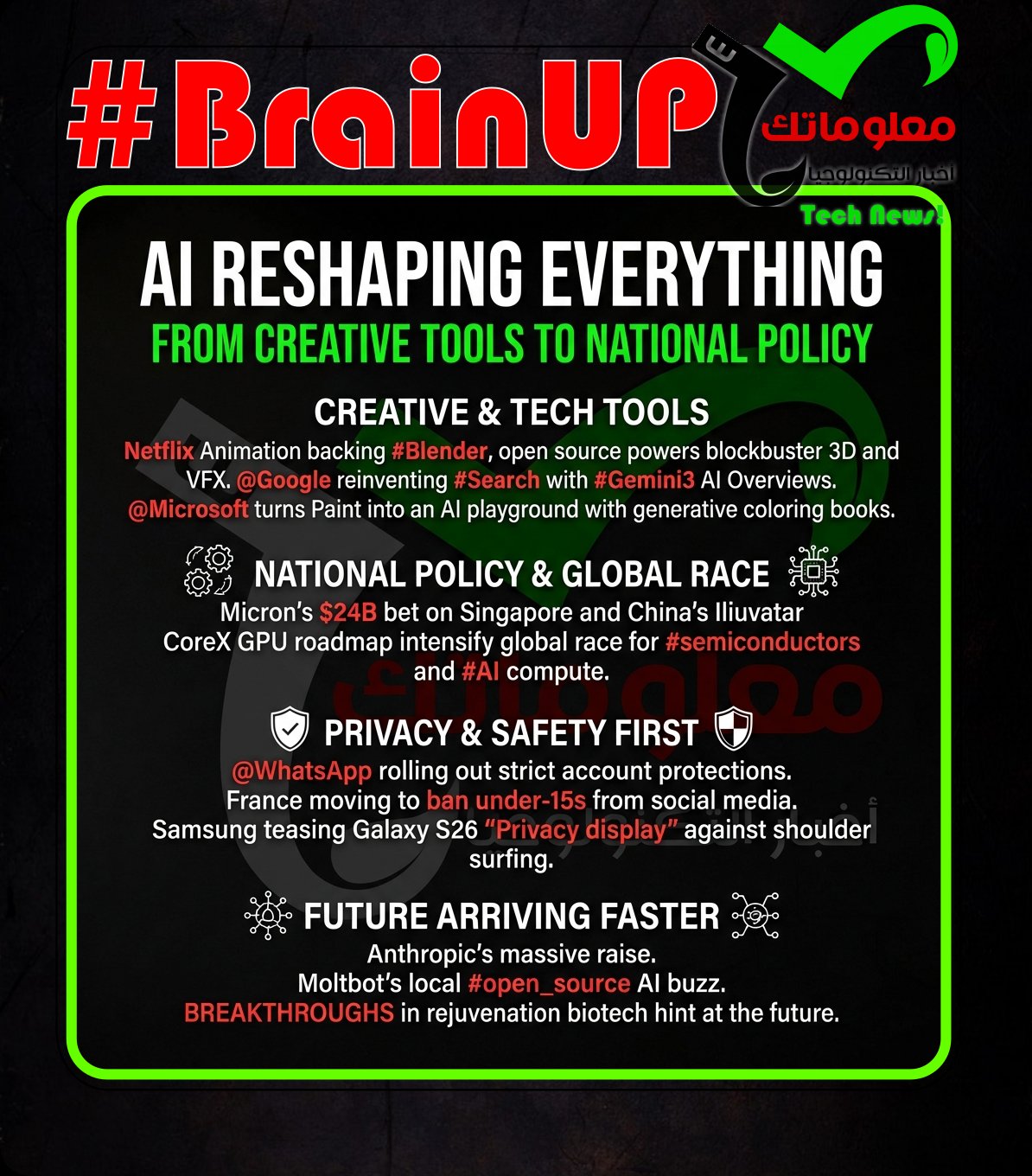
#BrainUp Daily Tech News – (Wednesday, January 28ᵗʰ)
Welcome to today’s curated collection of interesting links and insights for 2026/01/28. Our Hand-picked, AI-optimized system has processed and summarized 29 articles from all over the internet to bring you the latest technology news.
As previously aired🔴LIVE on Clubhouse, Chatter Social, Instagram, Twitch, X, YouTube, and TikTok.
Also available as a #Podcast on Apple 📻, Spotify🛜, Anghami, and Amazon🎧 or anywhere else you listen to podcasts.
1. Netflix Animation Studios joins the Blender Development Fund as Corporate Patron — Blender
Netflix Animation Studios joins the Blender Development Fund as Corporate Patron, backing general Blender core development and signaling the tool’s entrenched role in high-end animation workflows. The membership will fund core development for content creation tools and is described as an investment in a diverse, public, and open-source ecosystem by @Francesco Siddi, CEO at @Blender Foundation, and @Darin Grant, SVP Global Technology at Netflix Animation Studios #open-source #3D #animation #VFX. This historic move demonstrates growing industry support for open-source tools and expands Blender’s professional adoption among major studios. It aligns Blender’s mission to provide free, open-source tools for modeling, animation, VFX, and related workflows, benefiting a global community of creators.
2. WhatsApp’s Latest Privacy Protection: Strict Account Settings
@WhatsApp introduces new Strict Account Settings that give high-risk users, like journalists and public figures, extreme privacy by locking account settings to the most restrictive level and limiting how the app operates. When enabled via Settings > Privacy > Advanced, it blocks attachments and media from non-contacts and the feature is rolling out gradually over the coming weeks. This approach complements #EndToEndEncryption and signals a broader commitment to protecting private conversations from rare, highly-sophisticated cyber attacks, including spyware. Additionally, WhatsApp notes the Rust programming language behind the scenes to help safeguard photos, videos, and messages from threats. Together, these steps underscore @WhatsApp’s ongoing priority of privacy and threat protection in everyday messaging.
A former Ubisoft employee refuted claims that #Diversity, Equity, and Inclusion (#DEI) initiatives harmed the company, asserting these efforts only improved Ubisoft’s environment. The employee expressed surprise at misinformation linking DEI with the financial decline of Assassin’s Creed studios and related drop in share prices, emphasizing that #DEI created positive changes in workplace culture. They highlighted that challenges Ubisoft faced were unrelated to inclusion policies and stemmed from other business factors. This perspective counters narratives blaming DEI for corporate struggles, suggesting misinformation clouds public understanding of Ubisoft’s situation and the true impacts of diversity efforts.
4. French MPs vote to curb children’s screen time with under-15 social media ban
France’s National Assembly approved a bill to ban under-15s from using #socialMedia and to curb mobile phone use in high schools, moving toward stricter limits on children’s #screenTime. The measure, championed by @Emmanuel_Macron, is framed as protecting young people from excessive #screenTime and its potential mental health effects, with Macron saying he does not want an anxious generation nor manipulation by American platforms or Chinese algorithms. If enacted, the rules would apply from the start of the 2026 school year, initially to new accounts, with platforms given until the end of the year to deactivate existing accounts that fail to meet the age requirement. The bill passed 130-21 and now proceeds to the Senate, where @Gabriel_Attal is aiming for mid-February approval so the ban could take effect on 1 September. The move comes amid #EU-wide calls for #stricterSafeguards and concerns raised by #ANSES about risks such as cyberbullying and exposure to disturbing content, while supporters argue it could position France as a European pioneer in digital health policy.
5. Micron plans $24 billion investment in Singapore for chip production, Deputy PM says
Micron Technology is set to invest $24 billion in Singapore to enhance its chip production capabilities, according to Singapore’s Deputy Prime Minister Heng Swee Keat. This significant investment aims to strengthen Singapore’s position as a global semiconductor hub amid rising global demand for #semiconductors. The commitment reflects Micron’s strategy to expand production capacity and address supply chain challenges by leveraging Singapore’s skilled workforce and stable business environment. This move aligns with Singapore’s national goal to attract high-tech manufacturing and innovation in the semiconductor sector. The planned investment underscores the country’s efforts to consolidate its competitive edge in advanced technology industries.
6. Nudify apps get past Google, Apple app moderation
Researchers from @TechTransparencyProject found that many apps enable users to create fake non-consensual nudes of real people and have slipped past @Apple and @Google moderation. They counted 55 such apps in Google Play and 47 in the App Store, with about 705 million downloads and $117 million in revenue. Using clothed AI-generated models and #face_swap tests, the researchers demonstrated that these tools can render a person nude, confirming ease of creating non-consensual intimate imagery with #AI. Google has suspended several apps and is reviewing the rest; Apple removed 25 after researchers contacted them and faced criticism for sponsored nudify ads, underscoring tension between revenue and safety. The findings reinforce ongoing regulatory scrutiny of #AppStore and #PlayStore moderation and highlight the urgent need for clearer safeguards over #privacy and #digital_rights in AI-enabled tools #nudify.
7. Gladys West, Pioneering Mathematician Behind GPS, Dies at 99
Gladys West was a mathematician whose groundbreaking work led to the development of the Global Positioning System (#GPS). She worked at the Naval Weapons Laboratory in the 1950s and 1960s, where she developed precise mathematical models of the Earth’s shape, or geoid, which were instrumental in the accuracy of GPS technology. West’s contributions were historically overlooked, reflecting broader issues of recognition faced by Black women in STEM fields. Her legacy is increasingly acknowledged as essential for modern navigation and global communication, highlighting her vital impact on science and technology. This recognition ties the advancement of GPS to her pioneering efforts in applying computer technology to complex geodesic calculations.
8. SoftBank Pauses $50B Acquisition Talks for Nvidia’s Arm Stake
SoftBank has paused negotiations to sell its entire stake in #Arm to Nvidia for approximately $50 billion, citing unfavorable market conditions as the reason. The deal, which aimed to combine Nvidia’s strength in #AI and GPU technology with Arm’s CPU architecture, faced regulatory scrutiny and shareholder hesitation that contributed to the pause. While Nvidia remains interested in the acquisition, SoftBank is reconsidering its strategy amid a volatile financial environment. The acquisition’s delay reflects wider uncertainty in large tech mergers during current economic challenges. This development affects expectations for consolidation within the semiconductor industry and highlights the impact of macroeconomic factors on major transactions.
9. Google Search now lets you ask AI Overviews follow-up questions
Google is shifting Search from a links-first experience to AI-driven interactions by upgrading #AIOverviews with #Gemini3 and enabling seamless follow-up questions. Gemini 3 now powers AI Overviews’ summaries globally, and users can switch to AI Mode for deeper conversations by scrolling and typing, as @Robby Stein puts it: ‘A quick snapshot when you need it, and deeper conversation when you want it’. The upgrade aims for best-in-class Overview answers, addressing mixed results from earlier models, according to @Robert Hart. This reflects a broader shift at Google toward AI-first interfaces, with the company signaling a move away from traditional link-heavy results, though there’s no clear timeline for retiring the old Search. In sum, the changes anchor Google’s #Search strategy to AI-powered retrieval and conversational workflows, reshaping how users interact with information on the web.
Memory pricing appears to be leveling off after months of hikes, but at inflated levels that will be hard for enthusiasts to stomach. Specific modules have stabilized, including DDR4-3200 (2x8GB), DDR4-3600 (2x16GB), DDR4-3600 (2x32GB), DDR5-4800 (2x16GB), and DDR5-5200 (2x16GB), while higher-end kits like DDR5-5600 and DDR5-6000 still show upticks, albeit more slowly. Notable price movements include the Corsair Vengeance 32GB DDR5-6000 CL36 kit, which sat around $339 between November and January, rose to $439 in early January, and has remained there; the Patriot Viper Elite 5 16GB DDR5-6000 CL30 stayed at $169.99 since December 2025 after having been $43.99 in October 2025; and a Corsair 32GB Vengeance kit briefly dropped to $344 from $410. Indications of a memory shortage emerged in Q3 2025 as AI-driven demand for HBM coincided with DDR4 phasing out for DDR5, leading retailers in Japan and Germany to ration memory and storage components and prompting warnings from Kingston that prices would rise. For now, chip prices seem to stabilize at a new, inflated price level, suggesting the anticipated plateau may be the new norm rather than a return to previous prices. #RAM #DDR4 #DDR5 #HBM #AI
Newegg’s stock price dropped 17.7% on January 21, 2026 after it disclosed that its controlling shareholder and chairman, He Zhitao, was detained and placed under investigation by the Haibei Prefecture Supervisory Commission, triggering market panic. The company said the detention is personal and that operations, governance, and daily management, handled by its executive officers, remain normal, with @Lianluo Interactive Information Technology Co. owning 54.5% of Newegg. The shares fell by $9.79 to $45.53 at close, and several law firms, including Glancy Prongay & Murray LLP, are weighing class-action options over potential securities-law violations; similar lawsuits have targeted Oracle and Intel in related contexts. Despite assurances, investors remain cautious about governance under a single majority owner, even as Newegg emphasizes compliance with laws and continued business activity. The situation underscores investor sensitivity to anti-corruption actions in China and the potential scrutiny of disclosures affecting cross-border listings #anti-corruption #securities-laws #governance.
12. Anthropic reportedly upped its latest raise to $20B | TechCrunch
Anthropic is raising its latest round to $20B, doubling the prior target and signaling a value around $350B once closed, according to FT. The round’s size and valuation reflect strong investor interest, with backers including @Sequoia Capital, Singapore’s sovereign wealth fund, and @Coatue. Late last year, Anthropic reportedly hired lawyers in preparation for an IPO anticipated this year, building on a $13B raise in September that valued the company at about $183B. The move underscores appetite for AI platforms such as @Claude and @Claude_Code, and could position the company for significant market leadership in the near term. If the funding proceeds, Anthropic’s trajectory emphasizes continued momentum in the AI startup ecosystem and possibilities for an eventual public listing.
13. Experts Warn That OpenAI’s Bubble Is Facing a $200 Billion Reality Check
OpenAI, renowned for launching ChatGPT, is encountering skepticism as experts caution that its valuation might be inflated by up to $200 billion. Investors initially fueled excitement based on breakthroughs in #artificialintelligence and the potential impact on various sectors, yet recent evaluations highlight a potential overestimation of market size and revenues. Industry veterans like @MaryMeeker emphasize the need to temper expectations, pointing to historical bubbles driven by hype rather than sustainable growth. This #realitycheck urges both startups and investors to pursue more grounded strategies and innovation that match genuine demand and value creation. Consequently, OpenAI’s trajectory could influence how the broader #AI industry approaches valuation and development moving forward.
14. Palantir Defends Work With ICE to Staff Following Killing of Alex Pretti
After @AlexPretti’s killing by federal agents in Minneapolis, Palantir workers pressed leadership about the company’s work with @DHS and @ICE, while management framed it as boosting @ICE’s operational effectiveness. Palantir’s privacy and civil liberties team published an update to the internal wiki detailing its work on federal immigration enforcement, arguing the technology mitigates risks and enables targeted outcomes. Slack threads show internal frustration and ethical questions about involvement, with employees asking for clarity and some urging Palantir to pressure @ICE, while many colleagues signalled support with +1 reactions. The wiki outlines a six-month pilot begun in April 2025 supporting @ICE in Enforcement Operations Prioritization and Targeting, Self-Deportation Tracking, and Immigration Lifecycle Operations focused on logistics, tied to a $30 million contract for #ImmigrationOS; the pilot was renewed in September for another six months, with Self-Deportation Tracking folded into the enforcement work, and a separate pilot with @USCIS aims to identify fraudulent benefit submissions. The article highlights tensions between corporate loyalty and ethical concerns in immigration enforcement as Palantir expands its portfolio amid public controversy.
15. Pinterest cuts nearly 15% of jobs to redirect resources to AI
Pinterest is eliminating nearly 15% of its workforce, affecting about 150 employees, to reallocate resources toward artificial intelligence (#AI) development. CEO Bill Ready explained the decision aims to focus on improving the user experience by integrating AI capabilities. The company is prioritizing investments in AI as part of its strategy to enhance content discovery and user engagement on its platform. This move reflects broader trends in the tech industry where firms adjust workforce sizes and strategies to emphasize emerging technologies. Pinterest’s restructuring underscores its commitment to innovation despite the job cuts.
16. TikTok users “absolutely justified” for fearing MAGA makeover, experts say
TikTok users are absolutely justified in fearing a MAGA makeover and censorship, with experts arguing that whether the issues are glitches or deliberate shifts, the pattern of suppressed content matters. Ioana Literat, @IoanaLiterat, a Columbia University expert on technology, says the fears are justified and notes that a consistent suppression of anti-#Trump content, #Epstein references, and #antiICE videos points to more than random coincidence. Casey Fiesler, @CaseyFiesler, also says that even if the problems are technical glitches, they undermine trust and may push users away. Sensor Tower data cited by CNN show daily uninstalls up roughly 150 percent in the last five days, while TikTok says there have been no changes to the algorithm or content moderation, only updates to the terms of use and privacy policy; officials attribute the bugs to a power outage at a US data center and are investigating why #Epstein mentions and related topics show up in DMs. California Governor @GavinNewsom launched a review into whether TikTok is censoring #Trump-critical content, highlighting the broader political scrutiny of the platform’s moderation.
17. You can now create AI-generated coloring books in Microsoft Paint
Microsoft, echoing @SatyaNadella’s caution that AI still needs to prove its worth, is rolling out an AI-powered coloring book feature in its Paint app for Windows Insiders with Copilot+ PCs, enabling users to generate coloring pages from text prompts. A sample prompt like ‘a cute fluffy cat on a donut’ produces several image options that users can add to their workspace, then copy, save, or print #Copilot+. The update sits alongside enhancements to #Notepad’s Write, Rewrite and Summarize AI tools, with a new #FillTolerance slider letting you control how precisely colors are applied to the canvas. Access is limited to Windows Insiders in the Canary and Dev channels on Windows 11 and requires sign-in to a Microsoft account for cloud features, underscoring a cautious, staged rollout of AI capabilities with #Copilot+ and Paint.
18. The State-Led Crackdown on Grok and XAI Has Begun
State governments in the US have initiated crackdowns on AI companies like Grok and XAI due to growing concerns about the rapid development and deployment of AI technologies. Evidence shows regulators are scrutinizing these companies for potential risks including misuse, lack of transparency, and privacy violations. The crackdown reflects broader fears about unchecked AI development outpacing regulation, highlighting a need for state-level intervention to enforce ethical and safe AI practices. This trend signals a shift from purely industry-led AI innovation towards increased governmental oversight to balance technological progress with societal safety. It underscores the tension between fostering AI growth and ensuring accountability at both corporate and state levels.
19. 94% Of Americans Don’t Understand Privacy Risks Of AI At Work, Says NordVPN
A NordVPN survey reveals that 94% of Americans lack understanding of the privacy risks associated with using #ArtificialIntelligence at work, highlighting widespread unawareness of potential data vulnerabilities. Despite the rapid integration of AI tools in professional environments, many employees remain uninformed about how these technologies can expose sensitive information to unauthorized access or misuse. This knowledge gap increases organizational risk and emphasizes a critical need for comprehensive education on AI privacy issues to protect employee and corporate data. As AI continues to expand across industries, addressing these concerns through targeted awareness and policy implementation is essential to safeguard privacy and maintain trust in technology. The findings underscore the importance of prioritizing AI literacy and privacy training in the workplace to mitigate emerging threats.
20. TTP – Nudify Apps Widely Available in Apple and Google App Stores
Apple and Google host a sizable number of nudify apps that can strip clothing from images, despite bans, enabling nonconsensual sexualized imagery. TTP identified 55 such apps in the Google Play Store and 47 in the Apple App Store, collectively downloaded more than 705 million times and generating about $117 million in revenue, per AppMagic. While both stores prohibit depictions of nudity or objectification, removals have been uneven: Apple reportedly removed 28 identified apps (TTP counted 25 removals) and Google suspended several before removing 31 apps. The controversy around @ElonMusk’s #GrokAI on @X has drawn regulator scrutiny from Ofcom, the European Commission, and California, underscoring concerns that app stores’ safety promises lag behind the spread of AI deepfake tools, and calling for stronger enforcement and clearer standards #AI #deepfake #appstores
21. Vibe-Coded Sicarii Ransomware Decrypted
The article reveals that the #Sicarii ransomware, distributed via the Vibe platform, has been decrypted by security researchers, providing a valuable tool to victims. Researchers discovered a flaw in the ransomware’s encryption algorithm that allowed the development of a decryptor without paying the ransom, highlighting the importance of in-depth cryptanalysis in combating ransomware threats. This breakthrough mitigates the impact of the Sicarii strain by restoring access to encrypted files, aiding incident response efforts. The analysis underscores the significance of prompt vulnerability identification and collaboration between defenders and researchers to weaken ransomware operations. These findings contribute to broader cybersecurity defenses by undermining a prevalent ransomware-as-a-service model and demonstrate the potential of cryptanalytic approaches to counter evolving threats.
22. ChatGPT fails to spot 92% of fake videos made by OpenAI’s own Sora tool
A Newsguard study finds that leading chatbots struggle to identify AI-generated videos, including those produced by @OpenAI’s #Sora tool. The evidence shows @Grok failed to identify 95% of test Sora videos as AI-generated, @ChatGPT had a 92.5% error rate, and @Gemini missed 78%. Watermarks on Sora videos prove unreliable since free tools can remove them, and even videos with visible watermarks sometimes fooled detectors, while metadata using the #C2PA standard exists but did not prevent mislabeling. The result highlights a credibility gap for OpenAI, which sells Sora while its own assistant struggles to spot fakes, underscoring broader challenges in using AI to police AI-generated content.
23. Teen Social Media Addiction Trial Set to Kick Off in LA
A groundbreaking trial against Meta is set to begin in Los Angeles, where the company faces accusations of addicting teenagers to its platforms, including Instagram. The lawsuit alleges Meta knowingly designed algorithms and features to exploit adolescent vulnerabilities, increasing screen time and mental health issues. This case, one of the first of its kind, presents evidence gathered from internal company documents and expert testimonies highlighting the engineered addictive qualities in social media tools. The trial reflects growing concern about #socialmediaaddiction and its impact on youth, potentially prompting changes in industry practices and regulations. The outcome could significantly influence how technology companies address user well-being, especially among teenagers.
24. The first human test of a rejuvenation method will begin “shortly”
The Boston startup Life Biosciences has obtained FDA approval to begin the first human test of a rejuvenation method, code-named ER-100, aimed at treating glaucoma through partial cellular reprogramming. The plan is to inject viruses carrying three Yamanaka factors into one eye of about a dozen patients, with the reprogramming genes controlled by a genetic switch that activates only while patients take a low-dose doxycycline for roughly two months, and with effects monitored as the process unfolds. The approach seeks to reset epigenetic controls to make cells behave younger, a concept drawing substantial investment from #SiliconValley firms and linked to many tech-backed ventures; however, full reprogramming can trigger tumors in animals, so the partial approach is designed to limit risks. The trial is framed as a milestone for aging research and the biotech industry, as @ElonMusk and @DavidSinclair have touted aging reversibility and signaled that clinical trials could begin soon, underscoring the field’s momentum with #reprogramming and #YamanakaFactors.
25. The Samsung Galaxy Z Trifold will cost $2,900 in the US
Samsung announced the Galaxy Z Trifold, an ambitious foldable smartphone featuring three screens and priced at $2,900 in the US. The device includes a 7.6-inch main display alongside two additional foldable panels offering extensive multitasking capabilities, targeting users who desire productivity and versatility. Powered by high-end components, the Z Trifold aims to push the boundaries of #foldabletechnology while competing in the premium smartphone market. Samsung’s pricing reflects its commitment to innovation but also positions the device as a niche product due to the high entry cost. This move illustrates Samsung’s strategy to expand the foldable segment by catering to advanced users and tech enthusiasts.
26. China’s Iliuvatar CoreX Unveils Four-Generation GPU Roadmap Aimed at Surpassing Nvidia: Rubin
China’s Iliuvatar CoreX has announced an ambitious four-generation #GPU roadmap designed to surpass @Nvidia’s Rubin architecture. The company details advancements in performance, efficiency, and AI capabilities across upcoming product cycles, reflecting China’s growing ambition in the high-performance computing market. By leveraging innovations in chip design and architecture, Iliuvatar aims to close the gap with global leaders and drive competitive domestic technology. This roadmap underscores the strategic emphasis on developing indigenous #semiconductor technology to reduce reliance on foreign suppliers and boost national tech self-sufficiency. Iliuvatar’s staged approach presents a long-term vision for China to challenge established GPU players and expand its influence in AI and computing hardware.
27. Samsung’s first Galaxy S26 teaser is for the ‘Privacy Display’ [Gallery]
@Samsung is teasing a new ‘Privacy display’ for the Galaxy S26 that aims to shield your screen from shoulder surfing by making content disappear when viewed from an off-angle. In a series of videos, Samsung says it will soon unveil a new layer of privacy to shield your phone from shoulder surfing wherever you go and that it’s coming to Galaxy very soon, while making clear the feature is not an all-or-nothing solution. This tailored approach lets users adjust visibility with multiple settings and even protect specific parts of the experience, such as notifications or password entry, rather than applying a blanket privacy mode, reflecting five years of engineering and a fusion of hardware and software. The feature is rumored to be exclusive to the Galaxy S26 Ultra, with the Galaxy S26 standard and Plus models possibly not receiving it, and Samsung plans a late February launch for the Galaxy S26 series. If realized, it marks a shift toward integrated privacy controls designed to protect everyday privacy in public settings #PrivacyDisplay #ShoulderSurfing @Samsung
28. Clawdbot has AI techies buzzing — and buying Mac Minis
Clawdbot, now Moltbot, is an open-source #AI agent that runs locally to manage your digital life 24/7, and techies are buzzing as they link it to calendars, chats, and vibe-coding workflows. It connects to many consumer apps and can organize schedules, monitor vibe-coding sessions, and even build new AI employees, drawing praise from @GarryTan and @a16z partners. After Anthropic flagged similarities in the name and logo, its creator @PeterSteinberger renamed the agent Moltbot, signaling ongoing evolution and public scrutiny. Because it runs locally, some users are reviving old laptops and others are buying #MacMini to keep the AI online; @LoganKilpatrick of Google DeepMind even tweeted that a Mac mini was ordered, and Google Trends shows a spike in searches for ‘Mac Mini’. The piece frames this as part of a broader move toward #open-source, #localAI that could influence hardware demand and spark #security debates as the community weighs benefits against risks.
29. WinRAR path traversal flaw still exploited by numerous hackers
The WinRAR path traversal vulnerability continues to be exploited by hackers years after its disclosure, posing a serious security risk to users. This flaw allows attackers to write files outside the extraction directory by using specially crafted archives that traverse directories, potentially leading to malware installation. Despite patches being available, many users remain vulnerable as they use outdated versions of WinRAR, highlighting a gap in update adoption. Hackers integrate this exploit in widespread malware campaigns to evade detection and maintain persistence on victims’ systems. The ongoing exploitation underscores the importance of regular software updates and awareness of legacy vulnerabilities like those in #WinRAR to maintain cybersecurity.
That’s all for today’s digest for 2026/01/28! We picked, and processed 29 Articles. Stay tuned for tomorrow’s collection of insights and discoveries.
Thanks, Patricia Zougheib and Dr Badawi, for curating the links
See you in the next one! 🚀
