
#BrainUp Daily Tech News – (Wednesday, January 28ᵗʰ)
Welcome to today’s curated collection of interesting links and insights for 2026/01/28. Our Hand-picked, AI-optimized system has processed and summarized 29 articles from all over the internet to bring you the latest technology news.
As previously aired🔴LIVE on Clubhouse, Chatter Social, Instagram, Twitch, X, YouTube, and TikTok.
Also available as a #Podcast on Apple 📻, Spotify🛜, Anghami, and Amazon🎧 or anywhere else you listen to podcasts.
1. Netflix Animation Studios joins the Blender Development Fund as Corporate Patron — Blender
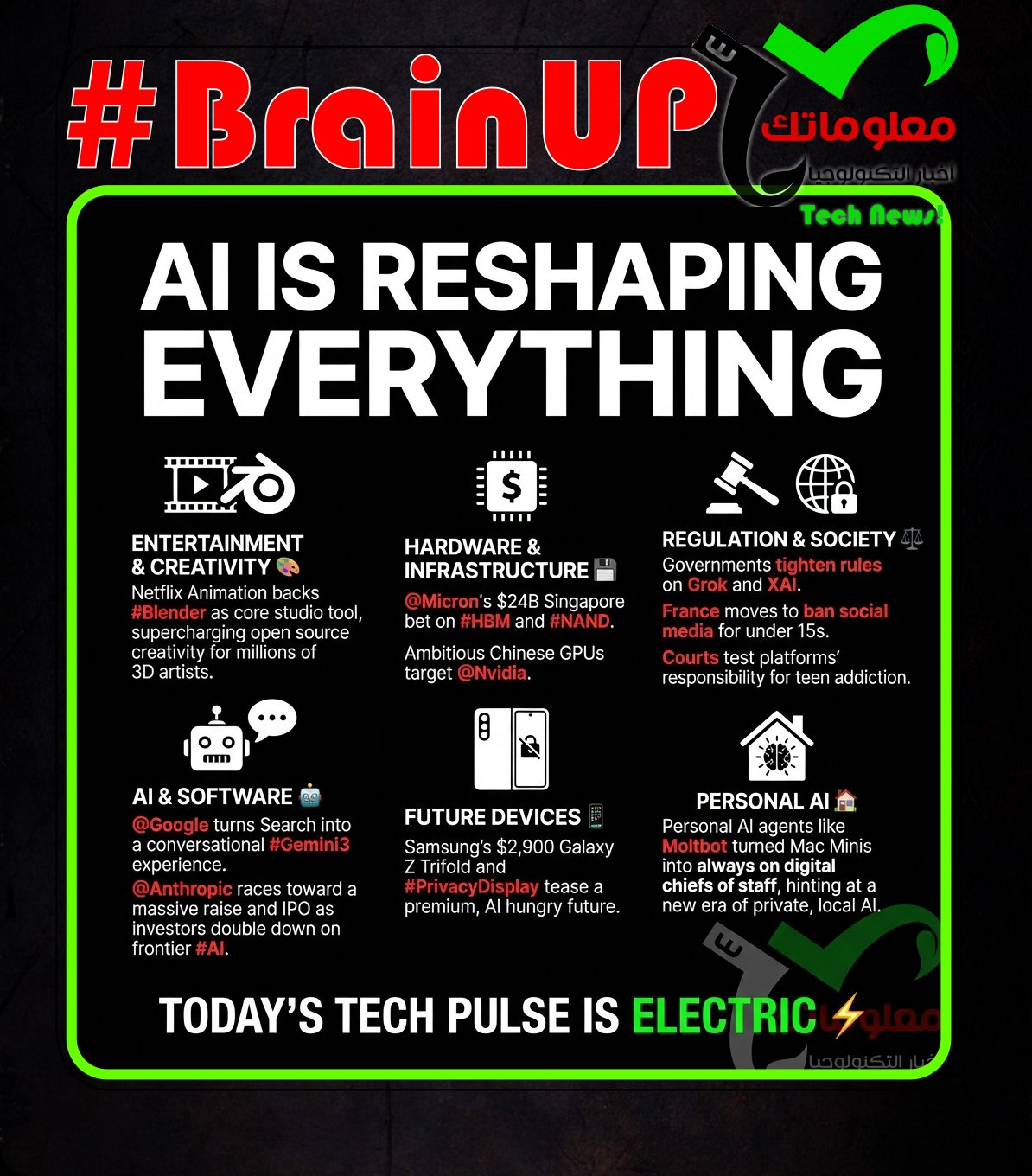
Netflix Animation Studios joins the Blender Development Fund (#BlenderDevelopmentFund) as Corporate Patron, marking a historic first for the animation industry and signaling deeper integration of Blender into professional studio pipelines, including @Netflix and @Blender. This membership will support general Blender core development to continuously improve content creation tools for individuals and teams working in media and entertainment workflows, reinforcing Blender’s role in high-end production. This move reflects Blender’s growing adoption by major studios and strengthens an open-source ecosystem that benefits the global community of content creators, #OpenSource, with remarks from @FrancescoSiddi, CEO at @Blender Foundation, and @DarinGrant, SVP Global Technology at Netflix Animation Studios. @DarinGrant says the studio is proud to be the first major animation studio to back Blender’s ongoing development and its expanding adoption among current and future animation professionals. Netflix is one of the world’s leading entertainment services with over 300 million paid memberships in over 190 countries, and Blender remains a free, open-source tool for modelling, animation, VFX, and more, underscoring the collaboration’s alignment with open tools in the global animation community.
2. WhatsApp’s Latest Privacy Protection: Strict Account Settings
@WhatsApp unveils a lockdown-style feature, Strict Account Settings, that locks privacy options to the most restrictive mode and blocks attachments and media from non-contacts. It targets high-risk users such as journalists or public-facing figures who may face highly sophisticated cyber attacks. The feature is rolled out gradually over the coming weeks via Settings > Privacy > Advanced. To bolster protection, WhatsApp has deployed the Rust programming language to help protect photos, videos, and messages from spyware, reinforcing @WhatsApp’s commitment to #privacy #end-to-end-encryption #Rust.
A major reset at @Ubisoft, including canceling six games and delaying seven others, coincided with a sharp dip in share prices, a move @Reuters reported. Kensuke Shimoda, a former @Ubisoft Osaka designer, says the idea that #DEI is to blame is misinformation and that ‘DEI only improved things’—citing a better workplace and expanded markets in South America and the Middle East. He argues that the wider decline stems from ‘Big Business Syndrome’ and leadership gaps lacking online/mobile/F2P expertise in senior roles, not from DEI initiatives. The piece notes the language and global expansion challenges of a French-origin company going global, suggesting misattributing the stock drop to DEI would be misleading and potentially harmful if scapegoating #DEI advocates occurs. Overall, the article frames the debate as a misattribution, urging careful attribution to internal dynamics rather than DEI policies.
4. French MPs vote to curb children’s screen time with under-15 social media ban
France’s National Assembly approved a bill banning under-15s from using social media and restricting mobile phone use in high schools, a move to curb screen time and protect youth mental health. The bill passed by 130 votes to 21 and now goes to the Senate before becoming law. @Emmanuel Macron called it a major step to protect children and teenagers, saying emotions should not be for sale or manipulated by #American platforms or #Chinese algorithms. If enacted, the rules would begin at the start of the 2026 school year, initially applying to new accounts, with platforms given until year-end to deactivate existing underage accounts. @GabrielAttal framed the measure as both a public health initiative and a bid for national independence, arguing it could position France as a European pioneer, while ANSES warned of risks such as cyberbullying and exposure to violent content but noted that social media is not the sole cause of mental health issues.
5. Micron plans $24-billion memory chipmaking plant in Singapore – The Economic Times
@Micron Technology plans a $24-billion investment to build a memory chipmaking facility in Singapore to boost capacity amid a global shortage. The plan envisions an advanced wafer fabrication plant over the next decade with wafer output starting in the second half of 2028 in a 700,000-square-foot cleanroom; @Micron already makes 98% of its flash memory chips in Singapore and is building a $7-billion advanced packaging plant for #HBM due to start production in 2027. The HBM packaging facility is expected to contribute to supply in 2027, and analysts foresee the memory shortfall possibly lasting through late 2027, while rivals like #Samsung and #SKHynix are also expanding. The move reflects a broader push to meet rising #AI and data-centric demand for #NAND memory and related tech, signaling intense competition and resilience in the memory supply chain. By expanding production in Singapore and potentially augmenting capacity with a Taiwan site acquisition, @Micron aims to secure steady supply and reinforce its position in the AI-driven memory market.
6. Nudify apps get past Google, Apple app moderation
Apple and Google host stores that have allowed nudify apps to proliferate, enabling users to create fake non-consensual nude images of real people despite claims to ban such software. The Tech Transparency Project identified 55 such apps in Google Play and 47 in the App Store, collectively downloaded 705 million times and generating about $117 million in revenue. The study shows face-swapping and nude-rendering features work on clothed AI models, making it easy to produce non-consensual imagery. Google has suspended several apps and is reviewing the rest; Apple removed 25 after researchers alerted them and was found to run sponsored ads for nudify results when users search for ‘nudify’. Regulators and the public have reacted to @Elon_Musk’s Grok, highlighting broader concerns about online abuse, safety, and the need for stronger moderation. The findings underscore gaps in enforcement and call for stronger, more transparent moderation and policy action by platform owners, with #nudify #moderation #policy as focal points.
7. Gladys West, a Pioneer in GPS Technology, Dies at 100
Gladys West, a mathematician whose work was essential to the development of GPS technology, has died at 100. Her expertise in geometry and satellite data modeling contributed to precise location tracking, laying the foundation for modern navigation systems. Despite her crucial role, West’s contributions were largely unrecognized publicly until later in life, reflecting broader issues of visibility for women and African Americans in STEM fields. Her legacy highlights the intersection of innovation and perseverance in advancing technology essential to everyday life. West’s passing marks the loss of a trailblazer whose work continues to impact global positioning systems worldwide.
8. SoftBank Pauses $50B Switch Acquisition Talks
SoftBank has put its planned $50 billion acquisition of Switch Inc. on hold, citing volatile market conditions and uncertainty around the company’s valuation. The pause follows intense negotiations that reflected SoftBank’s interest in expanding its data center portfolio amid digital infrastructure growth. The halt indicates cautious strategic recalibration amid fluctuating tech sector investment trends and economic pressures. This development signals the challenges faced by large-scale tech acquisitions in uncertain economic climates and may impact the data center industry’s consolidation trajectory. SoftBank’s decision reflects broader market dynamics influencing major technology investment deals.
9. Google Search now lets you ask AI Overviews follow-up questions
Google is reshaping Search to prioritize AI interactions by upgrading AI Overviews with #Gemini3 as the default model and enabling follow-up questions for a seamless, chatbot-like experience. If an Overview leaves you wanting more, you can jump into AI Mode for a deeper conversation, and switching between modes is described as easy by @Robby Stein. Gemini 3 is now the default model powering AI-generated summaries globally, making Overview answers ‘best-in-class,’ according to Google. The update marks a broader shift at Google away from presenting links toward AI-driven answers, though the company did not comment on whether Search will be phased out entirely. This move positions @Google to answer users’ questions more directly and blur the line between traditional search results and interactive AI dialogue, aligning with #AI and #AIOverviews strategies.
RAM prices, after a period of high volatility and inflation, are beginning to stabilize, although they remain elevated compared to previous norms. Prices for certain modules have plateaued, while the increases seen in high-performance kits are starting to diminish. This trend suggests a market adjustment as supply chains improve and demand moderates. The levelling off offers some relief for consumers seeking upgrades or builds during a financially challenging period. The evolving pricing dynamics highlight the ongoing balancing act in the #PCcomponents market amid broader economic pressures and tech supply issues.
@Newegg stock price declined sharply after news that its controlling shareholder, He Zhitao, was detained by anti-corruption authorities, signaling investor concerns about #governance and #regulatoryrisk. The company said the detention is personal and that its governance structure and daily operations remain normal, with the board and executive team continuing to fulfill their duties. The market reaction was a 17.7% drop to $45.53 on January 21, 2026, suggesting investors fear potential fallout even as Newegg emphasizes normal business activity. Since the disclosure, the stock has recovered some losses as the company reiterates that business activities are proceeding normally.
12. Anthropic reportedly upped its latest raise to $20B | TechCrunch
Anthropic reportedly upped its latest raise to $20B, targeting a $350B valuation for its #Claude AI ventures. The round’s target was doubled from $10B, and backers are expected to include @Sequoia Capital (which also backs rival @OpenAI), Singapore’s sovereign wealth fund, and @Coatue. Anthropic previously announced a $13B raise in September, valuing the company at about $183B. The move comes as investor interest in #AI booms and follows reports that Anthropic has hired lawyers to prep for an IPO that could come this year.
13. Experts Warn That OpenAI’s Bubble Is Facing a $200 Billion Reality Check
OpenAI’s soaring valuation and hype around generative AI are facing skepticism from experts who caution about an impending $200 billion correction. Despite impressive advancements in #AI capabilities, concerns about overvaluation stem from the technology’s uncertain monetization and long-term business viability. Industry veterans and analysts highlight that while OpenAI and similar entities have sparked enthusiasm, the market may be overestimating immediate returns and underestimating challenges such as scalability, regulatory risks, and ethical considerations. This criticism suggests a need for measured expectations as the field matures beyond the current hype cycle. Understanding the balance between innovation and realistic pacing is crucial for stakeholders navigating the evolving AI landscape.
14. Palantir Defends Work With ICE to Staff Following Killing of Alex Pretti
Palantir defends its work with #ICE and #DHS after the killing of Minneapolis nurse Alex Pretti, while employees press leadership for clarity on the partnership. Slack threads reveal internal frustration over the company’s immigration enforcement role and calls for transparency about involvement. Palantir’s privacy and civil liberties team published an update detailing DHS contracts, noting a six‑month pilot that began in April 2025 in areas including Enforcement Operations Prioritization and Targeting, Self‑Deportation Tracking, and Immigration Lifecycle Operations, tied to a $30 million ICE contract for ImmigrationOS. The pilot was renewed in September for another six months and is described as improving operational effectiveness and mitigating risks, with USCIS also piloting a program to identify fraudulent benefit submissions. Critics argue the ethics and business logic of continuing the ICE relationship are troubling, reflecting broader debates about private technology’s role in interior immigration enforcement and prompting calls to better understand Palantir’s involvement.
15. Pinterest cuts nearly 15% of jobs as it redirects resources to AI
Pinterest announced a job cut of nearly 15%, eliminating about 150 roles as the company plans to close some global offices and shift resources towards artificial intelligence (#AI). CEO Bill Ready stated the reduction aims to focus on improving the platform experience through AI and machine learning capabilities, reflecting broader tech industry trends. These cuts follow a previous workforce reduction and intend to streamline operations to enhance Pinterest’s competitive position and innovation potential. The company’s strategy underlines the prioritization of AI development in response to growing demand and competition in digital platforms. This shift highlights Pinterest’s adaptation efforts to leverage #AI for future growth and user engagement.
16. TikTok claimed bugs blocked anti-ICE videos, Epstein mentions; experts call BS
TikTok asserted that technical bugs caused the blocking of anti-ICE videos and references to Jeffrey Epstein, but experts have strongly disputed these claims. The platform’s claimed bugs coincided with content moderation decisions that appeared politically motivated, raising concerns about censorship and transparency on the app. Industry analysts and digital rights advocates have pointed to patterns in TikTok’s content suppression practices that suggest deliberate policy enforcement rather than accidental glitches. This skepticism highlights broader tensions around social media companies’ power to control political discourse and controversial topics on their platforms. Therefore, TikTok’s explanations are viewed as inadequate responses to substantive issues about content regulation and user rights.
17. You can now create AI-generated coloring books in Microsoft Paint
Microsoft has introduced a new feature in Paint that allows users to generate AI-created coloring books. This feature leverages #AI technology to create intricate coloring pages from user prompts, expanding Paint’s functionality beyond basic image editing. By integrating AI-generated art, Microsoft aims to make creative tools more accessible and engaging for users of all ages. This addition reflects the growing trend of incorporating AI in everyday applications to enhance user experience. As a result, Paint is evolving from a simple drawing tool to a platform supporting creative expression through AI.
18. The State-Led Crackdown on Grok and XAI Has Begun
Governments worldwide are initiating crackdowns on AI models like Grok and XAI amid rising concerns about their impact. Regulatory bodies are imposing stricter controls and oversight to address issues such as misinformation, privacy risks, and accountability in AI deployment. This shift reflects greater awareness of AI’s societal implications and the need for frameworks to ensure safe, ethical use of #artificialintelligence technologies. The crackdown involves both direct restrictions on AI services and broader policy discussions around transparency and consumer protection. These measures aim to balance innovation with public safety and trust in increasingly pervasive AI systems.
19. 94% of Americans don’t understand privacy risks of AI at work, says NordVPN
94% of Americans don’t understand privacy risks of using AI at work, highlighting a gap as workplaces increasingly rely on #AI tools like @ChatGPT and @Copilot. The National Privacy Test for 2025 shows that when employees share client details or internal strategies with AI assistants, data can be logged, stored, or used to train future models, creating unforeseen #privacy vulnerabilities, a concern echoed by @MarijusBriedis, NordVPN’s CTO. The risks extend beyond the workplace, with 24% unable to identify common AI-driven scams such as deepfakes and voice cloning, and previous NordVPN findings showing 78% have encountered online scams in two years, with 20% losing money and 46% clicking a phishing link. This suggests that rapid AI adoption without awareness magnifies exposure to fraud and data leakage, making it easier for cybercriminals to craft convincing counterfeit sites or scams. Readers can consult the full report at nationalprivacytest.org/report to understand the scope and seek guidance on #privacy and #cybersecurity practices.
20. TTP – Nudify Apps Widely Available in Apple and Google App Stores
Apple and Google host a sizeable ecosystem of apps that can strip clothes from images, despite official prohibitions on sexualized content. TTP identified 55 such apps in Google Play and 47 in the Apple App Store, collectively downloaded more than 705 million times and generating about $117 million in revenue, with Google and Apple taking a cut. Enforcement has been uneven: Apple said it removed 28 apps identified by TTP and warned developers of further removals, while Google suspended several apps and later removed 31. The findings come amid heightened scrutiny of AI-enabled nudification following incidents around @ElonMusk’s GrokAI on @X, underscoring risks of nonconsensual imagery and the need for stronger, clearer policies. This report highlights ongoing tensions between platform safety commitments and the availability of harmful tools in app stores.
21. The Vibe-Coded Sicarii Ransomware Decrypted
The Sicarii ransomware, linked to the Vibe-Coded group, has been decrypted, offering crucial insights into its operations and methods. Researchers uncovered how this ransomware encrypts victims’ files and uses unique evasion techniques to bypass detection by traditional security tools. The decryption allows organizations to recover affected data without paying ransoms, mitigating the impact of Sicarii attacks. By analyzing the ransomware’s structure and behavior, cybersecurity experts can develop improved defenses against similar threats associated with #ransomware and #endpointsecurity. The discovery highlights the ongoing arms race between cybercriminals and defenders, reinforcing the need for advanced threat intelligence and robust security measures.
22. ChatGPT fails to spot 92% of fake videos made by OpenAI’s own Sora tool
Leading chatbots struggle to identify AI-generated videos, including those produced by OpenAI’s own #Sora tool, exposing credibility gaps in both detection and disclosure. In a Newsguard test, #Grok misidentified 95% of Sora videos as real AI content, @ChatGPT erred on 92.5%, and @Gemini 78%, with watermarks easily removed by free tools. Even when watermarks remained, #Grok failed 30% and @ChatGPT 7.5%, while @Gemini correctly flagged all marked AI videos. Beyond visible marks, #Sora embeds #C2PA metadata that can be checked, yet metadata alone does not prevent deception, and in one case #Grok claimed a fake video came from a non-existent outlet. The findings highlight how current detectors can be fooled and suggest a broader need for reliable identity cues and transparent AI content practices, given that @OpenAI sells Sora while its own assistant struggles to spot fakes.
23. Teen Social Media Addiction Trial Set to Kick Off in L.A.
A landmark trial in Los Angeles will address the issue of teen social media addiction, focusing on whether platforms deliberately design features to foster dependency among minors. The lawsuit, backed by allegations from a former Facebook employee, claims the company’s practices increase usage and harm teenage mental health. This case highlights growing concerns around how algorithms target vulnerable users and the potential consequences on youth well-being. The trial’s outcome may set significant precedents for regulating #socialmedia companies and protecting young users from manipulative design. The proceedings reflect broader debates about technology’s role in public health and corporate responsibility.
24. The first human test of a rejuvenation method will begin “shortly”
Life Biosciences, led by @David Sinclair, plans the first human test of age-reversal using a broad #reprogramming approach (ER-100) to treat glaucoma, after FDA approval to proceed with a targeted first trial. The study will involve about a dozen patients in which viruses carrying three potent #Yamanaka factors are injected into one eye, with a genetic switch that turns on only while patients take the antibiotic doxycycline. Patients will take doxycycline for about two months as effects are monitored, in a bid to achieve partial or transient #reprogramming that rejuvenates cells without erasing their identity. The approach has drawn hundreds of millions in investment for Silicon Valley firms such as Altos Labs, New Limit, and Retro Biosciences, and has been highlighted by @Elon Musk in discussions about reversing aging, with investor @Karl Pfleger backing the effort. While reprogramming can raise cancer risks in animals, Life Biosciences says the version used here passed initial safety tests in animals, though the procedure remains complex and carries significant risks as the field watches this milestone in #age-reversal research.
25. The Samsung Galaxy Z Trifold will cost $2,900 in the US
The Galaxy Z Trifold will cost $2,900 in the US and goes on sale January 30 #price. It is a slim #foldable with a triple-screen layout, 512GB of storage, and arrives only in black. In hands-on CES 2026 coverage, @SamRutherford offered positive impressions while noting tradeoffs in bulk #CES2026. The article notes the price is steep but argues the device may be worth it for buyers who would otherwise purchase both a smartphone and a tablet, as it combines both into one #premium. It also suggests that once manufacturing scales up, prices could fall closer to reality for the average consumer #manufacturing.
The Shanghai Iluvatar CoreX Semiconductor unveiled a multi-year GPU roadmap with four architectures—#Tianshu, #Tianxuan, #Tianji, and #Tianquan—that aim to overtake Nvidia’s Rubin platform by 2027, signaling a bold domestic push against @Nvidia. It claims Tianshu already delivers Hopper-class performance, while Tianxuan is pitched against @Blackwell and Tianji is slated to surpass @Blackwell this year, with Tianquan projected to exceed Rubin by 2027. It also introduces four edge-focused TY GPUs spanning 100 to 300 TOPS as the #Tongyang series, with the TY1000 allegedly outperforming Nvidia’s @Jetson AGX Orin in tests, though independent benchmarks remain unpublished and #DeepSeekV3 is used for the claimed gains. Listed in Hong Kong in January, Iluvatar CoreX reported 2025 H1 revenue of about 324 million yuan and said it shipped more than 52,000 general-purpose GPUs, underscoring China’s drive to build domestic AI hardware amid regulatory headwinds for @Nvidia in China. Despite the ambitious roadmap, independent verification is lacking, and the plan includes a ‘breakthrough’ redesign after completing the four generations.
27. Samsung’s first Galaxy S26 teaser is for the ‘Privacy Display’ [Gallery]
Samsung @Samsung is teasing the Galaxy S26’s new #PrivacyDisplay feature, with initial focus on the Galaxy S26 Ultra, to shield the screen from shoulder surfing. In teaser videos, the display’s contents disappear when viewed from an off-angle. The feature isn’t all-or-nothing, letting users protect parts of the screen such as notifications, specific apps, or input fields. It took over five years of engineering, testing and refining to reach this point, blending hardware and software to protect privacy without hindering use. Though details remain, it’s rumored to be limited to the Galaxy S26 Ultra and Samsung’s launch is expected in late February.
28. Clawdbot has AI techies buzzing — and buying Mac Minis
Clawdbot, now Moltbot, is an open-source AI agent designed to manage your digital life by running locally on a computer 24/7 and connecting to many consumer apps. Created by Peter Steinberger, it can be fed instructions via messaging apps like WhatsApp or Telegram to organize emails, monitor vibe-coding sessions, automate home routines, and even prototype new AI employees. It is open source and distinct from many cloud AI products, and it has drawn praise from @GarryTan of Y Combinator and #AndreessenHorowitz partners, while also spurring memes and security concerns. Some fans are buying Mac Minis to run Moltbot, and Google Trends shows a spike in searches for ‘Mac Mini’ in the past four days, which some see as a potential lift for Apple. The episode underscores a broader move toward personal, locally run AI agents and raises questions about privacy and security as the technology gains mainstream attention.
29. WinRAR Path Traversal Flaw Still Exploited by Numerous Hackers
A critical path traversal vulnerability in #WinRAR identified in 2019 continues to be exploited by numerous hackers, years after patches were released. The flaw allows attackers to extract malicious files to arbitrary locations on a victim’s device by crafting specially named archives, enabling stealthy malware installation and execution. Despite the availability of security updates, many users remain unpatched, making them vulnerable to threats such as backdoors, ransomware, and banking trojans. Researchers and cybersecurity experts warn that the persistence of exploitation highlights ongoing challenges in patch adoption and the importance of timely software updates. This ongoing threat underscores the need for users to maintain updated software to prevent attackers from leveraging known vulnerabilities.
That’s all for today’s digest for 2026/01/28! We picked, and processed 29 Articles. Stay tuned for tomorrow’s collection of insights and discoveries.
Thanks, Patricia Zougheib and Dr Badawi, for curating the links
See you in the next one! 🚀
