
#BrainUp Daily Tech News – (Tuesday, January 27ᵗʰ)
Welcome to today’s curated collection of interesting links and insights for 2026/01/27. Our Hand-picked, AI-optimized system has processed and summarized 26 articles from all over the internet to bring you the latest technology news.
As previously aired🔴LIVE on Clubhouse, Chatter Social, Instagram, Twitch, X, YouTube, and TikTok.
Also available as a #Podcast on Apple 📻, Spotify🛜, Anghami, and Amazon🎧 or anywhere else you listen to podcasts.
1. NVIDIA Earth-2: Building the Metaverse with Open Models
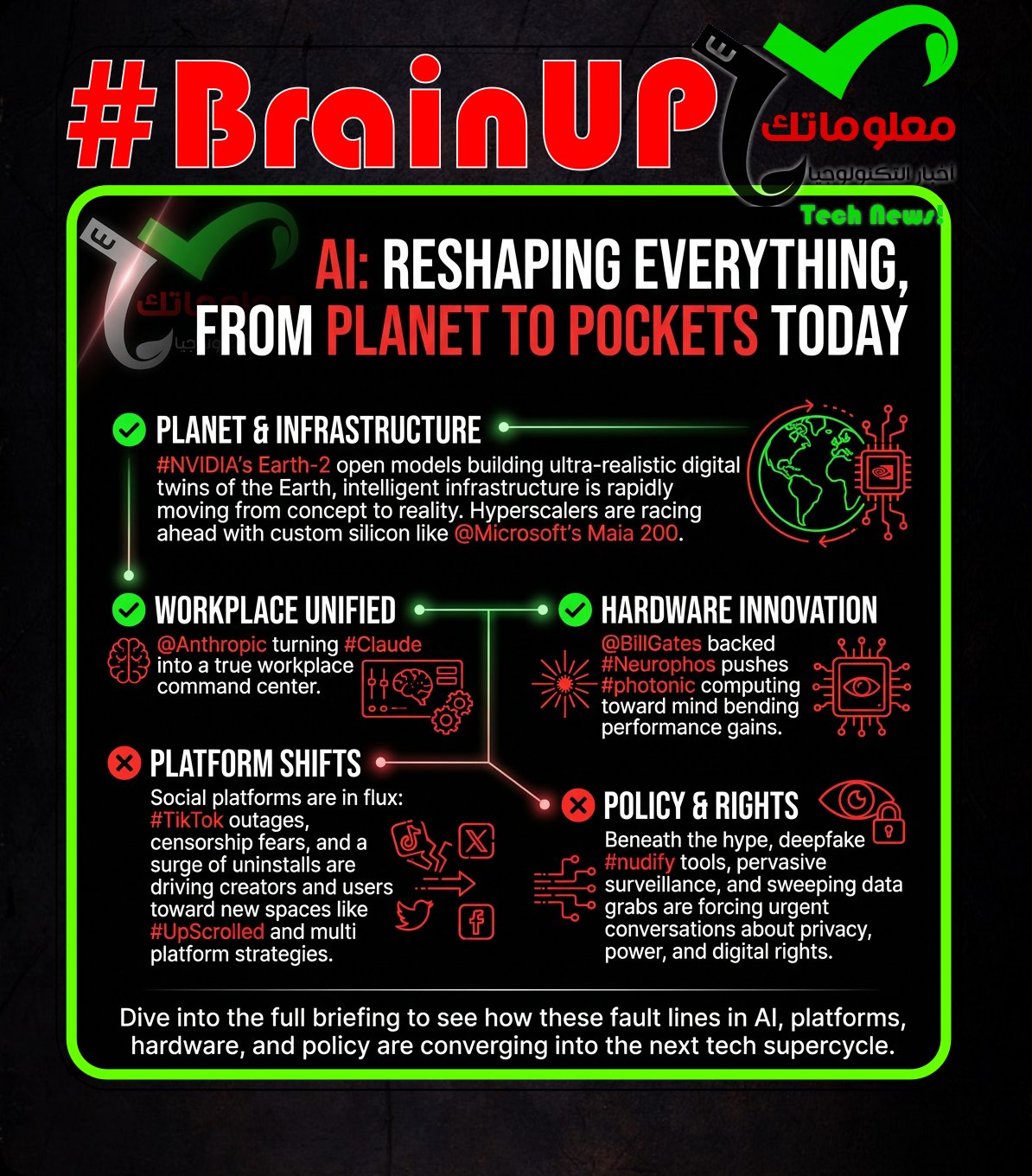
NVIDIA Earth-2 family of open, GPU-accelerated AI weather and climate models designed to make high-end forecasting technology widely accessible for scientists, developers and enterprises worldwide. The Earth-2 stack includes newly introduced open AI models such as Earth-2 Medium Range (using the Atlas architecture to generate 15-day forecasts across 70+ weather variables with high accuracy), Earth-2 Nowcasting (using StormScope to produce real-time local storm predictions up to six hours ahead), and Earth-2 Global Data Assimilation (using HealDA to rapidly convert raw observational data into precise atmospheric initial conditions) alongside existing tools like Earth-2 CorrDiff and Earth-2 FourCastNet3 that accelerate downscaling and global forecasting workflows. These models, available openly via NVIDIA Earth2Studio, Hugging Face and GitHub, dramatically reduce computational cost and time compared with traditional physics-based systems and are already being deployed by national meteorological agencies, energy firms and climate analytics companies to improve weather risk assessment, grid operation decisions and extreme event insights. Together with preprocessing, inference libraries and customization recipes, Earth-2 creates an open ecosystem for collaborative development of predictive weather intelligence on sovereign infrastructure.
2. Google pays $68M to settle claims its voice assistant spied on users | TechCrunch
Google will pay $68 million to settle a class-action case alleging its @Google voice assistant unlawfully intercepted and recorded users’ confidential communications without their consent and disclosed those recordings to third parties. The suit claimed information from these recordings was used for targeted advertising and other purposes. It centered on ‘false accepts,’ where the assistant allegedly activated and recorded conversations even when users had not spoken the wake word. Google did not admit wrongdoing as part of the settlement. The case fits into broader privacy scrutiny of voice assistants, following @Apple’s $95 million Siri settlement and Google’s $1.4 billion Texas privacy settlement, underscoring ongoing #privacy concerns #voice_assistant #advertising.
3. TikTok attributes recent glitches to a power outage at a US data center | TechCrunch
TikTok says the recent glitches were caused by a power outage at a U.S. data center, and it is working with its data center partner to restore services #dataCenter. The outages line up with the formal creation of a separate U.S. TikTok entity, the @USDS Joint Venture, a move mandated by the U.S. government over concerns that the Chinese government could access user data via @ByteDance; ByteDance owns under 20% of the JV, while @Oracle, @Silver Lake, and @MGX each hold 15%. Downdetector data shows the outage affected users across the country. Some users questioned the timing given the JV’s creation and ongoing events in Minneapolis, including ICE operations, but TikTok maintains the outages were due to the data center issue #surveillance. Privacy policy updates cited by TechCrunch are not new, having appeared before the ownership deal, underscoring ongoing concerns about data collection and surveillance on social platforms in unsettled times #privacyPolicy.
4. TikTok investigating why some users can’t write “Epstein” in messages
TikTok is investigating why some users can’t send the word Epstein in direct messages, a problem that has surfaced alongside massive outages and after the app’s sale to a mostly US investor group led by @LarryEllison’s Oracle. A TikTok spokesman said there are no rules against sharing Epstein in DMs and that the issue is under review, noting inconsistent results where some users can send the term while others cannot, with a prompt warning that the message may violate community guidelines. The company has faced widespread service disruptions tied to a data-center outage, affecting millions of users as the platform transitions under new leadership, while California Gov. @GavinNewsom has announced an inquiry into the matter. TikTok says none of its content moderation rules have changed, even as it updated privacy terms to collect precise location data, a move that has fueled broader discussions about censorship and data practices, including reaction under the hashtag #TikTokCensorship.
5. Newsom to review if TikTok is censoring Trump-critical content
California Governor @GavinNewsom has announced a review into whether #TikTok is censoring content critical of former President @realDonaldTrump. The inquiry responds to concerns raised by some users and officials about possible suppression of anti-Trump posts on the platform. This move reflects ongoing scrutiny of social media companies’ content moderation practices and their impact on political discourse. Newsom’s review aims to assess the fairness and transparency of TikTok’s algorithms in handling politically sensitive content. The outcome could influence regulatory approaches to tech companies and their handling of political expression.
6. TikTok Data Center Outage Triggers Trust Crisis for New US Owners
TikTok’s US outage coincided with transfer of control to majority-US investors, fueling concerns that the new owners could influence content and the platform’s #algorithm. Users reported trouble uploading and viewing content with lower engagement, and Downdetector tracked ongoing US outages; @SteveVladeck, a Georgetown professor, noted a video about DHS’s arguments for warrantless home entries remaining ‘under review’ for hours. US Senator @ChrisMurphy weighed in on Bluesky, while TikTok attributed the disruption to a power outage at a US data center and denied censorship, saying it is a technical issue and that new posts may take longer to publish due to the recommendation system. The company has formed the TikTok USDS Joint Venture to retrain, test, and update the content-recommendation algorithm on US user data, with Oracle owning 15% and hosting US user data; the outage heightens concerns about potential algorithmic influence as ownership transitions and regulatory compliance unfold.
7. TikTok moderation has pushed some news creators to the limit
This article examines how changes in #TikTok’s content moderation and recommendation systems are pushing news creators to their breaking point, with many reporting unpredictable takedowns, opaque enforcement and sharp drops in distribution that undermine their ability to reach audiences and earn income; established creators such as @Dylan Page of News Daddy describe situations where videos are removed or hit with strikes without clear explanations, forcing them to spend excessive time appealing decisions and adapt strategies just to maintain follower engagement. The piece highlights that cuts to human support staff and heavier reliance on automated moderation have amplified creator frustrations, leaving many without meaningful recourse or transparency, and that this volatility is feeding a broader trend of diversification away from TikTok toward platforms like YouTube and #Meta’s offerings for more stable monetization. Creators fear that TikTok’s evolving algorithm and the platform’s U.S.-centric ownership transition could bring even stricter moderation without the clarity or consistency needed for sustainable news production on short-form social feeds. The narrative underscores growing tension between platform governance, algorithmic unpredictability and the economic realities of independent news content creation.
8. TikTok users are deleting the app, with removals up 150% following U.S. joint venture
TikTok’s U.S. joint venture plan to keep the video app operating under American leadership has coincided with a spike in user departures, as the daily average of U.S. uninstalls rose about 150% in the past five days versus the prior three months. Some users expressed skepticism after being prompted to accept an updated #privacyPolicy, which outlines data categories including race, sexual life or orientation, citizenship or immigration status, and financial information. The policy language is not new, as an archived August 2024 version contains similar provisions, fueling concerns about censorship and how data is handled, a sentiment echoed by creators such as @Dre_Ronayne who deleted her account and shared criticisms on social media. Creators including @Nadya_Okamoto also reported posting issues and outages, with an X joint-venture account blaming a power outage at a U.S. data center and saying the service would be stabilized soon, illustrating how uncertainty around the venture and service interruptions are shaping user decisions.
9. Deepfake Nudify Technology Is Getting Darker and More Dangerous
Deepfake #nudify technology is rapidly advancing, enabling the creation of realistic fake nude images without consent, raising serious ethical and privacy concerns. Developers have released increasingly sophisticated tools that automatically strip clothing from images, amplifying risks of harassment and exploitation. @Wired highlights how these technologies exacerbate threats, particularly for women, by facilitating non-consensual pornography and harassment at scale. Experts warn that legal frameworks and platform policies currently lag behind these technological developments, complicating effective regulation and protection. The growing accessibility of such AI-driven tools demands urgent attention to safeguard individuals’ dignity and privacy.
10. iPhone 18 Pro: Leaker Reveals Alleged Size of Smaller Dynamic Island
Rumors peg the iPhone 18 Pro with a smaller #DynamicIsland, about 35% narrower than the iPhone 17 Pro and roughly 13.5mm wide when the screen is on and including surrounding black pixels. The claim comes from the leaker @IceUniverse, who shared a mockup showing the reduced width from 20.7mm. Live Activities can temporarily widen the area, and while earlier reports suggested under-screen Face ID, the latest word is that only the Face ID flood illuminator may move under the screen, leaving a pill-shaped cutout. Analyst @RossYoung says the smaller #DynamicIsland could persist through 2027, with Apple expected to unveil the iPhone 18 Pro models in September.
@Anthropic is turning @Claude into an interactive enterprise workspace by embedding popular business apps like @Slack, @Asana, @Figma, and @Amplitude, powered by its open-source #MCP ecosystem and the new #MCPApps extension of the #ModelContextProtocol, enabling teams to create projects, draft messages, and visualize data without leaving Claude. The rollout includes integrations with Amplitude, Asana, Box, Canva, Clay, Figma, Hex, Monday.com, and Slack, with #Salesforce coming soon, and pricing that bundles connectors into existing Claude plans rather than charging separately. Connectors require a paid Claude plan, but there is no extra charge for using connectors. Within Claude.ai, MCP Apps let an MCP server deliver an interactive UI, enabling granular control such as building analytics charts in Amplitude, turning conversations into Asana tasks with timelines, generating flowcharts in Figma’s FigJam, and drafting Slack messages with previews. Hex’s integration translates natural-language questions into interactive charts with charts, tables, and citations, effectively turning Claude into a #BI interface. Most major MCP clients, including @Claude, provide consent prompts to help users avoid unreviewed actions.
12. Cursor is better at marketing than coding
As @Steven J. Vaughan-Nichols argues, Cursor’s boast of building a browser with GPT-5.2 in Cursor is a marketing overreach, not a functioning browser. Independent developers who cloned the repo found it barely compiles, often does not run, and builds fail on GitHub Actions, despite the hype. Even the claim of 3M+ lines of code sits beside the reality that the effort consumed 10-20 trillion tokens and would have cost millions, with the rendering relying on #Servo and #QuickJS rather than a truly from-scratch engine. Critics such as @Gregory Terzian, a Servo maintainer, describe the code as a tangled mess that could not be turned into a working browser. The piece suggests that shipping software with AI remains extremely challenging and that headlines should be weighed against verifiable, ship-ready results #AI #Cursor.
13. China hacked Downing Street phones for years
China conducted a prolonged cyber-espionage campaign targeting the phones at #DowningStreet, infiltrating sensitive communications over multiple years. Intelligence reports revealed that the hacking operations aimed to monitor UK government discussions and policy decisions. This breach highlights the sophisticated nature of state-sponsored cyber threats and the ongoing risk posed by Chinese intelligence activities against Western institutions. The UK government has since intensified its cybersecurity measures to counteract such intrusions. The incident underscores the strategic importance of protecting government communications from foreign espionage in the digital age.
14. Meta CTO: Metaverse efforts led to a lack of focus on Quest
Meta’s CTO Andrew Bosworth admitted that the company’s push into the #metaverse caused Meta to lose focus on its established #Quest VR headset product line. Bosworth explained that while Meta was innovating in immersive digital worlds, the Quest platform experienced less attention and slower development progress. This shift in resources and priorities impacted user experience and product updates, raising concerns among Quest users about the company’s commitment. However, Bosworth also emphasized that Meta remains dedicated to VR and will balance metaverse ambitions with improving existing hardware. This realignment seeks to ensure Quest’s future growth while advancing immersive technology goals.
15. Amino acids fuel graphene for advanced biomedical applications
Researchers have discovered that amino acids can significantly enhance the energy storage capabilities of graphene, a material known for its exceptional electrical and mechanical properties. By integrating amino acids with graphene, the team created a biocompatible hybrid that boosts the material’s performance in biomedical devices. This approach leverages the natural chemical functionalities of amino acids to improve graphene’s conductivity and stability, making it suitable for sensitive bioelectronic applications. The development opens new avenues for designing advanced implantable devices that require reliable and efficient energy sources. Such innovations highlight the potential of combining biological molecules with nanomaterials to advance healthcare technologies.
16. Microsoft’s horrendous Patch Tuesday update exposes the weak QA process for Windows
Microsoft’s latest Patch Tuesday update revealed significant quality assurance weaknesses in Windows, leading to severe system issues for users. Numerous complaints surfaced about crashes, freezes, and performance degradation following the update, highlighting the failure in testing protocols. This suggests Microsoft’s QA process lacks the rigor needed to catch critical bugs before release, negatively impacting user experience and trust. The situation underscores the need for Microsoft to overhaul its testing and validation methods to uphold #Windows reliability and protect its reputation. Continuous failures like this risk eroding confidence in Microsoft’s update mechanisms and emphasize the importance of robust #softwarequality assurance.
@Johnny Finn of CNU and colleagues report that Flock cameras in Hampton Roads are concentrated in majority-Black, high-poverty neighborhoods, aligning with long-standing patterns of overpolicing and raising disturbing implications. Of the 10 census tracts with the most cameras, eight are majority Black, and across Hampton Roads majority-Black tracts have four times as many cameras as majority-white ones, with highly segregated areas showing almost eight times their population share in camera presence. In Norfolk, the highest concentrations cluster around Norfolk State University and in redlined neighborhoods like Huntersville and Berkley. The study notes that ALPR cameras snap photos of passing cars, collecting license plates and car details stored in searchable databases used by law enforcement, and that the locations of these cameras are not usually shared publicly, though 614 Flock camera locations were unsealed last November. While the researchers do not attribute intent to the agencies, they say surveillance can become the default for residents of Black communities, highlighting privacy concerns and broader questions about a public-private surveillance state, #privacy, #overpolicing, #surveillance, #ALPR, and #racialsegregation.
19. Harmful cholesterol levels cut in half with one-time gene editing drug in early trial
A Phase 1 trial suggests a one-time CRISPR-based gene-editing therapy could halve LDL cholesterol and triglycerides, potentially reducing lifetime heart-disease risk after a single dose. The treatment targets the ANGPTL3 gene in the liver, muting a pathway that normally preserves cholesterol by preventing its breakdown. In 15 participants, a single infusion lowered LDL cholesterol and triglycerides by about 50%, a result described as spectacular by @Steven Nissen. Because this would permanently alter a person’s genome, long-term safety remains unknown, and experts say more studies are needed before clinical use, noting that daily #statins are established and safer for now while #CRISPR and #ANGPTL3 therapies require careful assessment.
The Line, a 170-km Saudi megacity originally planned to house 9 million people, is reportedly being significantly downscaled under @Mohammed bin Salman and could be repurposed as an #AI data-center hub. FT sources say the project will be redesigned with a “totally different concept” that emphasizes industry and #AI data centers, while Neom says initiatives will be phased to align with national objectives and create long-term value. The pivot toward an AI data-center hub is underscored by @Nvidia supplying 18,000 AI GPUs for state-sponsored data centers in May 2025 and by talk of seawater cooling to support a major AI hub. The move comes amid liquidity pressures and a hot, dry climate that complicates data-center deployments, suggesting a path toward a more sustainable, value-driven project while preserving 95% of the site for nature.
@Bill Gates’ Gates Frontier Fund-backed Neurophos, an Austin-based #silicon photonics startup, says it has built an optical processing unit that it claims is about ten times more powerful than Nvidia’s Vera Rubin NVL72 AI system for FP4 / INT4 workloads while consuming a similar amount of power. The company attributes this to a on-chip 1,000 x 1,000 photonic matrix, which is about 15 times larger than the typical 256 x 256 AI GPU tile. It also claims an optical transistor roughly 10,000x smaller than current equivalents, addressing density constraints on a chip. The first-generation accelerator, called the Tulkas T100, has the optical equivalent of a single tensor core on a ~25 mm² die and would operate at 56 GHz, reportedly enabling it to beat Nvidia on paper despite a smaller reported core count. Neurophos says the transistors are built with existing semiconductor fabrication processes and could be mass-produced in fabs like Intel or TSMC, but volume production is not expected until 2028, and challenges include the need for massive vector units and SRAM. The shift toward #photonic computing is drawing industry attention, with Nvidia and AMD investing in related silicon photonics initiatives, making this a developing frontier with further progress anticipated as manufacturing and design challenges are addressed.
Maia 200 marks @Microsoft’s latest in-house AI accelerator, built on @TSMC’s 3nm process with 140 billion transistors and 216 GB of #HBM3e memory offering 7 TB/s of bandwidth for high-throughput AI inference. It can reach up to 10 petaflops of FP4 compute and is claimed to deliver ~30% better performance per dollar than Maia 100, while drawing a 750 W TDP, roughly half of @Nvidia’s Blackwell B300 Ultra. Microsoft also states Maia 200 is three times higher in FP4 performance than @Amazon’s Trainium3, signaling a strong hyperscaler advantage in FP4 workloads. The design emphasizes a memory hierarchy with 272 MB of on-die #SRAM partitioned into #CSRAM and #TSRAM to spread workloads across #HBM and SRAM and improve efficiency for FP4/FP8 workloads. Maia 200 has already been deployed in Microsoft’s US Central Azure data center, with future deployments planned, highlighting @Microsoft’s ongoing push into bespoke AI acceleration for hyperscale inference.
23. ICE Plans Influencer Push For Hiring – DevX
ICE is planning an aggressive recruitment push that leans on social media influencers and geo-targeted ads to hire thousands of deportation officers quickly #ICE #influencers #geo-targeted-ads #hiring. The approach is described in an internal document shared among immigration officials, signaling a fast-track hiring drive to expand enforcement capacity nationwide. Relying on digital influencers and targeted ads could accelerate intake timelines and raise questions about vetting, oversight, and due process. If implemented, the plan would mark a significant shift in ICE’s recruitment strategy across the country.
24. The Trump Administration wants your DNA and social media
@TrumpAdministration proposed expanding #CBP data collection so that visitors to the US must submit #socialMedia from the last five years, #email addresses from the last ten years (including family accounts), telephone numbers used in the last five years, and biometric data such as face, fingerprints, DNA, and iris scans, as a condition of entry. The changes would require all travellers to use a CBP #Home app and an #ESTA Mobile App, with the ESTA website being decommissioned, and would apply to those traveling without a visa. CBP would collect DNA, and the system would disclose the user’s location after leaving the US and perform liveness detection on selfie photos to help close the information gap. Analysts warn that the data would enable AI tools to summarize individuals’ lives and expand data access, creating a vast datastore given about 14 million ESTA travellers annually and an estimated 22 minutes to submit. @EdHasbrouck notes the DNA inclusion signals a troubling path, and the piece argues that companies and governments must push back now to prevent normalization of such mass data collection.
This press release outlines how the French government is scaling up “Visio,” a sovereign videoconferencing platform developed by the Direction Interministérielle du Numérique (DINUM), to become the single secure conferencing tool for all public servants across the state by 2027 as part of a broader push for digital sovereignty and reduced reliance on non-European tools such as Teams, Zoom, Webex or GoTo Meeting (@David Amiel announced this initiative during a visit to the CNRS I2BC lab with DINUM leadership). The rollout follows a successful one-year pilot with 40 000 regular users and ongoing deployment to 200 000 agents, with major administrations like the CNRS, Assurance Maladie, DGFiP and the Ministry of Armed Forces switching to Visio in early 2026; this unification aims to strengthen cybersecurity, cut strategic dependencies and simplify inter-ministerial cooperation while generating cost savings by eliminating external software licenses. Technically, Visio is hosted on a SecNumCloud-certified French infrastructure (Outscale), includes AI-based meeting transcription using French tech from #Pyannote and plans real-time subtitling via Kyutai by mid-2026, all underpinned by guidance from the French cybersecurity agency #ANSSI. The effort reflects a broader state commitment to reclaim digital independence, protect sensitive communications and foster sovereign tools tailored to the needs of the public sector.
26. TikTokers are heading to UpScrolled following US takeover
Following TikTok’s US takeover, users are flocking to UpScrolled, a platform that promises impartiality and open expression. The app is available on Android and iOS and recently ranked around #12 in the Apple App Store, while its servers struggled to handle a flood of new users. Appfigures data shows about 41,000 downloads from Thursday to Saturday, with an average of 14,000 per day, roughly 29 times the pre-takeover level. High-profile users, including @TaylorLorenz, say they are switching to UpScrolled amid concerns about censorship tied to Oracle and investors’ control of TikTok’s US operations. UpScrolled, founded in 2025 by Issam Hijazi, aims to avoid shadowbans and keep content visible and is pitched as an alternative during policy debates in social networks #openexpression #censorship #impartial.
27. After 5 years, AirTag 2 Arrives With Improved Range and Louder Speaker
The second-gen AirTag 2 refreshes Apple’s item tracker with a second-gen #UltraWideband chip delivering up to 50% farther range, plus improved #Bluetooth and a louder speaker. Precision Finding now works with @AppleWatch Series 9 and @AppleWatch Ultra 2, providing visual, audio, and haptic guidance to the item. The new speaker is 50% louder and can be heard up to 2x farther, with a distinctive new chime, while the AirTag otherwise keeps the same design and uses a CR2032 battery for about one year. Apple highlights protections against unwanted tracking, including cross-platform alerts and changing Bluetooth identifiers, and expands location sharing via #ShareItemLocation with airlines—15 more airlines bringing total to over 50—for faster luggage recovery, supported by SITA data on reduced delays and losses; pricing remains $29 for one or $99 for four, with availability starting today.
That’s all for today’s digest for 2026/01/27! We picked, and processed 26 Articles. Stay tuned for tomorrow’s collection of insights and discoveries.
Thanks, Patricia Zougheib and Dr Badawi, for curating the links
See you in the next one! 🚀
