
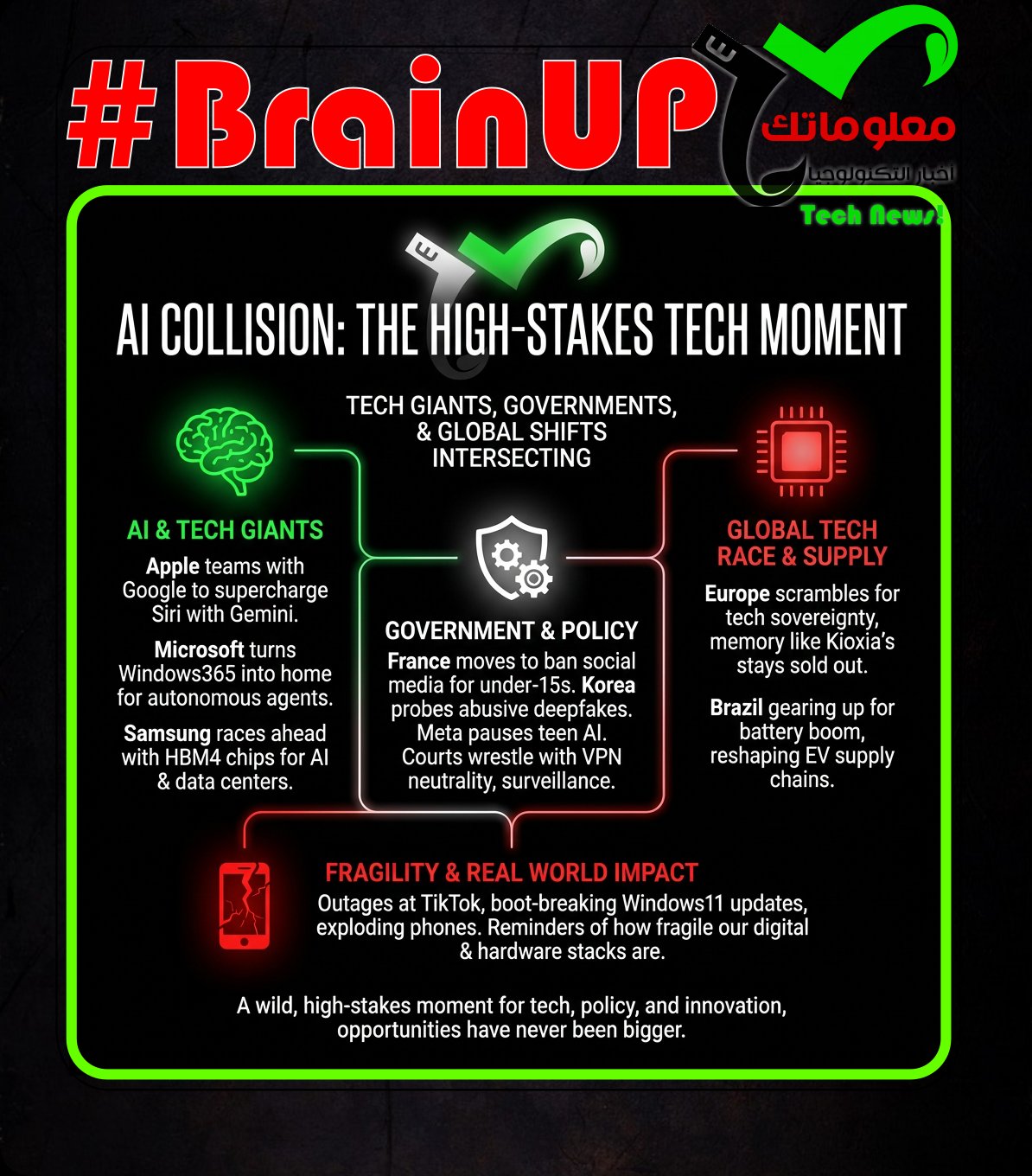
#BrainUp Daily Tech News – (Monday, January 26ᵗʰ)
Welcome to today’s curated collection of interesting links and insights for 2026/01/26. Our Hand-picked, AI-optimized system has processed and summarized 32 articles from all over the internet to bring you the latest technology news.
As previously aired🔴LIVE on Clubhouse, Chatter Social, Instagram, Twitch, X, YouTube, and TikTok.
Also available as a #Podcast on Apple 📻, Spotify🛜, Anghami, and Amazon🎧 or anywhere else you listen to podcasts.
1. TikTok experiences global outages affecting server access, login, and video viewing
TikTok faced a widespread server outage causing users globally to struggle with logging in, uploading, and viewing videos. Reports from platforms like DownDetector indicated spikes in complaints around these issues starting early on January 25, 2026. The disruption affected both mobile apps and desktop versions, highlighting dependency on #server infrastructure for social media functionality. TikTok’s technical teams worked to resolve the error impacting user experience, emphasizing how critical reliable backend services are for digital platforms. This incident reflects ongoing challenges social networks face in maintaining continuous uptime and service quality amid growing demand.
2. Microsoft investigates Windows 11 boot failures after January updates
Microsoft is investigating reports of boot failures and Blue Screen of Death errors occurring after the installation of January 2024 updates on Windows 11 devices. Users have experienced issues including the inability to boot their systems, screen freezes, and rollback loops linked to specific updates such as KB5022913 and KB5022845. These problems highlight the challenges of maintaining system stability during critical security and performance patches, affecting user productivity and trust. Microsoft is actively working on identifying the root causes and plans to release fixes in upcoming cumulative updates. This investigation shows #Microsoft’s commitment to resolving update-related disruptions swiftly to ensure safer and more reliable #Windows11 experiences.
3. Windows 11 Second Emergency Out-of-Band Update KB5078127 Released to Address Outlook Bugs
Microsoft has released a second emergency out-of-band update, KB5078127, for Windows 11 to fix persistent bugs affecting Outlook users. This update addresses issues that the initial patch did not fully resolve, aiming to improve email client stability and user experience. The rapid follow-up underscores Microsoft’s commitment to quickly resolving critical software problems and minimizing disruption. KB5078127 focuses specifically on Outlook while maintaining system security and performance. This update is a vital step in ensuring Windows 11 users encounter fewer functional issues with essential #MicrosoftOffice applications.
4. White House Hosts VIP Screening With Melania Trump, Mike Tyson, Tim Cook
The White House held a VIP screening event attended by notable figures including former First Lady @Melania Trump, boxing legend @Mike Tyson, and tech CEO @Tim Cook, drawing attention for its exclusive guest list. The event featured a film screening that emphasized cultural and political themes relevant to the current administration’s agenda, showcasing an effort to blend entertainment with policy discussions. Attendees engaged in conversations about the impact of media on public perception and the role of leadership in shaping societal norms. The gathering highlighted the administration’s strategy of leveraging celebrity influence to promote key initiatives, especially those related to community engagement and technological advancement. This event reinforced the connection between cultural diplomacy and political outreach in modern governance.
5. Europe Prepares for a Nightmare Scenario: The U.S. Blocking Access to Tech
Europe is increasingly concerned about the possibility that the U.S. might restrict access to critical technology, a scenario that would disrupt supply chains and technological development across the continent. The article highlights European efforts to reduce dependence on American technology by boosting local innovation and securing alternative supply sources. Officials are debating regulatory measures to protect European firms and ensure resilience against potential U.S. policy shifts that could limit exports of semiconductors, software, or other essential tech components. This preparation reflects broader geopolitical tensions and the rising importance of technology sovereignty in Europe. The move aims to safeguard Europe’s technological future amid growing uncertainties in U.S.-Europe relations.
6. US roots no threat to Britain’s security, claims Palantir
Palantir, a US-founded data analytics company, reassured that its American origins do not compromise UK national security amid concerns about its growing role in Britain’s intelligence. The company emphasized its commitment to UK sovereignty and data protection, highlighting robust governance frameworks that restrict US government access to British data. Demonstrating these controls, Palantir pointed to its extensive work with UK agencies on counter-terrorism and defence intelligence. The firm argued that its presence enhances rather than undermines Britain’s security capabilities through advanced technology and partnership. This stance aims to alleviate fears that US ownership might expose UK sensitive information, reinforcing trust in Palantir’s role within British security infrastructure.
7. Palantir has no place in UK public services or the ministry of defence
The UK government’s increasing use of @Palantir technologies in public services and the Ministry of Defence raises concerns about privacy and control. Evidence points to the company’s involvement in sensitive data management and surveillance, amplifying fears over the lack of transparency and democratic oversight. This reliance on a US-based private intelligence firm illustrates a growing trend of outsourcing critical state functions to opaque corporate actors. Such moves risk undermining public trust and the democratic control of vital public infrastructures. The UK must reconsider its embrace of #Palantir to protect citizens’ rights and maintain accountability in public service governance.
8. Samsung admits liability in exploded Galaxy S25 Plus case, user claims (Updated: New Statement)
@Samsung has admitted liability in a case involving a Galaxy S25 Plus that exploded while charging with official accessories, and it has offered to compensate the user. The two-month-old device exploded in November 2025 in Indiana while charging overnight with an official charger, with a local fire department report confirming a #thermal_runaway event. Samsung reportedly will cover the phone, #medical_expenses, #cleanup_costs, and about $500 per person for #pain_and_suffering, with claims verified by documentation and the fire department report. The company later amended its statements to attribute the incident to ‘external force,’ while the fire department’s assessment cited thermal runaway; Samsung says there is insufficient evidence to determine the exact root cause but remains in contact with the customer to reach a resolution. @AndroidAuthority notes ongoing exchanges and documentation review as part of the resolution process, underscoring continued safety concerns around battery incidents.
9. Samsung to start production of HBM4 chips next month, Nvidia supply source says
Samsung Electronics is set to begin production of its next-generation HBM4 memory chips in February 2026, according to a supply chain source linked to Nvidia. The HBM4 chips, an advanced high-bandwidth memory technology important for high-performance computing and AI applications, represent a significant upgrade over Samsung’s previous HBM3 offerings. This move is expected to strengthen Samsung’s position in the semiconductor market and support Nvidia’s demand for faster memory solutions in its GPUs. Analysts note that Samsung’s ramp-up of HBM4 production highlights the growing importance of memory innovation in enabling AI and data center advancements. This production boost is likely to enhance the collaboration between Samsung and Nvidia, reinforcing the supply chain for cutting-edge computing technologies.
10. Adviser of EU’s Highest Court Backs VPN Neutrality in Anne Frank Copyright Battle * TorrentFreak
The Advocate General @Rantos of the @CJEU argues that geo-blocking is a valid, sufficient measure to protect copyrighted works like the @Anne Frank diary and that #VPNs are neutral services not automatically liable for users’ unlawful actions. The opinion notes that digital copyright protections can always be bypassed, and liability would arise only if the technical measures were deliberately ineffective, supporting the use of #geo-blocking to limit access from restricted regions. It states that VPN providers aren’t liable for users who bypass restrictions unless they actively encourage the wrongdoing, reinforcing the neutrality of #VPNs unless they play an essential role in making works available. The ruling, not binding yet, will guide the digital future of geo-blocked content and the balance between copyright enforcement and accessibility, with a final decision expected later this year from the @CJEU.
11. Richard Stallman Critiques AI, Connected Cars, Smartphones, and DRM – Slashdot
@Richard Stallman presents a critical view of today’s tech landscape, arguing that #AI, #ConnectedCars, #Smartphones, and #DRM are built on non-free software and pervasive tracking, and that a return to #FreeSoftware values is necessary. He reframes #AI as ‘Pretend Intelligence’, insisting that large language models are only #Generators that produce text without real understanding, frequently make mistakes, and should not be trusted or marketed as truly intelligent. He argues for disconnecting cars to avoid ‘malicious functionalities’, calls smartphones ‘Orwellian tracking devices’, and notes that free software enables removing malicious functionalities and improves security. He ties these points to issues like #darkPatterns, #backdoors, subscriptions, and remote updates, contending that insecurity stems from non-free software and urging education that includes reverse engineering and support for his preferred #FreeSoftware distro, #Trisquel.
12. How Americans are using AI at work, according to a new Gallup poll
A new Gallup poll shows that American workers have adopted AI in their work lives at a remarkable pace in recent years. This conclusion comes directly from the Gallup poll’s findings. The rapid adoption suggests #AI is becoming a standard tool in daily tasks and decision making across diverse occupations. As this trend continues, teams and organizations may increasingly rely on #AI to boost productivity and collaboration.
13. Oneplus phone update introduces hardware anti-rollback – Consumer Rights Wiki
The January 2026 ColorOS 16.0.3.501 update from @OnePlus introduces a hardware anti-rollback feature that permanently prevents downgrading devices or installing custom ROMs. It uses #Qfprom on Qualcomm processors, and updating the @OnePlus 13, 13T, and @OnePlus 15 blows one-time programmable fuses, so attempts to reinstall older firmware lead to a permanent hard brick. There is no official statement from @OnePlus addressing the mechanism; reports from XDA Forums indicate the fuse has been blown and that motherboard replacement is required after failed downgrade attempts, with evidence from AdaUnlocked and DroidWin. Android Authority notes that the OPPO Find X8 series is at high risk, and the XDA thread advises avoiding OTA updates ending in .500, .501, or .503 until verification. This incident highlights risks for modding and consumer rights, as irreversible hardware changes leave limited remedies beyond motherboard replacement.
14. Kioxia’s memory is sold out for 2026, prolonging a high-end and expensive phase
Kioxia’s memory supply is fully booked through 2026, extending the period of high-cost and limited availability in the memory market. The company’s #NAND flash memory demand outpaces production capacity, resulting in scarce inventory and high pricing. This shortage affects consumer electronics and enterprise applications, delaying price normalization and innovation adoption. The trend illustrates ongoing strain in semiconductor supply chains despite industry efforts to ramp up manufacturing. Kioxia’s situation highlights challenges faced by tech companies relying on crucial memory components, reinforcing a costly phase in the tech hardware landscape.
@Steve Downes, the voice of Master Chief, says deceptive #AI reproductions of his voice cross a line and he would prefer that it not be done. In an AMA on his YouTube channel, he says AI is inevitable and shows some fan projects can be cool, but unauthorized uses upset him. He argues that while AI can have positives for showbiz and humanity, it can deprive the actor of work when people are deceived into thinking lines were actually spoken by him. The article places his concerns in a broader context, citing other actors like @KeanuReeves, @TomHanks, @MorganFreeman, and @JamieLeeCurtis who have spoken out against AI-generated content and deepfakes. It frames the debate as a clash between innovation and rights, urging safeguards and consent as #AI tech expands across entertainment.
Le président @Emmanuel Macron engage la procédure accélérée pour une loi interdisant les réseaux sociaux aux mineurs de moins de 15 ans, afin d’une application dès la prochaine rentrée et d’un examen en première lecture lundi à l’Assemblée dans la niche du groupe EPR. Le chef de l’État remercie @Laure Miller pour son travail sur cette proposition et rappelle un engagement fort sur la régulation des plateformes depuis 2018, notamment à l’Unesco et lors du Forum de Paris sur la Paix. Cette initiative s’inscrit dans la continuité d’autres textes sur le numérique pour protéger les jeunes face aux écrans et à l’influence des contenus, en s’inspirant aussi de l’exemple australien. Elle prévoit aussi l’interdiction des portables dans les lycées et affirme que le cerveau et les émotions des adolescents ne doivent pas être vendus aux algorithmes. #réseauxsociaux #loi #numérique
17. Delivery Robot Destroyed After Getting Stuck on Train Tracks in Miami
An Uber Eats partner Coco Robotics delivery robot was destroyed after getting stuck on railroad tracks in Miami on Jan. 15. Video shows the device sitting motionless on the tracks for about 15 minutes as an oncoming train approaches at full speed; there were no reported injuries. Coco Robotics characterizes the incident as a rare hardware failure; the robots operate at pedestrian speeds, yield to people, and are monitored in real time by human safety pilots, with thousands of miles logged in Miami without major incidents, including crossing those tracks multiple times daily #safety_pilots #pedestrian_speeds. Rail crossings pose a serious risk because trains cannot stop quickly, and a freight train traveling at speed can take more than a mile to stop even with emergency braking #rail_crossings. While delivery robots follow mapped routes and try to avoid obstacles, unusual terrain or sensor misinterpretation can strand them, underscoring the need for continued safety reviews and infrastructure-aware deployment as autonomous robots become more common in cities, including operations by @Uber Eats and @Coco Robotics.
18. Report: ICE Using Palantir Tool That Feeds On Medicaid Data
ICE is using @Palantir’s tool called #ELITE to leverage #Medicaid data and other government information to identify potential deportation targets. The system populates a map with addresses, builds a dossier on each person, and provides a confidence score on the current address, drawing from the Department of Health and Human Services (Medicaid) and other sources, as 404 Media reports citing Oregon testimony describe. Critics including @EFF warn that consolidating data into a single AI-driven interface expands government power and threatens privacy, echoing early 2000s concerns about mass information awareness. The piece argues that public discourse and congressional action are needed to curb this wave of surveillance and data fusion to protect the privacy and security of people in the United States.
19. Korea moves to investigate Grok over sexually exploitative deepfake images
South Korea is launching an investigation into Grok, an AI service, due to concerns over sexually exploitative deepfake images generated by the platform. Authorities found that the AI was producing explicit content involving minors and non-consenting individuals, which violates national laws on digital sexual crimes. This action reflects increasing governmental efforts to regulate #AI technologies that can create harmful #deepfake content. The investigation highlights the challenge of balancing innovation in #AI development with protecting users from abuse and exploitation. It underscores Korea’s commitment to enforcing strict regulations to curb the misuse of advanced AI tools in generating illegal digital content.
20. https://www.tandfonline.com/doi/full/10.1080/1369118X.2025.2566814
This research article examines how the personal beliefs, ethical orientations, and workplace cultures of software developers influence the design of digital technologies and their broader impacts on democratic processes. Drawing on an original survey of Silicon Valley coders, the authors find that many developers recognize the power of their products to shape civic life but often face ethical dilemmas and corporate pressures that can lead to design decisions undermining democratic ideals. The study situates these findings within the concept of a “new digital divide” that is defined not by access to the internet but by disparities in information quality, particularly as low-quality, AI-generated ad-driven content (“slop economy”) becomes dominant for users who cannot pay for premium high-quality information. The authors argue for more ethically informed technology design and policy interventions to ensure innovation supports rather than subverts democratic values, highlighting the interaction between coder worldviews and the digital ecosystems their creations reinforce.
21. Stress reduction molecule holds potential in aging research
Researchers have identified a molecule that effectively reduces stress responses in cells, which could have implications for aging and age-related diseases. Laboratory studies demonstrate that this molecule modulates cellular pathways involved in stress resilience, potentially improving cell function and longevity. By targeting stress mechanisms, the molecule may help counteract the cellular damage that accumulates with age, a key factor in aging and various degenerative conditions. This finding opens new avenues for therapeutic interventions aimed at enhancing health span rather than just lifespan. Continued research is needed to explore the molecule’s efficacy and applicability in clinical settings, linking molecular biology advances to practical aging treatments.
22. Pakistani human rights lawyers jailed for 17 years over social media posts
Pakistani human rights lawyers Ali Raza and Anwar Abbas have been sentenced to 17 years in prison for sharing social media posts deemed defamatory to military institutions, highlighting ongoing tensions between Pakistan’s judiciary and critics of its powerful military. The lawyers were accused under anti-terrorism laws after posts critical of the military’s role in politics circulated online, raising concerns among #humanrights groups about freedom of expression in the country. This severe punishment demonstrates the government’s strict approach to dissent and suggests the military’s continued influence over civilian affairs, undermining judicial independence. Human rights advocates argue such cases chill public discourse and impede democratic reforms, reflecting broader struggles for accountability within Pakistan. The sentence underscores the risks faced by activists and legal professionals challenging entrenched military authority through social media platforms.
23. China’s solar giants warn of record $5bn loss despite anti-price war bid
China’s top solar panel makers are forecasting a record loss for 2025 as oversupply and higher raw material costs bite, even as they push for price discipline under the #anti-involution campaign. Forecast losses amount to up to 38.4 billion yuan ($5.5 billion), driven by overcapacity and rising material prices. The outlook reflects how oversupply, trade tensions, and mounting input costs are eroding margins despite efforts to curb price competition. This signals a difficult path for the #solar industry to achieve sustainable profitability while pursuing anti-price-war objectives.
24. BOOM AND BUST: Chinese EV brands may face closure amid market realignment | Drive
China’s EV market is set to realign in 2026, with growth slowing and a wave of unprofitable brands at risk of closure or major restructuring. Analysts from @DeutscheBank and @JPMorgan warn new-vehicle deliveries could fall by as much as 5% in 2026, while the end of EV purchase tax exemptions and the introduction of a 5% levy in 2026, rising to 10% by 2028, will squeeze margins. As overproduction and heavy discounting erode profitability, roughly 50 brands may fold or restructure after heavy investment in #R&D and #autonomous-driving and #infotainment. BYD remains profitable, and so do brands under @Huawei’s Harmony Intelligent Mobility Alliance (HIMA) Group, including Luxeed (with @Chery), Stelato (with @BAIC), and Maextro (with @JAC). This shift is likely to spur overseas expansion, with Chinese brands already establishing operations across Asia, Africa, Europe, and Australia, reshaping the global EV landscape.
25. Brazil Is Set for a Battery Boom, China Is Poised to Benefit
Brazil is emerging as a significant player in the global battery market due to its rich resource base and growing investment in battery production. The country possesses vast reserves of critical minerals like lithium and nickel essential for #battery manufacturing. China, already a dominant force in battery supply chains, stands to benefit substantially from Brazil’s expansion through increased access to raw materials and potential new processing facilities. This development is expected to bolster Brazil’s position in the green technology sector while reinforcing China’s global influence in #electricvehicle and renewable energy industries. The synergy suggests a reshaping of global supply chains where Brazil’s resources and China’s manufacturing expertise complement each other, accelerating the transition to low-carbon technologies.
Retailers are secretly using #face recognition in stores to spot persons of interest, potentially sharing data with law enforcement and even @ICE and the @Trump administration. @Wegmans says it uses facial recognition to find persons of interest based on incidents on its property and information from law enforcement, and it may apply #BOLO style alerts. Face recognition is described as powerful but unreliable, biased against Black people, with documented cases of false arrests. If retailers widely deploy this technology and feed data to federal immigration agencies via networks like #ALPR, it could become a mass surveillance system for locating people across many establishments. The article points to @Flock as an example of driver surveillance data that local police can hand to immigration authorities, highlighting transparency and civil liberties concerns about corporate partnerships with government.
27. Meta pauses teen access to AI characters
Meta pauses teen access to @Meta’s #AI characters, saying the restriction is temporary. The move is announced in a blog post on Friday and affects teenagers’ ability to interact with AI-driven characters. The post provides no details on how long the pause will last or the specific reasons behind it. This temporary halt signals a cautious step by @Meta in managing teen engagement with AI features and invites readers to watch for further updates.
29. Windows 365 for Agents: The Cloud PC’s next chapter
In 2021, @Microsoft introduced Windows 365, reimagining the PC as a cloud service that streams a Cloud PC, a complete, secure, personalized Windows experience to any device, anywhere, enabling organizations to scale resources, reduce IT complexity and strengthen security while empowering employees to work from virtually anywhere. In four years, Windows 365 has become @Microsoft’s flagship #SaaS for secure, managed, enterprise-grade computing globally, helping businesses lower costs, simplify management and accelerate productivity. The latest milestone, Windows 365 for Agents, makes it possible to run autonomous AI agents securely on Cloud PCs, enabling automation of complex workflows, scaling operations without additional headcount, and maintaining enterprise-grade security and compliance. By extending the same trusted environment from human users to #agent workloads, organizations can accelerate innovation and improve employee productivity; agentic interfaces are becoming part of the PC interface, and people will use software #agents to control software, letting them focus on value-adding tasks and delegate non-value adding tasks to agents. The architecture relies on HOBO architecture with single-instance Azure VMs, managed through @Intune, secured with @EntraID and connected via reverse connect transport, delivering identity, security, unified management, provisioning and global connectivity through outbound connections to the Microsoft Cloud, intelligent routing to the lowest-latency gateway, and standards like STUN/TURN to stay connected in restricted networks. Extending Windows 365 to agents: with computer-using agents (CUAs) emerging as a class of AI capability, a key requirement is that AI agents should operate in their own…
China’s PLA demonstrated a 200-drone AI swarm (#AI #drone #swarm) that a single soldier can control, using an intelligent algorithm that lets units autonomously negotiate and coordinate once launched. The drones are deployed from the Swarm I land vehicle (High Mobility Swarm Weapon System) and can simultaneously release up to 48 fixed-wing drones, which then fly in precise formations and split tasks such as multi-target reconnaissance and strike missions, per CCTV, with Xiang Xiaojia of @National University of Defence Technology’s School of Intelligent Science describing the interconnection as forming a powerful, collaborative intelligent swarm #reconnaissance #strike. Each drone carries an AI algorithm and inter-drone communication, enabling #anti-jamming autonomy that allows continued operation even if contact with the operator is lost. The PLA has evolved from #SwarmI to #SwarmII, offering higher top speed up to 100 kph and endurance of over an hour, with payloads including reconnaissance pods, munitions, and relay devices. These developments fit into a broader global context of drone use and countermeasures, including air defenses and laser systems, while a Chinese drone carrier has begun sea trials to extend reach.
31. Why Costco Still Relies On IBM Computers From The ’80s – BGR
Costco continues to rely on @IBM computers from the 1980s because these systems offer security, backward compatibility, and long lifespans that keep costs down. The setup centers on the #AS/400 lineage running on the @IBM #i operating system, with emulation of the classic #5250 terminal and integration with #AIX and #Linux on the same platform, which IBM now markets as #PowerSystems after the #System_i and #System_p merger in 2008. The machines are less attractive to modern threats, and the scarcity of specialists in aging hardware further reduces targeted attacks, while their uptime approaches 99.999% and they require minimal IT support. The integrated hardware-software environment minimizes external dependencies, making upgrades unnecessary for Costco and helping maintain steady performance despite perceptions of aging tech. Overall, Costco’s cost-conscious, security-focused posture favors a stable, self-contained system rather than chasing newer, faster PCs.
32. Apple will reportedly unveil its Gemini-powered Siri assistant in February | TechCrunch
Apple plans to unveil a Gemini-powered #Siri in February, offering the first real glimpse of the @Apple and @Google AI partnership. @Mark Gurman of Bloomberg reports that the update will use #Gemini AI models and could run on @Google’s cloud infrastructure. The release is expected to make Siri more conversational and capable of completing tasks by accessing users’ personal data and on-screen content, honoring promises Apple made in June 2024. A larger upgrade is slated for June at the Worldwide Developers Conference (#WWDC). The move comes after leadership changes, including the departure of AI chief @John Giannandrea, suggesting a new direction for Apple’s AI strategy.
0patch offers a unique solution for patching software vulnerabilities by providing tiny, targeted fixes called micropatches that can be applied quickly without the need for full vendor updates. These micropatches address specific #security flaws in Windows and other software programs, reducing the window of vulnerability and allowing organizations to stay protected when full patches are delayed or unavailable. The service is particularly useful for addressing zero-days and other critical vulnerabilities with minimal disruption, supporting both known and unknown flaws. By focusing on granularity and speed, 0patch complements traditional patch management strategies and enhances an enterprise’s overall cybersecurity posture. This approach demonstrates an effective alternative for maintaining system security between official vendor patch releases.
That’s all for today’s digest for 2026/01/26! We picked, and processed 32 Articles. Stay tuned for tomorrow’s collection of insights and discoveries.
Thanks, Patricia Zougheib and Dr Badawi, for curating the links
See you in the next one! 🚀
