
#BrainUp Daily Tech News – (Sunday, January 25ᵗʰ)
Welcome to today’s curated collection of interesting links and insights for 2026/01/25. Our Hand-picked, AI-optimized system has processed and summarized 22 articles from all over the internet to bring you the latest technology news.
As previously aired🔴LIVE on Clubhouse, Chatter Social, Instagram, Twitch, X, YouTube, and TikTok.
Also available as a #Podcast on Apple 📻, Spotify🛜, Anghami, and Amazon🎧 or anywhere else you listen to podcasts.
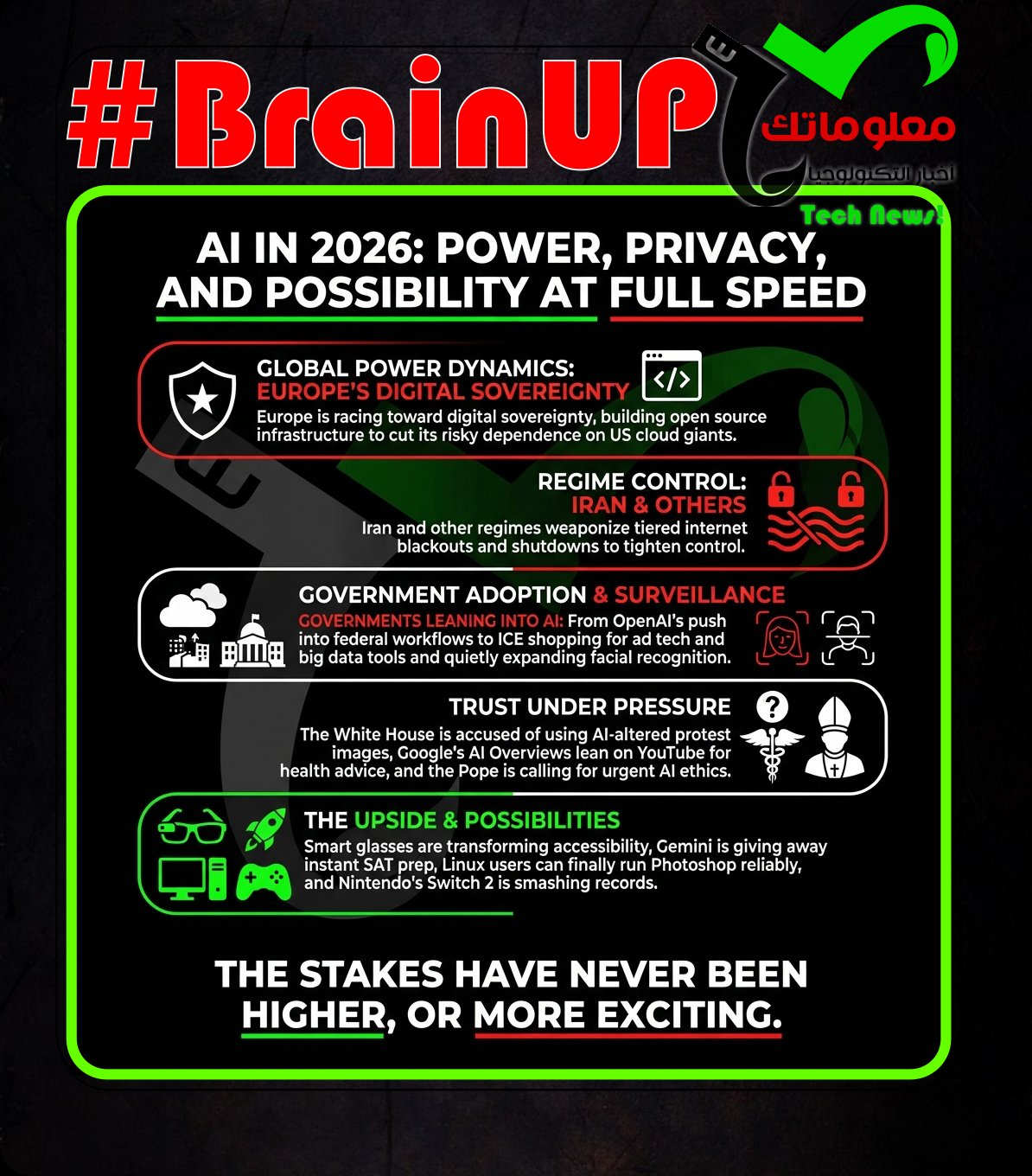
1. Europe wants to end its dangerous reliance on US internet technology
Europe is pursuing greater digital sovereignty to end its dangerous reliance on US internet technology and strengthen its tech capacity and security. With about 70% of Europe’s cloud market held by US-headquartered providers such as AWS, Microsoft Azure, and Google Cloud, while European providers hold roughly 15%, experts warn that dependence creates vulnerability to outages and geopolitical pressure. Recent incidents—an hours-long AWS outage in October 2025, a Cloudflare disruption two months later that knocked LinkedIn, Zoom and other platforms offline, and a major power outage across parts of Spain, Portugal and SW France in April 2025—illustrate this exposure. In Helsingborg, Sweden, a one-year pilot tests how public services would fare in a digital blackout, assessing risks in areas like medical prescriptions and social care to build a crisis-preparedness model for other municipalities. Across Europe, moves toward open source collaboration and digital sovereignty aim to reduce reliance on global tech giants, echoing @Ursula von der Leyen’s call for a structural imperative to build a new form of independence and aligning with #digital_sovereignty and #open_source as digital public goods.
2. Microsoft Starts Sharing Your Location With Your Employer
Microsoft plans to add a feature to @Microsoft Teams that automatically sets a user’s work location when they connect to their organization’s Wi-Fi, revealing to employers which building they are in. If users are off the organization’s network, the location shows as not at work; the rollout has been delayed to March and will be fully deployed by mid-month, with the feature opt-in and off by default, and tenant admins deciding whether to enable it. Guardrails promise end-user control, such as not updating location after work hours and clearing it at the end of the workday, but critics warn that mandatory deployments or IT-enforced policies could erase opt-out options. The debate centers on #locationTracking, #privacy, and #hybridWork, with observers noting it could signal an intensification of workplace surveillance or tie into a broader #returnToOffice push. Proponents argue it reduces manual updates and simplifies policy enforcement, but the backlash highlights the tension between trust in hybrid setups and tooling.
3. Pope Leo warns about AI chatbots
Pope Leo has issued a warning about the potential dangers of AI chatbots, emphasizing ethical concerns and the risk of misinformation. He highlighted the increasing reliance on #ArtificialIntelligence in communication, urging developers to implement safety measures that preserve human dignity. The Pope’s statement underlines the need for global cooperation to regulate AI technologies in a way that benefits society without compromising moral values. This cautionary approach by a major religious leader reflects wider debates on the responsible development and use of #AIChatbots. The call to action aims to balance technological progress with ethical considerations to protect individuals and communities.
4. OpenAI Partners with Major Government Contractor to ‘Transform Federal Operations’
OpenAI and @Leidos have partnered to deploy @OpenAI’s AI across federal workflows to boost the efficiency and effectiveness of government agencies. The agreement focuses on integrating OpenAI’s products into federal operations tied to national security, defense, and infrastructure, a move Leidos calls transforming federal operations. Leidos is a major contractor with a long-standing relationship with @DHS and supports cross-agency intelligence sharing and secure collaboration for federal and civilian agencies. Before this deal, OpenAI had an OpenAI for Government initiative and a Pentagon contract with a $200 million ceiling, and it has prior government contracts with @NASA, @NIH, the Air Force Research Laboratory, and the Treasury. Gizmodo reached out for comment on Leidos’ DHS work; no comment was provided.
5. Gmail is having issues with spam and misclassification | TechCrunch
Gmail is currently having issues with misclassification of emails and spam warnings, as indicated on the @Google Workspace status dashboard. Problems began around 5am PT, with the Primary inbox receiving messages that would normally appear in Promotions, Social, or Updates and spam warnings appearing on messages from known senders. Users on social platforms report that all the spam is going to the inbox and that Gmail’s filters seem suddenly busted, highlighting #misclassification and #spam. Google says it is actively working to resolve the issue and advises users to follow best practices when engaging with messages from unknown senders. TechCrunch has reached out to @Google for additional comment, underscoring ongoing efforts to fix the disruption.
A former crypto mining company is quietly developing a new AI data center in a secret location to prevent local resident backlash, reflecting growing sensitivity around large tech projects. The company chose to keep details under wraps to avoid public scrutiny and the protests that have accompanied similar builds. This approach highlights the tension between rapid expansion in #AI infrastructure and community concerns over environmental and societal impacts. By prioritizing secrecy, the company aims to streamline construction and operation without delays caused by public opposition. This case underscores the complex balance between advancing #technology development and maintaining good community relations.
7. US government House sysadmin stole 200 phones, caught by House IT desk
A US House of Representatives system administrator was caught stealing around 200 government-issued mobile phones before attempting to sell them. The employee exploited privileged access to acquire the devices and removed them from the office without authorization. The House IT desk identified the theft through inventory tracking discrepancies and security monitoring. This breach illustrates vulnerabilities in internal controls and the importance of robust oversight to prevent asset theft within government agencies. The incident prompted calls for improved security measures to safeguard government property and data.
8. UN warns of rising internet shutdowns as digital blackouts spread worldwide
A rising trend of government-enforced internet shutdowns has led @UNESCO to report at least 300 incidents in more than 54 countries over the last two years, threatening #freedomOfExpression and #rightToInformation. @UNESCO notes that shutdowns are used during protests, elections and crises, undermining democratic participation and other rights tied to #connectivity. The agency says 2024 was the worst year on record since 2016, with the pattern continuing into 2026 including blanket shutdowns in several countries facing major demonstrations or electoral processes, according to data from @Access Now. Shutdowns also fuel misinformation, because journalists, media outlets and public authorities are cut off from digital channels, making verified information harder to access. Examples include Iran’s near-total blackout in January 2026, Afghanistan’s 2025 nationwide shutdown by the Taliban, Nepal’s suspension of 26 social platforms in September 2025, Sri Lanka’s 2024 online-content law, and disruptions in Cameroon and Tanzania around the 2025 elections, with @UNESCO urging governments to expand access and protect rights.
9. ICE Asks Companies About ‘Ad Tech and Big Data’ Tools It Could Use in Investigations
ICE is requesting information from companies about commercial #Big Data and #Ad Tech tools that could directly support investigations, via a Federal Register request, indicating ICE is examining existing and emerging products that could help manage and analyze large volumes of information across criminal, civil, and regulatory matters. The filing notes a focus on Ad Tech and location data services for federal investigative and operational entities, considering regulatory constraints and privacy expectations, but provides few specifics about regulations, privacy standards, or vendors. This signals a shift toward using tools originally built for digital advertising and consumer data for law enforcement, a trend reinforced by ICE’s past use of @Palantir’s #Gotham and #FALCON systems (Investigative Case Management) to store, search, analyze, and visualize investigations, including mobile location data supplied by Webloc from Penlink. ICE asserts the filing is for information and planning and that it seeks to balance innovation with civil liberties and privacy, while DHS did not comment. This trend may expand the government’s capability to process vast data landscapes, potentially integrating commercial #Ad Tech data and location data into investigative workflows.
10. Financial experts warn OpenAI may go bankrupt by mid-2027
OpenAI could burn through about $14 billion in 2026 and face bankruptcy by mid-2027, as heavy spending on infrastructure, model training, and compute outpaces revenue, even with @Satya Nadella noting its 2-year lead in #ChatGPT. The company reportedly generates up to $13B in annual revenue from ChatGPT and LLM access but spends as much as $1.4B on computing, with @Sam Altman claiming revenue is growing steeply and that demand could surge to $100B by 2027. A report from Tom’s Hardware disputes Altman’s projection, suggesting OpenAI could run out of cash by mid-2027, alongside projections of an $8B loss in 2025 potentially rising to $40B by 2028 and challenges like ads backlash and ongoing litigation. Economist @Sebastian Mallaby of the Council on Foreign Relations says that even strategy changes or relying on overvalued shares may not easily resolve the crunch, underscoring the need for another funding round and a clear profitability path to keep operations afloat as investor interest wanes.
11. White House Pushes AI-Altered Images Of Arrested ICE Protesters To Manufacture Cruelty
The White House has promoted AI-altered images depicting arrested ICE protesters in a more menacing light to evoke a sense of cruelty. These digitally manipulated images present a distorted version of reality, portraying protesters with exaggerated features to influence public perception negatively. This practice raises ethical concerns about the use of #artificialintelligence in governmental communications, potentially undermining trust and spreading misinformation. By altering visuals, the administration appears to be manufacturing a narrative that supports harsher policies against immigration protests. This strategy highlights broader issues regarding transparency and accountability in the deployment of emerging technologies for political ends.
12. ICE Scanning Civilians’ Faces and Telling Them Apart without Consent
The article discusses the controversial use of facial recognition technology by the US Immigration and Customs Enforcement (#ICE) agency to scan and identify civilians without their consent. Reports reveal that this technology allows ICE agents to collect biometric data from public spaces, raising significant concerns about privacy violations and the potential for abuse. Critics argue that this practice undermines civil liberties and targets vulnerable communities disproportionately, while ICE defends the technology as vital for security and immigration enforcement. The debate highlights broader societal tensions surrounding the balance between security measures and individual rights amid advancing #AI and surveillance technologies. This issue underscores the need for stricter regulations to protect privacy against intrusive government surveillance.
13. Latest ChatGPT model uses Elon Musk’s Grokipedia as source, tests reveal
The latest ChatGPT model is citing @Elon Musk’s #Grokipedia as a source on a wide range of queries, including on Iranian affairs and Holocaust denial narratives. Guardian tests show GPT-5.2 cited Grokipedia nine times across more than a dozen questions, including queries on Iran’s political structures such as salaries of the Basij and the ownership of the Mostazafan Foundation, and the biography of Sir Richard Evans. Grokipedia, launched in October, is an AI-generated online encyclopedia that aims to compete with Wikipedia and has been criticized for propagating rightwing narratives; it does not allow direct human editing, instead content is produced by an AI model. OpenAI says the model’s web search draws from a broad range of publicly available sources and viewpoints, applies safety filters to reduce the risk of high-severity harms, and shows which sources informed a response through citations. Disinformation researchers warn that Grokipedia-backed cues can subtly filter into LLM outputs, highlighting concerns about LLM grooming and the need for robust source vetting and transparency.
14. WhatsApp Tests Chat History Sharing for New Group Members
WhatsApp is testing a feature that allows new group members to see past chat history, enhancing group communication continuity. This update would enable newcomers to catch up on previous conversations, making group chats more inclusive and coherent. The feature is currently in testing, indicating WhatsApp’s focus on improving user experience and addressing common pain points in group interactions. By integrating historical chat access, WhatsApp aims to maintain conversational context for all participants. This development reflects WhatsApp’s ongoing efforts to innovate within the messaging platform landscape.
15. Google AI Overviews cite YouTube more than any medical site for health queries, study suggests
@Google’s AI Overviews cite @YouTube more than any medical site when answering health queries, raising questions about the reliability of health information delivered at the top of search results. In a study by #SE Ranking of 50,807 health prompts in German, @YouTube was the single most cited domain, accounting for 4.43% of all AI Overview citations (20,621 of 465,823) and appearing in more than 82% of health searches. Because @YouTube is a general-purpose platform, content ranges from board-certified physicians to wellness influencers, which complicates medical credibility. Google says @Google surfaces high-quality content from credible sources, including authorities and licensed professionals on YouTube, but a Guardian investigation and reports of misinfo highlight public-health risks. The study’s German focus (#Germany) means findings may not generalize to other regions, underscoring the need to scrutinize AI-generated medical summaries as millions rely on them.
16. The Best Use for Smart Glasses Might Have Nothing to Do With Entertainment
Smart glasses may be most groundbreaking as accessibility aids for people with #low-vision or #hearing impairments rather than as entertainment devices. @eSight Go glasses process images in real time and shift visual information to the periphery of dual OLED displays, offering up to 24x magnification, image stabilization, better contrast, and color adjustments for reading. @Cearvol’s Lyra glasses pair with NeuroFlow AI 2.0 technology to analyze acoustic environments in real time, enhance speech, reduce background noise, and dampen the wearer’s own voice for more natural conversations. @Meta’s Ray-Ban AI and Ray-Ban Display add features like ‘conversation focus’ that use built-in microphones to augment speech. The article suggests that #computer-vision and audio-processing advances could let users understand their environment without fully seeing it, making #accessibility a potentially more useful, long-lasting use case for smart glasses even if other applications remain appealing.
17. Windows 365 going down is a rude awakening for Microsoft’s ‘Cloud PC’ dream
Windows 365 outage reveals a key risk in @Microsoft’s vision to turn a PC into a cloud service, relying on infrastructure and networks rather than local hardware. Evidence of the incident shows the North America service infrastructure not processing traffic as expected, with the outage first noted at 7:37 PM GMT and service restoration at 6:29 AM the following day, while DownDetector reported ongoing issues. The piece points to @Microsoft’s blog promise of streaming a Cloud PC with AI agents to automate workflows and maintain security, highlighting how outages threaten that model and echo concerns about #CloudPC and #AI in practice. The author draws a parallel with @GeForceNow and @Xbox Game Pass streaming to argue that living entirely in the cloud may force dependence on internet quality, challenging the appeal of less direct PC control. In sum, the article frames the outage as a rude awakening to the trade-offs of the Cloud PC dream, urging skepticism about turning personal computers into always-on cloud services while still acknowledging the appeal of remote access.
18. Gemini now offers free SAT practice tests with instant scoring
Gemini has introduced free SAT practice tests featuring instant scoring, enabling students to quickly assess their performance. The platform provides detailed feedback on answers, helping users identify their strengths and weaknesses efficiently. This innovation supports learners by offering accessible, real-time practice tools critical for SAT preparation. By leveraging technology, Gemini helps students enhance their exam readiness in a cost-effective way. This aligns with broader educational trends emphasizing digital tools to democratize test preparation.
20. How to Run Adobe Photoshop on Linux With Wine (Fix) in 2023
Adobe Photoshop can be run on Linux systems using the compatibility layer #Wine, but users often face crashes related to the #OpenGL implementation. A new fix released in Wine 8.16 addresses these crashes by improving support for OpenGL shaders, which are essential for Photoshop’s graphics processing. This update allows Photoshop to run smoothly without frequent instability or crashes, enhancing the reliability of using Adobe’s flagship photo editing software on Linux. The fix benefits professionals who prefer Linux environments but need Photoshop for their workflow. As a result, this development strengthens the feasibility of running complex Windows applications on Linux via Wine.
The Nintendo Switch 2 achieved remarkable success in 2025 by selling 4.4 million units in the US, retaining its position as the fastest-selling console in US history. This accomplishment highlights the strong consumer demand and successful launch strategy behind the #NintendoSwitch2. The rapid sales underscore the popularity and significant market impact Nintendo continues to hold in the gaming industry. This milestone cements the Switch 2’s role as a key player in the evolving console market, maintaining momentum from its predecessor and sustaining Nintendo’s influence. Overall, the Switch 2’s performance reaffirms Nintendo’s capacity to innovate and captivate gaming audiences.
22. Iran’s tiered internet blackout blurs the lines between censorship and control
Iran’s government has implemented a tiered internet blackout strategy that restricts access to the global internet while promoting a domestic intranet called the National Information Network (NIN). This approach intensifies censorship by throttling traffic, selectively blocking foreign sites, and pushing state-approved content onto users through the NIN, which is faster and more reliable during blackouts. The network emphasizes control over information flow, using technical measures to separate domestic and international internet usage and manipulate user experience in line with government policies. The blackout strategy leverages internet infrastructure to reinforce authoritarian control, blending censorship with infrastructural and political objectives. This illustrates a new model of digital repression, where partial connectivity serves as both a tool for control and a mechanism for surveillance.
23. Stanford Scientists Reveal Oldest Map of the Night Sky, Previously Lost to Time | KQED
Stanford researchers at @SLAC National Accelerator Laboratory used #X-ray imaging to recover the earliest-known star catalog by @Hipparchus from the Codex Climaci Rescriptus palimpsest, revealing long-lost coordinates of the night sky. Scanning 11 pages at the Museum of the Bible showed ancient Greek notes hidden beneath a Syriac overtext, with top-layer iron-rich ink and underlying calcium signals enabling their detection. This work, part of a decade-long effort, demonstrates the enduring value of palimpsests in preserving scientific ideas and the power of modern techniques to read them. By reviving Hipparchus’s methods, it sheds light on the origins of astronomy and the precision of naked-eye observations, connecting ancient inquiry with contemporary science.
That’s all for today’s digest for 2026/01/25! We picked, and processed 22 Articles. Stay tuned for tomorrow’s collection of insights and discoveries.
Thanks, Patricia Zougheib and Dr Badawi, for curating the links
See you in the next one! 🚀
