
#BrainUp Daily Tech News – (Thursday, January 22ⁿᵈ)
Welcome to today’s curated collection of interesting links and insights for 2026/01/22. Our Hand-picked, AI-optimized system has processed and summarized 35 articles from all over the internet to bring you the latest technology news.
As previously aired🔴LIVE on Clubhouse, Chatter Social, Instagram, Twitch, X, YouTube, and TikTok.
Also available as a #Podcast on Apple 📻, Spotify🛜, Anghami, and Amazon🎧 or anywhere else you listen to podcasts.
1. Upscale AI raises $200M to challenge Nvidia’s NVSwitch
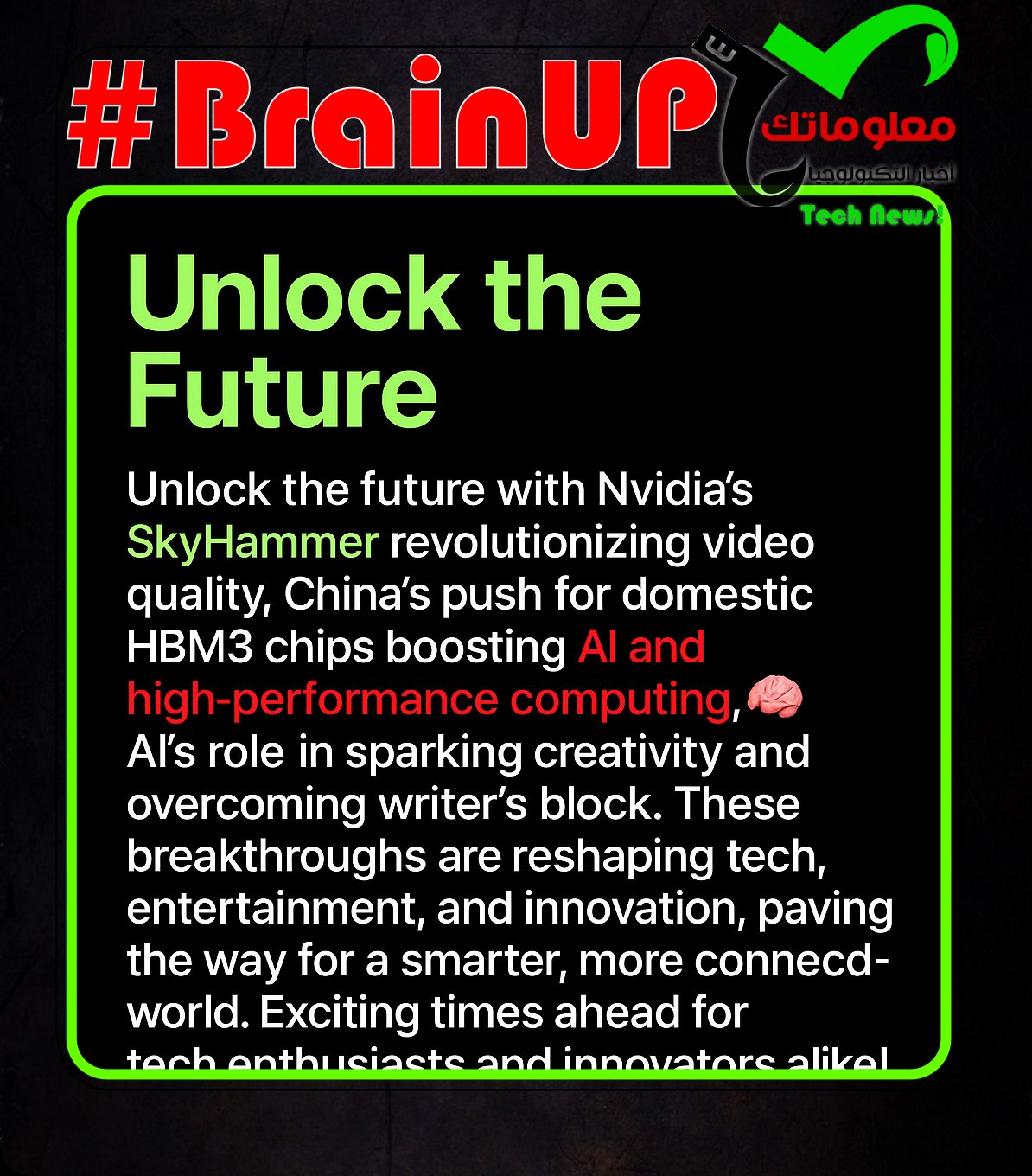
Upscale AI has raised $200 million in Series A funding to challenge @Nvidia’s #NVSwitch in rack-scale AI networking, aiming to deploy its own #SkyHammer silicon into #UALink switches later this year. It plans standalone #SkyHammer ASICs for hyperscale integration and as integrated switch blades and racks, with a memory semantic-based load-store network and acceleration for collective communication similar to Nvidia’s #Sharp. The platform will support both #UALink and #ESUN protocols, and Upscale is extending support for the open-source #SONiC NOS to manage scale. The round includes backers such as @TigerGlobal, @PremjiInvest, and @Xora Innovation, while existing backers include @Intel, @AMD, and @Qualcomm, as Upscale aims to expand engineering, sales, and operations to ship its first AI networking products later this year. AMD’s first #UALink-based rack systems are expected later this year but will tunnel the protocol over Ethernet, a context Upscale hopes to surpass by reimagining what scale means in AI networking.
China’s semiconductor sector is preparing to begin domestic production of #HBM3 memory chips by the end of 2026, a significant step toward self-reliance in advanced chip manufacturing. Key industry players such as #CXMT will manufacture these chips, while companies like #Naura, #Maxwell, and #U Preseason are developing design and assembly tools to support this goal. This collective effort addresses the country’s strategic priority to reduce dependency on foreign technology amid global supply chain challenges and geopolitical tensions. The initiative demonstrates a focused advancement in #DRAM and packaging technologies, aiming to enhance China’s position in the global semiconductor market. Progress in this area could reshape supply dynamics and boost China’s technological sovereignty.
3. Would you use AI to break writer’s block? We asked 5 experts
AI is being discussed as a way to break writer’s block, with five creative-writing experts weighing in. The Bloomsbury Publishing CEO, whose roster includes @SarahJMaas and @GeorgeSaunders, suggests AI will probably help creativity by getting writers in the zone and drafting the first paragraph or chapter. The five experts’ responses ranged from a firm rejection to innovative reasons for using AI, showing nuanced, context-dependent views on AI’s role in writing. The discussion implies AI could support the writing process without eclipsing human craft, prompting questions about when and how to deploy it. It touches on broader themes in #AI, #creativewriting, and #large-language-models, inviting readers to consider practical uses and limits of AI assistance.
4. Millions of people imperiled through sign-in links sent by SMS
Sign-in links and codes sent via SMS by services that require a phone number to sign up imperil privacy and expose millions to scams and identity theft. The study identified more than 700 endpoints delivering such texts for over 175 services, with tokens that can be easily enumerated or brute-forced, allowing attackers to access other users’ accounts and view or alter data such as partially completed insurance applications #token. Some links require only clicking and provide access with little or no additional authentication, and many remain valid for years, while #SMS messages are unencrypted. Researchers note the threat is straightforward to test at scale with consumer hardware and basic Web security knowledge, and they cite past findings of public SMS databases containing names, addresses, and credentials (2019). Using public SMS gateways, they surfaced 322,949 unique SMS-delivered URLs from over 33 million texts to more than 30,000 numbers, revealing numerous security and privacy threats. The findings argue for rethinking #SMS-based authentication and stronger safeguards for SMS-delivered credentials.
5. Volvo CEO Says ‘Good Luck’ to The Rest of You Legacy Automakers
Volvo’s CEO, Håkan Samuelsson, has confidently expressed that traditional car manufacturers face significant challenges amid the electric vehicle transition, suggesting they will struggle compared to more agile companies focused solely on EVs. He highlights that legacy automakers are burdened by existing combustion engine platforms and cultures, which impede rapid innovation in #electricvehicles. Samuelsson notes that Volvo’s clear strategy to become a fully electric car company by 2030 positions it advantageously for the future automotive market. This viewpoint underscores a broader industry disruption where established brands must rapidly adapt or risk losing competitiveness. The conversation reflects the urgency and strategic shifts reshaping the auto industry as electrification accelerates.
6. Lawsuit Challenges AI Hiring Tool Over Fair Credit Reporting Act Compliance
A lawsuit against Eightfold AI alleges violations of the Fair Credit Reporting Act (#FCRA) due to the company’s AI-powered hiring platform. The plaintiff claims Eightfold’s system, which uses #artificialintelligence and #machinelearning to screen job applicants, failed to meet legal obligations for accuracy and disclosure. This case highlights concerns about transparency and accountability in integrated AI hiring tools, as existing regulations like the FCRA may not explicitly address the nuances of #algorithmic decision-making. The legal challenge underscores the need to update recruitment laws to protect applicant rights while accommodating emerging #AI technologies. The outcome could influence how AI hiring platforms ensure compliance and balance innovation with fairness.
7. Not to be outdone by OpenAI, Apple is reportedly developing an AI wearable | TechCrunch
Apple is reportedly developing an AI wearable in the form of a pin worn on clothing, with a possible launch in 2027 and up to 20 million units. The device is described as a thin, flat, circular disc with an aluminum-and-glass shell, roughly the size of an AirTag but slightly thicker, and it includes a physical button, a speaker, a Fitbit-like charging strip, two cameras (standard and wide-angle) and three microphones. The project appears aimed at joining @OpenAI in accelerating AI hardware development, signaling a broader race in AI devices. Humane AI previously released a similar pin that included built-in microphones and a camera but shut down after its launch, illustrating the market’s uncertain consumer interest. TechCrunch reached out to @Apple for comment, and it remains to be seen whether such a #AI #wearable will gain broad adoption.
8. Threads rolls out ads to all users worldwide | TechCrunch
Meta is expanding ads on Threads to all users worldwide, with a gradual rollout starting next week that may take months to complete. The move follows testing and Threads’ rapid growth to over 400 million monthly active users, with @Mark Zuckerberg noting the potential to reach 1 billion users. Advertisers can use #Advantage+ or manual campaigns to place Threads ads, and manage Threads alongside Facebook, Instagram, and WhatsApp in Business Settings for easier cross posting, plus #thirdPartyVerification via Meta Business Partners for #brandSafety amid concerns about deepfakes. Supported formats include image and video ads, the new 4:5 aspect ratio, and carousel ads, while initial ad delivery will be low as the feature scales globally. The rollout underscores Meta’s plan to monetize Threads within its broader advertising ecosystem while leveraging existing tools and safety measures.
9. OpenAI’s internal documents predict USD$14 billion loss in 2026, according to report
OpenAI’s internal financial projections anticipate a significant loss of $14 billion by the year 2026, reflecting substantial operational and development costs associated with #AI technologies. The documents reveal the scale of investment OpenAI is committing to maintain its leadership in the rapidly evolving AI market. This projected deficit underscores the high-risk, high-reward nature of AI development as the company balances innovation with financial sustainability. The report also indicates that OpenAI expects eventual profitability as technologies mature and monetization strategies solidify. These financial forecasts highlight the challenges and ambitions faced by AI leaders like @OpenAI in shaping the future of artificial intelligence.
10. Microsoft Shares Workaround for Outlook Freezes After Windows Update
Microsoft has acknowledged that certain users experience Outlook freezing issues after recent Windows updates, causing disruptions in email usage. The problem arises due to conflicts introduced by the updates, which affect Outlook’s performance. To address this, Microsoft provided a workaround involving adjustments to Windows registry keys to restore Outlook functionality temporarily. This solution helps users avoid productivity loss while Microsoft works on a permanent fix. The company’s response highlights its commitment to resolving #softwarecompatibility problems swiftly and maintaining user trust.
11. Anthropic revises Claude’s constitution and hints at chatbot consciousness
Anthropic has updated the constitutional framework guiding its AI, Claude, integrating a mix of complex ethical principles and improved safety measures to enhance chatbot reliability and user trust. The revision underscores a dynamic approach to #AI alignment, suggesting the firm’s openness to evolving foundational norms as AI capabilities progress. Notably, discussions hint at the philosophical consideration of chatbot consciousness, indicating a shift in how Anthropic perceives advanced conversational agents beyond mere functional tools. By foregrounding ethical sophistication and philosophical questions, this update aligns with broader industry trends emphasizing responsible AI development and safety. Anthropic’s evolving constitution thus balances technical innovation with reflective deliberation on AI’s potential state of awareness, signaling a deepening engagement with the moral dimensions of #AI technology.
12. The Return of Windows Phone? This New Device Runs Android, Linux, Windows 11
The NexPhone is a tri-OS smartphone that can also function as a desktop when connected to a monitor, aiming to revive Windows Phone nostalgia while merging Android, Linux, and Windows 11. It runs Android 16, Linux, and Windows 11, can switch between Android and Linux without a reset, and requires a reboot to access Windows; it is powered by a Qualcomm QCM6490 with 12GB RAM and 256GB storage (expandable via microSD up to 512GB), features a 6.58-inch 120Hz LCD, a 5000mAh battery with 18W charging and wireless charging, and an IP69-rated rubberized build priced at $549 with $199 reservations. Web apps can launch from the browser, and NexDock says they launch fast, feel lightweight, and stop running when you close them. The setup targets users who want seamless mobile-to-desktop transitions and a familiar Windows Phone UI on Windows 11 while keeping costs below typical high-end devices, though the release timing remains uncertain. If NexPhone delivers as described, it could influence cross-OS devices and reopen the conversation about a Windows Phone-era experience in a modern, flexible form factor. #Windows11 #Android #Linux #NexPhone #NexDock #IP69
13. This smartphone runs Android, Linux, and even Windows 11
The NexPhone attempts to replace a traditional PC by delivering Android, Debian Linux, and Windows 11 on a single device with a desktop experience. When paired with a monitor and input devices, users can choose Android Desktop Mode, Debian desktop, or Windows 11, with Android and Linux sharing files while Windows exists on a separate partition and a custom tile-based Windows UI is included for quick access. On the go, Android remains the primary OS while Debian can be launched as an app for quick pivots, and users can reboot into Windows 11 for a full desktop environment. The hardware includes a 6.58-inch 120Hz LCD, 1080×2403 resolution, 12GB of RAM, 256GB storage plus microSD, plus a 64MP main camera, 13MP ultrawide, 10MP front camera, a 5,000mAh battery and wireless charging, with a $549 price and shipments expected in Q3 2026. This multi-OS approach offers flexibility for users who want a single device for mobile and desktop tasks, but its practicality will depend on performance, ecosystem integration, and how willing people are to adopt a nontraditional compute model. @StephenSchenck @NexPhone #AndroidDesktopMode #Debian #Windows11 #NexPhone
14. House of Lords backs social media ban for under-16s
The House of Lords backed a ban on social media for under-16s, moving the measure to the government, which could overturn it in the House of Commons. Peers voted 261 to 150 (majority 111) in support of @Lord Nash’s amendment to the #ChildrenWellbeing and #SchoolsBill. Technology Secretary @Liz Kendall announced a three-month consultation to weigh the advantages and disadvantages of a ban, including possible overnight curfews and actions to prevent doom-scrolling, with a report due in the summer. The debate notes that there is no penalty for a minor using social media, while firms face fines for failing to enforce the law, and cites an Australia-style approach with age checks and account disabling for underage users. If enacted, it could mirror Australia and align with the UK’s Online Safety Act, which already restricts access to adult content unless age is proven.
Ubisoft has cancelled Prince of Persia: The Sands of Time Remake as part of a major internal reset intended to drive sustainable growth. The remake is among six projects cancelled and seven delayed in a restructuring announced by CEO @Yves Guillemot, which centers on establishing five #Creative_Houses that consolidate production and publishing. The plan decentralizes decision-making and ties financial ownership to genre-focused houses, with CH1 (Vantage Studios) tasked with turning large franchises into annual #billionaire_brands like Assassin’s Creed, Far Cry, and Rainbow Six; CH2 focusing on #competitive_shooters and #cooperative_shooters, CH3 on #live_experiences, CH4 on #immersive_fantasy worlds including Prince of Persia and Beyond Good & Evil, and CH5 on #casual_games. The overhaul signals a broad shift toward specialized studios and closer alignment between brands and player experiences, potentially reshaping Ubisoft’s production and release strategy. The Sands of Time Remake, announced in 2020 and repeatedly delayed through a reboot, was cancelled after this restructuring, despite CFO Frederick Duguet’s 2025 statement that it would launch “very soon.”
16. Apps for Boycotting American Products Surge to the Top of the Danish App Store
Apps promoting the boycott of American products have recently surged in popularity in the Danish app store amid rising geopolitical tensions. These apps provide users with tools to identify and avoid purchasing goods from American corporations, reflecting a growing sentiment among some Danish consumers to economically distance themselves from the US. The phenomenon ties into broader trends of increased consumer activism and digital empowerment through technology. The rise of such applications highlights how political and trade conflicts can directly influence consumer behavior and market offerings. This development underlines the role of apps as mediums for political expression and economic influence in global markets.
GameStop has identified and stopped a trade-in exploit involving the upcoming Nintendo Switch 2 that allowed users to generate unlimited credit. The exploit relied on a flaw in the trade-in system, enabling customers to repeatedly trade in devices and receive credit fraudulently. GameStop’s swift action has plugged this loophole, protecting its trade-in program from abuse and potential financial losses. The incident highlights vulnerabilities in the trade-in and credit system that can be exploited with emerging technology like the Nintendo Switch 2. GameStop’s response underscores the importance of security measures in retail trade-in platforms to maintain trust and operational integrity.
18. Law Schools Should Teach How to Integrate AI Tools into Practice
Law schools need to adapt their curricula to include training on integrating #AI tools into legal practice as these technologies rapidly transform the profession. This push is supported by the increasing use of AI like large language models, which can enhance efficiency and decision-making in legal tasks. Faculty and legal professionals highlight the importance of teaching both the technical uses and ethical implications of AI to prepare students effectively. Incorporating AI education equips future lawyers with practical skills necessary for modern legal environments and addresses industry demands. Legal education reform aligned with technological advances ensures graduates remain competitive and competent in evolving practice landscapes.
20. The first commercial space station, Haven-1, is now undergoing assembly for launch
Haven-1, the first commercial space station by Vast Space, is progressing toward a 2027 launch after shifting from mid-2026, reflecting a careful balance of speed and safety. The company announced that the primary structure is complete and clean room integration has begun, covering the thermal control system, propulsion, interior shells, and avionics, with a full test campaign at Plum Brook planned by year’s end. The 15-ton, uncrewed satellite will launch on a Falcon 9, with post-launch uncrewed checks to validate pressure, attitude, and other functions before NASA and SpaceX approve crewed Dragon docking. This staged approach shows a cautious path to crewed operation that prioritizes safety while aiming to arrive ahead of rivals and to fulfill the evolving idea of continuous habitation later in the decade. Haven-1 illustrates the growing role of private companies in space infrastructure and signals how @NASA and @SpaceX may collaborate as commercial stations become the backbone of future outposts #commercial #space #Haven-1.
The study from MIT Media Lab investigates neural and behavioral consequences of #LLM-assisted essay writing, comparing three groups—#LLM, #SearchEngine, and Brain-only—across three sessions and a fourth reassignment, with EEG, NLP analysis, and human and AI scoring, led by @Pattie Maes. Across groups, EEG revealed the strongest and most distributed networks in Brain-only participants, moderate engagement for #SearchEngine users, and the weakest connectivity for #LLM users, showing cognitive activity scales down with external tool use. In session 4, #LLM-to-Brain participants showed reduced alpha and beta connectivity, indicating under-engagement, while Brain-to-#LLM users exhibited higher memory recall and activation in occipito-parietal and prefrontal regions, similar to #SearchEngine users. Self-reported ownership of essays was lowest in the #LLM group and highest in the Brain-only group, and #LLM users struggled to quote their own work. Although #LLMs offer immediate convenience, the study finds cognitive costs, with four months of exposure associated with underperformance at neural, linguistic, and behavioral levels, raising concerns about long-term educational implications and the need for deeper inquiry into AI’s role in learning, as reported by the MIT Media Lab publication.
22. 2027 Volvo EX60 Feels Like A No-Brainer For EV News With 400-Mile Range And Reasonable Price Tag
Volvo’s upcoming 2027 EX60 electric SUV offers a compelling option in the EV market with an estimated 400-mile range and a competitive price point. The model emphasizes sustainability by incorporating recycled materials and advanced batteries, highlighting Volvo’s commitment to environmental responsibility. Its range surpasses many current electric SUVs, providing strong utility for consumers wary of range anxiety. Volvo’s approach balances performance, eco-friendliness, and affordability, aiming to attract a broad customer base. The EX60 positions Volvo as a significant player in the transition to electric vehicles, aligning with global shifts toward sustainable transportation.
23. As Prediction Markets Grow in Popularity, Some Fear ‘Insider Trading.’ What’s Next?
Prediction markets are becoming more mainstream and have drawn intense scrutiny after a profitable, unlikely short-term bet on @Nicolás Maduro’s fate. The piece notes that these markets are regulated by the @CFTC, with the so-called Eddie Murphy rule aimed at preventing misappropriation of confidential information for unfair gain, signaling a complex regulatory path ahead. Lawmakers have asked the @CFTC chair about Maduro-related wagers, and offshore venues like @Polymarket complicate oversight, while @Kalshi asserts that insider trading is banned. Some observers see insider activity as potentially boosting trust and accuracy, while others warn of manipulation and unfair gains in markets tied to politics and other high-stakes contracts. The central question remains how to regulate prediction markets in a way that preserves integrity while reflecting their growing prominence in public discourse, highlighting ongoing debates about enforcement and jurisdiction #predictionMarkets #insiderTrading #regulation.
24. Amazon launches AI health-care tool for One Medical members
Amazon launches Health AI, an AI health-care assistant for @OneMedical members, built on #Bedrock large language models. It answers questions, uses patients’ medical records, lab results and current medications to offer personalized guidance, helps manage medications and book appointments with a user’s @OneMedical provider. Answers pull from licensed and proprietary data, knowledge verified by medical experts and, in some cases, public data, and it follows clinical protocols to flag when escalation to a provider or in-person visit is needed. Health AI isn’t designed to diagnose or replace a doctor, is easier to use because it doesn’t require uploading documents or connecting outside apps, and it’s described as more actionable than offerings from @OpenAI and @Anthropic. It sits in the One Medical app after Amazon’s 2023 acquisition of One Medical, with potential links to Amazon Pharmacy services, underscoring Amazon’s broader push into health care.
25. Tesla restarts Dojo AI project after shutdown, pivots to broader AI ambitions
Tesla has revived its #Dojo project, an AI training supercomputer initiative originally paused in 2023, signaling a renewed focus on AI beyond autonomous driving. The Dojo project emphasizes training massive neural networks to improve Tesla’s Full Self-Driving (FSD) capabilities and other AI applications. By pivoting, Tesla aims to leverage Dojo’s computing power for broader AI development, potentially enhancing both vehicle autonomy and other AI-driven technologies. This move highlights Tesla’s commitment to maintaining competitiveness in AI research and development amid growing industry interest. The restart reflects Tesla’s strategy to integrate advanced AI systems into its products more effectively while adapting to evolving technological demands.
26. South Korea’s Lee plays down proposed US chip tariffs, warns of higher prices
@Lee Jae Myung said that if Washington introduces higher US tariffs on semiconductor imports, it would likely boost US prices. He noted that #trade safeguards under a bilateral agreement with the US exist to prevent Korean chipmakers from being disadvantaged. Given the dominance of Korean and Taiwanese chipmakers, roughly 80% to 90%, a 100% duty would probably be passed on to US prices. Korea’s exports hit a record high in 2025, with chip shipments up 22%, and chip exports to the US accounted for about 8% of total semiconductor exports. Thus the tariffs could influence US prices and broader market dynamics despite safeguards.
27. Wikipedia volunteers spent years cataloging AI tells. Now there’s a plugin to avoid them.
An open-source plugin named ‘Humanizer’ for @Claude_Code aims to suppress AI-like writing by following 24 language and formatting patterns identified by @Wikipedia editors in their #AI_writing_patterns guide. The plugin is delivered as a ‘skill file’ appended to prompts, published by @Siqi Chen on GitHub, and built from materials from #WikiProject_AI_Cleanup, a group of Wikipedia editors cataloging AI tells since 2023, a project that had grown to over 1,600 stars on GitHub by Monday. In limited testing, the skill file made the AI output less precise and more casual, but it won’t guarantee improved factuality and might hinder coding ability, with some instructions urging opinions rather than neutrally listing pros and cons. The piece notes the irony that detection-rule sets can help subvert detection, illustrating the tension between making AI output human-like and evading safeguards. Overall, the article shows how @Wikipedia volunteers’ work to catalog AI tells informs tools that shape AI writing and detection.
28. [News] Samsung Reportedly Moves Custom HBM Logic Die to 2nm Foundry Process for the First Time
Samsung is moving its custom HBM logic die to a 2nm foundry process for the first time, aiming to gain a performance and power-efficiency edge in AI workloads. ZDNet reports that Samsung previously used a 4nm process for the HBM4 logic die, which is slated for mass production in 2026, and that the logic die is manufactured on a foundry process rather than a conventional DRAM process. This shift is intended to strengthen Samsung’s position against rivals and to attract major customers, including @NVIDIA, @AMD, @Broadcom, @AWS, and @OpenAI, with a portfolio spanning 4nm to 2nm. Broader adoption of custom HBM is expected with #HBM4E in 2027, and Samsung is advancing next-generation packaging such as #hybrid_bonding to support these advanced dies.
29. Google says Gemini won’t have ads as ChatGPT prepares to add them
Google has announced that its upcoming #GeminiAI will not include advertisements, distinguishing its approach from #ChatGPT, which is preparing to integrate ads into its platform. Google’s CEO Sundar Pichai emphasized that Gemini aims to deliver a user experience free of commercial interruptions, focusing on utility and privacy. This contrasts with #OpenAI’s strategy that plans to monetize ChatGPT through ads, potentially affecting user experience and content bias. Google’s ad-free stance on Gemini highlights a commitment to maintaining a cleaner, more trustworthy AI interaction. This decision reflects broader industry debates on balancing revenue generation with user trust and experience in AI development.
AI boom reshapes the storage market, signaling the end of cheap 1TB SSDs, according to @ShunsukeNakato, @Kioxia’s Managing Director of Memory Business Unit. He says this year’s production is already sold out and the days of bargain 1TB SSDs around ¥7,000 (~$45) are over, with price floors rising across SATA, PCIe 4/5 and other interfaces. Nakato notes that Kioxia has sold out its entire 2026 NAND production and expects the trend to continue through at least 2027, and explains the company’s supply allocation via a long-standing, trust-based gentleman’s agreement with partners rather than bidding, aided by AI/IoT driven yield improvements at Kioxia’s Yokkaichi plant and the upcoming BiCS8 production at Kitakami fab. This dynamic underscores a NAND shortage that will keep prices elevated and complicate sourcing for builders, so plan accordingly and stock up while inventories last #NAND #AI #SSDs
Netflix is redesigning its mobile app to fit a social-first video landscape by deeply integrating vertical video feeds and swipeable clips, signaling a shift for @Netflix. The update, set to launch later in 2026, will underpin ongoing experimentation to iterate and improve the experience as part of expanding the business over the coming decade, with short clips from Netflix shows and movies designed to boost time spent #mobile #verticalvideo. Netflix has been testing vertical feeds since May and is pushing into video podcasts, launching originals with @PeteDavidson and @MichaelIrvin and partnering with @Spotify and @iHeartMedia to bring established libraries to the platform #videoPodcasts #Spotify #iHeartMedia. The company frames the move as experimentation rather than imitation, saying the goal is to strengthen #discovery and daily engagement rather than become @TikTok while competing for attention across the broader entertainment ecosystem.
32. Anthropic’s CEO stuns Davos with Nvidia criticism | TechCrunch
At Davos, @Dario Amodei argues that the U.S. decision to allow Nvidia’s H200 chip sales to China is misguided and could backfire on American AI leadership. He calls the move ‘crazy,’ notes that the U.S. is years ahead of China in chip design, and warns that shipping these chips may undermine national security. Amodei describes AI as systems with cognition that carry ‘incredible national security implications,’ imagining a future where a country controls millions of smarter-than-Nobel minds in data centers. He emphasizes that #Nvidia is a core partner and investor for @Anthropic, and that Nvidia GPUs power Anthropic’s models, underscoring the tension between policy decisions and ongoing collaboration. The remarks frame the policy debate as a risk to innovation and security in #AI, urging a reevaluation of export controls to preserve both leadership and safety and highlighting the need to balance policy with partnership.
33. Base-edited baby: 10 Breakthrough Technologies 2026
Baby KJ, born with a rare metabolic disorder, became the first to receive a bespoke #base-editing gene therapy designed to correct a genetic misspelling. The Penn team led by @Rebecca Ahrens-Nicklas and @Kiran Musunuru tested the approach in human cells, mice, and monkeys before giving KJ a dose. KJ received an initial low dose at seven months and later two higher doses, and he is today meeting developmental milestones. Although other patients have received gene-editing therapies for conditions like sickle cell disease, KJ’s treatment was personalized for him alone, with costs around $1 million, similar to a liver transplant, though Musunuru expects future treatments to run in the low hundreds of thousands. Researchers plan a clinical trial in children with similar misspellings targeted by #base-editing, and the FDA has described a potential pathway for approving such personalized therapies, possibly with as few as five patients and at least three genetic variants, though KJ and others will be monitored for years to assess long-term outcomes.
34. FTC will appeal ruling in Meta antitrust case over Instagram, WhatsApp deals
The U.S. Federal Trade Commission (FTC) has decided to appeal a court ruling that dismissed its antitrust lawsuit aiming to undo Meta’s acquisitions of Instagram and WhatsApp. The FTC argued these deals harmed competition and innovation, but the court found insufficient evidence that Meta’s actions lessened competition illegally. The appeal signals the FTC’s continued commitment to challenging big tech mergers as part of its broader enforcement agenda. This move highlights ongoing regulatory scrutiny of major #tech acquisitions in digital markets, focusing on consumer welfare and market dynamics. By appealing, the FTC intends to reinforce antitrust standards applicable to large tech companies like @Meta.
36. Adobe Acrobat now lets you edit files using prompts, generate podcast summaries | TechCrunch
Adobe is expanding Acrobat with AI tools that let users edit files using prompts, generate podcast summaries of documents, and build presentations from Space content. By tapping information stored in Spaces—such as financial details, product plans, and competitor analysis—users can create a client pitch deck via text prompts, with the AI assistant first drafting an editable presentation and then allowing customization through @Adobe Express’ theme library, stock imagery, or user uploads while applying a brand style. This positions Acrobat’s AI features among tools from #Canva and @Google’s NotebookLM, which already convert documents into presentations, and underscores ongoing AI-driven cross‑product integrations across Adobe’s suite such as @Adobe Express. Acrobat also enables podcast creation to summarize a file or a Space, and supports editing via prompts with 12 actions like removing pages, text, comments, images; finding and replacing terms; and adding e‑signatures or passwords. When files are shared, AI-generated summaries with citations can accompany them and contributors can comment or tailor assistants (e.g., ‘analyst,’ ‘entertainer,’ ‘instructor’), further linking content across Spaces and presentations.
37. Panther Lake isn’t just a laptop chip. It’s Intel’s Hail Mary
Panther Lake, the @Intel Core Ultra Series 3 platform, marks a strategic pivot back to in-house manufacturing and a bid to challenge @AMD and @Qualcomm, while simplifying CPU branding for laptops. Intel contends Panther Lake delivers more than 50% higher multithreaded performance than Lunar Lake and Meteor Lake, with about 10% less power draw than Lunar Lake, and expects parity with Arrow Lake. The platform pairs an upgraded #ArcB390 iGPU with the faster CPU, aiming to deliver gaming-grade performance on integrated graphics close to the #RTX4000-series cards. Past generations struggled: Lunar Lake prioritized battery life with onboard memory, while Arrow Lake and Meteor Lake offered stronger CPUs but ran hotter. CES 2026 presented a calmer narrative for @Intel, with partnerships like @NVIDIA and broader government involvement signaling a turnaround, and if the promises hold, Panther Lake could reshape the laptop gaming market, though hands-on benchmarks are still awaited.
That’s all for today’s digest for 2026/01/22! We picked, and processed 35 Articles. Stay tuned for tomorrow’s collection of insights and discoveries.
Thanks, Patricia Zougheib and Dr Badawi, for curating the links
See you in the next one! 🚀
