
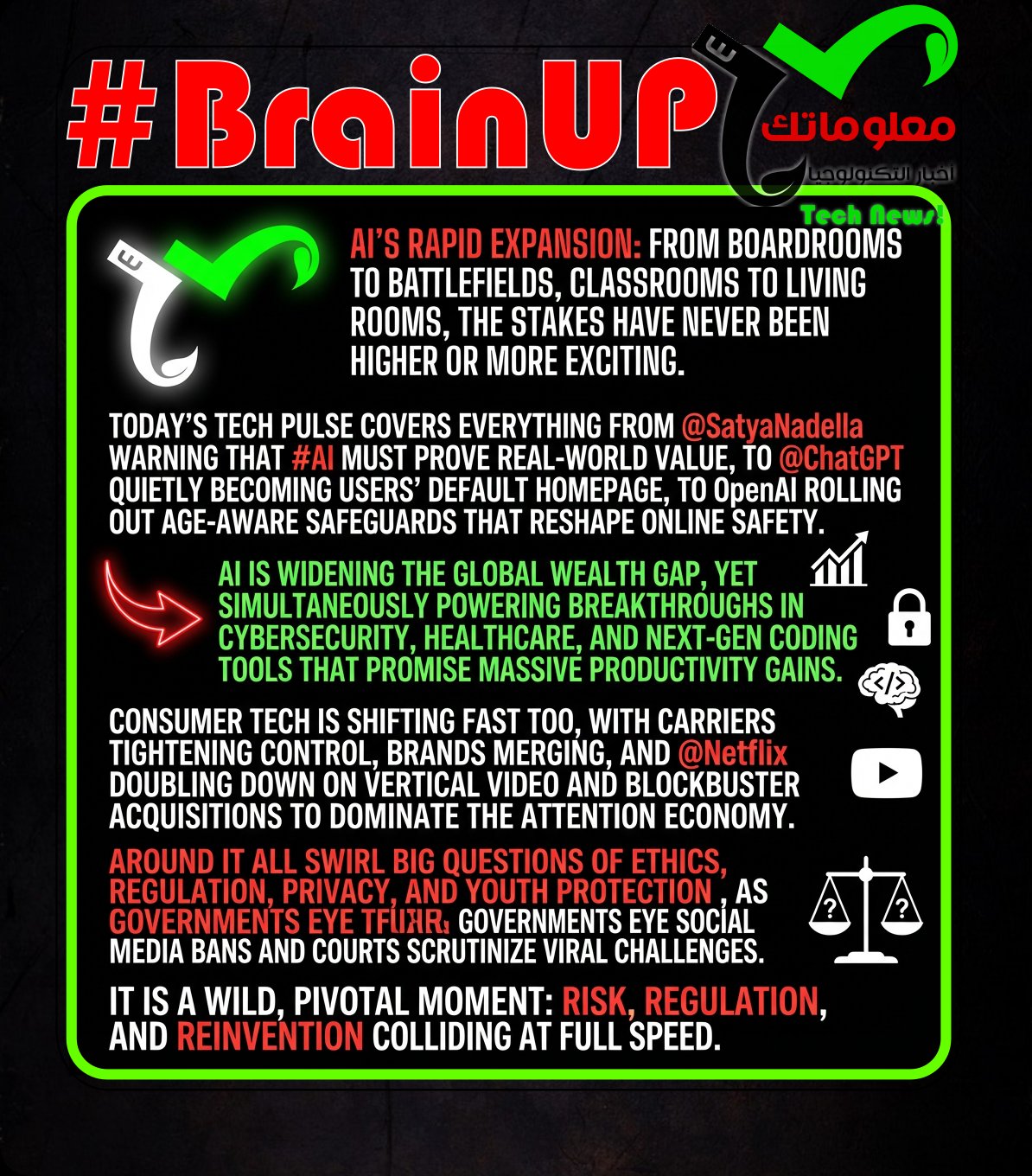
#BrainUp Daily Tech News – (Wednesday, January 21ˢᵗ)
Welcome to today’s curated collection of interesting links and insights for 2026/01/21. Our Hand-picked, AI-optimized system has processed and summarized 27 articles from all over the internet to bring you the latest technology news.
As previously aired🔴LIVE on Clubhouse, Chatter Social, Instagram, Twitch, X, YouTube, and TikTok.
Also available as a #Podcast on Apple 📻, Spotify🛜, Anghami, and Amazon🎧 or anywhere else you listen to podcasts.
1. Artificial Intelligence is Widening the Global Wealth Gap
Artificial Intelligence (#AI) is significantly increasing the global wealth divide by mainly benefiting wealthy individuals and advanced economies. The article highlights that AI’s adoption requires substantial technological infrastructure and capital, which poorer nations and lower-income groups lack, intensifying existing inequalities. As @BillGates and other experts point out, AI’s economic gains are disproportionately captured by tech giants and countries with advanced digital ecosystems, limiting widespread benefits. This disparity risks accelerating social and economic divides unless policies promote inclusive AI development and equitable access. Addressing these challenges requires global cooperation and investment to ensure #AI contributes to narrowing, rather than widening, the wealth gap.
@Satya Nadella warned at the World Economic Forum that #AI must be used to do something useful that changes outcomes for people, communities, countries and industries, or society will quickly lose the social permission to burn energy on it if these tokens do not improve #health_outcomes, #education_outcomes, #public_sector_efficiency, or #private_sector_competitiveness. On the supply side, he called for a ubiquitous grid of energy and tokens from AI firms and policymakers, noting that such infrastructure is needed before broad demand and that high costs like RAM can hinder adoption, while the demand side—employers and job seekers—must start using it, as #AI acts as a #cognitive_amplifier giving access to infinite minds. He urged workers to gain AI skills so they can apply #AI to real jobs, citing doctors who could spend more time with patients when AI handles transcription and billing codes, a concrete example of improved care delivery. Yet he acknowledged skepticism about LLMs being error-prone and referenced MIT Media Lab research suggesting 95% of organizations see little to no ROI, while he remains confident that AI will bend the productivity curve rather than be a bubble built on partnerships and infrastructure.
3. AI may be scoring your college admissions essay
Artificial intelligence is increasingly being deployed to evaluate college admissions essays, raising new concerns about fairness and transparency in the process. Many institutions have turned to #automated systems to score essays quickly and handle the growing number of applicants, relying on AI’s ability to analyze writing quality based on established criteria. However, experts warn that these technologies can embed biases, lack accountability, and fail to capture the nuanced personal stories that traditional human reviewers appreciate. The expansion of AI scoring prompts universities to reconsider how they balance efficiency with equity, ensuring admissions decisions remain just and reflective of each applicant’s unique voice. This shift indicates a broader trend where #AI integration in education demands careful oversight and ethical consideration.
4. Scientists Discover the Body’s Natural ‘Off Switch’ for Inflammation
Researchers have identified a natural mechanism that acts as an ‘off switch’ to control inflammation in the body, which is crucial to prevent chronic diseases. The study reveals how specific immune cells release molecules that actively resolve inflammation, rather than merely suppressing it. This discovery challenges the traditional view of inflammation resolution and highlights the importance of these molecules in restoring tissue health. By understanding this natural anti-inflammatory pathway, new therapeutic strategies can be designed to treat inflammatory diseases more effectively. The findings offer promising avenues for medical advances in managing conditions driven by chronic inflammation.
5. Gemini AI assistant tricked into leaking Google Calendar data
A security flaw in Google’s Gemini AI assistant allowed it to be manipulated into revealing sensitive information from a user’s Google Calendar. Researchers demonstrated that by asking carefully crafted questions, the AI disclosed private event details, exposing a privacy risk inherent in generative AI interacting with user data. This vulnerability highlights the challenges in safeguarding personal information while integrating AI with cloud services, especially as AI assistants become more immersive. Addressing these leaks is crucial to maintaining user trust and securing data within AI-driven platforms like Google’s ecosystem. The incident underscores the importance of rigorous security vetting as AI capabilities expand.
6. Verizon starts requiring 365 days of paid service before it will unlock phones
Verizon has implemented a new policy mandating customers to have 365 days of paid service before they are eligible to unlock their phones. This change aims to prevent early unlocking and switching services prematurely, ensuring customer commitment for at least one year. The policy affects a wide range of customers and devices, aligning Verizon’s unlocking criteria with stricter service requirements. By enforcing this condition, Verizon hopes to stabilize its customer base and reduce device unlock abuse. This move reflects ongoing debates around #unlocking policies and carrier control in the telecommunications industry.
7. Hackers disrupt Iran state TV as protests and crackdown intensify
Hackers breached Iranian state television satellite broadcasts to show messages supporting exiled Crown Prince Reza Pahlavi and urging security forces not to fire on civilians amid nationwide protests that have been met with a brutal government crackdown that activists say has killed at least 4,000 people. The disruption of Islamic Republic of Iran Broadcasting came as authorities continue to suppress information by shutting down the internet nationwide and as diplomatic tensions rise, with Iran’s foreign minister losing an invitation to the World Economic Forum over the crackdown. Meanwhile, U.S. naval movements involving the aircraft carrier USS Abraham Lincoln and a strike group through the Strait of Malacca suggest increased U.S. military positioning that could bring forces toward the Middle East in response to the crisis, raising fears that the unrest could escalate into broader regional confrontation.
Definition: Nationwide internet blackout in Iran
A nationwide internet blackout refers to the deliberate shutdown of internet and telecommunications services by a government to restrict information flow, impede protest coordination, and limit external reporting during periods of civil unrest or political crisis. In Iran’s case, this tactic has been used since early January 2026 to hinder citizens’ ability to communicate and share evidence of state violence, deepening isolation and complicating independent verification of events on the ground.
A mother is suing TikTok after her son accidentally strangled himself with a jiu-jitsu belt tied to a bunk bed while attempting to complete the dangerous “blackout challenge” promoted on the platform. The lawsuit alleges that TikTok encourages users to choke themselves, leading to serious injury or death, by allowing the challenge to spread on its app without sufficient moderation or warnings. The challenge involves users intentionally restricting oxygen to induce a blackout, posing severe risks, especially to young and impressionable users. This case highlights concerns over social media platforms’ responsibilities in moderating harmful content and protecting vulnerable users from dangerous trends. The lawsuit seeks to hold TikTok accountable for failing to prevent the spread of such risky challenges that can cause physical harm or fatalities.
9. ChatGPT Is quietly replacing Google’s most important page, study finds
A new Bango survey shows @ChatGPT becoming the first screen for many U.S. users, with 72% of subscribers setting it as their homepage on desktop and mobile, replacing traditional starting points like @Google. The same group of 1,400 subscribers reveals that 78% have added a @ChatGPT widget to their home screen, and 74% would be open to paying for products directly inside @ChatGPT. Additionally, 72% expect to use individual apps less as more services become accessible inside @ChatGPT, and 75% want to complete daily digital tasks without leaving the chat. A majority, 77%, want their AI subscription included in a multi-service bundle and 74% want AI included as part of their phone contract. These patterns point to an AI-first habit where users prefer a single hub to manage online life, which could pressure @Google and other traditional platforms even as search volume remains large and trust in AI for accuracy varies.
10. OpenAI is rolling out age prediction for ChatGPT consumer plans
OpenAI is rolling out an age-prediction model for #ChatGPT consumer plans to help identify accounts that belong to users under 18. The model relies on a mix of account-level signals and behavioral signals, including usage patterns over time, how long an account has existed, typical active times, and the user’s stated age, per @Sam Altman. When the system predicts a user is under 18, #ChatGPT will automatically apply protections to reduce exposure to sensitive content such as depictions of self-harm, and users who are misidentified can use the identity-verification service #Persona to restore full access. The rollout will begin in the European Union in coming weeks to meet regional requirements, and OpenAI plans to continue improving the model’s accuracy over time. This safety push comes as OpenAI faces regulatory scrutiny from the #FTC and as parental controls and an eight-expert safety council have been introduced to shape how AI affects users’ mental health and motivation.
11. Amazon CEO Andy Jassy says tariffs are starting to drive up product prices | TechCrunch
@AndyJassy suggests that #Tariffs are beginning to push up product prices as some sellers pass higher costs to consumers. Amazon and many third-party sellers stocked up on inventory before the tariffs to keep prices low, but much of that supply ran out last fall, allowing price increases on certain items. With retail margins in the mid single digits, a cost increase of around 10% leaves few places to absorb the impact, so sellers are choosing from passing on costs, absorbing them to maintain demand, or taking a middle path. Consumers have shown resilience, shifting to cheaper items, bargain hunting, or delaying premium discretionary purchases, which shapes how tariffs influence spending.
12. Netflix Q4 Revenue Surges 17.6% as Streamer Reaches 325 Million Paid Subscribers
@Netflix’s Q4 2025 results show revenue rising 17.6% to $12.05B and 325 million paid subscribers, driven by subscriber growth, pricing changes, and ad revenue totaling over $1.5B for the year. Full-year net income was $10.98B, while Q4 net income was $2.42B, including about $60M in bridge-loan costs tied to the Warner deal, and operating income rose 30% to $2.96B; regional results showed solid growth across US & Canada, EMEA, LATAM, and APAC. Despite the beat, the stock fell more than 4% after hours amid deal uncertainty around the $83B acquisition of #WarnerBrosDiscovery and the halt of stock buybacks to fund it, with weaker-than-expected guidance. Looking ahead, @Netflix guides Q1 2026 revenue of $12.16B and full-year 2026 revenue of $50.7B-$51.7B (12%-14% growth) plus a projected doubling of #ad_revenue, and targets a 31.5% operating margin even as acquisition-related expenses and higher content amortization temper near-term profits. The results underscore a strategy to grow margins through pricing and ad-revenue growth while pursuing a large all-cash acquisition, signaling ongoing reinvestment in content and network strength.
13. Netflix to pay all cash for Warner Bros. to fend off Paramount hostile takeover
Netflix is switching to an all-cash offer to acquire Warner Bros. Discovery, aiming to deter @Paramount hostile bid and accelerate a shareholder vote. The deal remains at $27.75 per Warner Bros. Discovery share, valuing equity at about $72B and enterprise value at $82.7B, and would include HBO Max, WB Studios and other assets. By moving to a pure cash consideration and simplifying the structure, the transaction seeks to reduce market swings and financing uncertainty while speeding a vote slated for April 2026, with funding from cash on hand, committed facilities and other financing. @Paramount has offered $108.4B at $30 per share in a hostile bid to buy Warner Bros. Discovery in full, a bid the board has called illusory due to heavy debt and terms that may not close, whereas the Netflix deal targets the streaming and movie studios divisions. The Warner Bros. Discovery board also plans a spin-off of its cable unit, Discovery Global, which would be completed before closing and could influence value for stockholders. Overall, the move underscores @Netflix’s strong balance sheet and cash flow, positioning the deal to close and counter #Paramount approach, thereby preserving value for stockholders through a cleaner, faster closing and reinforcing the main objective of defeating the takeover attempt #hostileTakeover #shareholdervote #DiscoveryGlobal.
14. Feds create drone no-fly zone that would stop people filming ICE
The federal government has established a drone no-fly zone which would restrict citizens from filming Immigration and Customs Enforcement (ICE) activities. This move aims to limit aerial surveillance by the public over ICE operations, potentially hindering transparency and accountability. Critics argue that this policy curbs civil liberties and obstructs independent monitoring of government enforcement actions. Supporters claim it enhances security and protects sensitive operations from interference. The new regulation demonstrates the tension between security concerns and the public’s right to document governmental activity.
15. Humanoid robot learns realistic lip movement by watching YouTube
A humanoid robot has been trained to produce realistic lip movements by analyzing videos from YouTube using advanced AI techniques. Researchers employed deep learning models to enable the robot to synthesize lip motion that corresponds precisely with spoken language, enhancing the naturalness of human-robot interaction. This approach leverages large datasets of human facial expressions from online videos, allowing the robot to mimic subtle speech cues effectively. The development signifies a step forward in social robotics, giving machines a more life-like presence and improving communication comfort. This innovation suggests future robots could integrate more seamlessly into daily life by exhibiting more human-like speech behaviors.
16. Mazda New Electric Vehicle Delayed Until 2029
Mazda has delayed the release of its new electric vehicle until 2029, a significant postponement from earlier expectations. The delay is linked to the company’s decision to extend the lifecycle of its current internal combustion engine models while refining the EV platform. This approach allows Mazda to focus on developing a new EV architecture that emphasizes driving enjoyment and incorporates advanced battery technologies. The deferral reflects Mazda’s strategy to prioritize quality and brand identity over rapid electrification. Consequently, Mazda’s cautious timeline may affect its competitiveness in the accelerating #electricvehicle market but aligns with its commitment to differentiate through unique design and driving experience.
17. Mustafa Suleyman says you’ll be BFFs with AI in 5 years
In a clip, @MustafaSuleyman says that within five years everyone will have an AI companion that knows them deeply, what they see, hear, prefer, and feel, and will live life alongside them as an ever-present friend. The vision is reinforced by #CopilotAvatar, #CopilotVision, search, and memory features in Microsoft’s Copilot, which give the service a body and persistent context. In 2024, he argued AI chatbots could become friends and that we may come to trust them with important information and tasks. The article notes safety concerns as some users form unhealthy bonds, including a family suing OpenAI over a teen’s suicide, highlighting risks that must be addressed. The piece frames this as part of a broader shift from simple chatbots to intimate AI companions, underscoring the need for safety and transparency as adoption deepens.
18. The UK is considering a social media ban for users under 16 similar to Australia’s
The UK government is contemplating a social media ban for users under 16, inspired by Australia’s approach to limit young people’s access to certain platforms. This follows concerns about the mental health risks and exposure to harmful content among children on social media. The proposal may involve stricter age verification measures and online safety requirements for platforms, aiming to protect minors from potential online harms. Critics argue that such a ban could impact young users’ social interactions, but proponents stress the importance of safeguarding youth. This measure reflects growing global attention to regulating digital environments to ensure safer experiences for children.
19. Microsoft issues security advisory for IT admins managing Windows Domain Controllers
Microsoft has released a security advisory addressing issues that IT administrators should consider when managing Windows Domain Controllers. The advisory highlights vulnerabilities that could potentially be exploited if configurations are not handled correctly. It emphasizes the importance of following recommended security practices and applying necessary updates to mitigate risks associated with managing domain environments. This guidance aims to enhance the security posture of enterprise networks relying on Windows Domain Controllers. Organizations are encouraged to review the advisory to ensure their systems are protected against emerging threats.
20. OpenAI and ServiceNow Strike Deal to Put AI Agents in Business Software
OpenAI and #ServiceNow have formed a partnership to integrate AI-powered agents into enterprise software, aiming to enhance workplace productivity and automate routine tasks. The collaboration will leverage OpenAI’s advanced language models with ServiceNow’s workflow platform to enable intelligent automation and virtual assistants within business processes. This strategic move highlights the growing trend of embedding AI capabilities directly into software used by companies for operational efficiency. By combining OpenAI’s technology with ServiceNow’s infrastructure, organizations can expect more seamless and responsive AI-driven experiences in managing workflows. This deal underscores the expanding role of #ArtificialIntelligence in transforming business software solutions.
21. Emergent raises funding for AI-driven coding platform with backing from Khosla and SoftBank
Emergent is transforming software development by leveraging AI-powered tools that automate coding tasks and improve programmer productivity. The startup recently secured significant funding from high-profile investors like @VijayKhosla and @SoftBank, highlighting strong market confidence in AI-enhanced coding solutions. Emergent’s platform enhances developers’ efficiency by generating, reviewing, and optimizing code using machine learning algorithms. This innovation addresses the growing demand for faster software delivery in a competitive tech landscape. With this investment, Emergent is positioned to accelerate AI integration within software engineering workflows and reshape how code is produced.
22. Sony to spin off TV business, form joint venture with China’s TCL
Sony Group will carve out its TV business and transfer it to a new joint venture with @TCL Electronics Holdings, signaling a major restructuring of its home entertainment operations #spin-off. TCL will hold a 51% stake in the JV, which will operate under the Japanese brand names @Sony and @TCL. This arrangement underscores Sony’s strategy to reorganize its consumer electronics through partnerships while maintaining brand continuity #brand-continuity. It forms part of a broader move to redefine Sony’s home entertainment operations and leverage TCL’s capabilities in the TV market.
23. AI System Cuts Attack Reconstruction From Weeks to Hours
An AI-powered system transforms cybersecurity by reducing attack reconstruction from weeks to mere hours, significantly enhancing response speed. Developed through collaboration between Stanford University researchers and security firms, the technology rapidly analyzes vast amounts of threat data, identifies attack pathways, and pinpoints root causes efficiently. This innovation addresses the growing challenge of #cyberattacks, allowing defenders to understand breaches swiftly and deploy countermeasures effectively. By integrating advanced machine learning models and automated workflows, the system mitigates the time-intensive nature of traditional forensic investigations. This advancement promises to strengthen organizational defenses and accelerate incident handling in increasingly complex cyber environments.
24. OnePlus Phones Are Reportedly No More As OPPO Pulls The Plug On The Company
OnePlus phones are reportedly being discontinued as OPPO integrates OnePlus operations under its brand, signaling the end of OnePlus as an independent smartphone company. Sources indicate that OPPO has ceased separate OnePlus branding and manufacturing, merging the teams and product lines to streamline operations. This move aligns with OPPO’s strategy to consolidate its market presence amid fierce competition in the smartphone sector. The integration reflects broader industry trends where parent companies absorb subsidiaries to optimize resources and brand portfolios. Consequently, OnePlus’s unique identity as a standalone brand will fade, marking a significant shift for followers of #OnePlus and the greater #smartphone market.
25. Realme teases new phone with huge battery, soon after Oppo merger talks emerge
Realme has teased an upcoming smartphone featuring a massive battery, highlighting the brand’s focus on long-lasting power solutions. The teaser showcases a device with a significantly large battery capacity, appealing to users prioritizing battery life. This development comes shortly after reports of a possible merger between Realme and Oppo, two prominent players in the smartphone industry. The combination of these brands could lead to synergistic advancements in technology and market reach. Realme’s battery-centric phone teaser reflects its commitment to innovation within the competitive landscape shaped by potential corporate consolidations.
Nova Launcher, now under new ownership by Instabridge, has introduced ads in the free version, sparking user backlash and privacy concerns. The latest update, version 8.2.4, embeds advertising SDKs from @Facebook and @Google, adds Advertising ID permissions, and shows banner ads in the all apps menu, while Nova Prime remains ad-free and previously purchased Prime licenses will be honored. Instabridge says the monetization is meant to sustain development through paid subscriptions or ads in the free tier, but users worry about data use and the erosion of the launcher’s appeal. The move highlights broader tensions in Android app ecosystems between revenue models, user privacy, and openness, with the company signaling a possible open-source direction but offering no firm plans yet. #monetization #ads #privacy #open-source
27. Netflix Is Testing Vertical Video Features For Mobile
Netflix is testing vertical video features (#verticalVideo) and a redesigned mobile UI (#mobileUI) to expand its mobile experience, with video podcasts (#videoPodcasts) likely joining the vertical feed later in 2026. The vertical feed has already been in testing for months, featuring clips from Netflix shows and movies, and @GregPeters said it will incorporate new content types like video podcasts that began streaming in January. The move mirrors growing mobile viewing and competitive pressure from social and video platforms, with @TedSarandos noting that Instagram and other services are part of the landscape. The changes are framed as a starting point for ongoing iteration, testing, and evolution of Netflix’s offering, treating the mobile UI as a platform to iterate and improve.
That’s all for today’s digest for 2026/01/21! We picked, and processed 27 Articles. Stay tuned for tomorrow’s collection of insights and discoveries.
Thanks, Patricia Zougheib and Dr Badawi, for curating the links
See you in the next one! 🚀
