
#BrainUp Daily Tech News – (Monday, January 19ᵗʰ)
Welcome to today’s curated collection of interesting links and insights for 2026/01/19. Our Hand-picked, AI-optimized system has processed and summarized 30 articles from all over the internet to bring you the latest technology news.
As previously aired🔴LIVE on Clubhouse, Chatter Social, Instagram, Twitch, X, YouTube, and TikTok.
Also available as a #Podcast on Apple 📻, Spotify🛜, Anghami, and Amazon🎧 or anywhere else you listen to podcasts.
1. Hackers claim to have Target source code for sale following cyberattack
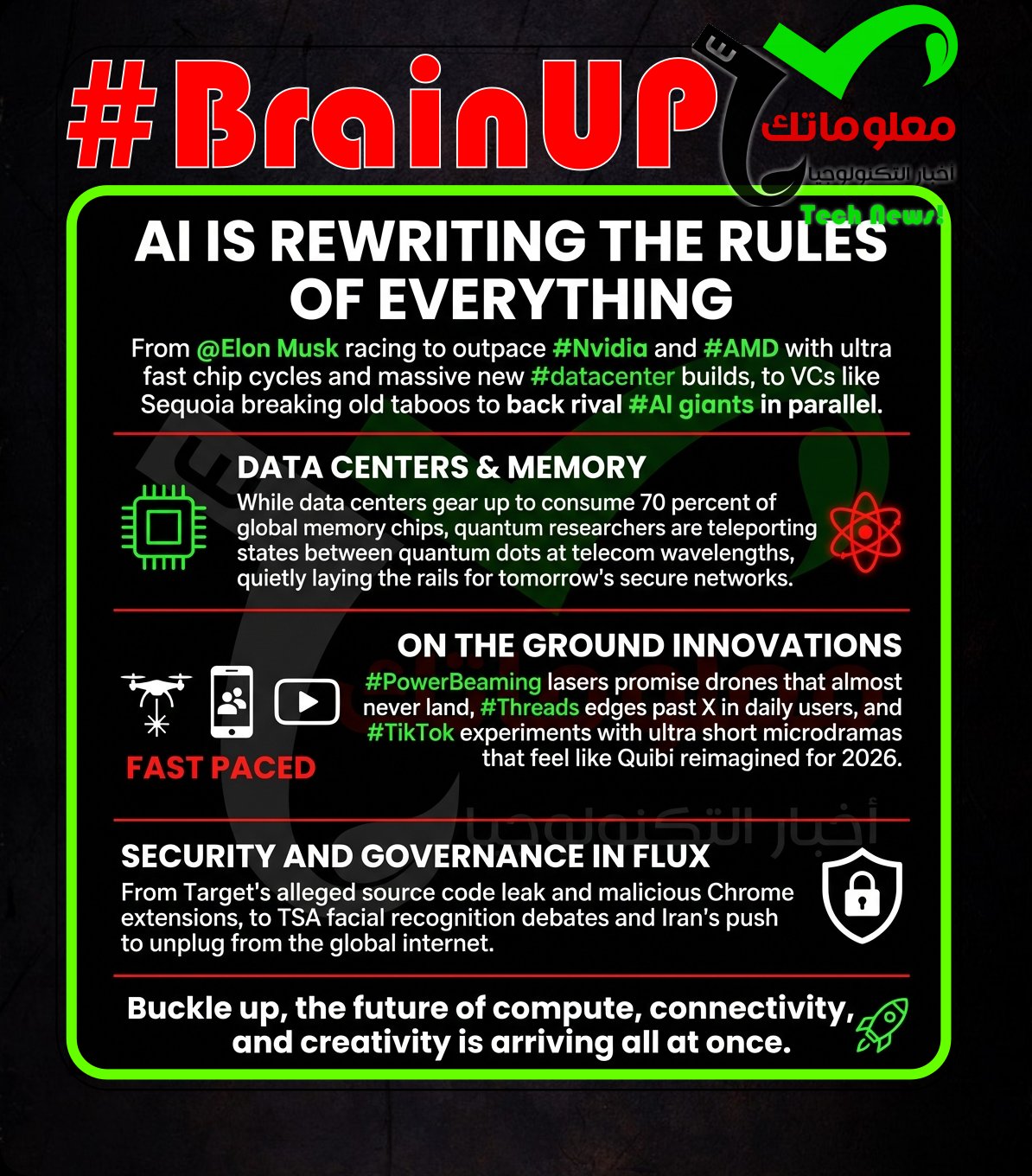
Unknown hackers claim to be selling ~860 GB of Target internal source code and documentation, including #wallet_services, #identity_management, #gift_card_systems and other internal tooling. The data appeared in multiple repositories on Gitea, with a SALE.MD file listing tens of thousands of files and directories and an index over 57,000 lines, billing the archive at roughly 860 GB. Commit metadata and documentation in the repositories referenced internal Target development servers and internal URLs such as confluence.target.com, and named current Target engineers. Target moved to take down the Gitea repositories and locked down its internal Git server after outreach. Authenticity of the claims is unverified, Target has not commented, and some data may have been publicly accessible earlier as search engines cached content from git.target.com.
@Elon Musk has outlined a strategy to release new #AI processors every nine months, aiming to outpace competitors like #Nvidia and #AMD, who operate on a yearly release cycle. This aggressive cadence is supported by Tesla’s growing chip production capabilities, intending to achieve the highest volume of AI chips globally. The roadmap focuses on enhancing processing efficiency and performance to support Tesla’s AI-driven initiatives, highlighting Musk’s commitment to maintaining technological leadership in AI hardware. By shortening the update cycle, Tesla positions itself to rapidly adapt and improve its AI infrastructure, potentially reshaping the competitive landscape in AI chip manufacturing. This plan underscores Musk’s vision to lead not only in electric vehicles but also in pioneering AI chip technology.
An erroneously assembled 1974 MITS Altair 8800 kit, originally left incomplete with errors, has been repaired with a new power supply and finally run a program after 52 years. SDF from the Interim Computer Museum documented that the Altair successfully ran its first program in 2016, using the front panel switches and LEDs to play the rudimentary game #KillTheBit by @Dean_McDaniel. A 2026 restoration with a new PSU enabled a public video showing the machine, which has no screen or video output, running its first game program again. The Altair 8800, famous for popularizing the #S100 bus and using the @Intel 8080 CPU at 2.0 MHz, cost $439 as a kit and $621 as an assembled model, illustrating the era’s hobbyist economics. This revival connects early microprocessor history to modern preservation, with @Federico_Faggin noted for the 8080 design, and frames the #retrocomputing story around the @Intel platform that shaped personal computing.
4. Microsoft confirms some Windows 11 PCs can’t shut down, hibernate after latest Patch Tuesday
Microsoft acknowledged that following the latest Patch Tuesday updates, some Windows 11 users experience issues where their PCs cannot shut down or enter hibernation. The problem affects certain devices after installing the cumulative updates released on June 13, 2023. Microsoft advises users to manually shut down their PCs using the physical power button as a temporary workaround while an official fix is in progress. The company is investigating the root cause and plans to release a solution in an upcoming update to restore normal shutdown and hibernation functionality. This situation reflects challenges in patch deployment for #Windows11, emphasizing the importance of timely updates and user awareness during troubleshooting.
An out-of-band emergency fix from @Microsoft addresses critical bugs introduced by the January 2026 Windows security update that left some Windows 11 devices unable to shut down or hibernate and also disrupted remote logins for Windows 10/11. The patch fixes the shutdown/hibernate issue for systems using Secure Launch and restores remote login via remote connection apps, while Microsoft notes credential prompts failures as the cause for remote-login problems. Some lingering issues from the January update, such as blank screens or Outlook Classic crashes, were reported by users. This incident underscores the ongoing challenge of patch management, where security updates must be balanced with stability across the Windows family, with Windows 10 still eligible for Extended Security Updates. It shows how #SecureLaunch and #RemoteLogin remain central to device security and access, and that follow-up fixes from @Microsoft are expected as the ecosystem evolves.
6. Sequoia to invest in Anthropic, breaking VC taboo on backing rivals: FT | TechCrunch
Sequoia Capital is reportedly joining a blockbuster funding round for Anthropic, the #AI startup behind Claude, signaling a rare break with the VC rule against backing competing players in the same sector. The round is led by #GIC and #Coatue, each contributing about $1.5 billion, as Anthropic seeks $25 billion or more at a $350 billion valuation, with Microsoft and Nvidia committing up to $15 billion and others adding more. Sequoia already backs multiple AI rivals, including @OpenAI and @Elon Musk’s @xAI, and its relationship with @Sam Altman runs deep, from Altman’s past connection to Sequoia to ongoing interactions even as OpenAI executives emphasize industry standard protections against non-passive investments in competitors. Sequoia’s shift contrasts with its history, such as the 2020 Finix episode in which it walked away from an investment after determining the startup competed with @Stripe, forfeiting $21 million and relinquishing a board seat and information rights. The move highlights a broader reevaluation of portfolio conflicts among leading investors and could reshape funding dynamics for #AI startups and the ecosystem around @Anthropic.
7. South Africa Turns to Batteries to Overcome Power Crisis
South Africa is investing in #battery storage to mitigate frequent electricity shortages caused by an aging power grid and unreliable coal plants. The government and private sector are deploying large-scale battery systems to store energy during off-peak hours and release it during peak demand, improving grid stability. This transition supports the integration of renewable energy sources like solar and wind, which are intermittent by nature. Experts highlight that batteries enable a more flexible and resilient energy system, reducing reliance on coal and cutting carbon emissions. The shift aligns with global trends toward sustainable energy solutions and addresses South Africa’s urgent need to provide consistent power to its population and economy.
8. Trump’s voice in a new Fannie Mae ad is generated by artificial intelligence, with his permission
An AP News article reports that a Fannie Mae ad is narrated by a voice that resembles @Donald Trump, but the video disclaimer confirms it is an AI-cloned voice created with his permission. The disclaimer states the voice is AI-generated and that @Donald Trump approved its use. This illustrates how #artificialintelligence and #voicecloning can imitate public figures in advertising when permission is granted, highlighting #transparency concerns for viewers. The piece points to evolving practices in AI usage in advertising and the need for clear disclosures to maintain trust.
9. Laser based charging system aims to keep drones airborne indefinitely
PowerLight Technologies is developing a laser-based wireless power system to keep drones airborne for extended periods without landing. The system can transmit kilowatt-class power over roughly 2 km, with an autonomous ground transmitter that tracks the aircraft and directs a laser beam with precision to deliver energy in flight, a concept described as a wireless power line in the air. The setup combines beam control software and hardware to sustain kilowatt energy delivery, while a lightweight onboard receiver of about six pounds converts non-visible laser energy back into electrical power and supports telemetry and a bi-directional optical data link. PowerLight is collaborating with @FatemaHamdani of Kraus Hamdani Aerospace to integrate the system into the #K1000ULE long-endurance drone, reshaping theater-wide mission persistence by eliminating refueling or recharging stops. Fully integrated flight testing is planned for early this year to demonstrate sustained in-flight charging and prove the end-to-end #PowerBeaming capability for #UAS.
10. Former USDS Leaders Launch Tech Reform Project to Fix What DOGE Broke
A small cadre led by @MikeyDickerson is launching #TechViaduct, a reform effort to reboot how the US delivers services and channel the bold decisiveness once associated with #DOGE toward the public good. The project is still early-stage but has funding from the Searchlight Institute, with about $1 million, and an advisory panel that includes @DenisMcDonough, @AlexanderMacgillivray, @MarinaNitze, and @RobbyMook, with @MikeyDickerson as senior adviser. Dickerson says the aim is to fix how government gets things done, asking what a terraformed, more agile federal ecosystem would look like. Tech Viaduct’s first aim is to produce a master plan to remake government services, establishing an unbiased procurement process, a merit-based hiring system, and strong oversight by inspector generals, with initial recommendations due by spring and potential White House adoption by 2029 if a Democrat wins.
11. DRAM makers brace for AI and data center demand amid semiconductor shortage
DRAM manufacturers are preparing for increased demand driven by the acceleration of artificial intelligence and data center expansion, amid ongoing semiconductor shortages. The surge in AI workloads requires higher memory density and faster DRAM chips, intensifying production challenges as supply chains remain strained. Companies like @Micron and @Samsung are ramping up output while investing in new technologies to meet the needs of cloud service providers and AI developers. This trend indicates a critical link between #AI technology growth and the semiconductor industry’s capacity, highlighting vulnerabilities in the supply chain. Sustained investment and strategic planning are essential to bridge this gap and support the expanding digital infrastructure.
Data centers are projected to consume 70 percent of memory chips produced by 2026, driven by increasing demand for cloud services and AI workloads. This surge in demand is creating a supply shortage that may extend the current chip scarcity to other sectors such as consumer electronics and automotive industries. Analysts highlight that the imbalance between supply and demand could intensify as memory chip manufacturers prioritize data center clients over other markets. The trend underscores how #data_center growth is reshaping the #memory_chip market, impacting the availability and pricing far beyond its original scope. Understanding this shift is crucial for stakeholders across technology segments to anticipate and adapt to the evolving chip supply landscape.
13. Plastic surgeons are now using fat harvested from dead people in controversial new procedure
Plastic surgeons are adopting alloClae, a fat filler derived from nonliving donor fat cells, to augment breasts, buttocks, and other contours, claiming instant volume and shorter recovery with no anesthesia. Manufactured by Tiger Aesthetics, alloClae can cost from $10,000 to $100,000 and is growing in demand as surgeons note faster results than traditional fat grafting. The trend has surged as weight loss drugs like #GLP-1 agonists such as #Ozempic leave some patients with loose skin, prompting interest in contouring options. Experts such as @Sachin Shridharani say the appeal is convenience, while @Darren Smith, MD notes the donor fat contains intact cells and growth factors that offer instant volume. Some doctors, including @Troy Pittman, MD, frame donor fat as a natural alternative to implants and synthetic fillers, though the morbid origin remains a point of debate. Overall, the piece portrays a controversial yet growing trend in cosmetic surgery that ties donor-derived tissue to modern body contouring.
14. Elon Musk’s XAI opens major new datacenter in Memphis
Elon Musk’s AI startup, XAI, has inaugurated a large-scale datacenter in Memphis aimed at advancing its AI research capabilities. The facility is designed to enhance computational power and storage capacity, supporting XAI’s development of next-generation AI models. This expansion reflects Musk’s commitment to leveraging cutting-edge #datacenter infrastructure to compete in the growing AI market. Analysts suggest that the Memphis datacenter will enable significant improvements in training efficiency and model performance. By investing in robust hardware, XAI positions itself to influence the rapidly evolving #AI landscape effectively.
15. NASA Artemis mission to return humans to the moon by 2028
NASA has set a new target to return humans to the moon by 2028 through its Artemis program, aiming to establish a sustainable human presence on the lunar surface. The decision follows budget adjustments and technical challenges that delayed previous timelines. Artemis is designed to build on the legacy of the Apollo missions and will include landing the first woman and next man on the moon. This initiative also supports long-term plans for lunar exploration and serves as a stepping stone for future missions to Mars. The timeline shift aims to balance ambition with technological readiness and fiscal responsibility.
16. CEO of Iranian telecom operator fired for failing to block internet
The CEO of an Iranian telecom operator was dismissed for failing to comply with government orders to block internet access during nationwide protests. Iranian authorities demanded the shutdown to disrupt communication among protesters and control the spread of information. This removal highlights the tensions between the government’s strict censorship policies and the operational challenges faced by telecom companies. The case emphasizes Iran’s ongoing efforts to maintain strict control over digital communication in times of civil unrest. It also underlines the impact of #internetshutdowns on both governance and public dissent in Iran.
17. Startup company wants to light up the night skies with reflected sunlight
The California startup Reflect Orbital aims to light up the night by placing 4,000 sky mirrors in orbit to reflect sunlight onto Earth after dusk, promising extra light for cities and energy sites but risking the night sky’s darkness. Led by @NASA’s Dr. Borlaff, the plan envisions mirrors up to 55 meters wide in a #sun-synchronous orbit to catch sunlight at the day-night boundary, with the first satellite #Earendil-1 targeted for a 2026 #FCC-licensed demonstration. The reflected beam could be four times brighter than the full moon and visible as a bright moving object up to about 60 miles away, potentially sweeping across telescopes and habitats and raising concern among observers. Space debris concerns loom as Low Earth Orbit hosts working satellites and fragments, with satellite trails forecast to contaminate images and numbers rising from ~2,000 in 2019 to 15,000 in 2025 and an estimated 560,000 by 2040, while night sky brightness rises about 10% annually. The project underscores a tension between urban illumination and preserving darkness for astronomy, as regulators and scientists weigh the risks of light contamination, skyglow, and safety in space.
18. Credential-stealing Chrome extensions target enterprise HR platforms
A new wave of malicious Chrome extensions is targeting enterprise HR platforms such as Workday, SAP, and Oracle PeopleSoft, aiming to steal employee credentials through browser injection techniques. These extensions masquerade as legitimate tools but inject malicious code to intercept login credentials and telephone numbers submitted on HR portal login pages. This threat exploits the trust users place in browser extensions and the critical nature of HR systems in managing sensitive employee data. The attackers leverage the extensions to collect information and potentially facilitate further corporate espionage or financial fraud. These incidents highlight the importance of scrutinizing browser extensions in enterprise environments and the need for improved security frameworks around browser-based authentication.
19. XREAL files lawsuit against rival smart glass maker Viture
In a Texas federal court, @XREAL filed a lawsuit against rival AR glasses maker @Viture, accusing it of illegally incorporating XREAL’s patented tech into its Luma Pro, Luma Ultra and Beast glasses. XREAL says the case goes beyond a single patent and signals a pattern of IP infringement that could threaten ongoing innovation in AR/VR, noting that it has secured a preliminary injunction in Germany that halted sales of Viture’s Pro, Luma and Luma Pro in Europe and that XREAL holds over 800 patents worldwide while Viture reportedly holds fewer than 70 with none in the US or Europe. Viture has denied infringement, stating the patent is weak and that claims of a nine-country ban are false, and it has said it is taking legal action in response to XREAL’s comments. The dispute underscores how patent fights can influence product availability and innovation in AR glasses, especially as @ASUS teams with XREAL on the CES 2026 ROG X R1 AR glasses, illustrating the competitive stakes in the industry.
20. Threads edges out X in daily mobile users, new data shows
Threads, Meta’s new social media app, has surpassed X (formerly Twitter) in daily mobile users, indicating a significant shift in user engagement within the social networking space. Data reveals that Threads achieved a faster growth rate, quickly capitalizing on migration from X following recent management and policy changes at X. This trend highlights the dynamic competition between social platforms and reflects changing user preferences for microblogging and interactive communication. Meta’s integration of Threads with Instagram likely contributed to its rapid adoption, emphasizing the advantage of ecosystem synergy. Overall, this development signals a potential reshaping of the social media landscape, with Threads emerging as a strong contender against established players like X.
21. ASUS 800 Series Boards Are Killing Ryzen 7 9800X3D Chips, Five Dead CPU Reports in Two Weeks
Reports have emerged indicating that ASUS 800 series motherboards are causing failures in Ryzen 7 9800X3D processors, with five cases of dead CPUs reported within two weeks. Users observed that the chips, when paired with these boards, experienced critical damage after brief usage, suggesting a compatibility or design flaw. The issue appears to be specific to ASUS motherboards within this series, highlighting a potential risk for consumers running #AMD Ryzen 7 9800X3D on these platforms. This situation underscores the importance of motherboard and CPU compatibility in system stability and may prompt @ASUS to investigate and address the hardware conflicts to prevent further damage. Such incidents could affect user trust and influence purchasing decisions in the #gaming and #PCbuilding communities.
22. TikTok’s latest spinoff app feels a lot like Quibi, but with shorter and cornier content
TikTok’s PineDrama app offers serialized #microdramas with minute-long episodes and cliffhangers designed to maximize scrolling on a vertical-video feed @TikTok; the shows, such as The Officer Fell For Me or Married to my past life’s nemesis, are free to watch with no ads for now, and the interface includes a Discover tab, favorites, and real-time reactions from viewers, echoing a social, bingeable model. The format channels Quibi’s short-form experiment, though PineDrama markets itself as a TikTok-native experience rather than standalone content, leaving monetization and ads as open questions and masking potential revenue strategies behind free access. The lack of a clear stance on ads or costs suggests an early testing phase as rival micro-drama platforms like DramaBox or ReelShort pursue paid structures, while TikTok previously experimented with Minis inside its app. This approach highlights a broader push toward ultra-short serialized content to capture attention and engagement, signaling TikTok’s continued diversification of formats even as Quibi’s downfall provides a cautionary backdrop.
@Intel’s Core Ultra 9 290HX Plus is an Arrow Lake refresh that delivers strong single-core and competitive multi-core performance for a mobile CPU #ArrowLake. In PassMark, it records 5,009 single-core points, the highest for any x86 mobile CPU and roughly 7.5% faster than its predecessor 285HX, while keeping pace with desktop peers like the Core Ultra 9 285K and Core Ultra 7 270K Plus #PassMark #Intel. In multi-core, it scores 66,203, just below the desktop 285K and AMD Ryzen 9 9950X3D, yet it leads among mobile chips and beats Ryzen 9 9955HX3D by about 6.2% #AMD #Mobile. The listing indicates a 24-core/24-thread config with 8 performance cores and 16 efficiency cores, with boost clocks rumored around 5.4 to 5.5 GHz and memory spec noted as DDR5-5600 SO-DIMM in the tested laptop #DDR5-5600. While the results come from a single PassMark run, the article notes a March or April launch window for the Arrow Lake refresh across laptops and desktops #Launch #CES2026.
24. Quantum state teleported between quantum dots at telecoms wavelengths – Physics World
A proof-of-principle demonstration teleports a quantum state between photons from two different quantum-dot sources located several metres apart, using telecom-wavelength photons to advance quantum networks and repeaters. One dot emits a single photon while the other produces an entangled photon pair; a photon from the pair interferes with the single photon, creating a superposition that transfers the state to the distant partner photon. To make the remote photons indistinguishable for interference, the team uses #quantum-frequency-converters to tune their wavelengths, shifting from ~780 nm to 1515 nm without altering the quantum state. The photons travel through a short optical fibre of about 10 m, and telecom wavelengths offer compatibility with existing fibre networks, a key step toward real-life applications and longer distances. The work, published in Nature Communications, is echoed by @Rinaldo Trotta’s group at Sapienza University, reinforcing the maturity of #quantum-dot light sources for scalable quantum networks.
25. Spotify’s 3rd price hike in 2.5 years hints at potential new normal
Spotify has announced its third price increase in 2.5 years, raising Premium from $12 to $13 per month for February billing and nudging other plans upward, while the Basic tier at $11 remains unchanged. This follows prior hikes in 2023 and 2024, with Duo and Family plans also increasing, signaling a broader pricing shift across its lineup. Spotify frames the changes as a reflection of the value delivered and a means to invest in features and artist pay, citing recent additions such as lossless audio, music videos, new Messages features, and a Hollywood podcast studio, as well as leadership from @DanielEk #royalties #lossless_audio #podcasts #pricing. The company also notes it paid $10 billion in music royalties in 2024, while industry voices continue to debate how much artists earn and how changes to royalties affect musicians. Despite criticisms—from ad campaigns to AI concerns—and strong growth metrics (Premium subs +12%, Basic users +11%, total MAUs +11%) with gross profit up 9% to $1.56B, Spotify appears positioned to pursue more frequent price updates to fund new ventures, features, and royalties, potentially establishing a new pricing normal.
26. Bluesky rolls out cashtags and live badges amid a boost in app installs
Bluesky has introduced new features including cashtags and live badges to enhance user engagement amid a recent surge in app installs. Cashtags allow users to tag stocks or financial assets easily, integrating social interaction with market trends on the platform. Live badges provide real-time status updates, enriching user profiles and interaction dynamics. These updates come as Bluesky’s popularity grows, potentially positioning it as a notable competitor in the social media landscape. By adding financial and interactive elements, Bluesky aims to deepen user involvement and diversify content, aligning with trends toward more dynamic and personalized social experiences.
27. Sanders grills Oz on robots, ultrasounds, Alabama
Senator @BernieSanders questioned Dr. Mehmet Oz regarding his views on automation and the use of robots in industry during a Senate hearing, emphasizing the potential impact on workers’ jobs. Sanders highlighted concerns about the replacement of human labor with #robots and stressed the importance of policies protecting workers during technological transitions. Oz responded by acknowledging the need to balance innovation with job security. This exchange reflects ongoing debates about #automation’s effects on the workforce and the role of policymakers in managing economic change.
28. TSA Facial Recognition Raises Traveler Rights Concerns | The Regulatory Review
Facial recognition at U.S. airports, implemented via @TSA credential authentication technology (#facialRecognition #privacy), raises privacy and civil liberties concerns even as the agency touts security and efficiency. Redmon argues that opt-out is often illusory due to vague signage and officer pressure, with notices about refusal being unclear. There is little transparency on demographic performance data, and independent studies show higher misidentification rates for women and people of color, risking harm from false matches. Even small error rates could yield thousands of false matches across hundreds of airports, and the COVID-19 pandemic has accelerated interest in contactless verification, expanding the potential reach of biometric checks. The article situates the program within a broader surveillance concern, arguing that embedding facial recognition into routine travel could normalize biometric tracking and later be repurposed for law enforcement or immigration monitoring, challenging Fourth Amendment protections.
29. Iran plans permanent break from global internet, say activists
Iran plans a permanent break from the global internet, allowing only government-vetted users to access a filtered version of the web while others would be confined to a domestic, parallel network. The plan is described as turning international internet access into a ‘governmental privilege’ by @Filterwatch, with @Amir_Rashidi noting that security-clearance holders would access the global, filtered internet and others would be limited to #whitelisting. State media signaling a permanent shift and warnings that unrestricted access will not return after 2026 are cited as evidence, alongside the ongoing internet shutdown that began on 8 January amid anti-regime protests. The move, if implemented, would be costly and far-reaching, enabling authorities to monitor and block traffic through #whitelisting technology and potentially aided by components from China, reflecting a 16-year effort to cement regime control over Iran’s internet. The plan completes a long-running effort to tighten information control and would have major economic and cultural impacts.
30. Musk wants up to $134B in OpenAI lawsuit, despite $700B fortune | TechCrunch
Elon Musk is seeking as much as $79 billion to $134 billion in damages from @OpenAI and @Microsoft, arguing that the AI venture defrauded him by abandoning its nonprofit mission and that he should be treated as an early investor with outsized returns. Expert witness @C. Paul Wazzan estimated wrongful gains of about $65.5B to $109.4B for @OpenAI and $13.3B to $25.1B for @Microsoft, tying the numbers to OpenAI’s current ~$500B valuation and Musk’s $38M seed donation, noting a 3,500-fold return on his investment. With a personal fortune around $700B, even a $134B payout would be a relatively modest addition and may fuel arguments that the case is less about money than a broader #harassment narrative. OpenAI has warned that Musk will make outlandish, attention-grabbing claims as the trial heads to court in April in Oakland, California.
That’s all for today’s digest for 2026/01/19! We picked, and processed 30 Articles. Stay tuned for tomorrow’s collection of insights and discoveries.
Thanks, Patricia Zougheib and Dr Badawi, for curating the links
See you in the next one! 🚀
