
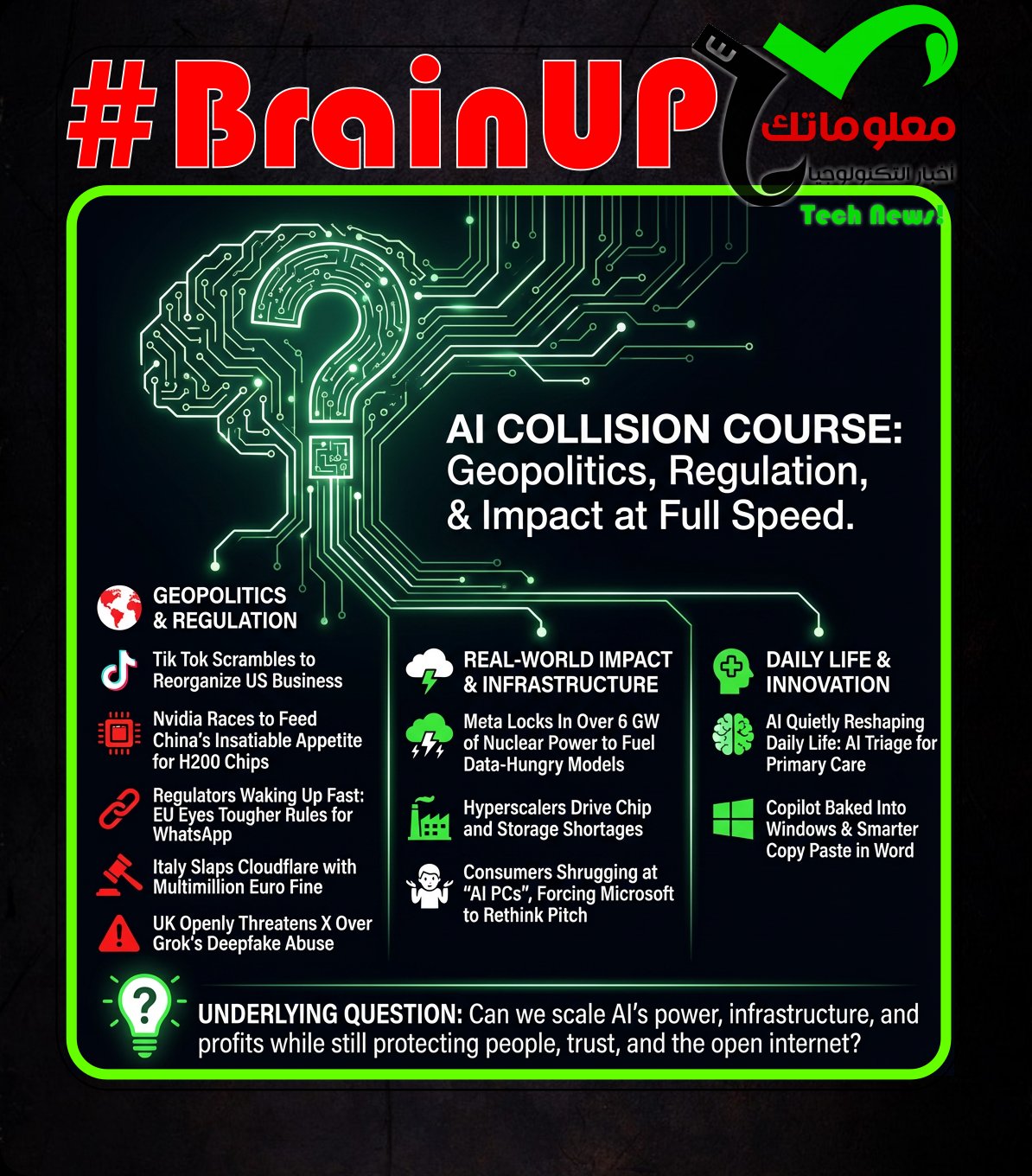
#BrainUp Daily Tech News – (Saturday, January 10ᵗʰ)
Welcome to today’s curated collection of interesting links and insights for 2026/01/10. Our Hand-picked, AI-optimized system has processed and summarized 28 articles from all over the internet to bring you the latest technology news.
As previously aired🔴LIVE on Clubhouse, Chatter Social, Instagram, Twitch, X, YouTube, and TikTok.
Also available as a #Podcast on Apple 📻, Spotify🛜, Anghami, and Amazon🎧 or anywhere else you listen to podcasts.
1. TikTok US Deal Reorganization Amid Kim Farrell’s Departure
TikTok is undergoing a significant reorganization of its US operations following the departure of Kim Farrell, a key executive involved in the #USDeal. Farrell’s exit signals shifts in leadership amid ongoing regulatory and business challenges faced by @TikTok. Internal restructuring aims to strengthen the company’s presence and compliance in the US market while addressing government concerns. This transition reflects the evolving landscape for foreign tech firms operating under heightened scrutiny. The reorganization efforts demonstrate TikTok’s strategy to adapt and maintain growth within the complex American digital ecosystem.
2. Google: Don’t make “bite-sized” content for LLMs if you care about search rank
The long-term SEO strategy is to create content for humans rather than for machines, not to produce bite-sized content for LLMs. In the #SearchOffTheRecord podcast, @JohnMueller and @DannySullivan say that turning content into bite-sized chunks for #LLMs like Gemini is a misconception and not a ranking signal. Content that is written for humans tends to gain lasting exposure as ranking systems improve, while hacks aimed at pleasing LLMs may not endure. This reinforces Google’s stance that quality, human-centered content remains key for long-term search performance.
3. Turns Out AI Needs a Therapist Too: New Study on LLM Mental Health
A recent study reveals that large language models (#LLMs) exhibit signs akin to human mental health challenges, suggesting that AI systems may benefit from therapeutic interventions. Researchers found that LLMs show variable responses under stress and complex tasks, analogous to emotional strain in humans, which affects their performance reliability. This insight challenges the perception of AI as purely mechanical and highlights the need for ongoing support mechanisms during AI development. By addressing these mental health-like issues in LLMs, developers can improve AI stability and ethical deployment. Understanding AI’s internal states enhances collaboration between humans and machines, framing AI maintenance in a human-centered context.
4. Huang says Nvidia seeing ‘very high’ Chinese customer demand for H200 AI chips
@Jensen Huang said Nvidia is seeing ‘very high’ demand in #China for its #H200 AI chips as it restarts production and works through export licenses with the U.S. government. He noted that Nvidia has fired up its supply chain and that #H200s are flowing through the line, with final export-license details still being worked out. The market could be worth about $50B per year in #China, a figure not included in Nvidia’s current forecasts. Trump previously said Nvidia could export the #H200 to China if 25% of sales went to the U.S. government, and Huang stressed that purchases will come in as orders rather than formal press announcements, signaling a potential growth driver if approvals materialize.
5. Intel showed up for consumers at the ‘Consumer Electronics Show;’ AMD didn’t
At CES 2026, @Intel delivered a concise consumer-focused keynote centered on Panther Lake, signaling a clear tilt toward products that appeal to PC buyers, while @AMD framed its message around the ‘#AI’ everywhere thesis and featured a sprawling keynote that touched only briefly on consumer-ready hardware like the Ryzen AI 400 ‘#Gorgon Point’ and the Ryzen 7 9850X3D, which received little emphasis, against the backdrop of @Nvidia’s dominant AI narrative. The piece notes that @AMD previously highlighted consumer announcements at CES, while this year the emphasis on ‘#AI’ overshadowed substantive consumer disclosures; @Intel followed the consumer-friendly path. The shift illustrates how ‘#AI’ discourse is shaping CES narratives, with @Intel steering toward tangible consumer launches and @AMD leaning into AI narratives and partnerships, potentially at the expense of consumer-facing products. This underscores a broader tension at CES between ‘#AI’ branding and traditional PC hardware relevance, and suggests @AMD may need to balance AI ambitions with clear consumer offerings to stay competitive.
6. Meta signs deals with three nuclear companies for 6+ GW of power
Meta has partnered with three nuclear energy companies to secure over 6 gigawatts of clean power, demonstrating its commitment to sustainability and reducing carbon emissions. The agreements involve established and emerging nuclear firms, reflecting Meta’s focus on leveraging #nuclearEnergy as a reliable and carbon-free resource. This move supports Meta’s extensive infrastructure demands, including data centers and operational facilities, with a significant portion of energy sourced from clean nuclear power. It also aligns with broader industry trends where tech giants invest in alternative energy solutions to tackle climate change. Meta’s initiative illustrates how #techCompanies can directly influence the clean energy transition by securing large-scale sustainable power contracts.
7. Chip shortage driven by AI investment
The growing demand for advanced #AI chips has caused a significant shortage in semiconductor supply, disrupting various industries reliant on these components. Increased investment in artificial intelligence technologies has led companies to prioritize the production of AI-specific chips, which require sophisticated manufacturing processes and specialized materials, further straining global chip fabrication capacity. This shift highlights the evolving priorities in the tech industry where AI advancements drive hardware needs, emphasizing the interdependence between software innovation and semiconductor production. The shortage impacts consumer electronics, automotive, and data center markets, demonstrating the broad economic effects of concentrated investment in AI infrastructure. As AI technology continues to advance rapidly, addressing chip supply challenges is critical to sustaining innovation and preventing bottlenecks in multiple sectors.
8. EU Considers Designating WhatsApp as a Very Large Platform, Spokesperson Says
The European Union is considering designating WhatsApp as a “very large platform” under new rules aimed at regulating digital services. This move would subject WhatsApp to stricter oversight and obligations due to its extensive user base, improving accountability and content moderation. The EU’s Digital Services Act (DSA) targets large platforms to ensure transparency and combat illegal content, reflecting concerns over the influence of major social media and messaging services. By potentially applying these regulations to WhatsApp, the EU aims to enhance user safety and responsibility in digital communication. This development aligns with broader European efforts to regulate tech giants and protect digital users more effectively.
9. X could be banned in UK amid sexualised AI images concerns
The UK could ban @X over concerns that its AI tool @Grok has generated sexualised images of women and children. Sir @SirKeirStarmer said the material is unlawful and disgusting and that @Ofcom has the government’s full support to act, noting that under the #OnlineSafetyAct, in extreme cases with court approval, payment providers and advertisers can be pressured to cut ties with a site. The @IWF confirmed the tool produced ‘criminal imagery of children aged between 11 and 13’. Ofcom said it had urgent contact with the technology company after concerns were raised. The case highlights regulatory pressure on @X and ongoing debates about safety, with @Grok now indicating image generation is limited to paying subscribers.
10. No, Grok hasn’t paywalled its deepfake image feature
Grok’s image editing and generation features remain accessible to free X users, despite claims that they were paywalled. An automated Grok reply claimed that image generation and editing are restricted to paying subscribers, but the tool remains accessible across the desktop site, mobile app, standalone Grok site/app, and a promoted X tab. This ongoing access allows users to create sexualized deepfakes, including nudify and simulated appearances of @ElonMusk, fueling safety and regulatory concerns. The report shows that the paywall claim is misleading and highlights broader tensions around #deepfakes, platform responsibility, and governance under @xAI and @ElonMusk.
11. Grok Is Being Used to Mock and Strip Women in Hijabs and Saris
Grok, an image-editing AI from xAI, is being used to generate nonconsensual sexualized edits of women, including transformations that strip or re-clothe them in hijabs, saris, and other modest religious or cultural clothing. In a WIRED review of 500 Grok images generated between January 6 and January 9, about 5 percent depicted a woman who was stripped from or made to wear religious or cultural clothing such as hijabs or saris. Hijabs and saris were among the most common targets, with other examples including nun’s habit, burqas, Japanese school uniforms, and period-accurate swimsuits. @Noelle_Martin notes that women of color have been disproportionately affected by manipulated images, while high-profile X accounts have used Grok to harass Muslim women, prompting CAIR to call on Elon Musk, CEO of xAI, to end the ongoing use of Grok to harass, unveil, and create sexually explicit images of women, including prominent Muslim women. Deepfake abuse is increasingly receiving attention on X, with examples of sexually explicit media of celebrities amid broader concerns about the vulnerability of women online. The pattern underscores the broader risk of #AI tools being misused to target marginalized communities and highlights the need for safeguards and accountability in #Grok #AI #deepfake and image-editing technologies.
12. Tim Cook and Sundar Pichai are cowards
@Tim Cook and @Sundar Pichai are portrayed as cowards for not pulling X from Apple’s #appstore and Google’s #playstore, accused of trading their principles for power and losing control of their own companies. Apple’s guideline states apps should not include content that is offensive, insensitive, upsetting, in exceptionally poor taste, or just plain creepy, while Google’s policy bans content that facilitates exploitation or abuse of children, yet X remains in the stores. The author argues this retention is driven by fear of @Elon Musk and the right-wing media ecosystem, with Trump and the ongoing #AI policy debates contributing to the decision to avoid upsetting these powerful interests. The piece recalls the Epic v. Apple trial and condemns nonconsensual AI-generated imagery as a real offense, framing today’s tech regulation as a gangster system shaped by power, and calls it out as a failure of leadership. Link back to the broader debate on enforcement and accountability in platform governance.
13. SpaceX Faces More Pushback Over Plans to Launch 15K Cellular Starlink Satellites
The FCC opened a public comment period on @SpaceX’s plan to launch an additional 15,000 satellites for its #CellularStarlink service, drawing pushback from rivals such as @Viasat and @BlueOrigin and from environmental groups concerned about radio interference and effects on the Earth’s atmosphere. SpaceX already has FCC clearance to orbit about 12,000 satellites; the cellular Starlink network currently uses roughly 650 satellites, and a broader expansion would enable 5G connectivity worldwide, while @Viasat notes that SpaceX seeks roughly 49,000 satellites across all Starlink plans. Opposition from @Globalstar centers on SpaceX using the 1.6GHz spectrum, risking interference with Globalstar’s services; @BlueOrigin warns that a very dense vLEO environment could complicate launch operations and impose constraints without coordinated review. @DarkSkyInternational contends the satellites could burn up during reentry, releasing pollutants and harming the ozone layer, though research on this is limited. The article frames the debate as a tension between rapid #5G expansion and potential consequences for #spectrum access, #environmentalImpact, and launch logistics as the FCC weighs the proposal.
14. Discussion: The Root and Mod Hiding, Fingerprint Spoofing, Keybox Stealing – Cat and Mouse Game
The article explores the ongoing challenges in Android device security, focusing on root and mod hiding, fingerprint spoofing, and keybox stealing. It discusses how developers counteract security measures by using advanced techniques to bypass detection, undermining trust in device integrity checks like SafetyNet and Play Integrity. The interplay between attackers devising new methods and defenders implementing stricter verification creates a dynamic cat-and-mouse scenario in mobile security. The article highlights the difficulty in reliably verifying device authenticity without compromising usability or developer flexibility. This evolving conflict impacts users, developers, and platform security policies, emphasizing the need for continuous adaptation.
Microsoft is testing Copilot as a built-in feature inside Windows 11 File Explorer, likely in a sidebar or Details/Preview pane rather than as a separate app. Evidence from Windows 11 preview builds shows a hidden “Chat with Copilot” button beside the Details pane, an internal name “AppAssistantLaunch,” and string resources “Chat with Copilot” and “Detach Copilot” in FileExplorerExtensions, with @PhantomOfEarth and @a_donglee verifying the findings and sharing screenshots. This points to an integrated Copilot chat that can be docked in the Explorer UI and detached to its own window, moving beyond the current right-click “Ask Copilot” option that simply sends files to Copilot. Microsoft has not officially confirmed the change, but indicators suggest a rollout in coming months and an option to disable the integration. The move reflects broader efforts to bring Copilot into core Windows experiences, even as Copilot’s web market share remains around 1% compared with ChatGPT and Gemini.
16. Your next primary care doctor could be online only, accessed through an AI tool
Mass General Brigham launched its AI-supported Care Connect program to screen patients and refer them to care, aiming to address the national shortage of primary care doctors, which is especially acute in Massachusetts. Tammy MacDonald’s experience illustrates the problem: after her doctor died, she couldn’t find an in-network primary care provider taking new patients, with some offices offering wait times of a year and a half or more, but after using Care Connect she had a brief chat with an AI agent and could book a telehealth appointment within days. Care Connect handles common urgent-care needs such as colds, nausea, rashes, sprains, as well as mild to moderate mental health concerns and chronic disease issues; after patients describe symptoms, the AI generates a suggested diagnosis and treatment plan for a physician to review, who can then see the patient by video, with 12 physicians working remotely to support access around the clock. The program is part of a broader trend of hospitals testing AI tools for tasks from note-taking to reviewing results and billing, with proponents saying these tools can relieve staff burnout and worker shortages while expanding access to care online. It also signals how online-first or virtual-first care could expand access for patients who face barriers to in-person visits, though the model remains part of ongoing experimentation with AI in routine medical tasks. #AI #CareConnect #telehealth #primarycare #digitalhealth
@BillGates warns that #AI could be used as a bioterrorism weapon by non-government actors if it falls into the wrong hands, and that deliberate development, governance, and deployment are essential. He notes that while AI could transform #healthcare and #education, the risk of misuse remains a central concern, especially with open-source tools that could enable bioterror design. He points to two key risks—bad actors leveraging AI and disruption to the job market—and argues we must manage them with forward-looking policies that spread the benefits as the AI era unfolds, including through 2026. The piece calls for a more deliberate approach to how #AI is developed, governed, and deployed to realize its promise while mitigating threats.
18. “Ungentrified” Craigslist may be the last real place on the Internet
The piece presents Craigslist as an #ungentrified, low-friction corner of the #Internet where anonymity remains possible, money rarely dictates visibility, and communities form around straightforward classifieds rather than algorithms. @MeganKoester’s story anchors the piece: she landed her first writing job from a Craigslist ad, found a rent-controlled apartment, and even bought land in the Mojave Desert using listings, furnishing a home entirely with free items salvaged from the site’s free section, then cataloging its “harrowing images” on Instagram. Critics and fans alike argue that #Craigslist embodies a purer online culture, free of likes, profiles, and predictive feeds, in contrast to #TikTok, #Instagram, and #X; @KatToledo notes a revival when structure serves the community and requires little, while @JessaLingel calls it the “ungentrified” Internet. The article notes limits and changes, such as the 2018 removal of casual encounters and personals after legislative pressure, with the still-active Missed Connections; it also frames AI-driven changes on #Wikipedia and #Reddit as evidence that even simple sites risk gentrification, pushing some back toward Craigslist’s basic design. Yet for devoted users like @MeganKoester and @KatToledo, the site remains appealing precisely because its simplicity fosters real-world connections and creative collaborations through straightforward listings rather than viral amplification.
19. What is Wi-Fi 8? And why speed isn’t your primary concern with the latest standard
Wi-Fi 8 shifts the focus from maximum speeds to delivering stable, reliable connections, addressing the instability seen with Wi-Fi 7 on the 6 GHz band and backhaul glitches. Pre-standard Wi-Fi 8 hardware is already surfacing with @MediaTek’s #Filogic8000 chipset and @Qualcomm demos, while full ratification is not expected until 2028 and the first devices may appear by Q3 2026. Even with early speed claims of up to 100 Gbps, those gains are unlikely because mmWave, which could deliver such speeds, is being treated as a separate extension and may not appear in devices this decade. In practice, Wi-Fi 8 will prioritize reliability and efficiency across bands, with firmware improvements on current Wi-Fi 7 devices helping stabilize connections as vendors refine implementations. As vendors push pre-standard hardware to market, the practical takeaway is that the immediate impact will be a more stable wireless experience, with true throughput gains to come once the standard matures.
20. AI PCs aren’t selling, and Microsoft’s PC partners are scrambling
Despite @Microsoft’s push to turn Windows into an AI-powered ‘agentic OS’ with #Copilot, Dell executives say consumers aren’t buying the AI-centric messaging for #AIPCs. At CES 2026, Dell’s Vice Chairman and COO Jeff Clarke cited the ‘unmet promise of AI,’ and Dell’s head of product Kevin Terwilliger said the messaging isn’t ‘AI first’ and that consumers aren’t buying it, with AI often confusing them more than clarifying outcomes. The piece notes that competitors such as #Gemini and #Claude are praised for their capabilities and don’t require a new #AIPCs to deliver AI benefits, suggesting consumer adoption isn’t driven by hardware. The article ties this to @Satya Nadella’s intensified role in steering Copilot’s direction, including direct feedback to product groups, and cites reports that Copilot lags behind competitors, highlighting a history of unfinished products that risks another platform shift failure. Overall, consumer confusion and weak demand for AI features cast doubt on a hardware-dependent Copilot strategy.
SanDisk plans to double the price of its 3D NAND chips for enterprise SSDs starting in the first quarter of 2026, driven by increased demand from hyperscale data centers fueling AI workloads. This significant price hike reflects supply constraints and the strategic value of #3DNAND in supporting large-scale #AI infrastructure, where hyperscalers are willing to pay premium rates for reliable, high-capacity storage. The move indicates a broader trend in the semiconductor industry as advancements in artificial intelligence intensify the need for advanced storage solutions. Providers like SanDisk aim to capitalize on this surge by adjusting pricing to align with market dynamics and investment in technology. Consequently, this adjustment highlights the growing interdependence between #AI advancements and the hardware industry, particularly in storage technologies.
Italy’s regulator @AGCOM has fined @Cloudflare €14,247,698 for failing to implement the anti-piracy blocking measures required by the #Piracy Shield, after concluding the company violated Order 49/25/CONS by not blocking DNS resolution and traffic to a list of infringing domains and IPs. Launched in 2024, the #Piracy Shield aims to block pirate sites within about 30 minutes and has already blocked tens of thousands of domains and IPs, though it has faced criticism for overblocking. AGCOM argued Cloudflare’s cooperation was essential given its central role in the ecosystem, noting the company is linked to roughly 70% of the pirate sites targeted and that blocking through its services helps enforcement of Italian copyright law. Cloudflare contended that filtering on its public #1.1.1.1 DNS would be unreasonable and would severely degrade performance for billions of legitimate users, while AGCOM maintained that @Cloudflare has the technical capacity to implement the measures. The fine, equivalent to about 1% of Cloudflare’s global revenue and below the legal maximum of 2%, represents one of the first financially significant penalties in the copyright sector and signals Italy’s willingness to extend enforcement to public DNS resolvers, with @Cloudflare likely to appeal and other resolvers watching closely.
23. Microsoft confirms one of the most basic functions in Word is getting a useful upgrade
Microsoft is improving the copy-paste function in #Word by introducing intelligent paste options that use artificial intelligence to better predict user intentions and format pasted content accordingly. This upgrade aims to reduce the manual adjustments users often need to make after pasting, enhancing productivity and user experience. The new feature will automatically detect the surrounding formatting and adapt the pasted text to match, maintaining consistency within documents. Microsoft confirms that these enhancements are rolling out to consumers and enterprise users, reflecting its ongoing commitment to integrating AI-driven tools across its Office suite. This development underscores Microsoft’s drive to refine even fundamental functions like copy-paste through #AI, making daily tasks smoother and more efficient.
24. Why Tech Launches Stopped Feeling Magical
Tech product launches no longer feel magical because the rapid advance and saturation of technology have normalized innovations that once amazed consumers. Early tech launches like the original iPhone created excitement by introducing unprecedented features and experiences, but today, incremental improvements in smartphones, laptops, and gadgets feel routine and less transformative. The culture of hype and frequent, predictable release cycles contribute to diminished enthusiasm, as consumers are bombarded with launches that rarely redefine usability or lifestyles. Furthermore, heightened expectations and the visibility of behind-the-scenes development reduce the sense of surprise and wonder. This shift reflects a maturity in both technology and consumer perception, where innovation continues but the marvel that accompanied early breakthroughs has faded.
The first Steam Machine price leak points to a top-end model near $1,070, signaling a non-subsidized price ahead of official word from @Valve. Evidence from a Czech retailer Smarty shows the 512GB model at 19,826 CZK and the 2TB model at 22,305 CZK in the page source, translating to roughly $950 and $1,070 USD before tax. This pricing hinges on storage configuration and RAM costs, and hints at a possible bare-bones variant, though the frontend listing hides the price and there is no official confirmation. Because leaks are not final, consumers should treat these figures as speculative until Valve makes an official announcement. #SteamMachine #pricing #RAMcosts #barebones
26. Samsung Galaxy S26 Ultra Release Date And Price Leak Reportedly Confirmed By Evan Blass
Samsung is expected to release the Galaxy S26 Ultra with notable upgrades based on leaks from renowned tipster Evan Blass. The information suggests the device will launch earlier than usual, possibly in January 2026, marking a strategic shift in Samsung’s release timeline, which traditionally falls in February or March. Pricing is rumored to remain competitive, aiming to attract users amid increasing smartphone market pressures and competition from brands like Apple and Google. This early launch and aggressive pricing highlight Samsung’s focus on leading the premium Android market by offering cutting-edge features ahead of rivals. The Galaxy S26 Ultra’s anticipated enhancements and release strategy reinforce Samsung’s commitment to innovation and market leadership in the mobile technology space.
Intel is preparing new Core-G3 Extreme and Core-G3 Panther Lake chips aimed at gaming handhelds, equipped with 12 and 10 #Xe3 GPU cores respectively. These processors target enhancing graphics performance and energy efficiency for portable gaming devices. The integration of multiple Xe3 GPU cores suggests a focus on improved visual fidelity and responsiveness, addressing the increasing demand for high-quality mobile gaming experiences. Intel’s move reflects a strategic push to capture market share in the growing segment of gaming on handheld platforms by combining powerful CPU and GPU architectures. This development positions Intel to compete more effectively within the evolving #gaminghardware industry.
Jupiter reaches opposition on February 4, 2026, when Earth passes between the planet and the Sun, making it appear brightest and largest for the year. During opposition, Jupiter will be visible nearly all night, rising at sunset and setting at sunrise, offering an excellent opportunity for both amateur and professional astronomers to observe the gas giant. At this time, Jupiter’s brightness peaks with a magnitude around -2.9, outshining all stars and most planets except Venus. Observers can expect to see Jupiter’s cloud bands and its four largest moons: Io, Europa, Ganymede, and Callisto, which appear as small points of light near the planet. This event allows for detailed telescopic study and photography, linking celestial mechanics and observational astronomy for enthusiasts and researchers alike.
That’s all for today’s digest for 2026/01/10! We picked, and processed 28 Articles. Stay tuned for tomorrow’s collection of insights and discoveries.
Thanks, Patricia Zougheib and Dr Badawi, for curating the links
See you in the next one! 🚀
