
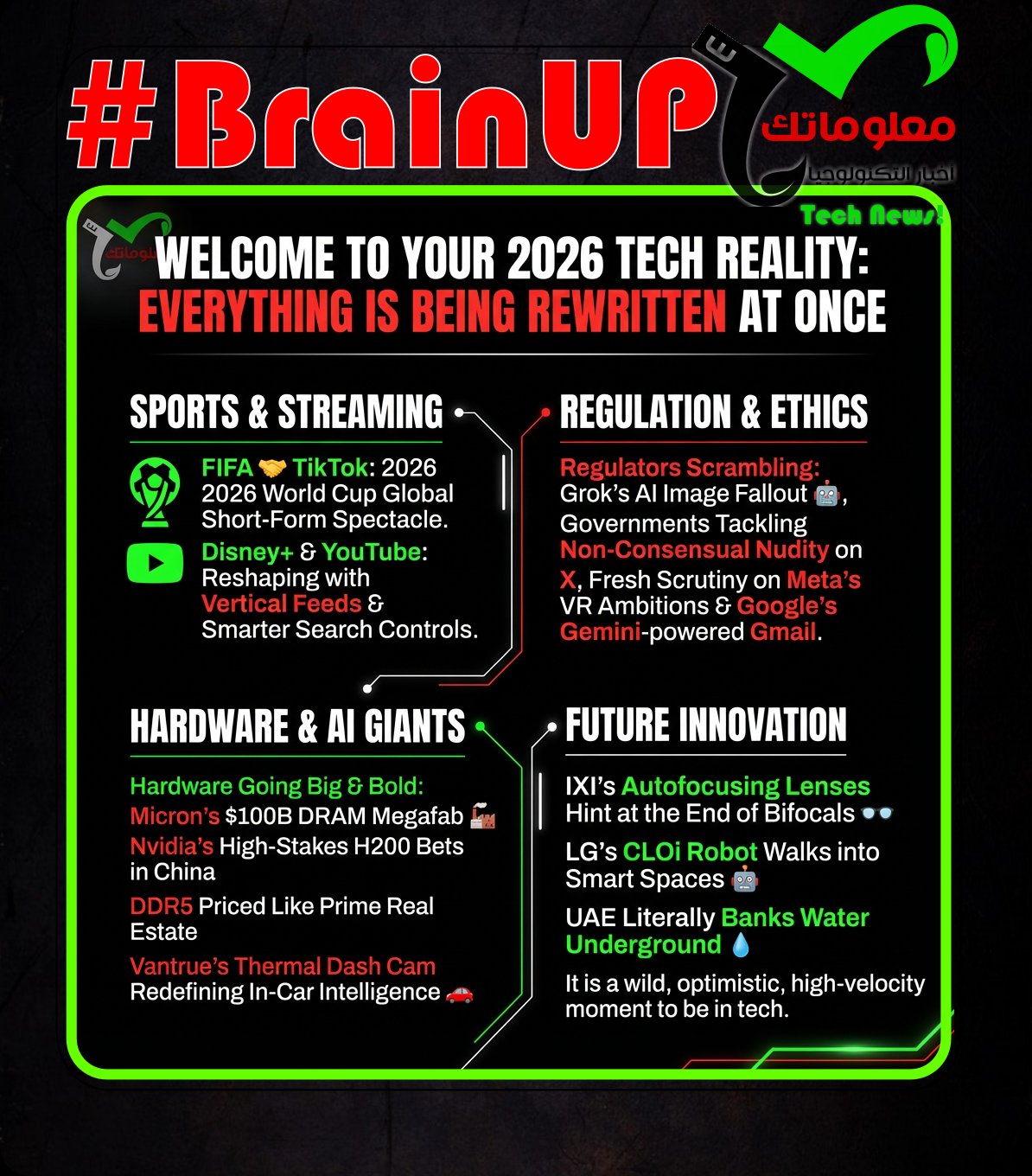
#BrainUp Daily Tech News – (Friday, January 9ᵗʰ)
Welcome to today’s curated collection of interesting links and insights for 2026/01/09. Our Hand-picked, AI-optimized system has processed and summarized 23 articles from all over the internet to bring you the latest technology news.
As previously aired🔴LIVE on Clubhouse, Chatter Social, Instagram, Twitch, X, YouTube, and TikTok.
Also available as a #Podcast on Apple 📻, Spotify🛜, Anghami, and Amazon🎧 or anywhere else you listen to podcasts.
1. FIFA appoints TikTok as official video content partner for 2026 World Cup
FIFA has named TikTok as the official video content partner for the 2026 World Cup, marking a strategic move to engage younger audiences through short-form video. This partnership will provide exclusive content and behind-the-scenes access, leveraging TikTok’s vast user base and dynamic platform to enhance fan interaction and global reach. By collaborating with a leading social media platform, FIFA aims to innovate how fans experience the tournament beyond traditional broadcasts. The move reflects a broader trend in sports marketing, where digital platforms are becoming central to fan engagement. This partnership positions TikTok as a key player in disseminating World Cup moments, complementing FIFA’s efforts to modernize and globalize the event.
2. Grok turns off image generator for most users after outcry over sexualised AI imagery
Grok’s image generation and editing features are now limited to paying subscribers, effectively turning off the tool for the vast majority of X users after a widespread outcry over sexually explicit AI imagery. The tool had been used to manipulate images of women to remove clothes and place them in sexualised poses, and Guardian-reported research found pornographic videos of women created without consent. Regulators threaten fines and action, including a possible UK ban, as UK Prime Minister @KeirStarmer demanded that X remove the material and Ofcom signaled readiness to act. On X, Grok said image generation is limited to paying subscribers, with full payment details stored to identify misuse. This move underscores heightened regulatory scrutiny and safety concerns around nonconsensual imagery, illustrating the ongoing tension between powerful #AI capabilities and platform responsibility @Elon Musk
3. Governments grapple with the flood of non-consensual nudity on X | TechCrunch
Governments are grappling with the flood of AI-generated non-consensual nudity on X powered by #Grok, underscoring the gap between rapid technology and policy action. The abuse has touched a wide range of people, from models and actresses to news figures and world leaders, with Copyleaks estimating about one image per minute at year-end and later tests finding far more; a Jan 5-6 sample counted 6,700 per hour. There are few clear mechanisms for regulators to rein in #xAI, though the European Commission ordered xAI to retain all Grok-related documents as a potential precursor to action, and CNN reported that @ElonMusk may have intervened to limit safeguards, with the public Grok media tab removed. In the U.K., @Ofcom said it would assess potential compliance issues, while @KeirStarmer called the phenomenon disgraceful and pledged support for action. In Australia, @JulieInman-Grant noted a doubling in complaints since late 2025 but stopped short of action against xAI, saying regulators will use tools to investigate. The episode highlights the limits of current tech regulation and tests regulators’ ability to respond to AI-driven harms.
4. Iran’s internet plunge deepens conflict and isolates citizens
Iran has experienced a widespread internet blackout amid ongoing internal conflicts, severely disrupting communication and access to information for its citizens. The blackout appears to be a government response to suppress dissent and control the flow of information during periods of unrest. Evidence indicates that this disruption affects both domestic and international internet services, leading to isolation within Iran and hampering the ability of people to connect globally. This measure deepens societal tensions by restricting access to independent news sources and amplifies the government’s control over public discourse. The blackout exemplifies how internet shutdowns are used as tools of governance to manage political instability while raising concerns about human rights and freedom of expression.
5. Learning to spot AI generated faces | University of Leeds
Five minutes of targeted training, paired with #super-recognisers, significantly improves the ability to spot #StyleGAN3-generated #AIfaces. In a 664-participant study from Leeds, Reading, Greenwich and Lincoln, baseline accuracy was 41% for super-recognisers and 31% for typical observers. After training, accuracy rose to 64% for super-recognisers and 51% for typical participants, with training highlighting artifacts such as misaligned teeth, unusual hairlines and ears. The training affected both groups equally, suggesting they rely on different visual cues than simply rendering mistakes. Published in Royal Society Open Science, the findings indicate that brief training plus human ability could help tackle security challenges like fake online profiles and identity verification, though questions remain about how long the effects last and how best to combine this with AI-detection tools.
6. Disney+ Adding TikTok-Style Vertical Videos to Attract the Kids
Disney+ is adding TikTok-style vertical short-form videos to attract younger viewers and increase daily engagement. The rollout will begin in the U.S. later this year, with a personalized dynamic feed spanning #Sports, #News, and #Entertainment, refreshed in real time based on your last visit, building on Disney’s Verts clips on the ESPN app. The move aligns with a shift in streaming profits toward advertising, as platforms seek more frequent, stickier engagement through short-form content. @Erin Teague, EVP of product management for Disney Entertainment and ESPN, says mobile is a major opportunity and that vertical video will live in a unified, short-form hub for Disney+. Disney emphasizes that these shorts are enhancements to the Disney+ experience rather than previews for longer content, a stance echoed by @Netflix and @YouTube as they experiment with vertical feeds.
AMD responds to Intel’s criticism by highlighting that Intel’s Panther Lake processors carry too much legacy baggage, making them less suitable for handheld PC devices compared to AMD’s Z2 series APUs. AMD argues that its use of more modern silicon offers better performance and efficiency for portable systems. The dispute underscores the competitive nature of the handheld and mobile processor market, where power consumption and performance per watt are critical factors. AMD’s rebuttal aims to position its chips as superior for handheld PCs, leveraging newer technology to meet the specific demands of portable computing. This exchange reflects ongoing innovation and rivalry between @AMD and @Intel in the segment of compact, power-efficient processors.
8. AI Misses Nearly One-Third of Breast Cancers, Study Finds
AI-based CAD (#AI) missed 127 of 414 breast cancers (30.7%), highlighting that AI alone may not reliably detect all cancers in imaging. Dense breast tissue and tumors 2 cm or smaller were strongly associated with missed cancers, with small tumors nearly five times more likely to be overlooked. Two radiologists reviewed only the diffusion-weighted imaging (#DWI) portion and found DWI identified the majority of these missed cancers, detecting 83.5% for one reader and 79.5% for the other. DWI (#DWI) performed best for cancers >1 cm and those invisible on mammograms, suggesting it can serve as a rapid, contrast-free safety net when AI misses lesions. However, the study was limited to women already diagnosed with cancer at a single institution, so prospective multicenter trials are needed to confirm DWI’s value in enhancing AI-assisted breast imaging, per @Kim JY et al.
9. 9. China’s humanoid bots were everywhere at America’s top tech show
At the CES 2026 technology show in Las Vegas, Chinese-made humanoid robots were on full display engaging in activities like playing table tennis, sweeping floors and performing kung fu routines, showcasing how Chinese robotics makers are pushing physical AI into the spotlight and intensifying the global competition with US firms in robotics and artificial intelligence. Exhibitors such as Fourier Intelligence, Booster Robotics, X-Humanoid and Unitree demonstrated a variety of robots with multitasking capabilities and coordinated choreography, attracting attention alongside keynotes from #Nvidia and #AdvancedMicroDevices on faster AI chips. The presence of numerous Chinese robotics startups signals ambitions to expand overseas and commercialize advanced humanoid machines, even though experts note a gap remains between impressive demos and widespread real-world deployment, underscoring both the rapid pace of innovation and the technical challenges still to be solved in bringing physical AI from showrooms into everyday applications.
Definition: Physical AI
Physical AI refers to artificial intelligence integrated with robotics and autonomous systems that can perceive and act in the physical world, rather than existing purely as software or digital assistants. It encompasses robots that interact with environments, perform tasks, and respond to commands using perception, machine learning and mechanical actuators, blending AI reasoning with real-world embodiment.
10. AI novel that won literature contest has awards taken away – Dexerto
An AI-generated novel that won the Grand Prize and Reader’s Choice in AlphaPolis’s Japanese literary contest has had its planned publication scrapped after updated rules ban AI-generated submissions, though the work remains listed as a prize winner. The publisher canceled a physical book release and a manga adaptation because the manuscript was largely generated with AI. The author, @James Busby, said the decision is not viewed negatively, telling the story has made them feel ‘freer and newer’ and that they want to continue creating works that can be made ‘in collaboration’ with AI. The case underscores a broader trend of AI tools being used behind the scenes in Japan’s entertainment industries, from piracy tracking to influencing hiring and production practices, even as policy-makers seek clearer lines for acceptable AI use. As AI-driven content grows commercially, publishers and contest organizers are defined by ongoing debates over how much AI assistance is permissible, highlighting the tension between innovation and regulation.
11. Tailwind CSS lays off 75% of engineering team as AI impacts revenue
Tailwind CSS laid off 75% of its engineering team on January 6, 2026, as an AI driven traffic decline slashed revenue by about 80% even as the framework grew more popular than ever. Founder @AdamWathan disclosed in a GitHub discussion that three of four engineers were let go as revenue plummeted. Traffic to Tailwind’s documentation has fallen roughly 40% since early 2023, undermining the business model that relies on developers visiting the docs to discover #TailwindPlus and other premium offerings. AI coding assistants now generate Tailwind CSS without consulting the official docs, reducing opportunities for monetization tied to documentation. Wathan rejected a community PR to add an llms.txt endpoint for LLM optimized docs, saying that turning the business around and paying remaining staff is the priority, illustrating the paradox of popularity without profit in #OSS as AI scraping becomes a headwind.
Micron plans to break ground on a $100 billion New York megafab near Clay to manufacture DRAM and shift a substantial share of its output into the U.S. by the 2040s, aiming for about 40% of DRAM in the United States. The project will comprise four fab modules with four 600,000-square-foot cleanrooms, and a ground-breaking ceremony is set for January 16, with all phases slated for completion by 2041. Construction timelines show Fab1 site prep in late 2025, with operations as early as Q1 2029 and tangible DRAM output by 2030, while Fab2 would break ground in late 2028, Fab3 in 2033, and Fab4 in 2039, reaching full volume production by 2045, roughly five years later than initially planned. The initial fab is projected at about $20 billion, with subsequent phases more costly, as Micron adopts Low-NA EUV tools (about $235 million per unit) and High-NA EUV tools (about $400 million per unit) for its process technologies, underscoring the scale and capital intensity of #DRAM fabrication and #EUV adoption, a backdrop that includes @Nvidia’s HBM roadmap. The New York complex will complement Micron’s Boise, Idaho site, reinforcing a broader push to expand U.S. semiconductor manufacturing capability and supply, aligning with a trajectory toward greater domestic DRAM output by mid-century.
13. Boxes of 100 DDR5 Server Memory Sticks in China Now Priced Like Shanghai Apartments
The article discusses the astonishingly high price of DDR5 server memory sticks in China, comparing the cost of a box of 100 sticks to luxury Shanghai apartments. This reflects the severe global shortage and increased demand for DDR5 memory, which is essential for modern servers and computing performance. The price spike is evidence of the supply chain disruptions and limited production capacity for #DDR5 technology. This situation impacts both consumers and enterprises relying on high-performance hardware. The article highlights the wider implications of hardware shortages, emphasizing the need for supply improvements to stabilize prices and accessibility.
@Nvidia now demands 100% upfront payment for its #H200 GPUs from Chinese buyers amid uncertainties over Beijing’s approvals for imports, a move Reuters reports may tighten how customers place and cancel orders. @Reuters notes that buyers cannot cancel even if imports are banned and that these terms are stricter than earlier partial-deposit policies. The company is hedging its risk as approvals are expected in early 2026 for select commercial customers while purchases by military, government, critical infrastructure operators, and state-owned enterprises remain barred #China #imports. Demand remains robust in China, with Chinese firms ordering more than two million H200 units at about $27,000 each, well above Nvidia’s roughly 700,000-unit stock. Initial deliveries will come from existing stock before the Lunar New Year, while the remaining 1.3 million+ units require new orders with #TSMC and #CoWoS-S packaging, likely delaying additional shipments to Q2 at the earliest.
15. China probes Meta’s acquisition of Manus, citing export concerns
China has launched an investigation into @Meta’s recent acquisition of Manus, a Dutch maker of virtual reality gloves, due to concerns over export controls and national security risks. The probe highlights Beijing’s tightening regulations on technology transfers that could affect sensitive data or advanced hardware. By scrutinizing this deal, China aims to prevent foreign firms from acquiring technologies that might have military or strategic applications. The investigation signals increased regulatory challenges for multinational tech firms operating amid geopolitical tensions. This development aligns with China’s broader efforts to safeguard its technological advancements and strengthen export oversight.
16. FCC to authorize more powerful wireless devices in 6 GHz Wi-Fi band
The FCC plans to allow more powerful wireless devices to operate in the 6 GHz Wi-Fi band, which will improve wireless coverage and performance for consumers and businesses. This decision expands the use of the 6 GHz spectrum by permitting devices to transmit at higher power levels, addressing previous limitations that affected range and penetration. The move supports the continued adoption of Wi-Fi 6E and paves the way for better connectivity in dense environments. By enhancing signal strength and reducing interference, the FCC aims to bolster wireless innovation and capacity. This policy aligns with evolving demands for faster and more reliable wireless networks, benefiting a wide range of applications.
The United Arab Emirates is building the world’s largest strategic reserve of desalinated water, storing over 20 billion liters underground to strengthen national water security. It relies on controlled underground storage in deep aquifers and excavated reservoirs, implemented through #Aquifer Storage and Recovery (#ASR), where desalinated water from coastal plants is injected into impermeable rock formations. These are not natural caves but engineered, porous formations that can hold large volumes with thermal stability and protection from evaporation, sandstorms, and salinization in the desert. When needed, the water is pumped back into the urban distribution network with controlled quality, linking subterranean tanks directly to the water supply system. This approach reframes water security as a national-scale engineering project, mirroring the UAE’s long-standing practice of using subterranean infrastructure for security and resilience in a desert environment.
18. LG Electronics Unveils CLOi, a Humanoid Robot for Smart Spaces
LG Electronics introduced CLOi, a humanoid robot designed to enhance smart spaces through personal assistance and service functions. CLOi can engage with users in environments like airports and hotels by providing information, guiding directions, and handling customer inquiries. The robot integrates #AI and #robotics technologies to offer natural interaction and efficient service, showcasing LG’s commitment to innovating smart living solutions. CLOi’s capabilities highlight the growing trend of employing humanoid robots in public venues to improve user experience and operational efficiency. This launch reflects LG’s strategic focus on expanding robotics as part of its broader smart technology ecosystem.
19. YouTube will now let you filter Shorts out of search results
YouTube is updating its search filters to let users filter results by video type and other criteria. In the new filters you can choose ‘Videos’ to see longform results or ‘Shorts’ to see Shorts. It is removing the ‘Upload Date – Last Hour’ and ‘Sort by Rating’ filters because they were not working as expected and contributed to user complaints, while keeping other date options like Today, This Week, This Month, and This Year, and adding a new ‘Popularity’ filter to replace the ‘View count’ sort. The ‘Popularity’ filter uses view count plus other relevance signals like watch time to determine its ranking for a given query, and the Sort By menu has been renamed to ‘Prioritize’ to improve utility. The Verge reporter @Jay Peters notes YouTube is refining its search experience with these changes.
20. Spotify Confirms ICE Recruitment Ads Are No Longer Running on Platform
Spotify confirms that @ICE recruitment ads are no longer running on its platform, ending a controversy tied to a U.S. government hiring push. The company tells Variety there are currently no @ICE ads, noting the campaign ran across major media and platforms as part of a broader effort. The Spotify ads, played between songs on the ad-supported tier, reportedly offered up to $50,000 in signing bonuses and were part of a campaign that also appeared on Hulu, Max, YouTube and Pandora, including Spanish-language messaging around #self-deportation. Coverage noted DHS funding for the ads, fueling criticism and boycotts from groups like the Indivisible Project, while Spotify said the content did not violate its #advertising policies and allowed users to thumbs-up or thumbs-down ads to tailor preferences. The decision to end the campaign follows backlash and a fatal shooting involving an @ICE agent, with Spotify noting the ads ended late last year as part of a broader, cross-channel government effort.
21. World-first: a dash cam with a thermal imaging camera and 6.25″ touchscreen monitor!
Vantrue has unveiled the world’s first dash cam with a thermal imaging camera, the Vantrue P2, enabling heat-signature detection and hazard awareness up to 200 feet. The 6.25-inch high-brightness touchscreen lets you monitor the thermal feed and includes built-in @AppleCarPlay and @AndroidAuto support, plus a HUD and fatigue alert. The P2 combines a front camera with a @Sony STARVIS 2 IMX675 sensor at 2K 1440p, a cabin camera at 1080p with an IMX662 sensor, and a rear camera at 1440p, all with HDR. It also supports Wi‑Fi 6, microSD up to 1 TB, and 24/7 smart parking monitoring via a hardwire kit. Pricing and availability are not disclosed, but the setup could be one of the most versatile dash cams of 2026 and a signal of advancing #thermalimaging and #smartcar tech in vehicles.
22. IXI’s autofocusing lenses are almost ready to replace multifocal glasses
IXI is nearing real‑world use of autofocusing glasses that adapt to a user’s focus in real time through cameraless #eye-tracking and #liquidcrystal lenses, potentially replacing bifocals and progressives. The system uses a row of LEDs and photodiodes around the lens edges to track eye movement, blinking, and gaze direction with infrared light, consuming about 4 milliwatts, while most sensors and driving electronics live in the front frame and arms; a battery the size of AirPods powers a full day of use. The lenses are ultra-thin, include a transparent ITO layer, and can switch between prescriptions, including cylindrical correction for astigmatism, without needing separate frames. Prototype frames are lightweight, resemble ordinary glasses, and have refined nose pieces and arms to fit different face shapes, with a charging port in the left hinge that prevents wearing them while charging. If proven at scale, the autofocus approach could eliminate the need for multiple glasses such as #bifocals and #progressives, moving toward a single adaptive solution for age-related farsightedness, as explained by @Niko_Eiden and shown in prototype frames by @Mat_Smith.
23. Google announces AI Overviews in Gmail search, experimental AI-organized inbox
@Google is expanding its Gemini-powered #AI features in Gmail, adding AI Overviews in search and an experimental AI Inbox alongside a new #AI Proofreading tool. AI Overviews in search generate a concise, cited answer from your emails in response to a natural-language query, rather than just listing matches. The #AI Proofreading tool uses Gemini 3 to offer nuanced edits via dotted underlines and suggested rewrites. The AI Inbox creates an interactive view of unread mail with a ‘Priorities’ section for important messages and a ‘Catch me up’ area for less urgent ones, and the feature will be optional during testing with no set rollout timeline. Initially, many features launch to paid tiers like @AI Pro or Ultra, but Google says they plan to extend access to the free tier over time, while users can disable Gemini only if they are willing to forfeit other Smart Features such as package tracking, calendar integration, and Wallet cards.
That’s all for today’s digest for 2026/01/09! We picked, and processed 23 Articles. Stay tuned for tomorrow’s collection of insights and discoveries.
Thanks, Patricia Zougheib and Dr Badawi, for curating the links
See you in the next one! 🚀
